Daily reading
Holy Week
Greater Double · Movable from Easter · Temporal
March 21, 2027
From Dom Guéranger’s The Liturgical Year.

|

Palm Sunday
Including descriptions of the following:
- Blessing of Palms
- The Procession
- Mass of Palm Sunday
- The Passion and Gospel according to St. Matthew
- Vespers of Palm Sunday
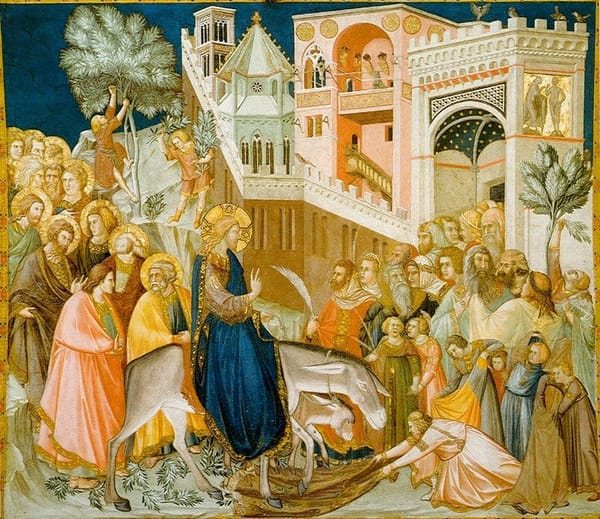
Early in the morning of this day, Jesus sets out for Jerusalem, leaving Mary His Mother, and the two sisters Martha and Mary Magdalene, and Lazarus, at Bethania. The Mother of sorrows trembles at seeing her Son thus expose Himself to danger, for His enemies are bent upon His destruction; but it is not death, it is triumph, that Jesus is to receive to-day in Jerusalem. The Messias, before being nailed to the cross, is to be proclaimed King by the people of the great city; the little children are to make her streets echo with their Hosannas to the Son of David; and this in presence of the soldiers of Rome’s emperor, and of the high priests and pharisees: the first standing under the banner of their eagles; the second, dumb with rage.
The prophet Zachary had foretold this triumph which the Son of Man was to receive a few days before His Passion, and which had been prepared for Him from all eternity, ‘Rejoice greatly, O daughter of Sion! Shout for joy, O daughter of Jerusalem! Behold thy King will come to thee; the Just and the Saviour. He is poor, and riding upon an ass, and upon a colt, the foal of an ass.’1 Jesus, knowing that the hour has come for the fulfilment of this prophecy, singles out two from the rest of His disciples, and bids them lead to Him an ass and her colt, which they would find not far off. He has reached Bethphage, on Mount Olivet. The two disciples lose no time in executing the order given them by their divine Master; and the ass and the colt are soon brought to the place where He stands.
The holy fathers have explained to us the mystery of these two animals. The ass represents the Jewish people, which had been long under the yoke of the Law; the colt, upon which, as the evangelist says, no man yet hath sat,2 is a figure of the Gentile world, which no one had ever yet brought into subjection. The future of these two peoples is to be decided a few days hence: the Jews will be rejected, for having refused to acknowledge Jesus as the Messias; the Gentiles will take their place, to be adopted as God’s people, and become docile and faithful.
The disciples spread their garments upon the colt; and our Saviour, that the prophetic figure might be fulfilled, sits upon him,3 and advances towards Jerusalem. As soon as it is known that Jesus is near the city, the holy Spirit works in the hearts of those Jews, who have come from all parts to celebrate the feast of the Passover. They go out to meet our Lord, holding palm branches in their hands, and loudly proclaiming Him to be King.4 They that have accompanied Jesus from Bethania, join the enthusiastic crowd. Whilst some spread their garments on the way, others cut down boughs from the palm-trees, and strew them along the road. Hosanna is the triumphant cry, proclaiming to the whole city that Jesus, the Son of David, has made His entrance as her King.
Thus did God, in His power over men’s hearts, procure a triumph for His Son, and in the very city which, a few days later, was to clamour for His Blood. This day was one of glory to our Jesus, and the holy Church would have us renew, each year, the memory of this triumph of the Man-God. Shortly after the birth of our Emmanuel, we saw the Magi coming from the extreme east, and looking in Jerusalem for the King of the Jews, to whom they intended offering their gifts and their adorations: but it is Jerusalem herself that now goes forth to meet this King. Each of these events is an acknowledgment of the kingship of Jesus; the first, from the Gentiles; the second, from the Jews. Both were to pay Him this regal homage, before He suffered His Passion. The inscription to be put upon the cross, by Pilate’s order, will express the kingly character of the Crucified: Jesus of Nazareth, King of the Jews. Pilate, the Roman governor, the pagan, the base coward, has been unwittingly the fulfiller of a prophecy; and when the enemies of Jesus insist on the inscription being altered, Pilate will not deign to give them any answer but this: ‘What I have written, I have written.’ To-day, it is the Jews themselves that proclaim Jesus to be their King: they will soon be dispersed, in punishment for their revolt against the Son of David; but Jesus is King, and will be so for ever. Thus were literally verified the words spoken by the Archangel to Mary, when he announced to her the glories of the Child that was to be born of her: ‘The Lord God shall give unto Him the throne of David, His father; and He shall reign in the house of Jacob for ever.’5 Jesus begins His reign upon the earth this very day; and though the first Israel is soon to disclaim His rule, a new Israel, formed from the faithful few of the old, shall rise up in every nation of the earth, and become the kingdom of Christ, a kingdom such as no mere earthly monarch ever coveted in his wildest fancies of ambition.
This is the glorious mystery which ushers in the great week, the week of dolours. Holy Church would have us give this momentary consolation to our heart, and hail our Jesus as our King. She has so arranged the service of to-day, that it should express both joy and sorrow; joy, by uniting herself with the loyal hosannas of the city of David; and sorrow, by compassionating the Passion of her divine Spouse. The whole function is divided into three parts, which we will now proceed to explain.
The first is the blessing of the palms; and we may have an idea of its importance from the solemnity used by the Church in this sacred rite. One would suppose that the holy Sacrifice has begun, and is going to be offered up in honour of Jesus, entry into Jerusalem. Introit, Collect, Epistle, Gradual, Gospel, even a Preface, are said, as though we were, as usual, preparing for the immolation of the spotless Lamb; but, after the triple Sanctus! Sanctus! Sanctus! the Church suspends these sacrificial formulas, and turns to the blessing of the palms. The prayers she uses for this blessing are eloquent and full of instruction; and, together with the sprinkling with holy water and the incensation, impart a virtue to these branches, which elevates them to the supernatural order, and makes them means for the sanctification of our souls and the protection of our persons and dwellings. The faithful should hold these palms in their hands during the procession, and during the reading of the Passion at Mass, and keep them in their homes as an outward expression of their faith, and as a pledge of God’s watchful love.
It is scarcely necessary to tell our reader that the palms or olive branches, thus blessed, are carried in memory of those wherewith the people of Jerusalem strewed the road, as our Saviour made His triumphant entry; but a word on the antiquity of our ceremony will not be superfluous. It began very early in the east. It is probable that, as far as Jerusalem itself is concerned, the custom was established immediately after the ages of persecution. St. Cyril, who was bishop of that city in the fourth century, tells us that the palm-tree, from which the people cut the branches when they went out to meet our Saviour, was still to be seen in the vale of Cedron.6 Such a circumstance would naturally suggest an annual commemoration of the great event. In the following century, we find this ceremony established, not only in the churches of the east, but also in the monasteries of Egypt and Syria. At the beginning of Lent, many of the holy monks obtained permission from their abbots to retire into the desert, that they might spend the sacred season in strict seclusion; but they were obliged to return to their monasteries for Palm Sunday, as we learn from the life of Saint Euthymius, written by his disciple Cyril.7 In the west, the introduction of this ceremony was more gradual; the first trace we find of it is in the sacramentary of St. Gregory, that is, at the end of the sixth, or the beginning of the seventh, century. When the faith had penetrated into the north, it was not possible to have palms or olive branches; they were supplied by branches from other trees. The beautiful prayers used in the blessing, and based on the mysteries expressed by the palm and olive trees, are still employed in the blessing of our willow, box, or other branches; and rightly, for these represent the symbolical ones which nature has denied us.
The second of to-day’s ceremonies is the procession, which comes immediately after the blessing of the palms. It represents our Saviour’s journey to Jerusalem, and His entry into the city. To make it the more expressive, the branches that have just been blessed are held in the hand during it. With the Jews, to hold a branch in one’s hand was a sign of joy. The divine law had sanctioned this practice, as we read in the following passage from Leviticus, where God commands His people to keep the feast of tabernacles: 'And you shall take to you, on the first day, the fruits of the fairest tree, and branches of palm-trees, and boughs of thick trees, and willows of the brook, and you shall rejoice before the Lord your God.'8 It was, therefore, to testify their delight at seeing Jesus enter within their walls, that the inhabitants, even the little children, of Jerusalem, went forth to meet Him with palms in their hands. Let us, also, go before our King, singing our hosannas to Him as the conqueror of death, and the liberator of His people.
During the middle ages, it was the custom, in many churches, to carry the book of the holy Gospels in this procession. The Gospel contains the words of Jesus Christ, and was considered to represent Him. The procession halted at an appointed place, or station: the deacon then opened the sacred volume, and sang from it the passage which describes our Lord’s entry into Jerusalem. This done, the cross which, up to this moment, was veiled, was uncovered; each of the clergy advanced towards it, venerated it, and placed at its foot a small portion of the palm he held in his hand. The procession then returned, preceded by the cross, which was left unveiled until all had re-entered the church. In England and Normandy, as far back as the eleventh century, there was practised a holy ceremony which represented, even more vividly than the one we have just been describing, the scene that was witnessed on this day at Jerusalem: the blessed Sacrament was carried in procession. The heresy of Berengarius, against the real presence of Jesus in the Eucharist, had been broached about that time; and the tribute of triumphant joy here shown to the sacred Host was a distant preparation for the feast and procession which were to be instituted at a later period.
A touching ceremony was also practised in Jerusalem during to-day’s procession, and, like those just mentioned, was intended to commemorate the event related by the Gospel. The whole community of the Franciscans (to whose keeping the holy places are entrusted) went in the morning to Bethphage. There, the father guardian of the holy Land, being vested in pontifical robes, mounted upon an ass, on which garments were laid. Accompanied by the friars and the Catholics of Jerusalem, all holding palms in their hands, he entered the city, and alighted at the church of the holy sepulchre where Mass was celebrated with all possible solemnity.
This beautiful ceremony, which dated from the period of the Latin kingdom in Jerusalem, has been forbidden, for now almost two hundred years, by the Turkish authorities of the city.
We have mentioned these different usages, as we have done others on similar occasions, in order to aid the faithful to the better understanding of the several mysteries of the liturgy. In the present instance, they will learn that, in to-day’s procession, the Church wishes us to honour Jesus Christ as though He were really among us, and were receiving the humble tribute of our loyalty. Let us lovingly go forth to meet this our King, our Saviour, who comes to visit the daughter of Sion, as the prophet has just told us. He is in our midst; it is to Him that we pay honour with our palms: let us give Him our hearts too. He comes that He may be our King; let us welcome Him as such, and fervently cry out to Him: ‘Hosanna to the Son of David!'
At the close of the procession a ceremony takes place, which is full of the sublimest symbolism. On returning to the church, the doors are found to be shut. The triumphant procession is stopped; but the songs of joy are continued. A hymn in honour of Christ our King is sung with its joyous chorus; and at length the subdeacon strikes the door with the staff of the cross; the door opens, and the people, preceded by the clergy, enter the church, proclaiming the praise of Him, who is our resurrection and our life.
This ceremony is intended to represent the entry of Jesus into that Jerusalem of which the earthly one was but the figure—the Jerusalem of heaven, which has been opened for us by our Saviour. The sin of our first parents had shut it against us; but Jesus, the King of glory, opened its gates by His cross, to which every resistance yields. Let us, then, continue to follow in the footsteps of the Son of David, for He is also the Son of God, and He invites us to share His kingdom with Him. Thus, by the procession, which is commemorative of what happened on this day, the Church raises up our thoughts to the glorious mystery of the Ascension, whereby heaven was made the close of Jesus’ mission on earth. Alas! the interval between these two triumphs of our Redeemer are not all days of joy; and no sooner is our procession over, than the Church, who had laid aside for a moment the weight of her grief, falls back into sorrow and mourning.
The third part of to-day’s service is the offering of the holy Sacrifice. The portions that are sung by the choir are expressive of the deepest desolation; and the history of our Lord’s Passion, which is now to be read by anticipation, gives to the rest of the day that character of sacred gloom, which we all know so well. For the last five or six centuries, the Church has adopted a special chant for this narrative of the holy Gospel. The historian, or the evangelist, relates the events in a tone that is at once grave and pathetic; the words of our Saviour are sung to a solemn yet sweet melody, which strikingly contrasts with the high dominant of the several other interlocutors and the Jewish populace. During the singing of the Passion, the faithful should hold their palms in their hands, and, by this emblem of triumph, protest against the insults offered to Jesus by His enemies. As we listen to each humiliation and suffering, all of which were endured out of love for us, let us offer Him our palm as to our dearest Lord and King. When should we be more adoring, than when He is most suffering?
These are the leading features of this great day. According to our usual plan, we will add to the prayers and lessons any instructions that seem to be needed.
This Sunday, besides its liturgical and popular appellation of Palm Sunday, has had several other names. Thus it was called Hosanna Sunday, in allusion to the acclamation wherewith the Jews greeted Jesus on His entry into Jerusalem. Our forefathers used also to call it Pascha Floridum, because the feast of the Pasch (or Easter), which is but eight days off, is to-day in bud, so to speak, and the faithful could begin from this Sunday to fulfil the precept of Easter Communion. It was in allusion to this name, that the Spaniards, having on the Palm Sunday of 1513, discovered the peninsula on the Gulf of Mexico, called it Florida. We also find the name of Capitilavium given to this Sunday, because, during those times when it was the custom to defer till Holy Saturday the baptism of infants born during the preceding months (where such a delay entailed no danger), the parents used, on this day, to wash the heads of these children, out of respect to the holy chrism wherewith they were to be anointed. Later on, this Sunday was, at least in some churches, called the Pasch of the competents, that is, of the catechumens, who were admitted to Baptism; they assembled to-day in the church, and received a special instruction on the symbol, which had been given to them in the previous scrutiny. In the Gothic Church of Spain, the symbol was not given till to-day. The Greeks call this Sunday Baïphoros, that is, Palmbearing.
THE BLESSING OF THE PALMS
It begins with the chanting of the following antiphon, which serves as an Introit.
Antiphon
Recording of the antiphon:
https://www.youtube.com/watch?v=S5sfnrALK0g
The priest then sums up, in the following prayer, the petitions of the faithful. This is what he asks for his people: that after this short life is over, they may come to that eternal kingdom, which has been prepared for them by the Death and Resurrection of Jesus.
After this prayer, the subdeacon chants a passage from the Book of Exodus, which relates how the people of God, after they had gone forth from Egypt, pitched their tents at Elim, beneath the shade of seventy palm-trees, where also were twelve fountains. While here, they were told by Moses that God was about to send them manna from heaven, and that, on the very next morning, their hunger would be appeased. These were figures of what is now given to the Christian people. The faithful, by a sincere conversion, have separated themselves from the Egypt of a sinful world. They are offering the palms of their loyalty and love to Jesus, their King. The fountains typify the Baptism, which, a few days hence, is to be administered to our catechumens. These fountains are twelve in number; the twelve articles of the symbol of our faith were preached to the world by the twelve apostles. And finally, on the morning of Easter day, Jesus, the Bread of life, the heavenly Manna, will arise from the tomb, and manifest His glory to us.
Cap. xv.In diebus illis: Venerunt filii Israel in Elim, ubi erant duodecim fontes aquarum, et Septuaginta palmæ: et castrametati sunt juxta aquas. Profectique sunt de Elim: et venit omnis multitudo filiorum Israel in desertum Sin, quod est inter Elim et Sinai: quintodecimo die mensis secundi, postquam egressi sunt de terra Ægypti. Et murmuravit omnis congregatio filiorum Israel contra Moysen et Aaron in solitudine. Dixeruntque filii Israel ad eos: Utinam mortui essemus per manum Domini in terra Ægypti, quando sedebamus super ollas carnium: et comedebamus panem in saturitate. Cur induxistis nos in desertum istud, ut occideretis omnem multitudinem fame? Dixit autem Dominus ad Moysen: Ecce ego pluam vobis panes de cœlo. Egrediatur populus, et colligat quæ sufficiunt per singulos dies: ut tentem eum, utrum ambulet in lege mea, an non. Die autem sexto parent quod inferant: et sit duplum, quam colligere solebant per singulos dies. Dixeruntque Moyses et Aaron ad omnes filios Israel: Vespere scietis, quod Dominus eduxerit vos de terra Ægypti: et mane videbitis gloriam Domini.
Ch. xv.In those days, the children of Israel came into Elim, where there were twelve fountains of water, and seventy palm-trees; and they encamped by the waters. And they set forward from Elim; and all the multitude of the children of Israel came into the desert of Sin, which is between Elim and Sinai, the fifteenth day of the second month after they came out of the land of Egypt. And all the congregation of the children of Israel murmured against Moses and Aaron in the wilderness. And the children of Israel said to them: Would to God we had died by the hand of the Lord in the land of Egypt, when we sat over the flesh pots, and ate bread to the full. Why have you brought us into this desert, that you might destroy all the multitude with famine? And the Lord said to Moses: Behold I will rain bread from heaven for you; let the people go forth, and gather what is sufficient for every day, that I may prove them whether they will walk in my law, or no. But the sixth day let them provide for to bring in, and let it be double to that they were wont to gather every day. And Moses and Aaron said to the children of Israel: In the evening you shall know that the Lord hath brought you forth out of the land of Egypt: and in the morning you shall see the glory of the Lord.
After this lesson, the choir sings one of the two following responsories, which commemorate the Passion of our Lord.
Responsory
Recording of the responsory:
https://www.youtube.com/watch?v=LLoLVshD3qc
The deacon then chants, from the Gospel of Saint Matthew, the history of Jesus’ triumphant entry into Jerusalem. The palms of the new Testament entwine with those of the old, in honour of the Man-God, who is the connecting link of both.
Gospel
Cap. xxi.In illo tempore: Cum appropinquasset Jesus Jerosolymis et venisset Bethphage, ad montern Oliveti; tunc misit duos discipulos, dicens eis: Ite in castellum, quod contra vos est: et statini invenietis asinam alligatam et pullum cum ea: solvite, et adducite mihi. Et si quis vobis aliquid dixerit, dicite quia Dominus his opus habet: et confestim dimittet eos. Hoc autem totum factum est, ut adimpleretur quod dictum est per prophetam dicentem: Dicite filiæ Sion: Ecce Rex tuus venit tibi mansuetus, sedens super asinam, et pullum filiura subjugalis. Euntes autem discipuli, fecerunt sicut præcepit illis Jesus. Et adduxerunt asinam, et pullum: et imposuerunt super eos vestimenta sua, et eum desuper sedere fecerunt. Plurima autem turba straverunt vestimenta sua in via. Alii autem cædebant ramos de arboribus, et sternebant in via. Turbæ autem quæ præcedebant, et quæ sequebantur, clamabant, dicentes: Hosanna filio David! benedictus qui venit in nomine Domini!
Ch. xxi.At that time: When Jesus drew nigh to Jerusalem, and was come to Bethphage, unto mount Olivet, he sent two disciples, saying to them: Go ye into the village that is over against you, and immediately you shall find an ass tied and a colt with her; loose them and bring them to me. And if any man shall say anything to you, say ye, that the Lord hath need of them; and forthwith he will let them go. Now all this was done that it might be fulfilled which was spoken by the prophet, saying: Tell ye the daughter of Sion: Behold, thy King cometh to thee, meek, and sitting upon an ass, and a colt, the foal of her that is used to the yoke. And the disciples going, did as Jesus commanded them: and they brought the ass and the colt, and laid their garments upon them, and made him sit thereon. And a very great multitude spread their garments in the way, and others cut boughs from the trees, and strewed them in the way; and the multitudes that went before and that followed, cried, saying: Hosanna to the Son of David! Blessed is he that cometh in the name of the Lord!
And now the mystery-speaking palms are to receive the Church’s blessing. The priest begins by two scriptural allusions: the first is to Noah, who received an olive-branch, when the waters of the deluge had subsided; the second is to Moses, whose people, after quitting Egypt, encamped under the seventy palm-trees. Then in the solemn tone of the Preface, he calls upon all creatures to give praise to the adorable name of Jesus, for whom we are preparing the homage of our devoted love. Let us respond to the invitation, and sing with all our hearts: Holy! Holy! Holy!—Hosanna in excelsis!
Pleni sunt coeli et terra gloria tua.
Hosanna in excelsis.
Benedictus qui venit in nomine Domini.
Hosanna in excelsis.
Heaven and earth are full of thy glory.
Hosanna in the highest!
Blessed is he that cometh in the name of the Lord.
Hosanna in the highest!
The prayers which now follow, explain the mystery of the palms, and draw down the blessing of God both upon them and upon the faithful who receive and keep them with proper dispositions.
The priest completes the blessing of the palms by sprinkling them with holy water and thurifying them with incense. After which, he adds the following prayer.
After this prayer, the priest distributes the palms to the faithful.9 During the distribution, the choir reminds us, by the two following antiphons, of the enthusiasm of the little children of Jerusalem, who, with their palms in their hands, sang their loud: Hosanna to the Son of David!
Antiphon
Recording of the antiphon:
https://www.youtube.com/watch?v=a16POhiuP8c
Antiphon
Recording of the antiphon:
https://www.youtube.com/watch?v=XKw_52x9dj8
As soon as the distribution is over, the priest concludes this first part of the service by the following prayer.
THE PROCESSION
The priest having blessed the incense—which, according to the custom of the Church, always heads a procession and sheds its perfume along the path that is to be taken—the deacon turns towards the people, and gives the signal for departure, with these words:
The choir answers:
The procession then advances, the clergy and people holding the palms in their hands. The choir chants the following antiphons, in honour of Jesus, the King of Israel.
Antiphon
Recording of the antiphon:
https://www.youtube.com/watch?v=WHNz7NE__tg
Antiphon
Recording of the antiphon:
https://www.youtube.com/watch?v=6JVZpN273ps
Antiphon
Recording of the antiphon:
https://www.youtube.com/watch?v=41GyvDYbFqU
Antiphon
Recording of the antiphon:
https://www.youtube.com/watch?v=F8Ee5Q1IWZE
Antiphon
Recording of the antiphon:
https://www.youtube.com/watch?v=DxIFVMTYeM4
Antiphon
The procession is now on its return to the church: but it cannot enter, for the doors are shut. We have already explained the meaning of this part of the ceremony. Immediately there are heard voices within the holy place; they are singing the praises of Christ, our King and Saviour. These cantors represent the holy angels in heaven, who are greeting the entry of Jesus into the eternal Jerusalem. Outside the church, there stands the choir, re-echoing the hymn of triumph; but it is man celebrating the entry of the Son of David into the earthly Jerusalem. The two choirs are thus kept separated from each other, until at length the victorious cross throws open the door, which represents the gate of heaven, and unites the Church militant with the Church triumphant. The hymn which is sung during this ceremony, was composed by Theodulf bishop of Orleans, when prisoner at Angers, by order of Louis the Good. The Church of Rome, by using the first six stanzas of this short poem, has immortalized it throughout the world.
The cantors within the church begin the first stanza, which is repeated by the choir without, not only after this, but also after each of the following five stanzas.
Hymn
Cui puerile decus prompsit Hosanna pium.
to whom the innocent children sang their fervent Hosanna.
Nomine qui in Domini, rex benedicte, venis.℟. Gloria, laus.
Et mortalis homo, et cuncta creata simul.℟. Gloria, laus.
Cum prece, voto, hymnis, adsumus ecce tibi.℟. Gloria, laus.
Nos tibi regnanti pangimus ecce melos.℟. Gloria, laus.
Rex bone, rex clemens, cui bona cuncta placent.℟. Gloria, laus.
Blessed art thou our King! that comest in the name of the Lord.℟. Glory, praise, &c.
and men on earth, and all created things praise thee.℟. Glory, praise, &c.
behold, we, too, present ourselves before thee, with our prayers, desires, and hymns.℟. Glory, praise, &c.
we sing our hymn to thee seated on thy throne.℟. Glory, praise, &c.
O dear and merciful King! to whom all is pleasing that is good.℟. Glory, praise, &c.
Recording of the Hymn:
https://www.youtube.com/watch?v=xtm0Jy1OFHM
As soon as the choir has sung its response to the last stanza, the subdeacon knocks with the cross at the door, which is immediately opened. In some places, it is the celebrant himself who performs this ceremony, and while doing it he recites the words of Psalm xxiii, in which David celebrates the entrance of our Redeemer into heaven on the day of His Ascension.
The procession then enters the church, singing the following responsory:
Responsory
Recording of the antiphon:
https://www.youtube.com/watch?v=BgLZrFHUHLY
Mass
The Station at Rome is in the basilica of St. John Lateran, the mother and mistress of all Churches. The papal function, however, now takes place at St. Peter’s; but the usual indulgences are still granted to those who visit the archbasilica.
The Mass of this Sunday retains no vestige of the joy, which characterized the ceremony of the palms. The Introit is taken from Psalm xxi, in which the royal prophet expresses the anguish of soul suffered by Jesus on the cross.
Introit
Ps. Deus, Deus meus, respice in me, quare me dereliquisti? Longe a salute mea verba delictorum meorum.
Domine, ne longe.
Ps. O God, my God, look upon me: why hast thou forsaken me? It is the cry of my sins that keeps salvation far from me.
O Lord, keep not, &c.
Recording of the Introit:
https://www.youtube.com/watch?v=MmM5BWlvFtg
In the Collect the Church prays that we may have grace to imitate the patience and humility of our Saviour. Jesus suffers and humbles Himself for us; it is but just that we should work out our salvation by following His example, that we should suffer, and be humble.
Collect
Epistle
Cap. ii.Fratres: Hoc enim sentite in vobis, quod et in Christo Jesu. Qui cum in forma Dei esset, non rapinam arbitratus est, esse se æqualem Deo: sed semetipsum exinanivit, formam servi accipiens, in similitudinem hominum factus, et habitu inventus ut homo. Humiliavit semetipsum, factus obediens usque ad mortem, mortem autem crucis. Propter quod et Deus exaltavit illum: et donavit illi nomen, quod est super omne nomen: ut in nomine Jesu (here, all kneel,) omne genu flectatur, cœlestium, terrestrium, et infernorum: et omnis lingua confiteatur, quia Dominus Jesus Christus in gloria est Dei Patris.
Ch. ii.Brethren: For let this mind be in you, which was also in Christ Jesus: who being in the form of God, thought it not robbery to be equal with God, but emptied himself, taking the form of a servant, being made in the likeness of men, and in habit found as a man. He humbled himself, becoming obedient unto death, even to the death of the cross. For which cause God also hath exalted him and hath given him a name which is above all names; that in the name of Jesus (here, all kneel,) every knee should bow, of those that are in heaven, on earth, and under the earth. And that every tongue should confess that the Lord Jesus Christ is in the glory of God the Father.
In obedience to the wishes of the Church, we have knelt down at those words of the apostle, where he says that every knee should bow at the holy name of Jesus. If there be one time of the year rather than another, when the Son of God has a right to our fervent adorations, it is this week, when we see Him insulted in His Passion. Not only should His sufferings excite us to tender compassion; we should also keenly resent the insults that are heaped upon our Jesus, the God of infinite majesty. Let us strive, by our humble homage, to make Him amends for the indignities He suffered in atonement for our pride. Let us unite with the holy angels, who, witnessing what He has gone through for the love of man, prostrate themselves, in profoundest adoration, at the sight of His humiliations.
In the Gradual, the Church makes use of the words of the royal prophet, who foretells the future glories of the Victim that dies on Calvary; but he also confesses that the success permitted to the enemies of Jesus had well nigh shaken his confidence.
Gradual
Recording of the antiphon:
https://www.youtube.com/watch?v=L_vhJ-IvDJI
The Tract consists of several verses taken from Psalm xxi, the first words of which were spoken by our Redeemer on the cross. So clear and explicit are the words of this psalm, that it might almost be called a history, as well as a prophecy, of the Passion.
Tract
Recording of the Tract:
https://www.youtube.com/watch?v=LnXYQkbB4mc
It is now time that we should hear the history of our Saviour’s Passion: but, in order that we may show both heaven and earth that we are not scandalized, as were the disciples, at the sight of His apparent weakness and the triumph of His enemies, we hold in our hands the palms, wherewith we have been proclaiming Him as our King.
The Church reads, on four different days of this week, the four evangelists’ narration of the Passion. She begins with that of St. Matthew, who was the first to write the Gospel. To express the sorrow which fills the hearts of the faithful, the acolytes do not carry the lights, nor is the book incensed. Omitting the customary salutation, the deacon, who is to take the part of the evangelist, at once begins the mournful history of our Lord’s sufferings and death.
The Passion and Gospel
Cum autem Jesus esset in Bethania, in domo Simonis leprosi, accessit ad eum mulier habens alabastrum unguenti pretiosi: et effudit super caput ipsius recumbentis. Videntes autem discipuli, indignati sunt, dicentes: ut quid perditio hæc? Potuit enim istud venundari multo, et dari pauperibus. Sciens autem Jesus, ait illis: Quid molesti estis huic mulieri? Opus enim bonum operata est in me. Nam semper pauperes habetis vobiscum: me autem non semper habetis. Mittens enim hæc unguentum hoc in corpus meum, ad sepeliendum me fecit. Amen dico vobis, ubicumque prædicatum fuerit hoc Evangelium in toto mundo, dicetur et quod hæc fecit in memoriam ejus.
Here the deacon pauses, and honours the Death of our Lord and Saviour by a solemn act of adoration. All the faithful kneel down, and remain for some time in that position. In many places, it is the custom to prostrate, and kiss the ground. The deacon then resumes his narration.
That the Mass of this Sunday may not be deprived of that essential rite which we call the Gospel, the deacon reserves a portion of the narrative; and going to the altar, he asks the priest to bless the incense. Which done, the deacon, himself also having received the priest’s blessing, goes to the place appointed for chanting the Gospel; but the acolytes do not carry their lights. After having thurified the book, he thus closes the history of the Passion.
Recording of St. Matthew Passion (Bach):
https://www.youtube.com/watch?v=ZwVW1ttVhuQ
The Offertory is again a prophecy of David. It foretells the state of abandonment to which our Saviour was to be reduced in the midst of all His sufferings, and the cruelty of His enemies, who would feed Him with gall and vinegar. Thus is He treated who is preparing to give us His Body for our food, and His Blood for our drink.
Offertory
Recording of the antiphon (Gregorian chant):
https://www.youtube.com/watch?v=YCBceN5Wtb0
Recording of the antiphon (Palestrina):
https://www.youtube.com/watch?v=oiEA8lCfM34
The Secret asks of God that He would impart to His servants the twofold fruit of Jesus’ Passion: grace in this life, and glory in the next.
Secret
In the Communion-anthem, the Church, after receiving into herself the life of Christ by the chalice of salvation, calls to our minds that other chalice which Jesus was to drink in order that He might gift us with immortality.
Communion
Recording of the antiphon:
https://www.youtube.com/watch?v=RmDey4MX3rA
The Church concludes the prayers of the Sacrifice she has just been offering, by asking the remission of sin for all her children, that they may see fulfilled that longing of their souls—a share in the glorious Resurrection of Jesus.
Postcommunion
Vespers
The psalms and antiphons are given on page 81.
Capitulum (Phil. ii.)
For the hymn and versicle, see page 89.
Antiphon of the Magnificat
Recording of the antiphon:
https://www.youtube.com/watch?v=u1H-cp3r3xg
Let us now go over in our minds the other events which happened to our divine Lord on this day of His solemn entry into Jerusalem. St. Luke tells us that it was on His approach to the city, that Jesus wept over it, and spoke these touching words: ‘If thou also hadst known, and that in this thy day, the things that are to thy peace! But now they are hidden from thine eyes. For the days shall come upon thee, and thine enemies shall cast a trench about thee, and compass thee round, and straiten thee on every side, and beat thee flat to the ground, and thy children who are in thee; and they shall not leave in thee a stone upon a stone; because thou hast not known the time of thy visitation.’10
A few days ago, we were reading in the holy Gospel how Jesus wept over the tomb of Lazarus; to-day He sheds tears over Jerusalem. At Bethania His weeping was caused by the sight of bodily death, the consequence and punishment of sin; but this death is not irremediable: Jesus is the resurrection and the life, and he that believeth in Him shall live.11 Whereas, the state of the unfaithful Jerusalem is a figure of the death of the soul, and from this there is no resurrection, unless the soul, while time is given to her, return to the Author of life. Hence it is, that the tears shed by Jesus over Jerusalem are so bitter. Amidst the acclamations which greet His entry into the city of David, His heart is sad; for He sees that many of her inhabitants will not profit of the time of her visitation. Let us console the Heart of our Jesus, and be to Him a faithful Jerusalem.
The sacred historian tells us that Jesus, immediately upon His entrance into the city, went to the temple, and cast out all them that sold and bought there.12 This was the second time that He had shown His authority in His Father’s house, and no one had dared to resist Him. The chief priests and pharisees found fault with Him, and accused Him to His face, of causing confusion by His entry into the city; but our Lord confounded them by the reply He made. It is thus that in after ages, when it has pleased God to glorify His Son and the Church of His Son, the enemies of both have given vent to their rage; they protested against the triumph, but they could not stop it. But when God, in the unsearchable ways of His wisdom, allowed persecution and trial to follow these periods of triumph, then did these bitter enemies redouble their efforts to induce the very people, that had cried Hosanna to the Son of David, to clamour for His being delivered up and crucified. They succeeded in fomenting persecution, but not in destroying the kingdom of Christ and His Church. The kingdom seemed, at times, to be interrupted in its progress; but the time for another triumph came. Thus will it be to the end; and then, after all these changes from glory to humiliation, and from humiliation to glory, the kingdom of Jesus and of His bride will gain the last and eternal triumph over this world, which would not know the time of its visitation.
We learn from St. Matthew13 that our Saviour spent the remainder of this day at Bethania. His blessed Mother and the house of Lazarus were comforted by His return. There was not a single offer of hospitality made to Him in Jerusalem, at least there is no mention in the Gospel of any such offer. We cannot help making the reflection, as we meditate upon this event of our Lord’s life:—an enthusiastic reception is given to Him in the morning, He is proclaimed by the people as their King; but when the evening of that day comes on, there is not one of all those thousands to offer Him food or lodging. In the Carmelite monasteries of St. Teresa’s reform, there is a custom, which has been suggested by this thought, and is intended as a reparation for this ingratitude shown to our Redeemer. A table is placed in the middle of the refectory; and after the community have finished their dinner, the food which was placed upon that table is distributed among the poor, and Jesus is honoured in them.
We give, as a conclusion to this day, a selection from the hymn used by the Greek Church on Palm Sunday. It was written by the celebrated hymnographer, Cosmas of Jerusalem.
Hymn (In Dominica Palmarum)
clamant: Benedictus qui venit in nomine Domini Salvatoris nostri.
that cry to him: Blessed is he that cometh in the name of the Lord our Saviour!
- Zach. ix. 9. ↩︎
- St. Mark xi. 2. ↩︎
- Ibid. 7, and St. Luke xix. 35. ↩︎
- St. Luke xix. 38. ↩︎
- St. Luke i. 32. ↩︎
- Cateches. x. versus fin. ↩︎
- Act. Ss. Jan. 20. ↩︎
- Lev. xxiii. 40. ↩︎
- In receiving the palm, the faithful should kiss first the palm itself, and then the priest's hand. ↩︎
- St. Matt. xxi.17. ↩︎
- St. John xi. 25. ↩︎
- St. Matt. xxi. 12. ↩︎
- St. Matt. xxi. 17. ↩︎
March 21: St. Benedict, Abbot
|
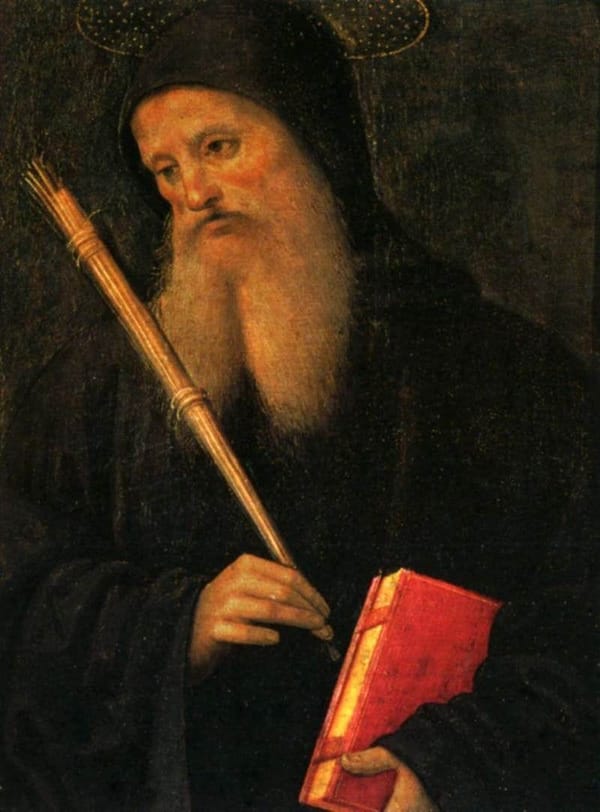
Forty days after the white dove of Cassino had mounted to heaven, Benedict, her glorious brother, ascended by a bright path to the blissful abode, where they were to be united for ever. Both of them reached the heavenly country during that portion of the year which corresponds with the holy season of Lent. It frequently happens, however, that St. Scholastica’s feast is kept before Lent has begun; whereas St. Benedict’s day, the twenty-first of March, always comes during the season of penance. God, who is the sovereign Master of time, willed that the faithful, whilst practising their exercises of penance, should always have before their eyes a saint whose example and intercession would inspire them with courage.
With what profound veneration ought we to celebrate the festival of this wonderful saint, who, as St. Gregory says, was filled with the spirit of all the just! If we consider his virtues, we find nothing superior in the annals of perfection presented to our admiration by the Church.
Love of God and man, humility, the gift of prayer, dominion over the passions—form him into a masterpiece of the grace of the Holy Ghost. Miracles seem to constitute his life: he cures the sick, commands the elements, casts out devils, and raises the dead to life. The spirit of prophecy unfolds futurity to him; and the most intimate thoughts of men are not too distant for the eye of his mind to scan. These superhuman qualifications are heightened by a sweet majesty, a serene gravity, and a tender charity, which shine in every page of his wonderful life; and it is one of his holiest children who wrote it, St. Gregory the Great. It is this holy Pope and Doctor, who had the honour of telling posterity all the wonders which God vouchsafed to work in His servant Benedict.
Posterity had a right to know the life and virtues of a man, whose salutary influence upon the Church and society has been so observable during the ages of the Christian era. To describe the influence exercised by the spirit of St. Benedict, we should have to transcribe the annals of all the nations of the western Church, from the seventh century down to our own times. Benedict is the father of Europe. By his Benedictines, numerous as the stars of heaven and as the sands of the sea-shore, he rescued the last remnants of Roman vigour from the total annihilation threatened by the invasion of barbarians; he presided over the establishment of the public and private laws of those nations, which grew out of the ruins of the Roman empire; he carried the Gospel and civilization into England, Germany, and the northern countries, including Slavonia; he taught agriculture; he put an end to slavery; and to conclude, he Baved the precious deposit of the arts and sciences from the tempest which would have swept them from the world, and would have left mankind a prey to a gloomy and fatal ignorance.
And Benedict did all this by that little book which we call his Rule. This admirable code of Christian perfection and prudence disciplined the countless legions of religious, by whom the holy patriarch achieved all these prodigies. During the ages which preceded the promulgation of this rule, so wonderful m its simple eloquence, the monastic life in the western Church had produced some few saintly men; but there was nothing to justify the hope that this kind of life would become, even more than it had been in the east, the principal means of the Christian regeneration and civilization of so many nations. Once this rule was written, all others gradually give place to it, as the stars are eclipsed when the sun has risen. The west was overspread with monasteries; and from these monasteries flowed upon Europe all those blessings, which have made it the privileged quarter of the globe.
An incredible number of saints, both men and women, who look up to Benedict as their father, purify and sanctify the world, which had not yet emerged from the state of semi-barbarism. A long series of Popes who had once been novices in the Benedictine cloister, preside over the destinies of this new world, and form for it a new legislation, which, being based exclusively on the moral law, is to avert the threatening prevalence of brutal despotism. Bishops innumerable, trained in the same school of Benedict, consolidate this moral legislation in the provinces and cities over which they are appointed. The apostles of twenty barbarous nations confront their fierce and savage tribes, and, with the Gospel in one hand and the rule of their holy father in the other, lead them into the fold of Christ. For many centuries, the learned men, the doctors of the Church, and the instructors of youth, belong, almost exclusively, to the Order of the great patriarch, who, by the labours of his children, pours forth on the people the purest beauty of light and truth. This choir of heroes in every virtue, of Popes, of bishops, of apostles, of holy doctors, proclaiming themselves as his disciples, and joining with the universal Church in glorifying that God, whose holiness and power shine forth so brightly in the life and actions of Benedict—what a corona, what an aureola of glory for one saint to have!
Let us now read the sketch of his life, as given us in the liturgy:
The Benedictine Order celebrates the praise of its illustrious patriarch in these three hymns:
Hymn I
Templa solemnes modulentur hymnos;
Hac die summi Benedicts arcem
Scandit Olympi.
Cum puer dulcis patriae penates
Liquit, et solus latuit silenti
Conditus antro.
Vicit altricem scelerum juventam:
lade conscripsit documenta vitæ
Pulchra beatæ.
Et nemus stravit Veneri dicatum,
Atque Baptistæ posuit sacrato
Monte sacellum.
Inter ardentes Seraphim catervas,
Spectat, et dulci reficit clientum
Corda liquore.
Et tibi compar utriusque semper
Spiritus alme, Deus unus, omni
Tempore sæcli.
let our temples echo with solemn hymns:
for on this day Benedict ascended
to the highest heavens.
he left his sweet home,
and hid himself from the sight of all
in a lonely cave.
by rolling amidst nettles and prickly thorns.
After this, he wrote a beautiful rule
of a holy life.
and a grove that was sacred to Venus:
and on the holy mount
he built an oratory in honour of the Baptist.
amidst the burning Seraphim:
he looks down on those that invoke him,
and refreshes their hearts with a nectar of sweetness.
To thee, also, O Spirit of love,
coequal with them, one God,
be glory for endless ages.
Hymn II
Quidquid æternæ monimenta legis,
Continet nobis celebranda summi
Vita monarchæ.
Inclytum proles Abraham decorat,
Isaac sponsae decus, et severi
Jussa parentis.
Celsior nostri patriarcha coetus
Isaac, Mosen, Abraham sub uno
Pectore clausit.
Hic pius flatu statuat secundo,
Pax ubi nullo, requiesque gliscit
Mista pavore.
Et tibi compar utriusque semper
Spiritus alme, Deus unus, omni
Tempore sæcli.
and all that the books of the divine Law tell us of holiness,
is contained in the life of the great patriarch
which we are now extolling.
Abraham for his being father of all believers;
Isaac for the beauty of his bride, and his obedience
to the trying commands of his father.
was richly laden with every virtue;
and in his single person represented
Isaac, Moses, and Abraham.
whom he has delivered from this stormy world,
and lead them with prosperous gales to the port
where there is no fear that can ruffle peace and repose.
To thee, also, O Spirit of love,
coequal with them, one God, be glory
for endless ages.
Hymn III
Quas sacro partas retinent agone,
Emicas celsis meritis coruscus,
O Benedicte.
Nil sibi de te rapuit voluptas,
Aruit mundi tibi flos ad alta
Mente levato.
Deseris, fervens nemorum colonus,
Edomas carnem, subigisque Christo
Tortor acerbus.
Signa te produnt operum pioruin,
Spargitur felix celeri per orbem
Fama volatu.
Et tibi, compar utriusque semper
Spiritus alme, Deus unus, omni.
Tempore sæcli.
with the crowns they have won in the holy contest,
thou, O Benedict, shinest resplendent
with thy sublime merits.
the pleasures of the world had no hold on thee,
and its flowers seemed but as withered weeds to a soul like thine,
that was fixed on heavenly things.
and becamest a fervent solitary.
Thou didst tame the rebellion of the flesh, and by sharp mortification
thou didst bring it into subjection to Christ.
thy holy miracles betrayed thee,
and the glorious fame of thy sanctity
swiftly spread through the world.
To thee, also, O Spirit of love,
coequal with them, one God,
be glory for endless ages.
The monastic missal contains the following sequence in honour of St. Benedict:
Sequence
Dona ferens novæ lucis,
Hodie recolitur.
Corde sonet in ardenti
Quidquid foris promitur.
Admiremur ascenderitis
Patriarchæ speciem.
Ilium fecit instar solis,
Abrahæ persimilem.
Hine Eliam latitantem
Specu nosce parvulo.
Cum securis revocatur
De torrentis alveo.
Illum Jacob futurorum
Mens effecit conscia.
Nos perducat in manentis
Semper Christi gaudia.
the happy death of our great leader,
which brings us the blessings of new light.
Oh! may the fervent heart re-echo
what the voice sings forth!
as he ascends to heaven
by the path of the east.
for he is the rich seed from which
a countless race hath sprung.
thou thinkest of Elias,
that hid himself in the little cave.
when he makes the head of the axe return
from the bed of the stream.
and like Jacob by the spirit
of prophecy.
and lead us safe to the joys of our Lord Jesus Christ,
who abideth for ever.
The Greek Church has not forgotten, in her liturgy, the praise of the great patriarch of the monks of the west. We take from the menæa some of the stanzas, in which she celebrates the name of Saint Benedict:
Hymn (Die XXI Martii)
O Benedict! thou vessel of election, thou palm of the wilderness, thou angel of earth, we offer thee the salutation of our love! What man was ever chosen to work on the earth more wonders than thou hast done? The Saviour has crowned thee as one of His principal co-operators in the work of the salvation and sanctification of men. Who could count the millions of souls who owe their eternal happiness to thee? Thy immortal rule has sanctified them in the cloister, and the zeal of thy Benedictines has been the means of their knowing and serving the great God who chose thee. Around thee, in the realms of glory, a countless number of the blessed acknowledge themselves indebted to thee, after God, for their eternal happiness; and upon the earth whole nations profess the true faith, because the Gospel was first preached to them by thy disciples.
O father of so many people! look down upon thine inheritance, and once more bless this ungrateful Europe, which owes everything to thee, yet has almost forgotten thy name! The light which thy children imparted to it has become dimmed, the warmth they imparted to the societies they founded and civilized by the cross has grown cold; thorns have covered a large portion of the land in which they sowed the seed of salvation. Come and protect thine own work; and, by thy prayers, keep it from perishing. Give firmness to what has been shaken. May a new Europe, a Catholic Europe, spring up in place of that which heresy and false doctrines have formed.
O patriarch of the servants of God! look down from heaven on the vineyard which thy hand hath planted, and see into what a state of desolation it has fallen. There was a time when thy name was honoured as that of a father in thirty thousand monasteries, from the shores of the Baltic to the borders of Syria, and from the green Erin to the steppes of Poland. Now, alas! few and feeble are the prayers that ascend to thee from the whole of that immense patrimony, which the faith and gratitude of the people had once consecrated to thee. The blight of heresy and the rapaciousness of avarice have robbed thee of these harvests of thy glory. The work of sacrilegious spoliation is now centuries old, and unceasingly has it been pursued; at one time having recourse to open violence, and at another pleading the urgency of political interests. Sainted father of our faith! thou hast been robbed of those thousands of sanctuaries, which, for long ages, were fountains of life and light to the people. The race of thy children has become almost extinct: watch over them that still remain, and are labouring to perpetuate thy rule. An ancient tradition tells us how our Lord revealed to thee that thy Order would last to the end of the world, and that thy children would console the Church of Rome and confirm the faith of many in the last great trials: deign to protect, by thy powerful intercession, the remnants of that family which still calls thee its father. Raise it up again; multiply it; sanctify it: let the spirit which thou hast deposited in thy holy rule flourish in its midst, and show, by thus blessing it, that thou art ever Benedict, the servant of God.
Support the holy Church, by thy powerful intercession, dear father! Assist the apostolic See, which has been so often occupied by disciples of thy school. Father of so many pastors of thy people! obtain for us bishops like those sainted ones whom thy rule has formed. Father of so many apostles! ask for the countries which have no faith preachers of the Gospel, who may convert the people by their blood and by their words, as did those who went out missioners from thy cloisters. Father of so many holy doctors! pray that the science of sacred literature may revive, to aid the Church and confound error. Father of so many sublime ascetics! rekindle the zeal of Christian perfection, which has grown so cold among the Christians of our days. Patriarch of the religious life in the western Church! bless all the religious Orders which the holy Spirit has given successively to the Church; they all look on thee with admiration, as their venerable predecessor: do thou pour out upon them the influence of thy fatherly love.
Lastly, O blessed favourite of God! pray for all the faithful of Christ during these days which are consecrated to thoughts and works of penance. It was in the midst of the holy austerities of Lent that thou didst mount to the abode of everlasting delight; ah! help us Christians, who are, at this very time, in the same campaign of penance. Rouse our courage by thy example and precepts. Teach us to keep down the flesh, and to subject it to the spirit, as thou didst. Obtain for us a little of thy blessed spirit, that, turning away from this vain world, we may think on the eternal years. Pray for us, that our hearts may never love, and our thoughts never dwell on, joys so fleeting as are those of time.
Catholic piety invokes thee as one of the patrons, as well as one of the models, of a dying Christian. It loves to tell men of the sublime spectacle thou didst present at thy death, when standing at the foot of the altar, leaning on the arms of thy disciples, and barely touching the earth with thy feet, thou didst give back, in submission and confidence, thy soul to its Creator. Obtain for us, dear saint! a death courageous and sweet as was thine. Drive from us, at our last hour, the cruel enemy who will seek to ensnare us. Visit us by thy presence, and leave us not till we have breathed forth our soul into the bosom of the God who has made thee so glorious a saint.
| Previous Saturday in Passion Week | Next March 21: St. Benedict, Abbot |