Daily reading
Holy Week
Double of the I Class · Movable from Easter · Temporal
March 27, 2027
From Dom Guéranger’s The Liturgical Year.
A Double of the I Class leads; St. John Damascene is commemorated.Rubric

|
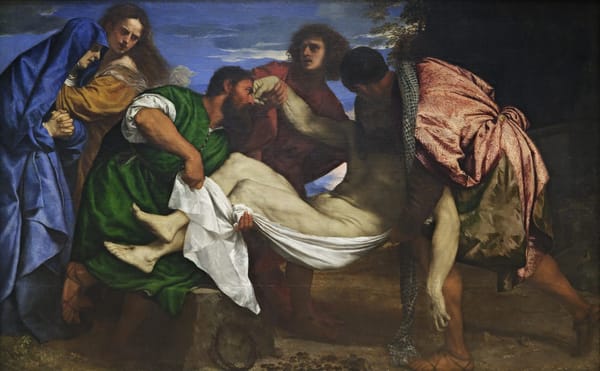
Holy Saturday
Including descriptions of the following:
- Blessing of the New Fire and Incense
- Paschal Candle
- The Twelve Prophecies
- Blessing of the Font
- Baptism
- Confirmation
- Litany
- Mass of Holy Saturday
- Vespers
A night has passed over the tomb, wherein lies buried the Body of the Man-God. Death is triumphant in that silent cave, and holds captive Him that gives life to every creature: but his triumph will soon be at an end. The soldiers may watch, as best they will, over that grave: they cannot hold Jesus prisoner, as soon as the moment fixed for His Resurrection comes. The holy angels are there, profoundly adoring the lifeless Body of Him, whose Blood is to reconcile all things, both on earth and in heaven.1 This Body, though for a brief interval separated from the Soul, is still united to the Person of the Son of God; so likewise the Soul, during its separation from the Body, has not for an instant lost its union with the Word. The Divinity remains also united with the Blood which lies sprinkled on Calvary, and which, at the moment of the Resurrection of the Man-God, is to enter once more into His sacred veins.
Let us also return to the sepulchre, and adore the Body of our buried Jesus. Now, at last, we understand what sin has done: by sin, death entered into the world; and it passed upon all men.2 Though Jesus knew no sin,3 yet has He permitted death to have dominion over Him, in order that He might make it less bitter to us, and by His Resurrection restore unto us that eternal life, of which we had been deprived by sin. How gratefully we should appreciate this death of our Jesus! By becoming Incarnate, He became a servant;4 His death was a still deeper humiliation. The sight of this tomb, wherein His Body lies lifeless and cold, teaches us something far more important than the power of death: it reveals to us the immense, the incomprehensible love of God for man. He knew that wo were to gain by His humiliations; the greater His humiliations, the greater our exaltation: this was His principle, and it led Him to what seems like an excess! Let us, then, love this sacred sepulchre, which is to give us life. We have thanked Him for having died for us upon the cross; let us thank Him, but most feelingly, for having humbled Himself, for our sake, even to the tomb!
And now let us visit the holy Mother, who has passed the night in Jerusalem, going over, in saddest memory, the scenes she has witnessed. Her Jesus has been a victim to every possible insult and cruelty; He has been crucified; His precious Blood has flowed in torrents from those five Wounds; He is dead, and now lies buried in yonder tomb, as though He were but a mere man, yea the most abject of men. How many tears have fallen, during these long hours, from the eyes of the daughter of David! And yet, her Son has not come back to her! Near her is Magdalene; heart-broken by yesterday’s events, she has no words to tell her grief, for Jesus is gone, and, as she thinks, for ever. The other women, less loved by Jesus than Magdalene, yet most dear to Him, stand around the disconsolate Mother. They have braved every insult and danger in order to remain on Calvary till all was over, and they intend returning thither with Magdalene, as soon as the Sabbath is over, to honour the tomb and the Body of Jesus.
John, the adopted son of Mary, and the beloved disciple of Jesus, is oppressed with sorrow. Others, also, of the apostles and disciples visit the house of mourning. Peter, penitent and humble, fears not to appear before the Mother of mercy. Among the disciples are Joseph of Arimathea and Nicodemus. We may easily imagine the conversation—it is on the sufferings and death of Jesus, and on the ingratitude of the Jews. The Church, in the seventh responsory of to-day’s Tenebrœ, represents these men as saying: ‘Behold! how the Just One dieth, and there is none that taketh it to heart. Iniquity has had its way. He was silent as a lamb under his shearer, and He opened not His mouth. He was taken away from distress and judgment: but His memory shall be in peace.’
Thus speak the men; the women are thinking of their morrow’s visit to the sepulchre. The saintliness of Jesus, His goodness, His power, His sufferings, His death—everything is remembered, except His Resurrection, which they had often heard Him say should certainly and speedily take place. Mary alone lives in expectation of His triumph. In her was verified that expression of the Holy Ghost, where, speaking of the valiant woman, He says: ‘Her lamp shall not be put out in the night.’5 Her courage fails not, because she knows that the sepulchre must yield up its Dead, and her Jesus will rise again to life. St. Paul tells us that our religion is vain, unless we have faith in the mystery of our Lord’s Resurrection: where was this faith on the day after our Lord’s death? In one heart only—and that was Mary’s. As it was her chaste womb that had held within it Him whom heaven and earth cannot contain, so, on this day, by her firm and unwavering faith, she resumes within her single self the whole Church. How sacred is this Saturday, which, notwithstanding all its sadness, is such a day of glory to the Mother of Jesus! It is on this account that the Church has consecrated to Mary the Saturday of every week.
But it is time to repair to the house of God. The bells are still silent: our faith must speak to us, and make us eager to assist at the grand mysteries which the liturgy is about to celebrate. Surely the Christian sentiment must be dead in those who can be willingly absent from the church on such a morning as this. No, it cannot be that we, who have followed the celebration of the mysteries of our religion thus far, can flag now, and lose the graces of this morning’s magnificent service.
THE MORNING SERVICE
It was the practice of the Church, and one that had been handed down from the earliest ages, that the Sacrifice of the Mass should not be offered up either yesterday or to-day. Yesterday, the anniversary of Jesus’ death, was exclusively devoted to the remembrance of the mystery of Calvary, and a holy fear kept the Church from renewing that Sacrifice upon her altars. For the same reason she abstained to-day, also, from its celebration. The burial of Christ is a sequel of His Passion: and during these hours when His Body lay lifeless in the tomb, it was fitting that the Sacrifice, wherein He is offered as the glorious and risen Jesus, should be suspended. Even the Greek Church, which never fasts on the Saturdays of Lent, follows the practice of the Latin Church for this Saturday: she not only fasts, but she even omits the celebration of the Mass of the Presanctified.
Such was the discipline of the Latin Church for nearly a thousand years: but about the eleventh century, an important change began to be introduced with regard to the celebration of Mass on Holy Saturday. The Mass which, hitherto, had been celebrated during the night preceding Easter Sunday, then began to be anticipated on the Saturday; but it was always considered as the Mass for the hour of our Lord’s Resurrection, and not as the Mass of Holy Saturday. The relaxations that had been introduced with regard to fasting were the occasion of this change in the liturgy. In the first ages, the faithful watched the whole night in the church, awaiting the hour when our Lord rose triumphant from the tomb. They also assisted at the solemn administration of Baptism to the catechumens, which so sublimely expressed the passing from spiritual death to the life of grace. There was no other Vigil of the whole year so solemnly observed as this: but it lost a great portion of its interest, when the necessity of baptizing adults was removed by Christianity having triumphed wheresoever it had been preached. The Orientals have kept up the ancient tradition to this day: but in the west, dating from the eleventh century, the Mass of the Resurrection hour has been gradually anticipated, until it has been brought even to the morning of Holy Saturday. Durandus of Menda, who wrote his Rational of the Divine Offices towards the close of the thirteenth century, tells us that, in his time, there were very few Churches which observed the primitive custom; and even these soon conformed to the general practice of the Latin Church.
As a result of this change, there is an apparent contradiction between the mystery of Holy Saturday and the Divine Service which is celebrated upon it; Christ is still in the tomb, and yet we are celebrating His Resurrection: the hours preceding Mass are mournful, and before midday the paschal joy will have filled our hearts. We will conform to the present order of the holy liturgy, thus entering into the spirit of the Church, who has thought proper to give her children a foretaste of the joys of Easter. We will give a general view of the solemn Service, at which we are going to assist; afterwards, we will explain each portion as it comes.
The great object of the whole of to-day’s Service, and the centre to which every one of the ceremonies converges, is the Baptism of the catechumens. The faithful must keep this incessantly before them, or they will be at a loss how to understand or profit by the liturgy of to-day. First of all, there is the blessing of the new fire, and incense. This is followed by the blessing of the Paschal candle. Immediately after this are read the twelve prophecies, which have reference to the mysteries of to-day’s Service. As soon as the prophecies are finished a procession is formed to the baptistery, and the water is blessed. The matter of Baptism thus prepared, the catechumens receive the Sacrament of regeneration. Confirmation is then administered to them by the bishop. Immediately after this, the holy Sacrifice is celebrated in honour of our Lord’s Resurrection, and the neophytes partake of the divine mysteries. Finally the joyous Vesper-Office comes in, and brings to a termination the longest and most fatiguing Service of the Latin liturgy. In order to assist our readers to enter fully into its spirit, we will go back a thousand years, and imagine ourselves to be celebrating this solemn eve of Easter in one of the ancient cathedrals of Italy, or of our own dear land.
At Rome, the Station is at St. John Lateran, the mother and mistress of all Churches. The Sacrament of regeneration is administered in the baptistery of Constantine. The sight of these venerable sanctuaries carries us back in thought to the fourth century; there, each year, holy Baptism is conferred upon some adult; and a numerous Ordination adds its own splendour to the sacred pomp of this day, whose liturgy, as we have just said, is the richest of the whole year.
BLESSING OF THE NEW FIRE AND INCENSE
Last Wednesday the catechumens were told to present themselves at the church, for the hour of to-day’s Terce (that is, nine o’clock in the morning).
It is the final scrutiny. The priests are there to receive them; those who have not previously been examined upon the Symbol, are now questioned. The Lord’s Prayer and the biblical attributes of the four evangelists having been explained, one of the priests dismisses the candidates for Baptism, bidding them spend the interval in recollection and prayer.
At the hour of None (our three o’clock in the afternoon), the bishop and all the clergy repair to the Church, and Holy Saturday vigil begins from this moment. The first ceremony consists in the blessing of the new fire, which is to furnish light for the whole Service. It was the daily custom, in the first ages of the Church, to strike a light from a flint before Vespers: from this the lamps and candles were lighted for the celebration of that Hour, and the light thus procured was kept up in the church till the Vespers of the following day. The Church of Rome observed this custom with great solemnity on Maundy Thursday morning, and the new fire received a special blessing. We learn, from a letter written in the eighth century by Pope St. Zachary to St. Boniface archbishop of Mayence, that three lamps were lighted from this fire, which were then removed to some safe place, and care taken that their light was kept in. It was from these lamps that the light for Holy Saturday night was taken. In the following century, under St. Leo IV, whose pontificate lasted from 847 to 855, the custom of every day procuring new fire from a flint was extended also to Holy Saturday.
It is not difficult to understand the meaning of this ceremony, which is no longer observed by the Latin Church save on this day. Our Lord said of Himself: ‘I am the light of the world.’6 Light, then, is an image of the Son of God. Stone, also, is one of the types under which the Scriptures speak to us of the Messias. St. Peter,7 and St. Paul,8 quoting the words of the prophet Isaias,9 speak of Jesus as the Corner-Stone. The spark which is struck from the flint represents our Lord rising from His rock-hewn sepulchre, through the stone that had been rolled against it.
It is fitting, therefore, that this fire which is to provide light for the Paschal candle, as well as for those that are upon the altar, should receive a special blessing, and be triumphantly shown to the faithful. All the lamps in the church have been extinguished. Formerly, the faithful used to put out the fires in their houses, before going to the church: they lighted them, on their return, with light taken from the blessed fire, which they received as a symbol of our Lord’s Resurrection. Let us not here omit to notice, that the putting out of all the lights in the church is a symbol of the abrogation of the old Law, which ended with the rending of the veil of the temple; and that the new fire represents the preaching of the new Law, whereby our Lord Jesus Christ, the light of the world, fulfilled all the figures of the ancient Covenant.
In order to help our readers to enter more fully into the mystery of the ceremony we are describing, we will here mention a miracle which was witnessed for many centuries. The clergy and people of Jerusalem assembled for the service of Easter eve in the church of holy sepulchre. After waiting for some time in silence, one of the lamps suspended over our Lord’s tomb was miraculously lighted. The other lamps and torches throughout the church were lighted from this, and the faithful took its holy flame with them to their homes. It would seem that this annual miracle first began after the Saracens had taken possession of Jerusalem: God so ordaining, that it might be a proof to these infidels of the divinity of the Christian religion. The historians of those times, who have written upon the Latin kingdom of Jerusalem, all speak of this miracle as of an incontestable fact; and when Pope Urban II went to France, there to preach the first Crusade, he brought forward this miracle as one of the motives which should inspire the faithful with zeal for the defence of the sepulchre of Christ. When our Lord, in the unsearchable ways of His justice, permitted Jerusalem to be reconquered by the infidels, the miracle ceased, nor has it ever been witnessed from that time. Our readers have no doubt heard of the scandalous scene, which is now repeated every Holy Saturday in the church of holy sepulchre in Jerusalem: we allude to the deception practised by the schismatic Greek priests, whereby they persuade their deluded people that their ingenious trick for lighting a lamp is the continuation of the miracle.
The Church also blesses the five grains of incense, which are to be used in this morning’s Service. They represent the perfumes prepared by Magdalene and her holy companions for embalming the Body of Jesus. The prayer said by the bishop, when blessing the incense, not only shows us the connection there is between it and the light, but it also teaches us what is the power these several sacred objects have against the wicked spirits.
The bishop, with his attendants, goes in procession from the church to the place where he is to bless the fire and incense. The fire, as we have already said, is the symbol of our Lord Jesus Christ; and the sepulchre, whence He is to rise to life, is outside the walls of Jerusalem. The holy women and the apostles, when they go to the sepulchre, will have to go forth from the city.
The bishop, having come to the appointed place, blesses the fire by the following prayers.
The bishop then blesses the incense, thus addressing himself in prayer to God:
After these prayers, an acolyte puts some of the blessed fire into the thurible. The bishop then censes the fire and the incense, after having first sprinkled them with holy water. Another acolyte lights a candle from the blessed fire, that the new light may be brought into the church. The deacon then vests in a white dalmatic. This festive colour, which contrasts so strongly with the purple cope worn by the bishop, is used on acoount of the joyful ministry which the deacon is about to fulfil. He takes into his right hand a reed, on the top of which is placed a triple-branched candle. The reed is in memory of our Lord’s Passion: it also expresses the weakness of the human Nature which He assumed to Himself by the Incarnation. The three-branched candle signifies the blessed Trinity, of which the Incarnate Word is the Second Person.
The procession returns. Having entered the church, the deacon, after advancing a few steps, lowers the reed, and the acolyte who carries the new light, lights one of the three branches of the candle. The deacon then kneels, as do also all the clergy and people. Raising the light on high, he sings these words:
All answer:
This first showing of the light expresses the revelation made to us, by Jesus, of the Divinity of the Father. ‘No one,’ says He, ‘knoweth the Father, but the Son, and he to whom it shall please the Son to reveal Him.’10
After this, all rise, and the procession advances as far as mid-way up the church. Here the deacon again lowers the reed, and a second branch of the candle is lighted by the acolyte. The same ceremonies are observed as before, and the deacon sings on a higher note:
The whole assembly answers:
This second showing of the light signifies the world’s receiving the knowledge of the Divinity of the Son; He appeared and dwelt among us, and, with His own sacred lips, taught us that He was God, equal to the Father in all things
The procession continues as far as the altar-steps. The third branch of the candle on the reed is lighted, and the deacon once more sings, but on a still higher and gladder note:
Again, the response is made:
This third showing of the light signifies the revelation of the Divinity of the Holy Ghost, which was made to us by our Saviour when He commanded His apostles to do what the Church is to do this very night: ‘Teach ye all nations, baptizing them in the name of the Father, and of the Son, and of the Holy Ghost.’11 It is, then, by Jesus, who is the Light of the world, that mankind has been taught to know the blessed Trinity. The bishop, before administering Baptism to the catechumens, will ask them if they believe in this great mystery. During the whole of this night’s Service, they will have before their eyes the expressive symbol of the Trinity, the three-branched candle.
This, then, is the first use to which the new fire is put: to proclaim the holy Trinity. It is next to publish the glory of the Incarnate Word, by lighting up the glorious symbol which is now to be brought before us. The bishop is seated on his throne. The deacon kneels before him, and asks a blessing, before beginning the great work entrusted to him. The pontiff thus blesses him:
Thus prepared, the deacon rises and goes to the ambo. The acolytes, holding the triple candle and the five grains of incense, are standing at his side. Near the ambo is a marble pillar, on which is fixed the Paschal candle.
THE PASCHAL CANDLE
The sun is setting, and our earth will soon be mantled in darkness. The Church has provided a torch, which is to spread its light upon us during the whole of this long vigil. It is of an unusual size. It stands alone, and is of a pillar-like form. It is the symbol of Christ. Before being lighted, its scriptural type is the pillar of a cloud, which hid the Israelites when they went out from Egypt; under this form, it is the figure of our Lord, when lying lifeless in the tomb. When lighted, we must see in it both the pillar of fire which guided the people of God, and the glory of our Jesus risen from His grave. Our holy mother the Church would have us enthusiastically love this glorious symbol, and speaks its praise to us in all the magnificence of her inspired eloquence. As early as the beginning of the fifth century, Pope St. Zozimus extended to all the churches of the city of Rome, the privilege of blessing the Paschal candle, although Baptism was administered no where but in the baptistery of St. John Lateran. The object of this grant was, that all the faithful might share in the holy impressions which so solemn a rite is intended to produce. It was for the same intention that, later, every church, even though it had no baptismal font, was permitted to have the blessing of the Paschal candle.
The deacon proclaims the Easter solemnity to the people, while chanting the praises of this sacred object: and whilst celebrating the glories of Him, whose emblem it is, he becomes the herald of the Resurrection. The altar, the sanctuary, the bishop, all are in the sombre colour of the lenten rite; the deacon alone is vested in white. At other times, he would not presume to raise his voice as he is now going to do, in the solemn tone of a Preface: but this is the eve of the Resurrection; and the deacon, as the interpreters of the liturgy tell us, represents Magdalene and the holy women, on whom our Lord conferred the honour of being the first to know His Resurrection, and to whom He gave the mission of preaching to the very apostles that He had risen from the dead, and would meet them in Galilee.
But let us listen to the thrilling Exsultet of our deacon, and learn from him the joys that await us on this wonderful night.
Here the deacon pauses, and taking the five grains of incense, he fixes them in the candle in the form of a cross. They represent the five Wounds received by our Lord upon the cross; as also the perfumes which Magdalene and her companions had prepared for embalming His Body in the tomb. Thus far, as we have already explained, the Paschal candle is the figure of the Man-God not yet glorified by the Resurrection.
After these words, the deacon again pauses, and taking the reed which holds the triple candle, he lights the Paschal candle with one of its branches. This signifies the instant of our Lord’s Resurrection, when the divine power restored His Body to life, by uniting with it the Soul which death had separated. The glorious symbol of Christ, our Light, is now perfect; and holy Church exults in the thought of soon beholding her heavenly Spouse triumph over death.
Here are lighted, from the new fire, the lamps of the church. They are lighted after the Paschal candle, to signify that Jesus’ Resurrection was made known gradually. It also tells us that our resurrection is to be a consequence and a likeness of that of our Saviour, who opens to us the way, whereby, after having like Him passed through the tomb, we shall enter into life everlasting.
THE PROPHECIES
The torch of the resurrection now sheds its light from the ambo throughout the holy place, and gladdens the hearts of the faithful. How solemn a preparation for what is now to engage our attention, viz. the Baptism of the catechumens, whose instruction and progress in good works we have followed with such interest during the past forty days! They are assembled together under the outward porch of the Church. The priests are performing over them the preparatory rites, which embody such profound teaching, and which were instituted by the apostles. First of all, the sign of the cross was made upon their foreheads; and then the priest, imposing his hand upon the head of each catechumen, adjures satan to depart from this soul and body, and give place to Christ. Imitating thus our Redeemer, the priest then touches the ears with his spittle, saying: ‘Be ye opened!’ He does the same to the nostrils, and says: ‘Breathe ye in the sweetness of fragrance! ‘The neophyte is next anointed, on the breast and between the shoulders with the oil of catechumens: but, as this ceremony expresses his having to fight the spiritual combat, the priest first receives from him the promise to renounce satan, with his works and pomps.
These rites are performed first over the men, and then over the women. The children of Christian parents are also admitted to take their place among the catechumens. If any of these latter be labouring under any sickness, and have notwithstanding come to the church in order to receive to-night the grace of regeneration, the priest says over them a prayer, in which he fervently begs of God to heal them, and confound the malice of satan.
These ceremonies, which are called the Catechization, occupy a considerable portion of time, on account of the great number of the aspirants to Baptism. It is for this reason that the bishop came to the church at the hour of None (three o’clock in the afternoon), and that the great vigil began so early. Whilst these rites are being administered to the catechumens, the rest of the faithful are listening to appropriate passages from the Scripture, which are being read from the ambo, and which are the complement to the lenten instructions.
These lessons are twelve in number: but in the venerable basilica, where we are now supposing ourselves to be, we may say there are twenty-four, since each of the twelve is read in Latin first, and then in Greek. In order to fix the attention, and excite the devotion of her children to what she reads to them, the Church, after each lesson, recites a prayer, which sums up the doctrine expressed in the preceding prophecy. To some of them is added an appropriate canticle from the old Testament, and it is sung, by the whole assembly, to the well known melody of the Tract. The aspirants to Baptism, as soon as they have received the ceremonies of catechization, are allowed to enter the church, where, in the place assigned to them, they listen to the lessons, and join in the prayers. How could they better continue their preparation for the great Sacrament? And yet, there is an aspect of mournfulness about this portion of the Service, which tells us that the longed-for hour has not yet come. Frequent genuflexions, and the sombre-coloured vestments, strongly contrast with the beautiful flame of the Paschal torch, which sheds its silent beams of light upon the faithful. Their hearts are still throbbing with the emotions excited within them by the Exsultet: they are impatient to see their Jesus’ Resurrection fulfilled in the Baptism of the catechumens.
First Prophecy
(Genesis, Chap, i.)
After the lesson, the bishop says:
The deacon, addressing the faithful:
The subdeacon:
The bishop then says this prayer:
Second Prophecy
(Genesis, Chap. v.)
The second lesson gives us the history of the Deluge. God makes the waters serve as the minister of His justice, those very waters which were afterwards, by Jesus, to become the instrument of His mercy; the ark, which is a type of the Church, is the shelter for those who would be saved from the flood; the human race is preserved by one family, which represents the disciples of Christ, who at first were few in number, but afterwards peopled the whole earth.
The bishop:
The deacon:
The subdeacon:
Third Prophecy
(Genesis, Chap. xxii.)
Abraham, the father of believers, is here offered to our catechumens as a model of faith. They are taught how man should ever depend upon his God, and faithfully serve Him. The obedience shown by Isaac to his father’s orders is a figure of that which our Saviour has shown on Calvary. The wood for the holocaust, carried up the mountain by Abraham’s son, brings to our minds the Son of God carrying His cross.
The bishop:
The deacon:
The subdeacon:
Fourth Prophecy
(Exodus, Chap. xiv.)
Here we have the great type of Baptism. The people of God, delivered from Pharao’s tyranny, are saved by the very water that destroys the Egyptian. The catechumens will come forth from the baptismal font freed from satan’s sway; their sins will perish for ever in its saving waters.
Here the Church sings the canticle of Moses. His sister Mary and the daughters of Israel sang it on the shore of the Red Sea, as they looked upon the dead bodies of the Egyptians.
Tract
The bishop:
The deacon:
The subdeacon:
℟. Amen.
Fifth Prophecy
(Isaias, Chap. lv)
Isaias, the most sublime of the prophets, here invites our catechumens to come to the waters, that their thirst may be quenched: he bids them satiate their hunger with the sweetest food: he tells them of the inheritance which God has in store for them: they need not fear their poverty, for the infinitely rich God will overwhelm them with good things.
The bishop:
The deacon:
The subdeacon:
℟. Amen.
Sixth Prophecy
(Baruch, Chap. iii.)
In this admirable passage from the prophet Baruch, God reminds the catechumens, who are about to receive holy Baptism, of their past sins, which made them unworthy of pardon: but by His gratuitous mercy, He has vouchsafed to pour out His Wisdom upon them, and they came unto Him. He then speaks to them of those men of the Gentile world, who were wealthy, and powerful, and enterprising, and have left a name behind them. But they perished, and their earthly wisdom with them. The new people, whom the Lord this day forms to Himself, shall not go astray: Wisdom is to be their portion. Heretofore, God spoke His mysteries to Jacob; but this His word did not reach all men: now, He has come in person upon earth; He conversed with men, and dwelt among them; therefore, the people He now raises up for Himself shall be for ever faithful.
The bishop:
The deacon:
The subdeacon:
℟. Amen.
Seventh Prophecy.
(Ezechiel, Chap. xxxvii.)
This lesson brings before our catechumens the resurrection of the body: a dogma which met with great opposition from the proud and sensual Gentiles. What a fitting occasion is this for remembering the promised resurrection, which God has mercifully made to us! For lo! Christ is about to rise from His grave, showing us hereby what our resurrection is to be, and giving us a pledge of its certainty. Our catechumens, also, are signified by these dry bones, which are to return to life, by the Spirit of God coming upon them: they are to form a numerous people to God.
The bishop:
The deacon:
The subdeacon:
℟. Amen.
Eighth Prophecy
(Isaias, Chap. iv.)
The seven women here mentioned, as having been set free from ignominy and cleansed from defilement, represent the souls of our catechumens, on whom God is about to pour His mercy. They desire to be called after the name of their Deliverer: their desire shall be granted, for, as they come from the font, they will be called Christians, that is, children of Christ. Henceforth, they will abide on Mount Sion, sheltered from whirlwind and rain. The abode of light and rest, here promised them, is the Church; there will they dwell in company with her divine Spouse.
This lesson is followed by a Tract, taken from the same prophet Isaias, wherein he foretells the favours to be lavished by Christ on His Church, His vineyard, the object of His loving and ceaseless care.
Tract
The bishop:
The deacon:
The subdeacon:
℟. Amen.
Ninth Prophecy
(Exodus, Chap. xii.)
It was by the blood of the figurative lamb, that Israel was protected against the sword of the destroying angel, was delivered from Egypt, and began his journey towards the promised land: it is by the Blood of the true Lamb, wherewith they are to be marked, that our catechumens will be delivered from eternal death and from the slavery in which satan has heretofore held them. They shall be guests at that banquet where the Flesh of this divine Lamb is eaten, for the Pasch is close upon us, and they are to join us in its celebration.
The bishop:
The deacon:
The subdeacon:
℟. Amen.
Tenth Prophecy
(Jonas, Chap. iii.)
Ninive is the Gentile world, debased by every crime, and a prey to false doctrines. God took compassion upon her and sent her His apostles, in the name of His own Son. She heard their preaching, abjured her errors and vices, and did Penance: and God made her the city of His elect. Our cateohumens were once children of Ninive: they are soon to be numbered among the children of Jerusalem. The grace of God, and their works of penance, have Drought about this wondrous adoption.
The bishop:
The deacon:
The subdeacon:
℟. Amen.
Eleventh Prophecy
(Deuteronomy, Chap. xxxi.)
The holy Church instructs the catechumens, by this lesson, upon the obligation they are about to contract with God. The grace of regeneration is not to be conferred upon them, until they have made a solemn promise that they renounce satan, the enemy of their God. Let them be faithful to their promise, and remember that God is the avenger of every infringement of so solemn a vow.
This lesson is followed by a Tract, which is taken from the sublime canticle sung by Moses, before quitting this earth. The whole assembly of Israel was present, and he put before them, in words of earnest zeal, the chastisements which God exercises against them that break the Covenant He vouchsafes to make with them,
Tract
The bishop:
The deacon:
The subdeacon:
℟. Amen.
Twelfth Prophecy
(Daniel, Chap. iii.)
Here is the last instruction given to our oatechumens, before they descend into the font of salvation. It is requisite that they should have a clear knowledge of what the Christian warfare will demand of them. Perhaps they will one day have to confess their God before the potentates of earth. Are they resolved to suffer every torture, even death itself, rather than deny His holy name? Have there not been apostates among those whose Baptism was once a source of joy to the Church? It is of the utmost importance, therefore, that they should know the trials that await them. Our holy mother the Church tells them .the history of the three young Jews, who refused to adore the statue of the king of Babylon, though their refusal was to be punished by their being cast into a fiery furnace. Since the promulgation of the Christian law, millions of martyrs have followed their example. The representation of these three heroes of the true God is a favourite subject among the paintings of of the catacombs. It is true, peace has been given to the Church; but the world is ever the enemy of Christ, and who knows but that Julian the apostate may succeed Constantine?
The bishop says a prayer after this, as well as after the other prophecies: but the deacon gives not his invitation to kneel. The Church omits the genuflexion, in order to inspire the catechumens with a horror for the idolatry of the Babylonians, who bend their knee before the statue of Nabuchodonosor.
THE BLESSING OF THE FONT
These lessons, and prayers, and chants, have taken up a considerable portion of time: the sun has long since set, and the night is far advanced. All the preparatory exercises are over, and it is time to repair to the baptistery. During the prophecies, seven subdeacons went thither, and there they have thrice recited the litany; in the first recitation, they repeated each invocation seven times; in the second, five times; and in the third, three times. A procession is formed towards this building, which is detached from the church, and is either circular, or octagonal, in form. In the centre is a large font, with several steps leading down to it. A stream of clear water flows into it from the mouth of a metal stag. Over the font is suspended a canopy or cupola, in the centre of which is a dove with extended wings, which represents the Holy Ghost giving virtue to the water beneath. Round the font is a railing, within which none may enter but those who are to be baptized, the sponsors, the bishop, and the priests. Two pavilions—one for the men, the other for the women—have been put up; they are for the baptized, wherein, after they come from the font, they may change their garments.
The procession moves from the church to the baptistery in the following order. The Paschal candle (which represents the pillar of fire that guided the Israelites, by night, to the Red Sea, in whose waters they found salvation) goes first, leading on the catechumens. These follow, having their sponsors on their right hand, for each candidate for Baptism is to be presented by a Christian. Then come two acolytes; one carries the holy chrism, the other the oil of catechumens. Next, the clergy; and lastly, the bishop and his assistant ministers. The procession is by torch-light. The stars are brightly shining in the canopy of heaven, and the air resounds with the melodious chanting. They are singing those verses of the psalm, in which David compares his soul’s pining after her God to the panting of a stag that thirsts for a fount of water. The stag, an image of which is in the font, is a figure of the catechumen who longs for Baptism.
Tract
They soon reach the baptistery. The bishop, having come within sight of the font, prefaces his blessing by a prayer, in which he again uses the comparison of a panting stag, to express to God the longing of this people after the new life of which Christ is the source.
Omnipotens sempiterno Deus, respice propitius ad devotionem populirenascentis, qui, sicut cervus, aquarum tuarum expetit fontem: et concede propitius ut fidei ipsius sitis, baptismatis mysterio, animam corpusque sanctificet. Per Dominum.℟. Amen.
Almighty and everlasting God, look mercifully on the devotion of the people desiring a new birth, who pant, as the hart, after the fountain of thy waters: and mercifully grant that the thirst of their faith may, by the sacrament of Baptism, sanctify their souls and bodies. Through, etc.℟. Amen.
The blessing of water for Baptism is of apostolic institution, as we learn from many of the holy fathers, among whom we may mention St. Cyprian, St. Ambrose, St. Cyril of Jerusalem, and St. Basil. It is just, that the instrument of so divine a work should receive every mark of honour, that could secure to it the respeot of mankind: and, after all, does not this honour and respect redound to God, who chose this creature to be, as it were, the co-operator of His mercies to us? It is from water that we came forth Christians. The early fathers allude to this, when they call Christians the fish of Christ. We cannot be surprised, after this, that the sight of the element that gave us our spiritual life should excite us to joy, or that we should pay to this element an honour, which is referred to the Author of all the graces about to be bestowed.
The prayer used by the bishop for blessing the water, is so full of elevation of thought, energy of diction, and authority of doctrine, that we may, without hesitation, attribute it to the earliest ages of the Church. The ceremonies which accompany it bespeak its venerable antiquity. It is sung to the solemn tone of the Preface, which imparts such a lyric effect. The pontiff first recites a preliminary prayer, and then begins his magnificent blessing. He is filled with the holy enthusiasm of the Church. He turns to the faithful, and they respond. He is going to lead them to such grand mysteries: Sursum corda!
Omnipotens sempiterne Deus, adesto magnæ pie ta tis tuæ mysteriie, adesto sacramentis; et ad recreandos novos populos, quos tibi fons Baptismatis parturit, Spiritum adoptionis emitte: ut quod nostræ humilitatis gerendum est ministerio, virtutie tuæ impleatur effectu. Per Dominum nostrum Jesum Christum Filium tuum, qui tecum vivit et regnat in unitate ejusdem Spiritus sancti Deus,
Per omnia sæcula sæculorum.℟. Amen.℣. Dominus vobiscum.℟. Et cum spiritu tuo.℣. Sursum corda.℟. Habemus ad Domi num℣. Gratias agamus Domino Deo nostro.℟. Dignum et justum est.
Almighty and everlasting God, be present at these mysteries, be present at these sacraments of thy great goodness: and send forth the Spirit of adoption to regenerate the new people, whom the font of Baptism brings forth: that what is to be done by our weak ministry, may be accomplished by the effect of thy power. Through our Lord Jesus Christ thy Son, who liveth and reign eth with thee, in the unity of the same Holy Ghost, God,
For ever and ever.℟. Amen.℣. The Lord be with you.℟. And with thy spirit.℣. Lift up your hearts.℟. We have them fixed on God.℣. Let us give thanks to the Lord our God.℟. It is meet and just.
Here the pontiff pauses a moment, and putting his hand into the water divides it in the form of a cross, to signify that it is by the cross that this element receives the power of regenerating the souls of men. This wonderful power had been promised to water; but the promise was not fulfilled until Christ had shed His Blood upon the cross. It is this Blood which operates by the water on the souls of men; and with the action of this precious Blood is joined that of the Holy Ghost, as the pontiff tells us in his prayer, which he thus continues.
After having thus besought God to protect the water of the font from the influence which satan seeks to exercise over every creature, the bishop puts his hand upon it. The august character of a pontiff or priest is a source of sanctification: the mere contaot of his consecrated hand produces a salutary effect, as often as he acts in virtue of the priesthood of Christ, which dwells within him.
While pronouncing the following words, the bishop blesses the water, thrice making over it the sign of the cross.
The bishop next makes an allusion to the four rivers which watered the earthly paradise. He again divides the water with his hand, and sprinkles it towards the north, south, east and west, for the four parts of the world received the preaching of Baptism. While performing this expressive ceremony, he continues his prayer as follows:
Here the bishop interrupts the solemn and triumphant tone of the Preface, and simply reads the following words. He has signed the water with the sign of the cross; he now invokes upon it the vivifying action of the Holy Ghost.
The Holy Ghost is called Spirit, which means a breath: He is the divine Breathing, that mighty Wind, which was heard in the cenacle. The pontiff to express this character of the Third Person of the blessed Trinity, thrice breathes, in the form of a cross, over the water of the font, and then continues in the same reading tone:
Then taking the Paschal candle, he dips the lower end of it into the font. This rite signifies the mystery of Christ’s baptism in the Jordan, whereby the element of water received the pledge of its future sanctifying power. The Son of God went down into the stream, and the Holy Ghost came upon Him in the form of a Dove. But now, it is something more than a promise: the water receives the reality, the virtue; and it receives it by the action of these two divine Persons. The bishop, therefore resuming the tone of the Preface, chants these words, while plunging into the font the Paschal candle, the symbol of Christ, over whom hovers the celestial Dove:
After these words, the pontiff takes the candle out of the water, and then plunges it in again still deeper, singing the same words, but on a higher note:
Having again withdrawn the candle, he plunges it a third time into the water, even to the bottom of the font: he sings the same words to a still higher note:
Before taking the candle from the water the third time, the bishop leans forward over the font: and that he may signify the union of the power of the Holy Ghost with that of Christ, he breathes again upon the water, not, this time, in the form of a cross, but in that of the Greek letter ψ, which is the initial of the Greek word for Spirit. This done, he resumes his prayer by the following words:
The Paschal candle is then raised out of the font, and the bishop thus continues:
The bishop recites the rest in the simple reading tone:
As soon as the people have answered Amen, one of the priests sprinkles them with the water, that has thus been blessed; and an acolyte fills a large vessel with it, that it may be used in the service of the Church, and in sprinkling the houses of the faithful.
But the Church is not satisfied with having given her blessing to the water. On Thursday, she was put in possession of the graces of the Holy Ghost by receiving the holy oils: with these she would now honour the font, mingling a portion of them with the water. The faithful—seeing how every symbol expressive of divine adoption is made to bear upon the water, whence men receive salvation—will learn what is the reverence they should have for the font. The bishop, taking the oil of catechumens, pours it into the water, saying:
Then, taking the holy chrism, he pours it into the font, saying:
Finally, taking the chrism in his right hand, and the oil of catechumens in his left, he pours from the two phials at once. This sacred rite signifies the superabundant grace of Baptism. While pouring in the two oils together, the bishop says:
After these words, the bishop puts his hand into the font, and mixes the holy oils with the water, that thus every portion of it may come into contact with this additional source of sanctification. Having wiped his hand, he takes off such of his vestments as would inconvenienoe him in the administration of Baptism.
BAPTISM
The pontiff returns to the font, and the catechumens are called in turns. They come one by one, led by their sponsors. The bishop stands upon a platform, that reaches over the font. The catechumen dentes baptizaren tur in te, dicens: Ite, docete omnes gentes, baptizantes eos in nomine Patris, et Filii, et Spiritus sancti. off all garments as far as the waist, descends the steps, and goes into the water, within reach of the bishop’s hand. The bishop then asks the catechumen: ‘Dost thou believe in God the Father almighty. Creator of heaven and earth?’ The catechumen answers: ‘I do believe.’— Dost thou believe in Jesus Christ, His only Son, our Lord, who was born and suffered for us?’—‘I do believe.’—‘Dost thou believe in the Holy Ghost, the holy Catholic Church, the communion of saints, the forgiveness of sins, the resurrection of the body, and life everlasting?’—‘I do believe.’ And having thus received the oonfession of the catechumen’s faith, the bishop asks him or her: ‘Wilt thou be baptized?’—‘I will,’ answers the catechumen. Then the bishop places his hand upon the catechumen’s head, and thrice immerges him, or her, under the water, saying: ‘I baptize thee, in the name of the Father, and of the Son, and of the Holy Ghost.’
Thrice, then, has the catechumen entirely disappeared under the water: it has closed over and shrouded him. We have the explanation of this given us by the great apostle: the water of Baptism is the tomb, in which we are buried together with Christ; and, together with Him, we rise again to life: the death we had suffered, was the death of sin; the life we are henceforth to live, is the life of grace.13 Thus is the mystery of Jesus’ Resurrection repeated, with all its fulness, in them that are baptized. But before the baptized comes from the font, a sacred rite is performed over him, which completes his resemblance with Christ. While Jesus was yet standing in the waters of the Jordan, the Holy Ghost descended upon Him in the form of a Dove: and before the neophyte comes forth from the font, a priest anoints his head with the chrism, which is a gift received from the holy Spirit. This anointing expresses the kingly and priestly character that resides in the Christian, for by his union with Jesus Christ, his Head, he partakes, in some degree, of the royalty and the priesthood of this divine Mediator. Thus loaded with honours by the divine Word and the Holy Ghost, and adopted by the eternal Father, who sees in him a member of His own Son, the neophyte comes up from the font by the steps of the side opposite to that by which he descended, beautiful in grace and spotless as the flocks of which the Canticle speaks such praises.14 The sponsor is ready to receive him from the font: he stretches out his hand to help him to mount the steps, and covers his shoulders with a cloth.
Thus goes on the divine work of the holy font: each Baptism is a resurrection from sin to justification. But the pontiff has to administer to the neophytes another sacrament, which is to confirm them by the gift of the Holy Ghost, and which he alone can confer. Were he to wait till all are baptized, Easterday would dawn upon them, before the whole of tonight’s service is over. He therefore baptizes a few himself—men, women, and children—and leaves his priests to administer Baptism to all the rest. In the baptistery, there is a part which is called the chrismarium, because the Sacrament of chrism, or Confirmation, is given there. Thither the pontiff now repairs, and sits upon the throne prepared for him. He resumes the vestments he had laid aside when descending to the font; and immediately they bring to him the neophytes he has baptized, and after them, those baptized by the priests. He gives to each a white robe, which they must wear till the following Saturday; and as he gives it, he says: ‘Receive this white garment, which is holy and unspotted: and see thou carry it before the judgment-seat of our Lord Jesus Christ, that thou mayst have eternal life!’ As soon as the neophytes have received it, they retire to the pavilions prepared in the baptistery. There they change their wet clothes for others, and, aided by their sponsors, they vest themselves with the white robes. They then repair to the chrismarium, where they are to receive the Sacrament of Confirmation.
CONFIRMATION
On Thursday last, when consecrating the chrism, the pontiff told us how, when the waters of the deluge had fulfilled their office of purifying the earth, the dove appeared, bearing an olive-branch in her beak; it was a symbol of peace, and of the reign of Him, whose sacred name signifies the Anointed: His name is Christ. Our neophytes have been purified from their sins by the water of Baptism: they are now kneeling before the pontiff, awaiting the gift of the Dove, and longing for the pledge of peace whereof the olive is the symbol. The holy chrism has been already marked upon their heads; but then it was only a sign of the dignity to which they had been raised. Now, it does more than signify grace, it works it in the soul. Neither is it in the power of a priest to give this anointing, which confirms the Christian; it requires the hand of a bishop, for he alone can consecrate the chrism.
The neophytes are arranged before him; on one side the men, on the other the women; the infants are in their sponsors’ arms. The adults place their right foot on the right foot of their godfather or godmother, showing, by this sign of union, their spiritual filiation in the Church.
The sight of this innocent flock gladdens the heart of the pontiff. He rises from his throne, and thus addresses them: ‘May the Holy Ghost come down upon you, and may the power of the Most High kecp you from sin!' Then stretching forth his hands, he invokes upon them the seven gifts of the holy Spirit, whose action is to confirm, in our neophytes, the graces they have reoeived in the font of baptism.
Led by their sponsors, they come, one by one, before the bishop. Their faces express the eagerness, wherewith they long to receive what will make them perfect Christians. The pontiff signs the forehead of each of them with the holy chrism; and by this he imprints an indelible character on the soul. The words he uses are these: ‘I sign thee with the sign of the cross, and I confirm thee with the chrism of salvation, in the name of the Father, and of the Son, and of the Holy Ghost.’ Then giving a slight blow on the cheek (which, with the ancients, was the sign of emancipating a slave), he signifies that the neophyte is admitted into the liberty of the children of God; and he says: ‘Peace be with thee!’ The assistant ministers tie a bandlet round the forehead, so that nothing may touch the part which has been anointed with holy chrism. The neophytes have to wear this bandlet until the Saturday following, when they will lay aside the white garments received at their Baptism.
The night has passed away during the solemnization of these sublime mysteries: the hour has come for the glad celebration of the holy Sacrifice in honour of our Lord’s Resurrection from the tomb. It is time for the pastor to lead back to the temple his happy flock, which has received such a glorious addition. It is time for him to give to his dear sheep the divine nourishment, to which they have henceforth a claim. The gates of the baptistery are thrown open, and all return in procession to the church. The Paschal candle, the pillar of fire, goes before the troop of neophytes, whose white robes glitter in the daydawn of Easter. The faithful people follow after the bishop and clergy, and all enter, with an air of triumph, into the church. During the procession, they again chant the canticle that was sung by Moses and the children of Israel after the passage through the Red Sea. The bishop repairs to the secretariurm, where he is robed in the richest vestments of the treasury. During this interval, the cantors recommence the litany, repeating each invocation thrice over. According to the present arrangement of the liturgy, it is sung but once during the whole of to-day’s Service—that is, as soon as the clergy return to the choir after the blessing of the font—and each invocation is sung twice. In churches where there is no font, the litany is sung after the prayer which follows the twelfth prophecy; and as far as the words, Peccatores, te rogamus audi nos, the celebrant and ministers lie prostrate on the altar steps, praying for the neophytes who are this day added to the Church, throughout the world. We here give the litany as it is now sung, with the additions that have been made to it at various times.
THE LITANY
Christe, eleïson.
Kyrie, eleïson.
Christe, audi nos.
Christe, exaudi nos.
Pater de cœlis, Deus, miserere nobis.
Fili, Redemptor mundi Deus, miserere nobis.
Spiritus sancte, Deus, miserere nobis.
Sancta Trinitas, unus Deus, miserere nobis.
Sancta Maria, ora pro nobis.
Sancta Dei Genitrix, ora pro nobis.
Sancta Virgo virginum, ora pro nobis.
Sancte Michael, ora pro nobis.
Sancte Gabriel,
Sancte Raphael,
Omnes sancti Angeli et Archangeli, orate pro nobis.
Omnes sancti beatorum spirituum ordines, orate pro nobis.
Sancte Joannes Baptista, ora pro nobis.
Sancte Joseph,
Omnes sancti patriarchæ et prophetæ, orate pro nobis
Sancte Petre, ora pro nobis.
Sancte Paule,
Sancte Andrea,
Sancte Joannes,
Omnes sancti apostoli et evangelistæ, orate pro nobis.
Omnes sancti discipuli Domini, orate pro nobis
Sancte Stephane, ora pro nobis.
Sancte Laurenti,
Sancte Vincenti,
Omnes sancti martyres, orate pro nobis.
Sancte Sylvester, ora pro nobis.
Sancte Gregori,
Sancte Augustine,
Omnes sancti pontifices et confessores, orate.
Omnes sancti doctores, orate pro nobis.
Sancte Antoni, ora pro nobis.
Sancte Benedicte,
Sancte Dominice,
Sancte Francisce,
Omnes sancti sacerdotes et levitæ, orate pro nobis.
Omnes sancti monachi et eremitae.
Sancta Maria Magdalena, ora pro nobis.
Sancta Agnes,
Sancta Cæcilia,
Sancta Catharina,
Sancta Agatha,
Sancta Anastasia,
Omnes sanctae virgines et viduæ, orate pro nobis.
Omnes sancti et sanctæ Dei, intercedite pro nobis.
Propitius esto, parce nobis Domine.
Propitius esto, exaudi nos Domine.
Ab omni malo, libera nos Domine.
Ab omni peccato, libera nos Domine.
A morte perpetua, libera nos Domine.
Per mysterium sanctæ Incarnationis tuæ, libera nos Domine.
Per adventum tuum, libera nos Domine.
Per nativitatem tuam, libera nos Domine.
Per baptismum et sanctum jejunium tuum, libera nos Domine.
Per crucem et Passionem tuam, libera nos Domine.
Per mortem et sepulturam tuam, libera nos Domine.
Per sanctam Resurrectionem tuam, libera nos Domine.
Per admirabilem Ascensionem tuam, libera nos Domine.
Per adventum Spiritus Sancti Paracliti, libera nos Domine.
In die judicii, libera nos Domine.
Peccatores, te rogamus audi nos.
Ut nobis parcas, te rogamus audi nos.
Ut Ecclesiam tuam sanctam regere et conservare digneris, te rogamus audi nös.
Ut domnum apostolicum, et omnes ecclesiasticos Ordines, in sancta religione conservare digneris, te rogamus audi nos.
Ut inimicos sanctæ Ecclesiæ humillare digneris, te rogamus audi nos.
Ut regibus et principibus Christiania pacem et veram concordiam donare digneris, te rogamus audi nos.
Ut nosmetipaos in tuo sancto servitio confortare et conservare digneris, te rogamus audi nos.
Ut omnibus benefactoribus nostris sempiterna bona retribuas, te rogamus audi nos.
Ut frac tus terræ dare et conservare digneris, te rogamus audi nos.
Ut omnibus fidelibus defunctis requiem æternam do nare digneris, te rogamus audi nos.
Ut nos exaudire digneris, terogamus audi nos.
Agnus Dei, qui tollis peccata mundi, parce nobis Domine.
Agnus Dei, qui tollis peccata mundi, exaudi nos Domine.
Agnus Dei, qui tollis peccata mundi, miserere nobis.
Christe, audi nos.
Christe, exaudi nos.
Christ, have mercy on us.
Lord, have mercy on us.
Christ, hear us.
Christ, graciously hear us.
God, the Father, of heaven, have mercy on us.
God, the Son, Redeemer of the world, have mercy on us.
God, the Holy Ghost, have mercy on us.
Holy Trinity, one God, have mercy on us.
Holy Mary, pray for us.
Holy Mother of God, pray for us.
Holy Virgin of virgins, pray for us.
Saint Michael, pray for us.
Saint Gabriel,
Saint Raphael,
All ye holy Angels and Archangels,
All ye holy orders of blessed spirits,
Saint John Baptist,
Saint Joseph,
All ye holy patriarchs and prophets,
Saint Peter,
Saint Paul,
Saint Andrew,
Saint John,
All ye holy apostles and evangelists,
All ye holy disciples of our Lord,
Saint Stephen,
Saint Lawrence,
Saint Vincent,
All ye holy martyrs,
Saint Sylvester,
Saint Gregory,
Saint Augustine,
All ye holy bishops and confessors,
All ye holy doctors,
Saint Antony,
Saint Benedict,
Saint Dominic,
Saint Francis,
All ye holy priests and levites,
All ye holy monks and hermits,
Saint Mary Magdalene,
Saint Agnes,
Saint Cecily,
Saint Catharine,
Saint Agatha,
Saint Anastasia,
All ye holy virgins and widows.
All ye saints of God, make intercession for us.
Be merciful to us, spare us, O Lord.
Be merciful to us, graciously hear us, O Lord.
From all evil, deliver us, O Lord.
From all sin, deliver us, O Lord.
From everlasting death,
Through the mystery of thy holy Incarnation,
Through thy coming,
Through thy nativity,
Through thy baptism and holy fasting,
Through thy cross and Passion,
Through thy death and burial,
Through thy holy Resurrection,
Through thy admirable Ascension,
Through the coming of the Holy Ghost the Comforter,
In the day of judgment,
We sinners, beseech thee, hear us.
That thou spare us, we beseech thee, hear us.
That thou vouchsafe to govern and preserve thy holy Church,
That thou vouchsafe to preserve our apostolic Prelate, and ail ecclesiastical Orders, in holy religion,
That thou vouchsafe to humble the enemies of thy holy Church,
That thou vouchsafe to give peace and true concord to Christian kings and princes.
That thou vouchsafe to strengthen and preserve us in thy holy service,
That thou render eternal good things to all our benefactors,
That thou vouchsafe to give and preserve the fruits of the earth,
That thou vouchsafe to give eternal rest to ail the faithful departed,
That thou vouchsafe graciously to hear us,
Lamb of God, who takest away the sins of the world, spare us, O Lord.
Lamb of God, who takest away the sins of the world, graciously hear us, O Lord.
Lamb of God, who takest away the sins of the world, have mercy on us.
Christ, hear us.
Christ, graciously hear us.
Mass
The solemn litany is drawing to its end, and the choir has already begun its closing invocation, the Kyrie eleison! The pontiff comes forth from the secretarium, with all the pomp that marks the principal feasts of the Church. The chant becomes more majestic, and lingers on the brief words of supplication. Kyrie eleison! thrice to the Father: Christe eleison! thrice to the Son: Kyrie eleison! thrice to the Holy Ghost. During this time, the bishop is reciting, at the foot of the altar, the usual psalm and prayers; and then, ascending to the altar, he offers the homage of incense to the Most High. Hence, an Introit, which on other occasions, is sung by the choir during the procession from the secretarium to the altar, is not needed.
The morning-star has blended its rays with those of our Paschal candle, as the deacon prayed might be; but now, the morning-star itself begins to pale, for the star of day—the figure of our Jesus, the Sun of justice—is soon to rise. The assembly of the faithful people—the men on the right, the women on the left—is now greater than it was at first. The space near the doors, for catechumens, is vacant. In a prominent part of the aisles, we see the neo-phytes, in their white robes and bandlets, and with lighted tapers in their hands.
The censing of the altar is finished: and then— Oh glorious triumph of our risen Jesus!—the pontiff sings forth, in a transport of joy: Gloria in excelsis Deo! The hitherto silent bells peal to the glad angelic hymn. The enthusiasm of our holy faith has mastered every heart, making it beat with emotion. The people take up the heavenly canticle, and continue it to the end; and then the bishop sings the following prayer for the newly baptized:
Collect
After the Collect, the subdeacon ascends the Epistle ambo, and chants these impressive words addressed by the great apostle to the neophytes who have just risen, by Baptism, with Christ.
Epistle
Cap. iii.Fratres: si consurrexistis cum Christo, quæ sursum sunt quærite, ubi Christus est in dextera Dei sedens; quæ sursum sunt sapite, non quæ super terrain. Mortui enim estis: et vita vestra est abscondita cum Christo in Deo. Cum autem Christus apparuerit vita vestra: tunc et vos apparebitis cum ipso in gloria.
Ch. iii.Brethren: if you be risen with Christ, seek the things that are above, where Christ is sitting at the right hand of God: mind the things that are above, not the things that are upon the earth. For you are dead; and your life is hid with Christ in God. When Christ shall appear, who is your life; then you also shall appear with him in glory.
Having chanted these few, but telling, words, the subdeacon comes down from the ambo, and goes to the bishop’s throne. He bows before the pontiff, and thus addresses him; and as’ he speaks, the souls of the faithful, yea, the very walls of the church echo with the joyful tidings: ‘Venerable Father! I bring you tidings of great joy: it is the Alleluia!' The bishop rises and, filled with holy ardour, intones the Alleluia to the well known melody. The choir repeats it after him. Thrice (and each time with an increase of joy) is the heavenly word interchanged between the pontiff and the choir. At this moment all mournfulness is at an end. One feels that God has accepted the expiatory works of our Lent; and that, by the merits of His Son now risen from the grave, He pardons our earth, since He permits us to hear once more the song of heaven. The choir subjoins this verse of the psalm, which celebrates the mercy of Jehovah.
But something is still wanting to the joy of our Easter. Jesue has risen from the tomb; but, so far, He has not shown Himself to all. His blessed Mother, Magdalene, and the other holy women, are the only ones who have as yet seen Him: it is not till the evening, that He will appear to His apostles. We have but just begun the day. Therefore it is that the Church once more offers her praise to her God, under the lenten formula of the Tract.
Tract
While the choir is singing this psalm to a melody which has something of mournfulness about it, the deacon goes to the ambo, from which he is to chant the Gospel. The acolytes do not accompany him with their torches, but the thurifer goes with him, as usual, with the incense. Here again we have an allusion to the events which took place on this great morning: the women went to the sepulchre, carrying sweet spices with them, but the light of faith in the Resurrection was not as yet in their hearts. The incense signifies their spices, the absence of light signifies their want of faith.
Gospel
Cap. xxvii..Vespere autem Sabbati quae lucescit in prima Sabbati: venit Maria Magdalene, et altera Maria videre sepulchrum. Et ecce terræ mo tus factus est magnus. Angelus enim Domini descendit de cœlo, et accedens revolvit lapidem, et sedebat super eum. Erat autem aspectus ejus, sicut fulgur: et vestimentum ejus, sicut nix. Præ timore autem ejus, exterriti sunt custodes: et facti sunt velut mortui. Respondens autem angelus, dixit mulieribus: Nolite timere vos. Scio enim quod Jesum, qui crucifixus est, quæritis. Non est hic: surrexit enim, sicut dixit. Venite, etvidete locum, ubi positus erat Dominus. Et cito euntes, dicite discipulis ejus, quia surrexit. Etecce præcedit vos in Galilæam; ibi eum videbitis: ecce prædixi vobis.
Ch. xxviii.In the end of the Sabbath, when it began to dawn towards the first day of the week, came Mary Magdalene and the other Mary to the sepulchre. And behold there was a great earthquake. For an angel of the Lord descended from heaven: and coming, rolled back the stone, and sat upon it; and his countenance was as lightning, and his raiment as snow. And for fear of him, the guards were struck with terror, and became as dead men. And the angel answering, said to the women: Fear not you; for I know that you seek Jesus who was crucified. He is not here, for he is risen, as he said. Come and see the place where the Lord was laid. And going quickly, tell ye his disciples that he is risen: and behold he will go before you into Galilee: there you shall see him. Lo, I have foretold it to you.
The bishop does not intone the glorious Symbol of faith: it is reserved for the second Mass, which is to be sung at a later hour in the morning. By this omission of the Creed, the Church would remind us of the hours which elapsed before the apostles, who were to preach to the world the mystery of the Resurrection, had themselves honoured it by their faith.
After having saluted the people with the usual Dominus vobiscum, the pontiff at once proceeds to offer to the divine Majesty the bread and wine, which are to be used in the Sacrifice; and the choir omits the antiphon, called the Offertory, which is sung or recited in every other Mass. The Offertory is intended as a chant to be sung while the people go up to the sanotuary to offer the bread and wine for the holy Sacrifice, which they are to receive, at the Communion, changed into the Body and Blood of Christ. But the Service of Holy Saturday is so long that this ceremony of the offering is omitted. The spirit is as prompt and fervent as ever, but the body begins to feel exhausted; and the little children, who are kept fasting, on account of having to go to holy Communion, show by their cries that they, too, are suffering from want of food. To save time, therefore, the bread and wine, the matter of the Sacrifice, are provided this morning by the Church. The neophytes will, nevertheless, approach to holy Communion, although they themselves have not brought bread and wine to the sanctuary.
After having made an offering, and censed, first the bread and the wine, then the altar, the pontiff recites the Secret, which is followed by the Easter Preface.
Secret
Per omnia sæcula sæculorum.℟. Amen.℣. Dominus vobiscum.
For ever and ever.℟. Amen.℣. The Lord be with you.
Preface
The Canon commences, and the divine mystery is effected. Nothing in the sacred rites is changed, until close upon the Communion. It is a custom, which has come down from the times of the apostles, that, before receiving the Body and Blood of our Lord in Communion, the faithful should give to each other the kiss of peace, saying: ‘Peace be with thee!’ This ceremony is omitted in this first Mass. It was not till the evening of the day of His Resurrection, that Jesus spoke these words to His disciples. Holy Church, reverencing as she does every detail of her Jesus’ life, loves to imitate them in her own practice. For the same reason, she omits the Agnus Dei,15 which, in its third repetition, has these words: ‘Give us peace.’
And now the moment has come, when our neophytes are to receive, for the first time, the Bread of life and the heavenly Chalice, which were instituted by Jesus at the last Supper. Baptized in water and the Holy Ghost, they have a right to approach the holy Table; and their white robes are the outward expression of their souls’ possessing the wedding garment, which all must have on, who would partake of the Banquet of the Lamb. They go up to the altar with joy and reverence. The deacon gives them the Body of our Lord, and then the Chalice of His precious Blood. The infants are also admitted to Communion: the deacon dips his finger into the Chalice, and then puts it into their innocent mouths. Lastly, to signify that all are now, by their Baptism, those new-born babes of whom St. Peter speaks,16 they receive after holy Communion a little milk and honey; it is a symbol of infancy, and at the same time, an allusion to the promised land.
The Communion over, the bishop ends the holy Sacrifice with a prayer, in which he beseeches God to unite us all to each other in a spirit of fraternal charity, seeing that we all participate in the celebration of the Pasch. We have all the same mother, the Church; the same font of Baptism has given to us all the same life of grace; we are all members of Jesus, our Head; the same holy Spirit has signed us all with His seal, and the Father has made us all one family by adopting us as His children. The signal for departure being given by the deacon, in the bishop’s name, the faithful leave the church, and return to their homes, there to remain till they reassemble for the holy Sacrifice, which is again to be offered up in a still more solemn celebration of this the Feast of feasts, the Pasch of the Resurrection.
Vespers
During the centuries, when the Church celebrated the vigil of Easter in the manner we have been describing, Holy Saturday had no Vespers. The vigil began towards the hour of None, and continued, as we have seen, till the early morning of the Sunday. It was not till later—when custom had authorized the anticipation of the Easter mid-night Mass on the morning of Holy Saturday—that this last day of Holy Week was provided with the Office of Vespers. In consequence of the service being so long, the Church made these Vespers as short as possible, and gave them a joyous character, in keeping with the return of the Alleluia. They are drawn up so as to form part of the Mass. They begin immediately after the Communion, and the Postcommunion serves as a conclusion both to them and to the Mass itself· This Postcommunion prayer is the one of which we have just been speaking, as terminating the ancient celebration of the Easter vigil.
After the Communion, then, the choir sings the following antiphon and psalm:
Psalm 116
Quoniam confirmata est super nos misericordia ejus: et veritas Domini manet in æternum.
Gloria Patri, &c.
For his mercy is confirmed upon us: and the truth of the Lord remaineth for ever.
Glory, &c.
Antiphon of the Magnificat
During the Magnificat (see page 90), the celebrant censes the altar; and as soon as the antiphon has been repeated, he sings, at the altar, the following prayer:
Postcommunion
When the deacon turns to the people, to give them the signal for departure, he adds two Allelus to the usual formula. The same is observed in every Mass till the following Saturday inclusively.
The Mass concludes, as usual, with the blessing of the celebrant, and the Gospel of St. John.
Such is the Service of this great Saturday. The prayers and ceremonies are precisely the same as in former times: but its being celebrated so early in the day, and the Baptism of catechumens having ceased to be a part of the function, rendered it almost a necessity that we should have embodied in our explanation the ancient ceremonial, otherwise the faithful would lose much of the meaning and grandeur of to-day’s Service.
During the day, the priest visits the houses of his parishioners, and sprinkles them with the baptismal water, taken from the font before the holy oils were put into it. This pious practice is an allusion to the command given by God to His people, on occasion of the first Passover, that they should mark their houses with the blood of the lamb, as a protection against the destroying angel. In a country like our own, it may be difficult to observe this holy custom; but where it can be done, the faithful should eagerly avail themselves of it, as it brings a special blessing upon our houses.
THE EVENING
The description we have been giving of the magnificent ceremonies of Baptism, has made us forget the sepulchre wherein reposes the Body of our crucified Jesus. Let us return thither in thought, for the hour of His Resurrection has not yet come. Let us devote a few moments to meditating on the mystery of the three days, during which the Soul of our Redeemer was separated from His Body. We went, this morning, to visit the tomb, where lies our buried Jesus; we adored that sacred Body, which Magdalene and her companions are preparing to honour, by anointing it early on the morrow. Now let us offer the tribute of our profound adoration to the Soul of our divine Master. It is not in the tomb, where His Body is: let us follow it to the place where it lives during these hours of separation.
In the centre of the earth there are four immense regions, into which no one living can ever enter: it it is only by divine revelation that we know of their existence. The farthest from us is the hell of the damned, the frightful abode where satan and his angels and the reprobate are suffering eternal torments. It is here that the prince of darkness is ever forming his plots against God and His creatures. Nearer to us, is the limbo wherein are detained the souls of children, who departed this world before being regenerated. The opinion which has met most favour from the Church is that these souls suffer no torment; and that, although they can never enjoy the beatific vision, yet are they enjoying a natural happiness, and one that is proportionate to their desires. Above the abode of these children, is the place of expiation, where souls that have departed this life in the state of grace cleanse themselves from any stains of lesser sins, or satisfy for the debt of temporal punishment still due to divine justice. And lastly, still nearer to us, is the limbo where are kept from heaven the saints who died under the old Law. Here are our first parents, Abel, Noe, Abraham, Moses, David, and the prophets; the just Gentiles, such as that great saint of Arabia, Job; and those holy personages who were closely connected with our Lord, such as Joachim and Anne, the parents of His blessed Mother, Joseph her spouse and His own foster-father, and John His precursor, together with his holy parents Zachary and Elizabeth.
Until such time as the gate of heaven shall have been opened by the Blood of the Redeemer, none of the just can ascend thither. How holy soever they might have been during this life, they must descend into limbo after death. We meet with innumerable passages of the old Testament, where mention is made of hell (that is, that portion of the regions in the centre of the earth which we call limbo) as being the abode of even the holiest of God’s servants: it is only in the new Testament that heaven is spoken of as being the abode of men. The limbo of the just is not one of torment, beyond that of expectation and captivity. The souls that dwell there are confirmed in grace, and are sure of enjoying, at some future period, an infinite happiness; they resignedly bear this long banishment, which is a consequence of Adam’s sin; and, as they see the time drawing nigh for their deliverance, their joy is beyond all we can imagine.
The Son of God has subjected Himself to every thing, save sin, that our human nature has to suffer or undergo: it is by His Resurrection that He is to triumph, it is by His Ascension alone that He is to open the gates of heaven: hence, His Soul, having been separated from His Body by death, was to descend into the depths of the earth, and become a companion with the holy exiles there. He had said of Himself: ‘The Son of Man shall be in the heart of the earth three days and three nights.'17 What must have been the joy of these countless saints! And how majestic must have been the entrance of our Emmanuel into their abode! No sooner did our Jesus breathe His last upon the cross, than the limbo of the saints was illumined with heavenly splendour. The Soul of the Redeemer, united to the Divinity of the Word, descended thither, and changed it from a place of banishment into a very paradise. Thus did He fulfil the promise He had made to the good thief: ‘This day shalt thou be with Me in paradise'
The happy hour, so long expected by these saints, has come! What tongue could tell their joy, their admiration, and their love, as they behold the Soul of Jesus, who thus comes among them to share and close their exile! He looks complacently on this countless number of His elect, this fruit of four thousand years of His grace, this portion of His Church purchased by His Blood, and to which the merits of His Blood were applied by the mercy of His eternal Father even before it was shed on Calvary! Let us who hope, on our departure from this world, to ascend to Him, who has gone to prepare a place for us in heaven,18 joyfully congratulate these our holy ancestors. Let us also adore the condescension of our Emmanuel, who deigns to spend these three days in the heart of the earth, that so He might sanctify every condition of our nature, and take upon Himself even what was but a transient state of our existence.
But the Son of God would have this His visit to the regions beneath our earth to be a manifestation of His sovereign power. His soul does not, it is true, descend into the hell of satan, but He makes His power felt there. The prince of this world is now forced to bend his knee and humble himself.19 In this Jesus, whom he has instigated the Jews to crucify, he now recognizes the Son of God. Man is saved, death is conquered, sin is effaced. Henceforth, it is not to the ‘bosom of Abraham', but to heaven itself, that the souls of the just made perfect shall ascend, there to reign, together with the faithful angels, with Christ their divine Head. The reign of idolatry is to be at an end: the altars, whereon men have offered incense to satan, are to be destroyed. The house of the strong one is to be entered by his divine Adversary, and his goods are to be rifled.20 The hand-writing of our condemnation is snatched from the serpent.21 The cross, which he had so exultingly prepared for the Just One, has been his overthrow; or, as St. Anthony so forcibly expresses it, it is the bait thrown out to the leviathan, which he took, and taking it, was conquered.
The Soul of our Jesus makes its presence felt also by the just who dwell in the abode of expiation. It mercifully alleviates their sufferings, and shortens their purgatory. Many of them are delivered altogether, and numbered with the saints in limbo, where they spend the forty days, between this and the Ascension, in the happy expectation of ascending to heaven with their Deliverer. It is not contrary to the principles of faith to suppose, as several learned theologians have taught, that the visit of the Man-God to limbo was a source of blessing and consolation to the abode of unregenerated children, and that they then received a promise that the time would come, when they should be reunited to their bodies, and, after the day of judgment, be placed in a happier land than that in which divine justice now holds them captives.
We adore Thee, O holy Soul of our Redeemer, for having deigned to pass these hours with Thy saints, our fathers, in the heart of the earth. We extol Thy goodness and love shown towards these Thy elect, whom Thou hast made to be Thine own brethren. We give Thee thanks for that Thou didst humble our enemy: oh, give us grace to conquer him! But now, dearest Jesus, it is time for Thee to rise from Thy tomb, and reunite Thy Soul to Thy Body. Heaven and earth await Thy Resurrection; the Church, Thy bride, has already sung the Alleluia of her glad expectation: rise, then, from Thy grave, O Jesus, our Life! Triumph over death, and reign our King for ever!
Let us close our day and our volume with the following Preface, taken from the Ambrosian missal. It is one of the finest pieces of this venerable liturgy, and is the blessing of the Paschal candle. The mystery of this great night is here treated with an eloquenoe and poetry worthy of the subject.
Preface
End of Passiontide and Holy Week
- Col. i. 20. ↩︎
- Rom. v. 12. ↩︎
- 2 Cor. v. 21. ↩︎
- Phil. ii. 7. ↩︎
- Prov. xxxi. 18. ↩︎
- St. John viii. 12. ↩︎
- 1 St. Peter ii. 6. ↩︎
- Eph. ii. 20. ↩︎
- Is. xxviii. 16. ↩︎
- St. Matt. xi. 27. ↩︎
- St. Matt. xi. 27. ↩︎
- The words here put in parentheses are said only in those countries, which are subject to the emperor of Austria. See above, page 482. ↩︎
- Rom. vi. 4. ↩︎
- Cant. iv. 2. ↩︎
- This formula does not date beyond the seventh century. ↩︎
- 1 St. Peter ii. 2. ↩︎
- St. Matt. xii. 40. ↩︎
- St. John xiv. 2. ↩︎
- Phil. ii. 10. ↩︎
- St. Matt. xii. 29. ↩︎
- Col. ii. 14. ↩︎
March 27: St. John Damascene, Confessor and Doctor of the Church
The faithful have not forgotten that on the first Sunday of Lent the Greeks keep one of their greatest solemnities, that of Orthodoxy. History proves that the Church of Constantinople, the new Rome, did not share the indefectibility of that of the old Rome, for it passed through a cycle of heresies on the dogma of the Incarnation. It rejected successively the consubstantiality of the Word, the unity of Person in Jesus Christ, and the integrity of His two natures. It seemed as though there were nothing left for heretical emperors and patriarchs to deny. Yet there was one more error to proclaim before the measure of false teaching was filled up.
Christ enthroned in heaven could not be belittled, but His images might be proscribed on earth. Heresy was powerless to touch the King even in these pictorial representations, but schism could at least shake off the yoke of His Vicar, and this last denial rolled the stone to the door of a tomb which the Crescent was one day to seal.
The heresy of the Iconoclasts or Image-breakers represents the last phase of Oriental error with regard to the Incarnation of the Son of God. It was right that the feast which commemorates the restoration of the holy Images should receive the glorious name of the Feast of Orthodoxy. It celebrates the last blow struck at Byzantine dogma, and recalls all those delivered by the councils of the Church between the first and second of Nicæa. A peculiar solemnity was given to this feast by the fact that all the anathemas formulated in previous times against the adversaries of revealed truth were renewed in the Church of St. Sophia while the Cross and the holy Images were exalted in triumph and the emperor stood at his throne.
Satan, the sworn foe of the Word, showed clearly that he looked upon the doctrine of the Iconoclasts as his last resource. There is no heresy which has caused more martyrdoms or more destruction. Nero and Diocletian seemed to be reincarnate in the baptized Caesars who defended it: Leo the Isaurian, Constantine Copronymus, Leo the Armenian, Michael the Stammerer and his son Theophilus. The edicts of persecution, published in defence of the idols of former times, were renewed for the destruction of the idolatry which was said to defile the Church.
In the early days of the heresy, St. Germanus of Constantinople reminded the crowned theologian of Isauria that Christians do not adore images but give them a relative honour, which is due to the persons of the saints whom they represent. The imperial pontiff replied by sending the patriarch into exile. The soldiers, whom the emperor charged to carry out his will, gave themselves up to the pillage of churches and private houses. On all sides venerated statues fell under the hammer of the destroyer. Mural paintings were covered with chalk, vestments and sacred vessels mutilated and destroyed on account of images in embroidery or enamel. Masterpieces of art, which had nourished the devotion of the people, were publicly burnt, and the artist who dared to represent Christ, Our Lady, or the saints, was himself subjected to fire and torture together with those of the faithful who had not been able to restrain their sorrow at the sight of such destruction. The shepherds bowed beneath the storm and yielded to re grettable compromises, and the reign of terror was soon supreme over the deserted flock.
But the noble family of St. Basil, both monks and consecrated virgins, rose en masse to withstand the tyrant. They passed through exile, imprisonment, starvation, scourging, death by drowning and the sword, but they saved the tradition of ancient art and the faith of their ancestors. The whole Order seems personified in the holy monk and painter Lazarus, who was first tempted by flattery and threats, then tortured and put in chains. It was impossible to repress him. His hands were burned with red-hot plates, but he still continued to exercise his art for the love of the saints, for the sake of his brethren, and for God, and he outlived his persecutors.
The heresy of the Iconoclasts helped, moreover to establish the temporal independence of the Roman pontiffs, for when the Isaurian threatened to enter Rome and destroy the statue of St. Peter, all Italy rose to repel the invasion of these new barbarians, defend the treasures of her basilicas and withdraw the Vicar of Christ from the yoke of Byzantium.
It was a glorious period, a hundred and twenty years, comprising the reigns of great popes, from St. Gregory II. to St. Paschal I. In the history of the Eastern Church it begins with John Damascene, who saw the opening of the conflict, and ends with Theodore the Studite, whose indomitable firmness secured the final triumph. For many centuries this period, which gave so many saints to the Greek Kalendar, was unrepresented in the Latin Liturgy. The feast of to-day was added by Pope Leo XIII. in 1892, and now John Damascene, the quondam vizier, the protege of Our Lady, the monk, whose excellent doctrine won for him the name of ‘Golden stream,’ commemorates in the Western cycle the heroic struggle in which the East rendered such glorious services to the Church and to the world.
The account given by the Liturgy of the life of this holy Doctor is so complete that we need add nothing further. But it will be well to give a short summary of the definitions by which in the eighth and sixteenth centuries the Church has avenged the holy Images from the attacks made on them by hell. The second Council of Nicæa declares that: ‘It is lawful to place in churches, in frescoes, in pictures, on vestments and the sacred vessels, on the walls of houses and in public streets, images, whether painted or mosaic or of other suitable material, representing Our Lord and Saviour Jesus Christ, our most pure Lady, the holy Mother of God, the angels and the saints; and it is equally lawful to burn incense before them and surround them with lights.’1 ‘Not that we must believe that these images have any divinity or virtue of their own,’ says the Council of Trent against the Protestants, ‘or that we must put our confidence in them as the pagans did in their idols. But the honour which is given to the images is referred to Christ the prototype,2 to whom through them all our adoration is addressed, and to the saints whom we venerate in their portraits.’3
O champion of the holy Images, obtain for us as the Church asks of thee,4 that we may imitate the virtues and experience the aid of those whom we see thus represented. The image directs our veneration and our prayers to those to whom they are due, to Christ the King and to the saints, who are the princes of His army and the most valiant of His soldiers, for it is right that the King should share with His army the honours of His triumph.5 The image is the book of those who cannot read, and even the learned may gain more from an instant’s gazing at an eloquent picture than from the prolonged study of many volumes.6 The work of the Christian artist is not only an act of religion but also an apostolate; thus it is easy to understand the opposition raised by hell in all times of disturbance against Christian art. We unite ourselves with thee, O glorious saint, in thy warfare against the devil, and cry: ‘Get thee behind us, Satan, with that envy which will not suffer us to look upon the image of Our Lord and thus be sanctified. Thou wilt not permit us to contemplate those sufferings which were the source of our salvation, to admire the gracious condescension of our God, to recognize and praise the power displayed in His miracles. Thou art envious of the saints and of the glory they have received from God, and wilt not have us contemplate this glory, lest the sight inspire us to imitate their courage and their faith. Thou canst not endure the thought that our confidence in them will profit us both in soul and in body. We will not follow thee, O jealous demon, thou enemy of mankind.’7
Be thou rather our guide, dear saint, whom sacred science salutes as one of her earliest Doctors.
‘Knowledge is the most precious of all treasures,’8 as thou didst once tell us, and it was thy desire to lead men to the only master who cannot lie, Christ the power and the wisdom of God. If they hear His voice in Holy Scripture, they will gain a true knowledge of all things. If they dispel all darkness of heart and mind, they will not stay on the threshold of the truth, but will pass into the secret of the nuptial chamber.9
Our Blessed Lady herself foretold the teaching and the works of John. She appeared to the master, whose voice he obeyed as that of God, and said to him: ‘Suffer the waters to flow, the clear sweet waters whose abundance will spread throughout the whole world, whose virtue will refresh souls athirst for knowledge and purity, whose power will stay the floods of heresy and transform them into a marvellous sweetness.’
The queen of the heavenly minstrels declared that thou, dear John, hadst received the prophetic harp and psaltery to sing the new canticle of the Lord our God in rivalry with the Cherubim.10 The daughters of Jerusalem, who are the Churches, sing the death and resurrection of Christ,11 and thou art one of the chief cantors. Lead us from the feasts of our exile— the Pasch of time—through the Red Sea and the desert to the eternal feast where all images of earth will vanish before the realities of heaven, where all knowledge will pass into vision, where reigns in glory the queen who inspired thy song, Mary, the mother of us all.
- Concil., Nic. II., sees. vii. ↩︎
- This formula, which gives the true theological basis of the cult of images, is borrowed by the Council of Trent from the second Council of Nicæa, and was originally taken word for word from St. John Damascene, De fide Orthodoxy iv. 16. ↩︎
- Concil., Trident,, sess. xxv. ↩︎
- Collect of the feast. ↩︎
- Damasc., De Imaginibus, i. 19-21. ↩︎
- Damasc., Comment, in Basil. ↩︎
- Ibid., De Imaginibus, iii. 3. ↩︎
- Ibid., Dialectica, i. ↩︎
- Ibid. ↩︎
- Joan. Hierosolymit., Vita J. Dama&ceni, xxxi. ↩︎
- Ibid ↩︎
| Previous Good Friday | Next March 27: St. John Damascene, Confessor and Doctor of the Church |