Daily reading
Paschal Time
Double · April 5 · Sanctoral
April 5, 2027
From Dom Guéranger’s The Liturgical Year.
A Double leads the weekday.Rubric
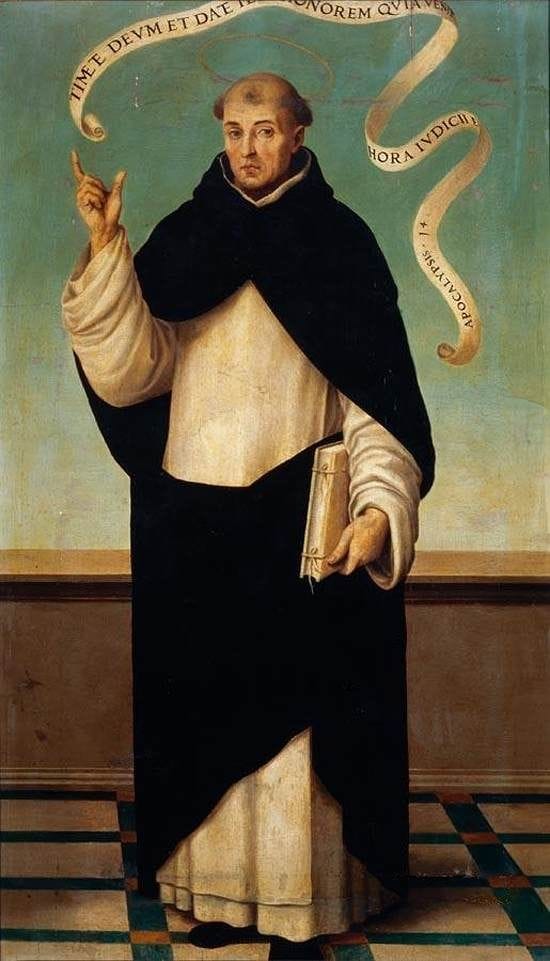 |
April 5: St. Vincent Ferrer, Confessor
To-day, again, it is Catholic Spain that offers one of her sons to the Church, that she may present him to the Christian world as a model and a patron. Vincent Ferrer, or, as he was called, the angel of the judgment, comes to us proclaiming the near approach of the Judge of the living and the dead. During his lifetime, he traversed almost every country of Europe, preaching this terrible truth; and the people of those times went from his sermons striking their breasts, crying out to God to have mercy upon them—in a word, converted. In these our days, the thought of that awful day, when Jesus Christ will appear in the clouds of heaven to judge mankind, has not the same effect upon Christians. They believe in the last judgment, because it is an article of faith; but, we repeat, the thought produces little impression. After long years of a sinful life, a special grace touches the heart, and we witness a conversion; there are thousands thus converted, but the majority of them continue to lead an easy, comfortable life, seldom thinking on hell, and still less on the judgment wherewith God is to bring time to an end.
It was not thus in the Christian ages; neither is it so now with those whose conversion is solid. Love is stronger in them than fear; and yet the fear of God’s judgment is ever living within them, and gives stability to the new life they have begun. Those Christians who have heavy debts towards divine justice, because of the sins of their past lives, and who, notwithstanding, make the time of Lent a season for evincing their cowardice and tepidity, surely such Christians as these must very rarely ask themselves what will become of them on that day, when the sign of the Son of Man shall appear in the heavens, and when Jesus, not as Saviour, but as Judge, shall separate the goats from the sheep. One would suppose that they have received a revelation from God, that, on the day of judgment, all will be well with them. Let us be more prudent; let us stand on our guard against the illusions of a proud, self-satisfied indifference; let us secure to ourselves, by sincere repentance, the well-founded hope, that on the terrible day, which has made the very saints tremble, we shall hear these words of the divine Judge addressed to us: ‘Come, ye blessed of My Father, possess the kingdom prepared for you from the foundation of the world!’1 Vincent Ferrer leaves the peaceful cell of his monastery, that he may go and rouse men to the great truth they had forgotten —the day of God’s inexorable justice; we have not heard his preachings, but, have we not the Gospel? Have we not the Church, who, at the commencement of this season of penance, preached to us the terrible truth, which St. Vincent took as the subject of his instructions? Let us, therefore, prepare ourselves to appear before Him, who will demand of us a strict account of those graces which He so profusely poured out upon us, and which were purchased by His Blood. Happy they that spend their Lents well, for they may hope for a favourable judgment!
The liturgy gives us, in the Matins of to-day, the following abridged account of the life of this holy servant of God:
The Dominican breviary contains the following responsories and antiphon in honour of this illustrious preacher:
How grand must have been thine eloquence, O Vincent, that could rouse men from their lethargy, and give them to feel all the terrors of that awful judgment. Our forefathers heard thy preaching, and returned to God, and were pardoned. We, too, were drowsy of spirit when, at the commencement of this holy season, the Church awakened us to the work of our salvation, by sprinkling our heads with ashes, and pronouncing over us the sentence of our God, whereby we are condemned to die. Yes, we are to die; we are to die soon; and a judgment is to be held upon us, deciding our eternal lot. Then, at the moment fixed in the divine decrees, we shall rise again, in order that we may assist at the solemn and terrible judgment. Our consciences will be laid open, our good and bad actions will be weighed, before the whole of mankind; after which, the sentence already pronounced upon us in our particular judgment will be made public. Sinners as we are, how shall we be able to bear the eye of our Redeemer, who will then be our inexorable Judge? How shall we endure even the gaze of our fellow-creatures, who will then behold every sin we have committed? But above all, which of the two sentences will be ours? Were the Judge to pronounce it at this very moment, would He place us among the blessed of His Father, or among the cursed? on His right, or on His left?
Our fathers were seized with fear when thou, O Vincent, didst put these questions to them. They did penance for their sins, and, after receiving pardon from God, their fears abated, and holy joy filled their souls. Angel of God's judgment! pray for us, that we may be moved to salutary fear. A few days hence we shall behold our Redeemer ascending the hill of Calvary, with the heavy weight of His cross upon Him; we shall hear Him thus speaking to the daughters of Jerusalem: ‘Weep not over Me, but weep for yourselves and for your children: for if in the green wood they do these things, what shall be done in the dry?’2 Help us, O Vincent, to profit by these words of warning. Our sins have reduced us to the condition of dry dead branches, that are good for nought but to bum in the fire of divine vengeance; help us, by thy intercession, to be once more united to Him who will give us life. Thy zeal for souls was extreme; take ours under thy care, and procure for them the grace of perfect reconciliation with our offended Judge. Pray, too, for Spain, the country that gave thee life and faith, thy religious profession and thy priesthood. The dangers that are now threatening her require all thy zeal and love; exercise them in her favour, and be her faithful protector.
Monday of the Second Week after Easter
THE first week has been devoted to the joyous celebration of our Emmanuel’s return to us. He has been visiting us each day, in order to make us sure of his Resurrection. He has said to us: See me! Touch me! Feel! it is indeed I!1 But we know that his visible presence among us is not to last beyond forty days. This happy period is rapidly advancing; the time seems to go so quickly! In a few weeks, he, for whom the whole earth has been in such expectation, will have disappeared from our sight. O Expectation and Saviour of Israel! why wilt thou he as a stranger in the land, and as a wayfaring man turning in to lodge? Why wilt thou be as a wanderer?2—So much the more precious are the hours, then! Let us keep close by his side; when we cannot hear his words, let us fix our eyes upon him; but when he does speak, let us treasure up the beautiful words, for they are as the last will of our dearest Master.
During these forty days he is continually with his disciples, not indeed to persuade them of his Resurrection (for of that they had no longer any doubt), but, as St Luke says, that he might speak to them of the Kingdom of God.3 He has redeemed man by his Blood, and his victory over death; he has wrought reconciliation between heaven and earth—all that now remains to be done is the organization of the Church. The Church is the Kingdom of God; for it is in and by her that God is to reign upon the earth. The Church is the Spouse of the risen Jesus; it is he that raised her up to so exalted an honour; and now he would give her the dowry which will prepare her for that glorious day when the Holy Ghost is to descend upon her, and proclaim her to all nations as Spouse of the Incarnate Word, and Mother of the elect.
Three things are needed by the Church in order that she may carry on her mission: a constitution framed by the very hand of the Son of God, whereby she will become a visible and permanent society; the possession of all the truths which her divine Lord came upon this earth to reveal or confirm—and in this is included the right to teach, and teach infallibly; thirdly, the means whereby she may efficaciously apply to the faithful the fruit of Jesus’ sacrifice on the Cross, that is to say, the graces of salvation and sanctification. Hierarchy, Doctrine, Sacraments—these are the all-important subjects upon which our Lord instructs his disciples during the forty days between his Resurrection and Ascension.
But before following him in his divine work of organizing the Church, let us spend the rest of this week in considering him as the Risen Jesus, dwelling among men, and winning their admiration and love. We have contemplated him in the humility of his swathing-bands and Passion; let us now exultingly feast on the sight of his glory.
He presents himself to us as the most beautiful of the sons of men.4 He was always so, even when he veiled the splendour of his beauty under the infirmity of the mortal flesh he had assumed; but what must not this splendour be now that he has vanquished death, and permits the rays of his glory to shine forth without restraint? His age is for ever fixed at that of thirtythree: it is the period of life wherein man is at the height of his strength and beauty, without a single sign of decay. It was the state in which God created Adam, whom he formed to the likeness of the Redeemer to come; it will be the state of the bodies of the just on the day of the general Resurrection—they will bear upon them the measure of the perfect age5 which our Lord had when he arose from his tomb.
But it is not only by the beauty of his features that the Body of our Risen Jesus delights the eye of such as are permitted to gaze upon him: it is now endowed with the glorious qualities of which the three Apostles caught a glimpse on Mount Thabor. In the Transfiguration, however, the Humanity shone as the sun because of its union with the Person of the Word; but now, besides the Brightness due to it by the Incarnation, the glorified Body of our Redeemer has that which comes from his being Conqueror and King. His Resurrection has given him such additional resplendence that the sun is not worthy to be compared with him; and St John tells us that he is the Lamp that lights up the heavenly Jerusalem.6
To this quality which the Apostle of the Gentiles calls Brightness,7 is added that of Impassibility, whereby the Body of our Risen Lord has ceased to be accessible to suffering or death, and is adorned with the immortality of life. This Body is as truly and really a Body as ever; but it is now impervious to any deterioration or weakness; its life is to bloom for all eternity. The third quality of our Redeemer’s glorified Body is Agility, by which it can pass from one place to another, instantly and without effort. The Flesh has lost that weight which, in our present state, prevents the body from keeping pace with the longings of the soul. He passes from Jerusalem to Galilee in the twinkling of an eye, and the Spouse of the Canticle thus speaks of him: The voice of my Beloved! Behold he cometh leaping upon the mountains, skipping over the hills!8 Finally, the Body of our Emmanuel has put on the quality of Subtility (which the Apostle calls ‘Spirituality’),9 whereby it is enabled to penetrate every material obstacle more easily than a sunbeam makes its way through glass. On the morning of his Resurrection, he passed through the stone that stood against the mouth of the sepulchre; and on the same day he entered the Cenacle, though its doors were shut, and stood before his astonished disciples.
Such is our Saviour, now that he is set free from the shackles of mortality. Well may the little flock that is favoured with his visits exclaim on seeing him: How fair and comely art thou,10 O dearest Master! Let us join our praises with theirs, and say: Yes, dearest Jesus, thou art beautiful above all the sons of men! A few days back and we wept at beholding thee covered with wounds, as though thou hadst been the worst of criminals: but now our eyes feast on the resplendent charm of thy divine beauty. Glory be to thee in thy triumph! Glory, too, be to thee in thy generosity, which has decreed that these our bodies, after having been purified by the humiliation of the tomb, shall one day share in the prerogatives which we now admire in thee!
Let us, destined as we are to share in the glory of our Jesus, offer to him this beautiful canticle, which used to be sung in the churches of Germany during the Middle Ages:
Sequence
Leo Juda magne, crucis virtute
Mors peccati, vita justitiæ.
Pro gustu scientiae, medicina gratiae
Pro rapina gloriae.
Jus romphææ restrinxit flammeae,
Paradisi pandis hortum,
Stirps obedientiæ, medicina gratiae.
Pax est in terris, fulgur inferis,
Et lux superis;
Dies duplicis baptismi, Legis et Evangelii.
Dum vetus transit, novum surgit.
Haec dies Domini,
Gaude mens expers fermenti, plena panis azymi.
Signatis postibus, assum Pascha
Nocte domo una,
Jam cum lactucis ede agrestibus.
Pellitis pedibus, cum baculo propera,
Et caput cum intestinis
Et pedibus vora.
Christe, mundans hyssopo,
Fac et dignos hoc mysterio;
Mare siccans, Leviathan perforans
Maxillam hamo armilla.
Sopi, suscita;
De torrente bibens in via
Damna nostra;
Tu Pontifex, hostia,
Torcular calcans, tu uva.
Plena septemplici rore,
Specie rosæ rubor,
Lilii candor,
Quo te tantæ clementiae Consilio,
Microcosmi inclinaveras Auxilio,
Ut miseris particeps
Redemptor esses,
Absque peccati naevo,
Gestans formulam peccati?
Servi, Domine,
Spes anastaseos primae,
Ultimae, per jusjurandum
Semini Abrahæ firma et nos.
Dux athanatos,
Nos tuo convivificans corpori,
Commortuos Adæ parent veteri;
Tu membris fortioribus
Jungens infirma,
Vitæ æternæ des pascua, tu Pascha.
Strong Lion of Juda! by the power of the Cross,
|thou art the Death of sin, and the Life of justice.
thou now givest us the fruit of the Tree of Life: to remedy the theft
committed by his ambition for glory, thou givest the medicine of grace.
the fiery sword which justly menaced us.
Thou openest heaven to us,
O Root of obedience! O Medicine of Grace!
which brings peace to earth, and terror to hell,
and light to heaven.
It is the day of the twofold baptism—of the Law and the Gospel.
the old one passes away, and the new rises in its stead.
This is the day which the Lord hath made: let us,
who have put away the old leaven and feed on the unleavened, let us rejoice!
thy threshold is signed with the Blood of the Lamb: eat the Pasch
prepared by fire in the night;
eat it in the One House; yea, eat it with wild lettuce.
shoe thy feet, and, with a stave in thy hand,
hasten and eat the head and entrails
and feet of the Lamb.
this day, with hyssop;
make us worthy of the Mystery.
Dry up the sea that we may pass; and with the hook
(of thy Cross) take the Leviathan.
inspirit us with thy chalice,
O thou that didst drink
of the torrent of our miseries in the way!
O thou our High Priest,
our Victim, our Wine-presser, our Vine!
rich with the dew of the seven gifts,
ruddy as the rose,
and fair as the lily!
—whence that merciful design of thine,
that made thee stoop to aid this little world,
sharing our nature
that thou mightest redeem us miserable men,
and taking the likeness of sin,
O thou the sinless God!
thou that hast made thyself Brother of thy creature man!
O Hope of our first and eternal Resurrection!
we beseech thee, by the promise
made to Abraham’s seed,
give us strength, O immortal King!
and make us, who were sharers
in our First Parent’s death, to be fellow-members of thy life.
Unite our weakness with thy strength, and bless us,
O Blessed Paschal Lamb!
with the pastures of eternal Life.
| Previous April 4: St. Isidore, Bishop and Doctor of the Church | Next Monday of the Second Week after Easter |