Daily reading
Paschal Time
Double · Movable from Easter · Temporal
April 11, 2027
From Dom Guéranger’s The Liturgical Year.

|
Second Sunday after Easter
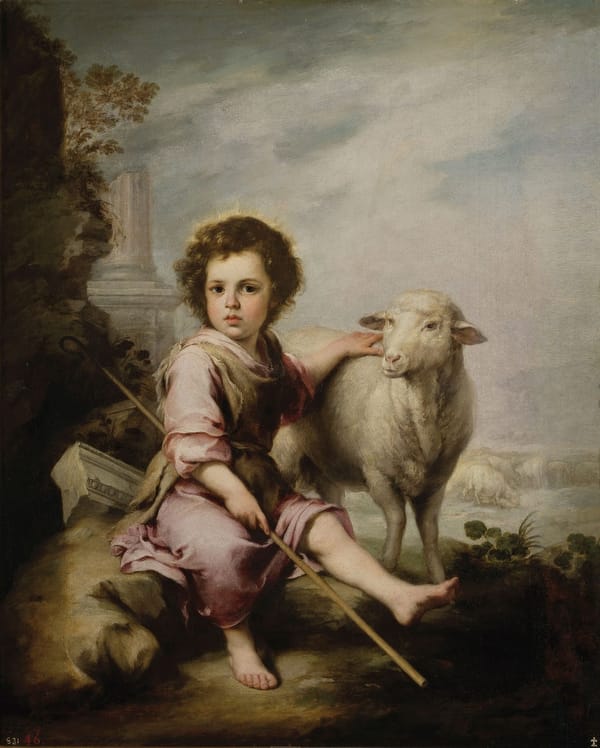
THIS Sunday goes under the name of Good Shepherd Sunday, because in the Mass there is read the Gospel of St John, wherein our Lord calls himself by this name. How very appropriate is this passage of this Gospel to the present season, when our divine Master began his work of establishing and consolidating the Church, by giving it the pastor, or shepherd, who was to govern it to the end of time!
In accordance with the eternal decree, the Man-God, on the fortieth day after his Resurrection, is to withdraw his visible presence from the world. He is not to be again seen upon the earth till the last day, when he will come again to judge the living and the dead. And yet he could never abandon mankind, for which he offered himself on the Cross, and delivered from death and hell by rising triumphantly from the grave. He will continue to be its Head after his Ascension into heaven: but what shall we have on earth to supply his place? We shall have the Church. It is to the Church that he will leave all his own authority to rule us; it is into the hands of the Church that he will entrust all the truths he has taught; it is the Church that he will make the dispenser of all those means of salvation which he has destined for the world.
This Church is a society, unto which all mankind is invited. It is composed of two classes of members; the governing and the governed; the teaching and the taught; the sanctifying and the sanctified. This society is the Spouse of Christ; it is by her that he produces his elect. She is the one only Mother of the elect; out of her bosom there is no salvation.
But how is this society to subsist? how is it to persevere through the long ages of time, even to the last day? who is to give it unity and adhesion of its parts? what is to be the visible link between its members—the palpable sign of its being the true Spouse of Christ, in the event of other societies rising up and disputing her titles? If Jesus himself could have remained with us we should have had nothing to fear, for where he is, there also are truth and life; but, as he says, he is going, and we may not as yet follow him. Give ear, then, and learn what is the primary quality of the true Spouse of Christ.
Jesus was one day, previous to his Passion, in the country of Cesarea Philippi; his Apostles were standing around him, and he began questioning them about what they thought of him. One of them, Simon the son of John or Jonas, and brother to Andrew, answered in the name of all, and said: Thou art Christ, the Son of the living God!1 Jesus expressed his pleasure at receiving Simon’s testimony, which was not the result of any human knowledge, but the expression of a divine revelation there and then granted to him; and he immediately told this Apostle that from that time forward he was to be, not Simon, but Peter (which means a rock). Christ had been spoken of by the prophets under the name of a Rock, or Stone;2 by thus solemnly conferring upon his disciple a title so characteristically that of the Messias, Jesus would give us to understand that Simon was to have something in common with himself which the other Apostles were not to have. After saying to him: ‘Thou art Peter (that is, thou art the rock), he added:' And upon this rock I will build my Church.’3
Let us weigh the force of these words of the Son of God: I will build my Church. He has, then, a project in view—he intends to build a Church. It is not now that he will build it, but at some future period; but one thing we already know as a certainty—it is that this Church will be built on Peter. Peter will be its foundation; and whosoever is not on that foundation will not belong to the Church. Let us again give ear to the text: And the gates of hell shall not prevail against my Church. In scriptural language gates signify powers: the Church of Christ, therefore, is to be proof against all the efforts of hell. And why? Because the foundation which Jesus is to give to it shall be one that no power can shake. The Son of God continues: And I will give to thee the keys of the kingdom of heaven. In the language of the Jews, keys signify the power of governing; and in the Gospel Parables the kingdom of heaven is the Church built by Christ. By saying to Peter (which is henceforth to be Simon’s name), I will give to thee the keys of the kingdom of heaven, Jesus implied this: ‘I will make thee the King of my Church, of which thou art to be the foundation!’ Nothing could be clearer. But let us remember that all these magnificent promises regard the future.4
That future has now become the present. We are now come to the last days of Jesus’ visible presence here below. The time is come for him to make good his promise, and found the kingdom of God—that Church which he was to build upon the earth. The Apostles, in obedience to the order sent them by the angels, are come into Galilee. Our Lord appears to them on the shore of the lake of Tiberias: after providing them with a mysterious repast, and whilst they are all attentive to his words, he suddenly addresses himself to Peter: Simon, son of John, lovest thou me?5 Observe, he does not call him Peter; he, as it were, goes back to the day when he said to him: Simon, son of Jonas, thou art Peter; he would have his disciples note the connection between the promise and its actual fulfilment. Peter, with his usual eagerness, answers his Master’s question: Yea, Lord, thou knowest that I love thee. Jesus resumes, with a tone of authority: Feed my lambs! Then repeating the question, he says: Simon, son of John, lovest thou me? Peter is surprised at his Master’s urging such an inquiry; still he answers with the same simplicity as before: Yea, Lord, thou knowest that I love thee: and as soon as he has given answer, Jesus repeats the words of investiture: Feed my lambs!
The disciples respectfully listen to this dialogue; they see plainly that, here again. Peter is made an object of Jesus’ partiality, and is receiving something which they themselves are not to receive. They remember what happened at Cesarea Philippi and how. ever since that day, Peter has been treated by their Master with especial honour. And yet there is another privilege or office to be added to this of feeding the lambs. A third time, then, Jesus says to Peter: Simon, son of John, lovest thou me? This is too much for the Apostle. These three questionings of his love bring to his mind the three denials he had so sinfully made to the servant girl of Caiphas. He feels the allusion to his recent infidelity; and this third time, his answer implies a prayer for forgiveness; his reply bespeaks humility rather than assurance: Lord! says he, thou knowest all things! Thou knowest that I love thee! Then, making Peter’s authority complete, Jesus pronounces these imposing words: Feed my sheep!6
Here, then, we have Peter made shepherd by him who says of himself: I am the good Shepherd. Firstly, our Lord gives his Apostle, twice over, the care of his lambs; this does not make him the complete shepherd: but when he bids him feed his sheep too, the whole flock is subjected to his authority. Now, therefore, let the Church show herself, let her take her stand, let her spread herself through the length and breadth of the nations; Simon, the son of John, is proclaimed its visible head. Is the Church a building? he is the foundation-stone, the Petra, the rock. Is she a kingdom? he holds the keys, that is, the sceptre. Is she a fold? he is the shepherd.
Yes, this Church, which Jesus is now organizing, which is to be proclaimed to the world on the day of Pentecost, is to be a fold. The Word, the Second Person of the blessed Trinity, is come down from heaven, that he may gather together in one the children of God that were dispersed;7 and the time is at hand when there shall he but one fold and one shepherd.8 O Jesus! our divine Shepherd! we bless thee, we give thee thanks. It is by thee that the Church thou art now founding subsists and lives through every age, congregating and saving all that put themselves under her guidance. Her authority, her strength, her unity, all come from thee, her infinitely powerful and merciful shepherd! We likewise bless and thank thee that thou hast secured this authority, this strength, this unity, by giving us Peter as thy Vicar, Peter our shepherd in and by thee, Peter to whom all, both sheep and lambs, owe obedience, Peter in whom thou, our divine Head, wilt be for ever visible, even to the end of the world!
In the Greek Church, the second Sunday after Easter, which we call Good Shepherd Sunday, goes under the appellation of the Sunday of the holy Myrophorœ, that is Perfume-Bearers. The Office celebrates the devotion of the holy women who brought their perfumes to the sepulchre, that they might embalm the Body of Christ. Joseph of Arimathea is also commemorated in the Greek Liturgy of this week.
The Roman Church reads the Acts of the Apostles in her Matins, from last Monday to the third Sunday after Easter exclusively.
Mass
The Introit takes a tone of triumph. It celebrates in the words of the Royal Psalmist the mercy of the Lord, which by the foundation of the Church has filled the whole earth. The heavens (by which, in the mysterious language of the Scripture, is frequently meant the Apostles), were firmly established by the Word of the Lord, when Jesus (the Word) gave them Peter as their shepherd and their rock.
Introit
Ps. Exsultate justi in Domino: rectos decet collaudatio.℣. Gloria Patri.
Misericordia.
Ps. Rejoice in the Lord, O ye just! Praise becometh the upright.℣. Glory, etc.
The earth, etc.
In the Collect, the Church asks the grace of holy Joy for her children: it is the spirit of Eastertide. Surely, it is a duty to rejoice at our having been saved from death by our Jesus' Resurrection! Moreover, these Paschal joys are a preparation for those of eternity.
Collect
To this are added two of the following Collects:
Of the Blessed Virgin
Against the Persecutors of the Church
For The Pope
Epistle
1 Cap. ii.Charissimi, Christus passus est pro nobis, vobis relinquens exemplum, ut sequamini vestigia ejus. Qui peccatum non fecit, nec inventus est dolus in ore ejus: qui quum malediceretur, non maledicebat, quum pateretur, non comminabatur: tradebat autem judicanti se injuste: qui peccata nostra ipse pertulit in corpore suo super lignum: ut peccatis mortui, justitiae vivamus: cujus livore sanati estis. Eratis enim sicut oves errantes, sed conversi estis nunc ad pastorem et episcopum animarum vestrarum.
1 Ch. ii.Dearly beloved: Christ also suffered, leaving you an example, that you should walk in his steps. Who did no sin, neither was guile found in his mouth. Who, when he was reviled, did not revile; when he suffered, he threatened not: but delivered himself to him that judged him unjustly: who his own self bore our sins in his body upon the tree: that we being dead to sins, should live to justice: by whose stripes you were healed. For you were as sheep going astray; but you are now converted to the shepherd and bishop of your souls.
It is the prince of the Apostles, the visible shepherd of the universal Church, who addresses these words to us. Observe how he ends by turning our thoughts to the invisible shepherd, whose Vicar he is; and how carefully he avoids any allusion to himself. So, also, when assisting his disciple Mark to write his Gospel, he would not allow him to relate the history of Christ's having made him the shepherd of the whole flock; whereas, he insisted on his telling every circumstance of his thrice denying Jesus to be his Master. See, too. how feelingly the Apostle here speaks of his Saviour—of the sufferings he endured, of his patience, of his devotedness for those poor straying sheep of whom he was to form his fold! These words will one day be verified in Peter himself. The hour will come when, like his Master, he will be fastened to a cross, and patiently endure every insult and cruelty. Jesus told him that it was to be so. After entrusting him with the care of the sheep and lambs, our Lord told him that when he should have grown old, he would stretch forth his hands upon a cross, and suffer violence from men.9 This is to happen not merely to Peter, but to a considerable number of his successors, who are one with himself, and whom future generations are to see continually persecuted, exiled, imprisoned, and put to death. Let us also follow Jesus' steps, by cheerfully suffering for justice’ sake: we owe it to him who from all eternity, being equal in glory to God the Father, deigned to come down to our earth that he might be the shepherd and bishop of our souls.
The first Alleluia Versicle commemorates the repast at Emmaus: in a few moments we also shall know Jesus in the breaking of the Bread of Life.
The second proclaims, in Jesus’ own words, the dignity and qualities of a shepherd, his love for his sheep, and the eagerness wherewith his sheep recognize him as their Master.
Alleluia.℣. Ego sum Pastor bonus; et cognosco oves meas, et cognoscunt me meæ, alleluia.
Alleluia.℣. I am the good Shepherd, and I know my sheep, and my sheep know me, alleluia.
Gospel
Cap. x.In illo tempore: Dixit Jesus Pharisæis: Ego sum Pastor bonus. Bonus pastor animam suam dat pro ovibus suis. Mercenarius autem et qui non est pastor, cujus non sunt oves propriae, videt lupum venientem, et dimittit oves, et fugit: et lupus rapit et dispergit oves: mercenarius autem fugit, quia mercenarius est, et non pertinet ad eum de ovibus. Ego sum Pastor bonus: et cognosco oves meas, et cognoscunt me meae. Sicut novit me Pater, et ego agnosco Patrem: et animam meam pono pro ovibus meus. Et alias oves habeo, quæ non sunt ex hoc ovili: et illas oportet me adducere, et vocem meam audient, et fiet unum ovile, et unus pastor.
Ch. x.At that time: Jesus said to the Pharisees: I am the good Shepherd. The good shepherd giveth his life for his sheep. But the hireling, and he that is not the shepherd, whose own the sheep are not, seeth the wolf coming, and leaveth the sheep, and flieth, and the wolf catcheth, and scattereth the sheep: and the hireling flieth, because he is a hireling: and he hath no care for the sheep. I am the good Shepherd: and I know mine, and mine know me. As the Father knoweth me, and I know the Father: and I lay down my life for my sheep. And other sheep I have, that are not of this fold: them also I must bring, and they shall hear my voice, and there shall be one fold, and one shepherd.
Divine Shepherd of our souls! how great is thy love for thy sheep! Thou givest even thy life to save them. The fury of wolves does not make thee flee from us; thou becomest their prey, that we may escape. Thou didst die in our stead, because thou wast our Shepherd. We are not surprised at thy requiring from Peter a greater love than thou didst require from his brother Apostles: thou didst will to make him their and our shepherd. Peter answered thee without hesitation, that he loved thee; and thou didst confer upon him thine own name, together with the reality of thine office, in order that he might supply thy place after thy departure from this world. Be thou blessed, O divine Shepherd! for thy having thus provided for the necessities of thy fold, which could not be one, were it to have many shepherds without one supreme shepherd. In obedience to thy command, we bow down before Peter, with love and submission; we respectfully kiss his sacred feet; for it is by him that we are united to thee; it is by him that we are thy sheep. Preserve us, O Jesus, in the fold of Peter, which is thine. Keep far from us the hireling who usurps the place and rights of the shepherd. He has intruded himself, or been intruded by violence, into the fold, and would have us take him as the master; but he knows not the sheep, and the sheep do not know him. Led, not by zeal, but by avarice and ambition, he flieth at the approach of danger. He that governs through worldly motives is not a man to lay down his life for others. The schismatic pastor loves himself; he does not love thy sheep; how could he give his life for them? Protect us, O Jesus, from this hireling! He would separate us from thee, by separating us from Peter, whom thou hast appointed thy Vicar; and we are determined to recognize no other. Anathema to him who would command as in thy name, and yet not be sent by Peter! Such a pastor could be but an impostor; he would not rest on the foundation; he would not have the keys of the kingdom of heaven; to follow him would be our ruin. Grant, then, Good Shepherd, Jesus! that we may ever keep close to thee and to Peter; that as he rests upon thee, we may rest upon him; and thus we may defy every tempest, for thou, dear Lord, hast said: A wise man built his house upon a rock; and the rain fell, and the floods came, and the winds blew, and they beat upon that house, and it fell not; for it was founded on a rock.10
The Offertory is an aspiration to God. taken from the royal Prophet.
Offertory
In the Secret, the Church prays that the divine energy of the Mystery, about to be consummated on the Altar may produce within us the effect for which we long—death to sin. and resurrection to grace.
Secret
To this the priest adds two of the following Secrets.
Of the Blessed Virgin
Against The Persecutors Of The Church
For the Pope
The Communion Anthem speaks to us of the beautiful Mystery of to-day—the Good Shepherd. Let us once more offer our homage to the Son of God, who deigns to assume this endearing character; and let us ever be his devoted sheep.
Communion
Jesus, the Good Shepherd, has given himself, in this divine banquet, to his sheep: holy Church prays, in the Postcommunion, that we may ever be penetrated with sentiments of love for this august Sacrament; we ought to glory in it, as being the food that prepares us for immortality.
Postcommunion
To this the priest adds two of the following Postcommunions.
Of the Blessed Virgin
Against the Persecutors of the Church
For the Pope
Vespers
The Psalms, Hymn and Versicle are given on pages 81-90.
Antiphon of the Magnificat
Oremus.
We will close the day with this beautiful preface taken from the Mozarabic Missal. It commemorates the Resurrection.
Illatio
(Feria vi Paschœ)
April 11: St. Leo the Great, Pope and Doctor of the Church
 |
ONE of the grandest Saints in the Church’s Calendar is brought before us to-day. Leo, the Pontiff and Doctor, rises on the Paschal horizon, and calls for our admiration and love. As his name implies, he is the Lion of Holy Church; thus representing, in his own person, one of the most glorious of our Lord’s titles. There have been thirteen Popes who have had this name, and five of the number are enrolled in the catalogue of Saints; but not one of them has so honoured the name as he whose feast we keep to-day: hence he is called ‘Leo the Great.’
He deserved the appellation by what he did for maintaining the faith regarding the sublime mystery of the Incarnation. The Church had triumphed over the heresies that had attacked the dogma of the Trinity, when the gates of hell sought to prevail against the dogma of God having been made Man. Nestorius, a bishop of Constantinople, impiously taught that there were two distinct Persons in Christ the Person of the Divine Word, and the Person of Man. The Council of Ephesus condemned this doctrine, which, by denying the unity of Person in Christ, destroyed the true notion of the Redemption. A new heresy, the very opposite of that of Nestorianism, but equally subversive of Christianity, soon followed. The monk Eutyches maintained that in the Incarnation the human nature was absorbed by the Divine. The error was propagated with frightful rapidity. There was needed a clear and authoritative exposition of the great dogma, which is the foundation of all our hopes. Leo arose, and, from the Apostolic Chair, on which the Holy Ghost had placed him, proclaimed with matchless eloquence and precision the formula of the ancient faith—ancient indeed, and ever the same, yet ever acquiring greater and fresher brightness. A cry of admiration was raised at the General Council of Chalcedon, which had been convened for the purpose of condemning the errors of Eutyches. ' Peter,' exclaimed the Fathers, ‘Peter has spoken by the mouth of Leo!’ As we shall see further on, the Eastern Church has kept up the enthusiasm thus excited by the magnificent teachings given by Leo to the whole world.
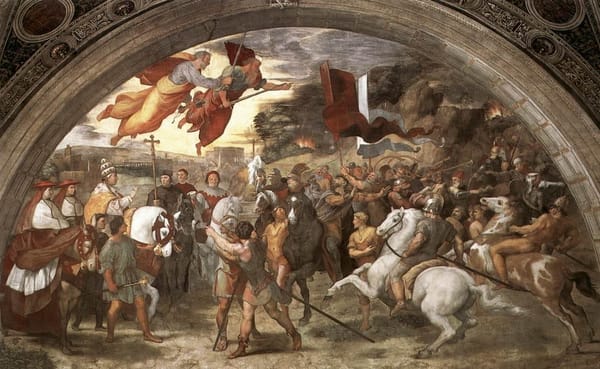
The barbarian hordes were invading the West; the Empire was little more than a ruin: and Attila, ‘the Scourge of God,’ was marching on towards Rome. Leo's majestic bearing repelled the invasion, as his word had checked the ravages of heresy. The haughty king of the Huns, before whose armies the strongest citadels had fallen, granted an audience to the Pontiff on the banks of the Mincio, and promised to spare Rome. The calm and dignity of Leo—who thus unarmed confronted the most formidable enemy of the Empire, and exposed his life for his flock—awed the barbarian, who afterwards told his people that, during the interview, he saw a venerable person standing in an attitude of defence, by the side of Rome’s intercessor: it was the Apostle St Peter. Attila not only admired, he feared the Pontiff. It was truly a sublime spectacle, and one that was full of meaning—a priest, with no arms save those of his character and virtues, forcing a king, such as Attila, to do homage to a devotedness which he could ill understand, and recognize by submission the influence of a power which had heaven on its side. Leo, singlehanded and at once, did what it took the whole of Europe several ages to accomplish in later times.
That the aureole of Leo’s glory might be complete, the Holy Ghost gifted him with an eloquence which, on account of its majesty and richness, might deservedly be called papal. The Latin language had at that time lost its ancient vigour; but we frequently come across passages in the writings of our Saint which remind us of the golden age.
In exposing the dogmas of our holy faith, he uses a style so dignified and so impregnated with the savour of sacred antiquity, that it seems made for the subject. He has several admirable sermons on the Resurrection; and speaking of the present season of the liturgical year, he says: ‘The days that intervened between our Lord's Resurrection and Ascension were not days on which nothing was done: on the contrary, great were the sacraments then confirmed, and great were the mysteries that were revealed.'1
Let us now read the sketch of the Saint’s life given by the Church in the Matins of the feast.
The Greek Church, in her Memea, has an office in honour of St Leo: we take from it the following stanzas. As they were composed before the Schism, they show us that the ancient Church of Constantinople believed the supremacy of the Roman Pontiff, and that it is not the Latins that have changed the faith. The Greeks keep the Feast of St Leo on February 18.
Hymn (Die XVIII Februarii)
Glory be to thee, O Jesus, Lion of the Tribe of Juda! that hast raised up in thy Church a Lion to defend her in those dark times, when holy Faith was most exposed to danger. Thou didst charge Peter to confirm his brethren2 and we have seen Leo, in whom Peter lived, fulfil his office with sovereign authority. We have heard the acclamation of the holy Council, which, in admiration at the heavenly teachings of Leo, proclaimed the signal favour thou didst confer on thy flock, when thou badest Peter feed both sheep and lambs.
O holy Pontiff Leo! thou worthily didst represent Peter in his Chair, whence thy apostolic teaching ceased not to flow, ever beautiful in its truth and majesty. The Church of thine own day honoured thee as the great teacher of faith; and the Church of every succeeding age has recognized thee as one of the most learned Doctors and preachers of the divine word. From thy throne in heaven, where now thou reignest, pour forth upon us the understanding of the great mystery, which thou wast called on to defend. Under thy inspired pen, this mystery grows clear; we see how sublimely it harmonizes with all other mysteries; and faith delights at gaining so close a view of the divine object of its belief. Oh! strengthen this faith within us. The Incarnate Word is blasphemed in our own times; avenge his glory, by sending us men of thy zeal and learning.
Thou didst triumph over barbarian invaders: Attila acknowledged the influence of thy sanctity and eloquence, by withdrawing his troops from the Christian land they infested. In these our days, there have risen up new barbarians—civilized barbarians, who would persuade us that religion should be eliminated from education. and that the State, in its laws and institutions, should simply ignore our Lord Jesus Christ, the King to whom all power has been given, not only in heaven but on earth also.3 Oh! help us by thy powerful intercession, for our danger is very great. Many are seduced, and have fallen into apostasy, whilst flattering themselves that they are still Christians. Pray that the light that is left within us may not be extinguished, and that the public scandals which now exist may be brought to an end. Attila was but a pagan; our modem statesmen and governments are, or at least call themselves, Christians: have pity cn them, and gain for them light to see the precipice to which they are hurrying society.
These days of Paschal Time remind thee, O holy Pontiff! of the Easters thou didst once spend here on earth, when, surrounded by the neophytes, thou gavest them the nourishment of thy magnificent discourses: pray for the faithful, who have this Easter risen to a new life with Christ. What they most need is a fuller and better knowledge of this their Saviour, in order that they may cling more closely to him, and persevere in his holy service. Thy prayers must obtain for them this knowledge; by thy prayers thou must teach them what he is both in his Divine and Human Nature: that as God he is their Last End, and their Judge after death; as Man, their Brother, their Redeemer, their Model. Bless, O Leo! and help the Pontiff who is now thy successor on the Chair of Peter. Show now thy love for that Rome whose sacred and eternal destinies were so frequently the subject of thy glowing and heavenly eloquence.
| Previous Saturday the Second Week after Easter | Next April 11: St. Leo the Great, Pope and Doctor of the Church |