Daily reading
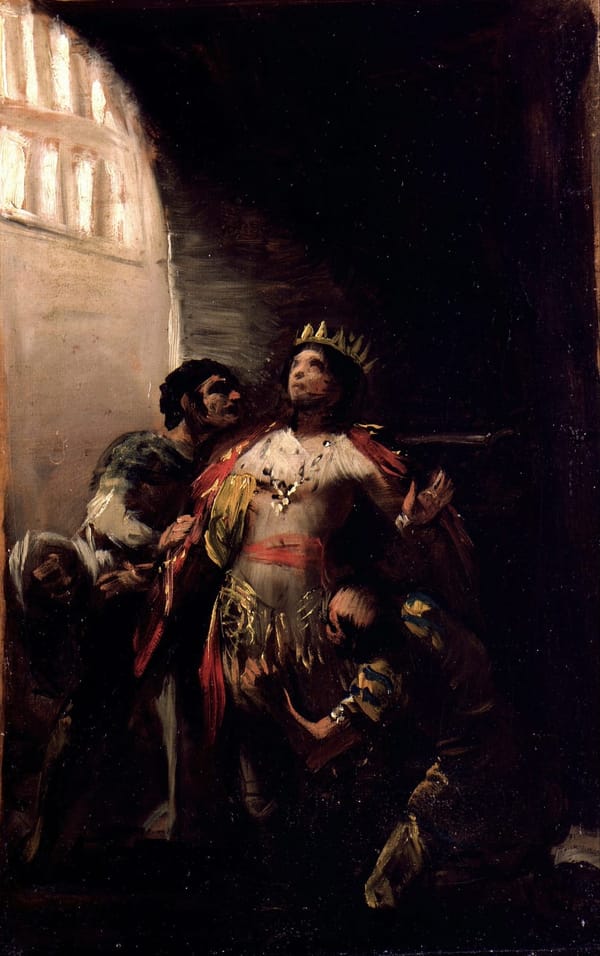
April 13: St. Hermenegild, Martyr
IT is through a martyr's palm-branch that we must to-day see the Paschal Mystery. Hermenegild, a young Visigoth prince, is put to death by his heretical father, because he courageously refused to receive his Easter Communion from an Arian bishop. The martyr knew that the Eucharist is the sacred symbol of Catholic unity; and that we are not allowed to approach the Holy Table in company with those who are not in the true Church. A sacrilegious consecration gives heretics the real possession of the divine Mystery, if the priestly character be in him who dares to offer sacrifice to the God whom he blasphemes; but the Catholic, who knows that he may not so much as pray with heretics, shudders at the sight of the profanation, and would rather die than share by his presence in insulting our Redeemer in that very Sacrifice and Sacrament which were instituted that we might all be made one in God.
The blood of the martyr produced its fruit: Spain threw off the chains of heresy that had enslaved her, and a Council, held at Toledo, completed the work of conversion begun by Hermenegild's sacrifice. There are very few instances recorded in history of a whole nation rising up as one man to abjure heresy; but Spain did it, for she seems to be a country on which heaven lavishes exceptional blessings. Shortly after this she was put through the ordeal of the Saracen invasion; she triumphed here again by the bravery of her children; and ever since then, her faith has been so staunch and so pure as to merit for her the proud title of The Catholic Kingdom.
St Gregory the Great, a contemporary of St Hermenegild, has transmitted to us the following account of the martyrdom. The Church has inserted it in her Lessons of today's Matins.
Pope Urban VIII composed the two following hymns for the feast of the holy martyr: we unite them under one conclusion.
Hymn
Hermenegilde jubar, gloria Martyrum,
Christi quos amor almis
Cœli cœtibus inserit.
Deo Servans obsequium! quo potius tibi
Nil proponis, et arces
Cautus noxia, quæ placent.
Surgentis vitii, non dubios agens
Per vestigia gressus
Quo veri via dirigit!
Non vitæ caperis divitis otio,
Gemmarumve nitore,
Regnandive cupidine.
Nec terret perimens carnificis furor:
Nam mansura caducis
Præfers gaudia cœlitum.
Clemens, atque preces, dum canimus tua
Quæsitam nece palmam,
Pronis auribus excipe.
Et natum celebrent ora precantium,
Divinumque supremis
Flamen laudibus efferant.
Hermenegild, as one of its glories:
so, too, do the martyrs,
whose love of Christ has numbered them among the blessed of heaven.
He was dear to thee above all things else;
and as to the dangerous pleasures of this world,
thou wisely didst reject them.
which excite and foster vice,
and march onwards, with unfaltering step,
whither the path of truth leads.
The luxuries of a life of ease and wealth,
the glitter of diamonds, the prospect of a throne
—they could not allure thee.
nor by the executioner's merciless rage;
for the everlasting joys of heaven
were dearer to thee than those of time.
from thy heavenly throne,
and graciously receive the prayers we present to thee
whilst celebrating the palm made thine by martyrdom.
Let the faithful assembled here in prayer, glorify the Son;
let them sing forth endless praise
to the Holy Ghost.
We offer thee, O brave witness to the truth of our holy faith! our admiration and gratitude. Thy courageous death was proof of the love thou hadst for Christ; and thy contempt of earthly honours teaches us to despise them. Though thou wert heir to a throne, a prison was thy abode here below. It was thence that thou didst ascend to heaven, wearing on thy brow the laurels of martyrdom, a crown far brighter than that which was offered thee on condition of thy apostatizing from the faith. Pray now for us: the Church asks it of thee, by inserting thy name in the Calendar of her Saints. The Pasch was the day of thy triumph; obtain for us that this may be a true Pasch to us, a real resurrection. which may lead us to the heaven above, where we may enjoy with thee the sight of our Risen Jesus. Intercede for us, that we may be firm in the faith, obedient to the teachings of holy Church, and enemies of every error and innovation. Protect Spain, thy fatherland, which owes to thy martyrdom long centuries of loyalty to the true faith. Pray for her, that she may ever continue to merit her glorious title of Catholic Kingdom.
Tuesday of the Third Week after Easter
THE Church, which our Risen Jesus is organizing during these days, and which is to be spread throughout the whole world, is a true and complete society. It must, consequently, have within it the power to govern, and be able, by the obedience of its subjects, to maintain order and peace. As we have already seen, our Saviour supplied this want by establishing a shepherd of both sheep and lambs, a Vicar of his own divine authority: yet Peter, after all, is but a man; and however sublime his authority, he cannot exercise it directly and personally over each member of the flock. The new society has need, therefore, of magistrates of a lower rank, who, as Bossuet so well expresses it, ‘are to be sheep with regard to Peter, and shepherds with regard to the people.’1
Jesus has provided for everything; he has chosen twelve men, whom he calls his Apostles, and to them he is about to entrust the magistracy of his Church. By his having made Peter the head, and, as it were, his second self, he does not intend the rest of the Twelve to have no share in the great work he has come from heaven to achieve. Far from this, he destines them to be the pillars of the building, of which he has already made Peter the foundation. They are twelve in number, as heretofore were the children of Jacob; for the ancient people was, in everything, a figure of the new. Before ascending into heaven, Jesus gives them power to teach in every part of the world, and appoints them pastors of the faithful in every place wheresoever they may happen to be. They are all on an equality, save with regard to Peter; and the very fact of these wonderful depositaries of Christ’s power being subject to Peter, is one of the clearest indications of the extraordinary authority committed to him by our Lord.
This unlimited delegation of pastoral power given to all the Twelve, was intended as a means of the solemn promulgation of the Gospel; but it was to cease at their deaths, save in the case of Peter, for his successor was alone to enjoy the apostolic power in its fullest extent. With this one exception, no lawful pastor has ever been allowed to exercise an unlimited territorial authority. And yet, by creating the college of the Apostles, our Redeemer founded that sacred and venerable dignity which we call the episcopacy. Although bishops have not inherited either the universal jurisdiction, or the personal infallibility in teaching, of the Apostles, yet do they really hold, in the Church, the place of the Apostles. Jesus puts into their hands, through the ministry of Peter’s successor, the keys of spiritual power; and these they use, that is, they therewith open and shut, throughout the whole extent of the territory placed under their jurisdiction.
How magnificent is this episcopal magistracy! See those thrones, whereon are seated the pontiffs of the whole Christian world! They hold the pastoral staff, the symbol of their power to govern their respective flocks. Go where you will, you will find the Church, and a bishop busily engaged in governing the flock entrusted to his charge. And when you reflect that all these pastors are brethren, that they all govern their flocks in the name of the same common Lord, and that all are united in obedience to one head—you will understand how the Church, wherein is exercised such an authority as this, has everything that constitutes a complete society.
Under the bishops, we find other subordinate magistrates in the Church; the reason of their being appointed is self-evident. Placed over a territory of greater or less extent, the bishop stands in need of co-operators who may represent his authority, and exercise it in his name and under his orders, wheresoever he himself cannot personally do so. These are priests, who have the care of souls. They correspond to the seventy-two disciples chosen by our Saviour, from whose number he selected the twelve Apostles. Thus he completed the government of the Church. By means of this Hierarchy, everything works in the most admirable harmony: authority is derived from the one supreme Head; thence it flows to the bishops; and these delegate it to the lower ranks of the clergy.
We are now at the very season of the year when the spiritual jurisdiction, which Jesus had promised to communicate to men, emanates from his own divine power. He thus solemnly confers it: All power is given to me in heaven and in earth: going, therefore, teach ye all nations!2 He communicates a portion of his own power to the pastors of his Church: it is an emanation of his own authority in heaven and on earth: and that we may have no doubts as to the source whence it flows, he says to them during these his last days on earth: As the Father hath sent me, I also send you.3
So that the Father has sent the Son, and the Son sends the pastors of the Church: nor will this mission ever be interrupted, so long as the world lasts. Peter will ever institute the bishops; the bishops will ever delegate a portion of their own authority to the priests who have the charge of souls. No human power shall ever be able to intercept this transmission, or have power to set up as pastors them that have not partaken of it. Cæsar (we mean mere temporal sovereignty) shall govern the state; but he shall not have power to create a single pastor, for Cæsar has no share in the sacred hierarchy, out of which the Church recognizes but subjects. He may command, as King or Emperor, in temporal matters; but he must obey, and as submissively as the last and poorest of the faithful, the pastor who has to govern him in what regards his soul. There will be times when Cæsar will be jealous of this superhuman power; he will strive to intercept it: but it will elude his grasp, for it is a purely spiritual power. At other times, he will despise and persecute them that are invested with this power; nay, he will occasionally attempt to exercise it himself; but his efforts will be as vain as they will be wicked, for this power, which emanates from Christ, cannot be confiscated nor interrupted; it is the salvation of the world, and on the last day the Church will have to restore it intact to him who deigned to entrust it to her before ascending to his Father.
Once more, to the praise of our dearest King! The great Fulbert of Chartres offers us the following hymn, which was adopted by the ancient Roman-French Liturgy.
Hymn
Novam mellis dulcedinem
Promat, colens cum sobriis
Paschale festum gaudiis.
Dracone surgens obruto,
Dum voce viva personat,
A morte functos excitat.
Praedam refudit tartarus:
Captivitate libera
Jesum sequuntur agmina.
Et dignus amplitudine,
Soli polique patriam
Unam facit rempublicam.
Regem precemur milites,
Ut in suo clarissimo
Nos ordinet palatio.
Patri supremo gloria,
Honorque sit cum Filio
Et Spiritu Paraclito.
bring forth the new sweetness of its honey;
and celebrate, with holy joy,
the paschal feast.
crushes the dragon, and rises from the tomb:
with a loud voice
he commands the dead to live.
gives back its prey;
and throngs of ransomed captives
follow Jesus.
he is worthy of all power;
he makes earth and heaven
be one kingdom.
let us humbly sing his praise,
and beseech him to admit us
into his palace of heaven above.
be to the Eternal Father,
and to the Son,
and to the Holy Paraclete.
| Previous Monday of the Third Week after Easter | Next Tuesday of the Third Week after Easter |