Daily reading
Simple · April 17 · Sanctoral
April 17, 2027
From Dom Guéranger’s The Liturgical Year.
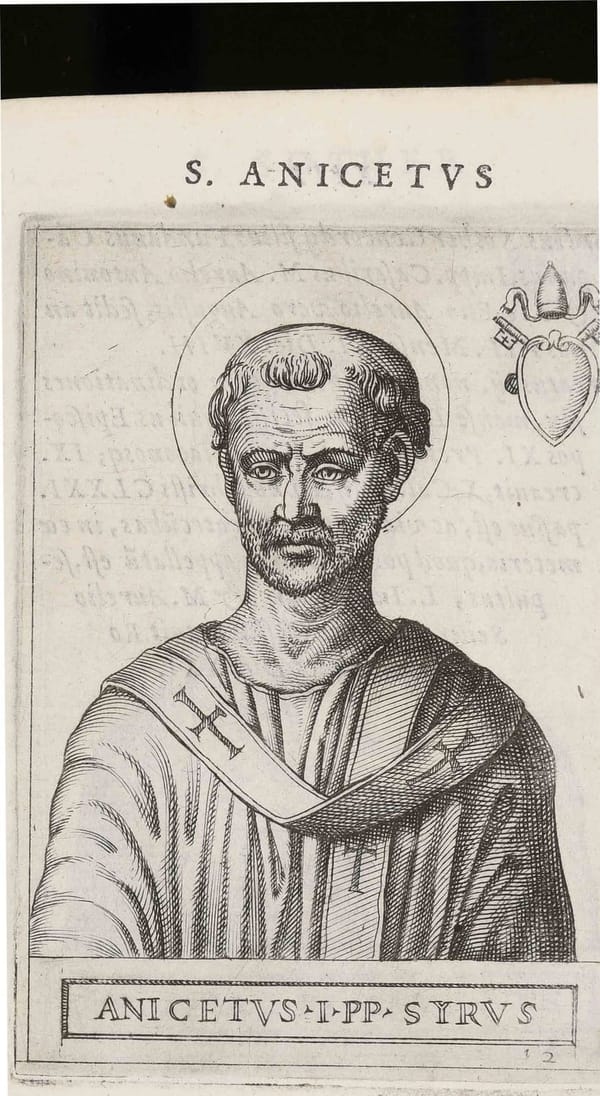
April 17: St. Anicetus, Pope
A POPE and martyr of the second century appears in the Calendar today. The martyrs stand in clusters near our Risen Lord; they are the Eagles of which he speaks in his Gospel, as gathering together around their longed-for object.* Anicetus is not the only Pope whose martyrdom has to be celebrated during Paschal Time; others will come, adding to our Easter joy. The Saint who claims our attention to-day is one of those whose holy actions are shrouded in the venerable gloom of the Church; and yet his memory will be held in veneration to the end of time, not only as being the eleventh successor of St Peter in the See of Rome, but as having imitated him also in holiness of life. St Poly carp, whose feast we kept on January 26, came from Smyrna to Rome, in order to visit him and receive his advice. There have also been transmitted to us one or two instances of the zeal wherewith he defended the Church against the heresiarchs, Valentine and Marcion. In a word, we know that he was a martyr; and that is enough to immortalize his name.
The Church makes the following commemoration of the holy Pontiff:
Holy Pontiff! who so many long ages ago wast made partaker of the glory of him whose Vicar and martyr thou hadst the privilege to be, we celebrate thy blessed memory today with filial affection. In thee we venerate one of the pillars of the early Church; and though thy name has been handed down to us without the history of those holy deeds which merited for thee a martyr’s palm—we at least know that it was dear to the faithful of the age in which thou didst live. Now that thou art in heaven, thy zeal for the glory of God is greater than it was when thou wast on this earth; pray, then, for the Church of these sad times. Upwards of two hundred Pontiffs have followed thee upon the Chair of Peter; and Christ has not yet come to judge the world. Assist thy successor who is our Father; assist the flock entrusted to his charge, for the dangers that now threaten us are extreme. Thy pontificate was during a stormy period; pray to our Risen Jesus that he would quell the tempest that is now howling round the Bark of Peter. Beseech him to give us perseverance and courage. Obtain for us that we may fix our hearts on our heavenly country; so that when God calls us hence, we may be prepared as thou wast. We are the descendants of the martyrs; their faith is ours; the hope that cheered them must be our consolation.
* St Matt. xxiv 28. ↩︎
Saturday of the Third Week after Easter
THE Saturday brings us back to Mary. Let us again contemplate her prerogatives; and yet, whilst so doing, let us still keep our thoughts on holy Church, which has been the subject of our meditations during this week. Let us, to-day, consider the relations existing between Mary and the Church: they will make us the better understand these two mothers of mankind.
Before taking possession of the Church, which was to be proclaimed before all nations on the day of Pentecost, the Man-God made a worthy prelude to this kingly possession by uniting himself with her, who is so deservedly styled the mother and representative of the human race. This was Mary. Of the family of David, Abraham and Sem; immaculate, from the first moment of her existence, as were our first parents when they came from their Creator's hands; and destined for the grandest honour which could be conferred on a mere creature; Mary was, during her sojourn here on earth, the inheritance and co-operatrix of the Incarnate Word: she was the Mother of all the living.1 She, in her single person, was what the Church, collectively, has been from the day of its foundation. Her office of Mother of God surpasses all her other glories; still, we must not overlook, but on the contrary admire and love them.
Mary was the first creature that fully corresponded with the intentions which induced the Son of God to come down from heaven. He found in her the most lively faith, the firmest hope, and the most fervent love. Never had human nature, perfected by grace, offered to God an object so worthy of his acceptance. Before celebrating his union with the human race, as its Shepherd, Jesus was the Shepherd of this single sheep, whose merits and dignity surpass those of the rest of mankind, even supposing it to have been always and in all things faithful to its God.
Mary, therefore, represented the Christian Church before it existed in itself. The Son of God found in her not only a Mother, but the faithful worshipper of his Divinity from the first moment of his Incarnation. We saw on Holy Saturday how Mary’s faith withstood the test of Calvary and the tomb, and how this faith, which never faltered, kept alive on the earth the light which was never to be quenched, and which was soon to be confided to the collective Church, whose mission was to win over all nations to the divine Shepherd.
It was not Jesus’ will that his Blessed Mother should exercise a visible and outward postulate, save in a limited degree. Besides, he was not to leave her here till the end of time. But, just in the same way as, from the day of his Ascension, he made his Church co-operate with him in all that he does for his elect, so likewise did he will, during his mortal life, that Mary should have her share in all the works done by him for our salvation. She, whose formal consent had been required before the Eternal Word took flesh in her womb, was present, as we have already seen, at the foot of the Cross, in order that she, as a creature, might offer him, who offered himself as God, our Redeemer. The Mother’s sacrifice blended with that of the Son, and this raised her up to a degree of merit which the human mind could never calculate. Thus it is, though in a less perfect manner, the Church unites herself, in unity of oblation, with her divine Spouse, in the sacrifice of the Altar. It was to be on the day of Pentecost that the Church’s maternity would be proclaimed to the world; Mary was invested with the office of Mother of men, as Jesus was hanging upon his Cross. When his Side was opened with the spear, that the Church, born from the Water and Blood of Redemption, might come forth, Mary was there to receive into her arms this future mother, whom she had hitherto so fully represented.
In a few days we shall behold Mary in the Cenacle; the Holy Ghost will enrich her with new gifts, and we shall have to study her mission in the early Church. Let us close the considerations we have been making to-day by drawing a parallel between our two Mothers, who, though one is so far above the other in dignity, are nevertheless closely united to each other.
Our heavenly Mother, who is also the Mother of Jesus, is ever assisting our earthly Mother, the Church, with heavenly aid. Mary exercises over her, in each of her existences—Militant, Suffering or Triumphant—an influence of power and love. She procures to the Church the victories she wins; she enables her to go through the tribulations and trials which beset her path. The children of one are children of the other; both have a share in giving us spiritual birth—one, the 'Mother of divine grace,1 by her all-powerful prayers; the other, by the word of God and holy baptism. If when we depart this life, our admission to the beatific vision is to be retarded on account of our sins, and our souls are to descend to the abode of Purgatory, the suffrages of our earthly Mother will follow us, and alleviate or shorten our sufferings; but our heavenly Mother will do still more for us during that period of expiation, so awful and yet so just. In heaven the elect are rejoiced at the sight of the Church Triumphant, though she be still Militant on earth; and who can describe the joy these happy children must feel at seeing the glory of the Mother that begot them in Christ? but with how much gladder ecstasy must not these same citizens of heaven gaze upon Mary, that other Mother of theirs, who was their Star on the stormy sea of life, who never ceased to watch over them with most loving care, who procured them countless aids to salvation, and who, when they entered heaven, received them into those same maternal arms which heretofore carried the divine Fruit of her womb—that First-Born,2 whose brothers and joint-heirs we are called to be!
As long as we dwell in this vale of tears, which is now being turned into a paradise by the presence of our Risen Jesus, let us sometimes think of Mary's joys. Last Saturday we borrowed a hymn from the ancient Churches of Germany, in order to celebrate her Seven Joys; let, us do the same to-day.
Sequence
Sponsa Christi singularis,
Jocundata nimium
Per salutis nuntium:
Casta Mater et fœcunda,
Et suprema gaudia
Nostro cordi nuntia.
Quæ tam mire fœcundata
Genuisti filium,
Velut sidus radium;
Partu semper fœcundari.
Atque corde steriles
Fac clementer fertiles.
Cujus novum filium
Magi cum muneribus
Placant flexis genibus;
Nos illorum munera
Deo ferre tribue
Semper et assidue.
Jam in templo præsentatus
Simeonis manibus
Tollitur cum laudibus:
Ut et illum nos geramus
Puris semper cordibus
Et sinceris mentibus.
Laetabaris nimio,
Resurgente filio
Mortis ab imperio:
Pia, nos resurgere,
Sursum tolle variis
Cor oppressum vitiis.
Conspexisti visibus
Ire tuum filium
Ad paternum solium:
Hujus vitæ terminum,
Valeamus libere
Sine metu cernere.
Quam post vitæ terminum
Dulcis Jesu dextera
Vexit super sidera:
Sublevamen sceleris,
Et post hanc miseriam
Duc ad veram patriam.
dearest Spouse of Christ!
for the angel of our salvation
announced to thee an exceeding great joy.
O Virgin Mother!
and speak to our heart
of the joys that never end.
in that thou didst conceive of the Holy Ghost,
and bring forth thy Child,
as the star emits its ray.
in works of salvation.
Take these barren hearts of ours,
and by thy merciful prayers make them fertile.
at the adoration and gifts
paid by the Magi
to thy new-born Babe.
pray that we may ever imitate them,
and give to God
what their gifts signified.
at the praises spoken by Simeon,
when, at thy presenting Jesus in the Temple,
he took the Child in his arms.
that we may serve thy Son
with purity
and earnestness of heart.
all thy soul’s power
be glad at thy Son's rising
from the grasp of death.
that we may rise from our sins,
and have our hearts set free
from the pressure of its many vices.
the happiness to see thy Son
ascend into heaven,
where he is seated on his Father’s throne.
of the world
we may without fear
welcome his return.
who after thy life’s course was run,
wast raised up
by thy sweet Jesus above the stars.
may be raised from our sins,
and after this miserable life
be led to our true country.
| Previous Friday of the Third Week after Easter | Next Saturday of the Third Week after Easter |