Daily reading
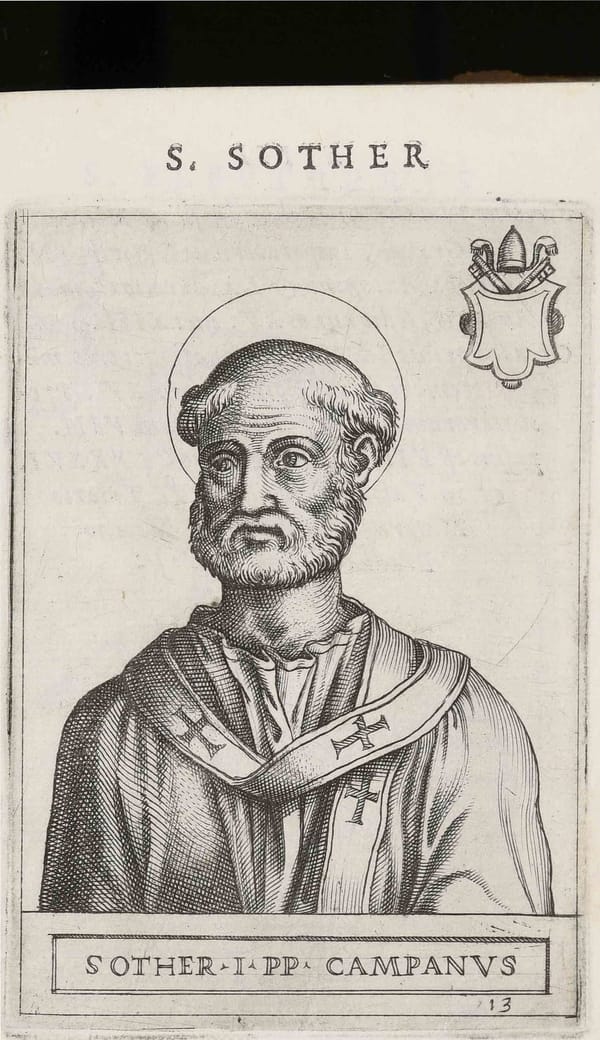
April 22: Sts. Soter and Caius, Popes and Martyrs
THE palms of two martyred Popes are intertwined and grace this day of the Calendar. Soter suffered for Christ in the second, and Caius in the third century; a hundred years separate them; and yet we have the same energy of faith, the same jealous fidelity to keep intact the depositum left by Christ to his Church. What human society ever existed that produced heroes for century after century? The Society, however, which was founded by Christ—in other words, the Church—is based on that traditional devotedness which consists in laying down one's life for the faith. And if so, we may be sure that the spirit of martyrdom would show itself in them that were the Heads and Fathers of this Society. The first thirty successors of St Peter paid dearly for the honour of the Supreme Pontificate; they were martyrs. How grand the throne of our Risen Jesus, surrounded as it is by all these Kings clad in their triumphant scarlet robes!
Soter was the immediate successor of Anicetus, whose feast we kept on the 17th of this month. Time has effaced the details of his life. Eusebius, however, gives us a fragment of a letter written by St Dionysius, bishop of Corinth, wherein thanks are expressed to the Pontiff for the alms he sent to the faithful of that Church, during a famine. An Apostolic Letter was sent with these alms; and St Dionysius tells us that it was read in the assemblies of the faithful, together with the one addressed to the same Church, in the preceding century, by St Clement. The Roman Pontiffs have ever united charity to their fidelity in preserving pure the deposit of our faith. With regard to Caius, he suffered death in the terrible persecution under Diocletian: and little more than a mere mention of his name is given in the annals of Christian Rome. We cannot, therefore, be surprised at the brevity wherewith the Liturgy speaks of these two martyred Popes. We subjoin the Lessons given in the Breviary.
O holy Pontiffs! you are of the number of those who went through the great tribulation,1 and passed, through fire and water,2 to the eternal shores of heaven. The thought of Jesus’ victory over death gave you courage: you remembered how his Passion was followed by a glorious Resurrection. By imitating him in laying down your lives for your sheep, you have taught us how we also should think no sacrifice too great to be made for our faith. Obtain for us this heroic courage. Baptism has numbered us among the soldiers of Christ; confirmation has given us the spirit of fortitude; we must then be ready for battle. It may be that, even in our own times, a persecution may rage against the Church; at all events, we have to fight against ourselves, the spirit of the world, and Satan; support us by your prayers. You were once the Fathers of the Christian people; you are still animated with the pastoral charity which then filled your hearts. Protect us, and make us loyal to the God, whose cause was so dear to you when here on earth.
Thursday of the Fourth Week after Easter
THE Apostles have received their mission. The Sovereign Master has bade them divide among themselves the nations of the earth, and preach everywhere the Gospel—that is, the Good Tidings—the tidings of man's Redemption wrought by the Son of God, who was made flesh, was crucified, and arose again from the dead. But what is to be the grand support of these humble Jews, who have been suddenly transformed into conquerors, and have to win the whole world to Christ? Their support is the solemn promise made to them by Jesus, when, after saying: Go, teach all nations! he adds: Lo! I am with you all days, even to the consummation of the world! Hereby he promises never to leave them, and ever to direct and guide them. They shall see him no more in this life; and yet he assures them that he will be ever in their midst.
But these men, with whom Christ thus promises that he will abide for ever, and preserve them from every fall and from every error in the teaching of his doctrine—these Apostles are not immortal. We shall find them, one after the other, laying down their lives for the faith and so leaving this world. Are we, then, condemned to uncertainty and darkness, like men who have been abandoned by the light? Is it possible, that the appearance of our Emmanuel upon the earth has been but like that of a meteor, which we sometimes behold in the night, emitting a lurid light, and then suddenly disappearing, leaving us in greater darkness than before? No: the words of our Risen Jesus forbid us to fear such a calamity. He did not say to his Apostles:’Lo! I am with you even to the end of your lives;' but Lo! I am with you all days, even to the consummation of the world. So that those to whom he addressed himself were to live to the end of the world! What means this, but that the Apostles were to have successors, in whom their rights were to be perpetuated? successors whom Jesus would ever assist by his presence and uphold by his power. The work founded by a God, out of his love for man, and at the price of his own precious Blood, must surely be imperishable! Jesus, by his presence amidst his Apostles, preserved their teaching from all error; by his presence he will also, and for ever, guide the teaching of their successors.
O precious and necessary gift of Infallibility in the Church! Gift, without which the mission of the Son of God would have been a failure! Gift whereby faith, that essential element of man’s salvation, is preserved upon the earth! Yes, we have the promise; and the effects of this promise are evident even to them that are not of the Church. Where is there an unprejudiced man, who would not recognize the hand of God in the perpetuity of the Catholic Symbol of Faith, whereas everything else on earth is for ever changing? Can we attribute to natural causes such a result as this—that a society, whose link is unity of belief, should live through so many ages, and yet lose nothing of the truth it possessed at its commencement, nor imbibe anything of the falseness of the world around it; that it should have been attacked by thousands of sects, and yet have triumphed over them all, survived them all, and be as pure in the faith now at this present day, as it was on the day when first formed by its divine Founder? Is it not an unheard-of prodigy, that hundreds of millions of men, differing from each other in country, character, and customs, yea, and frequently enemies to each other, should be united in one like submission to one same authority, which, with a single word, governs their reason in matters of faith?
How great is thy fidelity to thy promises, O Jesus! Who could help feeling that thou art in the midst of thy Church, mastering by thy presence the warring elements, and by irresistible yet sweet power, subjecting our pride and fickleness to thy dear yoke? And they are men, men like ourselves who rule and guide our faith! It is the Pope, the successor of St Peter, whose faith cannot fail,* and whose sovereign word is carried through the whole world, producing unity of mind and heart, dispelling doubt, and putting an end to disputation. It is the venerable body of the bishops united with their Head, and deriving from this union an invincible strength in the proclamation of the one same truth in the several countries of the universe. Oh yes; men are made infallible because Jesus is with and in them! In everything else they are men like ourselves; but the Chair on which they are throned is supported by the arm of God; it is the Chair of Truth upon the earth.
How grand is our faith! Miracles gave it birth; and this continued miracle, of which we have been speaking, and which disconcerts all the calculations of human wisdom, directs it, enlightens it, and upholds it. How stupendous are the wondrous works done by our Risen Jesus during these forty days! So far, he had been preparing his work; now he carries it into effect. May the divine Shepherd be ever praised for the care he takes of his Sheep! If he exacts their faith as the first pledge of their service, we must own that he has made the sacrifice not only meritorious by the submission of our reason, but most attractive to our heart.
Let us honour his glorious Resurrection by a new canticle—one from the ancient Missals of Germany.
Sequence
Voce modulemur supplici.
Omnis in hac die
Rerum natura jubilans,
Personet immensas
Filio Dei gratias.
Jam nostri concives,
Coelestis sanctuarii milites,
In vestra nos adunate gaudia.
Hymnite nunc superi,
Pariter resonate inferi,
Et omnis in Domino
Spiritus gratuletur ænesi;
Deus homo nascitur;
Et fragili carne,
Se deitas occulens,
Probra sustinuit patiens:
Virtutibus, signis ut
Deus emicuit;
Et corporis nostri necessitate fruens,
Verus terrigena claruit.
Ab hoste tentatus,
Non est agnitus neque divinitas patuit:
Ars artem delusit,
Donec veteris nodum piaculi secuit.
In ara crucis hostiam
Se pro nobis Christus obtulit Deo Patri,
Morte sua nostra mortificans crimina.
Jam victor Christus,
Barathro populato,
Mortis principe vinculato,
Ab inferis pompa regreditur nobili.
Hæc est dies quæ illuxit, post turbida
Regni Æthiopum tempora;
Christus in qua resurrexit
Ultra victurus,
Cum carne quam sumpsit de Maria virgine.
Qui ovem
Cum gaudio Patri quam perdiderat,
Humero revexit suo.
sing with suppliant voice our praise to Christ.
On this day let all nature,
in a transport of joy,
Sound forth one universal hymn of thanks
to the Son of God.
And you,
our fellow-citizens,
permit us to share in your joys.
Sing a hymn, ye that are highest!
Intone a loud canticle, ye that are lowest!
Yea, let every spirit be glad in the Lord,
and praise him!
For he, God,
became Man for man's salvation.
Hiding his divinity
with the veil of our frail flesh,
he patiently endured every insult;
But his power and miracles
revealed him as our God.
He subjected himself to all our human wants,
and was verily a wayfarer on our earth.
He was tempted by the enemy;
but he made not known his divinity.
Craft by craft was foiled,
till the hour came for him to cut the knot of Adam's sin.
For our sake, he offered himself to his Father
a victim upon the altar of the Cross: and by his Death,
he put our sins to death.
And now hell is ravaged
and the prince of death enchained,
and Christ returns from Limbo,
in all the pageant of his victory.
This is the day which has shone upon the world,
after the stormy times of the Ethiopian sway.
It is the day whereon,
with the flesh he assumed from the Virgin Mary,
Christ rose again, to live for evermore.
With joy, he carried on his shoulders,
to his Father,
the sheep that had been lost.
* St Luke xxii 32. ↩︎
| Previous Wednesday of the Fourth Week after Easter | Next Thursday of the Fourth Week after Easter |