Daily reading
Paschal Time
Double · April 24 · Sanctoral
April 24, 2027
From Dom Guéranger’s The Liturgical Year.
A Double leads the weekday.Rubric
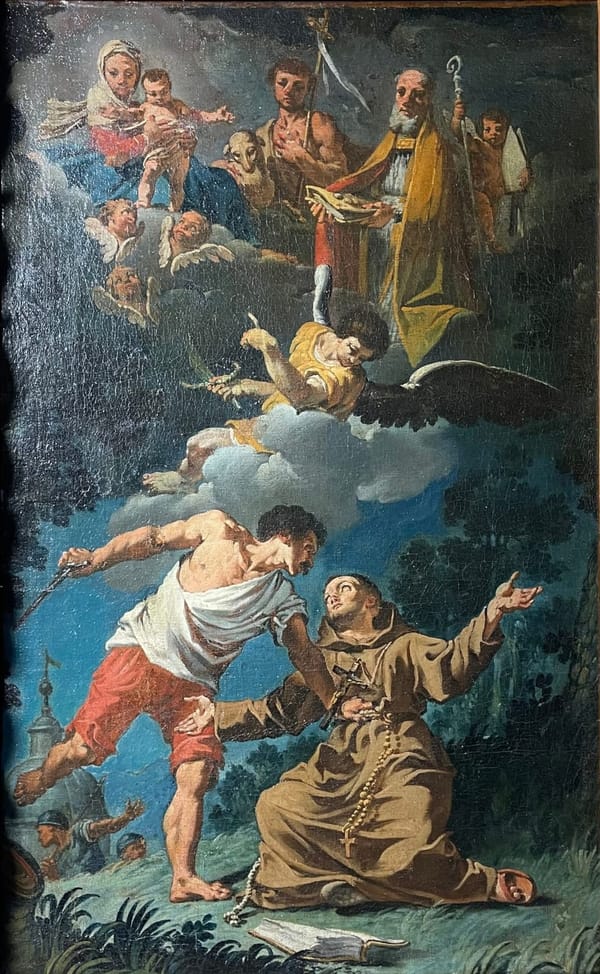 |
April 24: St. Fidelis of Sigmaringen, Martyr
OUR Risen Lord would have around him a bright phalanx of martyrs. Its privileged members belong to the different centuries of the Church’s existence. Its ranks open today to give welcome to a brave combatant, who won his palm, not in a contest with paganism, as those did whose feasts we have thus far kept, but in defending his mother, the Church, against her own rebellious children. They were heretics that slew this day’s martyr, and the century that was honoured with his triumph was the seventeenth.
Fidelis was worthy of his beautiful name. Neither difficulty nor menace could make him fail in his duty. During his whole life, he had but the glory and service of his divine Lord in view: and when the time came for him to face the fatal danger, he did so, calmly but fearlessly, as behoved a disciple of that Jesus who went forth to meet his enemies. Honour, then, be to-day to the brave son of St Francis! truly he is worthy of his seraphic Patriarch, who confronted the Saracens, and was a martyr in desire!
Protestantism was established and rooted by the shedding of torrents of blood; and yet Protestants count it as a great crime that, here and there, the children of the true Church made an armed resistance against them. The heresy of the sixteenth century was the cruel and untiring persecutor of men, whose only crime was their adhesion to the old faith—the faith that had civilized the world. The so-called Reformation proclaimed liberty in matters of religion, and massacred Catholics who exercised this liberty, and prayed and believed as their ancestors had done for long ages before Luther and Calvin were bom. A Catholic who gives heretics credit for sincerity when they talk about religious toleration, proves that he knows nothing of either the past or the present. There is a fatal instinct in error, which leads it to hate the Truth; and the true Church, by its unchangeableness, is a perpetual reproach to them that refuse to be her children. Heresy starts with an attempt to annihilate them that remain faithful; when it has grown tired of open persecution it vents its spleen in insults and calumnies; and when these do not produce the desired effect, hypocrisy comes in with its assurances of friendly forbearance. The history of Protestant Europe, during the last three centuries, confirms these statements; it also justifies us in honouring those courageous servants of God who, during that same period, have died for the ancient faith.
Let us now respectfully listen to the account given us, in the Liturgy, of the life and martyrdom of St Fidelis; we shall find that the Church has not grown degenerate in her Saints.
How truly couldst thou, O Fidelis! say with the Apostle: I have finished my course!1 Yea, thy death was even more beautiful than thy life, holy as that was. How admirable the calmness wherewith thou didst receive death! how grand the joy wherewith thou didst welcome the blows of thine enemies—thine, because they were those of the Church! Thy dying prayer, like Stephen's, was for them; for the Catholic, while he hates heresy, must love the heretics who put him to death. Pray, O holy martyr, for the children of the Church. Obtain for them an appreciation of the value of faith, and of the favour God bestowed on them when he made them members of the true Church. May they be on their guard against the many false doctrines which are now current through the world. May they not be shaken by the scandals which abound in this age of effeminacy and pride. It is faith that is to bring us to our Risen Jesus: and he urges it upon us by the words he addressed to Thomas: Blessed are they that have not seen and have believed!2 Of this number we wish to be: and therefore is it that we cling to the Church, the sovereign mistress of faith. We wish to believe her, and not human reason, which has neither the power to fathom the word of God, nor the right to sit in judgement over it. Jesus has willed that this holy faith should come down to us bearing on itself the strengthening testimony of the martyrs; and each age has had its martyrs. Glory to thee, O Fidelis, who didst win thy palm by combating the errors of the pretended Reformation! Take a martyr’s revenge, and pray without ceasing to our Jesus, that he would bring all heretics back to the faith and to union with the Church. They are our brethren by baptism; pray for them, that they may return to the Fold, and that we may one day celebrate with them the true Paschal banquet, wherein the Lamb of God gives himself to be our food, not figuratively, as in the Old Law, but really and truly, as fits the New Covenant.
Saturday of the Fourth Week after Easter
SATURDAY brings us once more to the dear Mother of our Jesus. Last Saturday, when closing our week’s considerations upon the establishment of the Church, we reverently drew a parallel between these two Mothers—Mary and the Church. During the present week, we have been considering how our Saviour confided his doctrine—that is, the object of our faith—to his Apostles; let us devote this last day to a loving remembrance of the dogmas which Jesus revealed to them regarding the dignity and office of her whom he chose for his own and our Mother.
Holy Church teaches us several truths concerning Mary; and these truths are the object of our faith, on the same ground as the other articles contained in the Catholic Creed. Now they could not be the object of our faith, except inasmuch as they were revealed by the lips of our divine Lord himself. The Church of our days has received them from the Church of past ages, just as this last named received them from the Apostles, to whom Jesus first confided them. There has been no new revelation since our Saviour’s Ascension; consequently, the manifestation of all the dogmas transmitted to the Church, and promulgated by her to the world, dates from the teaching given by Jesus to his Apostles. It is on this account that we believe them with theological faith—a faith which can only be given to truths directly revealed by God to man.
How beautiful is the affection here shown by the Son of God to his Mother! He revealed to his Apostles the impenetrable secrets of the divine Essence, the Trinity in Unity, the eternal generation of the Word in the Father's bosom, the eternal procession of the Holy Ghost from the Father and the Son, the union of the two Natures in one Person in the Incarnate Word, the Redemption of the world by the Blood of the Man-God, the restoration of fallen man and his elevation to a supernatural state by grace. But this same Jesus also reveals the prerogatives of his dearest Mother; and we are to believe them with the same faith as we do the dogmas which relate to God himself! Jesus, the Wisdom of the Father, the Conqueror of death, has revealed to us Mary's dignity with the same lips that taught us what he himself is: we believe the two revelations with equal faith because both come from him.
Jesus said to his Apostles, and they, under the guidance of the Holy Ghost, communicated his teaching to the Church:’Mary, my Mother, is a daughter of Adam and Eve; but the stain of original sin was not upon her. The decree that every human being should be conceived in sin was suspended in her regard. She was full of grace from the first moment of her Conception. Jeremiasand John the Baptist were sanctified in their mother’s womb; Mary was Immaculate from the first moment of her existence.’
Jesus also said to his Apostles, and commanded them to repeat his words to the Church:’ Mary is truly Mother of God, and must be honoured as such by all creatures; for she truly conceived me and gave me birth, according to my human nature, which forms but one Person with my divine nature.’
Jesus also said to his Apostles, and commanded them to repeat his words to the Church:’ Mary, my Mother, conceived me in her chaste womb without ceasing to be a Virgin, and she gave me birth without her Virginity suffering any injury.’
Thus, Mary’s Immaculate Conception which prepared her for her sublime office, her divine Maternity and her perpetual Virginity, are three dogmas of our faith, which were revealed to the Apostles directly by our Lord. Holy Church merely repeats them after the Apostles, just as the Apostles repeated them after hearing them from their divine Master.
But did not Jesus reveal other prerogatives of his august Mother—prerogatives which are consequences of the three magnificent gifts just mentioned? Let us ask the Church what she believes on this subject, and what she teaches, both by her doctrinal utterance, and by her equally infallible practice. Every development, which is produced in her by the action of the Holy Ghost, is based upon the word of God, which was spoken at the beginning. Thus it is impossible to doubt but that our Saviour made known to his Apostles his intention of raising his blessed Mother to the dignity of Queen of the universe, of Mediatrix of men, of Mother of grace, of Co-operatrix of our Redemption. Had she not, by the three unparalleled gifts just mentioned, already been raised above all other creatures? Yes, we cannot doubt it; these glories of the Mother of God were known, revered, and loved by the Apostles; and we, who have received from the Church these same sublime and consoling truths, we too prize and love our knowledge. Should we not be offering violence to every noble feeling of our nature, were we to believe that Jesus ascended into heaven, without having made known to the world the glories of his Mother, whom he loved both as her Son and her God!
What must have been thy sentiments, O Mary, thou most humble of creatures, when Jesus unveiled thy glories to the disciples? They already reverenced thee, but they could never have known the grand gifts bestowed on thee by God, unless that God himself had revealed them. What glorious things were said of thee, O City of God!1 If thy humility was troubled when the archangel called thee full of grace, and blessed among women; how must thou not have shrunk from the homage paid thee by the Apostles, when they were first told that thou wast the Mother of God, the ever spotless Virgin, Immaculate from thy very conception! But no, blessed Mother! thou canst not shun the honours that are richly thy due. The prophecy spoken by thyself, in Zachary’s house, must be fulfilled: All generations shall call thee Blessed!2 The time is at hand; a few days hence, the preaching of the Gospel will have commenced. Thy name, thy ministry, thy glories are an essential part of the Creed which is to be carried throughout the world. Up to this time, thou hast been shrouded in a veil of mystery; that veil must now be drawn aside —Jesus will have it so—and thou must be known as Mother of the God, who, when he came to save us, disdained not to assume our human nature in thy chaste womb. Dearest Mother! Queen of angels and men! suffer us to unite our fervent homage with that which the Apostolic College gave thee, when Jesus first revealed to them thy glories!
Let us, in honour of the blessed Mother, recite this sequence of the Cluny Missal of 1523. It is a graceful imitation of the Victimœ Paschali.
Sequence
Intonent Christiani.
Tua per suffragia
Reconcilientur peccatores.
A fermento veteri,
Victimae paschalis perceptores.
Virgo clemens et pia,
Et gloria frui resurgentis.
Christo reconcilia,
Es Genitrix Verbi Dei facta.
Et hominem natum, resurrexisse glorificatum.
A mortuis vere;
Conserva Mater nos et tuere.
their hymns of praise.
let sinners be reconciled to God
by thy prayers.
by thy intercession,
cleansed from the old leaven.
thou merciful and loving Virgin!
and Risen Christ.
by thy holy prayers,
Mother of the Word of God!
who was born of thee hath risen again in glory.
Do thou, O Mother!
preserve and defend us.
| Previous Friday of the Fourth Week after Easter | Next Saturday of the Fourth Week after Easter |