Daily reading
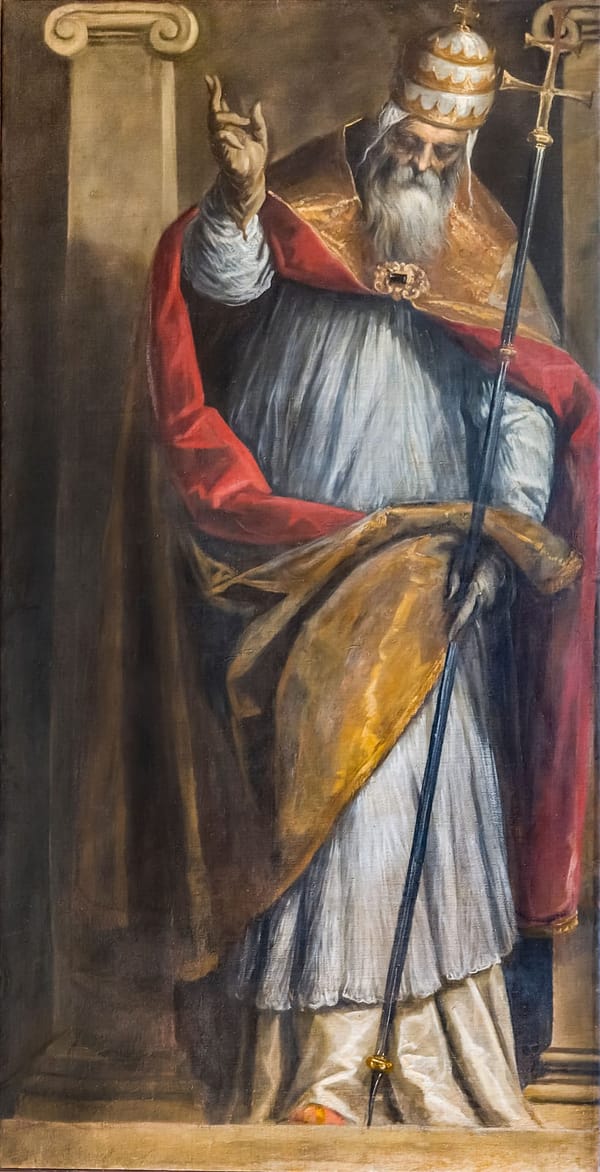
April 26: Sts. Cletus and Marcellinus, Popes and Martyrs
TWO bright stars appear this day on the ecclesiastical cycle, proclaiming the glory of our Jesus, the Conqueror of death. Again they are two pontiffs, and martyr pontiffs. Cletus leads us to the very commencement of the Church, for he was a disciple of Peter, and his second successor in the See of Rome. Marcellinus was a witness of the great persecution under Diocletian; he governed the Church on the eve of her triumph. Let us honour these two fathers of Christendom, who laid down their lives in its defence; and let us offer their merits to Jesus, who supported them by his grace, and cheered them with the hope that one day they would share in his Resurrection.
The following is the account given of St Cletus by the Liturgy:
The Life of St Marcellinus is thus given in the Breviary:
Pray for us, O holy Pontiffs, and look with fatherly love upon the Church on earth, which was so violently persecuted in your times, and at the present day is far from enjoying peace. The worship of idols is revived; and though they be not of stone or metal, yet they that adore them are as determined to propagate their worship as were the pagans of former days to make all men idolaters. The gods and goddesses now in favour are called Liberty, Progress, and Modern Civilization. Every measure is resorted to, in order to impose these new divinities upon the world; they that refuse to adore them are persecuted; governments are secularized, that is, unchristianized; the education of youth is made independent of all moral teaching; the religious element is rejected from social life as an intrusion: and all this is done with such a show of reasonableness that thousands of well-minded Christians are led to be its advocates, timid perhaps and partial, but still its advocates. Preserve us, O holy martyrs! from being the dupes of this artful impiety. It was not in vain that our Jesus suffered death, and rose again from the grave. Surely after this he deserves to be what he is—King of the whole earth, under whose power are all creatures. It is in order to obey him that we wish no other liberty save that which he has based upon the Gospel; no other progress save that which follows the path he has marked out; no other civilization save that which results from the fulfilment of the duties to our fellow-men, which he has established. It is he that created human nature, and gave it its laws; it is he that redeemed it, and restored to it its lost rights. Him alone, then, do we adore. O holy martyrs! pray that we may never become the dupes or slaves of the theories of human pride, even if they that frame or uphold them should have power to make us suffer or die for our resistance.
Monday of the Fifth Week after Easter
JESUS bestows an inestimable gift upon his Apostles; and from this gift there proceed two sacraments. On the sixth day of the creation, the divine Word infused his breath into man, whose body he had formed out of the slime of the earth; and immediately this body was animated by a soul, bearing upon it the image of God. On the evening of the day of his Resurrection, the same divine Word, then made visible in the flesh he had assumed, suddenly appeared in the midst of his Apostles, and said to them: Peace be to you! As the Father hath sent me, I also send you1. Then breathing upon them, he added, in a tone of command: Receive ye the Holy Ghost!2 What is this Breath, which is not given to all men but only to a few chosen ones? Jesus himself explains it, by the words he speaks: this Breath imparts the Holy Ghost to them that receive it. The Holy Ghost is given to the Apostles, because they are sent by Jesus, as Jesus is sent by the Father.
The Apostles, then, receive this divine Spirit, in order that they may communicate him to men, just as they themselves have had him given to them by Jesus. The Church's tradition fills up the brief account of the Gospel. Two sacraments, as we have already stated, take their origin from this act of our Risen Jesus, who afterwards instructed his Apostles as to the rites wherewith each of the two was to be administered.
The first of these two sacraments is Confirmation, for whose institution we will return our humble thanks to-day; the other is Holy Orders, which we will explain further on in the week; both of them belong, in their administration, to the episcopal character, which is the source whence flow the gifts conferred upon the Apostles for man’s sanctification.
Such is the importance of the sacrament of confirmation, that until such time as we have received it, we cannot be considered as perfect Christians. It is true that, by virtue of our baptism, we are children of God, members of Christ and his Church; but, as Christians, we are soldiers: we have to confess our faith, sometimes before tyrants, and even to the shedding of our blood; sometimes before the world, whose false seductive maxims are the occasion of so many apostasies; sometimes against Satan and his wicked angels, whose power is so justly feared by the servants of Christ. The seal of the Holy Ghost confers on us a degree of strength which baptism does not give. Baptism made us citizens of the Church; confirmation makes us soldiers of God and of his Christ. Again, it is true that we can fight and conquer with the armour of baptism; such is God’s will, who knows that the sacrament which perfects the Christian is oftentimes an impossibility; but, woe to them that neglect to receive the completion of their baptism I Hence, after administering the sacrament of regeneration on Holy Saturday, the bishop at once proceeded to give the Holy Ghost to all those who had been just bom in the Son, and had been adopted by the Father.
Yes, confirmation is administered by a bishop, it is for him to say to the baptized: Receive ye the Holy Ghost! It was just that this divine Spirit should be thus honoured. Even when, in cases of necessity, a priest is delegated, by the Pope, to administer this sacrament, he cannot validly do so except on the condition of his using chrism consecrated by a bishop: and thus the episcopal power is always uppermost in the conferring of the Holy Ghost.
What a solemn moment is that, wherein the Spirit of power, who strengthened the Apostles, descends upon the neophytes kneeling before the bishop! The pontiff stretches his hands over them: he pours out upon them the Spirit he has received in order to communicate him to others; and that he may give all possible solemnity to the gift he is about to bestow, he cites the words of Isaias, which prophesy the descent of the Spirit on the Branch that was to spring up from the root of Jesse—a prophecy which was fulfilled in our Jesus, when he received baptism in the river Jordan, from the hands of St John the Baptist:’ O Almighty and Eternal God! who hast vouchsafed to regenerate these thy servants by water and the Holy Ghost; send forth from heaven upon them thy sevenfold Spirit, the Holy Paraclete: the Spirit of wisdom and understanding; the Spirit of counsel and fortitude; the Spirit of knowledge and godliness; fill them with the Spirit of thy fear, and sign them with the sign of the Cross of Christ.’3
Then is brought the sacred chrism, of whose virtue we heard so much on Maundy Thursday. Confirmation was anciently called the Sacrament of Chrism—of chrism in which dwells the power of the Holy Ghost. The pontiff anoints with it the foreheads of the neophytes, and, at the same instant, the Holy Ghost imprints on their souls the sign of a perfect Christian. They are confirmed, and for ever. Let them but listen to the voice of the sacrament which is now within them, and no trial, no danger can master them. The holy oil wherewith the cross has been signed on their forehead has imparted to them that firmness of adamant which was given to the Prophet Ezechiel, and enabled him to withstand all his enemies.4
To a Christian, strength is salvation; for man's life on earth is a warfare.5 Glory, then, be to our Risen Jesus, who, foreseeing the attacks that would be made against us, has armed us for the battle, and, in this admirable sacrament of confirmation, has given us the divine Spirit, who proceeds from himself and the Father, that we might be strong and invincible! Let us thank him, with all our hearts, for his having thus completed the grace already given us in baptism. The Father, who so graciously adopted us, has delivered up his Only Begotten Son for us; the Son gives us the Spirit, that he may dwell within us; oh! how wonderful a creature is man, who is so loved by the Trinity! And yet man is a sinner and an unfaithful creature: and but too frequently, all these graces are rendered fruitless by his negligence or malice! Let us at least be faithful, by keeping ourselves closely united to Holy Church, and by devoutly celebrating, with her, the mysteries of God’s goodness which the liturgical year brings successively before us.
Let us adore our Risen Jesus, our divine Benefactor. In the name of his Church, enriched as she is by such precious gifts, let us offer him this beautiful Paschal canticle, taken from the ancient Missal of Saint Gall.
Sequence
Carmina comparibus
Ecclesia dilecto pangat suo,
Illius gaudens
Reditus triumpho.
Tergens gena lacrymulam,
Læta nunc excipiat regressum,
Quem nuper flebat
Ademptum.
Hujus et affectu ardens,
Tersit suo vulnere
Ab illa nævum
Parentis primulae.
Procul de nuptae gaudio
Synagoga pellatur,
Colore obfuscata nigerrimo.
Alta confixus crucis arbore
Sacravit lateris
Illam flumine.
Viri cum fabricatur a costa,
Et Noe arcula
Aquis levata.
Nuper tyrannus
Misere afflictam,
Atque suis a sedibus
Translatam,
Favens plorati,
Atque sternens Babylonem,
Revocasti Sion tuum
Ad montem.
Ovantem gaudiis
Gratia figurat
Mundi florentis,
Consortes nos esse
Fac Jesu redemptos
Tuo cruore;
Canopicos afflixisti
Morte principes,
Ut nos inde solveres,
Praesta in eremo
Hujus vitæ,
Viperas
Conteramus igneas.
Te duce, promissam
Veniamus ut ad terram.
rejoicing in the triumphant
return of her Beloved,
sing to him her canticles,
with voice well attuned.
from her beautiful cheeks,
and gladly welcome back her Jesus,
for whom she wept
when he was taken from her.
out of burning love for her;
and, by his Blood,
cleansed her
from the stain of Eve’s offence.
clad in robes of blackest hue,
is driven, by the Bridegroom’s piercing rays,
from the Marriage Feast.
Jesus was nailed to the lofty Tree of the Cross,
and he sanctified her by the stream
that flowed from his Side.
was a figure of the Church;
so, too, was Noe's Ark,
when it sailed on the waters.
cruelly treated thy Spouse,
O Christ,
and sent her
into exile:
on her sorrow,
and, destroying Babylon,
didst bring her back
to thy holy Mount of Sion.
decked in her flowers of spring,
is a figure of thy Church’s
triumphant joy.
to imitate her loveliness,
for thou hast redeemed us
by thy Blood.
and for our deliverance,
didst bring death
upon the princes of Egypt;
grant that we may safely walk through
the desert of this life
beneath our feet,
And, having thee
for our leader,
reach the Promised Land.
| Previous April 25 (the Same Day): The Greater Litanies | Next Monday of the Fifth Week after Easter |