Daily reading
Paschal Time
Double · April 28 · Sanctoral
April 28, 2027
From Dom Guéranger’s The Liturgical Year.
A Double leads the weekday; St. Vitalis is commemorated.Rubrics
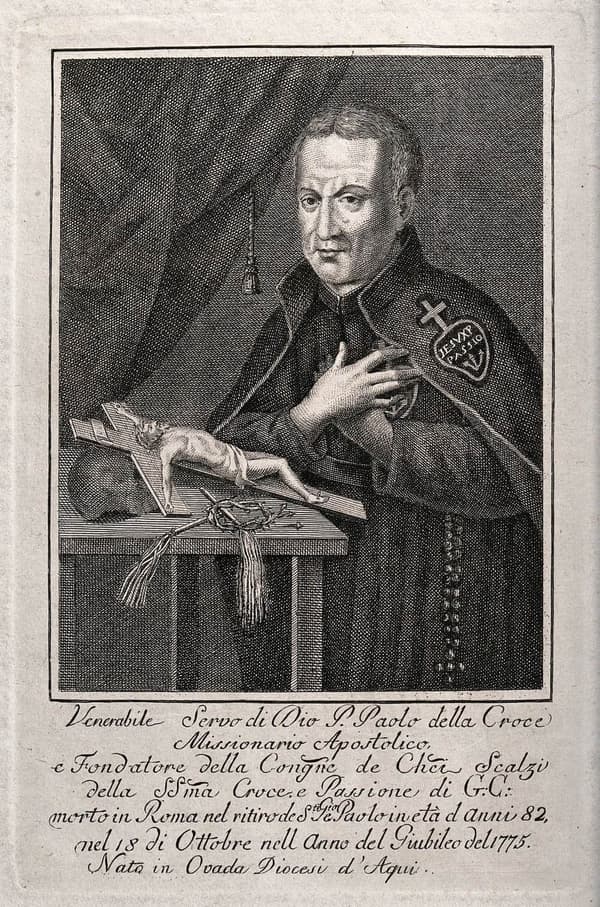 |
April 28: St. Paul of the Cross, Confessor
SPLENDIDLY adorned with the sacred sign of the Passion, Paul of the Cross comes to-day to pay homage to the Conqueror of Death. It behoved Christ to suffer and so enter into his glory. It behoves the Christian, the member of Christ, to follow his Head in suffering that he may share his triumph. Even as a child Paul penetrated deeply into the ineffable mystery of the suffering of a God. He was filled with an ardent love for the cross, and ran with giant strides along this royal road. He passed through the torrent, following his divine Head, he was buried with him in death, and has won a share in his Resurrection.
The diminution of truths among the children of men seemed to have dried up the fount of sanctity, when Italy, ever fruitful in her vivid faith, gave birth to the Christian hero, who stands out in the arid waste of the eighteenth century, like a saint of olden times. God never deserts his Church. He confronts a century of revolt and sensualism veiled under the name of philosophy with the Cross of his Son. A new Paul, recalling both in his name and his works the great Apostle of the Gentiles, rises in the midst of a generation intoxicated with pride and falsehood, to whom the Cross has become once more a folly and a scandal. This apostle was weak, poor, isolated and long misunderstood, but his heart was full of love and self-abnegation, and he sought to put to confusion the wisdom of sages and the prudence of prudent men. Clad in a coarse habit, with bare feet, his head crowned with thorns and a heavy cross on his shoulder, he journeyed through cities, claiming the attention of both the humble and the mighty, and desiring to know nothing but Jesus Crucified. The Cross made his zeal fruitful and showed itself to be indeed the power and the wisdom of God. Those who prided themselves on having banished the miraculous from history and the supernatural from the life of the people, might exult in their triumph, but, unknown to them, wonderful prodigies, countless miracles, were making whole peoples submissive to the voice of this man who, by completely destroying sin in his own person, had regained the power which Adam once had over nature, and seemed to possess in his mortal flesh the qualities of a glorified body.
But the apostolate of the Cross was not to end with Paul’s death. The resources of ancient times were no longer sufficient for a decrepit age. We are far from the days when the exquisite delicacy of Christian sentiment was strongly moved by the sight of the cross amid flowers, as it is seen in the paintings of the catacombs. Man’s senses have been dulled by unhealthy emotions, and there is need of a stimulant in the form of a constant representation of the tears, the Blood, and the gaping wounds of our divine Redeemer. Paul of the Cross received the mission to supply this need. At the cost of unspeakable sufferings he became the father of a new religious family, which adds to the three ordinary vows of religion a fourth vow—to propagate devotion to the sacred Passion of our Lord, the badge of which each Religious wears visibly on his breast.
We must not forget that the Passion of our Lord is for the Christian soul only a preparation for the great mystery of the Pasch, the glorious term of the manifestations of the Word, the supreme end of the elect, whose piety finds therein its completion and its crown. The Holy Spirit, who guides the Church throughout the admirable course of the liturgical cycle, has no other end in view for the souls who abandon themselves unreservedly to his sanctifying power. Paul's desire was to be nailed to the cross on Calvary, but he was often carried thence to the heights of heaven where he heard mysterious words such as it is not granted to man to utter.1 He assisted at the triumph of the Son of Man, who, after having lived on earth a mortal life and passed through death, is living now for ever and ever.2 He saw on the throne of God the Lamb standing as though slain, and giving light to the heavenly city,3 and this sublime vision of the realities of heaven inspired him with that divine enthusiasm, that intoxication of love, which, in spite of his terrifying austerities, gives an incomparable charm to his whole person. ‘Fear not,' he said to his children who were terrified by the furious attacks of the Devil, ' fear not, cry “Alleluia.” The devil is afraid of the Alleluia; it is a word that comes from Paradise.' He could not restrain his feelings when he saw nature born again with her Saviour in these days of spring, the flowers blossoming under the steps of his Risen Lord, the birds celebrating his victory in their harmonious songs. His heart was full to overflowing with love and poetry; he touched the flowers gently with his stick and upbraided them, saying: ‘Hold your peace, hold your peace.’ ‘To whom do these lands belong?’ he said one day to a companion, ‘to whom do these lands belong, I say? You do not understand. They belong to our great God.’ And his biographer relates that he was rapt in an ecstasy of love and carried some distance through the air. ‘Love God, my brethren,' he repeated to all those whom he met, ‘love God, who so well deserves our love. Do you not hear the very leaves on the trees telling you to love God? O love of God, love of God!'
We yield to the charm of a sanctity which is so sweet and yet so strong. It is a divine attraction, such as could never be exercised by the false spirituality, so much in vogue in the eighteenth century, even among the holiest. Under pretext of subduing man's evil nature and avoiding possible excesses, the new teachers allied themselves, though unwittingly, with Jansenism, checked the flight of the soul, disciplined it, remade it according to their own fashion, and confined it within the limits of certain rules which were supposed to lead all souls to perfection at the same rate. But saints are made by the divine Spirit, the spirit of love and holiness, to whose essence liberty belongs. He does not confine himself within the bounds of human methods. Our Lord says: ' The Spirit breatheth where he will . . . but thou knowest not whence he cometh and whither he goeth. So is every one that is bom of the Spirit.'4 The Holy Ghost chose Paul in his earliest infancy. He took possession of this child, so richly endowed by nature, destroyed nothing and sanctified everything. He formed him according to ancient models, always ardent, always attractive, and exceedingly holy. Such a one could never have been produced by a school whose over-correct methods wear the soul out by a barren and self-centred asceticism.
The Liturgy gives the following short account of St Paul of the Cross:
Romam profectus, theologicis disciplinis rite imbutus, a summo Pontifice Benedicto Decimo tertio ex obedientia sacerdotio auctus est. Facta sibi ab eodem potestate aggregandi socios, in solitudinem recessit Argentarii montis, quo eum beata Virgo jampridem invitaverat, veste illi simul ostensa atri coloris, Passionis Filli sui insignibus decorata, ibique fundamenta jecit novæ Congregationis. Quæ brevi, plurimis ab eo toleratis laboribus, præclaris aucta viris, cum Dei benedictione valde succrevit; a Sede Apostolica non semel confirmata una cum regulis, quas orando ipse a Deo acceperat, et quarto addito voto pergratam Dominicæ Passionis memoriam promovendi. Sacras Virgines quoque instituit, quæ excessum caritatis divini Sponsi sedulo meditarentur. Hæc inter, animarum inexhausta aviditate ab Evangelii prsedicatione numquam deficiens, homines pene innumeros etiam perditissimos aut in hæresim lapsos, in salutis tramitem adduxit. Præsertim Christi enarranda Passione, mirifica ejus prationis vis erat, qua una cum adstantibus in fletum effusus quælibet obdurata corda ad poenitentiam scindebat.
Thou hadst but one thought, O Paul. Hidden in those ‘clefts of the rock,’5 which are the sacred Wounds of the Saviour, thou wouldst bring all men to these divine fountains which quench the thirst of the true Israel in the desert of this life. Happy were they who could hear thy victorious word and save themselves by the Cross in the midst of a perverse generation. But in spite of thy apostolic zeal, thy voice could not make itself heard in all lands, and where thou wast absent evil was let loose upon the world. False science and mistaken piety, mistrust of Rome and the corruption of the great had prepared the way for the destruction of the old Christian social order, and the world was given over to teachers of lies. Thy prophetic gaze saw the abyss in which kings and peoples were soon to be engulfed. The successor of St Peter, unable to quell the storm which raged against the Church, sought by his efforts and sacrifices to hold back the floods, even for a time. Thou wert the friend of the Pontiffs and their support in those sad days, the witness of Christ suffering in his Vicar. What sorrows were confided to thee! And what must have been thy thoughts when at thy death thou didst bequeath the venerated image of the Mater Dolorosa to a Pontiff who was destined to drain the cup of bitterness and die a captive in a strange land! Thou didst promise to watch over the Church from thy throne in heaven with that tender compassion which identified thee on earth with her suffering Spouse. Keep this promise to-day, O Paxil! This age of social disintegration has neither made atonement for the sins of the past nor learnt wisdom from misfortune. The Church is the victim of oppression on all sides, the power is in the hands of her persecutors, and the Vicar of Christ is a prisoner in his palace and lives on alms. The Bride has no bed but the Cross of her Spouse, she lives on the memory of his sufferings. The Holy Spirit who guards her and is preparing her for the final summons, has raised thee up to keep her perpetually in mind of those sufferings which are to strengthen her in the trials of the last days.
Thy children all the world over are true to the spirit of their father and continue thy work on earth. They have gained a footing in England where thy prophetic gaze foresaw their labours, and this kingdom, for which thou didst pray so earnestly, is being gradually freed, through their influence, from the bonds of schism and heresy. Bless their apostolate. May they grow and be multiplied to meet the ever-increasing needs of these unhappy times! May their zeal ever continue to minister to the Church, and may the holiness of their lives ever redound to the glory of their father!
Thou, O Paul, wast faithful to thy crucified Master in his humiliation, and he has been faithful to thee in his triumphant Resurrection. In the hour of darkness thou didst live hidden in the clefts of the mysterious Rock. But what must be thy glory, now that Christ victorious ‘enlighteneth wonderfully from the everlasting hills’!6 Enlighten and perfect us, we beseech thee. We give thanks to God for thy triumph. Do thou in return help us to be faithful to the standard of the Cross, so that we, like thee, may be illuminated by its glory, when it appears in the clouds of heaven on the day of judgement.7 O Apostle of the Cross, initiate us into the mystery of the Pasch, which is so closely connected with that of Calvary. Only he who has shared the combat can comprehend the victory and have part in the triumph.
April 28 (the Same Day): St. Vitalis, Martyr
THERE are few martyrs of the West whose names are more celebrated than those of SS Gervasius and Protasius. The veneration in which they aie held by the Roman Church has led her to honour the memory of their father, who also won the palm under the persecution of Nero. She has chosen for his feast the glad season of Easter. The account given by the Liturgy of St Vitalis is short; but we can gather, from the few circumstances related, what fine characters these primitive Christians were who received the crown of martyrdom under the first of all the persecutions—the one that numbers among its choicest victims the two Apostles SS Peter and Paul.
Sin is the enemy of the soul; it throws her back again into that death whence Jesus had drawn her by his Resurrection. To preserve one of thy brethren from this misery, thou, O Vitalis, didst bravely raise a cry of zealous warning to him in the midst of his torments, and thy words awakened him to self-possession and courage. Show this same fraternal charity to us. We are living the life of our Risen Jesus; but the enemy is bent on robbing us of this life. He will seek to intimidate us; he will lay all manner of snares wherewith to deceive us; he will give us battle, and this untiringly. Pray then for us, O holy martyr, that we may be on our guard, and that the mystery of the Pasch may be fully accomplished within us, now and for ever!
Wednesday of the Fifth Week after Easter
WE now come to the fourth sacrament, which may be justly called the sacrament of mercy. Jesus knew the weakness of man. He knew that the great majority of Christians would not persevere in the grace they received at baptism; and that sin would in most cases spoil the beautiful plant which had been watered by the dew of heaven, and which, after growing and flowering, was to be transplanted into the garden of eternal life. Like grass that lies withered on the field, so would be this once fair plant. How could it ever revive, unless he that made it gave it life again? Thanks to his infinite mercy, this is what he has the will to do. Consulting the sinner's salvation rather than his own glory, he prepared, as the holy Fathers express it, a second plank after shipwreck. The first was baptism; but mortal sin came, and the soul was again plunged into the wild abyss. She had fallen once more into the hands of her enemy; she was fettered by chains which it was out of her power to break.
During his mortal life on earth, Jesus, who came not to judge the world, hut to save it,1 declared that these fetters, forged by the sinner’s malice, should be broken by a power which he would one day establish in his Church. Speaking to his Apostles, he told them that whatsoever they should loosen upon earth, should he loosed also in heaven.2 Since making that solemn promise, our Redeemer has offered his sacrifice on the Cross; his infinitely precious Blood has been shed for the superabundant expiation of the sins of the world. He that loved us to such a degree as this could never forget the promise he had made. On the contrary, he was most anxious to keep it, for he knew the fearful dangers to which our salvation is exposed. On the very day of his Resurrection, he appears to his Apostles, and his first words evince his eagerness to fulfil the promise he had previously made. It seems as though his mercy were impatient to break asunder the humiliating and terrible bonds of sin, which held us captives. No sooner has he breathed the Holy Ghost upon his Apostles, than he adds these words: Whose sins ye shall forgive, they are forgiven them.3 Observe here, as the holy Fathers have done, the strength of the words spoken by our Lord: They are forgiven. He says not, ‘they shall be forgiven;’ it is no longer the promise of a gift, but the gift itself. Before the Apostles have exercised the divine power conferred on them by Jesus, every absolution which they and their successors in this sacred ministry shall pronounce, even to the end of time, is already confirmed.
Glory, then, be to our Risen Jesus, who has removed the barriers of his justice, that his mercy might inundate the world! Let mankind unite and sing to him the sublime canticle of David, wherein, foreseeing the wondrous events that were to take place under the New Law, this royal psalmist prophesied the forgiveness of sins, which the Apostles were afterwards to teach us as an Article of our Creed.
Bless the Lord, O my soul! and let all that is within thee bless his holy Name. Who forgiveth all thine iniquities, who healeth all thy diseases, who redeemeth thy life from destruction.
Thy youth shall be renewed like the eagle's. The Lord is compassionate and merciful, long-suffering and plenteous in mercy. He will not always be angry. He hath not dealt with us according to our sins. As far as the east is from the west, so far hath he removed our iniquities from us.As a father hath compassion on his children, so hath the Lord compassion on them that fear him; for he knoweth our frame; he remembereth that we are dust. Man's days are as grass; as the flower of the field, so shall he flourish; for the spirit shall pass in him, and he shall not be, and he shall know his place no more. But the mercy of the Lord is from eternity and unto eternity upon them that fear him. O my soul! bless thou the Lord.4
And yet we, the children of the promise, know even better than David did the greatness of God’s mercy. Jesus was not content with giving us his assurance that if, after having sinned, we have recourse with humble repentance to the divine Majesty, we shall obtain pardon: as the sentence of God’s mercy would thus be without any outward sign, a cruel anxiety would have ever been upon us, leaving us in doubt of our forgiveness. Therefore did this loving Saviour ordain that men should give us pardon, in his name. That we might know that the Son of Man hath power on earth to forgive sins,5 he gave power to his delegates to pronounce over us a sentence of absolution which our very ears might hear, and which would convey to our souls the sweet confidence of pardon.
O ineffable sacrament, by whose means heaven is peopled by countless numbers who else had been lost, and who will for ever sing the mercies of the Lord!6 O irresistible power of the words of absolution, which, deriving their efficacy from the Blood of our Redeemer, take away all our iniquities, and plunge them into the abyss of divine mercy! The eternity of torments due to these iniquities would never have expiated them; and yet these few words of the priest: I absolve thee, have utterly annihilated them.
Such is the sacrament of penance. In return for the humble confession of our sins and the sincere sorrow for having committed them, we receive pardon, and this not once or twice only, but as often as we approach the sacred tribunal; not for this or that kind of sin only, but for every sin whatsoever. It is not to be wondered at that Satan should envy man this gift, and strive to throw such doubts and difficulties in the way as to prevent his profiting by it. What has not heresy said against this sacrament? It began by teaching that it takes from the glory of holy baptism; whereas on the contrary, it honours that first sacrament, by repairing the injuries done to it by sin. Later on, it exacted, as absolutely necessary for the sacraments, such perfect dispositions, that absolution would find the soul already reconciled with God. It was by this dangerous snare of Jansenism that so many were ruined, either by pride or by discouragement. And lastly, it has set up that Protestant dictum:’I confess my sins to God just as though God had not the right to lay down the conditions for pardon.
The sacraments being, as they are, such divine institutions, demand our faith; without faith they are simply impossibilities. Though this be true of all the seven, yet the sacrament of penance is especially welcome to a man of faith, because it so thoroughly humbles human pride. It sends man to ask of his fellow-man what God could have given directly himself. Jesus said to the lepers, whom he wished to cure: Go, show yourselves to the priests!7 Surely he has a right to act in the same manner when there is a question of spiritual leprosy.
Let us, as a homage to our generous Redeemer, offer him this Easter hymn; it is the one used by the Church in her Ferial Matins of Paschal Time.
Hymn
Rerum creator omnium,
Æqualis ante sæcula
Semper Parenti Filius.
Imaginem vultus tui
Tradens Adamo, nobilem
Limo jugasti spiritum.
Fædasset humanum genus,
Tu carne amictus perditam
Formam reformas artifex.
Nunc e sepulchro nasceris,
Tecumque nos a mortuis
Jubes sepultos surgere.
Aqua lavis baptismatis:
Hæc est lavacrum mentium,
Hæc est sepulcrum criminum.
Redemptor affixus cruci,
Nostræ dedisti prodigus
Pretium salutis sanguinem.
Paschale, Jesu, gaudium,
A morte dira criminum
Vitæ renatos libera.
Et Filio, qui a mortuis
Surrexit, ac Paraclito,
In sempiterna saecula.
Creator of all things!
Son co-equal with the Father,
before all ages!
thou gavest to Adam a resemblance to thine own divine Face;
and, to his body formed from slime,
thou joinedst a noble soul.
brought degradation upon mankind,
thou, our Maker, didst clothe thyself with flesh
and reform our lost race.
art now born from the sepulchre,
and biddest us rise with thee
from our death and burial.
who washest thy sheep in the waters of baptism:
it is the laver of our souls,
it is the grave of our sins.
upon the Cross that was due to us;
thou generously gavest us thy Blood,
as the ransom of our salvation.
Paschal joy to our hearts, free us,
who have been regenerated unto life,
from the dread death of sin.
and to the Son who rose
from the dead, and to the Paraclete,
for everlasting ages.
| Previous Tuesday of the Fifth Week after Easter | Next April 28 (the Same Day): St. Vitalis, Martyr |