Daily reading
Paschal Time
Double · April 29 · Sanctoral
April 29, 2027
From Dom Guéranger’s The Liturgical Year.
A Double leads the weekday.Rubric
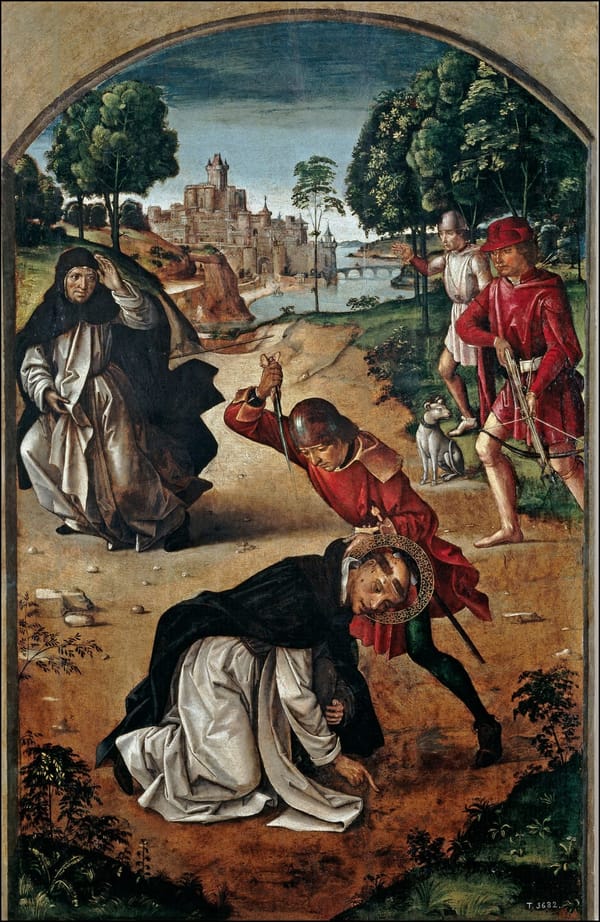 |
April 29: St. Peter, Martyr
THE hero deputed this day by the Church to greet our Risen Lord was so valiant in the good fight that martyrdom is part of his name. He is known as Peter the Martyr; so that we cannot speak of him without raising the echo of victory. He was put to death by heretics, and is the grand tribute paid to our Redeemer by the thirteenth century. Never was there a triumph hailed with greater enthusiasm than this. The martyrdom of St Thomas of Canterbury excited the admiration of the faithful of the preceding century, for nothing was so dear to our forefathers as the liberty of the Church; the martyrdom of St Peter was celebrated with a like intensity of praise and joy. Let us hearken to the fervid eloquence of the great Pontiff, Innocent IV, who thus begins the Bull of the martyr's canonization: ‘The truth of the Christian faith, manifested, as it has been, by great and frequent miracles, is now beautified by the new merit of a new Saint. Lo! a combatant of these our own times comes, bringing us new and great and triumphant signs. The voice of his blood shed (for Christ) is heard, and the fame of his martyrdom is trumpeted, through the world. The land is not silent that sweateth with his blood; the country that produced so noble a warrior resounds with his praise; yea, the very sword that did the deed of parricide proclaims his glory. . . . Mother Church has great reason to rejoice, and abundant matter for gladness; she has cause to sing a new canticle to the Lord, and a hymn of fervent praise to her God; . . . the Christian people has cause to give forth devout songs to its Creator. A sweet fruit, gathered in the garden of faith, has been set upon the table of the eternal King: a grape-bunch taken from the vineyard of the Church has filled the royal cup with new wine. . . . The flourishing Order of Preachers has produced a red rose, whose sweetness is most grateful to the King; and from the Church here on earth there has been taken a stone, which, after being cut and polished, has deserved a place of honour in the temple of heaven.'1
Such was the language wherewith the supreme Pontiff spoke of the new martyr, and the people responded by celebrating his feast with extraordinary devotion. It was kept as were the ancient festivals, that is, all servile work was forbidden upon it. The churches served by the Fathers of the Dominican Order were crowded on his feast; and the faithful took little branches with them, that they might be blessed in memory of the triumph of Peter the Martyr. This custom is still observed; and the branches blessed by the Dominicans on this day are venerated as being a protection to the houses where they are kept.
How are we to account for all this fervent devotion of the people towards St Peter? It was because he died in defence of the faith; and nothing was so dear to the Christians of those days as faith: Peter had received the charge to seize all the heretics who at that time were causing great disturbance and scandal in the country round about Milan. They were called Cathari, but in reality were Manicheans; their teachings were detestable, and their lives most immoral. Peter fulfilled his duty with a firmness and equity which soon secured him the hatred of the heretics; and when he fell a victim to his holy courage, a cry of admiration and gratitude was heard throughout Christendom. Nothing could be more devoid of truth than the accusations brought by the enemies of the Church and their indiscreet abettors against the measures formerly decreed by the public law of Catholic nations, in order to foil the efforts made by evil-minded men to injure the true faith. In those times, no tribunal was so popular as that whose office it was to protect the faith, and to put down all them that attacked it. It was to the Order of St Dominic that this office was mainly entrusted; and well may they be proud of the honour of having so long held one so beneficial to the salvation of mankind. How many of its members have met with a glorious death in the exercise of their stem duty! St Peter is the first of the martyrs given by the Order for this, holy cause: his name, however, heads a long list of others who were his brethren in religion, his successors in the defence of the faith, and his followers to martyrdom. The coercive measures that were once, and successfully, used to defend the faithful from heretical teachers have long since ceased to be used: but for us Catholics, our judgement of them must surely be that of the Church. She bids us to-day honour as a martyr one of her Saints, who was put to death whilst resisting the wolves that threatened the sheep of Christ’s fold; should we not be guilty of disrespect to our Mother if we dared to condemn what she so highly approves? Far, then, be from us that cowardly truckling to the spirit of the age, which would make us ashamed of the courageous efforts made by our forefathers for the preservation of the faith! Far from us that childish readiness to believe the calumnies of Protestants against an institution which they naturally detest! Far from us that deplorable confusion of ideas which puts truth and error on an equality, and, from the fact that error can have no rights, concludes that truth can claim none!
The following is the account given us by the Church of the virtues and heroism of St Peter the Martyr:
The following Antiphons and Responsory are taken from the Dominican Breviary:
The victory was thine, O Peter! and thy zeal for the defence of our holy faith was rewarded. Thou didst ardently desire to shed thy blood for the holiest of causes, and by such a sacrifice to confirm the faithful of Christ in their religion. Our Lord satisfied thy desire; he would even have thy martyrdom be in the festive season of the Resurrection of our divine Lamb, that his glory might add lustre to the beauty of thy holocaust. When the death-blow fell upon thy venerable head, and thy generous blood was flowing from the wounds, thou didst write on the ground the first words of the creed, for whose holy truth thou wast giving thy life.
Protector of the Christian people! what other motive hadst thou, in all thy labours, but charity? What else but a desire to defend the weak from danger induced thee not only to preach against error, but to drive its teachers from the flock? How many simple souls, who were receiving divine truth from the teaching of the Church, have been deceived by the lying sophistry of heretical doctrine, and have lost the faith? Surely the Church would do her utmost to ward off such dangers from her children; she would do all she could to defend them from enemies, who were bent on destroying the glorious inheritance which had been handed down to them by millions of martyrs! She knew the strange tendency that often exists in the heart of fallen man to love error; whereas truth, though of itself unchanging, is not sure of its remaining firmly in the mind, unless it be defended by learning or by faith. As to learning, there are but few who possess it; and as to faith, error is ever conspiring against it, and, of course, with the appearance of truth. In the Christian ages it would have been deemed not only criminal, but absurd, to grant to error the liberty which is due only to truth; and they that were in authority considered it a duty to keep the weak from danger, by removing from them all occasions of a fall; just as the father of a family keeps his children from coming in contact with wicked companions who could easily impose on their inexperience, and lead them to evil under the name of good.
Obtain for us, O holy martyr, a keen appreciation of the precious gift of faith—that element which keeps us in the way of salvation. May we zealously do everything that lies in our power to preserve it, both in ourselves and in them that are under our care. The love of this holy faith has grown cold in so many hearts; and frequent intercourse with heretics or free-thinkers has made them think and speak of matters of faith in a very loose way. Pray for them, O Peter, that they may recover that fearless love of the truths of religion which should be one of the chief traits of the Christian character. If they be living in a country where the modem system is introduced of treating all religions alike—that is, of giving equal rights to error and to truth—let them be all the more courageous in professing the truth, and detesting the errors opposed to the truth. Pray for us, O holy martyr, that there may be enkindled within us an ardent love of that faith without which it is impossible to please God.2 Pray that we may become all earnestness in this duty, which is of vital importance to salvation; that thus our faith may daily gain strength within us, till at length we shall merit to see in heaven what we have believed unhesitatingly on earth.
Thursday of the Fifth Week after Easter
BY the first four sacraments, our Saviour provided for the several spiritual necessities of man during this mortal life. Baptism gives him spiritual birth, Confirmation arms him for the battle, the Eucharist is his food, Penance is his cure. But the last moment of life—that most important and terrible of all, on which depends eternity—does it not seem to require a special sacramental aid? Could it be that our Redeemer, after so lovingly supplying us with a sacrament to meet our other wants, would leave us unprovided when we are dying, that is, when we are passing from this to another life, and are weighed down with bodily and mental sufferings? No: he has provided a sacrament for the dying; the grace of redemption puts on a new form, that it may visit and fortify us in our last struggle.
Even before his Passion, he gave us some idea of the sacrament he intended to institute for the help of the dying. When he sent his disciples before him, that they might prepare the people for his preaching, he commanded them to anoint the sick with oil: they did so, and the result was the cure of them that were thus anointed.1 But after his Resurrection, when our Redeemer was preparing the dowry of his Church, he gave her a sacrament wherewith this Mother was to administer special grace and consolation to her children when in danger of death.
Oil is the symbol of strength; hence, the wrestlers of old used it as a means for acquiring activity and nerve. Our Saviour chose it as the matter of the sacrament of confirmation, whereby our souls, after being regenerated by baptism, are strengthened for their future combats. The hour of death is a combat, but one so terrible that it stands apart by itself. It is then that Satan, seeing how the long-coveted prey is soon to be beyond his reach, redoubles his efforts to make it his own for ever. The dying Christian, standing as he does on the brink of eternity, is exposed to two temptations: presumption and despair. In a few moments he will be before the Judge, whose sentence is irrevocable. The remnants of sin are still upon him, and clog his soul. How will he comport himself in that last combat, on which depends the final success of all the previous ones of his life? Is not this an occasion for a special sacrament, whereby our Jesus may provide his combatant with the help so urgently needed? Yes; and here again it is oil. The first anointing was that of confirmation, and it gave strength; and the last, or as it is called, extreme unction, is equally rich in power: it is the last application made to mankind of the Redeemer’s blood,’which flows in such abundance with this holy oil.’2
Let us consider the effects of extreme unction, of which the Apostle St James speaks to us in his Epistle. What he there tells us, he had received from Jesus’ own lips. First of all, this sacrament brings forgiveness of sins;3 forgiveness of those sins which the conscience, however diligent it may have been in its examination, had overlooked; but which, nevertheless, injure the soul: and forgiveness of those remnants of sin, which continue after the guilt of sin has been remitted; like wounds which, though cured, are not quite closed, and keep the patient weak. The holy oil anoints each of the senses; each has been the source of sin; each now receives its special purification. These doors, which up to this moment had been open to the world, are now closed; so that the soul can be all intent upon eternal things. Let the enemy come now, if he will; his attacks can do no harm. He expected to find his adversary the poor earthly-minded creature of old, on whom he had inflicted hundreds of wounds; but lo! he finds a soldier of Christ, vigorous and brave. It is extreme unction that has worked the change.
But the effects of this sacrament do not stop here. Though primarily instituted for imparting strength to the soul, yet it has the power of restoring health to the body too. We learn this from the Apostle St James. His words are these: Is any man sick among you? Let him bring in the priests of the Church, and let them pray over him, anointing him with oil in the name of the Lord. And the prayer of faith shall save the sick man, and the Lord shall raise him up.4 The sacred formula, which accompanies each anointing in this sacrament, has therefore the power of restoring bodily health, at the same time that it drives away the remnants of sin, which is the chief cause of all man's miseries, whether of soul or body. Such is the interpretation put by the Church on the words of St James; and we have continual proofs that our divine Master has not forgotten the promise of twofold efficacy which he gave to this sacrament. Hence it is, that after having anointed the several senses of the sick person, the priest addresses God in earnest prayer, that he would restore strength of body to him or her whose soul has received the efficacy of the heavenly remedy. Nay, the Church looks upon the restoration to bodily health as so truly a sacramental effect of extreme unction, that she does not consider as miracles, properly so called, the cures produced by its administration.
Let us, then, offer to the conqueror of death the homage of our thanks for this fresh proof of his compassionate love. He would himself experience all our miseries, not excepting even death or the agony that precedes it. When on his Cross, and enduring every anguish, as though he were a poor dying sinner, and not the Saint of saints, he thought of our deaths, and mercifully blessed our last agony with an outpouring of his precious Blood. This was the origin of the beautiful sacrament of extreme unction, which he gave to his Church, after his Resurrection, and for which we offer him to-day our humble thanks.
The following hymn—composed by St Ambrose, and used during Paschal Time in the Church of Milan—celebrates with the Saint's characteristic vigour of style the thoroughness of the salvation wrought by the Death of Christ, as was made evident in the conversion of the Good Thief.
Hymn
Sanctus sereno lumine,
Quo diluit sanguis sacer
Probrosa mundi crimina.
Cæcosque visu illuminans:
Quem non gravi solvet metu
Latronis absolutio?
Jesum brevi acquirit fide,
Justusque praevio gradu
Pervenit in regnum Dei.
Pænam videntes corporis,
Christoque adhaerentem reum
Vitam beatam carpere.
Ut abluat mundi luem,
Peccata tollit omnium,
Camis vitia mundans caro.
Ut culpa quærat gratiam,
Metumque solvat charitas,
Reddatque mors vitam novam?
Suisque se nodis liget:
Moriatur vita omnium,
Resurgat ut vita omnium.
Omnes resurgunt mortui:
Consumpta mors ictu suo
Perisse se solam gemit.
Qui surrexisti a mortuis,
Cum Patre et Sancto Spiritu,
In sempiterna sæcula.
holy with its unclouded light,
whereon the sacred Blood washed away
the world’s infamous crimes.
it gives sight to the blind.
Oh! who would not cease to despair at the thought
of the pardon granted to the Thief?
he gained Jesus by a brief act of faith;
and, being justified, was the first
to enter into the kingdom of God.
they behold the criminal suffering bodily tortures,
yet united with Christ, and culling
the flower of life everlasting.
Jesus takes upon himself the sins of the world,
that he may cleanse it from its filth:
Flesh washes away the sins of flesh.
—sin seeking for grace,
love expelling fear,
and death giving a new life.
let him be caught in his own net!
Let him but die, who is the Life of all,
and all will rise to life.
and all the dead rise again to life:
death’s blow falls on himself,
and none die but he.
who didst rise again from the dead!
and to the Father, and to the Holy Ghost,
for everlasting ages.
| Previous Wednesday of the Fifth Week after Easter | Next Thursday of the Fifth Week after Easter |