Daily reading
Paschal Time
Double · April 30 · Sanctoral
April 30, 2027
From Dom Guéranger’s The Liturgical Year.
A Double leads the weekday.Rubric
 |
April 30: St. Catherine of Siena, Virgin
THE Dominican Order, which yesterday presented a rose to our Risen Jesus, now offers him a lily of surpassing beauty. Catharine of Siena follows Peter the Martyr: it is a coincidence willed by Providence, to give fresh beauty to this season of grandest mysteries. Our divine King deserves everything we can offer him; and our hearts are never so eager to give him every possible tribute of homage as during these last days of his sojourn among us. See how nature is all flower and fragrance at this loveliest of her seasons! The spiritual world harmonizes with the visible, and now yields her noblest and richest works in honour of our Lord, the author of grace.
How grand is the Saint whose feast comes to gladden us to-day! She is one of the most favoured of the holy Spouses of the Incarnate Word. She was his, wholly and unreservedly, almost from her very childhood. Though thus consecrated to him by the vow of holy virginity, she had a mission given to her by divine Providence which required her living in the world. But God would have her to be one of the glories of the religious state; he therefore inspired her to join the Third Order of St Dominic. Accordingly, she wore the habit, and fervently practised during her whole life the holy exercises of a Tertiary.
From the very commencement, there was something heavenly about this admirable servant of God, which we fancy existing in an angel who had been sent from heaven to live in a human body. Her longing after God gave one an idea of the vehemence wherewith the blessed embrace the Sovereign Good on their first entrance into heaven. In vain did the body threaten to impede the soaring of this earthly seraph; she subdued it by penance, and made it obedient to the spirit. Her body seemed to be transformed, so as to have no life of its own, but only that of the soul. The Blessed Sacrament was frequently the only food she took for weeks together. So complete was her union with Christ that she received the impress of the sacred stigmata, and with them the most excruciating pain.
And yet in the midst of all these supernatural favours, Catharine felt the keenest interest in the necessities of others. Her zeal for their spiritual advantage was intense, whilst her compassion for them in their corporal sufferings was that of a most loving mother. God had given her the gift of miracles, and she was lavish in using it for the benefit of her fellow-creatures. Sickness and death itself were obedient to her command; and the prodigies witnessed at the beginning of the Church were again wrought by the humble Saint of Siena.
Her communings with God began when she was quite a child, and her ecstasies were almost without interruption. She frequently saw our Risen Jesus, who never left her without having honoured her either with a great consolation or with a heavy cross. A profound knowledge of the mysteries of our holy faith was another of the extraordinary graces bestowed upon her. So eminent indeed was the heavenly wisdom granted her by God that she, who had received no education, used to dictate the most sublime writings, wherein she treats of spiritual things with a clearness and eloquence to which human genius could never attain, and with a certain indescribable unction which no reader can resist.
But God would not permit such a treasure as this to lie buried in a little town of Italy. The Saints are the supports of the Church; and though their influence be generally hidden, yet at times it is open and visible, and men then learn what are the instruments which God uses for imparting blessings to a world that would seem to deserve little else besides chastisement. The great question, at the close of the fourteenth century, was the restoration to the Holy City of the privilege of having within its walls the Vicar of Christ, who for sixty years had been absent from his see. One saintly soul, by merits and prayers, known to heaven alone, might have brought about this happy event after which the whole Church was longing; but God would have it done by a visible agency, and in the most public manner. In the name of the widowed Rome—in the name of her own and the Church's Spouse—Catharine crossed the Alps, and sought an interview with the Pontiff, who had not so much as seen Rome. The prophetess respectfully reminded him of his duty; and in proof of her mission being from God, she told him of a secret which was known to himself alone. Gregory XI could no longer resist; and the Eternal City welcomed its Pastor and Father. But at the Pontiff's death, a frightful schism, the forerunner of greater evils to follow, broke out in the Church. Catharine, even to her last hour, was untiring in her endeavours to quell the storm. Having lived the same number of years as our Saviour had done, she breathed forth her most pure soul into the hands of her God, and went to continue in heaven her ministry of intercession for the Church she had loved so much on earth, and for souls redeemed in the precious Blood of her divine Spouse.
Our Risen Jesus, who took her to her eternal reward during the season of Easter, granted her whilst she was living on earth a favour which we mention here as being appropriate to the mystery we are now celebrating. He one day appeared to her, having with him his blessed Mother. Mary Magdalen—she that announced the Resurrection to the Apostles—accompanied the Son and the Mother. Catharine's heart was overpowered with emotion at this visit. After looking for some time upon Jesus and his holy Mother, her eyes rested on Magdalen, whose happiness she both saw and envied. Jesus spoke these words to her: ‘My beloved! I give her to thee, to be thy mother. Address thyself to her, henceforth, with all confidence. I give her special charge of thee.' From that day forward, Catharine had the most filial love for Magdalen, and called her by no other name than that of mother.
Let us now read the beautiful, but too brief, account of our Saint’s life, as given in the Liturgy.
Her learning was not acquired, but infused. Theologians proposed to her the most difficult questions of divinity, and received satisfactory answers. No one ever approached her, who did not go away a better man. She reconciled many that were at deadly enmity with one another. She visited Pope Gregory the Eleventh, who was then at Avignon, in order to bring about the reconciliation of the Florentines, who were under an interdict on account of their having formed a league against the Holy See. She told the Pontiff that there had been revealed to her the vow which he, Gregory, had made of going to Rome a vow which was known to God alone. It was through her entreaty that the Pope began to plan measures for taking possession of his See of Rome, which he did soon after. Such was the esteem in which she was held by Gregory, and by Urban the Sixth, his successor, that she was sent by them on several embassies. At length, after a life spent in the exercise of the sublimest virtues, and after gaining great reputation on account of her prophecies and many miracles, she passed hence to her divine Spouse, when she was about the age of three and thirty. She was canonized by Pius the Second.
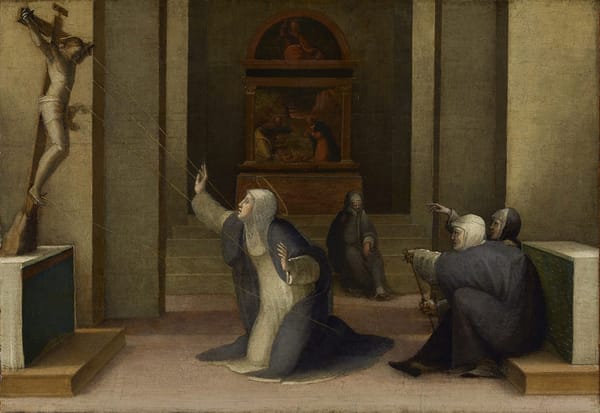
Being once at Pisa, on a Sunday, and having received the Bread of heaven, she was rapt in an ecstasy. She saw our crucified Lord approaching her. He was encircled with a great light, and from his five Wounds there came rays, which fell upon the five corresponding parts of Catharine's body. Being aware of the favour bestowed upon her, she besought our Lord that the stigmata might not be visible. The rays immediately changed from the colour of blood into that of gold, and passed, under the form of a bright light, to the hands, feet and heart of the Saint. So violent was the pain left by the wounds, that it seemed to her as though she must soon have died, had not God diminished it. Thus our most loving Lord added favour to favour, by permitting her to feel the smart of the wounds, and yet removing their appearance. The servant of God related what had happened to her to Raymund, her confessor. Hence, when the devotion of the faithful gave a representation of this miracle, they painted, on the pictures of St Catharine, bright rays coming from the five stigmata she received.***Her learning was not acquired, but infused. Theologians proposed to her the most difficult questions of divinity, and received satisfactory answers. No one ever approached her, who did not go away a better man. She reconciled many that were at deadly enmity with one another. She visited Pope Gregory the Eleventh, who was then at Avignon, in order to bring about the reconciliation of the Florentines, who were under an interdict on account of their having formed a league against the Holy See. She told the Pontiff that there had been revealed to her the vow which he, Gregory, had made of going to Rome a vow which was known to God alone. It was through her entreaty that the Pope began to plan measures for taking possession of his See of Rome, which he did soon after. Such was the esteem in which she was held by Gregory, and by Urban the Sixth, his successor, that she was sent by them on several embassies. At length, after a life spent in the exercise of the sublimest virtues, and after gaining great reputation on account of her prophecies and many miracles, she passed hence to her divine Spouse, when she was about the age of three and thirty. She was canonized by Pius the Second.
Pope Pius II, one of the glories of Siena, composed the two following hymns in honour of his saintly and illustrious fellow-citizen. They form part of the Office of St Catharine of Siena in the Dominican Breviary.
Hymn
Pope Pius II, one of the glories of Siena, composed the two following hymns in honour of his saintly and illustrious fellow-citizen. They form part of the Office of St Catharine of Siena in the Dominican Breviary.
Hymn
Quæ tu is læti, Catharina, sacris,
Hoc quidem pacto modulamur omnes,
Perfer Olympo.
Annuas nobis veniam, praecamur:
Non sumus tanti ingenii, fatemur,
Optima virgo.
Virginis laudes Quis in orbe toto
Fœminæ invictæ peritura numquam
Carmina pandet?
Moribus praestans, sapiens abunde;
Temperans, fortis, pia, justa, prudens,
Æthera scandis.
Quo nequit dici sanctius per orbem?
Vulnerum formam miserata Christi,
Exprimis ipsa.
Et malis cunctis penitus refertæ,
Fortiter spernens pretiosa quæque,
Sidera adisti.
Filio magni Genitoris almo,
Spiritum Sanctum veneremur, et sit
Laus tamen una.
these canticles of praise, which we,
gladdened by thy feast,
sing thus in thine honour.
pardon us, we beseech thee.
Nay, we own, O glorious Saint!
that we are not equal to the task we have undertaken.
Is there, in the wide world, a poet that could write an ode
immortal enough for this heroine,
whom no enemy could vanquish?
thou wast rich in virtue and wisdom;
and with the riches of thy temperance, fortitude,
piety, justice and prudence, thou didst ascend into heaven.
which were never surpassed in this world?
Thy compassion for the sufferings of Christ
stamped thee with the impress of his wounds.
of this short, mournful, and miserable life,
which abounds with every evil,
thou didst mount to heaven.
to the Son ever blessed of the Eternal Father!
let us give glory to the Holy Ghost!
to the Three, one equal praise!
Hymn
Jure censeris, quoniam triumphos
Ipsa cœlorum, probitate mira,
Nacta refulges.
Et simul munus probitatis almæ
Accipis cœlo, cumulata cunctis
Denique rebus.
Orbis exemplar, pietate plenum
Praedicatorum venerata Patrem,
Ordine fulges.
Nullus omatus, nitor ecce nullus
Corporis, semper fugiens iniqua
Crimina vitæ.
Quam pie flagris cruor hinc et inde
Fluxerat rivis! hominumque demum
Crimina flebas.
Orbe terrarum cruciantur omnes:
Quotque vel curis agitantur ipsi
Undique diris.
Si tuæ laudes repetantur omnes:
Tu quidem longe pietate cunctis
Inclyta præstas.
Et duces iras posuere sævas:
Hi necem diram populo minata
Sæpe Senensi.
Viribus summis operam dedisti:
Litteræ doctæ, lepidæque
Claris Urbibus exstant.
Niteris rectum suadere cunctis:
Sic ais: Tan tum probitas beatos
Efficit omnes.
Fortiter temnens, nihil extimescens,
Præmium nostræ vocitare vitæ
Sæpe solebas.
Quo sacros artus cineresque busto
Linqueres, cœlos aditura flentes
Ipsa docebas.
Hostiam libans, lacrymis obortis,
Dixeras cunctis documenta vitæ,
Voce suprema.
Filio magni Genitoris almo
Spiritum Sanctum veneremur, et sit
Laus tamen una.
thy praise, O Catharine!
for, by thy wondrous virtues, thou hast received
a triumphant welcome from heaven itself.
where thou art enriched with all good things,
that thou hast received the reward of thy holy life,
and the recompense of thy grand virtue.
that perfect model of every virtue;
thou didst enter his Order
and art one of its brightest glories.
none had charms for thee.
Thou couldst not brook sin,
the injustice offered to God by his creature.
and to atone for the sins of men,
oft didst thou severely scourge thyself till thine innocent blood
would flow in streams on the ground.
no matter where they might be, or what their misfortune.
Thy sympathy was ever ready for them, too,
that were a prey to care.
were we to tell all thy praises, O Catharine!
whose sanctity far surpassed
that of other mortals.
who were threatening
the people of Siena with death,
withdrew at thy word.
to the study of sacred things:
and thy letters, teeming with wisdom and elegance,
are still treasured in some of our richest cities.
and persuading all to follow what was right.
Thus didst thou speak to them:
'Virtue alone can make man happy.'
for the dread claims of death,
which thou wast wont to call
the recompense of life.
to leave thy sacred body to the tomb,
and ascend into heaven, thou gavest lessons of consolation
to them that stood weeping around thee.
and received amidst abundant tears of devotion the saving Host,
thou gavest thy last instructions
to all how to lead a holy life.
to the Son ever blessed of the Eternal Father!
let us give glory to the Holy Ghost!
to the Three, one equal praise!
Holy Church, filled as she now is with the joy of her Jesus’ Resurrection, addresses herself to thee, O Catharine, who followest the Lamb whithersoever he goeth1 Living in this exile, where it is only at intervals that she enjoys his presence, she says to thee: Hast thou seen him whom my soul loveth?2 Thou art his Spouse; so is she: but there are no evils, no separation, for thee; whereas for her, the enjoyment is at rare and brief periods, and, even so there are clouds that dim the lovely light. What a life was thine, O Catharine! uniting in itself the keenest compassion for the sufferings of Jesus, and an intense happiness by the share he gave thee of his glorified life. We might take thee as our guide both to the mournful mysteries of Calvary, and to the glad splendours of the Resurrection. It is these latter that we are now respectfully celebrating: oh! speak to us of our Risen Jesus. Is it not he that gave thee the nuptial ring, with its matchless diamond set amidst four precious gems? The bright rays which gleam from thy stigmata tell us that when he espoused thee to himself thou sawest him all resplendent with the beauty of his glorious Wounds. Daughter of Magdalen! like her, thou art a messenger of the Resurrection; and when thy last Pasch comes—the Pasch of thy thirty-third year—thou takest thy way to heaven, to keep it for eternity. O zealous lover of souls! love them more than ever, now that thou art in the palace of the King, our God. We too are in the Pasch, in the new life; intercede for us, that the life of Jesus may never die within us, but that we may strengthen its power by loving him with an ardour like thine own.
Obtain for us, great Saint, something of the filial devotedness for holy Mother Church which prompted thee to do such glorious things! Her sorrows and her joys were thine; for there can be no love for Jesus where there is none for his Spouse: and is it not through her that he gives us all his gifts? Oh, yes! we too wish to love this mother of ours; we will never be ashamed to own ourselves as her children! we will defend her against her enemes; we will do everything that lies in our power to win others to acknowledge, love, and be devoted to her.
Our God used thee as his instrument, O humble virgin, for bringing back the Roman Pontiff to his See. Thou wast stronger than the powers of this earth, which would fain have prolonged an absence disastrous to the Church. The relics of Peter in the Vatican, of Paul on the Ostian Way, of Lawrence and Sebastian, of Cecily and Agnes, exulted in their glorious tombs when Gregory entered with triumph into the Holy City. It was through thee, O Catharine, that a ruinous captivity of seventy years’ duration was brought on that day to a close, and that Rome recovered her glory and her life. In these our days, hell has changed its plan of destruction! men have deprived its Pontiff-King of the city which was chosen by Peter as the See where the Vicar of Christ should reign to the end of the world. Is this design of God, this design which was so dear to thee, O Catharine!—is it now to be frustrated? Oh! beseech him to end this sacrilege speedily. Come to our aid!—and though thy divine Spouse, in his just anger, permits us to suffer these humiliations, pray that at least they may be shortened.
Pray, too, for unhappy Italy, which was so dear to thee, and which is so justly proud of its Saint of Siena. Impiety and heresy are now permitted to run wild through the land; the name of thy Spouse is blasphemed; the people are taught to love error, and to hate what they had hitherto venerated; the Church is insulted and robbed; faith has long since been weakened, but now its very existence is imperilled. Intercede for thy unfortunate country, dear Saint! oh! surely, it is time to come to her assistance, and rescue her from the hands of her enemies. The whole Church hopes that thou mayest effect the deliverance of this her illustrious province: delay not, but calm the storm which seems to threaten a universal wreck!
Friday of the Fifth Week after Easter
WE have reverently followed our Redeemer in his institution of the sacramental helps, whereby man is placed and kept in the state of sanctifying grace, from his first entrance into this life to his leaving it for the eternal enjoyment of the beatific vision. We must now speak of that sublime sacrament, which was instituted by Jesus as the source whence mankind is to receive the other sacraments.
This sacrament is Holy Orders, and it is so called because of its being conferred in several distinct degrees upon those who receive it. As in heaven the angels are arranged in different ranks according as they have been endowed with a greater or less degree of light and power, in such wise that they who are higher act upon those that are lower; so it is in the sacrament of Holy Orders; there is order in the several ranks, and the higher act upon the lower by the communication of light and power. It is this that constitutes the hierarchy of the Church. Hierarchy means Sacred Government. It comprises three degrees: the episcopate, priesthood, and diaconate, in which last are included the Orders below it. This is called the hierarchy of Order, to distinguish it from the hierarchy of Jurisdiction. This second, which is entrusted with the government of the Church, is composed of the Pope, of the bishops, and of the inferior clergy to whom the Pope and bishops delegate a part of their power of government. We have already seen how this hierarchy takes its origin from that sovereign act whereby our Lord Jesus, the shepherd of men, gave to Peter the keys of the kingdom of God. The hierarchy of Order is intimately connected with the second, and its object is the sanctification of men by the administration of the treasures of grace confided to its keeping.
As we have already said, Jesus appeared to his Apostles on the day of his Resurrection, and said to them: As the Father hath sent me, I also send you.1 Now the Father sent his Son that he might be the Shepherd of men; and we have heard Jesus bidding Peter to feed his lambs and his sheep. The Father sent his Son that he might be the Teacher of men; and we have seen Jesus entrusting to his Apostles the truths which were to be proposed to us as the object of our faith. But the Father sent the Son that he might also be the High Priest of men; Jesus must, therefore, leave this same priesthood on earth, that it may be continued among us to the end of time. Now what is a priest? He is the mediator between heaven and earth; he reconciles man to his God, by offering a sacrifice that gives infinite honour to God and atones for man's sin; he cleanses the sinner's conscience, and makes him a just man; he, in a word, unites man to his God by the mysteries of which he is the dispenser.
Jesus exercised all these functions of a priest agreeably to the mission given him by the Father; but the Father would have them to be continued, even after his Son should have ascended into heaven. For this it was necessary that Jesus should communicate his priestly character, by a special sacrament, to a few chosen men, just as by baptism he conferred upon all his faithful the dignity of being his members. Here again, it will be the Holy Ghost that will act, in each stage or degree of the sacrament. It was by his divine operation that the Incarnate Word entered into Mary's womb; it is his action that will imprint on the souls of them that are presented the priestly character of this same Jesus our Lord. Hence, after using the words just cited, Jesus breathed on his Apostles, and said to them: Receive ye the Holy Ghost! hereby showing that it is by a special infusion of him who is the Spirit of the Father and the Son, that men are fitted for being sent by the Son, as the Son was sent by the Father.
And yet the Apostles and their successors are to confer this sacrament, not by a breath—that is the prerogative of the Word, the author of life—but by the imposition of hands. It is at the solemn moment of the imposition of the bishop's hands over them who are to be ordained, that the Holy Ghost comes down upon them. Thus will be transmitted the heavenly gift from generation to generation. It will be conferred in its several degrees, according to the will of the hierarch, by and with whom the Holy Ghost acts. So that when Jesus comes on the last day to judge the world, he will find on earth the sacred character which he conferred upon his Apostles when he gave them the Holy Ghost.
Let us attentively and devoutly contemplate the mystic ladder of the hierarchy, established by our Jesus, whereby we might ascend to heaven. At the very summit is the bishop, having in himself the plenitude of Holy Orders and the power to produce other pontiffs, and priests, and deacons. He has the power of offering up the Holy Sacrifice; he holds the keys whereof our Lord speaks, when he says: Whatsoever ye shall bind upon earth, shall be bound also in heaven; and whatsoever ye shall loose upon earth, shall be loosed also in heaven;2 he can administer all the sacraments; the consecration of the Chrism and Holy Oils belongs to his office; he can not only bless, he can also consecrate.
Next comes the priest, who truly looks upon the bishop as his spiritual father, seeing that it was by the imposition of the bishop’s hands that he received the dignity and character of priesthood. The priest, however, does not possess the plenitude of Jesus’ priesthood. His hands, though most holy, have not the power to produce other priests; he blesses, but he does not consecrate;3 he must look to the bishop for holy Chrism, for he himself cannot make it. Notwithstanding this, his dignity is great, for he has power to offer the Holy Sacrifice, and his offering is the same as that of the bishop. He forgives the sins of those whom the bishop has put under his care. The solemn administration of baptism is entrusted to him, when the bishop himself does not perform it: and as to extreme unction, it is essentially a priest’s function.
The next lower order is that of deacon, who is, as the Greek name implies, the servant of the priest. Not having the priesthood, he cannot offer sacrifice, nor remit sins, nor give extreme unction to the dying: but he assists and serves the priest at the Altar, and stands by his side during the solemn moment of consecration. He reads the holy Gospel, from the ambo, to the people. The Blessed Sacrament is entrusted to his care, and, failing a priest, he is allowed to distribute it to the faithful. In similar circumstances, he could solemnly administer baptism. He has also the power of preaching the word of God to the people.
These are the three degrees of the hierarchy of Order. They correspond, as the great St Denis teaches, with the three degrees whereby man attains to union with God: namely, purification, illumination, and perfection. The deacon prepares the catechumen and the sinner, by instructing them in the word of God, which will purify their minds from error, and incite them to the repentance of their sins and to a desire of being freed from them. The priest enlightens these same by the illumination of holy baptism, by the remission of their sins, and by admitting them to partake of the Body and Blood of Christ. The bishop pours out upon them the gifts of the Holy Ghost, and raises them, by their seeing his own supereminent prerogatives, to union with Christ. Such is the sacrament of Holy Orders. It is the essential means established for the salvation of mankind, the channel through which God has ordained that the infinite graces of the Incarnation should flow upon the earth, and the medium whereby is perpetuated among us the presence and action of our Redeemer.
Let us give thanks to our Jesus for this unspeakable blessing. Let us honour the priesthood of the New Law; it is Jesus who inaugurated it in his own person, and who afterwards entrusted it to men, chosen by him for continuing the mission given to him by his Father. The sacraments are the true life of the world; but who are the ministers of these sacraments? The priests of the Church. Let us pray for those who are in Holy Orders; for their responsibilities are great, their dignity is divine, and yet they themselves are but men. They are not a tribe or a caste, as were the priests in the Old Law; but they are taken from every race and family. Finally, a priest, though inferior to the angels by nature, is, by the office he holds, superior to these blessed spirits.
Let us celebrate, to-day, the Resurrection of our eternal High Priest, by this joyous canticle of the ancient Missal of Liége:
Sequence
Quibus e terris
Nuncias gaudia,
Visitans patriam.
Dulci voce dixit: Alleluia.
Pia miracula.
Cecinit voce laudanda.
Volucris vacuas
Redii famulis,
Et novam regnare gratiam.
Christus hodie redemit nos a morte dira.
Ut interimerent pro salute nostra.
Ut nos redimeret morte ab aeterna.
Et frui vita perpetua.
Celebri laude sanctum Pascha.
from what land comest thou,
to the whole world.
more our country?
and sweet voice, saying: ‘Alleluia!
dear prodigies wrought by Christ:
that the Lord hath risen from the tomb.
and joyfully sped my way through the thin air:
servants of God!
and the New Law of grace hath begun its reign.’
‘This day hath Christ delivered us from cruel death.
that they might slay him for the sake of our salvation.
that he might redeem us from eternal death.’
and enjoy never-ending life.
the praise of this holy Pasch.
| Previous Thursday of the Fifth Week after Easter | Next Friday of the Fifth Week after Easter |