Daily reading
Paschal Time
Double · Movable from Easter · Temporal
May 5, 2027
From Dom Guéranger’s The Liturgical Year.
 |
Rogation Days: Wednesday
For the third time, holy Church marshals her children in procession, and makes a solemn appeal to the divine mercy. Let us follow her sacred standard, and join her in invoking the intercession of the saints. The Litany, in which we pray to all the choirs of the heavenly Jerusalem, is both a magnificent and a powerful prayer: it is the Church triumphant uniting with the Church militant in praying for the salvation of the world.
O Mary! Mother of God, Virgin of virgins, miracle of divine power, exercise in our favour thy maternal mediation with Him, who, though God, is thy Son!
Michael the invincible, Gabriel, welcome messenger of our salvation, Raphael, affectionate physician of them that are suffering; Angels and Archangels, who watch over us, and co-operate in the work of our salvation; all ye choirs of blessed spirits, who are waiting for your ranks to be filled up by the elect of earth: intercede for your brethren, your clients!
John the Baptist, precursor of the Lamb of God; Joseph, spouse of Mary Immaculate, and foster-father of the Son of God; patriarchs, the glorious forefathers of the human race, and ancestors of the Messias; prophets, who foretold His coming, and described the events of His life, that so the earth might recognize Him as its promised Redeemer: remember us who are living in this exile, through which you also passed!
Peter, universal pastor, that holdest the keys of the kingdom of heaven; Paul, apostle of the Gentiles, armed with the sword of the word, and immolated by the sword of martyrdom; Andrew, crucified like thy master; James the Greater, son of thunder, founder of the Catholic kingdom; John, the beloved disciple, the adopted son and guardian of Mary, evangelist and prophet; Thomas, apostle of the Indies, pierced to death by a spear; James the Less, surnamed the 'brother of the Lord ’; Philip, who didst preach the Gospel to the Scythians, and wast crucified at Hierapolis; Bartholomew, the teacher and martyr of Armenia; Matthew, the evangelist, who didst carry the faith into the scorching regions of Ethiopia; Simon, by whose zeal Mesopotamia was led to the knowledge of Christ; Thaddeus, the courageous destroyer of the idols of Egypt; Mathias, chosen to fill up the place of the traitor Judas, and well worthy of the honour; Barnabas, Paul’s companion, and the light of the isle of Cyprus; Luke, disciple of the apostle of the Gentiles, and historian of the Incarnate Word; Mark, disciple of Peter, under whose direction thou wrotest the Gospel of salvation: we devoutly honour you as our fathers in the faith; pray for and with us!
Disciples of our Lord, who, though not raised to the rank of apostles, were chosen by Him to be their fellow-labourers, and who, on the day of Pentecost, were filled with the Holy Ghost; dear Innocents of Bethlehem, first-fruits of the martyrs: deign to join us in our supplications!
Stephen the crowned, Laurence the brave and cheerful winner of immortal laurels, Vincent the victorious,—the glorious triumvirate of deacons; Fabian, pontiff designated by a dove sent from heaven; Sebastian, dauntless soldier of holy Church; John and Paul, Cosmas and Damian, Gervasius and Protasius, brothers by nature and by martyrdom; oh! all ye holy martyrs, protect us under the shadow of your palms!
Sylvester, pontiff of peace; Gregory, vicar both of the meekness and of the authority of Christ; Ambrose, whose eloquence was sweet as honey, and whose courage was as that of a lion; Augustine, doctor of doctors, and apostle of divine charity; Jerome inspired interpreter of the Scriptures; Martin thaumaturgus of the west, and Nicholas, wonder-worker in the east; holy pontiffs, holy doctors of the Church, lead back to Christ all His sheep that have gone astray.
Antony, the glory of the desert, and the conqueror of satan; Benedict, the Abraham of the new Testament, whose children are countless as the stars of heaven; Bernard, pillar of the Church, and favourite of the Mother of God; Dominic, preacher of divine truth, and scourge of heresy; Francis friend and spouse of poverty, crucified together with Christ; we honour you all; enkindle within our souls the desire of Christian perfection!
Priests of the Lord; holy monks, and hermits, and confessors: pray for us who implore your aid!
Mary Magdalene, once a sinner, but afterwards a saint, whose devotedness to Jesus was so generous and fervent: obtain for us that compunction of heart, which makes amends for sin by love!
Agatha and Lucy, beautiful flowers of fair Sicily; Agnes, who followest the Lamb whithersoever He goeth; Cecily, wreathed with thy roses and lilies, and queen of sweet melody; Catharine the wise virgin that confoundest the false wisdom of philosophers; Anastasia, the valiant woman that didst triumph over the trials of life and the severity of tortures; oh! all ye holy virgins, spouses of Jesus, look with compassion on us who are dwelling in this land of exile!
All ye holy men and women, saints of God, who now reign in heaven above, think of us your brethren, who mourn in this vale of tears. We, too, are created for eternal happiness; and yet the vanities of time engross our thoughts and affections. Make intercession for us, that, henceforth, we may walk worthy of God, who hath called us unto His kingdom and glory.1
The Litany is finished; and for the third time, the holy Sacrifice is about to work reconciliation between our God and us His guilty children. Let us hope that He will make this a year of peace and plenty; and next year, when the Church invites us to join her in this public supplication for pardon, may the number of those who respond to her call, be such as to merit an increase of every blessing!
The Mass is given above, page 144. Let us assist at it with a deep conviction of our own insufficiency to make atonement for our sins, and yet with a firm confidence in the infinite merits of the Paschal Lamb, our risen Jesus.
The ancient Church of Gaul used to recite the following prayer on this third of the Rogation days. It will aid us to a spirit of penance.
Prayer (Immolatio)
The third morning of the Rogation days is over; the hour of noon has come, and from it we begin to count the hours of the last day which the Son of God is to spend upon earth in His visible presence. During these three days, we seem to have forgotten that the time of separation is close upon us; but no: the thought of our coming trial has often presented itself, and the humble supplications we have been presenting to heaven, in union with holy Church, have prepared us to celebrate the last mystery achieved by our Emmanuel on earth.
The disciples are all assembled in Jerusalem. They are grouped around the blessed Mother, in the cenacle, awaiting the hour when their divine Master is to appear to them for the last time. Recollected and silent, they are reflecting upon all the kindness and condescension He has been lavishing upon them during the last forty days; they are ruminating upon the instructions they have received from His sacred lips. They know Him so well now! They know in very deed that He came out from the Father.2 As to what regards themselves, they have learned from Him what their mission is: they have to go, ignorant men as they are, and teach all nations;3 but (Oh sad thought!) He is about to leave them; yet a little while, and they shall not see Him!4
What a contrast between their sorrow and the smiling face of nature, which is decked out in her best, for she is going to celebrate the triumphant departure of her Creator! The earth is blooming with the freshness of her first-fruits, the meadows have put on their richest emerald, the air is perfumed with blossom and flower; and all this loveliness of spring is due to the bright sun that shines upon the earth to give her gladness and life, and is privileged to be, both by its kingly splendour and the successive phases of its influence upon our globe, the grand symbol of our Emmanuel’s passage through this world.
Let us go back in thought to the dismal days of the winter solstice. The sun looked then so pallid; his triumph over night was slow and short; he rose, and sank again, often without our seeing him; his light had a certain timid reserve about it, and his heat was, for weeks, too feeble to rescue nature from the grasp of frost. Such was our divine Sun of justice, when first He came on earth; His rays made but little way in the world’s thick gloom; He kept His splendour in, lest men should be dazzled by too sudden a change from darkness to light. Like the material sun, He gained upon the world by slow advances; and even so, His progress was shrouded by many a cloud. His sojourn in the land of Egypt, His hidden life at Nazareth, were long periods during which He was wholly lost sight of. But when the time came for Him to show Himself, His glory shone forth, with all its magnificence, upon Galilee and Judea; He spoke as one having power,5 His works bore testimony to His being God,6 and the people hailed Him with the cry of 'Hosanna to the Son of David!'
He was almost at the zenith of His glory, when suddenly came the eclipse of His Passion and Death. For some hours, His enemies flattered themselves that they had for ever put out His light. Vain hope! On the third day, our divine Sun triumphed over this final obstruction, and now stands in the firmament, pouring out His light upon all creation, but warning us that His course is run. For He can never descend; there is no setting for Him; and here finishes the comparison between Himself and the orb of day. It is from heaven itself that He, our beautiful Orient, is henceforth to enlighten and direct us, as Zachary foretold at the birth of the Baptist.7 The royal prophet, too, thus exultingly sang of Him: 'He hath rejoiced, as a giant, to run the way: His going out is from the highest heaven, and His circuit even to the summit thereof: and there is no one that can hide himself from His heat.’8
This Ascension, which enthroned our Emmanuel as the eternal centre of light, was, by His own decree, to take place on one of the days of the month which men call May, and which clothes in its richest beauty the creation of this same God, who, when He had made it, was pleased with it, and found it very good.9 Sweet month of May! Not gloomy and cold like December, which brought us the humble joys of Bethlehem; not lowering and clouded like March, when the Lamb was sacrificed on Calvary; but buoyant with sunshine, and flowers, and life, and truly worthy to be offered, each year, to Mary, the Mother of God, for it is the month of her Jesus’ triumph.
O Jesus! our Creator and our Brother! our eyes and heart have followed Thee from Thy first rising upon our world. We have celebrated, in the holy liturgy, each of Thy giant steps. But Thy very growth in beauty and brightness told us that Thou must one day leave us, to go and take possession of the place that was alone worthy of Thee, the throne at the right hand of Thine eternal Father. The splendour that has been on Thee since Thy Resurrection, is not of this world; Thou canst no longer abide among us. Thou hast remained here below, for these forty days, only for the sake of consolidating Thy work; and tomorrow the earth that has been blessed with Thy presence for three and thirty years, will be deprived of its privilege and joy. We rejoice at Thy approaching triumph, as did Thy blessed Mother, Thy disciples, Mary Magdalene and her companions; but we are sad at the thought of losing Thee, and Thou wilt forgive us. Thou wast our Emmanuel, our ‘God with us'; henceforth, Thou art to be our Sun, our King, reigning from the throne of heaven, and we shall no longer be able to hear Thee, nor see Thee, nor touch Thee, O Word of life!10 Still, dearest Jesus, we say to Thee with all our hearts: Glory and love be to Thee, for Thou hast treated us with infinite mercy! Thou owedst nothing to us; we were unworthy of a single look from Thee; and yet Thou camest down to this sinful earth, Thou hast dwelt among us, Thou hast paid our ransom by Thy Blood, Thou hast re-established peace between God and man. Oh, yes! it is most just that Thou shouldst now return to Him that sent Thee.11 The Church, Thy bride, consents to her exile; she thinks only of what is most glorious to her Jesus; and she thus addresses Thee, in the words of the Canticle: 'Flee away, O my Beloved! and be swift as the roe and as the young hart, and ascend to the mountains, where the flowers of heaven exhale their sweet fragrance!’12 Can we, poor sinners as we are, refuse to imitate this loving resignation of her, who is Thy bride, and our mother?
May 5: St. Pius V, Pope
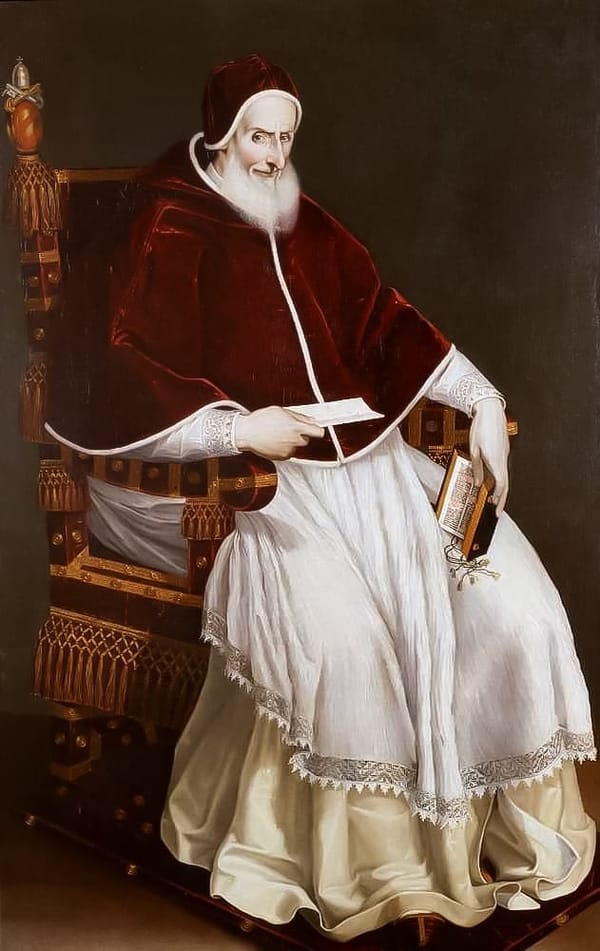 |
WE have already met with the names of several Pontiffs on the Paschal Calendar. They form a brilliant constellation around our Risen Jesus, who, during the period between his Resurrection and Ascension, gave to Peter, their predecessor, the keys of the kingdom of heaven. Anicetus, Soter, Caius, Cletus and Marcellinus, held in their hands the palm of martyrdom: Leo was the only one who did not shed his blood in the cause of his divine Master. To-day there comes before us a holy Pope who governed the Church in these latter times; he is worthy to stand amidst the Easter group of Pontiffs. Like Leo, Pius V was zealous in combating heresy; like Leo, he saved his people from the barbarian yoke.
The whole life of Pius V was a combat. His pontificate fell during those troubled times when Protestantism was leading whole countries into apostasy. Italy was not a prey that could be taken by violence: artifice was therefore used, in order to undermine the Apostolic See and thus develop the whole Christian world in the darkness of heresy. Pius defended the Peninsula with untiring devotedness from the danger that threatened her. Even before he was raised to the Papal Throne he frequently exposed his life by his zeal in opposing the preaching of false doctrines. Like Peter the Martyr, he braved every danger and was the dread of the emissaries of heresy. When seated on the Chair of Peter, he kept the innovators in check by fear, roused the sovereigns of Italy to energy and by measures of moderate severity drove back beyond the Alps the torrent that would have swept Christianity from Europe had not the Southern States thus opposed it. From that time forward, Protestantism has never made any further progress: it has been wearing itself out by doctrinal anarchy. We repeat it: this heresy would have laid all Europe waste, had it not been for the vigilance of the pastor who animated the defenders of truth to resist it where it already existed, and who set himself as a wall of brass against its invasion in the country where he himself was the master.
Another enemy, taking advantage of the confusion caused in the West by Protestantism, organized an expedition against Europe. Italy was to be its first prey. The Ottoman fleet started from the Bosphorus. This again would have meant the ruin of Christendom but for the energy of the Roman Pontiff, our Saint. He gave the alarm, and called the Christian Princes to arms. Germany and France, tom by domestic factions that had been caused by heresy, turned a deaf ear to the call. Spain alone, together with Venice and the little Papal fleet, answered the summons of the Pontiff. The Cross and Crescent were soon face to face in the Gulf of Lepanto. The prayers of Pius V decided the victory in favour of the Christians, whose forces were much inferior to those of the Turks. We shall return to this important event when we come to the Feast of the Rosary in October. But we cannot omit to mention to-day the prediction uttered by the holy Pope, on the evening of the great day of October 7, 1571. The battle between the Christian and Turkish fleets lasted from six o'clock in the morning till late in the afternoon. Towards evening, the Pontiff suddenly looked up towards heaven, and gazed upon it in silence for a few seconds. Then turning to his attendants, he exclaimed: ' Let us give thanks to God! The Christians have gained the victory!' The news soon arrived at Rome; and thus, Europe once more owed her salvation to a Pope! The defeat at Lepanto was a blow from which the Ottoman Empire has never recovered: its fall dates from that glorious day.
The zeal of this holy Pope for the reformation of Christian morals, his establishment of the observance of the laws of discipline prescribed by the Council of Trent and his publication of the new Breviary and Missal have made his six years' pontificate to be one of the richest periods of the Church’s history. Protestants themselves have frequently expressed their admiration of this vigorous opponent of the so-called Reformation.
‘I am surprised,’ said Bacon, ‘that the Church of Rome has not yet canonized this great man.’ Pius V did not receive this honour till about a hundred and thirty years after his death; so impartial is the Church, when she has to adjudicate this highest of earthly honours even to her most revered Pastors!
Of the many miracles which attested the merits of this holy Pontiff, even during his life, we select the two following: As he was one day crossing the Vatican piazza, which is on the site of the ancient Circus of Nero, he was overcome with a sentiment of enthusiasm for the glory and courage of the martyrs who had suffered on that very spot in the first persecution. Stooping down, he took up a handful of dust from the hallowed ground which had been trodden by so many generations of the Christian people since the peace of Constantine. He put the dust into a cloth which the Ambassador of Poland, who was with him, held out to receive it. When the Ambassador opened the cloth, after returning to his house, he found it all saturated with blood, as fresh as though it had been that moment shed: the dust had disappeared. The faith of the Pontiff had evoked the blood of the martyrs, which thus gave testimony against the heretics that the Roman Church, in the sixteenth century, was identically the same as that for which those brave heroes and heroines laid down their lives in the days of Nero.
The heretics attempted more than once to destroy a life which baffled all their hopes of perverting the faith of Italy. By a base and sacrilegious stratagem, aided by treachery, they put a deadly poison on the feet of the crucifix which the Saint kept in his Oratory, and which he was frequently seen to kiss with great devotion. In the fervour of prayer, Pius was about to give this mark of love to the image of his crucified Master, when suddenly the feet of the crucifix detached themselves from the Cross and eluded the proffered kiss of the venerable old man. The Pontiff at once saw through the plot whereby his enemies would fain have turned the life-giving Tree into an instrument of death.
In order to encourage the faithful to follow the sacred Liturgy, we will select another interesting example from the life of this great Saint. When, lying on his bed of death, and just before breathing his last, he took a parting look at the Church on earth, which he was leaving for that of heaven, he wished to make a final prayer for the flock which he knew was surrounded by danger; he therefore recited, but with a voice that was scarcely audible, the following stanza of the Paschal hymn: ‘We beseech thee, O Creator of all things! that in these days of Paschal joy, thou defend thy people from every assault of death!’1
Let us now read the eulogy of this saintly Pope of modern times, as given in the divine Office:
St Pius is one of the leading glories of the Dominican Order. We find the following Responsories and Hymns in the Breviary of that Order:
Responsories
Hymn
Canora pangant organa:
Nimbosque pellant nubilos
Sacræ diei gaudia.
Fregit draconis impetum:
Piique sumpto nomine,
Hostem repressit impium.
Umbone firmo depulit:
Sectariorum spicula
Mucrone forti messuit.
Sacris stetit pro mcenibus,
Ut barbaros acinaces
Arceret a fidelibus.
Cura revexit sedula:
Et impiis erroribus
Objecit hic repagula.
Non vinxit in sudario
Necessitates publicas
Toto juvans ærario.
Manus habens tomatiles,
Pavit greges famelicos
Effusione munerum.
In hoc paschali gaudio,
Ab omni mortis impetu
Tuum defende populum.
give forth their glad sound in honour of blessed Pius!
Let the joys of this sacred day
dispel all stormy clouds.
and he conquered the devil in battle:
he took the name of Pius
and repressed the impious foe.
against the dangers that attacked the Church:
he was the strong sword
that mowed down the ranks of the heretics.
who stood for the defence of the Holy City,
that he might protect the faithful
from the scimitar of the Turks.
redisciplined morals;
and to impious errors
he opposed a barrier of restraint.
to hide his wealth in a napkin;
he threw open his whole treasury,
that he might relieve the necessities of his people.
with his hands ever pouring forth charity,
he fed and amply provided for his subjects
when suffering famine.
that in these days of Paschal joy
thou defend thy people
from every assault of death.
The following hymn is placed near the tomb of our Saint, in the Church of Saint Mary Major, for the use of those who visit his shrine:
Hymn
Cultus Dei contemnitur:
Ultrixque culpam persequens,
Jam poena terris imminet.
Cœlestium de sedibus
Præsentiorem vindicem,
Quam te, Pie, invocabimus?
Intensiore robore
Quam tu, superni numinis
Promovit in terris decus;
Avertit a cervicibus,
Quod christianis gentibus
Jugum parabant barbari.
Tu supplices nunc aspice:
Tu civium discordias
Compesce et iras hostium.
Terras revisat, ut
Deo Tuti queamus reddere
Mox lætiora cantica.
Uni Deo sit gloria,
Laus et potestas omnia
Per sæculorum sæcula.
for the worship of God is despised:
the chastisement that avenges guilt
is menacing our earth.
which of the heavenly citizens
can we better invoke
in our defence than thee, O Pius?
no mortal ever laboured
with such zealous vigour
to promote God's glory on earth as thou didst;
to free Christian lands from the yoke
which barbarians were seeking
to put upon them.
that thou art in heaven:
look upon us thy clients!
Restrain civil discord and repel our enemies.
that in calm security
we may sing our canticles to God
with a gladder heart.
one God, be glory,
praise and power, for ever
and ever.
Pontiff of the living God! thou wast, whilst on earth, the pillar of iron and wall of brass, spoken of by the prophet.2 Thine unflinching firmness preserved the flock entrusted to thee from the violence arid snares of its many enemies. Far from desponding at the sight of the dangers thou didst redouble thy courage just as men raise the embankments higher when they see the torrent swell. By thee was the spread of heresy checked; by thee was the Mussulman invasion repelled, and the haughty Crescent humbled. God honoured thee by choosing thee as the avenger of his glory and the deliverer of the Christian people: receive our thanks and the homage of our humble praise! By thee were repaired the injuries .done to the Church during a period of unusual trial. The true reform—the reform that is wrought by authority—was vigorously applied by thy strong and holy hand. To thee is due the restoration of the Divine Service by the publication of the books of holy Liturgy. And all these glorious deeds were done in the six short years of thy laborious pontificate!
Hear now the prayers addressed to thee by the Church Militant, whose destinies were once in thy hands. When dying, thou didst beseech our Risen Jesus to grant her protection against the dangers which were then threatening her: oh! see the state to which licentious error has now reduced almost the whole Christian world! The Church has nothing left to her wherewith to make head against her countless enemies, save the promises of her divine Founder; all visible support is withdrawn from her; she has been deprived of everything except the merit of suffering and the power of prayer. Unite, O holy Pontiff, thy prayers to hers, and show how unchanged is thy love of the flock of Christ. Protect in Rome the Chair of thy successor attacked by open violence and astute hypocrisy. Princes and peoples seem to have conspired against God and his Christ: disconcert the schemes of sacrilegious ambition, and the plots of impiety which would fain give the lie to the word of God. Avert, by thine intercession, the scourges which are threatening those nations that have become ungrateful to the Church and indifferent to the attempts made against her to whom they owe all they possess. Pray that the blind may see and the wicked be confounded. Pray that the True Faith may enlighten those numberless souls that call error truth and darkness light.
In the midst of this dark and menacing night, thine eyes, O holy Pontiff, discern them that are the faithful sheep of Christ: bless them, aid them, increase their number. Graft them on the venerable Tree which dieth not, that they may not be carried away by the storm. Obtain for them docility to the Faith and traditions of Holy Church; it is their only stay amidst the tide of error which is now threatening to deluge the whole world. Preserve to the Church the holy Order in which thou wast trained for the high mission destined for thee; maintain within her that race of men, powerful in work and word, zealous for the faith and sanctification of souls, of which we read in her Annals, and which has yielded saints such as thyself. And lastly, O Pius, remember that thou wast once the Father of the faithful: continue to be so, by thy powerful intercession, till the number of the elect be filled up!
- The Stanza recited by the dying Pontiff was, in the Breviary of his time, as follows: Quæsumus, Auctor omnium, In hoc Paschali gaudio, Ab omni mortis impetus Tuum defende populum. When the hymns were corrected under the pontificate of Urban the Eighth, this stanza was totally changed: Ut sis perenne mentibus, etc. [The Monastic Breviary has retained the original.—Tr.] ↩︎
- Jer. i 18. ↩︎
| Previous May 4: St. Monica, Widow | Next May 5: St. Pius V, Pope |