Daily reading
Paschal Time
Double of the I Class · Movable from Easter · Temporal
May 6, 2027
From Dom Guéranger’s The Liturgical Year.
A Double of the I Class leads; St. John before the Latin Gate is commemorated.Rubric

|
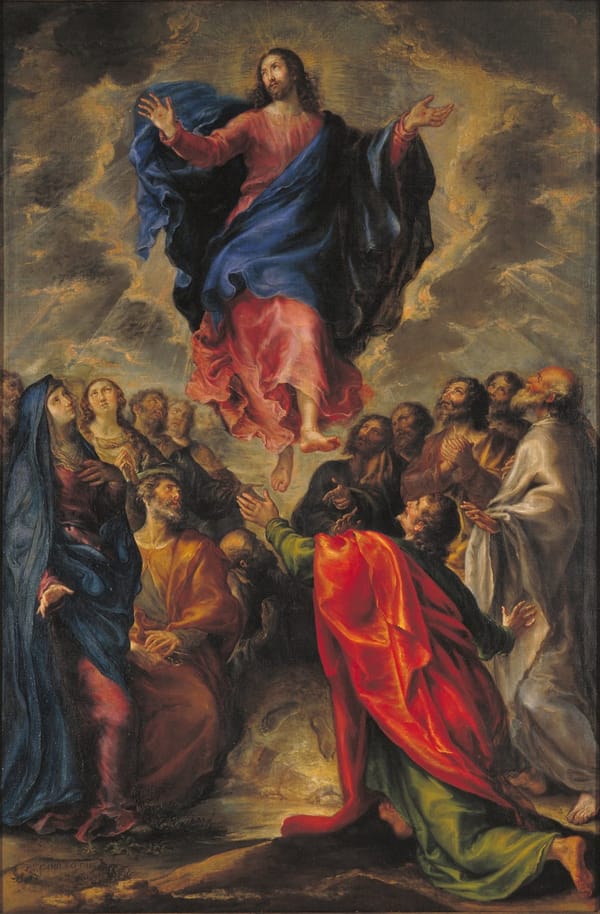
The Ascension of Our Lord
Including descriptions of the following:
The sun of the fortieth day has risen in all his splendour. The earth, which shook with gladness at the birth of our Emmanuel,1 now thrills with a strange emotion. The divine series of the mysteries of the Man-God is about to close. Heaven has caught up the joy of earth. The angelic choirs are preparing to receive their promised King, and their princes stand at the gates, that they may open them when the signal is given of the mighty conqueror’s approach.2 The holy souls, that were liberated from limbo on the morning of the Resurrection, are hovering round Jerusalem, waiting for the happy moment when heaven’s gate, closed by Adam’s sin, shall be thrown open, and they shall enter in company with their Redeemer:—a few hours more, and then to heaven! Meanwhile, our risen Jesus has to visit His disciples and bid them farewell, for they are to be left for some years longer in this vale of tears.
They are in the cenacle, impatiently awaiting His coming. Suddenly He appears in their midst. Of the Mother’s joy, who would dare to speak? As to the disciples and the holy women, they fall down and affectionately adore the Master, who has come to take His leave of them. He deigns to sit down to table with them; He even condescends to eat with them, not, indeed, to give them proof of His Resurrection, for He knows that they have no further doubts of the mystery; but now that He is about to sit at the right hand of the Father, He would give them this endearing mark of familiarity. Oh admirable repast! in which Mary, for the last time in this world, is seated side by side with her Jesus, and in which the Church, (represented by the disciples and the holy women) is honoured by the visible presidency of her Head and Spouse.
What tongue could describe the respect, the recollected mien, the attention of the guests? With what love must they have riveted their eyes on the dear Master! They long to hear Him speak; His parting words will be so treasured! He does not keep them long in suspense: He speaks, but His language is not what they perhaps expected it to be, all affection. He begins by reminding them of the incredulity wherewith they heard of His Resurrection.3 He is going to entrust His apostles with the most sublime mission ever given to man; He would, therefore, prepare them for it by humbling them. A few days hence they are to be the lights of the world; the world must believe what they preach, believe it on their word, believe it without having seen, believe what the apostles alone have seen. It is by faith that man approaches his God: they themselves were once without it, and Jesus would have them now express their sorrow for their former incredulity, and thus base their apostolate on humility.
Then, assuming a tone of authority, such as none but a God could take, He says to them: 'Go ye into the whole world, and preach the Gospel to every creature. He that believeth and is baptized, shall be saved: but he that believeth not, shall be condemned.’4 And how shall they accomplish this mission of preaching the Gospel to the whole world? how shall they persuade men to believe their word? By miracles. ‘And these signs,’ continues Jesus, ‘shall follow them that believe: in My name they shall cast out devils; they shall speak with new tongues; they shall take up serpents; and if they shall drink any deadly thing, it shall not hurt them; they shall lay their hands upon the sick, and they shall recover.’5 He would have miracles to be the foundation of His Church, just as He had made them the argument of His own divine mission. The suspension of the laws of nature proves to us that it is God who speaks; we must receive the word, and humbly believe it.
Here, then, we have men unknown to the world and devoid of every human means, and yet commissioned to conquer the earth and make it acknowledge Jesus as its King! The world ignores their very existence. Tiberius, who sits on the imperial throne, trembling at every shadow of conspiracy, little suspects that there is being prepared an expedition which is to conquer the Roman empire. But these warriors must have their armour, and the armour must be of heaven’s own tempering. Jesus tells them that they are to receive it a few days hence. ‘Stay,’' says He, ‘in the city, till ye be endued with power from on high.’6 But what is this armour? Jesus explains it to them. He reminds them of the Father’s promise, ‘that promise,’ says He, ‘which ye have heard by my mouth; for John, indeed, baptized with water; but ye shall be baptized with the Holy Ghost not many days hence.’7
But the hour of separation is come. Jesus rises: His blessed Mother, and the hundred and twenty persons assembled there, prepare to follow Him. The cenacle is situated on Mount Sion, which is one of the two hills within the walls of Jerusalem. The holy group traverses the city, making for the eastern gate, which opens on the valley of Josaphat. It is the last time that Jesus walks through the faithless city. He is invisible to the eyes of the people who denied. Him, but visible to His disciples, and goes before them, as heretofore the pillar of fire led on the Israelites. How beautiful and imposing a sight! Mary, the disciples, and the holy women accompanying Jesus in His heavenward journey, which is to lead Him to the right hand of His eternal Father! It was commemorated in the middle ages by a solemn procession before the Mass of Ascension day. What happy times were those, when Christians took delight in honouring every action of our Redeemer! They could not be satisfied as we are, with a few vague notions, which can produce nothing but an equally vague devotion.
They reflected on the thoughts which Mary must have had during these last moments of her Son’s presence. They used to ask themselves, which of the two sentiments was uppermost in her maternal heart, —sadness, that she was to see her Jesus no more, or joy, that He was now going to enter into the glory He so infinitely deserved. The answer was soon found: had not Jesus said to His disciples: ‘If ye loved Me, ye would indeed be glad, because I go to the Father.’8 Now, who loved Jesus as Mary did? The Mother’s heart, then, was full of joy at parting with Him. How was she to think of herself, when there was question of the triumph of her Son and her God? Could she that had witnessed the scene of Calvary, do less than desire to see Him glorified, whom she knew to be the sovereign Lord of all things,—Him whom, but a short time ago, she had seen rejected by His people, blasphemed, and dying the most ignominious and cruel of deaths?
The holy group has traversed the valley of Josaphat; it has crossed the brook Cedron, and is moving onwards to Mount Olivet. What recollections would crowd on the mind! This torrent, of which Jesus had drunk on the day of His humiliation, is now the path He takes to triumph and glory. The royal prophet had foretold it.9 On their left, are the garden and the cave, where He suffered His agony and accepted the bitter chalice of His Passion. After having come as far as what St. Luke calls the distance of the journey allowed to the Jews on a Sabbath-day,10 they are close to Bethania, that favoured village, where Jesus used to accept hospitality at the hands of Lazarus and his two sisters. This part of Mount Olivet commands a view of Jerusalem. The sight of its temple and palaces makes the disciples proud of their earthly city: they have forgotten the curse uttered against her; they seem to have forgotten, too, that Jesus has just made them citizens and conquerors of the whole world. They begin to dream of the earthly grandeur of Jerusalem, and, turning to their divine Master, they venture to ask Him this question: ‘Lord, wilt Thou, at this time, restore again the kingdom to Israel?’11
Jesus answers them with a tone of severity: ‘It is not for you to know the times or moments which the Father hath put in His own power.'12 These words do not destroy the hope that Jerusalem is to be restored by the Christian Israel; but, as this is not to happen till the world is drawing towards its end, there is nothing that requires our Saviour’s revealing the secret. What ought to be uppermost in the mind of the disciples, is the conversion of the pagan world, the establishment of the Church. Jesus reminds them of the mission He has just given to them: ‘Ye shall receive', says He, ‘the power of the Holy Ghost coming upon you; and ye shall be witnesses unto me in Jerusalem, and in all Judea, and Samaria, and even to the uttermost part of the earth.'13
According to a tradition, which has been handed down from the earliest ages of Christianity,14 it is midday, the same hour at which He was raised up, when nailed to His cross. Giving His blessed Mother a look of filial affection, and another of fond farewell to the rest of the group that stand around Him, Jesus raises up His hands and blesses them all. While thus blessing them, He is raised up from the ground whereon He stands, and ascends into heaven.15 Their eyes follow Him, until a cloud comes and receives Him out of their sight.16
Yes, Jesus is gone! The earth has lost her Emmanuel!—For four thousand years had He been expected: the patriarchs and prophets had desired His coming with all the fervour of their souls. He came. His love made Him our captive in the chaste womb of the Virgin of Nazareth; it was there He first received our adorations. Nine months after, the blessed Mother offered Him to our joyous love in the stable at Bethlehem. We followed Him into Egypt; we returned with Him; we dwelt with Him at Nazareth. When He began the three years of His public life, we kept close to His steps; we delighted in being near Him, we listened to His preaching and parables, we saw His miracles. The malice of His enemies reached its height; and the time came wherein He was to give us the last and grandest proof of the love that had brought Him from heaven, by dying for us on a cross. We kept near Him as He died, and our souls were purified by the Blood that flowed from His wounds. On the third day, He rose again from His grave, and we stood by exulting in His triumph over death, for that triumph won for us a like resurrection. During the forty days He has deigned to spend with us since His Resurrection, our faith has made us cling to Him: we would fain have kept Him with us for ever,—but the hour is come: He has left us. Yes, our dearest Jesus is gone! Oh happy the souls that He had taken from limbo! They have gone with Him, and, for all eternity, are to enjoy the heaven of His visible presence.
The disciples are still steadfastly looking up towards heaven, when lo! two angels, clad in white robes, appear to them, saying: ‘Ye men of Galilee! why stand ye looking up to heaven? This Jesus, who is taken up from you into heaven, shall so come as ye have seen Him going into heaven!’17 He has ascended, a Saviour; He is to return, a Judge: between these two events is comprised the whole life of the Church on earth. We are therefore living under the reign of Jesus as our Saviour, for He has said: ‘God sent not His Son into the world to judge the world, but that the world might be saved by Him:’18 and to carry out this merciful design He has just been giving to His disciples the mission to go throughout the whole world, and invite men, while yet there is time, to accept the mystery of salvation.
What a task is this He imposes on the apostles! And now that they are to begin their work, He leaves them! They return from Mount Olivet, and Jesus is not with them! And yet, they are not sad; they have Mary to console them; her unselfish generosity is their model, and well do they learn the lesson.
They love Jesus; they rejoice at the thought of His having entered into His rest. ‘They went back into Jerusalem with great joy.’19 These few simple words of the Gospel indicate the spirit of this admirable feast of the Ascension: it is a festival which, notwithstanding its soft tinge of sadness, is, more than any other, expressive of joy and triumph. During its octave, we will endeavour to describe its mystery and magnificence: we would only observe for the present, that this solemnity is the completion of the mysteries of our redemption; that it is one of those which were instituted by the apostles;20 and finally, that it has impressed a character of sacredness on the Thursday of each week, the day already so highly honoured by the institution of the Eucharist.
We have alluded to the procession, whereby our Catholic forefathers used, on this feast, to celebrate the journey of Jesus and His disciples to Mount Olivet. Another custom observed on the Ascension, was the solemn blessing given to bread and to the new fruits: it was commemorative of the farewell repast taken by Jesus in the cenacle. Let us imitate the piety of the ages of faith, when Christians loved to honour the very least of our Saviour’s actions, and, so to speak, make them their own, by thus interweaving the minutest details of His life into their own. What earnest reality of love and adoration was given to our Jesus in those olden times, when His being sovereign Lord and Redeemer was the ruling principle of both individual and social life! Now-a-days, we may follow the principle, as fervently as we please, in the privacy of our own consciences, or, at most, in our own homes; but publicly, and when we are before the world, no! To say nothing of the evil results of this modern limitation of Jesus’ rights as our King, what could be more sacrilegiously unjust to Him who deserves our whole service, everywhere and at all times? The angels said to the apostles: 'This Jesus shall come, as ye have seen Him going into heaven:’ happy we, if, during His absence, we shall have so unreservedly loved and served Him, as to be able to meet Him with confidence when He comes to judge us.
We will not here insert the Office of first Vespers, inasmuch as this festival is fixed for the Thursday; so that its vigil can never fall on a Sunday, and the faithful, consequently, have not the habit of assisting at them. Moreover, with the exception of the versicle and the Magnificat antiphon, the first and second Vespers are exactly alike.
Mass
The Roman missal gives St. Peter’s as the Station for to-day. It was a happy thought to choose this basilica, inasmuch as it possesses the tomb of one of the chief witnesses of Jesus’ Ascension. It is still the stational church; but for now several centuries, the Pope and sacred college of Cardinals repair to the Lateran basilica. It is in this venerable church, dedicated by Constantine to the Saviour of the world, that is closed our yearly series of the mysteries whereby the Son of God wrought our salvation.
In these two magnificent basilicas, as well as in the humblest church of Christendom, the liturgical symbol of the feast is the Paschal Candle. It was first lighted on the night of the Resurrection, and was to remind us, by its forty days’ presence, of the time which Jesus spent among His brethren, after He had risen from the grave. The eyes of the faithful are fixed upon it, and its light seems to be burning more brightly, now that we are about to lose it. Let us bless our holy mother Church, whom the Holy Ghost has taught to instruct us and excite us to devotion by so many admirable symbols. Let us glorify our divine master, who says, speaking of Himself: ‘I am the light of the world.'21
The Introit is the solemn announcement of to-day’s mystery. It is formed of the angels’ words to the apostles: Jesus has ascended into heaven; He is to come down again at the last day.
Introit
Ps. Omnes gentes plaudite manibus: jubilate Deo in voce exsultationis.℣. Gloria Patri. Viri Galilæi.
Ps. Clap your hands, all ye nations: shout unto God, with the voice of joy.℣. Glory. &c. Ye men, &c.
In the Collect, the Church sums up the prayers of her children, and beseeches God to grant them the grace of keeping their hearts fixed on their Redeemer, and of desiring to be united with Him in that home above, which He has gone to prepare for them.
Collect
Epistle
Cap. i.Primum quidem sermonem feci de omnibus, o Theophile, quæ cœpit Jesus facere et docere, usque in diem, qua præcipiens apostolis per Spiritum Sanctum, quos elegit, assumptus est: quibus et praebuit seipsum vivum post passionem suam in multis argumentis, per dies quadraginta apparens eis, et loquens de regno Dei. Et convescens, præcepit eis ab Jerosolymis ne discederent, sed expectarent promissionem Patris, quam audistis (inquit) per os meum: quia Joannes quidem baptizavit aqua, vos autem baptizabimini Spiritu Sancto non post multos hos dies. Igitur qui convenerant interrogabant eum dicentes: Domine, si in tempore hoc restitues regnum Israel? Dixit autem eis: Non est vestrum nosse tempora vel momenta, quæ Pater posuit in sua potestate: sed accipietis virtutem supervenientis Spiritus Sancti in vos, et eritis mihi testes in Jerusalem, et in omni Judæa, et Samaria, et usque ad ultimum terræ. Et cum hæc dixisset, videntibus illis, elevatus est: et nubes suscepit eum ab oculis eorum. Cumque intuerentur in cœlum euntem illum, ecce duo viri adstiterunt juxta illos in vestibus albis, qui et dixerunt: Viri Galilæi, quid statis aspicientes in cœlum? Hic Jesus, qui assumptus est a vobis in cœlum, sic veniet, quemadmodum vidistis eum euntem in cœlum.
Ch. i.The former treatise I made, O Theophilus, of all things which Jesus began to do and to teach, until the day on which, giving commandments by the Holy Ghost to the apostles whom he had chosen, he was taken up. To whom also he showed himself alive after his passion, by many proofs, for forty days appearing to them and speaking of the kingdom of God. And eating together with them, he commanded them, that they should not depart from Jerusalem, but should wait for the promise of the Father, which you have heard (saith he) by my mouth; for John indeed baptized with water, but you shall be baptized with the Holy Ghost not many days hence. They, therefore, who were come together asked him, saying: Lord, wilt thou at this time restore again the kingdom to Israel? But he said to them: It is not for you to know the times or moments which the Father hath put in his own power; but you shall receive the power of the Holy Ghost coming upon you, and you shall be witnesses unto me in Jerusalem, and in all Judæa, and Samaria, and even to the uttermost part of the earth. And when he had said these things, while they looked on, he was raised up; and a cloud received him out of their sight. And while they were beholding him going up to heaven, behold two men stood by them in white garments. Who also said: Ye men of Galilee, why stand you looking up to heaven? This Jesus who is taken from you into heaven, shall so come as you have seen him going into heaven.
This admirable description of our Jesus’ Ascension, brings the mystery so vividly before us, that we almost seem to see the happy group on Mount Olivet. With what affection the disciples gaze upon the divine Master as they see Him rising up towards heaven, and stretching out His hand to bless them! Their eyes, though full of tears, are riveted on the cloud which has come between themselves and Jesus. They are alone on the mount; Jesus’ visible presence is taken from them. How wretched would they not feel in the desert land of their exile, were it not for His supporting grace, and for that holy Spirit who is about to come down and create within them a new being? So then, it is only in heaven that they can ever again see the face of Jesus, who, God as He is, deigned to be their Master for three long happy years, and on the evening of the Last Supper, called them His friends!
Neither are they the only ones who feel this separation. Our earth leaped with joy as the Son of God walked upon it; that joy is now past. It had looked forward, for four thousand years, for the glory of being the dwelling-place of its Creator; that glory is now gone. The nations are in expectation of a Deliverer, and though, with the exception of the people of Judea and Galilee, men are not aware that this Deliverer has come and gone again,—it shall not long be so. They shall hear of His birth, and His life, and His works; they shall hear of His triumphant Ascension, too, for holy Church shall proclaim it in every country of the earth. Eighteen hundred years have elapsed since Ho left this world, and our respectful and loving farewell blends with that which His disciples gave Him when He was mounting up to heaven. Like them, we feel His absence; but like them, we also rejoice in the thought that He is seated at the right hand of His Father, beautiful in His kingly glory. Thou, dear Jesus! hast entered into Thy rest! We adore Thee on Thy throne, we Thy redeemed and the fruit of Thy victory. Bless us! Draw us to Thyself, and grant that Thy last coming may be to us a source of joy rather than of fear!
The two Alleluia-versicles give us the words of the royal psalmist, wherein he celebrates the glorious Ascension of the future Messias, the acclamations of the angels, the loud music of heaven’s trumpets, the gorgeous pageant of the countless fortunate captives of limbo whom the conqueror leads up, as His trophy, to heaven.
Gospel
Cap. xvi.In illo tempore: Recumbentibus undecim discipulis, apparuit illis Jesus, et exprobravit incredulitatem eorum et duritiam cordis: quia iis, qui viderant eum resurrexisse, non crediderunt. Et dixit eis: Euntes in mundum universum, prædicate Evangelium omni creaturæ. Qui crediderit et baptizatusfuerit, salvus erit: qui vero non crediderit, condemnabitur. Signa autem eos, qui crediderint, hæc sequentur: In nomine meo dæmonia ejicient; linguis loquentur novis: serpentes tollent: et si mortiferum quid biberint, non eis nocebit: super ægros manus imponen t, et bene habebunt. Et Dominus quidem Jesus, postquam locutus est eis, assumptus est in cœlum, et sedet a dextris Dei. Illi autem profecti prædicaverunt ubique, Domino cooperante, et sermonem confirmante, sequentibus signis.
Ch. xvi.At that time: Jesus appeared to the eleven as they were at table; and he upbraided them with their incredulity and hardness of heart, because they did not believe them who had seen him after he was risen again. And he said to them: Go ye into the whole world, and preach the Gospel to every creature. He that believeth and is baptized, shall be saved; but he that believeth not shall be condemned. And these signs shall follow them that believe: In my name they shall cast out devils: they shall speak with new tongues: they shall take up serpents: and if they shall drink any deadly thing, it shall not hurt them: they shall lay hands upon the sick, and they shall recover. And the Lord Jesus after he had spoken to them was taken up into heaven, and sitteth on the right hand of God. But they going preached everywhere; the Lord working withal, and confirming the word with signs that followed.
The deacon having sung these words, an acolyte ascends the arabo and extinguishes the Paschal Candle, the sweet symbol of our Jesus’ presence for the forty days after His resurrection. This expressive rite tells us of the widowhood of holy mother Church, and that we, when we would contemplate our beloved Lord, must turn our hearts to heaven, for it is there that He is to be seen. Alas! how short was His stay here below, and how quickly the time passed! How many ages have gone by, and how many must still come over this poor earth of ours, before she can again behold His face!
The Church languishes after Him, in this dreary exile of the vale of tears, taking care of us, the children her Jesus has given her by His holy Spirit. She feels His absence; and, if we are Christians, we shall feel it too. Oh! when will the day come, whereon reunited to our bodies, we shall be taken up in the clouds to meet Christ, and be with our Lord for ever!22 Then, and then only, shall we have attained the end for which we were created.
All the mysteries of the Word Incarnate were to close with His Ascension; all the graces we receive are to end with ours. This world is but a figure that passeth away;23 and we are hastening through it to rejoin our divine Leader. In Him are our life and our happiness; it is vain to seek them elsewhere. Whatever brings us nearer to Jesus, is good; whatever alienates us from Him is evil. The mystery of the Ascension is the last ray of light given to us by our Creator, whereby He shows us the path to our heavenly country. If our heart is seeking its Jesus, and longs to come to Him, it is alive with the true life; if its energies are spent upon created things, and it feels no attraction for its Jesus, it is dead.
Let us, therefore, lift up our eyes, as did the disciples, and follow in desire Him who this day ascends to heaven, and prepares a place there for each of His faithful servants. Sursum corda! Hearts on heaven! It is the parting word of our brethren, who accompany the divine Conqueror in His Ascension; it is the hymn wherewith the angels, coming, down to meet their King, invite us to ascend and fill up the vacant thrones: Sursum corda!
Farewell, dear paschal torch, that hast gladdened us with thy lovely flame! Thou hast sweetly spoken to us of Jesus, our light in the darkness of our pilgrimage; and now thou leavest us, telling us that He is no longer to be seen here below, and that we must follow Him to heaven, if we would again behold Him. Farewell, loved symbol made by the hand of our mother, the Church, that thou mightest speak to our hearts! The impressions excited within us, as we looked upon thee, during this holy season of Easter, shall not be forgotten. Thou wast the herald of our Pasch; thy leaving reminds us that the glad time is drawing to its close.
For the Offertory-antiphon, the Church uses the words of David, as before the Gospel. She is taken up with this one glad thought: the triumph of her Spouse, and the joy it caused in heaven. She would have this joy to be shared in by us who are on earth.
Offertory
Our desires, on this day, should be that we may follow our Jesus to life everlasting, and overcome all the hindrances that we may have to encounter on the way thither. This is what the Church asks of God for us, in the Secret.
Secret
Preface
It is the royal prophet who again speaks in the Communion-anthem. He foretells, a thousand years before the event, that the Emmanuel is to ascend from the east. Mount Olivet, whence our Lord took His departure to His Father’s kingdom, is to the east of Jerusalem.
Communion
The faithful people has just confirmed its union with its divine Head, by receiving the adorable Sacrament; the Church asks of God that this mystery, which contains Jesus within it in an invisible manner, may work in us what it outwardly expresses.
Postcommunion
NOON
A tradition, handed down from the early ages, and confirmed by the revelations of the saints, tells us that the Ascension of our Lord took place at the hour of noon. The Carmelites of St. Teresa’s reform honour this pious tradition by assembling in the choir, at the hour of midday on the Ascension, and spending it in the contemplation of this last of Jesus’ mysteries, following Him, in thought and desire, to the throne of His glory.
Let us also follow Him; but before looking on the bright noon which smiles on His triumph, let us go back in thought to His first coming among us. It was at midnight, in the stable of Bethlehem. That dark and silent hour was an appropriate commencement to the three and thirty years of His life on earth. He had come to accomplish a great mission: year by year and day by day, He laboured in its fulfilment. It was nigh to its fulfilment, when men laid their sacrilegious hands upon Him, and nailed Him to a cross. It was midday, when He was thus raised up in the air; but the eternal Father would not permit the sun to shine on Jesus’ humiliation. Darkness covered the face of the earth; and that day had no noon. Three hours after, the sun reappeared. Three days after, the Crucified rose again from the tomb, and it was at the early dawn of light.
On this day, yea at this very hour, His work is completed. He has redeemed us, by His Blood, from our sins; He has conquered death by His Resurrection to life: had He not a right to choose, for His Ascension, the hour when the sun is pouring forth his warmest and brightest beams? Hail, holy hour of noon, sacred with thy double consecration, which reminds us daily of the mercy and of the triumph of our Emmanuel, of salvation by His cross, and of heaven by His Ascension!
But art not Thou, O Jesus! O Sun of Justice! art not Thou Thyself the noontide of our souls? Where are we to find that fullness of light for which we were created, where that burning of eternal love which alone can satisfy our longing hearts, but in Thee, who camest down upon the earth to dispel our darkness and our cold? It is in this hope that we venture to address Thee in the sublime words of Thy faithful bride Gertrude: ‘O Love, O noontide, whose ardours are so soothing! Thou art the hour of sacred rest; and the unruffled peace I taste in thee is all my delight. O Thou whom my soul loveth, Thou who art my chosen and my elect above all creatures, tell me, show me, where Thou feedest Thy flock, where Thou liest to rest in the midday. My heart kindles with rapture at thought of Thy tranquil rest at noon! Oh that it were given me to come so near to Thee, that I might be not only near Thee, but in Thee! Beneath Thy genial ray, O Sun of justice, the flowers of all the virtues would spring forth from me, who am but dust and ashes. Then would my soul, rendered fruitful by Thee, my Master and my Spouse, bring forth the noble fruit of every perfection. Then should I be led forth from this valley of sorrows, and be admitted to behold Thy face, so long, so wistfully longed for; and then would it be my everlasting happiness to think that Thou hast not disdained, O Thou spotless Mirror, to unite Thyself to a sinner like me!’24
Vespers
The Lord Jesus has disappeared from our earth, but His memory and His promises are treasured in the heart of the Church. She follows in spirit the glorious triumph of her Spouse, a triumph so well deserved by His having accomplished the world’s Redemption. She keenly feels her widowhood; but she awaits, with unshaken confidence, the promised Comforter. The hours of this trying day are passing away, and evening is coming on; she once more assembles her children, and, in the Office of Vespers, commemorates all that has happened in this sublime mystery of the Ascension.
The antiphons of the psalms relate the great event of noon; the tone of sadness that runs through their melody, is in keeping with the feelings excited by the separation.
Psalm Dixit Dominus, page 92.
Psalm Confitebor, page 93.
Psalm Beatus vir, page 94.
Psalm Laudate, pueri, page 95.
Psalm 116
Quoniam confirmata est super nos misericordia ejus: et veritas Domini manet in æternum.
For his mercy is confirmed upon us: and the truth of the Lord remaineth for ever.
Capitulum (Acts of the Apostles , i .)
The hymn was composed by St. Ambrose, and is full of sweetness; it was somewhat changed in the seventeenth century, and in this changed form we now have it.
Hymn*
Jesu, voluptas cordium,
Orbis redempti conditor,
Et casta lux amantium.
Ut nostra ferres crimina,
Mortem subires innocens,
A morte nos ut tolleres?
Vinctis catenas detrahis:
Victor triumpho nobili,
Ad dexteram Patris sedes.
Ut damna nostra sarcias,
Tuique vultus compotes
Dites beato lumine.
Sis meta nostris cordibus,
Sis lacrymarum gaudium,
Sis dulce vitæ præmium.
joy of our hearts,
Creator of the world redeemed,
and chaste light of them that love thee.
to take upon thee our sins?
and suffer death, O innocent victim,
that thou mightest free us from death?
and the chains of them that were bound.
A conqueror, with noblest triumph,
thou now sittest at the right hand of the Father.
to repair our losses.
Oh! give us to see thy Face,
and enrich us with the blessed light.
be thou the object of our heart’s desire;
be thou the joy of our tears,
and the sweet recompense of a life spent for thee!
The Magnificat-anthem is an appeal made to our Jesus, that He would he mindful of His own and His Father’s promise, and not delay to console His bride by sending her the holy Spirit. The Church repeats this antiphon every day, till the arrival of the heavenly Guest.
Antiphon of the Magnificat
During the days of the octave, we will listen to the several Churches of old celebrating, each in its own style, but all with one and the same faith, the Ascension of our Redeemer. Let us give the first place to the Greek Church, which, in her usual pompous style, commemorates the glories of this mystery. It is her hymn for the evening Office.
Hymn (In Assumptione Domini, ad Vesperas)
O Jesus, our Emmanuel! Thy work is done, and this is the day of Thy entering into Thy rest. In the beginning of the world, Thou didst spend six days in harmonizing the varied portions of the creation; after which, Thou enteredst again into Thy rest. When, later on, Thou wouldst repair Thy work, which satan’s malice had deranged, Thy love induced Thee to live among us for three-and-thirty years, during which Thou didst work our redemption, and restoredst us to the holiness and honour whence we had fallen. Whatsoever had been assigned Thee in the eternal decrees of the blessed Trinity, whatsoever had been foretold of Thee by the prophets, all was done, dear Jesus! not an iota of it all was forgotten. Thy triumphant Ascension was the close of the mission Thou hadst so mercifully undertaken. It was Thy second entrance into Thy rest; but, this time, it was with our human nature which Thou hadst assumed, and which was now to receive divine honour. Thou wouldst have companions in Thine Ascension: the souls Thou hadst liberated from limbo; yea, and when about to leave us, Thou saidst this word of consolation to us: ‘I go to prepare a place for you!'25
Confiding O Jesus! in this promise; resolved to follow Thee in all the mysteries achieved by Thee for our sake—in the humility of Thy birth at Bethlehem, in Thy sufferings on Calvary, in the joy of Thy Resurrection—we hope, also, to imitate Thee, when our mortal course is run, in Thy glorious Ascension. Meanwhile, we unite with the holy apostles who rejoiced at Thy triumph, and with the ransomed captives of limbo who entered heaven in Thy company. Watch over us, O divine Shepherd, while we aro in our exile! Tend Thy faithful sheep; let none be lost; lead them all to Thy fold. The mystery of Thine Ascension shows us the object of our existence; it reanimates us to study more attentively, and love more warmly, all Thy other mysteries. Our one ambition, then, our one desire, shall henceforth be our own ascension to heaven and to Thee. It was for this Thou camest into the world: by humbling Thyself to our lowliness, to exalt us to Thine own majesty; and by making Thyself Man, to make man a partaker of Thy Divinity. But until the happy day of our union with Thee, what would become of us without that Power of the Most High whom Thou hast promised to send us, that He may bring us patience during our pilgrimage, fidelity to our absent King, and that solace of a heart exiled from its God, love? Come, then, O holy Spirit! Support our weakness; fix the eye of our souls on the heaven where our King awaits us; and never permit us to set our hearts on a world which, had it every other charm, has not the infinite one of Jesus’ visible presence!
Let us close our feast with this beautiful prayer, taken from the Mozarabic breviary.
Prayer
- Ps. xcv. xcvi. xcvii. ↩︎
- Ps. xxiii. 7. ↩︎
- St. Mark, xvi. 14. ↩︎
- Ibid. 15, 16. ↩︎
- St. Mark, xvi. 17, 18. ↩︎
- St. Luke, xxiv. 49. ↩︎
- Acts, i. 4, 5. ↩︎
- St. John, xiv. 28. ↩︎
- Ps. cix. 7. ↩︎
- Acts, i. 12. ↩︎
- Ibid. 6. ↩︎
- Ibid. 7. ↩︎
- Acts, i. 8. ↩︎
- Constit. Apost. lib. v. cap. xix. ↩︎
- St. Luke, xxiv. 51. ↩︎
- Acts, i. 9. ↩︎
- Acts, i. 10, 11. ↩︎
- St. John, iii. 17. ↩︎
- 1 St. Luke, xxiv. 52. ↩︎
- St. Augustine, Ep. ad Januar. ↩︎
- St. John, viii. 12. ↩︎
- 1 Thess, iv. 16. ↩︎
- 1 Cor. vii. 31. ↩︎
- Exercitia S. Gertrudis, Die V. * In the monastic rite, it is retained in its original form, as written by St. Ambrose. It is preceded by the following responsory: ℟. breve.—Ascendens Christus in altum, * Alleluia, alleluia. Ascendens. ℣. Captivam duxit captivitatem. Alleluia. Gloria Patri, &c. Ascendens. Jesu, nostra redemptio, Amor et desiderium, Deus Creator omnium, Homo in fine temporum. Quæ te vicit dementia, Ut ferres nostra crimina? Crudelem mortem patiens, Ut nos a morte tolieres? Inferni claustra penetrans, Tuos captivos redimens, Victor triumpho nobili, Ad dextram Patris residens. Ipsa te cogat pietas, Ut mala nostra superes Parcendo, et voti compotes, Nos tuo vultu saties. Tu esto nostrum gaudium, Qui es futurus præmium; Sit nostra in te gloria Per cuncta semper sæcula. Amen. ↩︎
- St. John, xiv. 2. ↩︎
May 6: St. John before the Latin Gate
THE beloved Disciple John, whom we saw standing near the crib of the Babe of Bethlehem, comes before us again to-day; and this time he pays his delighted homage to the glorious Conqueror of death and hell. Like Philip and James, he is clad in the scarlet robe of martyrdom. The month of May, so rich in Saints, was to be graced with the palm of St John.
Salome one day presented her two sons to Jesus, and with a mother’s ambition asked him to grant them the highest places in his kingdom. The Saviour, in his reply, spoke of the chalice which he himself had to drink, and foretold that these two disciples would also drink of it. The elder, James the Great, was the first to give his Master this proof of his love; we shall celebrate his victory when the sun is in Leo: it was to-day that John, the younger brother, offered his life in testimony of Jesus’ divinity.
But the martyrdom of such an Apostle called for a scene worthy the event. Asia Minor, which his zeal had evangelized, was not a sufficiently glorious land for such a combat. Rome, whither Peter had transferred his Chair and where he died on his cross, and where Paul had bowed down his venerable head beneath the sword, Rome alone deserved the honour of seeing the beloved disciple march on to martyrdom, with that dignity and sweetness which are the characteristics of this veteran of the Apostolic College.
Domitian was then Emperor—a tyrant over Rome and the world. Whether it were that John undertook this journey of his own free choice, and from a wish to visit the Mother Church, or that he was led thither bound with chains, in obedience to an imperial edict—John, the august founder of the seven Churches of Asia Minor, appeared before the tribunal of pagan Rome. He was convicted of having propagated, in a vast province of the Empire, the worship of a Jew who had been crucified under Pontius Pilate. He was a superstitious and rebellious old man, and it was time to rid Asia of his presence. He was therefore sentenced to an ignominious and cruel death. He had somehow escaped Nero’s power: but he should not elude the vengeance of Caesar Domitian!
A huge cauldron of boiling oil is prepared in front of the Latin Gate. The sentence orders that the preacher of Christ be plunged into this bath. The hour is come for the second son of Salome to partake of his Master’s chalice. John’s heart leaps with joy at the thought that he—the most dear to Jesus, and yet the only Apostle that has not suffered death for him—is at last permitted to give him this earnest of his love. After cruelly scourging him, the executioners seize the old man, and throw him into the cauldron; but, lo! the boiling liquid has lost all its heat; the Apostle feels no scalding; on the contrary, when they take him out again he feels all the vigour of his youthful years restored to him. The Praetor’s cruelty is foiled, and John, a martyr in desire, is to be left to the Church for some few years longer. An imperial decree banishes him to the niggled Isle of Patmos, where God reveals to him the future of the Church, even to the end of time.
The Church of Rome, which counts among her most glorious memories the abode and martyrdom of St John, has marked with a Basilica the spot where the Apostle bore his noble testimony to the Christian faith. This Basilica stands near the Latin Gate, and gives a title to one of the Cardinals.
In honour of the great Apostle of love, we give the following Sequence, composed by Adam of Saint-Victor:
Sequence
Summum regem gloriæ
Videns mentis acie
Non repulsa,
Angelis parificat,
Spiritu qui indicat
Cœli summa.
Hic est potus recumbentis
Supra pectus Domini;
Hic expugnat vires ignis
Et ferventis olei.
Tormenti sævitia,
Quod martyr quis fiat
Et pœnas non sentiat.
O custos Virginis
Per quam mundo gloria,
Ex quo sunt, in quo sunt,
Per quem sunt omnia,
Per te det suffragia!
Christum, a quo diligeris,
Interpellans et exorans,
Nos ei concilia.
Tu qui collis, due ad montem;
Præsta Sponsum ad videndum,
Virgo totus gratia.
where the King of glory
is seen by the soul's
unfettered gaze,
and equality with the angels, to
John, whose revelations have made known
to men the mysteries of heaven.
that spring up to life eternal,
when he leaned on his Lord's breast.
have made him shine as a bright light in the Church.
He quenched the heat of the boiling oil.
for him are cruel beyond measure;
yet do they wonder within themselves,
how a man can be a martyr and feel no pain.
O guardian of the Virgin
by whom the world received him
who is its glory!
pray for us to Jesus, from whom, and in whom,
and by whom are all things.
by thine intercession and prayers,
render Jesus, by whom thou wast loved,
propitious unto us.
O thou that art a hill, lead us to the mountain!
O thou whom grace made wholly pure,
pray for us that we may see the Beloved.
We are delighted to meet thee again, dear disciple of our Risen Jesus! The first time we saw thee was at Bethlehem, where thou wast standing near the Expected of Nations, the promised Saviour, who was sweetly sleeping in his crib. We then thought of all thy glorious titles: Apostle, Evangelist, Prophet, highsoaring Eagle, Virgin, Doctor of charity, and above all, Jesus' Beloved Disciple. To-day we greet thee as martyr; for if the ardour of thy love quenched the fire prepared for thy torture, thy devotion to Christ had honestly and willingly accepted the chalice of which he spoke to thee in thy younger years. During these days of Paschal Time, which are passing so rapidly, we behold thee ever close to this divine Master, who treats thee with every mark of affection. Who could be surprised at his special love for thee? Wast thou not the only one of all the disciples who stood at the foot of the Cross? Was it not to thee that he gave the care of his Mother, making her thine? Wast thou not present when his Heart was opened on the Cross by a spear? When, on the morning of the great Sunday, thou didst repair with Peter to the Tomb, wast thou not, by thy faith, the first of all the disciples to honour Jesus' Resurrection? Oh, yes! thou hast a right to all the special love wherewith Jesus treats thee; but pray to him for us, O blessed Apostle!
We ought to love him for all the favours he has bestowed upon us; and yet we are tepid in his love—we humbly confess it. Thou hast taught us to know the infant Jesus, thou hast described to us the crucified Jesus; show us now the Risen Jesus, that we may keep close to him during these last few days of his sojourn on earth. And when he has ascended into heaven, procure us brave hearts, that like thee we may be prepared to drink the chalice of trials which he has destined for us.
Rome was the scene of thy glorious confession, O holy Apostle! She is most dear to thee; join, then, with Peter and Paul in protecting her. If the palm of martyrdom be in thy hand as well as the pen of the Evangelist, remember it was at the Latin Gate that thou didst obtain it. It was in the East that thou didst pass the greater part of thy life; but the West claims the honour of counting thee as one of her grandest martyrs. Bless our Churches, reanimate our faith, rekindle our love, and deliver us from the Antichrists against whom thou didst warn the faithful of thine own times, and who are causing such ravages among us. Adopted son of Mary! thou art now enjoying the sight of thy Mother's glory: present to her the prayers we are offering to her during this month, which is consecrated to her, and obtain for us the petitions which we presume to make to her.
| Previous Rogation Days: Wednesday | Next May 6: St. John before the Latin Gate |