Daily reading
Paschal Time
Double · Movable from Easter · Temporal
May 7, 2027
From Dom Guéranger’s The Liturgical Year.
 |
Friday within the Octave of the Ascension
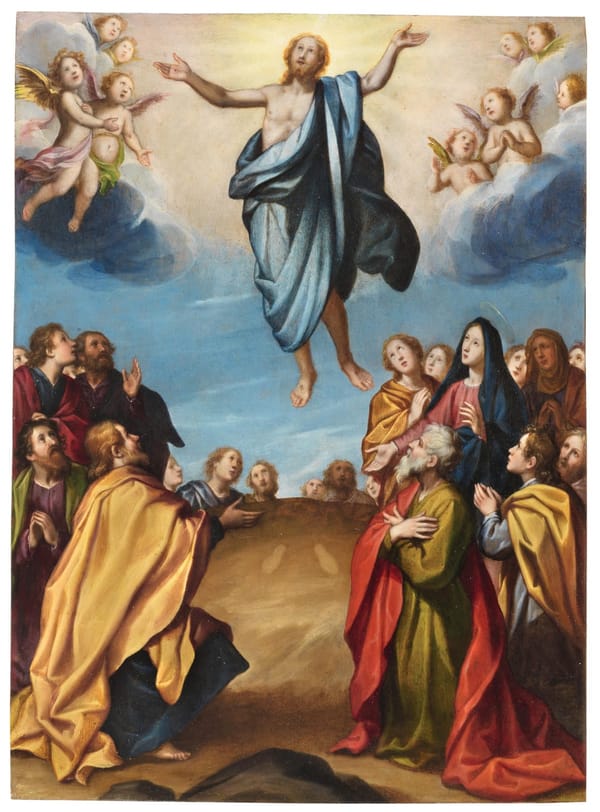
The feast of the Ascension shows us the work of God in its completion. Hence it is that the Church, in her daily offering of the holy sacrifice, thus addresses the eternal Father: the words occur immediately after the consecration, and contain the motives of her confidence in the divine mercy: ‘Wherefore, O Lord, we Thy servants, as also Thy holy people, calling to mind the blessed Passion of Christ Thy Son our Lord, His Resurrection from the dead, and His admirable Ascension into heaven, offer unto Thy most excellent Majesty a pure, holy, and unspotted Host.’ It is not enough for man to hope in the merits of his Redeemer’s Passion, which cleansed him from his sins; it is not enough for him to add to the commemoration of the Passion that of the Resurrection, whereby our Redeemer conquered death; man is not saved, he is not reinstated, except by uniting these two mysteries with a third: the Ascension of the same Jesus who was crucified and rose again. During the forty days of His glorified life on earth, Jesus was still an exile; and, like Him, we also are exiles until such time as the gate of heaven, which has been closed for four thousand years, shall be thrown open, both for Him and for us.
God, in His infinite goodness, made man for a nobler end than that of being mere lord of creation; He gave him a higher destiny than that of knowing such truths as his natural powers could grasp, and of practising virtues that were within the reach of his moral capabilities, and of paying to his Creator an imperfect worship. In His omnipotence and love, He gave to this frail creature an end far above his nature. Though inferior to the angel, and uniting in himself the two natures of matter and spirit, man was created to the same end as the angel. Both were to dwell for eternity in heaven; both were to be eternally happy in the face-to-face vision of God, that is, in the closest union with the sovereign Good. Grace—that wondrous and divine power—was to fit them for the supernatural end prepared for them by the gratuitous goodness of their Creator. This was the design which God had decreed from all eternity: to raise up to Himself these creatures that He had drawn out of nothingness, and to enrich them, agreeably to their sublime destiny, with the treasures of His love and His light.
We know the history of the fallen angels. They revolted against the commandment given them by God as a test of their fidelity, and as a condition of their being admitted into eternal happiness. Rebels were found in each of the choirs. They fell; but the fall and its punishment were personal, and injured none but the actual transgressors. The angels who remained faithful were at once rewarded with the beatific vision and possession of the sovereign Good. Thus did God vouchsafe to make created beings partake in His own infinite happiness: the first elect were the good angels of the nine choirs.
Man was created after the angels; he too fell, and his sin severed the link which united him with God. The human race was, at that time, represented by one man and woman; when they fell, all fell. The gate of heaven was then shut against mankind, for the fall of Adam and Eve implicated us their children; neither could they transmit to us an inheritance which they themselves had lost. Instead of a quick and happy passage through this world, and then a glorious ascension into heaven, we were to have a life short indeed but full of misery, a grave, and corruption. As to our soul, even had she aspired to the supernatural happiness for which she was created, she could never have attained to it. Man had preferred earth for his portion, and the earth was given to him; but this only for a few short years, after which others would take his place, disappear in their turn, and so on to the end, as long as it should please God to perpetuate this fallen portion of His creation.
Yes, it is thus we deserved to be treated; but our merciful Creator had compassion upon us. He hated sin; but He had created us that He might make us partakers of His own glory, and He would not have His design frustrated. The earth was not to be an abode for man to be merely born, live a few days, and then die. When the fulness of time should come, there was to appear in the world a Man, not indeed the first of a new creation, but one like ourselves and of our own race, or, as the apostle expresses it, ‘made of a woman.’1 This Man, who was to be heavenly and yet of earth, would share our misfortunes with us; He would die like us; He would be buried like us; but, on the third day, He would rise again, and men would see Him resplendent with glory and immortality. What a joy for us, who have within us ‘the answer of death,’ to see such a victory gained by One, who is one of ourselves, ‘flesh of our flesh!’
Thus were the divine intentions to be realized in our regard. Our earth presents to our Creator a new Adam. He cannot stay here, for He has conquered death; He must ascend to heaven, and if her gates be closed, she must open them and receive Him. ‘Lift up your gates, O ye princes! and be ye lifted up, O eternal gates! and the King of glory shall enter in!'2 Oh that He would take us thither with Him, for He is our brother, and He assures us that His ‘delight is to be with the children of men’!3 But what a joy it is for us to see our Jesus ascend to heaven! He is the holiest, the purest, the loveliest, of our race; He is the Son of a spotless Mother: let Him go and represent us in the kingdom of our inheritance. It is our own earth that sends Him; she is no longer a desert, now that she has produced such a flower, and such a fruit, for heaven. A flood of light poured into this lowly vale of tears, when the gates of heaven were raised up to receive Him. ‘Be Thou exalted, O Lord, in Thine own strength! and we, who are still on the earth, will sing and praise Thy power ’!4 Receive, O eternal Father, the brother whom we send to Thee; sinners though we are, this brother of ours is infinitely holy and perfect. Where is the curse that once fastened on our earth?’The earth hath given her fruit’!5 And if we may presume so far as to see in Him the first-fruits of a future harvest to be gathered into Thy house, may we not rejoice in the thought that the Ascension of our Jesus was the day whereon Thy primal work was restored to Thee?
Let us, to-day, borrow from the Armenian Church one of her sweetest hymns. Let us unite with her in sharing in the joy felt by the holy angels, when they saw the God-Man rising from earth, and taking possession of the highest throne in heaven.
May 7: St. Stanislaus, Bishop and Martyr
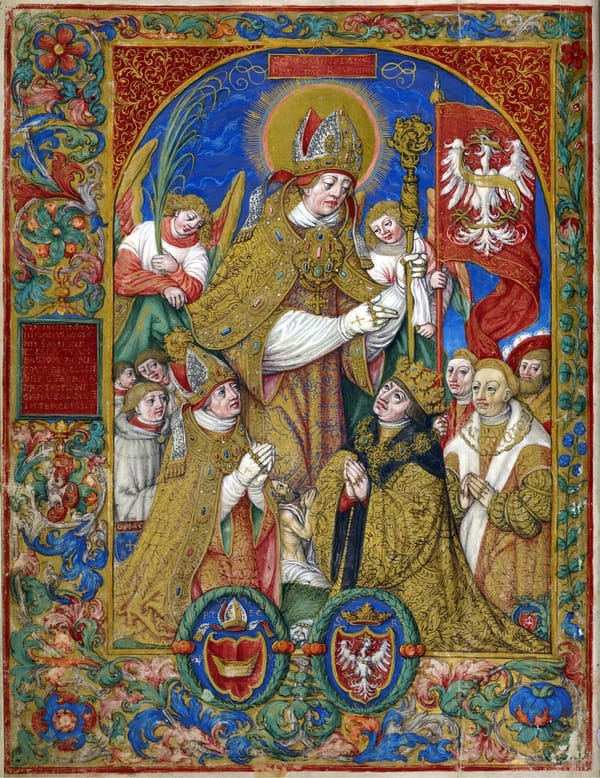 |
THE eleventh century, the century of contest between the priests of the Church and Barbarism, gives to-day another martyr to our Risen Jesus. It is Stanislaus, beloved by noble Poland as one of her chief protectors. He was slain at the altar by a Christian prince whom he had reproved for his crimes. The blood of the courageous Pontiff was mingled with that of our Redeemer in the same sacrifice. What an invincible energy there is in these lambs whom Jesus has sent amidst the wolves!1 They seem to be straightway changed into lions, as Jesus himself was at his Resurrection. There is not a century that has not had its martyrs: some for the faith, others for the unity of the Church, others for her liberty, others for justice, others for charity, and others, like our great Saint of to-day, for the maintenance of morals. The nineteenth century, too, has had its martyrs; scarcely a year elapses without our hearing of some who have been added to the bright list in the far East. At the commencement of the eighteenth century there was little probability of its providing such an abundant harvest of martyrdom as it did. Of one thing we are quite sure: whatever persecutions may arise in the future, the Spirit of fortitude will not be wanting to the champions of truth. Martyrdom is one of the Church's characteristics and it has never failed her. The Apostles who are very close to Jesus during these days preceding his Ascension drank the chalice which he drank; and only yesterday we were honouring the martyrdom of the favourite disciple—yes, even he had to tread the path prepared for all.
Holy Church tells us, in the account we now subjoin, how the saintly bishop of Cracow was offered the glorious chalice, and how courageously he accepted it.
Thou wast powerful in word and work, O Stanislaus! and our Lord rewarded thee with a martyr’s crown. From thy throne of glory, cast a look of pity upon us; obtain for us from God that gift of fortitude which was so prominent in thee, and which we so much need in order to surmount the obstacles which impede our progress. Our Risen Lord must have no cowards among his soldiers. He took by assault the kingdom into which he is about to enter; and he tells us plainly that if we would follow him thither, we must prepare to use violence.2 Brave soldier of the living God! obtain for us brave hearts. We need them for our combat—whether that be one of open violence for the faith or unity of the Church, or one which is to be fought with the invisible enemies of our salvation. Thou wast indeed a good shepherd, for the presence of the world neither made thee flee nor fear; ask our heavenly Father to send us shepherds like thee. Succour Holy Church, for she has to contend with enemies in every part of the world. Convert her persecutors, as thou didst convert Boleslaus; he was thy murderer, but thy martyrdom won mercy for him. Remember thy dear Poland, which honours thee with such fervent devotion. Be with her now that she has regained her rank among nations. During the severe triads which her sins drew down upon her, she maintained the sacred link of Catholic Faith and unity; she was patient and faithful; our Risen Jesus has had pity on her, and rewarded her patience and fidelity by granting her a share in his own Resurrection.
| Previous May 6: St. John before the Latin Gate | Next May 7: St. Stanislaus, Bishop and Martyr |