Daily reading
Paschal Time
Double · May 19 · Sanctoral
May 19, 2027
From Dom Guéranger’s The Liturgical Year.
A Double leads the weekday; St. Pudentiana is commemorated.Rubrics
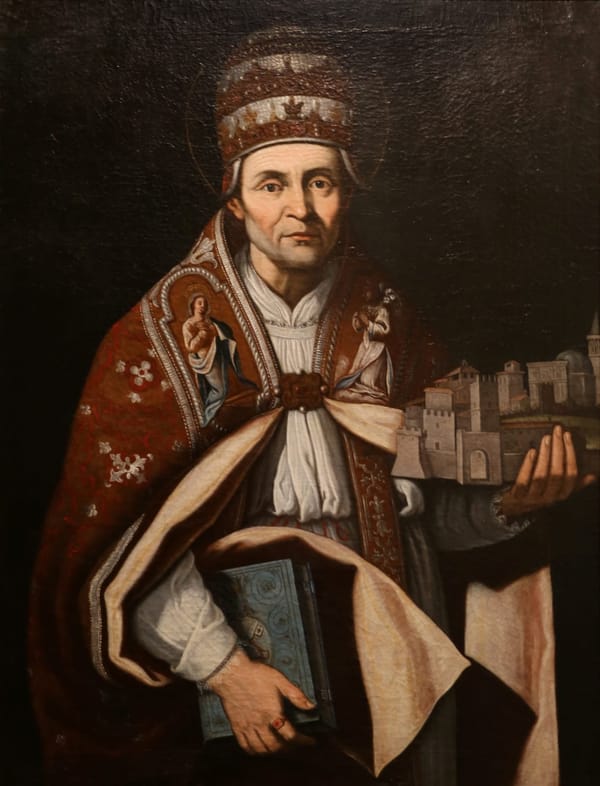 |
May 19: St. Peter Celestine, Pope
OUR Paschal season, which has already given us the admirable Doctor St Leo, brings before us to-day the humble Peter Celestine. He was, like Leo, sovereign pontiff, but no sooner was he throned on the chair of Peter than he left it and returned to solitude. Among the long list of sainted men who compose the venerable series of Roman Pontiffs, our Lord would have one in whose person was to be represented the virtue of humility; that honour was conferred on Peter Celestine. He was dragged from the quiet of his solitude, compelled to ascend the throne of St Peter, and made to hold in his trembling hand the keys of the kingdom of heaven. The holy hermit, whose eyes had been ever fixed on his own weakness, had then to provide for the necessities of the whole Church. In his humility, he judged himself to be unequal to so heavy a responsibility. He resigned the tiara, and begged to be permitted to return to his dear hermitage. His divine Master, Christ, had, in like manner, concealed his glory, first in thirty years of hidden life, and then, later on, under the cloud of his Passion and Sepulchre. The sunshine of the Pasch came; the gloom was dispersed, and the Conqueror of Death arose in all his splendour. He would have his servants share in his triumph and glory; but their share is to be greater or less, according to the measure in which they have, here on earth, imitated his humility. Who, then, could describe the glory which Peter Celestine receives in heaven, as a recompense for the profound humility which made him more eager to be unknown than the most ambitious of men could be for honour and fame? He was great on the pontifical throne, and still greater in his solitude; but his greatness, now that he is in heaven, surpasses all human thought.
Holy Church speaks his praise in these few lines; their simplicity admirably harmonizes with the hermit Pope, whose life they narrate:
Thou didst obtain, O Celestine, the object of thy ambition. Thou wast permitted to descend from the Apostolic Throne, and return to the quiet of that hidden life, which for so many years had been thy delight. Enjoy to thy heart's content the holy charm of being unknown to the world, and the treasures of contemplation in the secret of the face of God.1 But this life of obscurity must have an end; and then the Cross—the Cross which thou hast loved above all earthly possessions—will rise up in brightness before thy cell door, and summon thee to share in the Paschal triumph of him who came down from heaven to teach us this great truth, that he that humbleth himself shall be exalted.2 Thy name, O Celestine, will for ever shine on the list of Roman Pontiffs; thou art one of the links of that glorious chain which unites Holy Church with Jesus, her Founder and her Spouse; but a still greater glory is reserved for thee—the glory of being for ever with this same Risen Jesus. Holy Church, which during the short period of thy holding the keys of Peter, was obedient to thee, has now for centuries paid, and will continue to the end of the world to pay thee the tribute of her devotion, because she recognizes in thee one of God's elect, one of the princes of the heavenly court. And we, O Celestine, we also are invited to ascend where thou art, and contemplate, together with thee, the most beautiful among the children of men,3 the Conqueror of sin and hell. But there is only one path that can lead us thither; it is the path thou didst tread—the path of humility. Pray for us that we may be solidly grounded in this virtue, and desire it with all our hearts; that we may change our miserable self-esteem into an honest self-contempt; that we may despise all human glory, and be courageous, yea, cheerful under humiliation; and that thus having drunk of the torrent, as did our divine Master, we may one day, like him, lift up our heads,4 and cluster round his throne for all eternity.
May 19 (the Same Day): St. Pudentiana, Virgin
THIS same nineteenth of May has another glory attached to it; it is the day on which died the noble virgin Pudentiana. That name carries us back to the very first age of the Christian Church. She was a daughter of a wealthy Roman, called Pudens, a kinsman of the Pudens spoken of by St Paul, in his second Epistle to Timothy.1 She and her sister Praxedes had the honour of being numbered among the earliest members of the Church, and both of them consecrated their virginity to Jesus Christ. Upon their father’s death, the two sisters distributed their fortune to the poor, and devoted their whole time to good works. It was the eve of the persecution under Antoninus. Pudentiana, though scarcely sixteen years of age, was ripe for heaven, and winged her flight to her divine Spouse when the storm was at its height. Her sister survived her many years: we shall commemorate her saintly memory on July 21.
Pudentiana’s house, which in her grandfather’s time had been honoured by St Peter’s presence, was made over by the holy virgin herself to Pope Pius I, and the divine mysteries were celebrated in it. It is now one of the most venerable churches of Rome, and is the Station for the Tuesday of the third week of Lent.
Pudentiana is a tender floweret offered to our Risen Jesus by the Roman Church. Time has diminished nought of the fair lily’s fragrance; and pure as her very name, her memory will live in the hearts of the Christian people even to the end of the world.
The eulogy passed upon her by the holy Liturgy is but a commemoration; and yet says so much, and will say it each year, as long as time itself shall last.
Like the dove of Noe’s Ark, that found not where to rest her feet on the guilty earth, thou didst take thy flight, O Pudentiana, and rest in the bosom of Jesus, thy Spouse. Thus will it be at the end of the world, when the souls of the elect shall have been reunited to their bodies: they will fly like eagles to their King, and will cluster around him as the object of all their desires.2 They will flee from this sinful earth, as thou didst from the abominations of pagan Rome, that was drunk with the blood of the martyrs.3 We celebrate thy departure, dear youthful Saint, with a feeling of hope for our own future deliverance; we honour thy entrance into thy eternal home, and we long to be there, together with thee. Oh! gain for us detachment from all transitory things, intenser love of the new life which came to us with Easter, and indifference as to what concerns that other lower life, which is not that of our Risen Lord. Thou wast a daughter of the holy Church of Rome; pray, then, for thy mother. She is suffering now as she did during the pontificate of Pius I. After having reigned over Christian nations for centuries, she is now abandoned and disowned by the very people that owe all they have to her, and yet are now turning her own blessings against her. Use thine influence, O Pudentiana! assist and protect thine and our dearest mother.
Wednesday in Whitsun Week
|
We have seen with what fidelity the Holy Ghost has fulfilled, during all these past ages, the mission He received from our Emmanuel, of forming, protecting, and maintaining His bride the Church. This trust given by a God has been executed with all the power of a God, and it is the sublimest and most wonderful spectacle the world has witnessed during the eighteen hundred years of the new Covenant. This continuance of a social body, the same in all times and places; promulgating a precise Symbol of faith which each of its members is bound to accept; producing by its decisions the strictest unity of religious belief throughout the countless individuals who compose the society: this, and the wonderful propagation of Christianity, are the master facts of history. These two facts are not, as certain modern writers would have it, results of the ordinary laws of Providence; but miracles of the highest order, worked directly by the Holy Ghost, and intended to serve as the basis of our faith in the truth of the Christian religion. The Holy Ghost was not, in the exercise of His mission, to assume a visible form; but He has made His presence visible to the understanding of man, and thereby He has sufficiently proved His own personal action in the work of man’s salvation.
Let us now follow this divine action, not in its carrying out the merciful designs of the Son of God, who deigned to take to Himself a bride here below, but in the relations of this bride with mankind. Our Emmanuel willed that she should be the mother of men; and that all, whom He calls to the honour of becoming His own members, should acknowledge that it is she who gives them this glorious birth. The Holy Ghost, therefore, was to secure to this bride of Jesus what would make her evident and known to the world, leaving it, however, in the power of each individual to disown and reject her.
It was necessary that this Church should last for all ages, and that she should traverse the earth in such wise that her name and mission might be known to all nations; in a word, she was to be Catholic, that is, universal, taking in all times and all places. Accordingly, the Holy Ghost made her Catholic. He began by showing her, on the day of Pentecost, to the Jews who had flocked to Jerusalem from the various nations; and when these returned to their respective countries, they took the good tidings with them. He then sent the apostles and disciples into the whole world; and we learn from the writers of those early times, that a century had scarcely elapsed before there were Christians in every portion of the known earth. Since then, the visibility of this holy Church has gone on increasing gradually more and more. If the divine Spirit, in the designs of His justice, permitted her to lose her influence in a nation that had made itself unworthy of the grace, He transferred her to another where she would be obeyed. If, at times, there have been whole countries where she had no footing, it was either because she had previously offered herself to them and they had rejected her, or because the time marked by Providence for her reigning there had not yet come. The history of the Church’s propagation is one long proof of her perpetuity, and of her frequent migrations. Times and places, all are hers; if there be one wherein she is not acknowledged as supreme, she is at least represented by her members; and this prerogative, which has given her the name of Catholic, is one of the grandest of the workings of the Holy Ghost.
But His action does not stop here: the mission given Him by the Emmanuel in reference to His bride obliges Him to something beyond this; and here we enter into the whole mystery of the Holy Ghost in the Church. We have seen His outward influence, whereby He gives her perpetuity and increase; now we must attentively consider the inward direction she receives from Him, which gives her unity, infallibility, and holiness—prerogatives which, together with Catholicity, designate the true bride of Christ.
The union of the Holy Ghost with the Humanity of Jesus is one of the fundamental truths of the mystery of the Incarnation. Our divine mediator is called Christ because of the anointing which He received;1 and His anointing results from the union of His Humanity with the Holy Ghost.2 This union is indissoluble; eternally will the Word be united to His Humanity; eternally, also, will the holy Spirit give to this Humanity the anointing which makes Christ. Hence it follows, that the Church, being the body of Christ, shares in the union existing between its divine Head and the Holy Ghost. The Christian, too, receives in Baptism an anointing by the Holy Ghost, who, from that time forward, dwells in him as the pledge of his eternal inheritance:3 but, whilst the Christian may by sin forfeit this union, which is the principle of his supernatural life, the Church herself never can lose it. The Holy Ghost is united to the Church for ever; it is by Him she exists, acts, and triumphs over all those difficulties, to which by the divine permission she is exposed while militant on earth.
St. Augustine thus admirably expresses this doctrine in one of his sermons for the feast of Pentecost: ‘The spirit, by which every man lives, is called the soul. Now, observe what it is that our soul does in the body. It is the soul that gives life to all the members; it sees by the eye, it hears by the ear, it smells by the nose, it speaks by the tongue, it works by the hands, it walks by the feet. It is present to each member, giving life to them all, and to each one its office. It is not the eye that hears, nor the ear and tongue that see, nor the ear and eye that speak; and yet they all live; their functions are varied, their life is one and the same. So it is in the Church of God. In some saints she works miracles; in other saints she teaches the truth; in others she practises virginity; in others she maintains conjugal chastity. She does one thing in one class, and another in another: each individual has his distinct work to do; but there is one and the same life in them all. Now, what the soul is to the body of man, that the Holy Ghost is to the body of Christ, which is the Church: the Holy Ghost does in the whole Church what the soul does in all the members of one body.’4
Here we have a clear exposition, by means of which we can fully understand the life and workings of the Church. The Church is the body of Christ, and the Holy Ghost is the principle which gives her life. He is her soul—not only in that limited sense in which we have already spoken of the soul of the Church, that is, of her inward existence, and which, after all, is the result of the holy Spirit’s action within her—but He is also her soul, in that her whole interior and exterior life, and all her workings, proceed from Him. The Church is undying, because the love, which has led the Holy Ghost to dwell within her, will last for ever: and here we have the reason of that perpetuity of the Church, which is the most wonderful spectacle witnessed by the world.
Let us now pass on, and consider that other marvel, which consists in the preservation of unity in the Church. It is said of her in the Canticle: 1 One is my dove; my perfect one is One.’5 Jesus would have but one, and not many, to be His Church, His bride: the Holy Ghost will, therefore, see to the accomplishment of His wish. Let us respectfully follow Him in His workings here also. And firstly, is it possible, viewing the thing humanly, that a society should exist for eighteen hundred years, and never change? Nay, could it have continued all that time, even allowing it to have changed as often as you will? And during these long ages, this society has necessarily had to encounter, and from its own members, the tempests of human passions, which are ever showing themselves, and which not un frequently play havoc with the grandest institutions. It has always been composed of nations differing from each other in language, character, and customs; either so far apart as not to know each other, or, when neighbours, estranged one from the other by national jealousies and antipathies. And yet, notwithstanding all this—notwithstanding, too, the political revolutions which have made up the history of the world—the Catholic Church has maintained her changeless unity: one faith, one visible head, one worship (at least in the essentials), one mode of deciding every question, namely, by tradition and authority. Sects have risen up in every age, each sect giving itself out as the true Church: they lasted for a while, short or long according to circumstances, and then were forgotten. Where are now the Arians with their strong political party? Where are the Nestorians, and Eutychians, and Monothelites, with their interminable cavillings? Could anything be imagined more powerless and effete than the Greek schism, slave either to Sultan or Czar? What is there left of Jausenism, which wore itself away in striving to keep in the Church in spite of the Church? As to Protestantism, the produce of the principle of negation, was it not broken up into sections from its very beginning, so as never to be able to form one society? And is it not now reduced to such straits, that it can with difficulty retain dogmas, which, at first, it looked upon as fundamental, such as the inspiration of the Scriptures, or the Divinity of Christ?
Whilst all else is change and ruin, our mother the holy Catholic Church, the one bride of the Emmanuel, stands forth grand and beautiful in her unity. But how are we to account for it? Is it, that Catholics are of one nature, and sectarians of another? Orthodox or heterodox, are we not all members of the same human race, subject to the same passions and errors? Whence do the children of the Catholic Church derive that stability, which is not affected by time, nor influenced by the variety of national character, nor shaken by those revolutions that have changed dynasties and countries? Only one reasonable explanation can be given: there is a divine element in all this. The Holy Ghost, who is the soul of the Church, acts upon all the members; and as He Himself is One, He produces unity in the body He animates. He cannot contradict Himself: nothing, therefore, subsists by Him, which is not in union with Him.
To-morrow, we will speak of what the Holy Ghost does for maintaining faith, one and unvarying, in the whole body of the Church; let us, to-day, limit our considerations to this single point, namely, that the holy Spirit is the source of external union by voluntary submissson to one centre of unity. Jesus had said: ‘Thou art Peter, and upon this rock I will build my Church:’6 now, Peter was to die; the promise, therefore, could not refer to his person alone, but to the whole line of his successors, even to the end of the world. How stupendous is the action of the Holy Ghost, who thus produces a dynasty of spiritual princes, which has reached its two hundred and fiftieth Pontiff, and is to continue to the last day! No violence is offered to man’s free will; the holy Spirit permits him to attempt what opposition he lists; but the work of God must go forward. A Decius may succeed in causing a four years’ vacancy in the See of Rome; antipopes may arise, supported by popular favour, or upheld by the policy of emperors; a long schism may render it difficult to know the real Pontiff among the several who claim it: the holy Spirit will allow the trial to have its course, and, while it lasts, will keep up the faith of His children; the day will come when He will declare the lawful Pastor of the flock, and the whole Church will enthusiastically acknowledge him as such.
In order to understand the whole marvel of this supernatural influence, it is not enough to know the extrinsic results as told us by history; we must study it in its own divine reality. The unity of the Church is not like that which a conqueror forces upon a people that has become tributary to him. The members of the Church are united in oneness of faith and submission, because they love the yoke she imposes on their freedom and their reason. But who is it, that thus brings human pride to obey? Who is it, that makes joy and contentment be felt in a life-long practice of subordination? Who is it that brings man to put his security and happiness in having no individual views of his own, and in conforming his judgment to one supreme teaching, even in matters where the world chafes at control? It is the Holy Ghost who works this manifold and permanent miracle, for He it is who gives soul and harmony to the vast aggregate of the Church, and sweetly infuses into all these millions a union of heart and mind which forms for our Lord Jesus Christ His one dear bride.
During the days of His mortal life, Jesus prayed His eternal Father to bless us with unity: ‘May they be one, as we also are.’7 He prepares us for it, when He calls us to become His members; but, in order to achieve this union, He sends His Spirit into the world, that Spirit, who is the eternal link between the Father and the Son, and who deigns to accept a temporal mission among men, in order to create on the earth a union formed after the type of the union which is in God Himself.
We give Thee thanks, O blessed Spirit! who, by dwelling thus within the Church of Christ, inspirest us to love and practise unity, and suffer every evil rather than break it. Strengthen it within us, and never permit us to deviate from it by even the slightest want of submission. Thou art the soul of the Church; oh! give us to be members ever docile to Thy inspirations, for we could not belong to Jesus who sent Thee, unless we belong to the Church, His bride and our mother, whom He redeemed with His Blood, and gave to Thee to form and guide.
Next Saturday, the ordination of priests and sacred ministers is to take place throughout the whole Church. The Sacrament of Orders is one of the principal workings of the Holy Ghost, who comes into the souls of those who are presented for ordination, and impresses upon them, by the bishop’s hands, the character of priesthood or deaconship. The Church prescribes a three days’ fast and abstinence; with the intention of obtaining from God’s mercy, that the grace thus given may fructify in those who receive it, and bring a blessing upon the faithful. This is the first of the three days.
At Rome, the station is in the basilica of Saint Mary Major. It was but right that on one of the days of this great octave the faithful should meet together under the protection of the Mother of God, whose participation in the mystery of Pentecost, was a glory and a blessing to the infant Church.
We will close this day with one of the finest of Adam of Saint Victor’s sequences on the mystery of the Holy Ghost.
Sequence
Qua de throno missus ignis
In Christi discipulos
Corda replet, linguas ditat,
Ad concordes nos invitat
Linguæ cordis modulos.
Pignus sponsae, quam revisit
Die quinquagesima;
Post dulcorem melleum
Petra fudit oleum,
Petra jam firmissima.
Non in linguis igneis,
Lex de monte populo;
Paucis cordis novitas
Et linguarum unitas,
Datur in cœnaculo.
Dies, in qua primitiva
Fundatur Ecclesia!
Vivæ sunt primitiæ
Nascentis Ecclesiae,
Tria primum millia.
Sub una sunt adoptivi
Fide duo populi:
Se duobus interjecit
Sicque duos unum fecit
Lapis, caput anguli.
Sunt capaces novi musti:
Vasa parat vidua:
Liquorem dat Eliseus:
Nobis sacrum rorem
Deus, Si corda sint congrua.
Non hoc sumus digni rore,
Si discordes moribus.
In obscuris vel divisis,
Non potest haec
Paradisis Habitare cordibus.
Linguas rege, corda leni:
Nihil fellis aut veneni
Sub tua praesentia.
Nil jocundum, nil amoenum,
Nil salubre, nil serenum,
Nihil dulce, nihil plenum,
Sine tua gratia.
Tu cœleste condimentum,
Aquæ ditans elementum
Virtute mysterii.
Nova facti creatura,
Te laudamus mente pura,
Gratiæ nunc, sed natura
Prius irae filii.
Nostri cordis omne bonum,
Cor ad laudem redde pronum,
Nostræ linguæ formans sonum,
In tua præconia.
Auctor ipse puritatis,
Et in Christo renovatis
Da perfectae novitatis
Plena nobis gaudia!
—wherewith the heaven-sent Fire
filled the hearts of Jesus’ disciples
and gave them to speak in divers tongues
—invites us now to sing our hymns
with hearts in concord with the voice.
Christ revisited his bride,
by sending her the pledge he had promised.
After tasting the honeyed sweetness,
Peter, now the firmest of rocks,
pours forth the unction of his preaching.
was given on the mount to the people,
but it was written on tablets of stone,
and not on fiery tongues: but in the cenacle,
there was given to a chosen few
newness of heart and knowledge of all tongues.
whereon was founded
the primitive Church!
Three thousand souls!
Oh! how vigorous the first fruits
of the new born Church!
to be offered in the ancient Law
prefigured the two adopted
people now made one; the stone,
the head of the corner,
set himself between the two, and made both one.
into old bottles, but into new:
the widow prepares her vessels,
and Eliseus fills them with oil:
so, too, our God gives us his heavenly dew,
if our hearts be ready.
we are not fit to receive the wine,
or the oil,
or the dew.
The Paraclete can never dwell
in dark or divided hearts.
govern our tongues, soften our hearts:
where thou art, must be no gall or poison.
Nothing is joyous, nothing pleasant,
nothing wholesome,
nothing peaceful,
nothing sweet, nothing full,
save by thy grace.
thou the heavenly Saviour
that enrichest the element of water
with mysterious power.
We praise thee with hearts made pure;
we that have been made a new creature;
we that once, by nature, were children of wrath,
but now children of grace.
O thou, the only good of our hearts!
make our hearts eager to praise thee,
and teach our tongues
to sound forth thy glory.
purify us from sin!
Renew us in Christ;
and then, give us the full joy
of perfect newness!
Wednesday in Whitsun Week: The Gift of Fortitude
The gift of knowledge has taught us what we must do and what we must avoid, in order that we may be such as Jesus, our divine Master, wishes us to be. We now need another gift of the Holy Ghost, from which to draw the energy necessary for persevering in the way He has pointed out to us. Difficulties we are sure to have; and our need of support is proved enough by the miserable failures we are daily witnessing. This support the Holy Ghost grants us by the gift of fortitude, which, if we but faithfully use it, will enable us to master every difficulty, yea, will make it easy to us to overcome the obstacles which would impede our onward march.
When the difficulties and trials of life come upon him, man is tempted, sometimes to cowardice and discouragement, sometimes to an impetuosity which arises either from his natural temperament or from pride. These are poor aids to the soul in her spiritual combat. The Holy Ghost, therefore, brings her a new element of strength: it is supernatural fortitude, which is so peculiarly His gift, that when our Saviour instituted the seven sacraments, He would have one of them be for the special object of giving us the Holy Ghost as a principle of energy. It is evident that, having to fight during our whole lives against the devil, the world, and ourselves, we need some better power of resistance than either pusillanimity or daring. We need some gift, which will control both our fear, and the confidence we are at times inclined to have in ourselves. Thus gifted by the Holy Ghost, man is sure of victory; for grace will supply the deficiencies, and correct the impetuosities of nature.
There are two necessities, which are ever making themselves felt in the Christian life: the power of resistance, and the power of endurance. What could we do against the temptations of satan, if the fortitude of the holy Spirit did not clothe us with heavenly armour and nerve us for the battle? And is not the world, too, a terrible enemy? Have we not reason to dread it when we see how it is every day making victims by the tyranny of its claims and its maxims? What, then, must be the assistance of the Holy Ghost, which is to make us invulnerable to the deadly shafts that are dealing destruction around us?
The passions of the human heart are another obstacle to our salvation and sanctification; they are the more to be feared, because they are within us. It is requisite that the Holy Ghost change our heart, and lead it to deny itself as often as the light of grace points out to us a way other than that which selflove would have us follow. What supernatural fortitude we need in order to hate our life,1 as often as our Lord bids us make a sacrifice, or when we have to choose which of the two masters we will serve!2 The holy Spirit is daily working this marvel by means of the gift of fortitude: so that, we have but to correspond to the gift, and not stifle it either by cowardice or indiscretion, and we are strong enough to resist even our domestic enemies. This blessed gift of fortitude teaches us to govern our passions and treat them as blind guides; it also teaches us never to follow their instincts, save when they are in harmony with the law of God.
There are times, when the holy Spirit requires from a Christian something beyond interior resistance to the enemies of his soul: he must make an outward protestation against error and evil, as often as position or duty demands it. On such occasions, he must bear to become unpopular, and console himself with the words of the apostle: ‘If I yet pleased men, I should not be the servant of Christ.’3 But the Holy Ghost will be on his side; and finding him resolute in using His gift of fortitude, not only will He give him a final triumph, but He generally blesses that soul with a sweet and courageous peace, which is the result and recompense of a duty fulfilled.
Thus does the Holy Ghost apply the gift of fortitude, when there is question of a Christian’s making resistance. But, as we have already said, He imparts also the energy necessary for bearing up against the trials, which all must go through who would save their souls. There are certain fears, which damp our courage, and expose us to defeat. The gift of fortitude dispels them, and braces us with such a peaceful confidence, that we ourselves are surprised at the change. Look at the martyrs: not merely at such an one as Saint Mauritius, the leader of the Theban legion, who was accustomed to face danger on the battle-field; but at Felicitas, a mother of seven children; at Perpetua, a high-born lady with everything this world could give her; at Agnes, a girl of thirteen; and at thousands of others like them: and say, if the gift of fortitude is not a prompter to heroism. Where is the fear of death—that death the very thought of which is sometimes more than we can bear? And what are we to say of all those lives spent in self-abnegation and privation with a view to make Jesus their only treasure and to be the more closely united with Him? What are we to say of those hundreds and thousands of our fellow-creatures who shun the sight of a distracted and vain world, and make sacrifice their rule? whose peacefulness is proof against every trial, and whose acceptance of the cross is as untiring as the cross itself is in its visit? What trophies are these of the Spirit of fortitude! and how magnificent is the devotedness He creates for every possible duty! Oh! truly, man of himself is of little worth; but, how grand when under the influence of the Holy Ghost!
It is the same divine Spirit who also gives the Christian courage to withstand the vile temptation of human respect, by raising him above those worldly considerations which would make him disloyal to duty. It is He that leads man to prefer, to every honour this world could bestow, the happiness of never violating the law of his God. It is the Spirit of fortitude that makes him look upon the reverses of fortune as so many merciful designs of Providence; that consoles him, when death bereaves him of those who are dear to him; that cheers him under bodily Bufferings, which would be so hard to bear but for bis taking them as visits from his heavenly Father, In a word, it is He, as we learn from the lives of the saints, that turns the very repugnances of nature into matter for heroic acts, wherein man seems to go beyond the limits of his frail mortality and emulate the impassible and glorified spirits of heaven.
O divine Spirit of fortitude! take full possession of our souls, and keep us from the effeminacies of the age we live in. Never was there such lack of energy as now, never was the worldly spirit more rife, never was sensuality more unbridled, never were pride and independence more the fashion of the world. So forgotten and unheeded are the maxims of the Gospel, that when we witness the fortitude of self-restraint and abnegation, we are as surprised as though we beheld a prodigy. O holy Paraclete! preserve us from this anti-Christian spirit, which is so easily imbibed! Suffer us to present to Thee, in the form of prayer, the advice given by Saint Paul to the Christians of Ephesus: ‘Give us, we beseech Thee, the armour of God, that we may be able to resist in the evil day, and to stand in all things perfect. Gird our reins with truth; arm us with the breast-plate of justice; let our feet be shod with the love and practice of the Gospel of peace; give us the shield of faith, wherewith we may be able to extinguish all the fiery darts of the most wicked one; cover us with the helmet of the hope of salvation; put into our hand the spiritual sword, which is the word of God,’4 and by which we, as did our Jesus in the desert, may defeat all our enemies! O Spirit of fortitude! hear, we beseech Thee, and grant our prayer!
| Previous May 18: St. Venantius, Martyr | Next May 19 (the Same Day): St. Pudentiana, Virgin |