Daily reading
May 24 · Sanctoral
May 24, 2027
From Dom Guéranger’s The Liturgical Year.
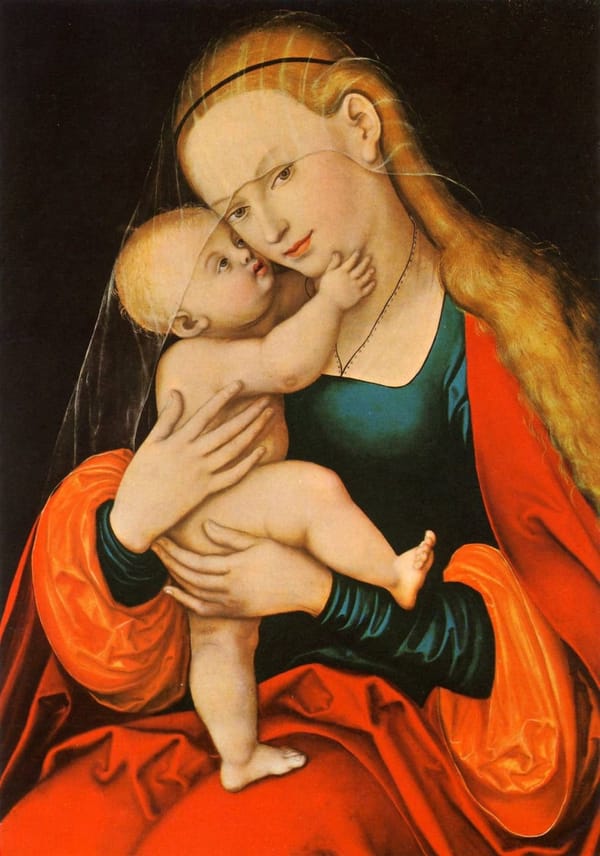
May 24: Feast of Our Lady, Help of Christians
EVER since our entrance upon the joys of the Paschal season, scarcely a day has passed without offering us some grand mystery or Saint to honour; and all these have been radiant with the Easter sun. But there has not been a single feast of our blessed Lady to gladden our hearts by telling us of some mystery or glory of this august Queen. The feast of her Seven Dolours is sometimes kept in April—that is, when Easter Sunday falls on or after the 10th of that month; but May and June pass without any special solemnity in honour of the Mother of God. It would seem as though Holy Church wished to honour, by a respectful silence, the forty days during which Mary enjoyed the company of her Jesus, after his Resurrection. We, therefore, should never separate the Mother and the Son, if we would have our Easter meditations be in strict accordance with truth—and that we surely must wish. During these forty days, Jesus frequently visits his disciples, weak men and sinners as they are: can he, then, keep away from his Mother, now that he is so soon to ascend into heaven, and leave her for several long years here on earth? Our hearts forbid us to entertain the thought. We feel sure that he frequently visits her, and that when not visibly present with her, she has him in her soul, in a way more intimate and real and delicious than any other creature could have.
No feast could have given expression to such a mystery; and yet the Holy Ghost, who guides the spirit of the Church, has gradually led the faithful to devote in an especial manner to the honour of Mary the entire month of May, the whole of which comes, almost every year, under the glad season of Easter. No doubt, the loveliness of the month would, some time or other, suggest the idea of consecrating it to the holy Mother of God; but if we reflect on the divine and mysterious influence which guides the Church in all that she does, we shall recognize, in this present instance, a heavenly inspiration, which prompted the faithful to unite their own happiness to that of Mary, and spend this beautiful month, which is radiant with their Easter joy, in commemorating the maternal delight experienced, during that same period, by the immaculate Mother when oh earth.
To-day, however, we have a feast in honour of Mary. True, it is not one of those feasts which are entered on the general Calendar of the Church; yet is it so widely spread, with the consent of the Holy See, that our Liturgical Year would have been incomplete without it. Its object is to honour the Mother of God as the Help of Christians—a title she has justly merited by the innumerable favours she has conferred upon Christendom. Dating from that day whose anniversary we are soon to celebrate, when the Holy Ghost descended upon Mary in the Cenacle, in order that she might begin to exercise over the Church Militant her power as Queen—who could tell the number of times that she has aided, by her protection, the kingdom of her Son on earth?
Heresies have risen up, one after the other; they were violent; they were frequently supported by the great ones of this world; each of them was resolved on the destruction of the true faith; and yet, one after the other, they have dwindled away, or fallen into impotency; those of the present day are gradually sinking by internal discord; and Holy Church tells us that it is Mary who ' alone destroys all heresies throughout the whole world.'1 If public scandals or persecutions, or the tyranny of secular interference, have at times threatened to stay the progress of the Church, Mary has stretched forth her arm, the obstacles were removed, and the Spouse of Jesus continued her onward march, leaving her foes and her fetters behind her. All this was vividly brought before the mind of the saintly Pontiff, Pius V, by the victory of Lepanto, gained by Mary’s intercession, over the Turkish fleet, and he resolved to add one more title to the glorious list given to our Lady in the Litany: it was Auxilium Christianorum, Help of Christians.
The nineteenth century had the happiness of seeing another Pontiff, also named Pius, institute a feast under this same title—a feast which is intended to commemorate the help bestowed on Christendom in all ages by the Mother of God. Nothing could be happier than the choice of the day on which this feast was to be kept. On May 24, in the year 1814, there was witnessed in Rome the most magnificent triumph that has yet been recorded in the annals of the Church. That was a grand day, whereon Constantine marked out the foundations for the Vatican Basilica in honour of the Prince of the Apostles; Sylvester stood by, and blessed the Emperor, who had just been converted to the true faith: but important as was this event, it was but a sign of the last and decisive victory won by the Church in the then recent persecution of Diocletian. That was a grand day whereon Leo III, Vicar of the King of kings, crowned Charlemagne with the imperial diadem, and by his apostolic power gave continuance to the long interrupted line of Emperors: but Leo III, by this, did but give an official and solemn expression to the power which the Church had already frequently exercised in the newly constituted nations, which received from her the idea of Christian government, the consecration of their rights, and the grace that was to enable them to fulfil their duties. That was a grand day, whereon Gregory IX restored to the city of Peter the Papal Throne, which had been transferred to Avignon for seventy sad years: but Gregory IX, in this, did but fulfil a duty, and his predecessors, had they willed it. might have effected this return to Rome for which the necessities of Christendom so imperatively called.
Yes, all these were glorious days; but May 24 of 1814 surpasses them all. Pius VII re-entered Rome amidst the acclamations of the holy City, whose entire population went forth to meet him, holding palm branches in their hands, and greeting him with their hosannas of enthusiastic joy. He had been a captive for five years, during which the spiritual government of the Christian world had suffered a total suspension. It was not the Powers allied against his oppressor who broke the Pontiff’s fetters; the very tyrant who kept him from Rome had given him permission to return at the close of the preceding year; but the Pontiff chose his own time, and did not leave Fontainebleau till January 25. Rome, whither he was about to return, had been made a part of the French Empire, five years previously, by a decree in which was cited the name of Charlemagne! The city of Peter had been made the head town of a Department, with a prefect for its administrator; and, with a view to making men forget that it was the city of the Vicars of Christ, the tyrant gave its name as a title to the heir-presumptive of the Imperial crown of France.
What a day was that 24th of May, which witnessed the triumphant return of the Pontiff into the holy City, whence he had been dragged during the night by the soldiers of an ambitious tyrant! He made the journey in short stages, meeting, on his way, the allied armies of Europe, who recognized his right as King. This right is superior, both in antiquity and dignity, to that of all other monarchs; and all, no matter whether they be heretics, schismatics, or Catholics, must admit it, were it only on the strength of its being an historical fact.
But what we have said so far is not sufficient to give an adequate idea of the greatness of the prodigy thus achieved by our Lady Help of Christians. In order to have a just appreciation of it, we must remember that the miracle was not wrought in the age of Sylvester and Constantine, or of St Leo III and Charlemagne, or of the great prophetess Catharine of Siena, who made known the commands of God to the people of Italy and to the Popes of Avignon. The century that witnessed this wondrous event was the nineteenth. Europe was under the degrading influence of Voltairism, and there were still living the authors and abettors of the crimes and impieties that resulted from the principles taught in the eighteenth century. Everything was adverse to such a glorious and unexpected triumph; Catholic feeling was far from being roused as it now is; the action of God's providence had to show itself in a direct and visible manner; and to let the Christian world know that such was the case, Rome instituted the annual feast of May 24, as an offering of acknowledgement to Mary, Help of Christians.
Let us now weigh the importance of the twofold restoration which was wrought on this day by the intercession of the holy Mother of God. Pius VII had been forcibly taken from Rome and dethroned; on this May 24 he was reinstated in Rome, both as Pope and as temporal sovereign. On the Feasts of St Peter’s Chair at Rome and at Antioch, we gave our readers the doctrine of the Church, which teaches us that the succession to the rights conferred by Christ upon St Peter belongs to the Bishop of Rome. From this it follows that residence in the city of Rome is both the right and the duty of the successor of St Peter, save in the case of his deeming a temporary absence to be demanded by circumstances. Whosoever, therefore, by means of physical force, keeps the Sovereign Pontiff out of Rome, or prevents him from residing there, is acting in opposition to the Divine Will; for the pastor ought to be in the midst of his flock: and Rome having been made by Christ the head of all Churches, these have a right to find in Rome him who is both the infallible doctor of faith and the source of all spiritual jurisdiction. The first blessing, therefore, for which we are indebted to Mary on this day, is that she brought back the pastor to his flock, and restored the supreme government of Holy Church to its normal state.
The second is her having reinstated the Pontiff in possession of his temporal power, the surest guarantee of his being independent in the exercise of his spiritual power. We have but to consult history, and we shall learn what miseries and dangers have followed from the Popes being the subjects of any earthly monarch. The experience of the past shows us that the city of Rome, if under any other government than that of the papacy, excites the mistrust of Christendom as to the liberty necessary for the due election of the supreme Pontiff. God, in his all-seeing wisdom, provided against what would have been a perpetual source of anarchy in the Church. From the earliest commencement of the Christian era, he prepared the foundation of the temporal dominion of the papacy over Rome and its territory, even before the sword of the Franks was drawn for the defence, the establishing and increasing this precious domain, which is the property of Christendom. Whosoever dares to invade it, attacks the liberty of the entire Church; and we know, as St Anselm says, that ‘there is nothing in this world more loved by God than the liberty of his Church’: hence the severe punishments that have ever followed such as offered violence to it.
The pontifical sovereignty over Rome and the States belonging to the Church has arisen from necessity—but that necessity belongs to the supernatural order of things. It follows that this sovereignty surpasses all others in dignity, and that, in consequence of its being consecrated to God’s service on earth, it is to be considered as a sacred thing. He that dares to lay hands upon it, is guilty not only of spoliation, but of sacrilege; and the anathemas of the Church lie heavily upon him.
Here again history tells us how terrible has been the lot of all those who, despising the anathema, refused to make restitution to the Church, and dared to defy the justice of him who conferred on Peter the power of binding and loosing.
Finally, authority being the basis of every society, and its maintenance being of the utmost importance to the preservation of order and justice, it should be respected and upheld first and foremost in the Roman Pontiff, for he is the highest representative of authority on earth, his temporal power is by far the oldest in existence, and his kingly character is enhanced by the union of supreme spiritual power. He, therefore, who attacks or overthrows the temporal sovereignty of the Pope is an enemy to every Government; for there is no other that can bear comparison with this in merit and rightful possession; and if it be not spared, no other is safe.
Let us then give thanks to the blessed Mother of God, on this feast of the twenty-fourth day of May, which has been instituted in commemoration of the twofold blessing she thus brought upon the world—the preservation of the Church, and the preservation of society. Let us unite in the fervent acclamations of the then loyal citizens of Rome, and like them sing with all the glad joy of our Easter Alleluia, our greetings of Hosanna to the Vicar of Christ, the father of that dear land, our common country. The remembrance of St Peter's deliverance from prison, and his restoration to liberty, must have been vividly on the minds of that immense concourse of people, whose love for their Pontiff was redoubled by the sufferings he had gone through. As the triumphal chariot on which he had been placed came near the Flaminian Gate, the horses were unyoked, and the Pontiff was conveyed by the people to the Vatican Basilica, where a solemn thanksgiving was made, over the tomb of the Prince of the Apostles.
But let us not close the day without admiring the merciful intervention of our Lady, Help of Christians. If the protection she gives to the faithful sometimes necessitates her showing severity to tyrants, her maternal heart is full of compassion for the vanquished, and she extends her Help even to them. Thus it was with the haughty Emperor, over whom she triumphed on May 24; she would then bring him back to humble repentance and to the practice of his religious duties. A messenger from the island of Saint Helena was one day ushered into the presence of Pius VII. The exiled Napoleon, whom he had consecrated Emperor in the Cathedral of Notre Dame, and whose conduct in later years brought him under the ban of excommunication, now besought the Pontiff, the true and only King of Rome, to allow him to be readmitted to those spiritual blessings of which he had been justly deprived. Our Lady was preparing a second victory.
Pius VII, whose name the fallen Emperor could never pronounce without emotion, and whom he called ‘a lamb'2—Pius VII, who had so courageously braved public opinion by giving hospitality at Rome to the members of Napoleon’s unfortunate family—readily complied with the request thus made to him; and the holy Sacrifice of the Mass was shortly afterwards offered up in the presence of the illustrious exile of Saint Helena. Our Lady of Help was advancing her conquest.
But before granting pardon, the justice of God had required a full and public expiation. He who had been the instrument of salvation to millions of souls by restoring religion to France, was not to be lost; but he had impiously imprisoned the sovereign Pontiff in the castle of Fontainebleau; and it was in that very castle that he had afterwards to sign the deed of his own abdication. For five years he had held captive the Vicar of Christ; for five years he himself had to endure the sufferings and humiliation of captivity. Heaven accepted the retribution and left Mary to complete her victory. Reconciled with the Church, and fortified by the holy sacraments which prepare the Christian for eternity, Napoleon yielded up his soul into the hands of his Maker, on May 5, the month that is sacred to Mary, and gives us the feast we are keeping to-day. The day chosen by God from all eternity for Napoleon’s death was the Feast of St Pius V; on which same feast, Pius VII was receiving the congratulations of his faithful Romans. The name Pius signifies compassion and mercy. It is one of the names given to God in the sacred Scripture: PIUS et misericors est Deus: God is compassionate and merciful.3 Mary, too, is compassionate; it is the title we give her in one of our favourite prayers: O demens, O Pia, O dulcis Virgo Maria! She is ever ready with her aid, be the danger one that affects the Church at large, or a single individual soul; she is the Help of Christians, and as such we honour her on this feast. God has willed her to be so; and we are but complying with his wishes, when we have an unreserved confidence in the protection of this powerful Queen, this loving Mother.
Let us now read the account, as given in to-day’s Liturgy, of the great event that prompted the institution of our feast:
The two beautiful hymns which follow are from the Office of this feast. They admirably express the gratitude we should feel towards the blessed Mother whose intercession has so often wrought the Church’s deliverance.
First Hymn
Hostis infensi premeretur armis,
Venit adjutrix pia Virgo coelo
Lapsa sereno.
Templa testantur spoliis opimis
Clara, votivo repetita cultu
Festa quotannis.
Cantici laetis modulis referre
Pro novis donis, resonante plausu
Urbis et Orbis.
Qua Petri sedes fidei magistrum
Triste post lustrum reducem beata
Sorte recepit!
Gestiens clerus, populusque grato
Corde Reginae celebrare cœli
Munera certent.
Mater, haec auge bona; fac, precamur,
Ut gregem pastor pius ad salutis
Pascua ducat.
Trinitas, summo celebranda plausu;
Te fide mentes, resonoque linguae
Carmine laudent.
by the blood-stained sword of a ruthless foe,
the compassionate Virgin came down
from bright heaven as their Help.
it is attested by the sacred edifices which are enriched
with the trophies taken from our enemies,
and by the yearly recurrence of our solemn feasts.
a new canticle of grateful and glad thanks to Mary:
it is the favour that made both Rome
and the world resound with joy.
whereon the See of Peter was blessed
with the return of the teacher of faith,
after a sad exile of five years.
and the glad clergy, and the people,
vie with each other in celebrating with grateful hearts
the favours granted by the Queen of heaven.
add favours still to these: pray, we beseech thee,
that the good pastor may lead the flock
to the pastures of salvation.
grant that we may praise thee through eternal years.
May our souls by their faith,
and our lips by their hymns, laud thy holy name.
Second Hymn
Dicimus Matrem, speciosa Virgo,
Christianorum decus, et levamen
Rebus in arctis.
Hostis antiquus fremat, et minaces,
Ut Deo sacrum populetur agmen,
Suscitet iras.
Mentibus castis, prece quas vocata
Annuens Virgo fovet, et superno
Robore firmat.
Bellici cessat sceleris tumultus,
Mille sternuntur, fugiuntve turmae,
Mille cohortes.
Turris, arx firmo fabricata muro,
Civitas David, clypeis et acri
Milite tuta.
Dextera, cœli cumulata donis,
A piis longe famulis repellit
Dæmonis ictus.
Trinitas, summo celebranda plausu;
Te fide mentes, resonoque linguae
Carmine laudent.
to be the Mother of our Saviour and God;
but thou art, too, the solace
and Help of Christians in their adversities.
the old enemy may, in his wrath,
stir up anger which may threaten
to destroy the people of God;
can do no hurt to those pure souls,
whose prayers have won protection and heavenly strength
from the Virgin ever blessed.
the din of wicked war must cease,
and our enemies must fail by thousands,
or be put to flight.
there was a tower and citadel with its well-built wall,
and the city of David was safe
with its shields and valiant men:
and laden with heaven’s gifts,
wards off from her devoted clients
the blows of Satan.
grant that we may praise thee through eternal years.
May our souls by their faith,
and our lips by their hymns, laud thy holy name.
O holy Trinity, to whom all praise is due! grant that we may praise thee through eternal years. May our souls by their faith, and our lips by their hymns, laud thy holy name. Amen.
I have lifted up mine eyes to the mountains, from whence help shall come to me: my help is from the Lord, who made heaven and earth.4 Thus prayed the Israelites of old: thus also prays the Church: though for her the help is nigher and comes more speedily. The Psalmist’s petition has been granted: the heavens have bowed down, and the divine help is now close by our side. This help is Jesus, Son of God and Son of Mary. He is unceasingly fulfilling the promise made us by his Prophet: In the day of thy salvation I have helped thee.5 But this King of kings has given us a Queen, and this Queen is Mary, his Mother. Out of love for her he has given her a throne on his right hand, as Solomon did for his mother Bethsabee;6 and he would have her also be the Help of Christians. The Church teaches us this, by inserting this beautiful title in the Litany; and Rome invites us, on this day, to unite with her in giving thanks and praise to our blessed Lady of Help for one of the most signal of her favours.
O Queen of heaven! our Paschal joy is increased on this the anniversary of thy giving back to Rome her pastor and her king. Yes, it was thy intercession that achieved the grand victory, and we offer thee the homage of our grateful rejoicings. This month is thine in an especial manner; but its twenty-fourth day makes us redouble our devotion. It encourages us to entreat thee, with all the earnestness of our souls, that thou wouldst protect Rome and its Pontiff, for new dangers have arisen. The Rock set by thy Jesus has again become a sign of contradiction, and the billows of impiety and violence are beating against it. We know the great promise: the Rock can never be swept away, and on it safely stands the Church; but we know, too, that this Church is one day to be taken up to heaven, and then the Judgement! Meanwhile, thou, Mary, art our Help: oh! stretch forth that arm of thine, which nothing can resist. Be mindful of Rome, where thou art so devoutly honoured, and where thy glory is proclaimed by so many sumptuous sanctuaries. The end of the world is not yet come; the holiest of causes requires thine aid. Never permit the holy City to be desecrated by her falling into the power of impious men; suffer her not to be deprived of the presence of her Pontiff; and restore the independence which the Vicar of Christ must possess, if the Church is to be rightly governed.
But Rome is not the only spot on earth that needs thy powerful help, O Mary! The vineyard of thy Son is everywhere being laid waste by the wild beast.7 Vice and error and seduction are everywhere. There is not a country where the Church is not persecuted, and her liberty trampled upon. Society has lost its Christian traditions; it is at the mercy of revolutions against which it has no power. O thou that art the Help of Christians, aid the world in these its perils! Thou hast the power to save it from danger! Wilt thou permit the people to be lost who were redeemed by the blood of Jesus, and whom he from his Cross entrusted to thy care?
Thou, O Mary, art the Help of each Christian soul, as well as of the entire world. That same enemy, who is bent on the destruction of the whole human race, is seeking to drag each one of us into perdition. He hates the image of thy Son, which he sees reflected in our human nature. Oh! come to our assistance; save us from this roaring lion of hell. He knows thy power, and that thou canst procure our deliverance, so long as we are left in this present life. Thou hast gained the most stupendous victories for the salvation of thy clients; tire not, we beseech thee, in aiding poor sinners to return to their God. When Jesus spoke of them that were invited to the marriage feast, and told us how the king said to his servants: Compel them to come in,8 it was thee that he had mainly in view. Lead us then to our King!
Our supplications to thee, O Help of Christians, are thus earnest, because our wants are great; but we are not on that account the less mindful of the special honour that we owe thee at this holy season of Easter, when the Church contemplates the joy thou hadst in the presence of thy Risen Jesus. She congratulates thee on the immense happiness that thus repaid thee for thine anguish on Calvary and at the Sepulchre. It is to the Mother consoled by and exulting in her Son’s triumphant Resurrection that we offer this sweet month, whose loveliness is so in keeping with her own incomparable beauty. In return for this homage of our devotion, pray for us, dear Mother, that our souls may persevere in the beauty of grace given to them by this year’s union with our Jesus! and that we may be so well prepared for the Feast of Pentecost as to merit to receive the gifts of the Holy Ghost, who comes that he may perfect the work of our Paschal regeneration.
Monday after Trinity Sunday
Having, by His divine light, increased the Church’s appreciation of the sovereign mystery of the august Trinity, the Holy Ghost next leads her to contemplate that other marvel, which concentrates in itself all the works of the Incarnate Word, and leads us, even in this present life, to union with God. The mystery of the holy Eucharist is going to be brought before us in all its magnificence; it behoves us therefore, to prepare the eyes of our soul for the worthy reception of the light which is so soon to dawn upon us. As, during the whole year, we have never lost sight of the mystery of the holy Trinity, and all our worship has unceasingly been offered to the Three divine Persons; so, in like manner, the blessed Eucharist has uninterruptedly accompanied us throughout the whole period of the liturgical year, either as the means for paying our homage to the infinite Majesty of God, or as the nourishment which sustains the supernatural life. Though we knew and loved these two ineffable mysteries before, yet the graces of Pentecost have added much to both our knowledge and our love; yesterday, the mystery of the Trinity beamed upon us with greater clearness than ever; and now we are close upon the solemnity which is to show us the holy Eucharist with an increase of light and joy to our faith.
The blessed Trinity is, as we have already shown, the essential object of all religion; It is the centre to which all our homage converges; and this, even when we do not seem to make It our direct intention. Now, the holy Eucharist is the best of all the means whereby we can give to the Three divine Persons the worship we owe Them; it is, moreover, the bond whereby earth is united with heaven. It is easy, therefore, to understand how it was that holy Church so long deferred the institution of the two festivals immediately following Whitsuntide. All the mysteries we have celebrated up to this time were contained in the august Sacrament, which is the memorial, and, so to say, the compendium, of the wonderful things wrought in our favour by our Redeemer.1 It is the reality of Christ’s presence under the sacramental species that enabled us to recognize in the sacred Host, at Christmas, the Child that was born unto us, in Passiontide, the Victim who redeemed us, and at Easter, the glorious conqueror of death. We could not celebrate all those admirable mysteries without the aid of the perpetual Sacrifice; neither could that Sacrifice be offered up, without renewing and repeating them.
It is the same with the feasts of our blessed Lady and the saints: they kept us in the continual contemplation of the holy Sacrament. When we honoured Mary on the solemnities of the Immaculate Conception, the Purification, or the Annunciation, we were honouring her who had, from her own substance, given that Body and Blood which was then offered upon our altars. As to the apostles and the martyrs, whose memories we solemnized, whence had they the strength to suffer so much and so bravely for the faith, but from the sacred banquet which we then celebrated, and which gives courage and constancy to them that partake of·it? The confessors and virgins, as their feasts came round, seemed to us as so many lovely flowers in the garden of the Church, and that garden itself all fruitful with wheat and clusters of grapes, because of the fertility given by Him who is called, in the Scriptures, both Wheat and Wine.2
Putting together all the means within our reach for honouring these blessed citizens of the heavenly court, we have chanted the grand Psalms of David, and hymns, and canticles, with all the varied formulas of the liturgy; but nothing that we could do towards celebrating their praise could be compared to the holy Sacrifice offered to the divine Majesty. It is in that Sacrifice that we entered into direct communication with them, according to the energetic term used by the Church in the Canon of the Mass (communicantes). The blessed in heaven are ever adoring the most holy Trinity by and in Christ Jesus our Lord; and it is by the Sacrifice of the Mass that we were united with them in the one same centre, and that we mingled our homage with theirs; hence, they received an increase of glory and happiness. So, then, the holy Euoharist, both as Sacrifice and Sacrament, has always been prominently before us. If we are now going to devote several days to a more attentive consideration of its magnificence and power; if we are now going to make more earnest efforts to taste more fully its heavenly sweetness; it is not something fresh, which attracts our special notice and devotion for a season, and will then give way for something else: the Eucharist is that element prepared for us by the love of our Redeemer, of which we must always avail ourselves in order that we may enter into direct communication with our God, and pay Him the debt not only of our worship, but also of our love.
And yet, the time was to come when the Holy Ghost, who governs the Church, would inspire her with the thought of instituting a special solemnity in honour of that august mystery, in which all others are included. There is a sacred element, which gives a meaning to every feast that occurs during the year, and graces it with the beauty of its own divine splendour; that sacred element, which is the most holy Eucharist, had itself a right to a solemn festival, in keeping with the dignity of its divine object.
But that festive exaltation of the divine Host, and those triumphant processions so deservedly dear to the present generation of Christians, were not practicable in the ages of the early persecutions. And when those rough times had passed away, and the courageous martyrs had won victory for the Church, those same modes of honouring the Eucharist would not have suited the spirit and form of the primitive liturgical observances, which were kept up for ages following. Neither were they needed for the maintenance of the lively faith of those times; they would have been superfluous for a period such as that was, when the solemnity of the Sacrifice itself, and the share the people at large took in the sacred mysteries, and the uninterrupted homage of liturgical chants sustained by the crowds of faithful adorers around the altar, gave praise and glory to God, secured correctness of faith, and fostered in the people a superabundance of supernatural life, which is not to be found now-a-days. The divine Memorial produced its fruits; the intentions our Lord had in instituting the Eucharist were realized; and the remembrance of that institution, which used then to be solemnized as we now celebrate Mass on Maundy Thursday, was deeply impressed on the minds of the faithful.
This state of things lasted till the beginning of the thirteenth century, when, as the Church expresses it, a certain coldness took possession of the world;3 faith grew weak, and the vigorous piety which characterized the Christians of the previous ages became exceedingly rare. There were grand exceptions, here and there, of individual saintliness; but there was an unmistakable falling off among people at large, and the falling off was progressive; so much so, indeed, that there was danger that the mystery, which by its very nature is the mystery of faith, would suffer, in a special manner, from that coldness, that indifference, of the new generation. Even at that period, hell had been at work, stirring up sacrilegious teachers here and there, who dared to throw doubts upon the dogma of the real Presence; fortunately, the people easily took alarm, and, as a general rule, were too strong in the old faith to be led astray. The pastors, too, of the Church were alive to the danger, for there were souls who allowed themselves to be deceived.
Scotus Erigena had formulated the sacramentarian heresy: he had taught that the Eucharist ‘was but a sign, a figure of spiritual union with Jesus, of which the intellect alone could be cognizant.’ His teaching made little impression; it was regarded as mere pedantry, and was too novel to make head against Catholic tradition, such as was to be found exposed in the learned writings of Paschasius Radbert, Abbot of Corbie. The sophistry of Scotus was revived, in the eleventh century, by Berengarius; but although its new promoter was more crafty and conceited than its originator, and did greater and more lasting mischief, yet it died with him. The time for hell to play havoc by such direct attacks as these had not yet come; they were laid aside for others of a more covert kind. That hotbed of heresies, the empire of Byzantium, fostered the almost extinct germ of Manicheism; the teaching of that sect regarding the flesh—that it is the work of the evil principle—was subversive of the dogma of the Eucharist. While Berengarius was trying to bring himself into notice by the noisy, but ineffectual, broaching of his errors, Thrace and Bulgaria were quietly sending their teachers into the west. Lombardy, the Marches, and Tuscany, became infected; so did Austria, in several places, and almost all at one and the same time; so, too, did three cities of France: Orleans, Toulouse, and Arras. Forcible measures were used for repressing the evil; but it knew how to grow strong by retreat. Taking the south of France for the basis of its operations, the foul heresy silently organized its strength during the whole of the twelfth century. So great was the progress it made thus unperceived, that when it came publicly before the world, at the beginning of the thirteenth century, it had an army ready for the maintenance of its impious doctrines. Torrents of blood had to be shed in order to subdue it, and deprive it of its strongholds; and for years after the defeat of the armed insurrection, the Inquisition had to exercise active watchfulness in the provinces that had been tainted by the Albigensian contagion.
Simon of Montfort was the avenger of the Catholic faith. But, while the victorious arm of the Christian hero was dealing a death-blow to heresy, God was preparing for His Son, who had been so unworthily outraged by the sectarians in the Sacrament of His love, a triumph of a more peaceful kind, and a more perfect reparation. It was in the year 1208, that a humble religious of the Congregation of the Hospitallers, by name the Blessed Juliana of Mont-Cornillon near Liege, had a mysterious vision, in which she beheld the moon at its full, but having a hollow on its disc. In spite of all her efforts to divert herself from what she feared was an illusion, the same vision appeared before her as often as she set herself to pray. After two years of such efforts and earnest supplications, it was revealed to her that the moon signified the Church as it then was; and that the hollow she observed on its disc expressed the want of one more solemnity in the liturgical year; a want which God willed should be supplied by the introduction of a feast, to be kept annually in honour of the institution of the blessed Eucharist. The solemn commemoration made of the last Supper, on Maundy Thursday, was no longer sufficient for the children of the Church, shaken as they had been by the influences of heresy; it was not sufficient even for the Church herself, who, on that Thursday, has her attention divided by the important functions of the day, and is wholly taken up, a few hours later, by the sad mysteries of the great Friday. At the same time that Juliana received this communication, she was also commanded to make known to the world what she had been told was the divine will. Twenty years, however, passed, before the humble and timid virgin could bring herself to put her person thus forward. She at length mentioned the subject to a Canon of St. Martin’s of Liége, named John of Lausanne, whom she much respected for his great holiness of life; and she besought him to confer with men of theological learning on the subject of the mission confided to her. All agreed that not only there was no reason why such a feast should not be instituted, but, moreover, that it would be a means for procuring much glory to God and great good to souls. Encouraged by this decision, the saintly Juliana had a proper Office composed and approved for the future festival; it begins with the words: Animarum cibus, and a few portions are still extant.
The Church of Liege, to which the universal Church owes yesterday’s solemnity of the blessed Trinity, was predestined to have the honour of originating the feast of Corpus Christi. It was a happy day, when, in the year 1246, after so many delays and difficulties, the bishop of Liege, Robert de Torôte, published a synodical decree that each year, on the Thursday after Trinity Sunday, there should be observed in all the churches of his diocese, with rest from servile work, and with the preparation of fasting on the eve, a solemn feast in honour of the blessed Sacrament.
But the mission of the Blessed Juliana was far from being at an end; she had to be punished for having so long deferred it. The bishop died; and the decree he had issued would have long been a dead letter, had there not been one, and only one, church of the diocese, whose clergy were determined to carry the decree into execution: these were the Canons of Saint Martin-au-Mont. Though there was no authority, during the vacancy, that cared to enforoe the observance, yet, in the year 1247, the feast of Corpus Christi was kept in that privileged church. Robert’s successor, Henry de Gueldre, a warrior and grandee, took no interest in what his predecessor had had so much at heart. Hugh de Saint Cher, Cardinal of St. Sabina, and legate in Germany, having gone to Liege with a view to remedy the disorders to which the new episcopal government had given rise, heard mention of the decree of the late bishop Robert, and of the new feast. The Cardinal had, formerly, been prior and provincial in the Order of St. Dominio, and was one of the theologians who, having been consulted by John de Lausanne, had favoured the project. He was of the same mind when legate; and claimed the honour of keeping the feast himself, and singing Mass with much solemnity. Not satisfied with that, he issued a circular, dated December 29,1253, which he addressed to the archbishops, bishops, abbots, and faithful of the territory of his legation; and, in that document, he confirmed the decree of the bishop of Liege, and extended it to all the country over which he was legate, granting one hundred days’ indulgence to all who, being contrite, and having confessed their sins, should, on the feast itself or during its Octave, devoutly visit a church in which the Office of Corpus Christi was being celebrated. In the year following, the Cardinal of St. George in Velabro, who had succeeded as legate, confirmed and renewed the ordinances made by the Cardinal of St. Sabina. These reiterated decrees, however, failed to remove the wide-spread indifference. A terrible blow had been given, by the proposed feast, to the powers of hell, and satan excited every possible opposition to it. As soon as the legates had taken their departure, several local superiors, men of note and authority! published their own ordinances in opposition to what had been already given. In 1258, the year of the Blessed Juliana’s death, there was still but the single church of St. Martin that would celebrate the feast, which it was her mission to spread throughout the entire world. But she left the continuation of her work to a holy recluse, of the name of Eve, to whom she had confided her secrets.
On the twenty-ninth day of August, 1261, James Pantaléon ascended the papal throne, under the name of Urban IV. He owed his election to this dignity to his great personal merits, for by birth4 he had nothing to recommend him. He had been archdeacon of Liege, and there had met with the Blessed Juliana, and had approved her work. In this his exaltation to the papacy, Eve thought she had an indication of God’s providence. She induced the bishop, Henry de Gueldre, to send his written congratulations to the new Pontiff, and, at the same time, to entreat him to confirm, by his own approbation, the feast which had been instituted by Robert de Torôte. About the same time, several supernatural events had attracted public attention; and in particular, the prodigy at Bolsena, near Orvieto, (where the papal court happened to be then residing) of a corporal having been stained with blood by a miraculous Host. These events seemed as though providentially permitted in order to rouse Urban’s attention, and to confirm him in the holy zeal he had formerly evinced for the glory of the blessed Sacrament. St. Thomas of Aquin was appointed to compose, according to the Roman rite, the Office for the feast; which Office was to be substituted for the one prepared by the Blessed Juliana, which she had adapted to the ancient liturgy of France. The Bull Transiturus was published soon after; it made known to the Church the Pope’s intentions. Urban there mentions the revelations which had come to his knowledge before his election; and declares that, in virtue of his apostolic authority, both for the confounding of heresy, and for the increase of the true faith, he institutes a special solemnity in honour of the divine Memorial left, by Christ, to His Church. The day there fixed for the feast is the fifth feria (that is, the Thursday) after the Octave of Pentecost; for the Papal document does not mention, as the decree of the bishop of Liege had done, the feast of the blessed Trinity, which had not yet been received into the calendar of the Church of Rome. In imitation of what had been done by Hugh de Saint Cher, the Pontiff granted a hundred days’ indulgence to all the faithful, who, being contrite, and having confessed their sins, should assist at Mass, or Matins, at first or second Vespers, of the feast; and for assisting at Prime, Tierce, Sext, None, and Compline, forty days for each of those Hours. He also granted a hundred days to those who should assist, on any day within the Octave, at the Mass and the entire Office. Among all these details, there is no allusion to the procession, for this was not introduced till the following century.
All now seemed settled; and yet, owing to the troubles which were then so rife in Italy and the Empire, the Bull of Urban IV was forgotten, and remained a dead letter. Forty years and more elapsed before it was again promulgated and confirmed by Pope Clement V, at the Council of Vienne. John XXII gave it the force of a settled law, by inserting it in the Clementines, about the year 1318; and he had thus the honour of putting the finishing stroke to the great work, which had taken upwards of a century for its completion,
The feast of the blessed Sacrament, or, as it is commonly called, Corpus Christi, began a new phase in the Catholic worship of the holy Eucharist. But, in order to understand this, we must go more thoroughly into the question of Eucharistic worship, as practised in the previous ages of the Church: the inquiry is one of importance for the full appreciation of the great feast, for which we must now be preparing our souls. No preparation, it seems to us, could be more to the point, than to devote the next two days to a faithful and compendious study of the chief features in the history of the blessed Eucharist.
It belongs to Thee, O holy Spirit, to teach us the history of so great a mystery. Scarcely has Thy reign begun upon the earth, when, faithful to Thy divine mission of glorifying our Emmanuel,5 who has ascended into heaven, Thou at once raisest our eyes and hearts up to that best gift of His love, whereby we still possess Him under the eucharistic veil. During those long ages of the expectation of nations, it is Thou who didst bring the Word before mankind; Thou spakest of Him in the Scriptures, Thou proclaimedst Him by the prophets.6 O Thou who art the Gift of the Most High,7 Thou art, also, infinite Love; and it is through Thee, as such, that are wrought all the manifestations which God vouchsafes to make to us His creatures. It is Thou that broughtest this divine Person, the Word, into the womb of the immaculate Virgin Mary, there to clothe Him with sinless flesh, and so make Him our Brother and our Saviour. And now that He has ascended to His Father and our Father,8 depriving us of the sight of His human Nature all beauteous with its perfections and charms; now that we have to go through this vale of tears deprived of His visible company: He has sent Thee unto us;9 and Thou hast come, O divine Spirit, as our Consoler. But the consolation Thou bringest us, dear Paraclete, is ever the same: it is the faithful remembrance of Jesus;10 yea, more, it is His divine Presence, perpetuated by Thee in the Sacrament of love. We had already been told that this would be so; that Thou wouldst not speak of Thyself,11 or for Thyself; but that Thou wouldst come to give testimony of the Emmanuel,12 continue His work, and produce His divine likeness in each one of us.
How admirable is this Thy fulfilment of Thy sublime mission, which is all for the glory of Jesus! O divine Spirit, Guardian of the Word in the Church! it is far beyond our power to describe how great is Thy vigilance over the word of teaching, brought by the Saviour to this earth of ours, a teaching which is the true expression of Himself, and which, coming, as He Himself does, from the mouth of the Father, is the nourishment of His bride here below.13 But with what infinite respect and vigilance, O holy Spirit, dost Thou preside over the august Sacrament, wherein is present, with all the reality of His adorable Flesh, that same Incarnate Word, who, from the very beginning of creation, was the centre and object of all Thy dealings with creatures! It is by the mystery produced by Thine omnipotence, that the exiled bride recovers her Spouse; it is by Thee that she traverses the long ages of time, holding and prizing her infinite treasure; it is by Thee that she, with such superhuman wisdom, puts it to profit, by so arranging, so modifying her discipline, yea, her very life, as to secure in each age of time the greatest possible faith, respect and love towards the divine Eucharist. If she anxiously hide It from the profane men that would only turn their knowledge into blasphemy; or if she lavish upon It all that liturgy can give of pomp and magnificence; or if, again, she bring It forth from her sacred temples, and triumphantly carry It in procession through the crowded streets of cities, or the green lanes of the quiet country, it is Thou, O divine Spirit, that inspirest her with what is best; it is Thy divine foresight that suggests to her what is the surest means for gaining, in each respective period and age, the most of honour and love for Jesus who is ever present in the sacred Host, and who deigns to let His love be delighted with being thus among the children of men.14
Vouchsafe, O Holy Ghost, to aid us in our contemplations of this sacred mystery. Enlighten our understanding, inflame our hearts, during these hours of preparation for its feast. Give to our souls the knowledge of that Jesus, who is coming to us beneath the sacramental veil.
May this holy mystery be to us, during this last portion of the year and its liturgy, our Bread to support us on the journey we have still to make through the desert, before we can reach the mount of God;15 we have yet a great way to go, and a way so different from the one we have already passed through, when we had the company of Jesus in the mysteries He was working for our salvation. Be Thou, O holy Spirit, our guide in those paths, which the Church, under Thy direction, is courageously traversing, while she is every day approaching nearer to the end of her pilgrimage here below. Yet scarcely have we entered on this second portion of our year, than Thou, divine Spirit, bringest us to the banquet prepared by divine Wisdom,16 where the pilgrim receives the strength he needs for his journey. We will walk on, then, in the strength of this heavenly food;17 and when our course is run, we will, with the same Bread to support us, cry out, with the Spirit and the bride, that our Lord Jesus may come18 to us, at that last hour, and admit us into His eternal kingdom.
In honour of the adorable Sacrament, and in memory of the Blessed Juliana, to whom the Church owes the feast she is about to celebrate, we will offer our readers, to-day and during the Octave, the main portions, which are still extant, of the Office which bears her name. It will be interesting to them to hear how this Office was drawn up; we give the details as supplied to us by the Bollandists, in the life written of her by one of her contemporaries.
Juliana, then, began to ask herself whom she should get to compose the Office of the great feast. She knew of no clever man, or holy priest, who seemed to her fitted for the work; so, trusting solely to divine Wisdom, she made up her mind to select a young brother of the Hospital, named John,19 whose innocent life had been revealed to her by God. John refused the work, declaring that it far exceeded his powers or learning; he begged her to excuse him, as he was but an ignorant man. Juliana knew all that; but she also knew that divine Wisdom, whose work she was furthering, could speak admirable things through an unlearned man; she kept to her purpose; and John, unable to resist the entreaties and influence of Juliana, began his labours. She prayed, and he wrote; and with the efforts of the two united, the work progressed in a way that surprised the young brother. He attributed all, and he was not far wrong, to Juliana’s prayers. When he had any considerable portion of the composition ready, he gave it to her, saying: ‘This, Sister, is what heaven sends thee: read it, and examine whether I have put down anything, either in the chant, or the words, which needs correction.’ She would then take it; and, by the wonderful infused wisdom which she possessed, would examine, and, where needed, correct; and with so much prudence and judgment, that not even the most expert critics could find anything to change. And thus, by the wondrous help of God, was completed the whole Office of the new feast.20
The antiphons we here subjoin were taken by the Bollandists,21 from a very ancient Directorium of the church of Saint-Martin-au-Mont. They are the antiphons assigned for the Benedictus and Magnificat of each day during the Octave.
Antiphons
- Ps. cx. 4. ↩︎
- Zach. ix. 17· ↩︎
- Collect for the feast of the Stigmata of St. Francis. ↩︎
- Troyes, France, was his native town. ↩︎
- St. John xvi. 14. ↩︎
- 2 St. Pet. i. 19-21. ↩︎
- Hymn for Pentecost. ↩︎
- St. John xx. 17. ↩︎
- St. Luke xxiv. 49. ↩︎
- St. John xiv. 26. ↩︎
- St. John xvi. 13. ↩︎
- St. John xv. 26. ↩︎
- St. Matt. iv. ↩︎
- Prov. viii. 31. ↩︎
- 3 Kings xix. 8. ↩︎
- Prov. ix. ↩︎
- 3 Kings xix. 8. ↩︎
- Apoc. xxii. 17. ↩︎
- We must not confound him with John de Lausanne, of whom we have previously spoken. ↩︎
- Vita B. Julianæ, ab auctore coævo descripta lib. ii. cap. 2. Act. Ss. ad diem quintam Aprilis. ↩︎
- Ibid. in Append. ↩︎
| Previous Feast of the Most Holy Trinity | Next Monday after Trinity Sunday |