Daily reading
After Pentecost
Double · Movable from Easter · Temporal
May 30, 2027
From Dom Guéranger’s The Liturgical Year.

|
Sunday within the Octave of Corpus Christi
The Desired of all nations,1 the Angel of the testament whom Israel longs for,2 has come down from heaven. Wisdom has come among us. Who, asks the prophet, shall go up into heaven to take Wisdom, and bring Him down from the clouds? Who shall pass over the sea, and bring Him from distant lands, Him, the treasure more precious than the purest gold? The fountain of Wisdom has been forsaken by Israel. He has not even been heard of in the land of Chanaan; He has not been seen in Idumea. The children of Agar, the princes of the nations, the philosophers of earthly wisdom, the ingenious inventors, the searchers after science, the hoarders of riches, and makers of strength and beauty which do but cheat the beholder—all these have not known the ways of Wisdom, they have not understood His paths.3 But, lo! the Son promised to David has sat upon His throne of glory; He is the source of Wisdom; the four rivers of paradise have derived all their waters from Him. His thoughts are more vast than the sea, and His counsels more deep than the great ocean.4 He has come to fulfil the mysterious design of the divine and sovereign will, that is, to re-establish all things that are in heaven and on earth,5 by uniting all in Himself. He is truly Mediator, for He is Himself both God and Man; and being also High Priest, He is the bond of that holy religion, which fastens all things on to the Creator, in the unity of one same homage. His Sacrifice is the master-piece of divine Wisdom: it is by that Sacrifice, that, embracing all created beings in the immensity of the love whose impatient ardour has been the subject of our past considerations, He makes the whole world become one sublime holocaust to His Father’s glory. Let us, then, proceed to consider Him in this immolation of His victim; let us reverently watch Him setting forth His table.6 The Eucharist has been instituted for the very purpose of ceaselessly applying, here on earth, the reality of Christ’s Sacrifice. To-day, therefore, we will turn our thoughts to this Sacrifice, as it is in itself; this will enable us the better to understand how it is continued in the Church.
God has a right to His creature’s homage. If earthly kings and lords may claim from their vassals this recognition of their sovereignty, the sovereign dominion of the great and first Being, the first cause and last end of all things, demands it, on an infinitely just title, from beings called forth from nothing by His almighty goodness. And just as, by the rent or service which accompanies it, the homage of vassals implies, together with the avowal of their submission, the real and effective declaration that they hold their property and rights from their liege-lord; so the act whereby the creature, as such, subjects himself to his Creator, should adequately manifest, by and of itself, that he acknowledges Him as the Lord of all things, and as the author of life. Moreover, if, by the infringement of His commands, he has deserved death, and lives only because of the infinite mercy of this his sovereign Lord—then his act of homage or fealty will not be complete, unless it also express an avowal of his guilt, and the justice of the punishment. Such is the true notion of sacrifice, so called because it sets apart from the rest of similar beings, and makes sacred, the offering whereby it is expressed: for spirits purely immaterial, the offering or oblation will be interior and exclusively spiritual; but, as regards man, this oblation must be spiritual, and at the same time material, for, being composed of a soul and a body, he owes homage to his God for both.
Sacrifice may not be offered but to the one true God, for it is the effective acknowledgment of the Creator’s sovereign dominion, and of that glory which belongs to Him, and which He will not make over to another.7 It is essential to religion, be the state that of innocence or of fall; for religion, the queen of moral virtues, whose object is the worship due to God, necessarily demands sacrifice, as its own adequate exercise and expression. This sacrifice offered by unfallen man would have been witnessed in Eden. It would have been one of adoration and thanksgiving; its material portion would have been that garden’s richest fruits, those symbols of the divine fruit, promised by the the tree of life; sin would not have put its own sad stamp on such sacrifice, and blood would not have been required. But man fell; and then sacrifice became the only means of propitiation, and the necessary centre of religion, in this land of exile. Until Luther’s time, all the nations of the earth held and lived up to this truth; and when the so-called reformers excluded sacrifice from religion, they took away its very basis. Nor is the duty of sacrifice limited to man’s earthly existence: the creature when in heaven, and in the state of glory, must still offer sacrifice to his Creator; for he has as great an obligation, when he is in the brightness of the vision, as when he lived amid the shadows of faith, to offer to the God who has crowned him the homage of those gifts received.
It is by sacrifice that God attains the end He had in view by creation, that is, His own glory.8 But in order that this universe might offer a homage in keeping with the magnificence of its Maker, there was needed some one leader or head, who should represent all creation in his one person; and then, using it as his own property, should offer it, in all its integrity, together with himself, to the Lord God. There was something better than this; and it is just what God has done: by giving His own Son, clad in our nature, to be the Head of creation, He obtains an infinite return of glory; for the homage of this inferior nature assumes the dignity of the Person offering it; and the honour thus paid becomes truly worthy of the supreme Majesty. And as a banker knows how to draw golden interest from even the least sum intrusted to his keeping, so our God has, from a world made out of nothing, produced a fruit of infinite worth.
Oh truly marvellous finish to His work of creation! The immense glory rendered to the Father by the Word Incarnate, has brought God and the creature nearer to each other; it tells upon the world, by filling up its hateful depths of misery with grace, grace abundant and rich; and thereby the distance between God and us does not exclude the union for which He first made us. The Sacrifice of the Son of Man becomes the basis and cause of the supernatural order, both in heaven and on earth. Christ was the first and chief object of the decree of creation; and therefore, it was for Him, and upon Him as type, and in harmony with the qualities of the nature which he was, at a given future time, to assume to Himself, that, at the Father’s bidding, there came forth out of nothing the various grades of being, spiritual and material, all of which were intended to form the palace and court of the future God-Man, It was the same, also, in the order of grace: this God-Man, who is to be the most beautiful among the children of men, is, in all truth, the Well-Beloved. The Spirit of love, as a precious and fragrant ointment, will flow from this one Well-Beloved, from this dear Head, upon all His members, yea, and even to the lowest skirt of His garment,9 generously communicating true life, supernatural being, to those whom Christ shall have graciously called to a participation of His own divine substance, in the banquet of love. For the Head will lead on His members; these will unite to His, their own homage, which, being in itself too poor to be offered to God’s infinite Majesty, will—by their incorporation with the Incarnate Word in the act of His Sacrifice—put on the dignity of Christ Himself.
It is on this account, as we have already noticed, and cannot too strongly urge, that one should inveigh against the narrow-minded individualism which is now so much the fashion, of attaching more importance to the practices of private devotion, than to the solemnity of those great acts of the liturgy, which form the very essence of religion. Thus, as we were just saying, it is by the Sacrifice of the God-Man, that the entire creation is consummated in unity, and that true social life is founded upon God. God is one in His Essence; the ineffable harmony of the three divine Persons does but bring out more clearly, by its sublime fecundity, this infinite Unity. The creature, on the contrary, is multiplicity; and the division resulting from Adam’s fall has strongly emphasized this mark of finite and borrowed being. And yet, having come forth from God’s hands, it must return thither, it must, that is, procure His glory; and this it cannot do, save on the condition of that unhappy division being removed, which separates it from both God and its fellow-creatures; its very multiplicity must reproduce, as it tends towards its Maker, an image of the fruitful harmony of the three divine Persons. That they also may be one in Us, as We also are one:10 there is the grand revelation of God’s intentions, when He produced creatures; and the revelation is made to us by the Angel of the great Counsel, who has come upon this earth, that He might carry out the divine plan. Now, what is it that brings all the several elements of the social body into oneness, by bringing them back to their Creator? It is religion. And what is the fundamental act of religion? Sacrifice. Sacrifice is both the means and the scope of this magnificent unification in Christ; its perfect realization will mark the consummation of the eternal kingdom of the Father, who will have become, through His Christ, all in all.11
But this royalty of endless ages, which is to be procured for the Father by Christ’s reign here below,12 has enemies, and they must be subdued. The principalities, and powers, and virtues, of satan’s kingdom are leagued against it. They were jealous of man, the image of God’s own likeness; and that envy made them turn their attacks upon man; they led him to disobedience, and disobedience brought death into the world.13 By man, now become its slave, sin took occasion, by every one of God’s commandments, to insult that God.14 Far from studying how to offer to its Maker the homage due to Him, the human race seemed bent on intensifying the poverty of its original nothingness, by adding to it the baseness of every sort of defilement. So that, before being capable of acceptableness with the Father, the future members of Christ have need of a Sacrifice of propitiation and acquittance. Their Christ will Himself have to live the expiatory life, which comports a sinner; He will have to suffer their sufferings, and die the death.15 Death was the penalty threatened, from the very commencement, as sanction of God’s commandment; it was the severest penalty the transgressor could possibly pay; and yet was not adequate to the offence offered, by the transgression, to the infinite Majesty of God, unless a divine Person, taking upon Himself the terrible responsibility of this infinite debt, were Himself to undergo the punishment, and so restore man to innocence.
Oh! then, let our High Priest come forth; let the divine Head of our human race show Himself! Because He hath loved justice, and hated iniquity, therefore hath God anointed Him with the oil of gladness, above His fellows,16 His brethren. He was Christ by the priesthood destined to be His from the very bosom of His Father, and confirmed by a solemn oath;17 He is Jesus, too, for the sacrifice He is about to offer will save His people from their sin:18 JesusChrist, then, is to be for ever the name of the eternal Priest. What power and what love are there in His Sacrifice! Priest and Victim at one and the same time, He swallows death in order to destroy it, and, by that very act, crushes sin by suffering its penalty in His own innocent Flesh; He satisfies, even to the last farthing, yea, and far beyond it, the justice of His Father; He takes the decree that was against us, nails it to the cross, and blots out the hand-writing; and then, despoiling the principalities and powers of their tyrant sway, He triumphs over them in Himself.19 Our old man was crucified together with Him, that the body of sin might be destroyed; renovated by the Blood of his Redeemer, he can rise, together with Him, from the tomb, and begin a new life.20 ‘Ye are dead,’ says the apostle, ‘and your life is hidden with Christ in God; when Christ shall appear, who is your life, then ye also shall appear with Him in glory.’21 For it is as our Head that Christ suffered; His Sacrifice includes the whole body, of which He is the Head, and He transforms it, by uniting it to Himself, for an eternal holocaust, the sweet fragrance of which is to fill heaven itself.
‘The Word comes forward,’ says St. Ambrose, ‘in the robes of the High Priest, which Moses described;22 He is clad with the world in its magnificence, that He may fill all with the fullness of God. He is the Head which rules the body, and He unites it closely to Himself.’23 Speaking of Himself, He said: ‘And I, if I be lifted up from the earth, will draw all things unto Myself.’24 David had sung all this, in the Psalm, wherein he said: ‘All flesh shall come unto thee.’25 How so? ‘Because,’ answers St. Augustine, ‘He took flesh; and that flesh, which He took, shall draw all flesh. He took its first-fruits, when He took flesh from the Virgin’s womb; the rest, the whole human race, will follow, and will complete the holocaust, of which this same Psalm says, that the vow shall be paid in Jerusalem.’26 For, what is this vow, made by Christ our Head, but the vow which He Himself describes so fully in the next Psalm? I will go into thy house with burntofferings; I will pay thee my vows, which my lips have uttered. And my mouth hath spoken, when I was in trouble: I will offer up to thee holocausts full of marrow, with the incense of rams; I will offer to thee bullocks with goats.27
What is this day, whereon our High Priest was in trouble? It is that of which the apostle speaks, when he tells us that, with a strong cry and tears, He offered up prayers and supplications to His Father, who was able to save Him from death.28 But why does Jesus mention rams and bullocks and goats—those offerings become useless and rejected of God? Did He not Himself say, when He came into our world: 'Sacrifice and oblation Thou wouldst not; but a Body Thou hast fitted unto Me’?29 Yea, truly: and it is this Body of Christ, says St Augustine, which is here shown to us, in this Psalm; He presents His Body, as the offering He vows to His Father; the rams are the leaders of the Church.30 ‘Hear my prayer,’ continues the psalmist, prophesying of our High Priest, ‘O hear my prayer: all flesh shall come unto Thee.’ Princes and people of all nations, children, young men and old, Jews and Gentiles, Greeks, Romans, Barbarians, all are on the cross and are the victim vowed to the Father. It is with all these, and in their name, and for their sake, in the entirety and unity of His Body, that Christ said to His Father: ‘I will go into Thy house with burnt-offerings; send Thy fire, the fire of Thy Spirit, the divine flame of Me, eternal Wisdom; let it burn and wholly burn this Body which I have taken to Myself; let it be a holocaust, that is, let it be all Thine, O Father!’31
Come, then, O ye children of God! bring unto the Lord the offspring of rams.32 The voice of the Lord has been heard in its power; He bids the flame of fire come down upon the mount; the holocaust is already burning, and from Calvary the fire will spread throughout the world. The divine fire pursues its work, each succeeding generation; it absorbs into itself each of the members of the great Victim, that is, each one of the faithful; it devours sin; it burns out the dross of vice; it purifies, even in the dust of the grave, the flesh that has once been sanctified by the touch of Christ, in the sacred Mystery. It is a true fire of heaven; it is the uncreated flame; it destroys nought but evil; it sends, indeed, suffering and death among men, but only that it may deliver them from the wreck and ruin of the fall, and, by expiation, remake the whole human race. The day will come when, this fire of the great Sacrifice having drawn into itself the last member of Christ's mystical body, the very flesh itself of the elect will reappear all spiritual and glorified; and this wonderful transformation of the victim will make it a sacrifice truly worthy of the Lord God, and an assertion, far stronger than was its destruction by death, of the sovereign power and dominion of Him who is the Author of life. Then will the complete body of the Word Incarnate ascend, like purest incense, from the holy mount whereon the Church had fixed her tent here below, and make its way even to the altar of heaven; it will be the eternal aliment of the divine flame, the immense holocaust, in which ‘the city of the redeemed, the people of the saints, will be offered to God as the universal sacrifice by the great High Priest, who offered Himself for us in His Passion, in the form of a servant and slave, that we might be the body of so great a Head.’33
In this universal sacrifice of adoration and thanksgiving, wherein expiation will no longer have part, the very spirits of the angelic hosts will be included; for they, too, are the sacrifice of the Lord, making up, together with ourselves, the one only city of God of which the Psalm sings.34 St. Cyril of Alexandria thus speaks on the angels forming part of the universal sacrifice: 'We have all received of the fullness of Christ, as St. John tells us; for every creature, not only visible but invisible also, receives of Christ; for the Angels and Archangels, and the spirits that are above these, and, finally, the very Cherubim, are sanctified in the Holy Ghost, not otherwise than by Christ alone. So that He (Christ) is the altar, He is the incense, He is the High Priest, just as He is the blood of the cleansing away of sins.’35
Having, therefore, as our great High Priest Jesus the Son of God who by one oblation hath perfected for ever the holy city, let us hold fast the teaching of this glorious faith.36 As the high priest of old went, on the day of atonement, himself alone into the Holy of holies, holding in his hands the blood of propitiation, so our High Priest, Jesus, having purchased eternal redemption for us, has withdrawn Himself, for a time, from our sight.37 Minister of the true sanctuary and tabernacle, set up by God Himself,38 Jesus has entered, by His triumphant Ascension, beyond that veil which still hides God’s sovereign Majesty from our view There, in the sanctuary of heaven, is He celebrating, with unbroken unity, the rite of His Sacrifice; presenting thereby to His Father, in the human nature which He has assumed, and which is now marked with the bright stigmata of His Passion, the august Victim, whose immolation here on earth called for the consummation in heaven. Meanwhile, as heretofore the people of Israel awaited the high priest’s return out of the Holy of holies, so too we Christians here below keep close to our Priest, and are ever at prayer round the altar which is in the outer court. ‘It is the day of atonement,’ says Origen, ‘and it lasts till the setting sun, that is, till the world comes to an end. We stand nigh the door, awaiting our High Priest who is within the Holy of holies, praying, not for the sins of all, but for the sins of them that are awaiting Him.... There were two portions of the holy place, as we are told by Scripture: one was visible and accessible to all the priests; but the other was invisible, and no one might enter into it, save only the high priest; and, while he was there, the rest stood outside. I believe that by this first portion is to be understood the Church wherein we now are, while in the flesh. In this portion priests are ministering at the altar of holocausts which is fed by that fire of which Jesus speaks, saying: “I came to cast fire upon earth, and I will it to be enkindled.”... It is there, in that first portion, that the High Priest offers the victim; and it is thence, also, that He goes forth, in order to enter into the inner veil, the second portion, which is heaven itself, and the throne of God. But take notice of the wonderful order of the mysteries: the fire, which He takes with Him into the Holy of holies, He takes from the altar of that first portion; and the incense He takes from that same portion, yea, and the vestments wherewith He is robed He received in that same place.’39
Nor is that all: even after His departure, the fire of the Sacrifice is not extinguished in the outer court; and the Victim of atonement, whose Blood gives Him admission into the most holy sanctuary, continues to burn, and be offered on our outer altar.
Mass
This Sunday within the octave of Corpus Christi is the second after Pentecost. The Introit is taken from Psalm xvii, which sings the praises of God, who protects His people, and delivers them from their enemies. Let us lovingly extol this God, who is our support and our refuge.
Introit
Ps. Diligam te, Domine, virtus mea: Dominus firmamentum meum, et refugium meum, et liberator meus.
Ps. I will love thee, O Lord, my strength: the Lord is my support, my refuge, and my deliverer.
In the Collect, the Church prays that we may have both the love and the fear of God’s holy name. For the fear here spoken of, the fear which children have for their father, does not exclude love; on the contrary it strengthens love, by guarding it against the negligence and oversights into which certain souls are led by a false familiarity.
Collect
Commemoration of Corpus Christi
Epistle
1 Cap. iii.Carissimi, nolite mirari, si odit vos mundus. Nos scimus quoniam translati sumus de morte ad vitam, quoniam diligimus fratres. Qui non diligit, manet in morte: omnis qui odit fratrem suum, homicida est. Et scitis quoniam omnis homicida non habet vitam æternam in semetipso manentem. In hoc cognovimus caritatem Dei, quoniam ille animam suam pro nobis posuit: et nos debemus pro fratribus animas ponere. Qui habuerit substantiam hujus mundi, et viderit fratrem suum necessitatem habere, et clauserit viscera sua ab eo: quomodo caritas Dei manet in eo? Filioli mei, non diligamus verbo, neque lingua, sed opere et veritate.
1 Ch. iii.Dearly beloved, wonder not if the world hate you. We know that we have passed from death to life, because we love the brethren. He that loveth not, abideth in death. Whosoever hateth his brother, is a murderer. And you know that no murderer hath eternal life abiding in himself. In this we have known the charity of God, because he hath laid down his life for us: and we ought to lay down our lives for the brethren. He that hath the substance of this world, and shall see his brother in need, and shut up his bowels from him: how doth the charity of God abide in him? My little children, let us not love in word, nor in tongue, but in deed and in truth.
These impressive words of the beloved disciple could not be addressed to the faithful on a more appropriate occasion than in this joyous octave. God’s love for us is both the model and the motive of that which we owe to our fellow-men; the divine charity is the type of ours. ‘I have given you an example,’ says our Lord, ‘that, as I have done unto you, so ye may also do.’40 If, then, He has gone so far as to lay down His life for us, we also should be ready, if occasion so required, to lay down ours in order to procure our neighbour’s salvation; and still more ready to help him, to the best of our power, when he is in need; we should love, not in wordy or in tongue, but in deed, and in truth.
Now, what else is the divine Memorial, which is shining on us in all its splendour, than an eloquent demonstration of infinite love? A living remembrance, and abiding representation of that death of our Lord, upon which the apostle bases his argument.
Hence it is that our divine Master deferred His promulgation of the law of fraternal love, which He came upon our earth to establish, till He instituted the holy Sacrament, which was to give the strongest support to the observance of that law. No sooner has He effected the august mystery, no sooner has He given Himself to mankind under the sacred Species, than He exclaims: ‘A new commandment I give unto you: that ye love one another, as I have loved you.’41 Truly, the commandment was a new one, considering that the world, to which it was given, had egotism as its leading law. This new commandment was to be the distinctive mark of all Christ’s disciples,42 and, as one of the shrewd observers of the early pagan times says, to consign them to the hatred of the human race,43 which was in open violation of this law of love. It was in answer to the hostile reception given by the world to the new progeny, that is, to the Christians, that St. John thus speaks, in the Epistle of this Sunday: Wonder not, dearly beloved, if the world hate you. We know that we have passed from death to life, because we love our brethren. He that loveth not, abideth in death.
The union of the members with each other, through their divine Head, is the condition on which the existence of the Christian religion is based. The Euoharist is the vigorous nourishment of this union; it is the strong bond of Christ’s mystical body, which thereby maketh increase in charity.44 Charity, therefore, and peace, and concord, are, together with the love of God Himself, the best proof that our reception of holy Communion is not turning to our condemnation, and the most needful of all preparations for our participation in the sacred Mysteries. It is the meaning of that injunction of our Lord: ‘If thou art offering thy gift at the altar, and there thou remember that thy brother hath anything against thee, leave there thine offering before the altar, and go first to be reconciled to thy brother; and then coming, thou shalt offer thy gift.’45
The Gradual, which is taken from the Psalms, gives thanks to God for the protection He has accorded us in the past; and prays for its continuation, seeing that our enemies are as unrelenting as ever.
Gradual
Gospel
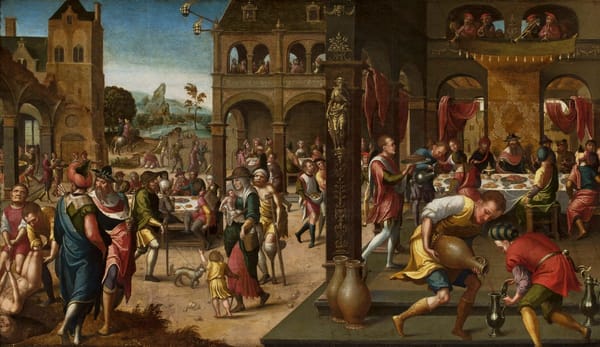
Cap. xiv.In illo tempore: dixit Jesus pharisæis parabolam hanc: Homo quidam fecit cœnam magnam, et vocavit multos. Et misit servum suum hora cœnæ dicere invitatis ut venirent, quia jam parata sunt omnia. Et coeperunt simul omnes excusare. Primus dixit ei: Villam emi, et necesse habeo exire, et videre illam: rogo te, habe me excusatum. Et alter dixit: Juga boum emi quinque, et eo probare illa: rogo te, habe me excusatum. Et alius dixit: Uxorem duxi, et ideo non possum venire. Et reversus servus nuntiavit haec domino suo. Tunc iratus paterfamilias, dixit servo suo: Exi cito in plateas, et vicos civitatis: et pauperes, ac debiles, et caecos, et claudos introduc huc. Et ait servus: Domine, factum est ut imperasti, et adhuc locus est. Et ait dominus servo: Exi in vias et sepes: et compelle intrare, ut impleatur domus mea. Dico autem vobis, quod nemo virorum illorum, qui vocati sunt, gustabit cœnam meam.
Ch. xiv.At that time, Jesus spoke this parable to the pharisees: A certain man made a great supper, and invited many. And he sent his servant, at the hour of supper, to say to them that were invited, that they should come, for now all things are ready. And they began all at once to make excuse. The first said to him: I have bought a farm, and I must needs go out and see it: I pray thee, hold me excused. And another said: I have bought five yoke of oxen, and I go to try them: I pray thee hold me excused. And another said: I have married a wife, and therefore I cannot come. And the servant returning, told these things to his lord. Then the master of the house, being angry, said to his servant: Go out quickly into the streets and lanes of the city; and bring in hither the poor, and the feeble, the blind, and the lame. And the servant said: Lord, it is done as thou hast commanded, and yet there is room. And the lord said to the servant: Go out into the highways, and hedges; and compel them to come in, that my house may be filled. But I say unto you that none of those men that were invited, shall taste of my supper.
The Gospel just read was appointed for this Sunday long before the institution of the Corpus Christi feast, as we learn from Honorius of Autun,46 and Rupert.47 The holy Spirit, who guides the Church in her arrangement of the liturgy, was thus anticipating and completing the instructions suited for the future grand solemnity.
The parable here spoken by Jesus at the table of one of the leading pharisees,48 was again used by Him, when He spoke so strongly in the temple, a few days previous to His Passion and death. And what is this supper, to which many are invited? What is this marriage-feast, but that which eternal Wisdom has been getting ready from the very beginning of the world? Nothing could exceed the magnificence of these preparations; there was a splendid banquethall, built on the top of a mountain,49 and supported by seven pillars50 of mysterious beauty; there were the choicest meats—purest bread, and wine the most delicious—served up to the King’s table. With His own hands, the Wisdom of the Father pressed the rich cluster of Cyprus grapes into the cup;51 He Himself ground down the wheat, that had sprung up, without having been sown, from a soil holy beyond description; He immolated the Victim.52 Israel, the the Father’s chosen people,53 was the fortunate guest invited by the loving kindness of the Master, that is, Wisdom, the Son of the Father, who had sent messengers without end to the children of Jacob. The Wisdom of God had said: ‘I will send unto them prophets and apostles.’54 But this favoured people, this loved one, as the Book of Deuteronomy says, ‘grew fat and kicked,’ that is, it abused the gifts bestowed on it; it seemed to study how to provoke the anger of God its Saviour, by despising His invitations, and going its own way.55 This daughter of Sion, in her adulterous pride, preferred the bill of divorce to the marriage-feast;56 Jerusalem rejected the heavenly messengers, and killed the prophets,57 and crucified the Spouse Himself.
But even so, eternal Wisdom still offers the first place at the supper to the ungrateful children of Abraham, Isaac, and Jacob; He does so because of their saintly fathers. It is to the lost sheep of the house of Israel, that the apostles are first sent.58 ‘What delicate attention!’ may we justly exclaim with St. John Chrysostom. ‘Before His crucifixion, Christ calls the Jews; He does the same after it, He goes on inviting them. Instead of crushing them with a terrible chastisement, as it seemed most just He should do, He invites them to a marriage; He loads them with honours. But they that have slain His prophets, and murdered even Him—these same, invited so pressingly by such a Spouse, urged so lovingly to go to the wedding, and that by the very Victim of their own making—these same, I say, pay no regard to the invitation, and give, as an excuse, their yokes of oxen, and their wives, and their estates!’59 Soon, these priests, these scribes, these hypocrite pharisees, will persecute and slay these apostles also; and the servant of our parable will find none in Jerusalem, whom he can induce to come to the Master’s supper, except the poor, and little, and sickly ones, of the roads and by-lanes, with whom there is no ambition, or avarice, or pleasure, to keep them from the divine banquet.
Then will be realized the vocation of the Gentiles, that great mystery of a new people being substituted for the former one, in the covenant with Jehovah. ‘The marriage of My Son is, indeed, ready,' will God the Father say to His servants; but they that were invited, were not worthy. Go ye therefore: abandon the wicked city that hath not known her time, and My visit; go ye into the high-ways, and hedges, and countries of the Gentiles; and as many as ye shall find, call ye to the marriage!’60
O ye Gentiles, praise the Lord for His mercy!61 You have been invited, without any merits of your own, to a feast that was prepared for another people; take heed, lest you incur the reproach given to the intended guests, who were excluded from the promises made to their fathers. O thou lame one, and blind, that hast been called from the by-path of thy sin and misery, hasten to the holy table! But then, take care, out of respect to Him who calls thee, to put off the rags of thy former life; and quickly put on the wedding-garment! The invitation given thee has made a queen of thy soul; ‘give her, then, the purple robe and diadem, and set her on a throne! Think of the marriage thou art invited to attend, the marriage of God! Oh! the soul that goes to it, should be clad and decked with a garment richer than all the garments of earth!’62
Like the Gradual, the Offertory is an earnest prayer for God’s help; it is His mercy that encourages the soul to make this prayer.
Offertory
In the Secret, the Church prays for the twofold effect of the holy Sacrament, in the transformation of man’s soul: purification from the remnants left by sin, and progress in the works which lead to life everlasting.
Secret
Commemoration of Corpus Christi
During the Communion, holy Church, enriched as she is with heavenly favours, pours forth her gratitude towards Him, who, though the Most High God, is also her Spouse, and loads her with exquisite gifts.
Communion
Let us pray with the Church, in the Postcommunion, that our frequent participation in these sacred Mysteries may not he fruitless in our souls, but may effect with increased assurance the whole work of our salvation.
Postcommunion
Commemoration of Corpus Christi
Vespers
The Vespers for this Sunday within the octave of Corpus Christi, are the same as those of the feast itself (page 273), excepting what follows;
Capitulum (1 St. John iii.)
Antiphon of the Magnificat
Commemoration of the Octave
Deus, qui nobis sub Sacramento mirabili passionis tuæ memoriam reliquisti: tribue, quaesumus, ita nos Corporis et Sanguinis tui sacra mysteria venerari, ut redemptionis tuae fructum in nobis jugiter sentiamus. Qui vivis.
O God, who, under the wonderful Sacrament, hast left us a memorial of thy Passion: grant us, we beseech thee, so to reverence the sacred mysteries of thy Body and Blood, that, in our souls, we may always feel the fruit of thy Redemption. Who livest, &c.
The liturgy given in the Apostolic Constitutions, under the name of St. James, thus continues, after the Trisagion; it is the bishop who is speaking:
Constitutio Jacobi
- Agg. ii. 8. ↩︎
- Malach. iii. 1. ↩︎
- Baruch. iii. 12-38. ↩︎
- Ecclus. xxiv. 34-39. ↩︎
- Eph. i. 10. ↩︎
- Prov. is. 2. ↩︎
- Is. xlviii. 11. ↩︎
- Prov. xvi. 4. ↩︎
- Ps. cxxxii. 2. ↩︎
- St. John xvii. 21, 22. ↩︎
- 1 Cor. xv. 24-28. ↩︎
- Ibid. 24, 25. ↩︎
- Wisd. ii. 23, 34. ↩︎
- Rom. vii. 11. ↩︎
- Gen. ii. 17. ↩︎
- Ps. xliv. 8. ↩︎
- Ps. cix. 4. ↩︎
- St. Matt. i. 21. ↩︎
- Col. ii. 14.15. ↩︎
- Rom. vi. 4-10. ↩︎
- Col. iii. 3. ↩︎
- Exod. xxviii. ↩︎
- De fuga sæculi, xvi. ↩︎
- St. John xii. 32. ↩︎
- Ps. lxiv. 3. ↩︎
- Enarrat. in Ps. lxiv. ↩︎
- Ps. lxv. 13-15. ↩︎
- Heb. v. 7. ↩︎
- Ibid. x. 5, 6. ↩︎
- Enarrat. in Ps. lxv. ↩︎
- St. Aug. passim in Psalmos. ↩︎
- Ps. xxviii. 1. ↩︎
- St. Aug. De civit. Dei, x. 6. ↩︎
- Ibid. 7. and in Ps. lxxxvi. ↩︎
- De adorat. in spir. ct ver., lib. ix. ↩︎
- Heb. iv. 14; x. 14. ↩︎
- Heb. ix. 12, 24. ↩︎
- Ibid. viii. 2. ↩︎
- In Levit. Hom. ix. ↩︎
- St. John xiii. 15. ↩︎
- St. John xiii. 34. ↩︎
- Ibid. 35. ↩︎
- Tacitus, Ann xv. ↩︎
- Eph. iv. 16. ↩︎
- St. Matt. v. 23, 24. ↩︎
- Gemma anim, iv. 45, 46. ↩︎
- De Div. Off. xii. 2. ↩︎
- St. Luke xiv. 1. ↩︎
- Is. ii. 2. ↩︎
- Prov. ix. 1. ↩︎
- Cant. i. 13. ↩︎
- Prov. ix. 2. ↩︎
- Ecelus. xxiv. 13. ↩︎
- St. Luke xi. 49. ↩︎
- Deut. xxxii. 15. ↩︎
- Is. 1. 1. ↩︎
- St. Matt. xxii. 34-37. ↩︎
- Ibid. x. 6; Acts xiii. 46. ↩︎
- Freely from Hom. 69, in Matt. ↩︎
- St. Matt. xxii. 8-14; St. Luke xix. 44. ↩︎
- Rom. xv. 9. ↩︎
- From St. John Chrys. ubi supra. ↩︎
May 30: St. Felix I, Pope and Martyr
THE holy Popes of the primitive ages of the Church abound during these last days of our Paschal season. To-day we have Felix I, a martyr of the persecution under Aurelian, in the third century. His Acts have been lost, with the exception of this one detail: that he proclaimed a dogma of the Incarnation, with admirable precision, in a letter addressed to the Church of Alexandria, a passage of which was read with much applause at the two (Ecumenical Councils of Ephesus and Chalcedon.
We also learn from a law he passed for those troubled times of the Church, that this holy Pontiff was zealous in procuring for the martyrs the honour that is due to them. He decreed that the Holy Sacrifice should be offered up on their tombs. The Church still keeps this law in mind by requiring that all altars, whether fixed or portable, must have, amongst the relics that are placed in them, a portion of some belonging to the martyrs. We shall have to speak of this custom in a future volume.
The Liturgy gives us this short notice regarding the holy Pontiff:
Thou, O holy Pontiff, didst imitate thy divine Master in his death, for thou gavest thy life for thy sheep. Like him, too, thou art to rise from thy tomb, and thy happy soul shall be reunited to its body, which suffered death in testimony of the truth thou proclaimedst at Rome. Jesus is the first-born of the dead;* thou didst follow him in his Passion, thou shalt follow him in his Resurrection. Thy body was laid in those venerable vaults, which the piety of early Christians honoured with the appellation of Cemeteries—a word which signifies a place wherein to sleep. Thou, O Felix, wilt awaken on that great day whereon the Pasch is to receive its last and perfect fulfilment: pray that we also may then share with thee in that happy resurrection. Obtain for us that we may be faithful to the graces received in this year's Easter; and prepare us for the visit of the Holy Ghost, who is soon to descend upon us, that he may give stability to the work that has been achieved in our souls by our merciful Saviour.
* Apoc. i 5. ↩︎
June 1 [May 31]: St. Angela de Merici, Virgin
 |
[This feast day, previously kept on May 31, was moved to June 1 when the feast of the Queenship of Mary was established on May 31.-Ed.]
From Dom Guéranger's The Liturgical Year.
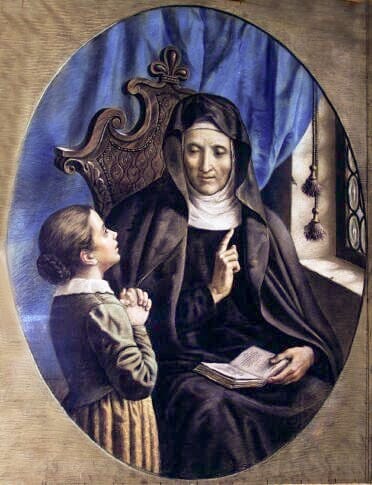
THIS last day of May, which is honoured by the virginal triumph of Aurelia Petronilla, in the first age of the Church, is also fragrant with the lilies that wreathe the brow of Angela de Merici. The sixteenth century, which, a few days back, offered to our Risen Lord the seraphic Magdalen de Pazzi, now presents him with this second fruit of heroic sanctity. Angela realized the whole meaning of her beautiful name. She possessed the purity of the blessed spirits in a mortal body, and she imitated their celestial energy by the vigorous practice of every virtue. This heroine of grace trampled beneath her feet everything that could impede her heavenward march. Gifted at an early age with the highest contemplation, she bravely travelled to Palestine, there to venerate the footsteps of her divine Spouse Jesus. After this, she visited the New Jerusalem, Rome, and offered up her fervent prayers at the Confession of St Peter. She then returned to her life of seclusion, and founded a Religious Order which is, and will be to the end of time, one of the glories and aids of Holy Church.
The thought of the great St Ursula and her virginal legion made a deep impression on Angela’s soul, and she too would form to our Lord an army of valiant women. Ursula confronted the barbarian host; Angela would give battle to the world and to its seductions, which are so dangerous to young girls. God blessed her with victory. As a trophy of her combats, she can point to the countless generations of young people whom her Order has saved during the last three centuries, by giving them a solid Christian education.
The Liturgy thus speaks of the virtues and actions of St Angela:
Thou didst fight the battles of our Lord, O Angela, and thy holy labours merited for thee a glorious rest in the mansions of eternal bliss. An insatiable zeal for the honour of Jesus whom thou hadst chosen as thy Spouse, and an ardent charity for the creatures redeemed by his precious Blood were the characteristics of thy whole life. This love of thy neighbour made thee the mother of a countless progeny; for who can number the young children that have been educated, in sound doctrine and piety, by thy daughters? Thou didst powerfully contribute to the welfare of Christian society, by thus preparing so many for the duties of domestic life; and how many other Congregations, in imitation of thy Ursulines, have taken up the same admirable work, and have brought consolation to the Church, and happiness to the world? The sovereign Pontiff has ordered that thy feast should be kept throughout the whole Church. He declared, in issuing this decree, that he wished to put under thy maternal protection the young girls who are nowadays exposed to such fearful dangers by the enemies of Christ and his Church. They have formed the project of undermining the faith of women, that so their good influence may be destroyed in their families. Disconcert these impious plans, O Angela! Protect thy sex; nourish within it the sentiment of the dignity of Christian woman, and society may still be saved.
We turn to thee, O Spouse of Christ, and ask for fervour in the liturgical year, wherein we are made to follow in the path that was so dear to thee. Thy devotion in following the divine Mysteries which are successively brought before us, led thee to visit the Holy Land. Thou didst long to see Nazareth and Bethlehem, to traverse Galilee and Judea, to give thanks in the Cenacle, to weep on Calvary, and to adore the glorious Sepulchre. Deign to bless our feeble desires and efforts to tread in these same holy paths. We have still to follow thee to Mount Olivet, whence our Redeemer ascended into heaven; we have to return to the Cenacle, which the Holy Ghost is preparing to light up with his divine Fire. Obtain for us, O Angela, that we may follow thee to these hallowed spots, which made thee quit thy country and undertake a long and perilous pilgrimage. Oh! prepare our hearts for the sublime Mysteries which are to crown our Paschal season.
May 30 (the Same Day): St. Ferdinand III, King of Castile and Confessor
DURING the season consecrated to the mystery of our Emmanuel's Birth, we saw standing near his crib the blessed Emperor Charlemagne. Crowned with the imperial diadem, and with a sword in his fearless hand, he seemed to be watching over the Babe, whose first worshippers were shepherds. And now near the glorious Sepulchre, which was first visited by Magdalene and her companions, we perceive a king—Ferdinand the Victorious—wearing a crown, and keeping guard with his valiant sword, the terror of the Saracen.
Catholic Spain is personified in her Ferdinand. His mother Berengaria was sister to Blanche, the mother of St Louis of France. In order to form ‘the Catholic Kingdom,’ there was needed one of our Lord's Apostles, St James the Great; there was needed a formidable trial, the Saracen invasion, which deluged the Peninsula; there was needed a chivalrous resistance, which lasted eight hundred years, and by which Spain regained her glory and her freedom. St Ferdinand is the worthy representative of the brave heroes who drove out the Moors from their fatherland and made her what she is: but he had the virtues of a saint, as well as the courage of a soldier.
His life was one of exploits, and each was a victory. Cordova, the city of the Caliphs, was conquered by this warrior Saint. At once its Alhambra ceased to be a palace of Mahometan effeminacy and crime. Its splendid Mosque was consecrated to the divine service, and afterwards became the Cathedral of the City. The followers of Mahomet had robbed the Church of St James at Compostella of its bells, and had them brought in triumph to Cordova; Ferdinand ordered them to be carried thither again, on the backs of the Moors.
After a siege of sixteen months, Seville also fell into Ferdinand's hands. Its fortifications consisted of a double wall, with a hundred and sixty-six towers. The Christian army was weak in numbers; the Saracens fought with incredible courage, and had the advantages of position and tactics on their part: but the Crescent was to be eclipsed by the Cross. Ferdinand gave the Saracens a month to evacuate the city and territory. Three hundred thousand withdrew to Xeres, and a hundred thousand passed over into Africa. The brave Moorish General, when taking his last look at the city, wept, and said to his officers: ‘None but a Saint could, with such a small force, have made himself master of so strong and well-manned a place.’
We will not enumerate the other victories gained by our Saint. The Moors foresaw that the result would be their total expulsion from the Peninsula. But this was not all that Ferdinand proposed: he even intended to invade Africa, and thus crush the Mussulman power for ever. The noble project was prevented by his death, which took place in the fifty-third year of his age.
He always looked upon himself as the humble instrument of God’s designs, and zealously laboured to accomplish them. Though most austere towards himself, he was a father in his compassion for his people, and was one day heard to say: ‘I am more afraid of the curse of one poor woman, than of all the Saracen armies together.’ He richly endowed the churches which he built in Spain. His devotion to the holy Mother of God was most tender, and he used to call her his Lady: in return, Mary procured him victory in all his battles, and kept away all pestilence and famine from the country during his entire reign, which, as the contemporary chroniclers observe, was an evident miracle, considering the circumstances of the age and period. The life of our Saint was one of happiness and success, whereas the life of that other admirable king, St Louis of France, was one of almost uninterrupted misfortune; as though God would give to the world, in these two Saints, a model of courage in adversity, and an example of humility in prosperity. They form unitedly a complete picture of what human life is, regenerated as it has now been by our Jesus, in whom we adore both the humiliations of the Cross and the glories of the Resurrection. What happy times were those, when God chose kings whereby to teach mankind such sublime lessons!
One feels curious to know how such a man, such a king, as Ferdinand, would take death when it came upon him. When it came, he was in his fifty-fourth year. The time approached for his receiving the Holy Viaticum. As soon as the priest entered the room with the blessed Sacrament, the holy king got out of bed, prostrated himself in adoration, and, humbly putting a cord round his neck, received the Sacred Host. This done, and feeling that he was on the verge of eternity, he ordered his attendants to remove from him every sign of royalty, and called his sons round his bed. Addressing himself to the eldest, who was Alphonsus the Good, he entrusted him with the care of his brothers, and reminded him of the duties he owed to his subjects and soldiers; he then added these words: ‘My son, thou seest what armies, and possessions, and subjects thou hast, more than any other Christian king; make a proper use of these advantages; and as thou hast the power, be good and do good. Thou art now master of the country which the Moors took, in times past, from king Rodriguez. If thou keep the kingdom in the state wherein I now leave it to thee, thou wilt be, as I have been, a good king, which thou wilt not be, if thou allowest any portion of it to be lost.’
As his end drew nigh, the dying king was favoured with an apparition from heaven. He thanked God for granting him that consolation, and then asked for the blessed candle; but before taking it in his hand, he raised up his eyes to heaven, and said: 'Thou, O Lord, hast given me the kingdom, which I should not otherwise have had; thou hast given me more honour and power than I deserved; receive my thanks! I give thee back this kingdom, which I have increased as far as I was able; I also commend my soul into thy hands!' He then asked pardon of the bystanders, begging them to overlook any offence that he might have committed against them. The whole court was present, and, with tears, asked the Saint to forgive them.
The holy king then took the blessed candle into his hands, and raising it up towards heaven, said: ‘Lord Jesus Christ! my Redeemer! naked I came from my mother’s womb, and naked I return to the earth. Lord, receive my soul! and, through the merits of thy most holy Passion, deign to admit it among those of thy servants!’ Having said this, he gave back the candle, and asked the bishops and priests, who were present, to recite the Litanies; which being ended he bade them sing the Te Deum. When the hymn was finished, he bowed down his head, closed his eyes, and calmly expired.
Thus died those men, whose glorious works were the result of their faith, and who looked on themselves as only sent into this world that they might serve Christ and labour to propagate his kingdom. It was to them that Europe owed its highest glory; they made the Gospel its first law, and based its constitution on the Canons of the Church. It is now governed by a very different standard; it is paying dearly for the change, and is drifting rapidly to dissolution and ruin.
The following are the Lessons used in the Office of St Ferdinand:
By delivering thy people from the yoke of the infidel, thou, O Ferdinand, didst imitate our Risen Jesus, who rescued us from death and restored us to the life we had lost. Thy conquests were not like those of this world’s conquerors, who have no other aim than to satisfy their own and their people’s pride. Thy ambition was to deliver thy people from an oppression which had weighed heavily on them for long ages. Thy object was to save them from the danger of apostasy, which they incurred by being under the Moorish yoke. O Champion of Christ! it was for his dear sake that thou didst lay siege to the Saracen cities. His banner was thine; and thy first anxiety was to spread his kingdom. He, in return, blessed thee in all thy battles, and made thee ever victorious.
Thy mission, O Ferdinand, was to form for our God a nation, which has been honoured by Holy Church above all others with the glorious name of the 'Catholic Kingdom.’ Happy Spain, for by her perseverance and courage she broke the Mussulman yoke, that still weighs down the other countries which it made its prey! Happy Spain, for she repelled the invasion of Protestantism, and, by this, preserved the faith, which both saves souls and constitutes a nation’s strongest power! Pray for thy country, O saintly king! False doctrines and treacherous influences are now rife within her, and many of her children have been led astray. Never permit her to injure, by cowardly compromise, that holy faith which has hitherto been her grandest glory and safeguard. Frustrate the secret plots which are working to undermine her Catholicity. Keep up within her her old hatred of heresy, and maintain her in the rank she holds among Catholic nations. Unity in faith and worship may still save her from the abyss into which so many other countries have fallen. O holy king! save once more the land that God entrusted to thy keeping, and which thou didst restore to him with such humble gratitude, when thou wast about to change thine earthly for a heavenly crown. Thou art still her beloved protector; hasten, then, to her aid!
May 30 (the Same Day): St. Joan of Arc, Virgin
WHILE the angelic hosts acclaim the Incarnate Word as he takes possession of his eternal throne, a virgin at the head of the armies of earth re-echoes the praises of heaven. She was a child of the countryside, pious, gentle, and utterly ignorant, especially of the art of war, but Michael the soldier of God trained her with the aid of the Virgin Martyrs Catharine and Margaret, and suddenly, like a challenge thrown to modem naturalism in the broad daylight of history, she made her appearance, at the age of seventeen, as an incomparable warrior. Her victories, her personal influence and strategical genius equal those of the most famous captains of any times. But she surpasses them all in heroism, in her childlike simplicity, virginal purity, and faith in her Lord Jesus, the Son of St Mary, for whom she died—even greater at the stake at Rouen than in the days of her triumph. ‘De par le Roi du ciel’ (‘By order of the King of heaven’) was the motto on her banner. By order of the King of heaven, her sovereign liege, in whose royal service she is day by day, she calls upon cities to return, to their lawful obedience. By order of the King of heaven she intimates to the English that she has been sent to drive them out of France. ‘For,’ as she declared to the Dauphin's representative, 'the kingdom does not appertain to the Dauphin, but to my Lord. But it is the will of my Lord that the Dauphin should be made king and should hold the kingdom in commendam.’ ‘And who is thy Lord?’ asked Baudricourt. ‘My Lord is the King of heaven.’
To Charles she said: ‘I am called Joan the Maid, and through me does the King of heaven give you to understand that you shall be viceregent of the King of heaven who is king of France.' To the Duke of Burgundy, who was then in alliance with the enemy, she said: 'I tell you by order of the King of heaven, that all who make war on the said holy kingdom, make war on the King Jesus, the King of heaven and of all the earth.'
Joan came into the world on the feast of the glorious Epiphany, which manifested the divine Child to the world as the Lord of lords. It was during these days of his Ascension, when he takes his seat at the right hand of his Father, that she began her campaigns in 1428, achieved her greatest triumph in 1429, and closed her warlike career in 1430.
She died May 30, 1431, the eve of the Feast of Corpus Christi—a worthy consummation for a life like hers, a supreme consecration for her cause. As her soul rose from the flames to join Michael and his hosts and the Virgin Martyrs at the court of the immortal King of Ages, she left the Church on earth prostrate before Christ the King, the Ruler of the Nations, who, as it were, holds his royal assizes where he is glorified in the mystery of faith.
The following account of her life is given by the Church:
O King of Glory, who dost to-day ascend above the heights of heaven, thou didst drink of the torrent in the way and therefore dost thou now lift up thy head. Thy ancestor David prophesied it, thine Apostle proclaimed it. Thou didst humble thyself unto death, even the death of the cross, and therefore has God the Father exalted thee on this day, therefore does every knee bow at thy name, in heaven, on earth, and under the earth. It was becoming that the law of the Head should be the law also of all those who were to be called to share his glory. Before all the ages, in the great Counsel of which, as the Church sings on Christmas Day, thou wert the Angel, the conditions of definitive victory and eternal success were thus laid down.
The Gospel tells us that the hour would come for the disciples of Jesus to give testimony and that men would think to serve God by putting them to death. Joan, like Jesus, was questioned, judged and condemned with all the legal forms and imposing ceremonial of orthodoxy. But, O ye enemies of Joan and of France, ye thought yourselves her executioners, and ye were offering her in sacrifice. France was saved, for God accepted the virginal victim. Her passing mission became a permanent patronage, and the deliverer of her country on earth has become her immortal protectress in heaven.
| Previous May 29: St. Mary Magdalen de Pazzi, Virgin | Next May 30: St. Felix I, Pope and Martyr |