Daily reading
After Pentecost
Double · Movable from Easter · Temporal
June 3, 2027
From Dom Guéranger’s The Liturgical Year.

|
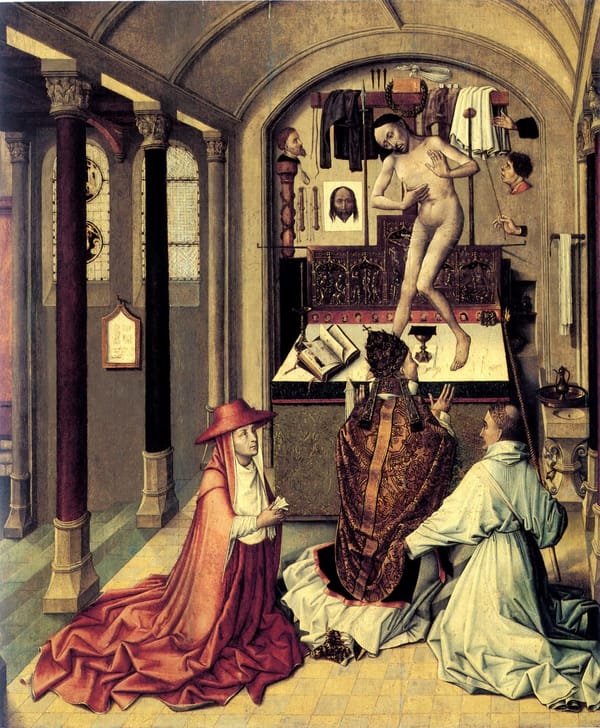
Thursday, the Octave of Corpus Christi
The bright octave, consecrated to the glory of the blessed Sacrament, closes to-day; and although we began the subject three days before the feast itself, we have been able to do little more than slightly touch upon the sublime subject proposed for our consideration and love by the Church. The Memorial left us by our Lord of all His wondrous mercies1 far exceeds the measure of our poor thoughts, and the capabilities of human language; such is the extremity of the infinite love, which God bears to His own2 creatures, that no possibility of ours could make it a return such as it deserves.
Eternal Wisdom was, even from His Father’s bosom, betrothed to human nature. He came down into this world, which sin had marred, and there He found man, who had become the slave of sin;3 He assumed the nature of man: He was thus able to make a Sacrifice, which gives infinite glory and full satisfaction to God, and He perfected His union with His creature, by means of that divine banquet, at which, as food and drink, He Himself is served; for He is the divine Victim4 immolated on the cross and at our altars.
O man! O child of Adam, that wast formed of earthy slime,5 what art thou, that thou shouldst be remembered in the court of heaven?6 Thou desired one of the everlasting hills7—for we may apply this name even to thee—what hast thou done, that thou shouldst thus be glorified?8 Yet doubt it not, thou hast had all these favours. ‘Let not my few weak words stagger thee,’ cries out St. Cyril, the brave defender at Ephesus of the sacred nuptials, of which the Eucharist is what the fathers call the glorious extension, ‘heed not my unworthiness, but listen to the voice, respect the authority, of them that have gone before us, and have preached these truths. They were not men of the common sort, they were not men undeserving of notice, who went about, like hired criers, to proclaim these things on the highroads; no, they were such men as the great Solomon, who was sent as the herald of the King of kings; he sat on his high throne, and proclaimed the mysteries of the Most High; he was clad in scarlet robes, and wore a diadem on his brow, and he was the one to publish the mandate of the God who makes and unmakes kings.’9
Christians! ye people of kings,10 who are to have crowns and thrones yonder in heaven,11 it is to you this Solomon speaks. Your dignity is great. Listen to this herald of God; learn whence comes your greatness, and live up to it. ‘Hearken, ye kings, and understand! Give ear, ye kings! To you are these my words. If ye love your thrones and your sceptres, love wisdom, that ye may reign for ever. I preferred this wisdom before kingdoms and thrones; I loved her above all treasures, and health, and beauty, and chose to have her instead of light. What this wisdom is, and what her origin, I will declare, and I will not hide from you the mysteries of God; but will seek wisdom out from the beginning of her birth, and bring the knowledge of her to light, and will not pass over the truth. I have learned her without guile, and I communicate her to you without envy. Receive, therefore, instruction by my words, and it shall be profitable unto you.’12 Would to God, that we had been able to tell the wonderful mystery we have been celebrating! Divine Wisdom Himself has been pressing us, during all these days, to study the excellencies of that sacred Bread, which yields delights to the kings, His guests.13 The Church has kept close to the throne of her Jesus, that cloud in which He dwells out of love for us.14 She is full of love for Him; He has given her unity by the Sacrament of union; and she, like a strong compact city, summons her tribes of Israel,15 the holy nation, the people of the redeemed, the chosen race of the priests and kings,16 to come together again on this octave-day, that they may testify their faith, and sing their love, and be grateful for the peace which the holy Eucharist secures to them, and for the abundance of grace and blessing it gives to these her children.17 These days of universal joy and festivity around the holy Host were revealed by the Holy Ghost to the son of Sirach; and the vision made him exclaim: ‘Wisdom shall praise her own self, and shall be honoured in God, and shall glory in the midst of her people, and shall open her mouth in the churches of the Most High, and shall glorify herself in the sight of His power. And in the midst of her own people, she shall be exalted, and shall be admired in the holy assembly. And in the multitude of the elect, she shall have praise, and among the blessed (of the Father) she shall be blessed.’18
‘Blessed the man,’ continues the inspired writer, still speaking in the future, ‘that shall dwell in wisdom! Blessed the man that considereth her ways in his heart, and hath understanding in her secrets, who goeth after her as one that traceth, and prepareth for her snares of love;19 who looketh in at her windows, and hearkeneth at her door! Blessed is he that lodgeth near her house, and, fastening a pin in her walls, shall set up his tent nigh unto her, where good things shall rest in his lodging for ever. He shall set his children under her shelter, and shall lodge under her branches. He shall be protected under her covering from the heat, and shall rest in her glory.’20
O house of God, house of the feasting of kings,21 filled with the fragrance of sweetest incense!22 Better is one day in thy precincts, than a thousand elsewhere. It is a joy to my soul to think of days spent there!23 The poor bird that once was lonely, and sat moaning on a roof that could never give her rest,24 here, in the house of God, finds all she wants. The turtle-dove, having found at the altar of her Lord a nest for her young ones,25 has no further solicitude. In the secret of that little cloud, far from the conflicts and disturbances of the world, and where there is no contradiction of tongues—there, from early dawn, eternal Wisdom is pouring out upon souls the multitude of His light and sweetness;26 there, each of the Church’s hours, choirs will be singing psalms and canticles of praise and joy around the tabernacle,27 wherein resides the Lamb who, though slain, is ever living,28 beautiful on His throne of love, the Hod of gods in our Sion.29
Truly, He abides among us; our earth has received the mystery of the marriage-feast, of the divine espousals with human nature, and she ever possesses the Lord her Hod dwelling with her in the Eucharist. O thou gladness of morning!30 O heavenly wine that bringest forth virgins!31 O happy moments, wherein the beauty of Jesus, whose full vision is the joy of the angels, gives itself under the sacramental veil to our souls, you leave behind you something more than a joyous recollection. The altar of Sacrifice, and the house of the great Banquet, both continue as the throne ever occupied by our King; they are the earthly abode of that Wisdom, who, though He is seated at the right hand of the Father in the brightness of the saints,32 and is loved by the Lord of all things,33 yet has not changed towards us poor children of men; He still delights to be with us, and keep up His loved union with us; and, as He tells us He did at the beginning, so He still loves this world of ours, and, to use His own word, He still plays with it.34 On the throne of His tabernacle, He, beautiful Wisdom, receives the adorations of them that rule this world, for it is from Him they have their crowns and sceptres; and when they have wisdom, it is from Him they have it, and they asked Him for it on bended knees.35 On that same throne He hears and grants the prayer of those little ones, little by humility and simplicity of heart, whom He so sweetly presses to go to Him;36 they are attracted to Him by His divine loveliness and riches;37 and they go to Him, that He may teach them how to love Him and fill their treasures to the brim.38
Glory be to the Lamb, whose Sacrifice has given us this wonderful Presence in the blessed Sacrament I To Him be power, and divinity, and wisdom, and strength, and honour, and glory, and benediction, for ever and ever!39 By His lovely light40 let us, as a close to this day and the octave, respectfully contemplate what this ineffable permanence is, which thus secures to us in its fullness, to the end of time, the great mystery of faith.
How different is the divine Lamb of the true Passover, from that ancient one of the Jewish people, which we now so well understand!41 In prescribing the rites to be observed in the sacrifice of the figurative Paschal Lamb, which was to be eaten but once a year, Moses laid down this strict injunction: ‘Neither shall there remain anything of it until morning’;42 nothing was to be left, all was to be consumed! Let us listen, now, to an apostle of the new Law: it is Andrew, brother of Peter; he is speaking to a Roman proconsul, and, through him, to all the Gentiles: ‘Every day, I offer up to the almighty God, who is one and true, not the flesh of oxen, nor the blood of goats, but the spotless Lamb, upon the altar; of whose Flesh the whole multitude of the people eat; and the Lamb that is sacrificed, remains whole and living.’43
‘How can that be?’ asks the proconsul. ‘Become a disciple and thou shalt learn,' replies Andrew. But that could not be: the representative of the pagan world was officially appointed to persecute the crucified Jesus in His members; and as to the sublime dogma he had just heard, and which was the very basis of the religion proscribed by the State, he had but one way of dealing with it and its preacher: laugh at it, and hang Andrew on the cross. The apostle thus sealed his testimony by his death, leaving to the Holy Ghost, who had inspired him with the words he had spoken,44 the future victory which that teaching was to win. His brother-apostles, who had been his fellow-guests at the last Supper, also laid down their lives for Jesus and His doctrine; and, by that sacrifice of themselves, they made themselves food to the same dear Lord. So did Andrew. He followed the counsel of the Wise Man: ‘When thou shalt sit to eat with a prince, consider diligently what is set before thy face, and lay this to thy heart, and know that it behoveth thee to give a like feasting to the prince.’45 Having, therefore, been fed with Jesus’ cross in the banquet of His Body at the last Supper, as St. Augustine expresses it,46 Andrew made a right noble return.
And so was it with the other martyrs, who came after him: the joy they showed, in the midst of their tortures, kept up the proof of the power that exists in the precious Wine and heavenly Bread, which can thus gladden man’s heart and make it brave.47 The time would come, when the demonstration of the mystery of faith, so sublimely expressed by the apostle St. Andrew, would convince the world; not indeed by the force of argument, or by the clever sequel of learned deductions, but by the world itself becoming transformed from paganism to Christianity. That transformation was an impossibility, as far as the world’s own misery and power were concerned; and yet it was an undeniable fact; and it was the result of an irresistible influence: the influence of the divine leaven, which, in the language of the Gospel, was put into the whole measure of flour at the last Supper. From south to north, from east to west, everywhere throughout the globe, the children of the Church now sing these words, which are but St. Andrew’s expression that has triumphed over the world, won its faith, and is set to rhythm and music: ‘Christ’s Flesh is food, and His Blood is drink; yet is He whole under each Species. He is not cut by the receiver, nor broken, nor divided: He is taken whole. He is received by one, He is received by a thousand; the one receives as much as all; nor is He consumed, who is received And when the Sacrament is broken, waver not, but remember that there is as much under each fragment as is hidden under the whole. Of the substance there is no division; it is but the sign that is broken; and He who is the Signified, is not thereby diminished, either as to state or stature.’48
The Church’s doctrine is this: that ‘under each Species, and under each part of each Species, there is contained, truly, really, and substantially, the Body and the Blood, together with the Soul and Divinity of our Lord Jesus Christ, and therefore the whole Christ.’49 Of themselves, it is true, the words of Consecration in the Sacrifice do but produce what they signify; and therefore, exclusively and isolatedly, under the twofold Species, produce the Body and the Blood; but our risen Lord, who liveth now for ever, remains indivisible. As the apostle teaches us, Christ, rising again from the dead, dieth now no more; for, in that He died to sin (that is, because of our sin), He died once; but in that He liveth, He liveth unto God.50 Therefore, wheresoever, in virtue of the words of consecration, there is the most holy Body, or the Blood of our Redeemer, there also, by an essential and necessary concomitance, is the whole entire sacred Humanity, united with the Word.
And here, for the sake of greater precision, we are going to adopt the scholastic phraseology. And firstly, the change of bread into the Body, and of wine into the Blood, is one of substance into substance; but in this miraculous change, very appropriately, on that account, called trans-substantiation, the accidents or modes of the two terms of the change are in no way altered or destroyed. So that, being deprived of their natural subject, or support, the species, or appearances of bread and wine are immediately sustained by God’s omnipotence, and they produce and receive the same impressions as they would do if they were joined to their own proper substances. They are the sacramental sign; and although they do not inform the Body of Christ, that is, do not give It their own qualities or properties, yet they determine and maintain Its presence, so long as these species are not essentially modified. As regards the Body of our Lord—which, in Its own true substance, is substituted for the substance alone of bread and wine—It is withdrawn, by the sacred formula, from those mysterious laws of extension, which are so far from being thoroughly understood by human science; It is whole under the whole species, and whole under each sensible portion of the species; and, in this, It resembles spiritual substances, such as, for instance, the soul of man, which is whole in his whole body, and whole in each member of the same. Such, then, is the mystery of the sacramental state: whilst present to us under the dimensions of the Host, and not beyond them, by reason of His substance being independent of our known laws of extension, Christ our Lord abides in Himself precisely what He is in heaven. As St. Thomas of Aquin expresses it: ‘The Body of Christ, in the Sacrament, retains all Its accidents, as a necessary consequence; and Its several parts are just as they are in His sacred Body, although they are not subject to the conditions of external space.’51
The very notion of Sacrifice required this passive appearance; in the same way that the idea of a banquet, in which He is received, determined what was to be the peculiar nature of the sacramental elements selected by our divine Lord. Of course, when we behold the sacred Host, we must banish every such thought as bondage, or actual suffering, or laborious virtues, on the part of the divine Guest who dwells under the sacred Species: under this external passiveness or apparent death, there abound life, and love, and the beauty of the Lamb, who has vanquished death, and who is the immortal King of ages.
He resides under the white Host, with all His power and brightness, the most beautiful of the children of men;52 He has all those admirable proportions, and all the perfect finish of those divine members, which were formed from the flesh of the most beautiful of the daughters of Adam, and the purest of virgins. Let us venerate, with all the respect we are capable of, those feet, which were watered by the tears of the repentant Magdalene, and dried with her hair,53 and embalmed with the sweetest ointment, beforehand, as Jesus emphasised her act, when He praised it;54 those feet of our merciful Redeemer, more beautiful than the feet of them who bring us the tidings of His having come among us;55 they are bright, beyond the brightness of fine brass when in a burning furnaoe.56 Let us send our reverential kisses, beyond the veil, to those hands, which are spotless, and consecrated for the office of High Priest;57 those hands, which worked at the wood in Joseph’s shop; those hands, which scattered blessings and miracles throughout the land of Israel; they are there, under that Host, just as the bride of the Canticle saw and described them, bright as gold, formed to the model of perfection, and full of something extremely precious, which she called hyacinths,58 and which perhaps signify those wounds of which the prophet speaks, saying, ‘horns are in His hands, and there is His strength hid.’59 Would that we might look beneath the little cloud which hides from us that divine head, the admiration of the angels; that face, once disfigured, and buffeted, and covered all over with reproaches, out of love for us,60 but now resplendent as the sun when he shineth in his power!61 O mouth of our Jesus, thou instrument of the Word, whose voice is as the sound of many waters,62 and whose breathing is death to the wicked!63 O lips, which our Scriptures tell us, are as lilies dropping choice myrrh!64 And you, O eyes, which shed tears over Lazarus,65 and now are lighting up with your brightness66 the abode of the saints! Oh! that we might see all, see Thee Thyself, Jesus, beneath the mystery and the veil! But no! the mystery and the veil may not be removed; and surer are we, than if our eyes were the witnesses, that Thou, O Beloved of our hearts, art behind our wall, looking at us through the lattices;67 and this is enough to make us adore Thee. Verily the sweetest test to which Thou couldst put our love, was that we should have faith in this mystery of the adorable Sacrament!
O precious Blood, thou price of our ransom, shed profusely on this earth, but now again within the sacred veins of Jesus! thou art now, as during His years here below, diffusing thy life-giving qualities to His divine members, under the action of that sacred Heart, which we are so solemnly to honour to-morrow! Most holy Soul of Jesus, present in the Sacrament as form substantial68 of that most perfect Body, which, through thee, is the ever-living Body of the Man-God, thou possessest within thee all the treasures of eternal Wisdom.69 Thou hadst the office intrusted to thee, of putting into a varied and sensible language the ineffable beauty of that Wisdom of the Father, who was taken with love for the children of men, and desired, by a manifestation which they could understand, to secure their love to Himself! Every word, every step, of Jesus, every mystery of His public or hidden life, was a gradual revelation, to us men, of that divine brightness. Truly, as we have it in the Gospel, this Wisdom, like the grace that was within Him, advanced in His manifestation to the creatures, whose love He had come down from heaven to win.70 When, at length, He had achieved all His work—given us His teachings, and examples, and mysteries, those marvellous manifestations of His own infinite perfections—He gave them perpetuity, that so all ages to come might possess them and benefit by them; He fixed them, so to say, in the Sacrament of love, that abiding source of grace and light to men, that living Memorial, wherein divine love is ever ready to bestow upon us the graces of the wonderful works He has wrought by His Incarnation. ‘The Flesh, the Blood of Christ, is the Word made manifest,’ says St. Basil; ‘it is Wisdom made visible by the Incarnation and by all that mystery of His life in the flesh, whereby He unfolds to us all moral perfection, and all the beautiful, both natural and divine. It is that which is the food of our soul, and which is preparing her, even in this world, for the contemplation of the divine realities.’71
The solemn Exposition, during which the blessed Sacrament has been receiving our most fervent homage of adoration and love, is concluded, as it began, with a procession. As soon as the Vespers are over (and they are the same as those of the feast, page 273), the deacon takes the monstrance from the throne, and gives it to the priest. The sacred Host is once more carried outside the church, with the same holy ceremonies, and chants, and joyous worship of the faithful. Again It has all nature doing homage to the Creator; It sanctifies every place through which It is carried; drives away the hostile power which, as the apostle tells us, seeks to infest this air;72 blesses our streets and our country lanes, and imparts to our fields a pledge of rich harvest. It is then brought back to the church, not to leave the hallowed precincts again, save for the sake of the dying, to strengthen them for their last long journey, or for the sick, that It may be administered to them, since they are not able to go to their Lord. The Benediction is then given to the adoring assembly, and the sacred Host is replaced in the tabernacle.
Whilst these sentiments of faith and love are so active within us, let us give them expression, by the beautiful hymn, Adoro te devote: it was composed by the Angelic Doctor, St. Thomas of Aquin; and it is hard to say which of the two predominates in these verses, the theological science of the saint, or his humble and glowing love.
But when the tabernacle-door closes upon Jesus in His holy Sacrament, our hearts will still continue with Him. This octave always brings with it such an increase of light regarding the great Mystery! It has been so, this year. More than ever, for the future, will we love and reverence the Banquet which is, and produces, all that we have been considering during these days: we know so much better now, than formerly, the perfections of eternal Wisdom, who has given Himself to us in the Eucharist; we will let Him guide us into all grace and truth.
Rhythmus S. Thomæ
Quæ sub his figuris vere latitas:
Tibi se cor meum totum subjicit,
Quia te contemplans totum deficit.
Sed auditu solo tuto creditur.
Credo quidquid dixit Dei Filius,
Nil hoc verbo veritatis verius.
At hic latet simul et humanitas;
Ambo tamen credens atque confitens,
Peto quod petivit latro pœnitens.
Deum tamen meum te confiteor.
Fac me tibi semper magis credere,
In te spem habere, te diligere.
Panis vivus, vitam præstans homini:
Præsta meæ menti de te vivere,
Et te illi semper dulce sapere.
Me immundum munda tuo sanguine,
Cujus una stilla salvum facere
Totum mundum quit ab omni scelere.
Oro fiat illud quod tam sitio:
Ut te revelata cernens facie
Visu sim beatus tuæ gloriæ.
who truly liest concealed under these forms:
to thee my whole heart subjects itself,
because it finds itself quite lost in contemplating thee.
but the hearing alone may be safely believed.
I believe whatsoever the Son of God has spoken;
nothing is more true than this word of truth.
but here the humanity also lies hid:
but I believe and confess them both,
and ask for what the penitent thief asked.
yet do I confess thee to be my God.
Oh! grant that I may ever believe in thee, more and more,
and put my hope in thee, and love thee.
O living Bread, that givest life to man!
Grant that my soul may ever live on thee,
and may ever relish thy sweetness.
cleanse me, an unclean sinner, with thy Blood,
one drop whereof
could save the whole world from all its guilt.
I beseech thee, let that be done,
for which I do so thirst: that I may see thine unveiled face,
and be happy in the vision of thy glory.
The devout Ratpert, monk of St. Gall, friend of Notker, and, like him, a writer of liturgical compositions, shall provide us with an appropriate conclusion to this our octave of Corpus Christi, in the following devout hymn, which he composed for the faithful of the ninth century.
Ad Eucharistiam Sumendam
Corporis immensi, Sanguinis atque tui.
Tu licet indignis propitiare tuis:
Prosit ut invictis appropiare sacris.
Purificans corpus, cor pariterque pius.
Interea terris dans medicamen opis.
Summeque pascentes protege Pastor oves.
Consolidans dono nos sine fine tuo.
Tu pietate tua, Rex, rege castra tua.
Spiritus atque potens, trinus et unus apex.
honouring the gifts bestowed upon us of the adorable Body and Blood.
have mercy on us thy servants, though unworthy ones.
that our approaching these triumphant sacred Mysteries may be to our profit.
the holy angel who will lovingly cleanse both our body and soul.
giving us meanwhile, here on earth, the restoring power.
O best of shepherds, protect us thy sheep, now feeding on it!
for ever strengthen us by the gift
do thou in thy mercy, O King, rule thine own soldiers!
and the all-powerful Spirit, the perfect Three and One giver of the gifts.
- Ps. cx. 4. ↩︎
- St. John xiii. 1. ↩︎
- Heb. ii. 14, 15. ↩︎
- Prov. ix. 2. ↩︎
- Gen. ii. 7. ↩︎
- Ps. viii. 5. ↩︎
- Gen. xlix. 26. ↩︎
- Job vii. 17. ↩︎
- Hom. div. x in Myst. cœn. ↩︎
- St. Matt. xxv. 34. ↩︎
- Apoc. v. 9, 10. ↩︎
- Wisd. vi. vii. passim. ↩︎
- Gen. xlix. 20. Cf. ant. 3 Laud. in die festi. ↩︎
- Ecclus. xxiv. 7. ↩︎
- Ps. cxxi. 3, 4. ↩︎
- 1 St. Pet. ii.9. ↩︎
- Ps. cxxi. 4-8. ↩︎
- Ecclus. xxiv. 1-4. ↩︎
- Juxta græc. ↩︎
- Ecclus. xiv. 22-27. ↩︎
- Ps. xli. 5. ↩︎
- Ecclus. xxiv. 20, 21. ↩︎
- Ps. lxxxiii. 2, 11. ↩︎
- Ps. ci. 8. ↩︎
- Ibid. lxxxiii. 4. ↩︎
- Ibid. xxx. 20, 21. ↩︎
- Ibid. xxvi. 6. ↩︎
- Apoc. v. 6. ↩︎
- Ps. lxxxiii. 8. ↩︎
- Ps. xxix. 6. ↩︎
- Zach. ix. 17. ↩︎
- Ps. cix. 3. ↩︎
- Wisd. viii. 3. ↩︎
- Prov. viii. 31. ↩︎
- Ibid. 14-16. ↩︎
- Prov. ix. 4; St. Mark x. 14. ↩︎
- Ecclus, xxiv. 26. ↩︎
- Prov. viii. 21. ↩︎
- Apoc. v. xii. ↩︎
- Ibid. xxi. 23. ↩︎
- Paschal Time, vol. 1. ↩︎
- Exod. xii. 10. ↩︎
- Pass. S. Andr. ap. Lipom. ↩︎
- St. Matt. x. 20. ↩︎
- Prov. xxiii. 1, 2. juxta græc. ↩︎
- In Ps. c. ↩︎
- Ps. ciii. 15. ↩︎
- Sequen. Lauda Sion. ↩︎
- Conc. Trid. Sess. xiii. can. 1, 3. ↩︎
- Rom. vi. 9, 10. ↩︎
- P. 3. Q,. lxxvi. a, 4; Sent. lib. 4. dist. 10, art. 2. ↩︎
- Ps. xliv. 3. ↩︎
- St. Luke vii. 37, 38. ↩︎
- St. Mark xiv. 8. ↩︎
- Is. lii. 7. ↩︎
- Apoc. i. 15. ↩︎
- Lev. xxi. 10. ↩︎
- Cant. v. 14. ↩︎
- Hab. iii. 4. ↩︎
- Lam. iii. 30. ↩︎
- Apoc. i. 16. ↩︎
- Ibid. 15. ↩︎
- Is. xi. 4. ↩︎
- Cant. v. 13. ↩︎
- St. John xi. 35. ↩︎
- Apoc. i. 14. ↩︎
- Cant. ii. 9. ↩︎
- Concil. Vienn. ↩︎
- Col. ii. 3. ↩︎
- St. Luke ii. 52. ↩︎
- Epist. viii. ↩︎
- Eph. ii. 2; vi. 12. ↩︎
June 3: St. Clotilde, Queen of the Franks
At this season, in which the Office of the time is leading us to consider the early developments of holy Church, eternal Wisdom so arranges, now as ever, that the feasts of the saints should complete the teachings of the movable cycle. The Paraclete, who has but just come down upon us, is to fill the whole earth;1 the Man-God has sent Him expressly to win over the whole earth and to secure all time to His Church. Now, it is by subjecting kingdoms to the faith, that He is to form Christ’s empire;
it is by enabling the Church to assimilate all nations to herself, that He gives growth and continuance to the bride. See, therefore, how at this Season wherein He has but just taken possession of the world anew, His co-operators in this His work of conquest shine out on every side in the heavens of the holy liturgy. But the west above all concurs in forming the magnificent constellation that is mingling its radiant splendour with the fires of Pentecost. Indeed, what could better show the omnipotence of the Spirit of Christ, than the establishment of this Latin Christendom, in these distant lands of the west?
What star is this shining to-day in such silvery beauty on the land of the Franks? The city of Lyons, prepared by the blood of martyrs for this her second glory, sees this new light rise in her midst. Clotilde is a mother; and the cruel sufferings which wrung her heart while she was yet young matured her soul for the grand destinies reserved by God for the privileged children of sorrow. The violent death of her father Chilperic, dethroned by a fratricidal usurper; the sight of her brothers massacred, and of her mother drowned in the Rhone; her long captivity in the Arian court of the murderer who brought heresy with him to the throne of the Burgundians, developed in her the heroism that was to make this niece of Gondebaud become the mother of a whole nation to Christ.
God drew the visible universe out of nothingness, solely to manifest His goodness. In like manner, He has willed that man, coming from His hands without power as yet to recognize his Creator, should recognize, at least, a mother’s tender love, the first sensible ray, as it were, of infinite love. Irresistible is this ray, sublime in its gentleness, exquisite in its purity, giving to the mother a facility, belonging only to her, to complete in the soul of her child the reproduction of the divine ideal that is to be impressed upon him. Now this she does by education. To-day’s feast reveals how much more sublime, more potent, more extensive, is maternity in the order of grace than in that of nature. For when God, coming down amongst us, was pleased, to take Flesh of a daughter of Adam, maternity was raised in her to the extreme limit that separates the endowments of a simple creature from the divine attributes. Thus rising above the heavens, maternity at the same time embraced the world, bringing all mankind together into close union, without distinction of nation or family, in the one filiation of that Virgin-Mother. The new Adam, the perfect model of our race, and our first born,2 willed to have us for His brethren, in all fullness, brethren in Mary as in God.3 The Mother of God was then proclaimed Mother of men on Calvary; from the summit of the cross, the Man-God replaced upon the brow of Mary that diadem of Eve, broken beneath the fatal tree. Constituted sole Mother of the living by this noble investiture,4 our Lady once again participated in the privileges of the Father who is in heaven. Not only was she Mother by nature, as He is Father, of His Son; but, just as all paternity flows down from the eternal Father, and borrows thence supereminent dignity; so from that moment, all maternity was nought but an outflow of Mary’s in the truest sense; a delegation of her love, and a communication of her august privilege whereby she brings forth men unto God, whose sons they are to be.
Good reason, therefore, have Christian mothers to glory in their maternity, for in that does their greatness consist; through Mary, their dignity has increased to a degree that nature could never have dreamed of. But at the same time, under the aegis of Mary, not less real is the maternity of holy virgins, not only in God’s eyes, but often manifested to their own: the wife, too, prepared by a special call from God and by suffering, is sometimes, like Clotilde, endowed with a fecundity of a spiritual order, a thousand times more prolific than that of earth. Happy the fruits of this supernatural maternity, which under the favour of Mary is fraught with so much greatness! Happy the nations on whom the divine munificence has bestowed a mother!
History tells us how the founders of empires have ever had the terrible prerogative of impressing upon nations the distinctive character, disastrous or beneficial, which, through length of ages, continues to be theirs. How often does that want of counterpoise to the preponderance of power, make itself only too evident in the impetus given rather to destroy than to build up! And wherefore? Because ancient empires never had a mother; for this noble title cannot be applied to those heroines who have transmitted their names to posterity merely for having rivalled the ambition and pomp of conquerors. To Christian times it was reserved to behold introduced into a people’s life this element of maternity, more salutary, more efficacious in its humble gentleness, than that which springs from the talents or vices, from the power or genius, of their first princes.
Time was needed to subdue the savage instincts of the warriors of Clovis, and to fit his sword to the noble destiny that awaited it in the hand of a Charlemagne, or of a St. Louis. With good reason has it been said that the honour of this labour is due to the bishops and the monks. But to be more accurate and to prove a deeper insight into the ways of divine Providence, it would have been well, perhaps, to pass less lightly over woman’s part in the work of conversion and of education, which made the Frankish nation become the eldest son of the Church. Clotilde it was who led the Franks to the baptistery of Rheims, and presented to Remigius the proud Sicambrian, transformed far less by the exhortations of the holy bishop than by the force of prayer, the prayer of that strong woman elected by God to bear away this rich spoil from the camp of hell. What manly energy, what devotedness to God, are displayed in every measure taken by this noble daughter of the Burgundians’ dethroned king! Beneath the suspicious eye of the usurper, the murderer of her family, she awaits, in the silence of prayer and in the exercise of charity, heaven’s appointed hour. When at last the moment comes, taking counsel of none save the Holy Ghost and her own heart, how nobly does she dart forward to conquer unto Christ her betrothed, though yet a stranger to her, out-doing in valour, in this instance, all the warriors of her escort! Strength and beauty were indeed her covering,5 her adornment on her bridal day; and the heart of Clovis soon learnt that the conquests reserved to his bride far out-stripped in importance the booty he had hitherto seized by force of arms. Clotilde, on the other hand, found her work already prepared on the banks of the Seine. For fifty years, St. Genevieve had been busy defending Paris against the pagan hordes, and only awaiting the Baptism of the king of the Franks in order to open to him the city gates.
Still, when on that Christmas night Clotilde gave birth to the eldest son of holy Church in Mary’s name, the great work was far from being completed; this new-born people had yet, by the slow process of a laborious education to be fashioned into the most Christian nation. This chosen one of God and of our Lady does not fall short of the maternal task. But still what anguish of heart to be endured, what tears yet to be shed over these her sons, whose inborn violence seems simply indomitable, and the very exuberance of whose rich nature yields them up to the fury of passions, urging them blindly on to crimes the most atrocious! Her grand-children, inveigled from her side and caught in the perfidious trap laid for them by their faithless uncles, are massacred. Fratricidal wars carry devastation over the whole of that territory of ancient Gaul, purged by her from paganism and heresy. Finally another pang, but one of a more glorious kind, seems given as a compensation for the bitterness of intestine strife. Her cherished daughter, Clotilde the younger, dies, worn out by ill usage endured for her faith at the hand of her Arian husband. Surely all this must have shown clearly enough to the queen of the Franks, that if she was chosen by heaven to be their mother, she was to have all the pangs as well as the honour that title involves. Thus does Christ ever deal with His own, when they have earned His confidence. Clotilde well understood this: already a widow and deprived by death of the aid of Genevieve likewise, she had long ago retired to Tours, near to the sepulchre of the Thaumaturgus of the Gauls. There, in the secret of prayer and in the heroism of her childhood’s faith, did she continue, aided by St. Martin, the preparation of this new people for its mighty destinies.
An immense work was this, and one for which no single life-time could suffice! But though Clotilde was not to witness the desired transformation accomplished, her life was not to close until she had pressed to her heart, at Tours, her illustrious daughter-in-law, Radegonde; and having by this last embrace invested her with her own sublime maternity, she sends her to Poitiers, there to continue, at the tomb of St. Hilary, this great work of intercession. Then, when at length Radegonde herself, having ended her task of suffering and love, must likewise quit this earth, Bathilde will presently come forward to consummate the work, in that remarkable seventh century, when ‘the Frank, at last ready for his mission, is betrothed to holy Church, and dubbed a knight of God.’6
Clotilde, Radegonde, Bathilde, all three of them mothers of France, bear a striking resemblance to one another. All three are prepared, from the early dawn of life, to the devotedness their grand mission would require, by the like trials, captivity, slavery, and massacre or loss of their own relatives: all three bring to the throne nought but a dauntless love of Christ, the King, and a desire of seeing Him rule the people; all three set aside the queenly diadem as soon as may be, in order to be able, prostrate before God in retirement and penitence, to attain more surely the one object of their maternal and royal ambition. Heiresses of Abraham, in very deed, they found in his faith7 the fecundity which made them mothers of those countless multitudes, which the soil watered by their tears produced for heaven. Even in these weakened times of ours, there is still a goodly throng ever passing from the land of the Franks to their true home yonder, there to join the happy bands of the combatants of better days. At the sight of this ever increasing group of sons joyously pressing round their thrones, the hearts of Clotilde, Radegonde, and Bathilde, overflowing with love, give utterance in one united cry, to this word of the Prophet: ‘Who hath begotten these? I was barren and brought not forth, led away, and captive: and who hath brought up these? I was destitute and alone: and these where were they?’ Then the Lord answering, saith: ‘As I live, thou shalt be clothed with all these as with an ornament, and as a bride thou shalt put them about thee. For thy deserts, and thy desolate places, and the land of thy destruction shall now be too narrow by reason of the inhabitants. The children of thy barrenness shall still say in thine ear: the place is too strait for me, make me room to dwell in. And kings shall be thy nursing fathers, and queens thy nurses. And thou shalt know that I am the Lord, for they shall not be confounded that wait for Him.’8
But it is time to listen to the liturgical account of Saint Clotilde’s life.
Great is thy glory on earth and in heaven, O Clotilde, mother of nations! Not only hast thou given to holy Church that people of France, surnamed the most Christian; but our own England and Spain also claim their descent from thee (in the pedigree of faith) by Bertha and Ingonda, thy noble granddaughters. Ingonda, more fortunate than thy daughter Clotilde, succeeded, by the help of Saint Leander of Seville, in bringing back to the true faith her husband Hermenegilde, and even leading him to the crown of martyrdom. Bertha, queen of our own fair Kent, welcomed Augustine to our Saxon shores, and through her influence was our royal Ethelbert brought from the darkness of paganism even unto Baptism and the aureola of sanctity: realizing thus that word of the apostle, that the unbelieving husband is sanctified by the believing wife.9 Since those early days, in how many other parts of Europe, and on how many other more distant shores, have the sons of thine own nation, that nation of which thou wast mother, propagated that light of faith which they received of thee: whether brandishing the sword in defence of the Church’s right to teach freely and everywhere the word of truth; or whether, becoming themselves missioners and apostles, carrying that same truth to infidel nations, far beyond reach of any possible protection, and at the expense of their sweat and of their blood. Happy thou, to be the first in bringing forth unto Christ, the King, a nation pure from every stain of heresy and vowed to holy Church from the first moment of its new birth! Rightly indeed the church of Sainte-Marie at Rheims was the one selected on that Christmas day of the year 496, for this birth unto God of the Frankish nation; wherein our Lady, in a proportionate measure, gave thee to share her own motherhood of our race.
There especially lies our motive of confidence as we turn to thee, O Clotilde, in our intercessory prayer this day. Alas! how many of thy sons are far from being what they should be towards such a mother! But when our Lady gave thee a share in her own maternal rights, she necessarily communicated to thee also her own tender compassion for beguiled children deaf to their mother’s voice. Take pity on these unfortunate sons, led so very far astray by strange doctrines.10 The Christian monarchy founded by thee is no more. Thou didst build it upon the recognized rights of God in His Christ and in the Vicar of His Christ. Princes with shortsighted views of self-interest, traitors to the mission they had received to maintain thy work, imagined they were performing marvels, when they allowed maxims to be spread in thy France, proclaiming the independence of civil power in respect of that of holy Church; and now by a just retribution, society has proclaimed its independence of princes! But at the same time, the infatuated populace has really no other idea than that of being its own sovereign; and intoxicated by this false liberty which it dreams of having acquired, it goes so far as to contemn even the supreme dominion of the Creator Himself. The rights of man have usurped the rights of God, as the basis of social contract; a new-fangled Gospel, which France, with misguided proselytism, is fain to carry over the whole world in place of the true Gospel so loved of yore!
In that unhappy country poisoned by a lying philosophy, such is the excess of delirium, that many who deplore the apostasy of the mass of the population, and wish to remain themselves Christians, imagine they can do so whilst at the same time maintaining the destructive principle of liberalism, the very essence of revolution. Let Christ have heaven and souls, say they, but let man have earth, together with full right of governing it as he chooses, and of thinking as suits him best. While they fall on their adoring knees before the Divinity of our Lord Jesus Christ in the sanctuary of their own conscience, they search the Scriptures, and are too blind to see there expressed how the Man-God is and must be King of the whole earth. In learned theses they inform us that they have probed the very depths of history, and find therein nothing that can contradict their arguments. If indeed they must admit that the government of a Clovis, or a Charlemagne, or a St. Louis does not correspond in everything with their political axioms, we must, they say, make allowances for those primitive ages: a nation cannot be expected to come in a day to the perfect age attained at last by the law of progress! Alas! have pity, O dear mother of France, on the ravings of these poor sons of thine! Arouse once more, in that noble land, the faith of the Franks! Oh! may the God of Clotilde, the Lord of hosts, the King of nations, show Himself once more, leading on thy sons to victory, in the name that won for Clovis the field of Tolbiac: Jesus Christ!
| Previous June 2: Sts. Marcellinus, Peter, and Erasmus, Martyrs | Next June 3: St. Clotilde, Queen of the Franks |