Daily reading
After Pentecost
Double · Movable from Easter · Temporal
June 6, 2027
From Dom Guéranger’s The Liturgical Year.

|
The Third Sunday after Pentecost
The faithful soul has now witnessed in the holy liturgy the close of the mysteries of our redemption. The Holy Ghost has come down to support her during this second portion of her career, by forming and developing within her the fullness of the Christian life as taught by her divine Saviour when on earth. He begins by teaching her how to pray. Prayer, said our Lord, must be continual: we ought always to pray, and not to faint.1 We know not what we should pray for as we ought; but the holy Spirit helpeth our infirmity, and Himself asketh for us with unspeakable groanings.2
In the Introit and the whole Mass for this Sunday, we are taught that prayer must have, amongst its other requisite qualities, that of humble repentance for our past sins, and of confidence in God’s infinite mercy.
This is the Third Sunday after Pentecost; it is the first that has no rubrical connexion with the great feasts we have been solemnizing; it is a Sunday with all the simplicity of the Office of the Time.
Introit
Ps. Ad te, Domine, levavi animam meam: Deus meus, in te confido, non erubescam.
Gloria Patri. Respice.
Ps. To thee, O Lord, have I lifted up my soul: in thee, O my God, I place my trust, let me not be ashamed.
Glory, etc. Look thou.
Collect
Second Collect
The third Collect is left to the priest’s own choice.
Epistle
I. Cap. v.Carissimi, humiliamini sub potenti manu Dei, ut vos exaltet in tempore visitationis: omnem sollicitudinem vestram projicientes in eum, quoniam ipsi cura est de vobis. Sobrii estote, et vigilate: quia adversarius vester diabolus tanquam leo rugiens circuit, quærens quem devoret: cui resistite fortes in fide; scientes eamdem passionem ei, quæ in mundo est, vestræ fraternitati fieri. Deus autem omnis gratiae, qui vocavit nos in aeternam suam gloriam in Christo Jesu, modicum passos ipse perficiet, confirmabit, solidabitque. Ipsi gloria, et imperium in saecula sæculorum. Amen.
I. Ch. v.Dearly beloved: be ye humbled under the mighty hand of God, that he may exalt you in the time of visitation. Casting all your care upon him, for he hath care of you. Be sober and watch: because your adversary the devil, as a roaring lion, goeth about, seeking whom he may devour: whom resist ye, strong in faith; knowing that the same affliction befalls your brethren who are in the world. But the God of all grace, who hath called us unto his eternal glory in Christ Jesus, after you have suffered a little, will himself perfect you, and confirm you, and establish you. To him be glory and empire for ever and ever. Amen.
The miseries of this present life are the test to which God puts His soldiers; He passes judgment upon them, and classifies them, according to the degree of courage they have shown. Therefore is it, that we all have our share of suffering. The combat has commenced. God is looking on, watching how each of us comports himself. The day is not far off, when the Judge will pass sentence on the merits of each combatant, and award to each one the recompense he has won. Combat now; peace and rest and a crown, then. Happy they who, during these days of probation, have recognized the mighty hand of God in all the trials they have had, and have humbled themselves under its pressure, lovingly and confidingly! Against such Christians, who have been strong in faith, the roaring lion has not been able to prevail. They were sober, they were watchful, during this their pilgrimage. They were fully convinced of this, that every one has to suffer in the present life; they therefore never sighed and moaned, as though they were the only sufferers; they did not assume the attitude of victims, and call it resignation; but they took each trial as it came, and, without talking to every one about it, they quietly and joyously united it with the sufferings of Christ. O true Christians! you will be joyous for all eternity, when there will be made the manifestation of that eternal glory in Christ Jesus, which He will pass on to you, that you may share it with Him for ever!
The Gradual keeps up the same strain: it encourages the faithful soul to confidence. Let her cast all her care upon her heavenly Father; has He not always graciously heard her in all her troubles and necessities? As to enemies, let her cast away the thought; God will think of that, and, if it so please Him, will avenge the soul they persecuted.
Gradual
Gospel
Cap. xv.In illo tempore, erant appropinquantes ad Jesum publicani et peccatores, ut audirent illum. Et murmurabant pharisæi, et scribae, dicentes: Quia hic peccatores recipit, et manducat cum illis. Et ait ad illos parabolam istam, dicens: Quis ex vobis homo, qui habet centum oves: et si perdiderit unum ex illis, nonne dimittit nonaginta novem in deserto, et vadit ad illam, quae perierat, donec inveniat eam? Et cum invenerit eam, imponit in humeros suos gaudens: et veniens domum, convocat amicos, et vicinos, dicens illis: Congratulamini mihi quia inveni ovem meam quae perierat! Dico vobis quod ita gaudium erit in coelo super uno peccatore poenitentiam agente, quam super nonaginta novem justis, qui non indigent poenitentia. Aut quae mulier habens drachmas decem, si perdiderit drachmam unam, nonne accendit lucernam, et everrit domum, et quaerit diligenter donec inveniat? Et cum invenerit, convocat amicas et vicinas, dicens: Congratulamini mihi quia inveni drachmam, quam perdideram? Ita dico vobis, gaudium erit coram angelis Dei super uno peccatore pœnitentiam agente.
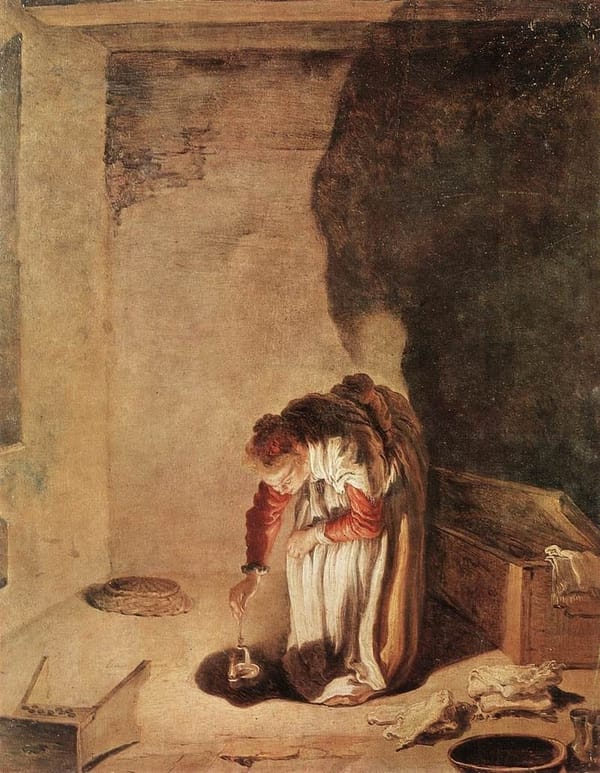
Ch. xv.At that time: the publicans and sinners drew near unto him to hear him. And the pharisees and scribes murmured, saying: This man receiveth sinners and eateth with them. And he spoke to them this parable, saying: What man of you that hath a hundred sheep, and if he shall lose one of them, doth he not leave the ninety-nine in the desert, and go after that which was lost until he find it? And when he hath found it, lay it upon his shoulders rejoicing: and coming home call together his friends and neighbours, saying to them: Rejoice with me, because I have found my sheep that was lost? I say to you, that even so there shall be joy in heaven upon one sinner that doth penance, more than upon ninety-nine just who need not penance. Or what woman having ten groats: if she lose one groat, doth not light a candle, and sweep the house, and seek diligently until she find it? And when she hath found it, call together her friends and neighbours, saying: Rejoice with me, because I have found the groat which I had lost? So I say to you there shall be joy before the angels of God upon one sinner doing penance.
The parable of the sheep that is carried back to the fold on the shepherd’s shoulders was a favourite one with the early Christians; and they made representations of it at almost every turn. The same is put before us in to-day’s Gospel, that our confidence may be strengthened in God’s infinite mercy. It reminds us, in its own beautiful way, of our Lord Jesus; whom we contemplated, a few weeks back, ascending triumphantly into heaven, carrying thither, in His arms, the lost human family, which He had won back from satan and death and sin. For, as St. Ambrose says, ‘who is the Shepherd of our parable? It is Christ, who carries thee, poor man, in His own Body, and has taken all thy sins upon Himself. The sheep is one, not by number, but by its kind. Rich Shepherd this, of whose flock all we human beings form but the hundredth part! for He has the Angels, and Archangels, and Dominations, and Powers, and Thrones, and all the rest; all those other countless flocks, whom He has left yonder up the mountain, that He might run after the one sheep He had lost.’3
But it is from St. Gregory the Great that the Church, in her Matins of this Sunday, took the commentary on this Gospel. And in the sequel of his homily, the holy doctor gives us the explanation of the parable of the woman and the ten groats. ‘He,’ says St. Gregory, ‘that is signified by the shepherd is also meant by the woman. Jesus is God; He is the Wisdom of God. And because good coin must bear the image of the king upon it, therefore was it that the woman lost her groat, when man, who had been created after God’s image, strayed from that image by committing sin. But the woman lights a lamp; the Wisdom of God hath appeared in human flesh. A lamp is a light which burns in a vessel of clay; and Light in a vessel of clay, is the Divinity in our flesh. It is of the vessel of His Body, that this Wisdom says: My strength is dried up like a potsherd.4 For, just as day is made hard by the fire, so His strength was dried up like a potsherd, because it has strengthened unto the glory of His resurrection, in the crucible of sufferings, the Flesh which He (Wisdom) had assumed. . . . Having found the groat she had lost, the woman calleth together her friends and neighbours, saying: Rejoice until me! because I have found the groat which I had lost. Who are these friends and neighbours, if not the heavenly spirits, who are so near to divine Wisdom by the favours they enjoy of the ceaseless vision? But we must not, meanwhile, neglect to examine why this woman, who represents divine Wisdom, is described as having ten groats, one of which she loses, then looks for, and again finds. We must know, then, that God made both angels and men, that they might know Him; and that having made both immortal, He made both to the image of God. The woman, then, had ten groats, because there are nine orders of angels, and man, who is to fill up the number of the elect, is the tenth groat; he waslost by his sin, but was found again, because eternal Wisdom restored him, by lighting the lamp, that is, by assuming his flesh, and through that working wonderful works, which led to his recovery.’5
The Offertory is an outpouring of gratitude and love for the God who dwelleth in Sion; He does not abandon them that seek Him; He does not forget the poor man's prayer.
Offertory
Secret
Second Secret
The third Secret is left to the priest’s own choice.
The Preface is that appointed for all Sundays during the year, page 45; unless a feast is being kept which has a proper one assigned to it.
The Communion-anthem recalls to our minds, and with much appropriateness, the merciful teaching of to-day’s Gospel, now that eternal Wisdom has regained full possession of the lost groat, by means of the sacred Banquet, which He Himself had given to the repentant prodigal.
Communion
Postcommunion
Second Postcommunion
The third Postcommunion is left to the priest’s own choice.
Vespers
The psalms, capitulum, hymn, and vesicle, as above, pages 71-79.
Antiphon of the Magnificat
June 6: St. Norbert, Bishop and Confessor
 |
THE helpful influence of the Holy Ghost is more and more multiplied along the Church's path. It seems as though he would show us to-day how the divine power of his action is not crippled by lapse of years: for here we have, twelve centuries after his first coming among us, miracles of grace and conversion quite as brilliant as those that marked his glorious descent upon earth.
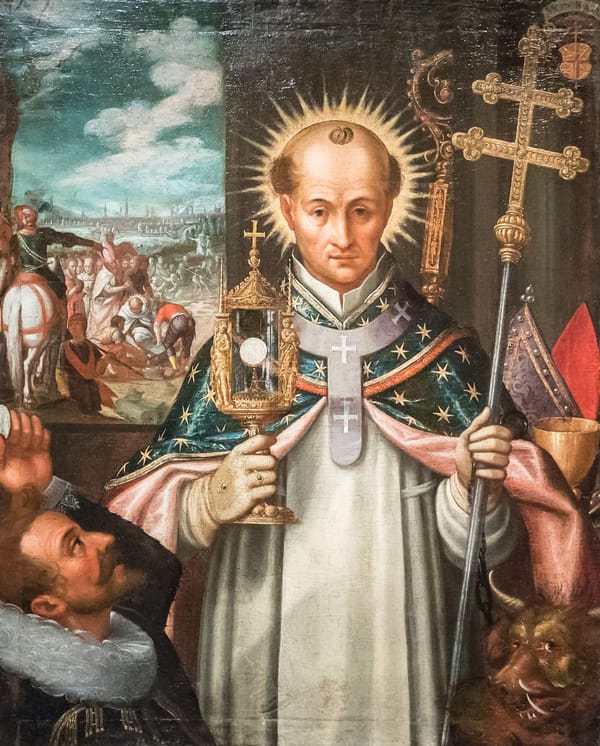
Norbert, in whose veins flowed the blood of emperors and kings, was, from the very breast of his mother Hedwige, supernaturally invited to a nobility loftier still: yet did he devote to the unreserved enjoyment of pleasure three-and-thirty years of a life that was to number but fifty in all. The Holy Ghost at length hastened to the conquest. There burst a sudden storm, a thunderbolt falls right in front of the prodigal, throwing him to the ground and making a frightful chasm between him and the point whither, a moment ago, he was hastening in pursuit of new vanities, that needs must fail, as all others had done, to fill the hopeless void in his heart. Then, in the very depths of his soul resounds a voice, such as Saul once heard on his way to Damascus: ‘Norbert, whither goest thou?' Like another Paul he replies: ‘Lord, what wilt thou have me to do?' He is answered: ‘Depart from evil and do good; seek after peace and pursue it.' Twenty years later, Norbert is in heaven, seated amidst pontiffs, upon a glorious throne, and all radiant with that special brilliancy that distinguishes the founders of the great religious Orders, when they have reached the eternal home.
Deep are the traces left by him on earth of his few years of penitential life. Germany and France receive his preaching; Antwerp is delivered from a shameful heresy; Magdeburg is rescued, by her archbishop, from the irregularities that were sullying the house of God: such are his works; and though these alone would have sufficed to a long life of holiness, yet they are not the only claims, nor the most brilliant, which Norbert has to the Church's gratitude. Before being called, against his will, to the honours of the episcopate, this once gay courtier made choice of an uninhabitable solitude amidst the forests of the diocese of Laon where he devoted himself to prayer and to the maceration of his flesh. The renown of this holy penitent gained rapidly; and Prémontré soon beheld her swampy marshes invaded by a vast multitude, formed of the fairest names of the nobility, pressing thither to learn the science of salvation from the lips of the saintly anchorite. There, too, did our Lady show to him, in vision, the white habit wherewith his disciples were to be clothed; and St Augustine, in like manner, delivered to him his own rule. Thus was founded the most illustrious branch of the Order of Canons Regular. They add to the obligation of solemnizing the Divine Office the austerities of an uninterrupted penance; and devote themselves, moreover, to the service of souls, by preaching and the administration of parishes.
In the foregoing century, the episcopacy and papacy had been raised by the monks above the danger of feudal servitude; and Norbert was now raised up to give the needed completion to their work. Although, in principle, the monastic life excludes no sort of labour useful to the Church, the monks could not (however numerous they might be) quit their cloisters in order to undertake charge of souls. Yet great were the wants of the lambs of the flock at that time; for many unworthy pastors of secondary order, slaves to simony and immorality, still continued to lead astray the simple laity. The religious life was alone capable of raising the priesthood from such degradation, whether on the pinnacles of the hierarchy, or amongst the lowest degrees of sacred Orders. Norbert was the man chosen by God to effect, in part at least, this immense work; and the importance of his mission explains the sublime prodigality wherewith the Holy Ghost multiplied vocations to his standard. The number and rapidity of foundations permitted succour to be promptly and everywhere afforded. Even into the far east did the light of Prémontré reach, almost at its first dawn. In the eighteenth century, notwithstanding the devastations of the Turks and the ravages of the pretended Reformation, the Order, divided into twenty-eight provinces, still contained, in almost every one of its houses, as many as from fifty to one hundred and twenty canons, and the parishes that continued under their care might be counted by thousands.
Nuns, whose holy life and prayers are the ornament and aid of the Church militant, occupied from the very beginning the place deservedly their due in this numerous family. In the time of the founder, or soon after his death, there were more than a thousand of them at Prémontré alone. Such an incredible number gives us an idea of the prodigious propagation of the Order from its very origin. Norbert moreover extended his charity to persons who, like Thibault Count of Champagne, would gladly have followed him into the desert, but who were retained by God’s will in the world; he thus made a prelude to those pious associations, which we shall see St Francis and St Dominic organizing in the thirteenth century, under the name of Third Orders.
The liturgy thus condenses the life of this great servant of God:
Thou didst indeed know how to redeem the time,1 as was fitting in those evil days, wherein thou thyself, O Norbert, led away by the example of the senseless crowd, hadst for so long frustrated the designs of God's love. Those years, at first refused by thee to the true Master of the world, were at length returned unto him, multiplied a hundredfold, through those countless sons and daughters thou didst train up in sanctity. Even thy personal works, in but twenty years' space, filled the whole earth. Schism crushed; heresy confounded to the greater glory of the most holy Sacrament which it had already dared to attack; the rights of the Church intrepidly defended against worldly princes and unjust retentions; the priesthood restored to its primitive purity; the Christian life established on its true basis, of prayer and penance; such and so many victories achieved in so few years, are due to the generosity which prevented thee from looking back for one moment, once the Holy Ghost had touched thy heart. Do thou make all understand that it is never too late to begin to serve God. Were it even, as in thy case, the evening of life, what yet remains of time would suffice to make us saints, if we would but generously give that little fully to heaven.2
Faith and patience were thy cherished virtues; make them flourish once more in this sad world, which boasts of its disbelief, and with jibe and jeer hurries onward to the abyss of hell. Forget not, dear apostle, now that thou art in heaven, the countries thou didst formerly evangelize; we implore this of thee, in spite of their forgetfulness and deliberate return to the deceits of the devil.
Holy Pontiff, Magdeburg has lost her ancient faith, and with it the precious relics of thy body, which she no longer deserved to possess: Prague is now the favoured place of thy repose. But, whilst blessing this hospitable city, pray still for the ungrateful one that has cast aside her double treasure. O thou founder of Prémontré, smile once more on France, which derives from thee one of her fairest glories. Obtain of God that, for the salvation of these calamitous times, thine Order may recover something of its former splendour. Bless, few as they are, those sons and daughters of thine who, in spite of the hostility of the 'powers that be,' seek to shed once more their beneficent influence on France. May England benefit also by their return to her midst, and may their fruits be multiplied in every direction. Maintain thine own spirit among them; may they find in interior peace the secret of triumph over Satan and his crew; may the full magnificence of the divine worship solemnly carried out be ever to their souls as the dearly loved mount, whence, Moses-like, they may declare the will of the Lord to the new Israel, the Christian people.
| Previous June 5: St. Boniface, Apostle of Germany, Bishop and Martyr | Next June 6: St. Norbert, Bishop and Confessor |