Daily reading
After Pentecost
Double · Movable from Easter · Temporal
June 13, 2027
From Dom Guéranger’s The Liturgical Year.

|
The Fourth Sunday after Pentecost
The fourth Sunday after Pentecost was called, for a long period, in the west, the Sunday of mercy, because, formerly, there was read upon it the passage from St. Luke beginning with the words : ‘Be merciful, as your Father is merciful.’ But, this Gospel having been since assigned to the Mass of the first Sunday after Pentecost, the Gospel of the fifth Sunday was made that of the fourth; the Gospel of the sixth became that of the fifth; and so on, up to the twenty-third. The change we speak of was, however, not introduced into many Churches till a very late period;1 and it was not universally received till the sixteenth century.
Whilst the Gospels were thus brought forward a week, in almost the whole series of these Sundays, the Epistles, Prayers, and the other sung portions of the ancient Masses were, with a few exceptions, left as originally drawn up. The connexion which the liturgists of the eleventh, twelfth, and thirteenth centuries had fancied they found between the Gospel and the rest of the liturgy for these Sundays was broken. Thus the Church spared not those favourite views and explanations which were at times farfetched; and yet she did not intend thereby to condemn those writers, nor to discourage her children from perusing their treatises, for, as the holy reflections they contained were frequently suggested by the authority of the ancient liturgies, such reading would edify and instruct. We are quite at liberty, then, to turn their labours to profit; let us only keep this continually before us—that the chief connexion existing between the several portions of the proper of each Mass for the Sundays after Pentecost consists in the unity of the sacrifice itself.
In the Greek Church there is even less pretension to anything approaching methodical arrangement in the liturgy of these Sundays. On the morrow of Pentecost they begin the reading of the Gospel of St. Matthew, and continue it, chapter after chapter, up to the feast of the Exaltation of the holy Cross, in September. St. Luke follows St. Matthew, and is read in the same way. The weeks and Sundays of this season are simply named according to the Gospel of each day; or they take the name of the evangelist whose text is being read : thus, our first Sunday after Pentecost is called by them the first Sunday of St. Matthew; the one we are now keeping is their fourth of St. Matthew.
So important is the Sunday's liturgy, destined each week to honour such profound mysteries, that, for a long time, the Roman Pontiffs kept down the number of feasts which were above the rank of semi-doubles; that thus the Sunday, which is itself a semi-double, might not be superseded. It was not till the second half of the seventeenth century that this discipline of reserve was relaxed. Then it was that it had to give way in order thereby to meet the attacks, made by the Protestants and their allies the Jansenists, against the cult of the saints. It was needful to remind the faithful that the honour paid to the servants of God detracts not from the glory of their Master; that the cult of the saints, the members of Christ, is but the consequence and development of that which is due to Christ their Head. The Church owed it to her Spouse to make a protest against the narrow views of these innovators, who were really aiming at lessening the glory of the Incarnation by thus denying its grandest consequences. It was, therefore, by a special inspiration of the holy Spirit that the apostolic See then permitted several feasts, both old and new, to be ranked as of a double rite. To strengthen the solemn condemnation she had pronounced against the heretics of that period, she wisely adopted the course of allowing the feasts of saints to be sometimes kept on Sundays, although these latter were considered as being especially reserved for the celebration of the leading mysteries of our Catholic faith, and for the obligatory attendance of the people.
The Sunday, or dominical, liturgy was not, however, altogether displaced by the celebration of any particular feast on the Lord’s Day; for, no matter how solemn soever the feast falling on a Sunday may be, a commemoration must always be made of the Sunday, by adding its Prayers to those of the occurring feast, and by reading its proper Gospel, instead of that of St. John, at the end of Mass. Neither let us forget that after the assisting at the solemn Mass and the canonical Hours, one of the best means for observing the precept of keeping holy the sabbath-day is oar own private meditation upon the Epistle and Gospel appointed by the Church for each Sunday.
Recently, however, in view of the great increase in the number of festivals of Saints kept by the Universal Church, which had resulted in the Sunday liturgy being very rarely used, the Holy See has thought well to ordain that greater or lesser double feasts falling on Sundays shall be merely commemorated in the Mass and Office of the day. Henceforth the Mass of the season is said on every Sunday throughout the year which is not occupied by a double feast of the first or second class, or by a Feast of Our Lord. Thus the Sunday liturgy is restored to its former high rank in the scheme of the Church's year.
Mass
The Church, on the morrow of Trinity Sunday, began the reading of the Books of Kings in her Night Office. On this very night preceding our Sunday she entered on the admirable history of Davids triumph over Goliath, the Philistine giant. Now, who is the Church's true David but that divine leader who, for these eighteen hundred years, has been marshalling the army of the saints to victory? Is not she herself the King's daughter,2 who was promised to Him who should win the battle against satan? That battle was won on Calvary by our Lord Jesus Christ; He saved the true Israel, and avenged the insult offered to the God of hosts. Filled with the sentiments breathed into her by this episode of sacred history, the Church, the bride, borrows the words of David,3 wherewith to celebrate the noble exploits of her Spouse, and to tell the confidence which she has in Him, in consequence of His triumph. It is her Introit
Introit
Notwithstanding her confidence in heaven’s help in times of trial, yet does the Church ever pray to the Most High that He would bless the world with peace. If, when the battle comes, the bride thrills at the thought that she will then have the chance of proving her devoted love, yet, as mother, she trembles when she thinks that many of her children, who would have been saved had the times been peaceful, will perish because of days of trouble overtaking them. Let us pray with her in the Collect.
Collect
Second Collect
The third Collect is left to the priest's own choice.
Epistle
Cap. viii.Fratres, Existimo quod non sunt condignæ passiones hujus temporis ad futuram gloriam, quæ revelabitur in nobis. Nam exspectatio creaturæ revelationem filiorum Dei exspectat. Vanitati enim creatura subjecta est non volens, sed propter eum qui subjecit eam in spe : quia et ipsa creatura liberabitur a servitute corruptionis in libertatem gloriæ filiorum Dei. Scimus enim quod omnis creatura ingemiscit, et parturit usque adhuc. Non solum autem illa, sed et nos ipsi primitias Spiritus habentes, et ipsi intra nosgemimus, adoptionem filiorum Dei exspectantes, redemptionem corporis nostri: in Christo Jesu Domino nostro.
Ch. viii.Brethren : I reckon that the sufferings of this time are not worthy to be compared with the glory to come, that shall be revealed in us. For the expectation of the creature waiteth for the revelation of the sons of God. For the creature was made subject to vanity, not willingly, but by reason of him that made it subject, in hope : because the creature also itself snail be delivered from the servitude of corruption, into the liberty of the glory of the children of God. For we know that every creature groaneth, and travaileth in pain even till now. And not only it, but ourselves also, who have the first-fruits of the Spirit, even we ourselves groan within ourselves, waiting for the adoption of the sons of God, the redemption of our body in Christ Jesus our Lord.
The first-fruits of the Spirit are the grace and the virtues which He has put into our souls, as the earnest of salvation and the germ of future glory. Our faith confirms our possession of these divine pledges; and regenerate human nature, even amidst all the trials of this life, is consoled at the very thought of the noble destiny to which it is called. Satan may use his fiercest efforts to regain his lost ground; and the soul may have many and frequent battles to fight, in order to hold what was once under the dominion of the enemy; but Christian hope is an armour of heavens own making. Hope 'entereth in even within the veil';4 and then she comes, telling the combatant about the disproportion, here mentioned by the apostle, between the fatigues of the march here below and the bliss which is to reward our fidelity in the happy land above. He has the promises of God and the marvellous dealings of the Paraclete in his regard, both in the past and now, all justifying his expectations of the future glory that shall then be revealed, be realized, in him. The very earth he dwells on, which now so often tyrannizes over him and deceives his senses, urges him to fix his heart on something far better than itself; it even seems to share in his hopes. St. Paul tells us so in our to-day's Epistle : the wild upheavings, the restless changes of material creation, are so many voices clamouring for the destruction of sin, and for the fìnal and total triumph over the which followed sin. The present condition of this world, therefore, furnishes a special and most telling motive, inviting us to the holy virtue of hope. They alone can find anything strange in such teaching who have no idea of how man's being raised up to the supernatural order was, from the beginning, a real ennobling of the world which was made for man's service. Men of this stamp have their own ways of explaining God's creation; but the truth which explains everything both on earth and in heaven—the divine axiom which is the principle and reason of everything that has been made—is this : that God, who of necessity does everything for His own glory, has, of His own free choice, appointed that the perfection of this His glory shall consist in the triumph of His love, by the ineffable mystery of divine union realized in His creature. To bring this divine union about is, consequently, by God's gracious will, not only the one sole end, but, moreover, the one only law, the vital and constitutive law, of creation. When the Spirit moved over chaos, He adapted the informal matter to the designs of infinite love. Thereby the various elements, and the countless atoms, of the world that was in preparation really derived from this infinite love the principle of their future development and power; they received it as their one single mission to co-operate, each in its own way, with the holy Spirit, in leading man, the creature chosen by eternal Wisdom, to the proposed glorious end—union with God. Sin broke the alliance, and would have destroyed the world by taking from it the purpose of its existence, had it not been for the incomprehensible patience of the God it outraged, and the marvellous renovations of the original plan achieved by the Spirit of love. A violent state, the state of struggle and expiation, has now been substituted for what, in the primal design of the Creator, was to be the effortless advance of the king of creation to his grand destiny, the spontaneous growth of what someone has called man, ‘the god in the bud.’ Divine union is still offered to the world, but at what a cost of trouble and travail! We may still enjoy the eternal music of triumph, and all the joys of the divine nuptial banquet; but oh! what a long prelude of sighs and sobs must precede!
Men who recognize no other law than that of the flesh may be as deaf and as indifferent as they please to the teachings of positive revelation; but mere matter will go on ever condemning their materialism. Nature, which they pretend to acknowledge as their only authority, will continue to preach the supernatural with her thousand mouths, and will preach it in every nook of the earth; and creation, disturbed though it be, and turned astray by the fall of Adam, will still keep proclaiming—all the louder because it is in suffering—that the fallen king, whom it was intended to serve, has a destiny far beyond all finite things. O ye mysterious sufferings of creatures, which the apostle here calls your groanings, may we not name you, as one of the poets did, ‘the tears of things'?5 Truly, you are like the soul of music of this land of trial; we have but to listen to your sweet plaintive sounds, and let you speak your eloquence, and you lead us to Him who is the source of all beauty and love. The pagan world heard your voice; but its philosophers would have it that you meant pantheism! The Holy Ghost had not yet begun His reign. He alone could explain to us the strange language of nature, and her vehement aspirations, all of which had been put into her by Himself. All is now made clear to us : the Spirit of the Lord hath filled the whole earth;6 the divine witness, who giveth us assurance that we are the sons of God,7 has carried His precious testimony to the farthest limits of creation; for all creation thrills with expectancy, impatient to see the coming of that glorious day which is to be the revelation of the glory that belongs to these sons of God. It is on their account that they too have had to suffer; together with them they shall be set free, and shall share in the brightness of their coronation-day. St. John Chrysostom compares the earth to 'the nurse who has brought up the king's son; when he succeeds to his father's kingdom, she too is made all the better off. . . . It is much the same with all men; when a son of theirs is to appear in the splendour of some new dignity, they let his very servants wear richer suits. So will God vest in incorruption every creature when the day of the deliverance and glory of His children shall come.’8
The Gradual offers up to God the prayers of Christians who, though they are far from being free from sin, and feel that they are unworthy of His assistance, yet, for His own glory's sake, sue Him to have compassion on them. Poor though they be, they are His soldiers; their cause is His. The Alleluia-verse shows us the Church, though here below she be poor and persecuted, sending up her prayer of confidence to the throne of her Spouse, the most just Judge.
Gradual
℣. Adjuva nos, Deus salutaris noster : et propter honorem nominis tui, Domine, libera nos. Alleluia, alleluia. ℣. Deus, qui sedes super thronum, et judicas æquitatem, esto refugium pauperum in tribulatione. Alleluia.
℣. Help us, O Lord, our Saviour, and, for the honour of thy name, deliver us, O Lord. Alleluia, alleluia. ℣. O God, who sittest on thy throne, and judgest justly, be a refuge to the poor in distress. Alleluia.
Gospel
Cap. v.In illo tempore : Cum turbæ irruerent in Jesum, ut audirent verbum Dei, et ipse stabat secus stagnum Genezareth. Et vidit duas naves stantes secus stagnum: piscatores autem descenderant, et lavabant retia. Ascendens autem in unam navim, quæ erat Simonis, rogavit eum a terra reducere pusillum. Et sedens, docebat de navicula turbas. Ut cessavit autem loqui, dixit ad Simonem : Duc in altum, et laxate retia vestra in capturam. Et respondens Simon, dixit illi : Præceptor, per totani noctem laborantes, nihil cepimus : in verbo autem tuo laxabo rete. Et cum hoc fecissent, concluserunt pisci um multitudinem copiosam; rumpebatur autem rete eorum. Et annuerunt sociis, qui erant in alia navi, ut venirent, et adjuvarent eos. Et venerunt, et impleverunt ambas naviculas, ita ut pene mergerentur. Quod cum videret Simon Petrus, procidit ad genua Jesu, dicens : Exi a me, quia homo peccafcor sum, Domine. Stupor enim circumdederat eum, et omnes qui cum illo erant, in captura piscium quam ceperant : similiter autem Jacobum et Joannem, fìlios Zebedæi, qui erant socii Simonis. Et ait ad Simonem Jesus : Noli timere: exhoc jam homines eris capiens. Et subductis ad terram navibus, relictis omnibus secuti sunt eum.
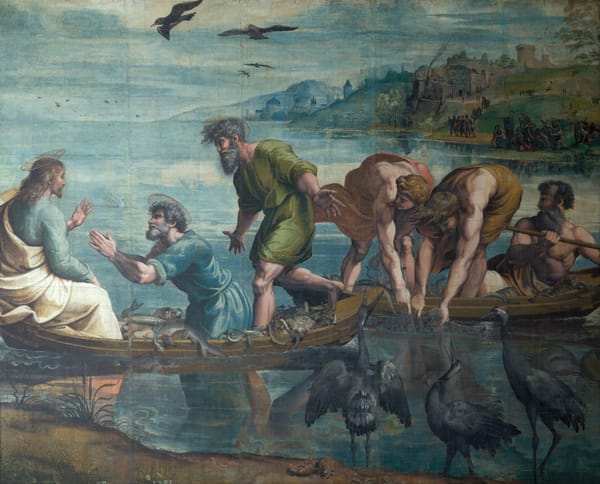
Ch. v.At that time, it came to pass, that when the multitude pressed upon him to hear the word of God, he stood by the lake of Genesareth, and saw two ships standing by the lake; but the fishermen were gone out of them and were washing their nets. And going into one of the ships that was Simon's, he desired him to draw back a little from the land. And sitting he taught the multitudes out of the ship. Now when he had ceased to speak, he said to Simon : Launch out into the deep, and let down your nets for a draught. And Simon, answering, said to him : Master, we have laboured all the night, and have taken nothing; but at thy word, I will let down the net. And when they had done this, they enclosed a very great multitude of fishes, and their net broke. And they beckoned to their partners that were in the other ship, that they should come and help them. And they came and filled both the ships, so that they were almost sinking. Which when Simon Peter saw, he fell down at Jesus' knees, saying : Depart from me, for I am a sinful man, O Lord. For he was wholly astonished, and all that were with him, at the draught of the fishes which they had taken. And so were also James and John the sons of Zebedee, who were Simon’s partners. And Jesus saith to Simon : Fear not; from henceforth thou shalt catch men. And having brought their ships to land, leaving all things they followed him.
The prophecy and promise made by Jesus to Simon the son of John is now fulfilled. We were in amazement, on the day when the Holy Ghost came down, at the success which attended Peter's first fishing for men; he cast in his nets, and it was the choicest of the sons of Israel that he took, and offered them to the Lord Jesus. But the bark of Peter was not to be long confined within Jewish waters. Insignificant as it seems to human views, the ship is now sailing on the high seas; it rides on the deep waters, which are, so St. John tells us, peoples and nations.9 The boisterous wind, the surging billows, the storm, no longer terrify the boatman of Lake Tiberias; for he knows that he has on board Him who is the master of the waves— Him, that is, who has given the deep as a garment to clothe the earth.10 Endued with power from on high,11 Peter has cast his net, the apostolic preaching, all over the great ocean; for it is large as the world, and is to bring the sons of the ‘great fish,’12 the divine Ichthus,13 to the eternal shore. Grand indeed is the work assigned to Peter. Though fellow-labourers have been joined to him in his divine enterprise, yet does he preside over them all as their undisputed head, as master of the ship where Jesus commands in person, and directs all the operations to be done for the worlds salvation. Our to-day's Gospel very opportunely prepares us for, and sums up, the teachings included in the feast of the prince of the apostles, which always comes close on the fourth Sunday after Pentecost. For that very reason, we leave for that feast the detailed enumeration of the glories inherent in the vicar of Christ; and limit ourselves, for the present, to the consideration of the other mysteries contained in the text before us.
The evangelists have left us the account of two miraculous fishings made by the apostles in presence of their divine Lord : one of these, related by St. Luke, the Church proposes for our consideration on this Sunday; the other, with its exquisite symbolism, was put before us by the beloved disciple on Easter Wednesday. The former of these, which took place while our Lord was still in the days of His mortal life, merely states that the net was cast into the water, and that it broke with the multitude of the draught; but no notice is taken by the evangelist of either the number or the kind of fish. In the second, it is our risen Lord who tells the fishermen, His disciples, that the net must be let down on the right side of their boat; it catches, and without breaking, a hundred and fifty great fishes ; these are brought to the shore where Jesus is waiting for them, that He may join them with the mysterious bread and fish that He Himself has already prepared for His labourers.14 The fathers are unanimous in the interpretation of these two fishings : they represent the Church; first of all, the Church as she now is, and next as she is to be in eternity. As she now is, the Church is the multitude, without distinction between good and bad; but afterwards—that is, after the resurrection—the good alone will compose the Church, and their number will be for ever fixed. ‘The kingdom of heaven,’ says our Lord, ‘is like to a net cast into the sea, and gathering together of all kind of fishes; which, when it was filled, they drew out; they chose out the good into vessels, but the bad they cast forth.’15
To speak with St. Augustine, the fishers of men have cast forth their nets; they have taken the multitude of Christians which we see in wonderment; they have filled the two ships with them, the two peoples, Jew and Gentile. But what is this we are told? The multitude weighs down the ships, even to the risk of sinking them; it is what we witness now : the pressing and mingled crowd of the baptized is a burden to the Church. Many Christians there are who live badly; they are a trouble to, and keep back, the good. Worse than these, there are those who tear the nets by their schisms or their heresies; they are impatient of the yoke of unity, and will not come to the banquet of Christ; they are pleased with themselves. Under pretext that they cannot live with the bad, they break the net which kept them in the apostolic track, and they die far off the shore. In how many countries have they not thus broken the great net of salvation? The Donatists in Africa, the Arians in Egypt, Montanus in Phrygia, Manes in Persia; and since their times, how many others have excelled in the work of rupture! Let us not imitate their folly. If grace have made us holy, let us be patient with the bad while living in this world's waters. Let the sight of them drive us neither to live as they do, nor to leave the Church. The shore is not far off, where those on the right, or the good, will alone be permitted to land, and from which the wicked will be repulsed, and cast into the abyss.16
In the Offertory, the Christian army sues for that light of faith which alone can make it sure of victory; and this, because it tells where the enemy is, and what are his plans. For a servant of God who is thus enlightened, night has no dangers; the brightness of heaven's beams keeps off from his eyes that fatal sleep which implies defeat and death.
Offertory
The gifts offered on the altar for the all-mighty transformation of the sacrifice are a figure of the faithful themselves. It is on this account that the Church prays, in the Secret, that our Lord would draw to Himself our rebel wills, and change them, as He is about to do with these gifts. Let us remember, that of all the fish that were in the mysterious net, those only, as the fathers tell us, will be the elect of the eternal shores who 'live in such wise as to deserve to be introduced, by the fishermen of the Church, to the banquet of Christ Jesus.'17
Secret
Second Secret
The third Secret is left to the priest's own choice.
That God who enabled David's weakness to triumph over the giant Philistine, gives Himself to us in the sacred mysteries. Let us sing the psalm from which the Communion-anthem is taken: let us sing these few words in praise of His merciful power, which makes itself become ours by means of this adorable Sacrament.
Communion
St. Augustine18 gives the name of sacrament of hope to the divine mystery wherein the Church daily proclaims and restores, here below, her social union. The real union, though at present it be veiled, of the Head and the members in the banquet of eternal Wisdom, is a pledge of the future glories of regenerate humanity, far exceeding that restless expectation of creation, of which the apostle spoke to us in to-day's Epistle. Let us pray, in the Postcommunion, that our defilements may be removed, and may not impede this holy Sacrament from producing its full effect in us; for such is its virtue, that it is able to lead us to the consummate perfection of salvation.
Postcommunion
Second Postcommunion
The third Postcommunion is left to the priest's own choice.
Vespers
The psalms, capitulum, hymn, and versicle, as above, pages 71-81.
Antiphon of the Magnificat
- Cf. cum Missali hodierno Bern. Aug. De offic. Mis. cap. V; Microlog. De eccl. obs. cap. lxi; Honor. Augustod. Gemma animæ,l. iv; Rupert. De div. off. l. xii; Durand. 1. vi; etc. ↩︎
- Kings xvii. 25-27. ↩︎
- Ps. xxvi. ↩︎
- Heb. vi.19. ↩︎
- Virg., ‘Æn.,’ I. 462. ↩︎
- Wisd. i. 7. ↩︎
- Rom. viii. 16. ↩︎
- In Ep, ad Rom., Hom. xiv. 5. ↩︎
- Apoc. xvii. 15. ↩︎
- Ps. ciii. 6. ↩︎
- St. Luke xxiv. 49. ↩︎
- Titul. S. Abercii. ↩︎
- Inscript. Augustod. ↩︎
- St. John xxi. 1-13. ↩︎
- St. Matt. xiii. 47, 48. ↩︎
- S. Aug. Serm. 248-252, passim. ↩︎
- Bruno Ast. Expos. in Gen., c. I. ↩︎
- Contra Faustum. L. xii. 20. ↩︎
June 13: St. Anthony of Padua, Confessor
 |
REJOICE thee, happy Padua, rich in thy priceless treasure!1 Anthony, in bequeathing thee his body, has done more for thy glory than the heroes who founded thee on so favoured a site, or the doctors who have illustrated thy famous university!
The days of Charlemagne were past and gone: yet the work of Leo III still lived on, despite a thousand difficulties. The enemy, now at large, had sown cockle in the field of the divine householder; heresy was springing up here and there, whilst vice was growing apace in every direction. In many an heroic combat, the Popes, aided by the monastic Order, had succeeded in casting disorder out of the sanctuary itself: still the people, too long scandalized by venal pastors, were fast slipping away from the Church. Who could rally them once more? Who wrest from Satan a reconquest of the world? At this trying moment the Spirit of Pentecost, ever living, ever present in holy Church, raised up the sons of St Dominic and of St Francis. The brave soldiers of this new militia, organized to meet fresh necessities, threw themselves into the field, pursuing heresy into its most secret lurking-holes, and thundering against vice in every shape and wheresoever found. In town or in country, they were everywhere to be seen confounding false teachers by the strong argument of miracle as well as of doctrine; mixing with the people, whom the sight of their heroic detachment easily won over to repentance. Crowds flocked to be enrolled in the Third Orders instituted by these two holy founders, to afford a secure refuge for the Christian life in the midst of the world.
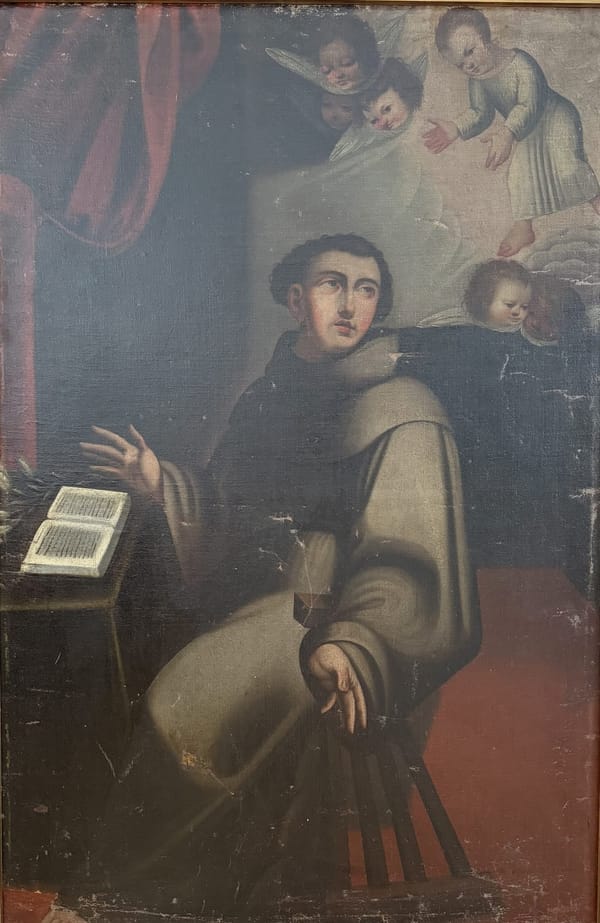
The best known and most popular of all the sons of St Francis is Anthony, whom we are celebrating this day. His life was short; at the age of thirty-five he took his flight to heaven. But a span so limited allowed, nevertheless, of a considerable portion of time being directed by our Lord to preparing this chosen servant for his destined ministry. The all-important thing in God's esteem, where there is question of fitting apostolic men to become instruments of salvation to a greater number of souls, is not the length of time which they may devote to exterior works, but rather the degree of personal sanctification attained by them, and the thoroughness of their self-abandonment to the ways of divine Providence. As to Antony, it may almost be said that, up to the last day of his life, eternal Wisdom seemed to take pleasure in disconcerting all his thoughts and plans. Out of his twenty years of religious life, he passed ten amongst the Canons Regular, whither the divine call had invited him at the age of fifteen, in the full bloom of his innocence; and there, wholly captivated by the splendour of the liturgy, occupied in the sweet study of the Holy Scriptures and of the fathers, blissfully lost in the silence of the cloister, his seraphic soul was ever being wafted to sublime heights, where (so it seemed) he was always to remain, held and hidden in the secret of God's face. Suddenly, behold! the divine Spirit urges him to seek the martyr's crown: and presently he is seen emerging from his beloved monastery, and following the Friars Minor to distant shores, where already some of their number had won the glorious palm. Not this, however, but the martyrdom of love, was to be his. Falling sick and reduced to impotence before his zeal could effect anything on the African soil, he was recalled by obedience to Spain, but was cast by a tempest on the Italian coast.
It happened that St Francis was just then convoking his entire family, for the third time, in general chapter. Anthony, unknown, lost in this vast assembly, beheld at its close each of the friars in turn receive his appointed destination, whereas to him not a thought was given. What a sight! The scion of the illustrious family de Bouillon and of the kings of the Asturias completely overlooked in the throng of holy poverty’s sons! At the moment of departure the Father Minister of the Bologna province, remarking the isolated condition of the young religious whom no one had received in charge, admitted him, out of charity, into his company. Accordingly, having reached the hermitage of Monte Paolo, Anthony was deputed to help in the kitchen and in sweeping the house, being supposed quite unfitted for anything else. Meanwhile, the Augustinian Canons, on the contrary, were bitterly lamenting the loss of one whose remarkable learning and sanctity, far more even than his nobility, had, up to this, been the glory of their Order.
The hour at last came, chosen by Providence, to manifest Anthony to the world; and immediately, as was said of Christ himself, the whole world went after him.2 Around the pulpits where this humble friar preached there were wrought endless prodigies in the order of nature and of grace. At Rome he earned the surname of ‘ark of the covenant'; in France, that of 'hammer of heretics.' It would be impossible for us here to follow him throughout his luminous course; suffice it to say that France, as well as Italy, owes much to his zealous ministry.
St Francis had yearned to be himself the bearer of the gospel of peace throughout the fair realm of France, then sorely ravaged by heresy; but in his stead, he sent thither Anthony, his well-beloved son, and, as it were, his living portrait. What St Dominic had been in the first crusade against the Albigenses, Anthony was in the second. At Toulouse was wrought that wondrous miracle of the famished mule turning aside from the proffered grain in order to prostrate in homage before the sacred Host. From the province of Berry, his burning word was heard thundering in various distant provinces; whilst heaven lavished delicious favours on his soul, ever childlike amidst the marvellous victories achieved by him, and the intoxicating applause of an admiring crowd. Under the very eyes of his host, at a lonely house in Limousin, the Infant Jesus came to him radiant in beauty; and throwing himself into his arms, covered him with sweetest caresses, pressing the humble friar to lavish the like on him. One feast of the Assumption Anthony was sad, because a phrase then to be found in the Office seemed to throw a shade of discredit on the fact of Mary’s body being assumed into heaven together with her soul. Presently, the Mother of God herself came to console her devoted servant, in his lowly cell, assuring him of the truth of the doctrine of her glorious Assumption; and so left him, ravished with the sweet charms of her countenance and the melodious sound of her voice. Suddenly, as he was preaching at Montpellier, in a church of that city thronged with people, Anthony remembered that he had been appointed to chant the Alleluia at the conventual Mass in his own convent, and he had quite forgotten to get his place supplied. Deeply pained at this involuntary omission, he bent his head upon his breast: whilst standing thus motionless and silent in the pulpit, as though asleep, his brethren saw him enter their choir, sing his verse, and depart; at once his audience beheld him recover his animation, and continue his sermon with the same eloquence as before. In this same town of Montpellier another well-known incident occurred. When engaged in teaching a course of theology to his brethren, his commentary on the Psalms disappeared; but the thief was presently constrained, even by the fiend himself, to bring back the volume, the loss whereof had caused our saint so much regret. Such is commonly thought to be the origin of the popular devotion, whereby a special power of recovering lost things is ascribed to St Anthony. However this may be, it is certain that, from the very outset, this devotion rests on the testimony of startling miracles of this kind; and in our own day constantly repeated favours of a similar nature still confirm the same.
The following is the abridgement of this beautiful life, as given in the liturgy.
Want of space obliges us to be very meagre in the number we give of liturgical pieces; but we cannot omit here the miraculous Responsory, as it is called, the composition whereof is attributed to St Bonaventure. It continues still to justify its name, in favour of those who recite it in the hour of need. In the Franciscan breviary it is the eighth responsory of the office of St Antony of Padua. At a very early date, this, together with the nine Tuesdays in our Saint's honour, became a very popular devotion and was fraught with immense fruits of grace.
The Miraculous Responsory
O glorious Anthony, the simplicity of thine innocent soul made thee a docile instrument in the hand of the Spirit of love. The Seraphic Doctor, St Bonaventure, hymning thy praises, takes for his first theme thy childlike spirit, and for his second thy wisdom which flowed therefrom. Wise indeed wast thou, O Anthony, for, from thy tenderest years, thou wast in earnest pursuit of divine Wisdom; and wishing to have her alone for thy portion, thou didst hasten to shelter thy love in some cloister, to hide thee in the secret of God’s face, the better to enjoy her chaste delights. Silence and obscurity in her sweet company was thine heart's one ambition; and even here below her hands were pleased to adorn thee with incomparable splendour. She walked before thee; and blithely didst thou follow, for her own sake alone, without suspecting how all other good things were to become thine in her company.3 Happy a childlike spirit such as thine, to which are ever reserved the more lavish favours of eternal Wisdom!
'But,' exclaims thy sainted panegyrist, 'who is really a child nowadays? Humble littleness is no more; therefore love is no more. Naught is to be seen now but valleys bulging into hills, and hills swelling into mountains. What saith Holy Writ? “When they were lifted up, thou hast cast them down.”4 To such towering vaunters, God saith again: "Behold I have made thee a small child ”; but exceedingly contemptible among the nations5 such infancy is. Wherefore will ye keep to this childishness, O men, making your days an endless series of inconstancy, boisterous and vain effort at garnering wretched chaff? Other is that infancy which is declared to be the greatest in the land of true greatness.6 Such was thine, O Anthony! and thereby wast thou wholly yielded up to Wisdom's sacred influence.’7 In return for thy loving submission to God our Father in heaven, the populace obeyed thee, and fiercest tyrants trembled at thy voice.8 Heresy alone dared once to disobey thee, dared to refuse to hearken to thy word: thereupon, the very fishes of the sea took up thy defence; for they came swimming in shoals, before the eyes of the whole city, to listen to thy preaching which heretics had scorned. Alas! error, having long ago recovered from the vigorous blows dealt by thee, is yet more emboldened in these days, claiming even sole right to speak. The offspring of Manes, whom, under the name of Albigenses, thou didst so successfully combat, would now, under the new appellation of freemasonry, have all France at its beck; thy native Portugal beholds the same monster stalking in broad daylight almost up to the very altar; and the whole world is being intoxicated by its poison. O thou who dost daily fly to the aid of thy devoted clients in their private necessities, thou whose power is the same in heaven as heretofore upon earth, succour the Church, aid God's people, have pity upon society, now more universally and deeply menaced than ever. O thou ark of the covenant, bring back our generation, so terribly devoid of love and faith, to the serious study of sacred letters, wherein is so energizing a power. O thou hammer of heretics, strike once more such blows as will make hell tremble and the heavenly powers thrill with joy.
| Previous June 12 (the Same Day): St. Basilides and Companions, Martyrs | Next June 13: St. Anthony of Padua, Confessor |