Daily reading
After Pentecost
Greater Double · Movable from Easter · Temporal
August 1, 2027
From Dom Guéranger’s The Liturgical Year.

|
The Eleventh Sunday after Pentecost
With the Greeks, this Sunday—their eleventh of Saint Matthew—is called the Parable of the King, who calls his servants to account.1 In the western Church, it has gone under the name of Sunday of the deaf and dumb, ever since the Gospel of the pharisee and the publican has been assigned to the tenth. To-day's Mass, as we now have it, still gives evidence as to what was its ancient arrangement. Our commentary on to-day's liturgy will show us this very plainly.
In the years when Easter falls nearest to March 21 the Books of Kings are continued as lessons of Matins up to, but never beyond, this Sunday. The sickness of the good king Ezechias, and the miraculous cure he obtained by his prayers and tears, are then the subject of the first lessons of the night-Office.2
Mass
The learned and pious Abbot Rupert, writing on this Sunday's Mass previous to the change made in the order of the Gospel lessons, thus explains the Church's reason for selecting the following Introit : ‘The publican in the Gospel accuses himself, saying : “I am not worthy to lift up mine eyes to heaven.” St. Paul, in the Epistle, does in like manner, and says : I am the least of the apostles, who am not worthy to be called an apostle, because I persecuted the Church of God." As, then, this humility, which is set before us that we may practise it, is the guardian of the union between the servants of God, because it keeps them from being puffed up one against the other,3 it is most appropriate that we should first sing the Introit, which tells us that God maketh men, in His house, abide together as though they were all but one soul.’4
Introit
The Collect which follows is most touching, when we see it in the light of the Gospel formerly fixed for this Sunday. Though that connexion has now been broken, yet the appropriateness is still very striking; for the Epistle, as Abbot Rupert was just telling us, continues to urge us to humility by proposing to us the example of St. Paul; the humility of the repentant publican has been anticipated. Our mother the Church is all emotion at beholding this publican, this object of contempt to the Jew, striking his breast, and scarce able to put his sorrow into words : she, with motherly tenderness, comes and takes up his faltering prayer, and gives it her own eloquence. Nothing could exceed the delicate way in which she. asks of the Omnipotent that, in His infinite mercy, He would restore peace to troubled consciences, by pardoning them their sins, and granting them what they, poor sinners, are too afraid to presume to ask for.
Collect
The other Collects, as on page 120.
Epistle
1 Cap. xv.Fratres, Notum vobis facio Evangelium, quod prædicavi vobis, quod et accepistis, in quo et statis, per quod et salvamini : qua ratione prædicaverim vobis, si tenetis, nisi frustra credidistis. Tradidi enim vobis, in primis quod et accepi : quoniam Christus mortuus est pro peccatis nostris secundum Scripturas : et quia sepultus est, et quia resurrexit tertia die secundum Scripturas : et quia visus est Cephæ, et post hoc undecim. Deinde visus est plus quam quingentis fratribus simul: ex quibus multi manent usque adhuc, quidam autem dormierunt. Deinde visus est Jacobo, deinde apostolis omnibus : novissime autem omnium tamquam abortivo visus est et mihi. Ego enim sum minimus apostolorum, qui non sum dignus vocari apostolus, quoniam persecutus sum Ecclesiam Dei. Gratia autem Dei sum id quod sum, et gratia ejus in me vacua non fuit.
1 Ch. xv.Brethren : I make known unto you the Gospel which I preached to you, which also you have received, and wherein you stand, by which also you are saved : if you hold fast after what manner I preached unto you, unless you have believed in vain. For I delivered unto you first of all, which I also received : how that Christ died for our sins according to the Scriptures : and that he was buried, and that he rose again the third day according to the Scriptures : and that he was seen by Cephas; and after that by the eleven. Then he was seen by more than five hundred brethren at once; of whom many remain until this present, and some are fallen asleep. After that he was seen by James, then by all the apostles; and last of all, he was seen also by me, as by one born out of due time. For I am the least of the apostles, who am not worthy to be called an apostle, because I persecuted the Church of God. But by the grace of God I am what I am; and his grace in me hath not been void.
Last Sunday the publican reminded us of the humility which should exist in the sinner; to-day the Doctor of the Gentiles shows us, by his own example, that this virtue is quite as suitable to a man who, though now justified, never forgets how, in the past, he offended his Maker. The sins of the now just man, even though long since forgiven, are always before him.5 Having a tendency to be his own accuser,6 he finds, in the fact that God has pardoned and forgotten his sins,7 nothing but an additional motive for his own unceasing remembrance of them. Heavenly favours may sometimes be granted him as a recompense for the sincerity of his repentance; the manifestation of the secrets of eternal Wisdom may be accorded him;8 he may, perhaps, be permitted to enter into the powers of the Lord, and obtain a keen insight into the rights of infinite justice;9 yet all these favours do but help him to see more clearly the enormity of those voluntary sins of his, which added their own malice to the original stains with which he was born.10 As he progresses in sanctity, humility becomes to him something more than a satisfaction paid to justice and truth, by a mind enlightened from on high : in proportion as he lives with God in closer and closer union, and, by contemplation, goes up higher11 in light and love, divine charity, which is ever pressing him12 on every side, turns the very remembrance of his past sins into what will make that charity more ardent. That burning charity fathoms the deep abyss whence grace has drawn him; and then she darts upwards from those depths of hell, more vehement, more imperious, more active, than ever. Gratitude for the priceless riches he now possesses by the munificence of his divine Benefactor does not satisfy that sinner of former days; the avowal of his past miseries must and does escape from his enraptured soul as a hymn to his God.
Like Augustine, who was but imitating Paul,13 'he glorifies the just and the good God by publishing both the good he has received and the evil of his own acts; and this in order to win over to the one sole Object of his praise and his love the minds and hearts of all who hear him.’14 This illustrious convert of Monica and Ambrose headed the magnificent book of his 'Confessions' with these words of Psalm xlvii., which so admirably express the object he proposed to himself by thus telling all about himself : 'Great art Thou, O Lord, and exceedingly to be praised. Great is Thy power, and of Thy wisdom there is no number,'15 'And yet,’ says the saint, 'man wishes to praise Thee— man, a mere speck of Thy creation, who carries about him his own mortality, and the testimony of his sin, and the testimony that thou resistest the proud;16 and yet this man wishes to praise Thee— man, a mere speck of Thy creation. Thou excitest him to take delight in praising Thee. Receive, then, the homage which is offered Thee by the tongue that was formed for the purpose of praising Thee. Let my flesh and all my bones, that have been healed by Thee, cry out : "Who, O Lord, is like unto Thee?”17 Let my soul praise Thee, that she may love Thee; and, that she may praise Thee, let her confess Thy mercies. I wish now to go over in my mind all my long wanderings, and I will confess the things which fill me with shame, and will make of them a sacrifice of joy.18 Not that I love my sins, but it is that I may love Thee, O my God, that I recall them to mind; it is out of love of Thy love that I now recur to those bitter things, that I may taste Thy delights, O Sweetness that never deceives! Blissful Sweetness, that has no dangers! O Thou that collectest all my powers, and recallest them from the painful scattering into which they had been thrown by my separation from Thee, O Thou one centre of all being! What am I to myself, when I have not Thee, but a guide that leads me to the abyss? Or what am I, when all is well with me, but a little one that is sucking in the milk which Thou providest, or enjoying Thee, the Food that knows not corruption? And what manner of man is any man, for he is but a man? Let them that are strong and mighty—them that have not as yet had the happiness of being laid low and cast down—let them laugh at me! I am a weak man, and poor, and I give Thee praise. For that I need neither voice nor words; the cries of the thought are what Thou hearest. For when I am wicked, my being displeased with myself is a real praise to Thee; but when I am pious, my not attributing it to myself is again a real praise to Thee; for if Thou, O Lord, bless the just man,19 it is because Thou hast first justified20 him when he was ungodly.'21
'By the grace of God, I am what I am.' The just man should make this language of the apostle be his own, and when this fundamental truth is thoroughly impressed upon his soul, then may he fearlessly add with him : 'His grace in me hath not been void.' For humility is based upon truth, as we said last Sunday; and, as it would be contrary to truth were one to refer to man what man has from God, so likewise would it be an injury to truth not to recognize, as the saints did, the works of grace where Goa has wrought them. In the former case justice, in the latter gratitude, would be offended, as well as truth. Now, humility, whose direct aim is to avoid these unjust infringements on the glory due to Goa, by repressing the risings of pride, is also the earnest prompter of gratitude—so truly so, indeed, that a proud man can never be a grateful one, or, to say it in other words, the greatest enemy to the generous virtue of gratitude is pride.
It is quite true that it is good, and prudent, and, generally speaking, necessary, for souls to dwell on the consideration of their faults rather than upon the favours they have received from God, and this more especially in the first beginning of their conversion; still, it is never lawful for any man to forget that, besides being grieved for his past sins and being vigilant as to present temptations, he has also the bounden duty of ceaselessly thanking the divine Benefactor, who gave him both the grace of a change of life and the subsequent progress in virtue.22 When a Christian cannot see a grace or any good in himself without having immediately to struggle against self-complacency and a tendency to prefer himself to others, he must not be troubled, of course, for the sin of pride is not in the evil suggestions which may arise within him, but in the consent which is yielded to such suggestions; and yet this weakness which accompanies the thought of God's graces is not without its dangers in the spiritual life; and the Christian who is resolved on making any advance in perfection must gently endeavour to get altogether rid of such weakness. Aided by grace, he will gradually find the eye of his soul growing stronger by the infirmity of nature being cured, and by the removal of the involuntary remnants of sin, which, as so many vicious humours, falsify the beautiful light of God's gifts, or even sometimes distort it altogether by an unhappy refraction. 'If thine eye be single,' says our Lord, 'thy whole body will be lightsome, having no part of darkness; the whole shall be lightsome';23 the light shall enlighten thee completely and surely, because it will come to thee without obstacle and without deviation.
It is holy simplicity, daughter and inseparable companion of humility, that will show us how, when a soul is what she should be, these two things coexist, and mutually tell on each other, viz., the close, deliberate consideration of the favours she has received from heaven, and the clear consciousness of her own miseries. This admirable simplicity will lead us to the school of the Scriptures and of the saints, there to teach us that the soul's being praised in the Lord,24 and our glorying in the Lord,25 is really a giving praise and glory to God Himself. When our Lady declared, in her canticle, that all generations would call her blessed, the divine enthusiasm which was inspiring her was quite as fully the ecstasy of her humility as of her love.26 The lives of God's best servants are, at every turn, showing us these sublime transports, wherein they make the Magnificat of their Queen become their own hymn of praise to God, magnifying Him for all the great things which He, the mighty One, has vouchsafed to do through their instramentality.27 When St. Paul, after having expressed the low estimation he had of himself compared with the other apostles, adds that grace had not been a failure in him, and that he had even laboured more abundantly than all of them,28 we are not to suppose that he has changed his tone, or that the holy Spirit, who guides him, now wishes to recall his previous words. No; it is one and the same conviction, one and the same desire, which inspires these words, apparently so different and so contrary; the conviction and the desire that God must not, and shall not, be disappointed in His gifts, either by the self-appropriation of pride, or by the silence of ingratitude.
We have purposely limited our reflexions to the truths suggested by the concluding lines of our Epistle, because they complete what we had to say on humility, that indispensable virtue, on which depends, not only all progress, but even all security, in the Christian life. What St. Paul here says regarding the Resurrection of our Lord, which is the basis of the apostolic preaching and of the faith of mankind,29 is a subject of quite equal importance; but this grand doctrine has been treated of during the Easter octave, with all the fullness it deserved; and even were we not compelled from want of space, we could not do better than refer our readers to the paschal volume.30
The Gradual, according to some of our most esteemed liturgists, expresses the thanksgiving of the humble, who are healed by God, according to the hope they had put in Him.31
Gradual
Gospel
Cap. vii.In illo tempore : Exiens Jesus de finibus Tyri, venit per Sidonem ad mare Galilææ inter medios fines Decapoleos. Et adducunt ei surdum et mutum, et deprecabantur eum, ut imponat illi manum. Et apprehendens eum de turba seorsum, misit digitos suos in auriculas ejus : et exspuens, tetigit linguam ejus : et suspiciens in cœlum, ingemuit, et ait illi : Ephpheta, quod est, adaperire. Et statim apertæ sunt aures ejus, et solutum est vinculum linguae ejus, et loquebatur recte. Et præcepit illis, ne cui dicerent. Quanto autem eis præcipiebat, tanto magis plus prædicabant : et eo amplius admirabantur, dicentes : Bene omnia fecit : et surdos fecit audire, et mutos loqui.
Ch. vii.At that time : Jesus going out of the coasts of Tyre, came by Sidon to the sea of Galilee through the midst of the coasts of Decapolis. And they bring to him one deaf and dumb : and they besought him that he would lay his hand upon him. And taking him from the multitude apart, he put his fingers into his ears, and spitting, he touched his tongue; and looking up to heaven, he groaned and said to him : Ephpheta, which is, Be thou opened. And immediately his ears were opened, and the string of his tongue was loosed, and he spoke right. And he charged them that theyshould tell no man. But the more he charged them, so much the more a great deal did they publish it. And so much the more did they wonder, saying : He hath done all things well; he hath made both the deaf to hear and the dumb to speak.
Jesus is no longer in Judea; the names of the places mentioned in the beginning of to-day’s Gospel tell us that the Gentile world has become the scene of the divine operations for man's salvation. What manner of man, then, is this who is led to the Saviour, and the sight of whose miseries makes the Incarnate Word heave a sigh? And what is the meaning of the extraordinary circumstances which produce the cure? A single word of Jesus could have done it all, and His power would have shone forth all the more brightly. But the miracle which is here related contains a great mystery; and the Man-God, who aims mainly at giving us a lesson by this His mercy, makes the exercise of His power subordinate to the teaching which He desires to convey to us.
The holy fathers tell us that this man represents the entire human race,32 exclusive of the Jewish people. Abandoned for four thousand years in the sides, that is, in the countries of the north, where the prince of this world was ruling as absolute master,33 it has been experiencing the terrible effects of the seeming forgetfulness on the part of its Creator and Father, which was the consequence of original sin. Satan, whose perfidious craftiness caused man to be driven out of Paradise, has made him his own prey, and nothing could exceed the artifice he has employed for keeping him in his grasp. Wisely oppressing34 his slave, he adopted the plan of making him deaf and dumb, for this would hold him faster than chains of adamant could ever do. Dumb, he could not ask God to deliver him; deaf, he could not hear the divine voice; and thus the two ways for obtaining his liberty were shut against him. The adversary of God and man, satan, may boast of his tyranny. The grandest of all God’s creations looks like a failure; the human race, in all its branches, and in all nations, seems ruined; for even that people which God had chosen for His own, and which was to be faithful to Him when every other had gone astray,35 has made no other use of its privileges than to deny its Lord and its King, more cruelly than all the rest of mankind.
What, then? Is the bride, whom the Son of God came to seek upon the earth—is the society of saints, to be limited to those few who declared themselves His disciples during the years of His mortal life? Not so; the zeal of the newly formed Church, and the ineffable goodness of God, produced a far grander result. Driven from Jerusalem, as her divine Spouse had been, the Church met the poor captive of satan beyond the boundaries of Judea; she would fain bring him into the kingdom of God: and, through the apostles and their disciples, she brings him to Jesus, beseeching Him to lay His divine hand upon him. No human power could effect his cure. Deafened by the noise of his passions, it is only in a confused way that he can hear even the voice of his own conscience; and, as to the sounds of tradition, or the speakings of the prophets, they are to him but as an echo, very distant and faint. Worst of all, as his hearing, that most precious of our senses, is gone, so, likewise, is gone the power of making good his losses; for, as the apostle teaches, the one thing that could save him is faith, and faith cometh by hearing.36
Our Jesus groans when they have brought this poor creature before Him. He is grieved at seeing the cruelties the enemy has inflicted on this His own privileged being, this beautiful work, of which He Himself served as model and type to the blessed Trinity, at the beginning of the world.37 Raising up to heaven those eyes of His sacred Humanity —those eyes whose language has such resistless power—He sees the eternal Father acquiescing in the intentions of His own merciful compassion.38 Then, resuming the exercise of that creative omnipotence which, in the beginning, had made all things to be very good,39 and all His works to be perfect,40 He, as God and as the Word,41 utters the mighty word of restoration: Ephpheta! Be thou opened! Nothingness, or rather (in this instance) ruin, which is worse than nothingness, obeys the well-known voice; the ears of the poor sufferer are opened, joyfully opened to the teachings, which his delighted mother the Church pours into them. She is all the gladder, because it is her prayers that have won this deliverance; and he, to whom faith comes now through hearing, finding that his tongue can speak, speaks, or rather sings, a canticle of praise to his God.
And yet, as we were observing, our merciful Lord, by this cure, aims not so much at showing the power of His divine word as at giving a glorious teaching to His followers; He wishes to reveal to them, under certain visible symbols, the invisible realities produced by His grace in the secret of the sacraments. It is for the sake of such teaching that the Gospel has mentioned such an apparently trifling detail as this—that when the deaf and dumb man was brought before Him, He took him apart—apart, so to say, from the multitude of the noisy passions and the vain thoughts42 which had made him deaf to heavenly truths. After all, would there be much good in curing him if the occasion of his malady were not removed, and he were to relapse perhaps that same day? So, then, having by this separation taken precautions for the future, Jesus inserts into the man’s ears His own divine fingers which bring the Holy Ghost,43 and make to penetrate right to the ears of his heart the restorative power of this Spirit of love. And finally, more mysteriously, because the truth which was to be expressed is more profound, He touches with the saliva of His sacred mouth that tongue which had become incapable of giving glory and praise; and Wisdom (for it is she that is here mystically signified)—Wisdom, ‘that cometh forth from the mouth of the Most High,’44 and flows for us from the Saviour’s fountains45 as a life-giving drink46— openeth the mouth of the dumb man, just as she maketh eloquent the tongues of speechless infants.47
Therefore it is that the Church—in order to show us that the event recorded in to-day’s Gospel is figurative, and regards not merely one individual man, but all of us—has prescribed that the circumstances which accompanied the cure of this deaf and dumb sufferer shall be expressed in the ceremonies of holy Baptism. The priest, before pouring the water of the sacred font on the person who is presented for Baptism, puts on the catechumen’s tongue the salt of wisdom, and touches his ears, saying : Ephpheta! that is, Be opened!48
There is an instruction of another kind included in our Gospel, and worthy of our notice, as closely bearing on what we have been saying regarding humility. Our Lord imposed silence on those who had been witnesses of the miraculous cure, although He knew that their praiseworthy enthusiasm could never allow them to obey Him. By this injunction, He wished to give a lesson to His followers, that if, at times, it is impossible to keep men from being in admiration at the works they achieve—if, sometimes, the holy Spirit, in opposition to their wishes, forces them to undergo public applause for the greater glory of the God whose instruments they are—yet must they always do all in their power to avoid being noticed; they must prefer to be despised,49 or, at least, not talked of; they must love to be hidden in the secret of the face of God;50 and, after the most brilliant, just as truly as they would after the most menial, duties, they must say from the heartiest conviction: 'We are unprofitable servants, we have but done what we ought to do.’51
It is again the hymn of the humble, whether delivered, or healed, or glorified, by God, which is sung in the Offertory.
Offertory
The assembly of God’s servants beseech Him, in the following Secret, graciously to accept their gifts; and, in this holy sacrifice, to turn them into the homage of their delighted service, and the support of their weakness.
Secret
The other Secrets, as on page 130.
No more appropriate anthem than the following could have been selected as the Communion for the season which finds men busy in harvesting the fruits of the earth. We should make it our first thought to give to God, through His Church and the poor, the first fruits of these blessings which He has bestowed upon us. But, in order becomingly to honour the Lord in this, we must take care not to boast, as the pharisee did, of fulfilling a duty so imperative, and yet so very profitable to ourselves who obey it.
Communion
The heavenly remedy of these sacred mysteries acts upon our body and soul: it is for the salvation of both, and, therefore, we should love these mysteries as our best glory on earth. In the Postcommunion, the Church prays that her children may be blessed with the whole fullness of these blessings.
Postcommunion
The other Postcommunion, as on page 131.
Vespers
The psalms, capitulum, hymn and versicle, as above, pages 71-81.
Antiphon of the Magnificat
- St. Matt. xviii 23-85. ↩︎
- 4 Kings xx. ↩︎
- 1 Cor. iv. 6. ↩︎
- Rup., De Div. Off., xii.11. ↩︎
- Ps. 1. 5. ↩︎
- Prov. xviii. 17. ↩︎
- Ezech. xviii. 22. ↩︎
- Ps. 1. 8. ↩︎
- Ps. lxx.16. ↩︎
- Ps. l. 6, 7. ↩︎
- St. Luke xiv. 10. ↩︎
- 2 Cor. v. 14. ↩︎
- 1 Cor. xv. 8-10. ↩︎
- St. Aug., Retract, ii. 6. ↩︎
- Ps. xlvii. 2; cxlvi. 5. ↩︎
- St. Jas. iv. 6. ↩︎
- Ps. xxxiv. 10. ↩︎
- Ps. cxv. 17. ↩︎
- Ps. v. 13. ↩︎
- Rom. iv. 5. ↩︎
- St. Aug., Confessions, i. 1, ii. 1, iv. 1, v.1, x. 2. ↩︎
- Ps. 1. 16, 17. ↩︎
- St. Luke. xi. 34-36. ↩︎
- Ps. xxxii. 3. ↩︎
- 1 Cor. i. 31. ↩︎
- St. Luke. i. 48. ↩︎
- St. Luke. i. 49. ↩︎
- 1 Cor. xv. 10. ↩︎
- Ibid. 14. ↩︎
- ‘Paschal Time,’ vol. i. ↩︎
- Rup., ubi supra; Durand., Ration., vi. 125. ↩︎
- Ludolph. Carth., Vita J. Chr., i. 90. ↩︎
- Isa. xiv.13. ↩︎
- Exod. i. 10. ↩︎
- Deut. xxxii. 9. ↩︎
- Rom. x. 17. ↩︎
- Gen. i. 26. ↩︎
- St. John. xi. 42. ↩︎
- Gen. i. 31. ↩︎
- Deut. xxxii. 4. ↩︎
- St. John. i. 1. ↩︎
- ℣. Bed., in Marc., ii. ↩︎
- Cf. St. Luke. xi. 20; St. Matt. xii. 28. ↩︎
- Ecclus. xxiv. 5. ↩︎
- Isa. xii. 3. ↩︎
- Ecclus. xv. 3. ↩︎
- Wisd. x. 21. ↩︎
- Rit. rom., Ordo baptism. ↩︎
- Ps. lxxxiii. 11. ↩︎
- Ps. xxx. 21. ↩︎
- St. Luke xvii. 10. ↩︎
August 1: St. Peter's Chains
|
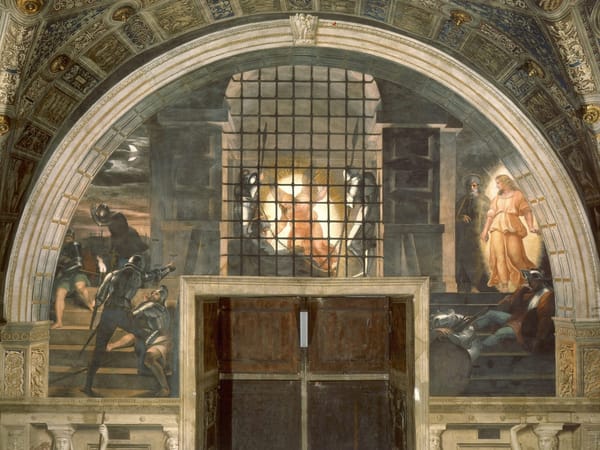
ROME, making a god of the man who had subjugated her, consecrated the month of August to Cæsar Augustus. When Christ had delivered her, she placed at the head of this same month, as a trophy of her regained liberty, the feast of the chains wherewith, in order to break hers, Peter the Vicar of Christ had once been bound. O divine Wisdom, who hast a better claim to reign over this month than had the adopted son of Cæsar, Thou couldst not have more authentically inaugurated Thy empire. Strength and sweetness are the attributes of Thy works, and it is in the weakness of Thy chosen ones that Thou triumphest over the powerful. Thou Thyself, in order to give us life, didst swallow death; Simon, son of John, became a captive, to set free the world entrusted to him. First Herod, and then Nero, showed him the cost of the promise he had once received, of binding and loosing on earth as in heaven: he had to share the love of the supreme Shepherd, even to allowing himself, like Him, to be bound with chains for the sake of the flock, and led where he would not.
Glorious chains! never will ye make Peter's successors tremble any more than Peter himself; before the Herods and Neros and Cæsars of all ages ye will be the guarantee of the liberty of souls. With what veneration have the Christian people honoured you, ever since the earliest times! One may truly say of the present feast that its origin is lost in the darkness of ages. According to ancient monuments,1 St. Peter himself first consecrated on this date the basilica on the highest of the seven hills, where the citizens of Rome are gathered to-day. The name Title of Eudoxia, by which the venerable Church is often designated, seems to have arisen from certain restorations made on occasion of the events mentioned in the lessons. As to the sacred chains which are its treasure, the earliest mention now extant of honour being paid to them occurs in the beginning of the second century. Balbina, daughter of the tribune Quirinus, keeper of the prisons, had been cured by touching the chains of the holy Pope Alexander; she could not cease kissing the hands which had healed her. ‘Find the chains of blessed Peter, and kiss them rather than these,' said the pontiff. Balbina, therefore, having fortunately found the apostle’s chains, lavished her pious veneration upon them, and afterwards gave them to the noble Theodora, sister of Hermes.2
The irons which had bound the arms of the Doctor of the Gentiles, without being able to bind the word of God, were also after his martyrdom treasured more than jewels and gold. From Antioch in Syria, St. John Chrysostom, thinking with holy envy of the lands enriched by these trophies of triumphant bondage, cried out in a sublime transport: 'What more magnificent than these chains? Prisoner for Christ is a more beautiful name than that of Apostle, Evangelist, or Doctor. To be bound for Christ’s sake is better than to dwell in the heavens; to sit upon the twelve thrones is not so great an honour. He that loves can understand me; but who can better understand these things than the holy choir of apostles? As for me, if I were offered my choice between these chains and the whole of heaven, I should not hesitate; for in them is happiness. Would that I were now in those places, where it is said the chains of these admirable men are still kept! If it were given me to be set free from the care of this church, and if I had a little health, I should not hesitate to undertake such a voyage only to see Paul’s chains. If they said to me: Which wouldst thou prefer, to be the angel who delivered Peter or Peter himself in chains? I would rather be Peter, because of his chains.’3
Though always venerated in the great basilica which enshrines his tomb, St. Paul's chain has never been made, like those of St. Peter, the object of a special feast in the Church. This distinction was due to the preeminence of him 'who alone received the keys of the kingdom of heaven to communicate them to others,’4 and who alone continues, in his successors, to bind and loose with sovereign power throughout the whole world. The collection of letters of St. Gregory the Great proves how universally, in the sixth century, was spread the cultus of these holy chains, a few filings of which enclosed in gold or silver keys was the richest present the Sovereign Pontiffs were wont to offer to the principal churches, or to princes whom they wished to honour. Constantinople, at some period not clearly determined, received a portion of these precious chains; she appointed a feast on January 16, honouring on that day the Apostle Peter, as the occupant of the first See, the foundation of the faith, the immovable basis of dogma.5
The following is the legend of the feast in the Roman Breviary:
Put thy feet into the fetters of Wisdom, and thy neck into her chains, said the Holy Spirit under the ancient alliance. . . and be not grieved with her bands. . . . For in the latter end thou shalt find rest in her, and she shall he turned to thy joy. Then shall her fetters he a strong defence for thee. . . and her hands are a healthful binding. Thou shalt put her on as a robe of glory.6 Incarnate Wisdom, applying the prophecy to thee, O prince of apostles, declared that in testimony of thy love the day would come when thou shouldst suffer constraint and bondage. The trial, O Peter, was a convincing one for eternal Wisdom, who proportions her requirements to the measure of her own love. But thou, too, didst find her faithful; in the days of the formidable combat, wherein she wished to show her power in thy weakness, she did not leave thee in bands; in her arms thou didst sleep so calm a sleep in Herod's prison; and, going down with thee into the pit of Nero, she faithfully kept thee company up to the hour when, subjecting the persecutors to the persecuted, she placed the sceptre in thy hands, and on thy brow the triple crown.
From the throne where thou reignest with the Man-God in heaven, as thou didst follow Him on earth in trials and anguish, loosen our bands which, alas! are not glorious ones such as thine; break these fetters of sin which bind us to Satan, these ties of all the passions which prevent us from soaring towards God. The world, more than ever enslaved in the infatuation of its false liberties which make it forget the only true freedom, has more need now of enfranchisement than in the times of pagan Cæsars: be once more its deliverer, now that thou art more powerful than ever. May Rome, especially, now fallen the lower because precipitated from a greater height, learn again the emancipating power which lies in thy chains; they have become a rallying standard for her faithful children in these latter trials.7 Make good the word once uttered by her poets, that 'encircled with these chains she will ever be free.'8
The August heavens glitter with the brightest constellations of the sacred cycle. Even in the sixth century, the second Council of Tours remarked that this month was filled with the feasts of saints.9 My delights are to he with the children of men, says Wisdom; and in the month which echoes with her teachings she seems to have made it her glory to be surrounded with blessed ones, who, walking with her in the midst of the paths of judgment, have in finding her found life and salvation from the Lord. This noble court is presided over by the Queen of all grace, whose triumph consecrates this month and makes it the delight of that Wisdom of the Father, who, once enthroned in Mary, never quitted her. What a wealth of divine favours do the coming days promise to our souls! Never were our Father's bams so well filled as at this season, when the earthly as well as the heavenly harvests are ripe.
- Martyrolog. Hieronym., Bed., Raban., Notker. ↩︎
- Acta S. Alexandri. ↩︎
- Chrys. in Ep. ad Eph., hom. viii. ↩︎
- Op. Milev. contra Parmen., vii., iii. ↩︎
- Menæa. ↩︎
- Eccli. vi. 25-32. ↩︎
- Archconfraternity of St. Peter’s Chains, erected June 18, 1867. ↩︎
- Arator. De Act. Apost., L. 1, v. 1070-1076. ↩︎
- Toto Augusto . . . festivitates sunt et missæ sanctorum. De observatione psallendi. Labbe, V, 857. ↩︎
August 1 (the Same Day): The Seven Brothers Machabees, Martyrs
While the Church on earth inaugurates these days by adorning herself with Peter’s chains as with a precious jewel, a constellation of seven stars appears for the third time in the heavens. The seven brothers Machabees preceded the sons of Symphorosa and Felicitas in the bloodstained arena; they followed divine Wisdom even before she had manifested her beauty in the flesh. The sacred cause of which they were the champions, their strength of soul under the tortures, their sublime answers to the executioners were so evidently the type reproduced by the later martyrs, that the Fathers of the first centuries with one accord claimed for the Christian Church these heroes of the synagogue, who could have gained such courage from no other source than their faith in the Christ to come. For this reason they alone of all the holy persons of the ancient covenant have found a place on the Christian cycle; all the martyrologies and calendars of East and West attest the universality of their cultus, while its antiquity is such as to rival that of St. Peter's chains in that same basilica of Eudoxia where their precious relics lie.
At the time when in the hope of a better resurrection they refused under cruel torments to redeem their lives, other heroes of the same blood, inspired by the same faith, flew to arms and delivered their country from a terrible crisis. Several children of Israel, forgetting the traditions of their nation, had wished it to follow the customs of strange peoples; and the Lord, in punishment, had allowed Judea to feel the whole weight of a profane rule to which it had guiltily submitted. But when King Antiochus, taking advantage of the treason of a few and the carelessness of the majority, endeavoured by his ordinances to blot out the divine law which alone gives power to man over man, Israel, suddenly awakened, met the tyrant with the double opposition of revolt and martyrdom. Judas Machabeus in immortal battles reclaimed for God the land of his inheritance, while by the virtue of their generous confession, the seven brothers also, his rivals in glory, recoveredl, as the Scripture says, the law out of the hands of the nations, and out of the hands of the kings..10 Soon afterwards, craving mercy under the hand of God and not finding it, Antiochus died, devoured by worms, just as later on were to die the first and last persecutors of the Christians, Herod Agrippa and Galerius Maximian.
The Holy Ghost, who would Himself hand down to posterity the acts of the protomartyr of the New Law, did the same with regard to the passion of Stephen's glorious predecessors in the ages of expectation. Indeed, it was he who then, as under the law of love, inspired with both words and courage these valiant brothers, and their still more admirable mother, who, seeing her seven sons one after the other suffering the most horrible tortures, uttered nothing but burning exhortations to die. Surrounded by their mutilated bodies, she mocked the tyrant who, in false pity, wished her to persuade at least the youngest to save his life; she bent over the last child of her tender love and said to him: My son, have pity upon me, that bore thee nine months in my womb, and gave thee suck three years, and nourished thee, and brought thee up unto this age. I beseech thee, my son, look upon heaven and earth, and all that is in them: and consider that God made them out of nothing and mankind also: so thou shalt not fear this tormentor, but being made a worthy partner with thy brethren, receive death, that in that mercy I may receive thee again with thy brethren1 And the intrepid youth ran in his innocence to the tortures; and the incomparable mother followed her sons.
Prayer
| Previous July 31: St. Ignatius, Confessor | Next August 1: St. Peter's Chains |