Daily reading
After Pentecost
Double · Movable from Easter · Temporal
August 22, 2027
From Dom Guéranger’s The Liturgical Year.

|
The Fourteenth Sunday after Pentecost
In the western Church this Sunday is called that of the two masters, because of the Gospel which is read upon it. The Greeks give it the name of the Sunday of the invited to the marriage-feast,1 or, the fourteenth of St. Matthew, unless the feast of the Exaltation of the holy Cross (September 14) happen to fall during the ensuing week. In this latter case this and the following Sunday are called ‘of the Exaltation,' and take for their Gospels the first from St. John, the second from St. Mark. After this, follow the Sundays called ‘of St. Luke,’which go on till Lent, in the manner already described for St. Matthew.
Mass
Behold, O God, our protector! and look on the face of thy Christ! Thus begins the Church, as she advances towards the altar, whereon the holy sacrifice is going to be offered up. The Church is the bride of the Man-God; she is, as the apostle says, His glory; but the Spouse, according to the same St. Paul, is both the image and the glory of God,2 and the head of His bride.3 In all truth, then, and with full confidence that she will be graciously heard, the Church, in presenting her petitions to the Most High, begs of Him to look on the face of His Christ, who is also hers.
Introit
The thought of the future glories which fills the Church with gladness, and the dignity of the divine union which, even in this present life, makes her truly bride, do not prevent her from always feeling the need she has of help from on high. Were she to be deprived one single moment of God’s assistance, she would see her children, through their innate human frailty, hurrying into the abyss of vice, such as the apostle describes in to-day's Epistle. Let us join with our mother in her Collect, and beseech God to grant us that uninterrupted, that constant mercy, which is absolutely necessary for us.
Collect
The other Collects, as on page 120.
Epistle
Cap. v.Fratres, Spiritu ambulate, et desideria carnis non perficietis. Caro enim concupiscit adversus spiritum : spiritus autem adversus carnem: hæc enim sibi invicem adversantur : ut non quacumque vultis, illa faciatis. Quod si spiritu ducimini, non estis sub lege. Manifesta sunt autem opera carnis : quæsunt fornicatio, immunditia, impudicitia, luxuria, idolorum servitus, veneficia, inimicitiæ, contentiones, æmulationes, iræ, rixæ, dissensiones, sectæ, invidiæ, homicidia, ebrietates, comessationes, et his similia; quæprædico vobis, sicut prædixi: quoniam qui talia agunt, regnum Dei non consequentur. Fructus autem Spiritus est : charitas, gaudium, pax, patientia, benignitas, bonitas, longanimitas, mansuetudo, fides, modestia, continentia, castitas. Adversus hujusmodi non est lex. Qui autem sunt Christi, carnem suam crucifixerunt cum vitiis et concupiscentiis.
Ch. v.Brethren: Walk in the spirit, and you shall not fulfil the lusts of the flesh. For the flesh lusteth against the spirit; and the spirit against the flesh: for these are contrary one to another: so that you do not the things that you would. But if you are led by the spirit, you are not under the law. Now the works of the flesh are manifest, which are, fornication, uncleanness, immodesty, luxury, idolatry, witchcrafts, enmities, contentions, emulations, wraths, quarrels, dissensions, sects, envies, murders, drunkenness, revellings, and such like. Of the which I foretell you, as I have foretold to you, that they who do such things shall not obtain the kingdom of God. But the fruit of the Spirit is charity, joy, peace, patience, benignity, goodness, longanimity, mildness, faith, modesty, continency, chastity. Against such there is no law. And they that are Christ’s have crucified their flesh with the vices and concupiscences.
The bride, who came from the top of Sanir and Hermon that she might be crowned,4 knows not the servitude of Sinaï;5 still less is she under the slavery of the senses. On the mountain, where her tent is fixed for ever,6 her Spouse has broken the fetters of the Jewish Law, and that more galling chain which tied all people down—the network of sin that covered all the nations of the earth.7 She, the bride, is queen; her sons are kings;8 the milk whereon she feeds them9 infuses liberty within them.10 Filled with the holy Spirit, who is their glory and their strength,11 they have the Lord of hosts looking on them, as they bravely engage in battles such as princes should fight.12 Satan, too, has beheld their glorious struggles, and his kingdom has been shaken to its foundations.13 Two cities now divide the world between them;14 and the holy city, made up of vanquishers over the devil, the world, and the flesh, is full of admiration and joy at seeing that the noblest of the nations flock to her.15 The law which reigns supreme within her walls is love, for the holy Spirit, who rules her happy citizens, takes them far beyond the injunctions or prohibitions of any law. Together with charity, there spring up joy, peace, and those other fruits, here enumerated by the apostle; they grow spontaneously from a soil which is saturated with the glad waters16 of a stream, which is no other than the sanctifying Spirit, who inundates the city of God.17 We are not astonished at this new Sion’s being loved by the Lord above all the tabernacles of Jacob,18 beautiful as those once were.19 Now that the blessing has taken on earth the place once held by the Law, the servants of God have become sons and daughters. Even while living in the flesh, they bear evidence of their heavenly origin, by going on from virtue unto virtue. Though sojourning in this vale of tears, they are ever on the ascent, approaching gradually nigher to the high summits of holiness; they reflect in their lives the perfection of their heavenly Father,20 who, surrounded as He thus is in Sion by this noble family, is seen to be, in all truth, the God of gods.21
Flesh and blood have had no share in their divine birth;22 flesh and blood have no hand in their regenerated life.23 Their first birth being in the flesh, they were flesh, and did the works of death and ignominy mentioned in the Epistle, showing at every turn that they were from slime of earth;24 but, born of the Spirit, they are spirit,25 and do the works of the spirit, in spite of the flesh which is always part of their being.26 For, by giving them of His own life, the Spirit has emancipated them, by the power of love, from the tyranny of sin,27 which held dominion over their members;28 and, having been grafted on Christ, they bring forth fruit unto God.29
Man, therefore, who was once a slave to concupiscence, has regained on the cross of Christ that equilibrium of his existence30 which is true liberty. The supremacy, which the soul had forfeited in punishment for her revolt against God,31 has been restored to her by the laver of the water of Baptism, and now that she is once more queen, it is but just that she chastise the slave who so long lorded it over her, his rightful sovereign. Man owes nothing to the flesh,32 especially after the miseries it has brought upon him; but further than this, God, too, has been insulted by the sensual abominations committed in His sacred presence; and He, too, demands atonement. For this purpose He mercifully takes man, now that he is enfranchised, and confides to him the task of sharing with His divine Majesty in taking revenge on their common enemy and usurper. Then again, this mortifying the flesh and keeping it in subjection is a necessary means for retaining the good position already obtained. It is true that the rebel has been made incapable of damaging those who are in Christ Jesus, and who walk not according to the flesh and its vile suggestions;33 but it is equally true that the rebel is rebel still, and is ever watching for opportunities to assail the spirit. If there be exceptions, they are exceedingly rare. The rule of the flesh is, to attack the spirit all through life, and try to make it yield. If one were an Antony in the desert, the flesh would be fierce in its assaults even there. If the saint were a Paul, just fresh from the third heaven of his sublime revelations, the flesh would have impudence enough to buffet even him.34 So that, had we no past sins to atone for, the commonest prudence would urge us to take severe measures of precaution against an enemy who is so fearfully untiring in his hatred of us, and, what is worse, lives always in our own home. St. Paul, of whom we were just speaking, says of himself: ‘I chastise my body, and bring it into subjection, lest, perhaps . . . I should become reprobate!’35
Penance and mortification differ in this: that penance is a debt of justice, incumbent on the sinner; mortification is a duty commanded by prudence; which duty becomes that of every Christian who is not foolish enough to pretend to be out of the reach of concupiscence. Is there anyone living who could honestly say that he has fully acquitted himself of these two duties, that he has satisfied the claims of God’s justice, and that he has stifled every germ of his evil passions? All spiritual masters, without exception, teach that no man who is desirous either of perfection or of salvation should limit himself to the rules of simple temperance, that cardinal virtue which forbids excess in pleasures of any kind. This, they tell us, is not enough; and that the Christian, taking up another virtue, namely fortitude, must from time to time refuse himself even lawful gratifications; must impose privations on himself which are not otherwise of obligation; must even inflict punishment on himself in the manner and measure permitted him by a discreet director. Amidst the thousands of holy writers who treat of this point of asceticism, let us listen to the amiable and gentle St. Francis of Sales. ‘If,'says he, in his Introduction to a Devout Life—’if you can bear fasting you would do well to fast on certain days, beyond those fasts which the Church commands us to observe . . .; even when one does not fast much, yet does the enemy fear us all the more when he sees that we know how to impose a fast on ourselves. Wednesdays, Fridays, and Saturdays were the days whereon the Christians of former times most practised abstinence. Therefore, do you choose out of these for your fasts, as far as your devotion and the discretion of your director will counsel you to do.... The discipline, when taken with moderation, possesses a marvellous power for awakening the desire for devotion. The hair-shirt is efficacious in reducing the body to subjection . . .; on days which are especially devoted to penance, one may wear it, the advice of a discreet confessor having been previously taken.'36 Thus speaks the learned Doctor of the Church, the saintly Bishop of Geneva, whose sweet prudence is almost proverbial; and they to whom he addresses these instructions are persons living in the world. In the world, quite as much as in the cloister, the Christian life, if seriously taken up, imperatively requires this incessant war of the spirit against the flesh. Let that war cease, and the flesh speedily usurps the sway, and reduces the soul to a state of torpor, by either seizing her very first attempts at virtue and chilling them into apathy, or by plunging her, at a single throw, deep into the filth of sin.
Neither is it to be feared that affability in the Christian’s social intercourse will be in any way impaired by this energy of self-mortification. That virtue which is based on such forgetfulness of oneself, as to make him love discomfort and suffering for God’s sake, does not render such a man one whit less pleasing in company, or rob the friendly circle he frequents of one single charm. But will it not interfere somewhat with an article which the world is very jealous about? No. When dress is what Christian reserve would have it be, in other and plainer words, when it is the love of Jesus that regulates the arrangements, there is no toilet where the jewels of penance may not find their place, without in the least intruding upon those of the world. The day of judgment will give a strange lesson to those many good-for-nothing and cowardly Christians who feel sure that everyone of their acquaintance is as fond of easy-going softness as they themselves are! Then will be revealed to them the pious schemes of penance, which Christian love of the cross suggested, as means for crucifying their flesh even amidst pleasures, and to those very persons who were the most admired in the worldling’s earthly paradise of gay saloons.
And ought it not to be thus? Ought not the cross to be most dear to men? Yes, unless we hold that Christianity and divine love have entirely disappeared from this world. How is it possible to love Jesus, the Man of sorrows,37 and not love His sufferings? Can we say that we are walking in His footsteps if we are not on the road to Calvary? ‘If any man will come after Me,’ says Jesus, 'let him deny himself, and take up his cross, and follow Me!’38 And the Church, who is one with her divine Spouse—the Church who completes Him in all things,39 and, therefore, continues through all ages His life of expiation and atonement—puts on her children the sublime task which the apostle thus expresses: 'I fill up those things that are wanting of the sufferings of Christ, by suffering in my flesh for His body, which is the Church.'40
Sublime task indeed! Filial, as far as the Church is concerned, but divine, also, and deifying, if we consider the union it produces between the Word and the soul. The Word gives to the soul what He has not given to the angels; He invites her to a share of that chalice, which the eternal Father reserved to Jesus’ sacred Humanity.41 Here we have the intimacy of the bride: the one same cup for the two, and it unites their two lives into one. It is a cup of sorrow’s holy inebriation; they both drink it with avidity; and that avidity gives such vehemence to their union that the creature at times leaves her ecstasy all stigmatized in soul, yea, it may be in her body too, with the wounds of her crucified Lord. But whether our Lord communicate or not, either invisibly or visibly, the stigmata of His love to the soul that is devoted to Him, there is always, under one form or other, the royal seal, which gives the surest sign of authenticity to the contract of divine union here below; that seal is suffering. Many, who on hearing or reading the favours gratuitously granted to certain saintly souls are excited to a feeling of holy envy, would shrink back with dismay if they were told of the trials they had to go through before gaining such mystic ascensions. Even when the trials of purification (of which we were speaking on a former occasion42) are all over, the place of meeting is invariably that which the inspired Canticle calls the Mount of myrrh,43 which is but another name for suffering. Myrrh is the first fragrant herb culled by the divine Word in the mystic garden; nay, it is the only one He expressly mentions.44 Myrrh distils from the bride’s hands, and her fingers are full of it;45 her Spouse is the bouquet she clasps to her heart, but that bouquet is one of myrrh;46 and His lips are as lilies dropping choice myrrh.47
Of course, we are too miserable ever to aspire to be raised up by the holy Spirit to those heights of the mystic life, where divine union produces such marvellous results as those we have already mentioned; but let us remember that neither the intensity, nor the merit of love, nor even the reality of effective union depends on those exterior manifestations. It should suffice to make us love, and even go in quest of suffering, to remember how faith teaches us that it was life-long with Him, who wishes, and infinitely deserves, to be the one object of our thoughts and affections. We are members of a Head who was crowned with thorns; can we pretend to have nothing but pleasures and flowers? Let us not forget that all the saints must, when in heaven, be likenesses of the new Adam;48 and that the eternal Father admits no one into His house, who is not conformable to the image of His Son.49
In the Gradual, the Church sings the happy confidence she has put in her divine Spouse. The Alleluia-verse invites us to rejoice, as she, our mother, does in God our Saviour.
Gradual
℣. Bonum est sperare in Domino, quam sperare in principibus.
Gospel
Cap. vi.In illo tempore : Dixit Jesus discipulis suis : Nemo potest duobus dominis servire : aut enim unum odio habebit, et alterum diliget : aut unum sustinebit, et alterum contemnet. Non potestis Deo servire, et mammonse. Ideo dico vobis, ne solliciti sitis animæ vestræ quid manducetis, neque corpori vostro quid induamini. Nonne anima plus est quam esca : et corpus plus quam vestimentum? Respicite volatilia cœli, quoniam non serunt, neque metunt, neque congregant in horrea : et Pa ter vester cœlestis pascit illa. Nonne vos magia pluris estis illis? Quis autem vestrum cogitans, potest adjicere ad staturam suam cubitum unum? Et de vestimento quid solliciti estis? Considerate lilia agri, quomodo crescunt: non laborant, neque nent. Dico autem vobis, quoniam nec Salomon in omni gloria sua coopertus est sicut unum ex istis. Si autem fœnum agri, quod hodie est, et cras in clibanum mittitur, Deus sic vestii : quanto magia vos modicæ fidei? Nolite ergo solliciti esse, dicentes : Quid manducabimus, aut quid bibemus, aut quo operiemur? Hæc enim omnia gentes inquirunt. Scit enim Pater vester, quia his omnibus indigetis. Quærite ergo primum regnum Dei, et justitiam ejus: et hæc omnia adjicientur vobis.
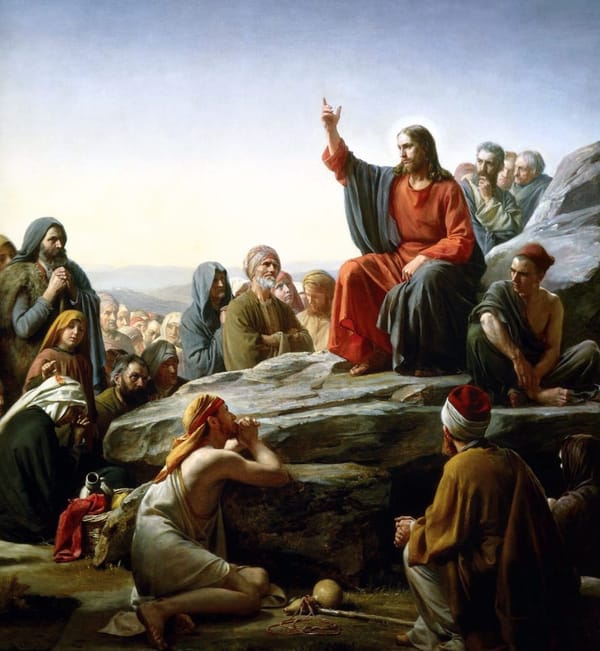
Ch. vi.At that time: Jesus said to his disciples : No man can serve two masters. For either he will hate the one, and love the other : or he will sustain the one, and despise the other. You cannot serve God and mammon. Therefore I say to you, be not solicitous for your life, what you shall eat, nor for your body, what you shall put on. Is not the life more than the meat, and the body more than the raiment? Behold the birds of the air, for they neither sow, nor do they reap, nor gather into barns, and your heavenly Father feedeth them. Are not you of much more value than they? And which of you, by taking thought, can add to his stature one cubit? And for raiment why are you solicitous? Consider the lilies of the field how they grow: they labour not, neither do they spin. But I say to you, that not even Solomon in all his glory was arrayed as one of these. And if the grass of the field, which is to-day, and to-morrow is cast into the oven, God doth so clothe; how much more you, O ye of little faith? Be not solicitous therefore, saying, what shall we eat, or what shall we drink, or wherewith shall we be clothed? For after all these things do the heathens seek. For your Father knoweth that you have need of all these things. Seek ye therefore first the kingdom of God, and his justice, and all these things shall be added unto you.
The supernatural life can never be healthy in men’s souls, unless it triumph over the three enemies, which St. John calls concupiscence of the flesh, concupiscence of the eyes, and the pride of life.50 As to the first of these, our Epistle has been instructing us upon the obstacle it raises against the action of the holy Spirit, and on the means we are to adopt for surmounting it. Pride of life is overcome by humility, on which the Church has several times spoken to us during the previous Sundays. The Gospel which has just been read to us is the condemnation of the concupiscence of the eyes—that is, attachment to the goods of this world which, of themselves, are goods but in name and appearance.
No man, says our Lord, can serve two masters; and these two masters are, God and mammon. Mammon means riches.51 Riches are not, of their own nature, bad. When lawfully acquired, and used agreeably to the designs of God, riches help the possessor to gain true goods for his soul; he stores up for himself, in the kingdom of his eternal home, treasures, which neither thieves nor rust can reach.52 Ever since the Incarnation, wherein the divine Word espoused poverty to Himself, it is the poor that are heaven’s nobility. And yet, the mission of the rich man is a grand one: he is permitted to be rich in order that he may be God’s minister to make all the several portions of material creation turn to their Creator’s glory. God graciously vouchsafes to entrust into his hands the feeding and supporting of the dearest of His children, that is, the poor, the indigent and suffering members of His Christ. He calls him to uphold the interests of His Church, and be the promoter of works connected with the salvation of men. He confides to him the keeping up of the beauty of His temples. Happy that man, and worthy of all praise, who thus directly brings back to the glory of their Maker the fruits of the earth, and the precious metals she yields from her bosom! Let not such a man fear: it is not of him that Jesus speaks those anathemas uttered so frequently by Him against the rich ones of this world. He has but one Master—the Father who is in heaven, whose steward he humbly and gladly acknowledges himself to be. Mammon does not domineer over him; on the contrary, he makes her his servant, and obliges her to minister to his zeal in all good works. The solicitude he takes in spending his wealth in acts of justice and charity, is not that which our Gospel here blames; for, in all such solicitude, he is but following our Lord's precept, of seeking first the kingdom of God; and the riches which pass through his hands in the furtherance of good works, do not distract his thoughts from that heaven where his heart is, because his true treasure is there.53
It is quite otherwise when riches, instead of being regarded as a simple means, become the very end of a man's existence, and that to such an extent as to make him neglect, yea, and sometimes forget, his last end. ‘The ways of every covetous man,' says the Scripture, 'destroy the souls of the possessors.'54 The apostle explains this by saying that the love of money drives a man into temptation and the snares of the devil, by the countless unprofitable and hurtful desires it excites within him; it drowns men in destruction and perdition, making them even barter away their faith.55 And yet, the more an avaricious man gets, the less he spends. To nurse his treasure, to gaze upon it,56 to be thinking of it all day and night long, when obliged to go from home—that is what he lives for; and his money becomes at last his idol.57 Yes, mammon is not merely his master, whose commands are obeyed before all others, but it is his god, before which he sacrifices friends, relatives, country, and himself, for he devotes, and, as it is said in Ecclesiasticus, throws away his whole soul and body to his idol.58 Let us not be astonished at our Gospel declaring that God and mammon are irreconcilable enemies; for, who was it but mammon that had our Lord Jesus sacrificed on its hateful altar, for thirty pieces of silver? Of all the devils in hell, is there one whose hideous guilt is deeper than the fallen angel who prompted Judas to sell the Son of God to His executioners? It is the avaricious who alone can boast of deicide! The vile love of money, which the apostle defines as the root of all evils,59 can lay claim to having produced the greatest crime that was ever perpetrated!
But, without going into such crimes as made the authors of the inspired Books of even the old Testament say that 'nothing is more wicked than the covetous man . . .; there is not a more wicked thing than to love money’60—it is easy to allow oneself to be led, as regards this world's goods, into an excessive solicitude, which prudence condemns. What ineffable truth and clearness in the reasoning of our Jesus, as put before us in to-day's Gospel! To attempt to add any human words to these of His, would be an insult offered to both their charm and their energy. The exquisitely beautiful comparisons of the birds of the air, and the lilies of the field, by which our divine Master shows how such solicitude is the very opposite of the confidence we should have in our heavenly Father, are beyond all comment We may add, however, that solicitude of this sort would prove the existence of an attachment to earthly things, which is incompatible with anything approaching to Christian perfection, or to the desire of making progress in the paths of divine union. The unitive way is possible in every state of life; only, there must be one condition observed, and that is, the soul must be detached from every tie that could keep her from going to God. The religious breaks these ties by his three vows, which are in direct opposition to the triple concupiscence of fallen nature; the layman, who, though he is living in the world, desires to be what his Creator would have him be, must, without the aid of the real separation which the religious makes, be quite as completely detached from his own will, and sensuality, and riches, in order that all his intentions and aspirations may be fixed on the eternal home, where his one infinite, loved treasure is. If he does not bring himself, even in the midst of his riches, to be as poor in spirit as the religious is in deed, his progress will be checked at the very first step he takes in the contemplative life; and, if he allow the obstacle to block up the way, he must give up all idea of rising, in light and love, above the lowly paths of the majority of Christians.
Like the other portions of to-day’s liturgy, the Offertory is all confidence and joy. The prince of the heavenly hosts—the Archangel St. Michael, whose feast is at hand, and whom the Church always invokes in the blessing of the incense at this part of the Mass—is he not ever ready to protect and watch over those who fear the Lord?
Offertory
Let us, in the Secret, pray that the saving Host, offered on the altar, may, by its virtue, purify our soul, and draw the divine power to our assistance.
Secret
The other Secrets, as on page 130.
The Communion-anthem, taken from the Gospel which now is assigned to this Sunday, was not the one primitively used; the ancient liturgists make no mention of it in its present position, nor is it to be found there in any of the manuscripts consulted by Blessed Thomasi, when he was preparing the publication of his Antiphonary. The composition of this and some other Masses shows some few variations of this kind; but these are details, which, whatever may be their interest in other respects, savour too much of erudition, and the nature of this work necessarily excludes them.
Communion
An ever-growing love of purity, heaven's protection, and final perseverance—these are the precious fruits of our frequent assistance at these sacred mysteries. Let us secure them, by joining our mother in her Postcommunion prayer.
Postcommunion
The other Postcommunions as on page 181.
Vespers
The psalms, capitulum, hymn, and versicle, as above, pages 71-81.
Antiphon of the Magnificat
- St. Matt. xxii. ↩︎
- 1 Cor. xi. 7. ↩︎
- Ibid. 3; Eph. v. 28. ↩︎
- Cant. iv. 8. ↩︎
- Gal. iv. 24-26. ↩︎
- Isa. ii. 2. ↩︎
- Ibid. xxv. 7. ↩︎
- 1 St. Pet. ii. 9. ↩︎
- Isa. lxvi. 8-12. ↩︎
- Gal, iv. 31. ↩︎
- Rom. viii. 14, 26. ↩︎
- Eph. iv. 8, vi. 12. ↩︎
- St. John xii. 31. ↩︎
- St. Aug., De Civit. Dei. ↩︎
- Isa. lx. 5. ↩︎
- Ps. lxiv. 11. ↩︎
- Ibid. xlv. 5. ↩︎
- Ibid, lxxxvi. 2. ↩︎
- Num. xxiv. 5. ↩︎
- St. Matt. v. 48. ↩︎
- Ps. lxxxiii. 6-8. ↩︎
- St. John i. 12. ↩︎
- 1 Cor. xv. 60. ↩︎
- Gen. ii. 7. ↩︎
- St. John iii. 6. ↩︎
- 2 Cor. x. 3. ↩︎
- Rom. viii. 2. ↩︎
- Ibid. vii. 23. ↩︎
- Ibid. 4. ↩︎
- Ibid. viii. 3. ↩︎
- Ibid. i. 28. ↩︎
- Ibid. viii. 12. ↩︎
- Ibid. 1. ↩︎
- 2 Cor. xii. 7. ↩︎
- 1 Cor. ix. 27. ↩︎
- Introduction to a Devout Life, Part III., ch. xxiii ↩︎
- Isa. liii. 8. ↩︎
- St. Matt. xvi. 24. ↩︎
- Eph. i. 23. ↩︎
- Col. i. 24. ↩︎
- St. John xviii. 11. ↩︎
- The sixth Sunday after Pentecost. ↩︎
- Cant. iv. 6. ↩︎
- Ibid. v. 1. ↩︎
- Cant. v. 5. ↩︎
- Ibid. i. 12. ↩︎
- Ibid. v. 13. ↩︎
- 1 Cor. xv. 45-49. ↩︎
- Rom. viii. 29, 30. ↩︎
- 1 St. John ii. 16. ↩︎
- Homil. diei. ↩︎
- St. Matt vi. 19, 20. ↩︎
- St. Matt, vi. 21. ↩︎
- Prov. i. 19. ↩︎
- 1 Tim. vi. 9, 10. ↩︎
- Eccles. v. 9, 10. ↩︎
- Eph. v. 5; Col. iii. 5. ↩︎
- Ecclus. x. 10. ↩︎
- 1 Tim. vi. 10. ↩︎
- Ecclus. x. 9, 10. ↩︎
August 22: The Octave of the Assumption
HE alone who could understand Mary’s holiness could appreciate her glory. But Wisdom, who presided over the formation of the abyss, has not revealed to us the depth of that ocean, beside which all the virtues of the just and all the graces lavished upon them are but streamlets. Nevertheless, the immensity of grace and merit, whereby the Blessed Virgin’s supernatural perfection stands quite apart from all others, gives us a right to conclude that she has an equal supereminence in glory, which is always proportioned to the sanctity of the elect. Whereas all the other predestined of our race are placed among the various ranks of the celestial hierarchy, the holy Mother of God is exalted above all the choirs, forming by herself a distinct order, a new heaven, where the harmonies of angels and saints are far surpassed. In Mary God is more glorified, better known, more loved than in all the rest of the universe. On this ground alone, according to the order of creative Providence, which subordinates the less to the more perfect, Mary is entitled to be Queen of earth and heaven. In this sense, it is for her, next to the Man-God, that the world exists. The great theologian, Cardinal de Lugo, explaining the words of the saints on this subject, dares to say: 'Just as, creating all things in His complacency for His Christ, God made Him the end of creatures; so, with due proportion we may say He drew the rest of the world out of nothing, through the love of the Virgin Mother, so that she, too, might thus be justly called the end of all things.’1
As Mother of God, and at the same time His firstborn, she had a right and title over His goods; as Bride she ought to share His crown. 'The glorious Virgin,' says St. Bernardine of Siena, 'has as many subjects as the Blessed Trinity has. Every creature, whatever be its rank in creation, spiritual as the angels, rational as man, material as the heavenly bodies or the elements, heaven and earth, the reprobate and the blessed, all that springs from the power of God, is subject to the Virgin. For He who is the Son of God and of the Blessed Virgin, wishing, so to say, to make His Mother's principality in some sort equal to His Father's, became, God as He is, the servant of Mary. If, then, it be true to say that everyone, even the Virgin, obeys God, we may also convert the proposition, and affirm that everyone, even God, obeys the Virgin.'2
The empire of Eternal Wisdom comprises, so the Holy Spirit tells us, the heavens, the earth, and the abyss: the same, then, is the appanage of Mary on this her coronation day. Like the divine Wisdom to whom she gave Flesh, she may glory in God. He whose magnificence she once chanted to-day exalts her humility. She who is blessed above all others has become the honour of her people, the admiration of the saints, the glory of the armies of the Most High. Together with the Spouse, let her, in her beauty, march to victory; let her triumph over the hearts of the mighty and the lowly. The giving of the world's sceptre into her hands is no mere honour void of reality: from this day forward she commands and fights, protects the Church, defends its head, upholds the ranks of the sacred militia, raises up saints, directs apostles, enlightens doctors, exterminates heresy, crushes hell.
Let us hail our Queen, let us sing her mighty deeds; let us be docile to her; above all, let us love her and trust in her love. Let us not fear that, amidst the great interests of the spreading of God’s kingdom, she will forget our littleness or our miseries. She knows all that takes place in the obscurest comers, in the furthest limits of her immense domain. From her title of universal cause under the Lord is rightly deduced the universality of her providence; and the masters of doctrine show us Mary in glory sharing in the science called of vision, whereby all that is, has been, or is to be is present before God. On the other hand, we must believe that her charity could not possibly be defective: as her love of God surpasses the love of all the elect, so the tenderness of all mothers united, centred upon an only child, is nothing to the love wherewith Mary surrounds the least, the most forgotten, the most neglected of all the children of God, who are her children too. She forestalls them in her solicitude, listens at all times to their humble prayers, pursues them in their guilty flights, sustains their weakness, compassionates their ills, whether of body or of soul, sheds upon all men the heavenly favours whereof she is the treasury. Let us, then, say to her, in the words of one of her great servants: ' O most holy Mother of God, who hast beautified heaven and earth, in leaving this world thou hast not abandoned man. Here below thou didst live in heaven; from heaven thou conversest with us. Thrice happy those who contemplated thee and lived with the Mother of life! But in the same way as thou didst dwell in the flesh with them of the first age, thou now dwellest with us spiritually. We hear thy voice; and all our voices reach thine ear; and thy continual protection over us makes thy presence evident. Thou dost visit us; thine eye is upon us all; and although our eyes cannot see thee, O most holy one, yet thou art in the midst of us, showing thyself in various ways to whomsoever is worthy. Thy immaculate body, come forth from the tomb, hinders not the immaterial power, the most pure activity of that spirit of thine, which being inseparable from the Holy Ghost, breathes also where it wills. O Mother of God, receive the grateful homage of our joy, and speak for thy children to Him who has glorified thee: whatsoever thou askest of Him, He will accomplish it by His divine power; may He be blessed for ever!'3
The inexhaustible Adam of St. Victor gives us another sequence for the Assumption; it was sung at Saint Victor on the octave day.
Sequence
In qua sanctæ fit Mariæ celebris Assumptio;
Dies ista, dies grata
Qua de terris est translata in cœlum cum gaudio.
Angelorum, est prælata cunctis cœli civibus.
In decore contemplatur
Natum suum, ut precatur pro cunctis fidelibus.
Ut illius, mundicordes, assistamus laudibus;
Si concordent linguis mentes,
Aures ejus intendentes erunt nostris vocibus.
Et in laude proclamemus: Ave, plena gratia!
Ave, Virgo Mater Christi,
Quæ de Sancti concepisti Spiritus præsentia!
Tibi nostræ sit jocunda vocis modulatio.
Nobis opem fer desursum,
Et, post hujus vitæ cursum, tuo junge Filio.
Litterali diu tecta fuisti sub cortice;
De te, Christum genitura,
Prædixerunt in Scriptura prophetæ, sed typice.
Est, dum Verbum, caro factum, ex te nasci voluit,
Quod nos sua pietate
A maligni potestate potenter eripuit.
Te per vellus Gedeonis præsignatam credimus;
Et per rubum incombustum,
Testamentum si vetustum mystice perpendimus.
Et in rubo flamma splendens (neutram tamen læditur),
Fuit Christus carnem sumens,
In te tamen non consumens pudorem, dum gignitur.
Florem mundo profuturum Isaias cecinit,
Flore Christum præfigurans
Cujus virtus semper durans nec cœpit, nec desinit.
Ardens, lucens es lucerna;
Per te nobis lux superna suum fudit radium:
Ardens igne caritatis,
Luce lucens castitatis,
Lucem summæ claritatis mundo gignens Filium.
Nos exaudi, nos conforta,
Et a via nos distorta revocare propera:
Te vocantes de profundo,
Navigantes in hoc mundo,
Nos ab hoste furibundo tua prece libera.
Ob meritum singulare
Tuæ Matris, visitare
In hac valle nos dignare tuæ dono gratiæ.
Qui neminem vis damnari,
Sic directe conversari
Nos concedas in hoc mari,
Ut post mortem munerari digni simus requie.
whereon is celebrated the Assumption of holy Mary;
this day, this happy day
when from earth she was translated into heaven with joy.
she is set over all the citizens of heaven.
She contemplates her Son in His beauty,
and prays for all the faithful.
that clean of heart we may take part in her praises;
if our minds be in accord with our tongues,
her ears will be attentive to our voices.
and in her praise cry out: Hail, full of grace!
hail, Virgin Mother of Christ,
who didst conceive Him by the presence of the Holy Spirit!
may the music of our voice be pleasing to thee.
Bring us help from on high,
and after this life’s course, unite us to thy Son.
long wast thou hidden in the shell of the letter;
of thee as future Mother of Christ,
the Prophets foretold in the Scripture, but in types.
when the Word made Flesh willed to be born of thee,
who in His love did powerfully
snatch us from the power of the wicked one.
thee by the fleece of Gedeon, we believe to be foreshown,
and by the bush unburnt,
if the ancient Testament we mystically ponder.
in the bush the flame resplendent (yet neither hurt thereby),
was Christ assuming flesh in thee,
yet not destroying thy purity by His birth.
the stem, and benefit the world, Isaias sang;
by the flower prefiguring Christ,
whose power everlasting neither began nor endeth.
thou art a lamp burning and shining:
through thee the light supernal on us hath shed its ray;
burning with fire of charity,
shining with light of chastity,
bringing into the world thy Son, the light of supreme brightness.
hear us and comfort us,
and from our crooked ways hasten to call us back:
we are calling on thee from the abyss,
sailing on the sea of the world;
from the furious enemy deliver us by thy prayer.
by the incomparable merit
of Thy Mother, deign to visit
us in this valley with the gift of Thy grace.
Thou who willest that no one be condemned,
grant us to steer our course so straightly
through this sea that after death
we may be worthy to be rewarded in Thy rest.
The following prayer is remarkable for the symbolism wherewith it is inspired. It is used at the blessing of medicinal herbs and fruits, given from time immemorial, in certain places, on the day of the Assumption.
Prayer
But let us close the radiant octave by hearing Mary herself speak in this beautiful antiphon, appointed amongst others in certain manuscripts to accompany the Magnificat on the feast. Our Lady there appears, not in her own name alone, but as representing the Church, which begins in her its entrance in body and soul into heaven. The present happiness of the Blessed Virgin is the pledge for us all of the eternal felicity promised us; the triumph of the Mother of God will not be complete until the last of her children has followed her into glory. Let us, then, join in this prayer so full of sweet love: it is truly worthy to express the feelings of Mary as she crossed the threshold of her heavenly home.
Antiphon
August 22 (the Same Day): St. Timothy and Companions, Martyrs
Let us honour the group of martyrs which forms the rearguard of our triumphant Queen. Timothy, who came from Antioch to Rome, Hippolytus, Bishop of Porto, and Symphorian, the glory of Autun, suffered for God at different periods and at different places; but they gathered their palms on the same day of the year, and the same heaven is now their abode. ' My son, my son,' said his valiant mother to Symphorian, 'remember life eternal; look up, and see Him who reigns in heaven; they are not taking thy life away, but changing it into a better.' Let us admire these heroes of our faith; and let us learn to walk like them, though by less painful paths, in the footsteps of our Lord, and so to rejoice Mary.
Prayer
| Previous August 21: St. Jane Frances de Fremiot de Chantal, Widow | Next August 22: The Octave of the Assumption |