Daily reading
After Pentecost
Greater Double · Movable from Easter · Temporal
August 29, 2027
From Dom Guéranger’s The Liturgical Year.

|
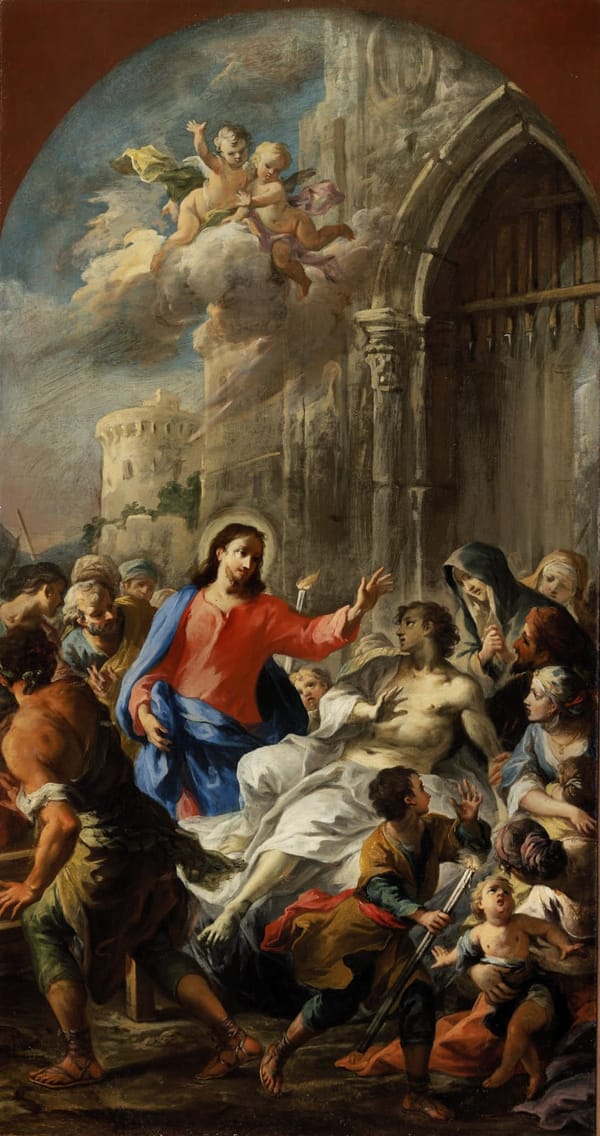
The Fifteenth Sunday after Pentecost
The Introit for this Sunday, which now goes under the name of the Sunday of the widow of Naim, because of the Gospel read on it, gives us a sample of the prayers we should address to our Lord in our necessities. Last Sunday we heard our Jesus promising to provide for all our wants, on the condition that we would serve Him faithfully, by seeking His kingdom. When we present our petitions to Him, let us show Him the confidence He so well deserves from us; and we shall be graciously heard.
Introit
The humility wherewith our holy mother the Church presents her supplications to God should serve as a model to us. If the bride herself thus treats with God, what ought not to be our sentiments of lowliness, when we appear in the presence of sovereign Majesty? We may well say to this tender mother of ours what the disciples said to Jesus: ‘Teach us how to pray!’;1 Let us unite with her in this Collect.
Collect
The other Collects, as on page 120.
Epistle
Cap. v. et vi.Fratres, Si spiritu vivimus, spiritu et ambulemus. Non efficiamur inanis gloriæ cupidi, invicem provocantes, invicem invidentes. Fratres, et si præoccupatus fuerit homo in aliquo delicto, vos, qui spirituales estis, hujusmodi instruite in spiritu lenitatis, considerans teipsum, ne et tu tenteris. Alter alterius onera portate, et sic adimplebitis legem Christi. Nam si quis existimat se aliquid esse, cum nihil sit, ipse se seducit. Opus autem suum probet unusquisque, et sic in semetipso tantum gloriam habebit, et non in altero. Unusquisque enim onus suum portabit. Communicet autem is, qui catechizatur verbo, ei, qui se catechizat, in omnibus bonis. Nolite errare : Deus non irridetur. Quæ enim seminaverit homo, hæc et metet. Quoniam qui seminat in carne sua, de carne et metet corruptionem : qui autem seminat in spiritu, de spiritu metet vitam æternam. Bonum autem facientes, non deficiamus: tempore enim suo metemus, non deficientes. Ergo dum tempus habemus, operemur bonum ad omnes, maxime autem ad domesticos fidei.
Ch. v. and vi.Brethren: If we live in the Spirit, let us also walk in the Spirit. Let us not be made desirous of vain-glory, provoking one another, envying one another. Brethren, if a man be overtaken in any fault, you who are spiritual, instruct such a one in the spirit of meekness, considering thyself, lest thou also be tempted. Bear ye one another’s burdens: and so you shall fulfil the law of Christ; For if any man think himself to be something, whereas he is nothing, he deceiveth himself. But let every one prove his own work, and so he shall have glory in himself only, and not in another. For every one shall bear his own burden. And let him that is instructed in the word, communicate to him, that instructeth him, in all good things. Be not deceived, God is not mocked. For what things a man shall sow, those also shall he reap. For he that soweth in the flesh, of the flesh also shall reap corruption. But he that soweth in the spirit, of the spirit shall reap life everlasting. And in doing good, let us not fail. For in due time we shall reap not failing. Therefore, whilst we have time, let us work good to all men, but especially to those who are of the household of the faith.
Holy Church resumes the lesson of St. Paul, where she left it last Sunday. The spiritual life— the life produced in our souls by the holy Spirit, in place of the former life of the flesh—is still the subject of the apostle’s teaching. When the flesh has been subdued, we must beware of supposing that the structure of our perfection is completed. Not only must the combat be kept up after the victory, under penalty of losing all we have won, but we must also be on the watch, lest one or other of the heads of the triple concupiscence take advantage of the soul's efforts being elsewhere directed, to raise itself against us, and sting us all the more terribly, because it is left to do just as it pleases. The apostle warns us here of vain-glory, and well he may; for vain-glory is, more than other enemies, always in a menacing attitude, ready to infuse its subtle poison even into acts of humility and penance; hence the Christian, who is desirous to serve God, and not his own gratification, by the virtues he practises, must keep up a specially active vigilance over this passion.
Let us think for a moment of the madness that culprit would be guilty of, who having his sentence of death commuted for a severe flogging, should take pride in the stripes left on his body by the whip! May this madness never be ours! It would seem, however, as though it were far from being impossible, seeing how the apostle, immediately after telling us to mortify our flesh, bids us take heed of vain-glory. In fact, we are not safe on this subject, excepting inasmuch as the outward humiliation, inflicted by us on our body, has this for its principle, that our soul should voluntarily humble herself at the sight of her miseries. The ancient philosophers, too, had their maxims about the restraint of the senses; but those among them who practised those admirably worded maxims found them a stepping-stone for their pride to mount up mountains high in self-conceit. It could not be otherwise; for they were totally devoid of anything like the sentiments which actuated our fathers in the faith, who, when they clad themselves in sackcloth and prostrated on the ground,2 cried out from the heartfelt conviction of the miseries of human nature: 'Have mercy on me, O God, according to Thy great mercy! for I was conceived in iniquities, and my sin is ever before me!’3
To practise bodily mortification, with a view to get the reputation of being saints, is it not doing what St. Paul here calls sowing in the flesh, that in due time—that is, on the day when the intentions of our hearts will be made manifest4—we may reap, not life and glory everlasting, but endless disgrace and shame? Among the works of the flesh mentioned in last Sunday’s Epistle, we found contentions, dissensions, jealousies,5 all of which are the ordinary outcome of this vain-glory, against which the apostle is now warning us. The production of such rotten fruits would be an unmistakable sign that the heavenly sap of grace had gone from our souls, and that in its stead there had been brought the fermentation of sin; and that now, having made ourselves slaves as of old, we must tremble because of the penalties threatened by God’s law. God is not mocked; and as to the confidence which generous fidelity of love imparts to those who live by the Spirit, it would, in the case we are now supposing, be but a hypocritical counterfeit of the holy liberty of the children of God. They alone are His children, whom the holy Spirit leads6 in charity; those others are led on by the flesh, and such cannot please God.7
If, on the contrary, we would have an equally unmistakable sign which is quite compatible with the obscurities of faith, that we are really in possession of divine union, let us not take occasion from the sight of others' defects and faults to be puffed up with pride, but rather from the consideration of our own miseries, be indulgent to everyone else. If others fall, let us give them a helping and prudent hand. Let us bear one another's burdens along the road of life, and then, having thus fulfilled the law of Christ, we shall know (and oh! the joy there is in such knowing!) that we abide in Him, and He in us.8 These most thrilling words were made use of by our Lord to express the future intimacy He would have with those who should eat the Flesh of the Son of Man and drink His Blood in holy Communion9 and St. John, who has recorded them in his Gospel, takes them and uses them in his Epistles, and (let us mark the deep mystery of the application) applies them to all who, in the Holy Ghost, observe the great commandment of loving their neighbours.;10
Would to God we could ever have ringing in our ears the saying of the apostle: Whilst we have time, let us work good to all men! For the day will come (and it is not so very far off) when the angel, carrying the mysterious book, and having one foot on the earth and the other on the sea, shall make his mighty voice as that of a lion heard through the universe, and, with his hand lifted up towards heaven, shall swear by Him that liveth for ever and ever, that time shall be no more.11 Then will man reap with joy what he shall have sown in tears12 he failed not, he grew not weary of doing good while in the dreary land of his exile; still less will he ever tire of the everlasting harvest, which is to be in the living light of the eternal day.
As we sing the Gradual, let us remember that the only praise which gives God pleasure is that which goes up to Him from a soul where reigns the harmony of the several virtues. The Christian life, which is regulated by the ten commandments, is the ten-stringed psaltery,;13 on which the Finger of God, the Holy Ghost,14 plays to the Spouse the music that He loves to hear.
Gradual
Gospel
Cap. vii.In illo tempore : Ibat Jesus in civitatem quæ vocatur Naim : et ibant cum eo discipuli ejus, et turba copiosa. Cum autem appropinquaret portæcivitatis, ecce defunctus efferebatur, filius unicus matris suæ : et hæc vidua erat: et turba civitatis multa cum illa. Quam cum vidisset Dominus, misericordia motus super eam, dixit illi: Noli flere. Et accessit, et tetigit loculum (hi autem qui portabant steterunt). Et ait: Adolescens, tibi dico, surge. Et resedit qui erat mortuus, et cœpit loqui. Et dedit illum matri suæ. Accepit autem omnes timor: et magnificabant Deum, dicentes : Quia Propheta magnus surrexit in nobis: et quia Deus visitavit plebem suam.
Ch. vii.At that time: Jesus went into a city that is called Naim: and there went with him his disciples, and a great multitude. And, when he came nigh to the gate of the city, behold a dead man was carried out, the only son of his mother; and she was a widow: and a great multitude of the city was with her. Whom when the Lord had seen, being moved with mercy towards her, he said to her: Weep not! And he came near, and touched the bier. And they that carried it stood still. And he said: Young man! I say to thee arise. And he that was dead, sat up, and began to speak. And he gave him to his mother. And there came a fear on them all: and they glorified God, saying : A great Prophet hath risen up among us, and God hath visited his people!
This is the second time during the year that holy Church offers this Gospel to our consideration; we cannot be surprised at this, for the fathers selected by her as its interpreters15 tell us, on both of these occasions, that the afflicted mother who follows her son to the grave is the Church herself.
The first time we saw her under this symbol, of a mother mourning for her child, was in the penitential season of Lent.16 She was then, by her fasting and prayer (united as those were with her Jesus’ sufferings), preparing the resurrection of such of our brethren as were dead in sin. Their resurrection was realized, and we had them, in all the fullness of their new life, seated side by side with us at the Paschal Table. What exquisite joy, on that feast of feasts, inundated the mother's heart, as she thus shared in the triumphant gladness of her divine Spouse! Jesus was, by His one Resurrection, twice over the conqueror of death—He rose from the grave, and He gave back the child to the mother. The disciples of this risen Lord, who follow Him closely by their observance of the evangelical counsels, they, and the whole multitude that associated themselves with the Church, glorified Jesus for His wonderful works, and sang the praises of God who thus vouchsafed to visit His people.
The mother ceased to weep. But since then the Spouse has again left her, to return to His Father; she has resumed her widow’s weeds, and her sufferings are continually adding to the already wellnigh insupportable torture of her exile. And whence these sufferings? From the relapses of so many of those ungrateful children of hers, to whom she had given a second birth,17 and at the cost of such pains and tears! The countless cares she then spent over her sinners, and that new life she gave them in the presence of her dying Jesus—all this made each of the penitents, during the Great Week, as though he were the only son of that mother. What an intense grief, says St. John Chrysostom, that so loving a mother should see them relapsing, after the communion of such mysteries, into sin which kills them! 'Spare me,’ as she may well say, in the words which the holy doctor puts into the apostle’s mouth. 'Spare me! No other child, once born into this world, ever made his mother suffer the pangs of child-birth over again!’ To repair the relapse of a sinner costs her no less travail than to give birth to such as have never believed.18
And if we compare these times of ours with the period when sainted pastors made her words respected all over the world, is there a single Christian still faithful to the Church, who does not feel impelled by such contrast to be more and more devoted to a mother so abandoned as she now is? Let us listen to the eloquent words of St. Laurence Justinian on this subject. 'Then,' says he, 'all resplendent with the mystic jewels wherewith the Bridegroom had beautified her on the wedding-day, she thrilled with joy at the increase of her children, both in merit and in number; she urged them to ascend to ever greater heights; she offered them to God; she raised them in her arms up towards heaven. Obeyed by them, she was, in all truth, the mother of fair love and of fear19 she was beautiful as the moon, bright as the sun, terrible as an army set in array. .20 She stretched out her branches as the turpentine tree, and beneath their shadow she sheltered those whom she had begotten against the heat, and the tempest, and the rain. So long, then, as she could she laboured, feeding at her breasts all those she was able to assemble. But her zeal, great as it was, has redoubled from the time she perceived that many, yea very many, had lost their first fervour. Now for many years she is mourning at the sight of how, each day, her Creator is offended, how great are the losses she sustains, and how many of her children suffer death. She that was once robed in scarlet has put on mourning garments; her fragrance is no longer perceived by the world; instead of a golden girdle, she has but a cord, and instead of the rich ornament of her breast, she is vested in haircloth.21 Her lamentations and tears are ceaseless. Ceaseless is her prayer, striving if, by some way, she may make the present as beautiful as times past; and yet, as though it were impossible for her to call back that lovely past, she seems wearied with such supplication. The word of the prophet has come true: " They are all gone aside, they are become unprofitable together; there is none that doth good, no, not one!”22 . . The manifold sins committed by the Church’s children against the divine precepts show that they who so sin are rotten members, members alien to the body of Christ. Nevertheless the Church forgets not that she gave them birth in the laver of salvation; she forgets not the promises they then made to renounce the devil, and the pomps of the world, and all sin. Therefore does she weep over their fall, being their true mother, and never losing the hope of winning their resurrection by her tears. Oh what a flood of tears is thus every day shed before God! What fervent prayers does this spotless virgin send, by the ministry of the holy angels, up to Christ, who is the salvation of sinners! In the secret of hearts, in lonely retreats, as well as in her public temples, she cries out to the divine mercy, that they, who are now buried in the filth of vice, may be restored to life. Who shall tell the joy of her heart, when she receives back living, the children she mourned over as dead? If the conversion of sinners is such joy to heaven,23 what must it be to such a mother? According to the multitude of the sorrows of her heart,24 so will be the consolations, giving joy to her soul.’25
It is the duty of us Christians, who by God’s mercy have been preserved from the general decay, to share in the anguish of our mother, the Church; we should humbly but fervently co-operate with her in all her zealous endeavours to reclaim our fallen brethren. We surely can never be satisfied with not being of the number of those senseless sons who are a sorrow to their mother,26 and despise the labour of her that bore them.27 Had we not the holy Spirit to tell us how he that honoureth his mother is as one that layeth up to himself a treasure,28 the thought of what our birth cost her29 would force us to do everything that lies in our power to comfort her. She is the dear bride of the Incarnate Word; and our souls, too, aspire to union with Him. Let us prove that such union is really ours by doing as the Church does; that is, by showing in our acts the one thought, the one love which the divine Spouse always imparts to souls that enjoy holy intimacy with Him, because there is nothing He Himself has so much at heart; the thought of bringing the whole world to give glory to His eternal Father, and the love of procuring salvation for sinners.
Let us unite with the Church, our mother, in singing now in the Offertory the realization, in part at least, of her expectations; let not our lips ever be shut up in senseless silence when we have our God bestowing favours on us.
Offertory
In the Secret let us put ourselves, and everything that belongs to us, under the all-powerful custody of the divine mysteries.
Secret
The other Secrets, as on page 130.
Jesus’ word called back from death the son of the widow of Naim; His Flesh is the life of the world, for it is the Bread, whose praise we are now to celebrate in our Communion-anthem.
Communion
Divine union is not perfect in us unless the mystery of love so predominates over both our minds and bodies, as that they be fully possessed by it, as our mother here words its efficacy; we must be influenced and directed by it, and not by nature, that is, by the dictates of flesh and blood and human sense.
Postcommunion
The other Postcommunions, as on page 131.
Vespers
The psalms, capitulum, hymn, and versicle, as above, pages 71-81.
Antiphon of the Magnificat
- St. Luke xi. 1. ↩︎
- 1 Paralip. xxi. 16, etc. ↩︎
- Ps. 1 ↩︎
- 1 Cor, iv. 5. ↩︎
- Gal v. 19-21. ↩︎
- Rom. viii. 14. ↩︎
- Ibid. 8. ↩︎
- 1 St. John iv. 13. ↩︎
- St. John vi. 57. ↩︎
- 1 St. John iii. 23, 24; iv. 12, 13. ↩︎
- Apoc. x. 1-6. ↩︎
- Ps. cxxv. 5. ↩︎
- Ps. cxliii. 9. ↩︎
- Cf. St. Luke xi. 20; St. Matt. xii. 28. ↩︎
- St. Amb., in Luc., v.; St. Aug., Serm. 44, de Verb. Dom ↩︎
- Thursday of the fourth week of Lent. ↩︎
- Gal. iv. 19. ↩︎
- St. Chrys., De pænit., Hom. I. ↩︎
- Ecclus. xxiv. 24. ↩︎
- Cant. vi. 9. ↩︎
- Isa. iii. 24. ↩︎
- Ps. xiii. 3. ↩︎
- St. Luke xv. 7. ↩︎
- Ps. xciii. 19. ↩︎
- S. Lour. Just., De Compunct. et Planctu Christ. Perfect. ↩︎
- Prov. xvii. 25. ↩︎
- Prov. xxx. 17. ↩︎
- Ecclus. iii. 5. ↩︎
- Tob. iv. 4. ↩︎
August 29: The Decollation of St. John the Baptist
|
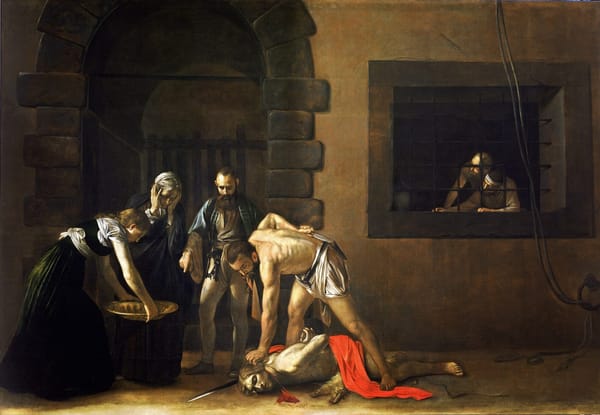
At that time, Herod sent and apprehended John, and bound him in prison for the sake of Herodias, the wife of Philip his brother, because he had married her. For John said to Herod: “It is not lawful for thee to have thy brother’s wife.” Now Herodias laid snares for him, and was desirous to put him to death, and could not. For Herod feared John, knowing him to be a just and holy man, and kept him, and when he heard him did many things; and he heard him willingly. And when a convenient day was come, Herod made a supper for his birthday, for the princes, and tribunes, and chief men of Galilee. And when the daughter of the same Herodias had come in, and had danced, and pleased Herod, and them that were at table with him, the king said to the damsel: “Ask of me what thou wilt, and I will give it thee.” And he swore to her, “Whatsoever thou shalt ask, I will give thee; though it be the half of my kingdom.” Who, when she was gone out, said to her mother: “What shall I ask?” But she said, “The head of John the Baptist.” And when she was come in immediately with haste to the king, she asked, saying, “I will that forthwith thou give me in a dish the head of John the Baptist.” And the king was struck sad; yet because of his oath, and because of them that were with him at table, he would not displease her; but sending an executioner he commanded that his head should be brought in a dish. And he beheaded him in the prison, and brought his head in a dish, and gave it to the damsel, and the damsel gave it to her mother. Which his disciples hearing, came, and took his body, and laid it in a tomb.1
Thus died the greatest of ‘them that are born of women:’ without witnesses, the prisoner of a petty tyrant, the victim of the vilest of passions, the wages of a dancing girl! Rather than keep silence in the presence of crime, although there were no hope of converting the sinner, or give up his liberty, even when in chains: the herald of the Word made flesh was ready to die. How beautiful, as St. John Chrysostom remarks, is this liberty of speech, when it is truly the liberty of God’s Word, when it is an echo of heaven’s language! Then, indeed, it is a stumbling-block to tyranny, the safe-guard of the world and of God’s rights, the bulwark of a nation’s honour as well as of its temporal and eternal interests. Death has no power over it. To the weak murderer of John the Baptist, and to all who would imitate him to the end of time, a thousand tongues, instead of one, repeat in all languages and in all places: ‘It is not lawful for thee to have thy brother’s wife.’
‘O great and admirable mystery!’ cries out Saint Augustine:
He must increase, but I must decrease, said John, said the voice which personified all the voices that had gone before announcing the Father’s Word Incarnate in His Christ. Every word, in that it signifies something, in that it is an idea, an internal word, is independent of the number of syllables, of the various letters and sounds; it remains unchangeable in the heart that conceives it, however numerous may be the words that give it outward existence, the voices that utter it, the languages, Greek, Latin and the rest, into which it may be translated. To him who knows the word, expressions and voices are useless. The prophets were voices, the apostles were voices; voices are in the psalms, voices in the Gospel. But let the Word come, the Word who was in the beginning, the Word who was with God, the Word who was God; when we shall see Him as He is, shall we hear the Gospel repeated? Shall we listen to the prophets? Shall we read the Epistles of the apostles? The voice fails where the Word increases . . . . Not that in Himself the Word can either diminish or increase. But He is said to grow in us, when we grow in Him. To him, then, who draws near to Christ, to him who makes progress in the contemplation of wisdom, words are of little use; of necessity they tend to fail altogether. Thus the ministry of the voice falls short in proportion as the soul progresses towards the Word; it is thus that Christ must increase and John decrease. The same is indicated by the decollation of John, and the exaltation of Christ upon the cross; as it had already been shown by their birthdays: for, from the birth of John the days begin to shorten, and from the birth of our Lord they begin to grow longer.2
The holy doctor here gives a useful lesson to those who guide souls along the path to perfection. If, from the very beginning, they must respectfully observe the movements of grace in each of them, in order to second the Holy Ghost, and not to supplant Him; so also, in proportion as these souls advance, the directors must be careful not to impede the Word by the abundance of their own speech. Moreover, they must discreetly respect the ever-growing powerlessness of those souls to express what our Lord is working in them. Happy to have led the bride to the Bridegroom, let them learn to say with John: ‘He must increase, but I must decrease.’
The sacred cycle itself seems to convey to us too a similar lesson; for, during the following days, we shall see its teaching as it were tempered down, by the fewness of the feasts, and the disappearance of great solemnities until November. The school of the holy liturgy aims at adapting the soul, more surely and more fully than could any other school, to the interior teaching of the Spouse. Like John, the Church would be glad to let God alone speak always, if that were possible here below; at least, towards the end of the way, she loves to moderate her voice, and sometimes even to keep silence, in order to give her children an opportunity of showing that they know how to listen inwardly to Him, who is both her and their sole love. Let those who interpret her thought, first understand it well. The friend of the Bridegroom, who, until the nuptial-day, walked before Him, now stands and listens; and the voice of the Bridegroom, which silences his own, fills him with immense joy: ‘This my joy therefore is fulfilled,' said the precursor.3
Thus the feast of the Decollation of St. John may he considered as one of the landmarks of the liturgical year. With the Greeks it is a holiday of obligation. Its great antiquity in the Latin Church is evidenced by the mention made of it in the martyrology called St. Jerome’s, and by the place it occupies in the Gelasian and Gregorian sacramentaries. The precursor’s blessed death took place about the feast of the Pasch; but, that it might be more freely celebrated, this day was chosen, whereon his sacred head was discovered at Emesa.
The vengeance of God fell heavily upon Herod Antipas. Josephus relates how he was overcome by the Arabian Aretas, whose daughter he had repudiated in order to follow his wicked passions; and the Jews attributed the defeat to the murder of St. John.4 He was deposed by Rome from his tetrarchate, and banished to Lyons in Gaul, where the ambitious Herodias shared his disgrace. As to her dancing daughter Salome, there is a tradition gathered from ancient authors,5 that, having gone out one winter day to dance upon a frozen river, she fell through into the water; the ice, immediately closing round her neck, cut off her head, which bounded upon the surface, thus continuing for some moments the dance of death.
From Macherontis, beyond the Jordan, where their master had suffered martyrdom, John’s disciples carried his body to Sebaste (Samaria), out of the territory of Antipas; it was necessary to save it from the profanations of Herodias, who had not spared his august head. The wretched woman did not think her vengeance complete, till she had pierced with a hairpin the tongue that had not feared to utter her shame; and that face, which for seven centuries the church of Amiens has offered to the veneration of the world, still bears traces of the violence inflicted by her in her malicious triumph. In the reign of Julian the Apostate, the pagans wished to complete the work of this unworthy descendant of the Machabees,6 by opening the saint’s tomb at Sebaste, in order to burn and scatter his remains. But the empty sepulchre continued to be a terror to the demons, as St. Paula attested with deep emotion a few years later. Moreover, some of the precious relics were saved, and dispersed throughout the east. Later on, especially at the time of the Crusades, they were brought into the west, where many churches glory in possessing them.
Let us make our own the following formulæ found in the Gregorian sacramentary for the feast of the Decollation.
Prayer
Super Oblata
Preface
Benedictio
Ad Complendum
- Gospel of the feast, St. Mark vi. 17-29. ↩︎
- Aug Sermon cclxxxviii, In Natali S. J. Bapt. II. De voce et rerbo. ↩︎
- St. John iii. 29. ↩︎
- Joseph. Antiquit. Jud. xviii. 6. ↩︎
- Pseudo- Dexter, chronicon, adænn. Christi 31; Niceph. Call. i. xx. ↩︎
- By her grand-mother, Mariamne, grand-daughter of Hyrcanus. ↩︎
August 29 (the Same Day): St. Sabina, Martyr
Let us greet the noble martyr Sabina, whose triumph completes the glories of this day. The very ancient church of St. Sabina on the Aventine is one of the gems of the eternal city. It shared with St. Sixtus the Old the honour of sheltering Saint Dominic and his first children.
Prayer
| Previous August 28 (the Same Day): St. Hermes, Martyr | Next August 29: The Decollation of St. John the Baptist |