Daily reading
After Pentecost
Double · September 22 · Sanctoral
September 22, 2027
From Dom Guéranger’s The Liturgical Year.
A Double leads the weekday; St. Maurice and his Companions are commemorated.Rubrics
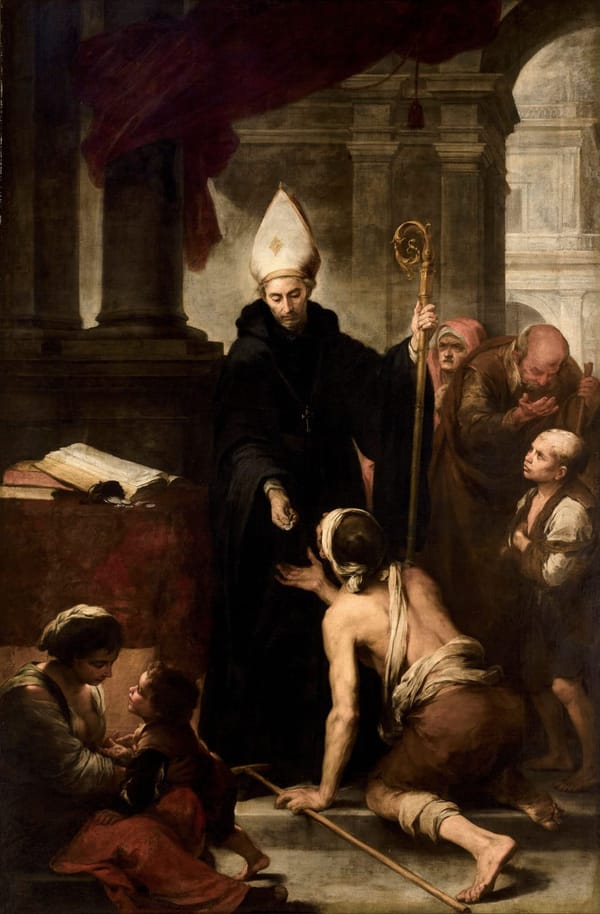 |
September 22: St. Thomas of Villanova, Bishop and Confessor
In 1517 a cruel blow fell upon the great Augustinian family; Luther, one of its members, raised the cry of revolt which was to be echoed for centuries by every passion. But the illustrious Order, which had unwittingly nurtured this child of evil, was none the less acceptable to God; and He deigned, before long, to demonstrate this, for the consolation of institutes whose very excellence exposes unworthy subjects to more dangerous falls. It was at the First Vespers of All Saints that Luther broached, at Wittenburg, his famous theses against indulgences and the authority of the Roman Pontiff; within a month, on November 25 of the same year, Thomas of Villanova pronounced his vows at Salamanca, and filled up the place left vacant by the heresiarch. Amid the storms of social disorder, and the noise of the world’s disturbances, the glory rendered by one saint to the ever-tranquil Trinity, outweighs all the insults and blasphemies of hell.
Let us bear all this in mind as we read the following lessons.
Thy name, as well as thy justice, shall remain for ever, O Thomas, because thou hast distributed and given to the poor;1 all the church of the saints shall declare thy alms.2 Teach us to show mercy to our brethren, so that, by thy prayers, we may obtain for ourselves the mercy of God. Thou hast great power with the Queen of heaven, whose praises thou didst love to celebrate, and whose birthday on earth was thy birthday in heaven. Give us an ever increasing knowledge of her, and an ever growing love.
Thou art the glory of Spain; watch over thy country, over thy church of Valencia, and over the Order adorned with such saints as Nicholas of Tolentino, John of San Facundo, and thyself. Bless the religious women who have inherited thy charity, and who, for well-nigh three centuries, have caused thy name, and that of thy father St. Augustine, to be held in veneration. May the preachers of the divine word throughout the world profit by the writings thou hast fortunately left us, monuments of that eloquence which made thee the oracle of princes, the light of the poor, and the mouth-piece of the Holy Ghost.3
September 22 (the Same Day): St. Maurice and his Companions, Martyrs
At Sion in Valais, at a place called Agaunum, the birthday of the holy martyrs Maurice, Exuperius, Candidus, Victor, Innocent, and Vitalis, with their companions of the Theban legion, who were massacred under Maximian for the name of Christ, and filled the whole world with the renown of their martyrdom.1 Let us unite with Rome in paying honour to these valiant soldiers, the glorious patrons of Christian armies as well as of numerous churches. ‘Emperor,’ said they, ‘we are thy soldiers, but we are also the servants of God. To Him we took our first oaths; if we break them, how canst thou trust us to keep our oaths to thee?’2 No command, no discipline can overrule our baptismal engagements. Every soldier is bound, in honour and in conscience, to obey the Lord of hosts rather than all human commanders, who are but His subalterns.
Prayer
Ember Wednesday of September
For the fourth time in her year, holy Church comes claiming from her children the tribute of penance, which, from the earliest ages of Christianity, was looked upon as a solemn consecration of the seasons. The historical details relative to the institution of the Ember-days will be found on the Wednesdays of the third week of Advent and of the first week of Lent; and on those same two days, we have spoken of the intentions which Christians should have in the fulfilment of this demand made upon their yearly service.
The beginnings of the winter, spring, and summer quarters were sanctified by abstinence and fasting, and each of them, in turn, has received heaven’s blessing; and now autumn is harvesting the fruits which divine mercy, appeased by the satisfactions made by sinful man, has vouchsafed to bring forth from the bosom of the earth, notwithstanding the curse that still hangs over her.1 The precious seed of wheat, on which man’s life mainly depends, was confided to the soil in the season of the early frosts, and, with the first fine days, peeped above the ground; at the approach of glorious Easter, it carpeted our fields with its velvet of green, making them ready to share in the universal joy of Jesus' resurrection; then, turning into a lovely image of what our souls ought to be in the season of Pentecost, its stem grew up under the action of the hot sun; the golden ear promised a hundred-fold to its master; the harvest made the reapers glad; and, now that September has come, it calls on man to fix his heart on that good God, who gave him all this store. Let him not think of saying, as that rich man of the Gospel did, after a plentiful harvest of fruits : 'My soul! thou hast much goods laid up for many years! Take thy rest, eat, drink, make good cheer!’ And God said to that man : ‘Thou fool! this night do they require thy soul of thee; and whose shall those things be which thou hast provided?’2 If we would be truly rich before God, if we would draw down His blessing on the preservation, as well as on the production, of the fruits of the earth, let us, at the beginning of this last quarter of the year, have recourse to those penitential exercises whose beneficial effects we have always experienced in the past. The Church gives us the commandment to do so, by obliging us, under penalty of grievous sin, to abstain and fast on these three days, unless we be lawfully dispensed.
We have already spoken of the necessity of private penance for the Christian who is at all desirous to make progress in the path of salvation. But in this, as in all spiritual exercises, a private work of devotion has neither the merit nor the efficacy of one that is done in company with the Church, and in communion with her public act; for the Church, as bride of Christ, communicates an exceptional worth and power to works of penance done, in her name, in the unity of the social body. St. Leo the Great is very strong on this fundamental principle of Christian virtue. We find him insisting on it in the sermons he preached to the faithful of Rome, on occasion of this fast, which was then called the fast of the seventh month. He says:
Although, it be lawful for each one of us to chastise his body by self-imposed punishments, and restrain, with more or less severity, the concupiscences of the flesh which war against the spirit, yet need is that, on certain days, a general fast be celebrated by all. Devotion is all the more efficacious and holy, when the whole Church is engaged in works of piety, with one spirit and one soul. Everything, in fact, that is of a public character is to be preferred to what is private; and it is plain, that so much the greater is the interest at stake, when the earnestness of all is engaged upon it. As for individual efforts, let each one keep up his fervour in them; let each one, imploring the aid of divine protection, take to himself the heavenly armour, wherewith to resist the snares laid by the spirits of wickedness; but the soldier of the Church (ecclesiasticus miles), though he may act bravely in his own private combats (specialibus prœliis), yet will he fight more safely and more successfully, when he shall confront the enemy in a public engagement; for in that public engagement, he has not only his own valour to which to trust, but he is under the leadership of a King who can never be conquered, and engaged in a battle fought by all his fellow-soldiers; so that, being in their company and ranks, he has the fellowship of mutual aid.3
Another year, when preaching for the same occasion, this eloquent pontiff and doctor of the Church was even more energetic and lengthy, in putting these great truths before the people; would to God the words of such a Pope as Leo the Great could make themselves heard by our present generation, and induce us Christians to mistrust the individualistic tendencies of modern piety. Fortunately, the words of the saint exist, and in all their ‘pontifical eloquence we invite our readers to peruse his sermons; we have only space for a short selection from his third sermon on the fast of the seventh month (our September Ember-days).
God has sanctioned this privilege, that what is celebrated in virtue of a public law is more sacred than that which depends on a private regulation. The exercise of self-restraint which an individual Christian practises by his own will is for the advantage of that single member; but a fast undertaken by the Church at large includes everyone in the general purification. God’s people never is so powerful as when the hearts of all the faithful join together in the unity of holy obedience, and when, in the Christian camp, one and the same preparation is made by all, and one and the same bulwark protects all . . . . See, most dearly beloved, here is the solemn fast of the seventh month urging us to profit by this invincible unity . . . . Let us raise up our hearts, withdraw from worldly occupations, and steal some time for furthering our eternal welfare . . . . The plenary remission of sin is obtained when the whole Church unites in the like prayer and the like confession; for, if the Lord promises that when two or three shall, with a holy and pious unanimity, agree to ask Him anything whatsoever, it shall be granted to them,4 what can be refused to many thousands, who are all engaged in observing one and the same practice of religion, and in praying with one and the same spirit? In the eyes of God, my dearly beloved, it is a great and precious sight, when all Christ’s people are earnest at the same Offices; and when, without any distinction, men and women of every grade and order are all working together with one heart. To depart from evil and do good,5 that is the one determination of them all. They all give glory to God for the works He achieves in His servants. They all unite in returning hearty thanks to the loving Giver of all blessings. The hungry are fed; the naked are clad; the sick are visited; and no one seeketh his own profit, but that of others . . . . By this grace of God, who worketh all in all,6 the fruit is common, and the merit is common; for the affection of all may be the same, although all are not equally rich; and those who have less to bestow can rejoice in the liberality of others. There is nothing inordinate in such a people as that; there are no variances; for all the members of the whole body are alike in the energy of the same piety . . . . The beauty of the whole becomes the excellence of each member . . . . Let us, then, embrace this blessed solidity of holy unity, and with the same resolution and the same good will, let us enter upon this solemn fast.7
Let us not, in our prayers and fasts, forget the new priests and other ministers of the Church, who, on Saturday next, are to receive the imposition of hands. The September ordination is not usually the most numerous of those given by the bishop during the year. The sublime function, to which the faithful owe their fathers and guides in the spiritual life, has, however, a special interest at this period of the year, which, more than any other, is in keeping with the present state of the world in its rapid decline towards ruin. Our year, too, is on the fall, as we say. The sun, which we beheld rising at Christmas as a giant who would burst the bonds of frost asunder and restrain the tyranny of darkness, now, as though he had grown wearied, is drooping towards the horizon; each day we see him gradually leaving that glorious zenith, where we admired his dazzling splendour on the day of our Emmanuel’s Ascension; his fire has lost its might; and though he still holds half the day as his, his disc is growing pale. All this foretells the approach of those long nights, when nature, stripped of all her loveliness by angry storms, seems as though she would bury herself for ever in the frozen shroud which is to bind her. So is it with our world. Illumined as it was by the light of Christ, and glowing with the fire of the Holy Ghost, it sees, in these our days, that charity is growing cold,8 and that the light and glow it had from the Sun of justice are on the wane. Each revolution takes from the Church some jewel or other, which does not come back to her when the storm is over; tempests are so frequent, that tumult is becoming the normal state of the times. Error predominates, and lays down the law. Iniquity abounds. It is our Lord Himself who said: ‘When the Son of Man cometh, shall He find, think ye, faith on earth?’9
Lift up your heads, then, ye children of God! for your redemption is at hand.10 But, from now until that time shall come when heaven and earth are to be made new for the reign that is to be eternal, and shall bloom in the light of the Lamb, the Conqueror,11 days far worse than these must dawn upon this world of ours, when the elect themselves would be deceived, if that were possible!12 How important is it, in these miserable times, that the pastors of the flock of Christ be equal to their perilous and sublime vocation! Let us then fast and pray; and how numerous soever may be the losses sustained in the Christian ranks, of those who once were faithful in the practices of penance, let us not lose courage. Few as we may be, let us group ourselves closely round the Church, and implore of Jesus, her Spouse, that He vouchsafe to multiply His gifts in those whom He is calling to the now more than ever dread honour of the priesthood; that He infuse into them His divine prudence, whereby they may be able to disconcert the plans of the impious; His untiring zeal for the conversion of ungrateful souls; His perseverance even unto death, in maintaining without reticence or compromise the plenitude of that truth which He has destined for the world, and the unviolated custody of which is to be, on the last day, the solemn testimony of the bride’s fidelity.
- Gen. iii. 17. ↩︎
- St. Luke xii. 16-21. ↩︎
- St. Leo, Serm, iv., De Jejun. Sept. Mensis, ↩︎
- St Matt. xviii. 19, 20. ↩︎
- Ps. xxxiii. 15. ↩︎
- 1 Cor. xii. 6. ↩︎
- St. Leo, Serm. iii., De Jejun Sept, Mensis. ↩︎
- St. Matt. xxiv. 12. ↩︎
- St. Luke xviii. 8. ↩︎
- Ibid. xxi. 28-31. ↩︎
- Apoc. xxi. ↩︎
- St. Mark xiii. 22. ↩︎
| Previous September 21: St. Matthew, Apostle and Evangelist | Next September 22 (the Same Day): St. Maurice and his Companions, Martyrs |