Daily reading
After Pentecost
Double · Temporal
November 14, 2027
From Dom Guéranger’s The Liturgical Year.

|
The Sixth Resumed Sunday after Epiphany
Introit
Collect
The other Collects, as on page 120.
Epistle
1 Cap. i.Fratres, Gratias agimus Deo semper pro omnibus vobis, memoriam vestri facientes in orationibus nostris sine intermissione, memores operis fidei vestra, et laboris et charitatis, et sustinentiæ spei Domini nostri Jesu Christi, ante Deum et Patrem nostrum : scientes, fratres, dilecti a Deo, electionem vestram : quia Evangelium nostrum non fuit ad vos in sermone tantum, sed et in virtute, et in Spiritu sancto, et in plenitudine multa, sicut scitis quales fuerimus in vobis propter vos. Et vos imitatores nostri facti estis, et Domini, excipientes verbum in tribulatione multa, cum gaudio Spiritus sancti : ita ut facti sitis forma omnibus credentibus in Macedonia, et in Achaia. A vobis enim diffamatus est sermo Domini, non solum in Macedonia, et in Achaia, sed et in omni loco fìdes vestra, quæ est ad Deum, profecta est, ita ut non sit nobis necesse quidquam loqui. Ipsi enim de nobis annuntiant qualem introitum habuerimus ad vos : et quomodo conversi estis ad Deum a simulacris, servire Deo vivo, et vero, et exspectare Filium ejus de cœlis (quem suscitavit ex mortuis) Jesum, qui eripuit nos ab ira ventura.
1 Ch. i.Brethren : We give thanks to God always for you all: making a remembrance of you in our prayers without ceasing: being mindful of the work of your faith, and labour and charity, and of the enduring of the hope of our Lord Jesus Christ, before God and our Father; knowing, brethren beloved of God, your election. For, our Gospel hath not been to you in word only, but in power also, and in the Holy Ghost, and in much fullness, as you know what manner of men we have been among you for your sakes. And you became followers of us, and of the Lord, receiving the word in much tribulation, with joy of the Holy Ghost: so that you were made a pattern to all that believe in Macedonia and in Achaia. For from you was spread abroad the word of the Lord, not only in Macedonia and in Achaia, but also in every place your faith, which is towards God, is gone forth, so that we need not to speak anything. For they themselves relate of us, what manner of entering in we had unto you : and how you turned to God from idols, to serve the living and true God, and to wait for his Son from heaven (whom he raised up from the dead) Jesus, who hath delivered us from the wrath to come.
Gradual
Gospel
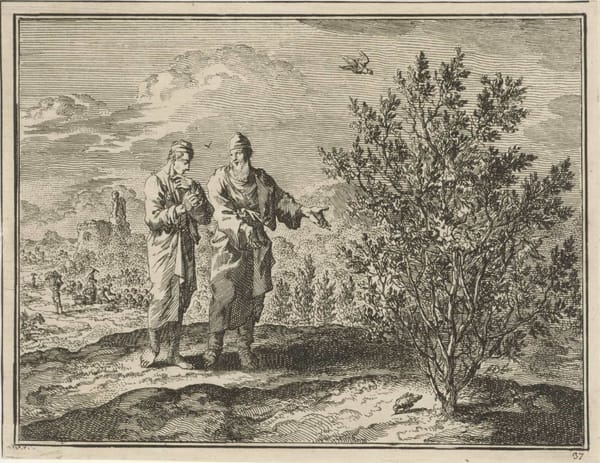
Cap. xiii.In illo tempore: Dixit Jesus turbis parabolam hanc : Simile est regnum cœlorum grano sinapis, quod accipiens homo seminavit in agro suo : quod minimum quidem est omnibus seminibus : cum autem creverit, majus est omnibus oleribus, et fit arbor, ita ut volucres cœli veniant, et habitent in ramis ejus. Aliam parabolam locutus est eis: Simile est regnum cœlorum fermento, quod acceptum mulier abscondit in farinæ satis tribus, donec fermentatum est totum. Hæc omnia locutus est Jesus in parabolis ad turbas et sine parabolis non loquebatur eis : ut impleretur quod dictum erat per prophetam, dicentem: Aperiam in parabolis os meum, eructabo abscondita a constitutione mundi.
Ch. xiii.At that time : Jesus spoke to the multitude this parable : The kingdom of heaven is like to a grain of mustard-seed, which a man took and sowed in his field. Which is the least indeed of all seeds; but, when it is grown up, it is greater than all herbs, and becometh a tree, so that the birds of the air come and dwell in the branches thereof. Another parable he spoke to them : The kingdom of heaven is like to leaven, which a woman took and hid in three measures of meal, until the whole was leavened. All these things Jesus spoke in parables to the multitudes, and without parables he did not speak to them : that it might be fulfilled which was spoken by the prophet, saying : I will open my mouth in parables; I will utter things hidden from the foundation of the world.
Offertory
Secret
The other Secrets, as on page 130.
Communion
Postcommunion
The other Postcommunions, as on page 131.
Vespers
The psalms, capitulum, hymn, and versicle, as above, pages 71-81.
Antiphon of the Magnificat
November 14: St. Josaphat, Bishop and Martyr
JOSAPHAT Kuncewicz, contemporary with St. Francis de Sales and St. Vincent de Paul, might have been taken for a Greek monk of the eleventh century, or an ascetic of the Thebaid. A stranger to the intellectual culture of the West, he knew only the liturgical books and sacred texts used in his own church ; as a priest, an archimandrite, a reformer of his Order of St. Basil, and lastly as Archbishop, he combated all his life against the consequences of the schism of Photius, and closed the struggle by culling the palm of martyrdom. Yet all this took place in the heart of Europe, in the countries then subject to Catholic Poland, during the reign of the most pious of its kings. How is this mystery to be explained?
Immediately after the Mongolian invasions, Poland received into her arms, rather than conquered, the Ruthenian nation, that is to say the Slays of the Greek rite from the Dnieper and the Dwina, who had formed around their capital and religious metropolis, Kiev, the nucleus of the power now known as Russia. Had she granted a participation in her own national life to these brethren separated from, but not enemies to, the Roman unity, who came to her full of confidence in her strength and her justice, Poland would have secured the triumph of the Catholic cause, and her own dominion throughout Slavonia. The union of the newcomers with the Roman Pontiff, which a little more political insight and religious zeal might have brought about in the fourteenth century, was not concluded until 1595.
This was the union of Brzeso. By the compact signed in this little town of Lithuania, the metropolitan of Kiev and the other Greek bishops declared that they returned to the communion of the holy Apostolic See. Being the spiritual superiors of half the nation, they thus completed the union of the three peoples, Ruthenian, Lithuanian, and Polish, then subject to Sigismund III. Now, a religious reform, even if decreed by a council, does not become a reality until men of God, true apostles, and if need be martyrs, come forward to consummate it. This was the vocation of St. Josaphat, the apostle and martyr of the Union of Brzeso. What he did not himself carry out was completed by his disciples. A century of glory was secured to the nation, and its political ruin was delayed for two hundred years.
But Poland left in a state of humiliating inferiority the clergy and people of the Graeco-Slavonic rite, who had taken shelter in her bosom; her politicians never admitted practically that Christians of the Greek rite could be true Catholics, on an equality with their Latin brethren. Soon, however, the Latin Poles were engaged in deadly combat with the Muscovites, and we know how the former were vanquished. Historians lay down the causes of Poland's defeat; but they usually forget the principal one, which rendered it irremediable, viz: the almost total destruction of the Union of Brzesc, the forced return to schism of the immense majority of the Ruthenians whom St. Josaphat had brought into the Catholic Church. The consummation of this execrable work contributed, far more than political circumstances or military triumphs, to establish Russia's victory. Poland, reduced to nine or ten million Latins, could no longer struggle against her former rival now become her stern ruler.
The power of the Slays separated from Catholic unity is on the increase. Young nations, emancipated from the Mussulman yoke, have formed in the Balkan Peninsula. Fidelity to the Graeco-Slavonian rite, identified in their eyes with their nationality and with Christianity, was alone able to save these peoples from being stamped out by the Turkish forces. Victorious over the universal enemy, they cannot forget whence came their safety: the moral and religious direction of these resuscitated nations belongs accordingly to Russia. Profiting of these advantages with consummate skill and energy, she continues to develop her influence in the East. In Asia her progress is still more prodigious. The Czar, who at the end of the eighteenth century ruled over thirty million men, now governs one hundred and twenty-five millions; and by the normal increase of an exceptionally prolific population, the Empire, within another half century, will reckon more than two hundred millions of subjects.
Unhappily for Russia and for the Church, this power is guided at present by blind prejudice. Not only is Russia separated from Catholic unity, but political interest and the recollection of ancient strifes, convince her that her greatness depends upon the triumph of what she calls orthodoxy, which is simply the Photian schism. Yet the Roman Church, ever devoted and generous, opens wide her arms to welcome back her wandering daughter; forgetting the injuries she has received, she asks but to be greeted with the name of mother. Let this word be uttered, and a whole sad past will be effaced.
Russia becoming Catholic would mean an end to Islamism, and the definitive triumph of the Cross upon the Bosphorus, without any danger to Europe; the Christian empire in the East restored with a glory and a power hitherto unknown; Asia evangelized, not by a few poor isolated priests, but with the help of an authority greater than that of Charlemagne ; and lastly, the Slavonic race brought into unity of faith and aspirations, for its own greater glory. This transformation will be the greatest event of the century that shall see its accomplishment; it will change the face of the world.
Is there any foundation for such hopes? Come what may, St. Josaphat will always be the patron and model of future apostles of the Union in Russia, and in the whole Graeco-Slavonic world. By his birth, education, and studies, by the bent of his piety and all his habits of life, he resembled far more the Russian monks of the present day, than the Latin prelates of his own time. He always desired the ancient Liturgy of his Church to be preserved entire; and even to his last breath he carried it out lovingly, without the least alteration or diminution, just as the first apostles of the Christian faith had brought it from Constantinople to Kiev. May prejudices born of ignorance be obliterated; and then, despised though his name now is in Russia, St. Josaphat will no sooner be known, than he will be loved and invoked by the Russians themselves.
Our Grieco-Slavonian brethren cannot much longer turn a deaf ear to the invitations of the Sovereign Pontiff. Let us hope, then, that the day will come, and that before very long, when the wall of separation will crumble away for ever, and the same hymn of thanksgiving will echo at once under the dome of St. Peter’s and the cupolas of Kiev and of St. Petersburg.1
We cannot presume to ad anything to these authoritative words; the details will be filled up by the liturgical Legend.
“Stir up, O Lord, we beseech thee, in thy Church the Spirit wherewith the blessed Josaphat thy Martyr and Pontiff was filled.”2
Thus prays our Mother to-day ; and the Gospel likewise points to her desire of obtaining pastors like to thee, O holy Bishop! The sacred text speaks of the false shepherd, who flees at first sight of the wolf; but the Homily, which explains it in the Night Office, brands equally with the title of hireling the keeper who, though he does not flee, suffers the enemy unresisted to work havoc in the fold. May the divine Shepherd, whom thou didst imitate unto the end, even unto laying down thy life for the sheep, live again in all those whom he calls, like Peter, to exercise a greater love.
Apostle of unity, second the designs of the Sovereign Pontiff, calling back his scattered sheep to the one fold. The Guardian Angels of the Slavonic race applauded thy combats: thy blood ought to produce other heroes; the graces won by the shedding of that blood still uphold the admirable population of the humble and the poor of Ruthenia, in resisting the all-powerful schism; while, on the confines of that land of martyrs, hope springs up anew with the revival of the great Basilian Order, of whioh thou wast the glory. May these graces overflow upon the children of the persecutors; may the present state of peace be the prelude to a full development of the light, and lead them back, in their turn, to that Rome whioh holds for them the promises both of time and of eternity.
| Previous November 13: St. Didacus, Confessor | Next November 14: St. Josaphat, Bishop and Martyr |