Daily reading
After Pentecost
Greater Double · Movable from Advent · Temporal
November 21, 2027
From Dom Guéranger’s The Liturgical Year.

|
The Twenty-Fourth Sunday after Pentecost
The number of the Sundays after Pentecost may exceed twenty-four, and go as far as twenty-eight, according as Easter is each year more or less near to the vernal equinox. But the Mass here given is always reserved for the last; and the intervening ones, be their number what it may, are taken from the Sundays after the Epiphany, which, in that case, were not used at the beginning of the year.1 This, however, does not apply to the Introit, Gradual, Offertory, and Communion, which, as we have already said, are repeated from the twenty-third Sunday.
We have seen how that Mass of the twenty-third Sunday was regarded, by our forefathers, as really the last of the cycle. Abbot Rupert has given us the profound meaning of its several parts. According to the teaching we have already pondered over,2 the reconciliation of Juda was shown us as being, in time, the term intended by God: the last notes of the sacred liturgy blended with the last scene of the world’s history, as seen and known by God. The end proposed by eternal Wisdom in the world’s creation, and mercifully continued, after the fall, by the mystery of Redemption, has now (we speak of the Church’s year and God’s workings) been fully carried out. This end was no other than that of divine union with human nature, making it one in the unity of one only body.3 Now that the two antagonistic people, Gentile and Jew, are brought together in the one same new Man in Christ Jesus their Head,4 the two Testaments, which so strongly marked the distinction between the ages of time, the one called the old, the other the new, fade away, and give place to the glory of the eternal Alliance.
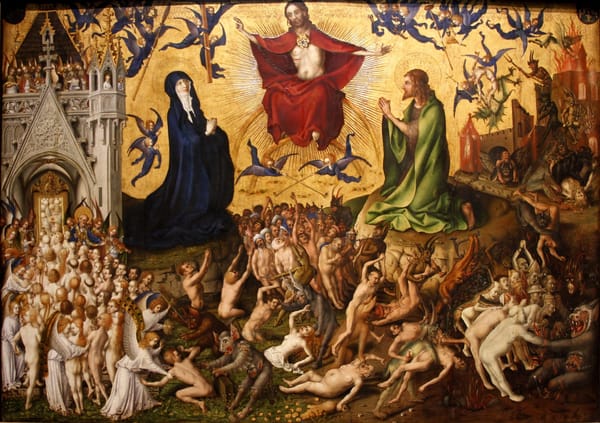
It was here, therefore, that mother Church formerly finished her liturgical year. She was delighted at what she had done during all the past months; that is, at having led her children, not only to have a thorough appreciation of the divine plan, which she had developed before them in her celebrations, but moreover, and more especially, to unite them themselves, by a veritable union, to their Jesus, by a real communion of views, and interests, and loves. On this account, she used not to revert again to the second coming of the God-Man and the last judgment, two great subjects which she had proposed for her children’s reflexions, at the commencement of the purgative life, that is, in her season of Advent. It is only a few centuries ago that, with a view of giving to her year a conclusion more defined and intelligible to the faithful of these comparatively recent times, she chose to conclude the cycle with the prophetic description of the dread coming of her Lord, which is to put an end to time, and to open eternity. From time immemorial, St. Luke had had the office of announcing, in Advent, the approach of the last judgment;5 the evangelist St Matthew was selected for this its second, and more detailed, description, on the last Sunday after Pentecost.
Mass
Introit
Ps. Benedixisti, Domine, terram tuam: avertisti captivitatem Jacob. Gloria Patri. Dicit Dominus.
Ps. Thou, O Lord, hast blessed thy land: thou hast brought back the captive children of Jacob. Glory, etc. The Lord.
The doing of good works, by the help of divine grace, prepares us to receive a still greater grace, for greater works in the future. In the Collect, let us unite with our mother, the Church, in praying for an efficacious influence of the divine Mover upon our wills.
Collect
The other Collects, as on page 120.
Epistle
Cap. i.Fratres, Non cessamus pro vobis orantes et postulantes, ut impleamini agnitione voluntatis Dei in omni sapientia, et intellectu spiritali : ut ambuletis digne Deo per omnia placentes: in omni opere bono fructificantes, et crescentes in scientia Dei : in omni virtute confortati secundum potentiam claritatis ejus, in omni patientia, et longanimitate cum gaudio, gratias agentes Deo Patri, qui dignos nos fecit in partem sortis sanctorum in lumine : qui eripuit nos de potestate tenebrarum, et transtulit in regnum Filii dilectionis suæ; in quo habemus redemptionem per sanguinem ejus, remissionem peccatorum.
Ch. i.Brethren: We cease not to pray for you, and to beg that you may be filled with the knowledge of his will, in all wisdom, and spiritual understanding: that you may walk worthy of God, in all things pleasing: being fruitful in every good work, and increasing in the knowledge of God: strengthened with all might, according to the power of his glory, in all patience and longsuffering with joy. Giving thanks to God the Father, who hath made us worthy to be partakers of the lot of the saints in light: who hath delivered us from the power of darkness, and hath translated us into the kingdom of the Son of his love, in whom we have redemption through his blood, the remission of sins.
Thanksgiving and prayer! There we have the epitome of our Epistle, and an eloquent conclusion of the apostle’s course of instructions: it is also both the summary and the conclusion of the year of the sacred liturgy. The Doctor of the Gentiles has been zealous, beyond measure, in his fulfilment of the task assigned to him by mother Church. Of a certainty, the fault is not his, if the souls he undertook to guide, on the morrow of the descent of the Spirit of love, have not all reached that summit of perfection, which he longed for us all to attain. Those who have gone bravely forward in the path which, a year since, was opened out to them by holy Church, now, by a happy experience, know that that path most surely leads them to the life of union, where divine charity reigns supreme. Who is there that, with anything like earnestness, has allowed his mind and heart to take an interest in the several liturgical seasons which have been brought before us, and been celebrated by the Church during the past twelve months, has not also felt an immense increase of light imparted to him? Now, light is that indispensable element, which delivers us from the power of darkness, and translates us, by the help of God, into the kingdom of the Son of His love. The work of redemption, which this His beloved Son came down upon earth to accomplish for His Father’s glory, could not do otherwise than make progress in those who have, with more or less fervour, entered into the spirit of His Church, during the whole year, that is, from the opening of Advent right up to these the closing days of the sacred cycle. All of us, then, whosoever we may be, should give thanks to this Father of lights,6who hath thus made us worthy to be partakers, somewhat at least, of the lot of the saints.
So, then, all of us, be the share of our participation what it may, must pray that the excellent gift,7 which has been put into our hearts, may fervently yield itself to the still richer development, which the coming new cycle is intended to produce within us.
The just man cannot possibly remain stationary in this world; he must either descend or ascend; and whatever may be the degree of perfection to which grace has led him, he must be ever going still higher as long as he is left in this life.8 The Colossians, to whom the apostle was writing, had fully received the Gospel; the word of truth which had been sown in them had produced abundant fruit in faith, hope, and love;9 and yet, instead of relenting on that account his solicitude in their regard, it is precisely for that reason10 that St. Paul, who had prayed for them up till then, ceases not to pray for them. So let us do: let us go on praying. Let us beg of God, that He will again, and always, fill us with His divine Wisdom, and with the Spirit of understanding. We need all that, in order to correspond with His merciful designs. If the new year of the Church, which is so soon to begin, finds us faithful and making fresh progress, we shall be repaid with new aspects of truth in the garden of the Spouse, and the fruits we shall produce there will be more plentiful, and far sweeter, than in any bygone year. Therefore, let us make up our minds to walk worthy of God, ‘with dilated hearts,’11 and bravely; for the eye of His approving love will be ever upon us, as we toil along. Oh, yes! let us run on in that uphill path, which will lead us to eternal repose in the beatific vision!
Gradual
Gospel
Cap. xxiv.In illo tempore : Dixit Jesus discipulis suis: Cum videritis abominationem desolationis, quæ dicta est a Daniele propheta, stantem in loco sancto, qui legit intelligat: tunc qui in Judæa sunt, fugiant ad montes: et qui in tecto, non descendat tollere aliquid de domo sua: et qui in agro, non revertatur tollere tunicam suam. Væautemprægnantibus, et nutrientibus in illis diebus. Orate autem ut non fìat fuga vestra in hieme, vel Sabbato. Erit enim tunc tribulatio magna, qualis non fuit ab initio mundi usque modo, neque fiet. Et nisi breviati fuissent dies illi, non fìeret salva omnis caro: sed propter electos breviabuntur dies illi. Tunc si quis vobis dixerit : Ecce hic est Christus, aut illic : nolite credere. Surgent enim pseudochristi, et pseudoprophetæ : et dabunt signa magna et prodigia, ita ut in errorem inducantur (si fieri potest) etiam electi. Ecce prædixi vobis. Si ergo dixerint vobis : Ecce in deserto est, nolite exire: Ecce in penetralibus, nolite credere. Sicut enim fulgur exit ab Oriente, et paret usque in Occidentem : ita erit et adventus Filii hominis. Ubicumque fuerit corpus, illic congregabuntur et aquilæ. Statim autem post tribulationem dierum illorum sol obscurabitur, et luna non dabit lumen suum, et stellæ cadent de cœlo, et virtutes cœlorum commovebuntur : et tunc parebit signum Filii hominis in cœlo: et tunc plangent omnes tribus terræ : et videbunt Filium hominis venientem in nubibus cœli cum virtute multa et majestate. Et mittet angelos suos cum tuba, et voce magna: et congregabunt electos ejus a quatuor ventis, a summis cœlorum usque ad terminos eorum. Ab arbore autem fici discite parabolam : cum jam ramus ejus tener fuerit, et folia nata, scitis quia prope est æstas; ita et vos, cum videritis hæc omnia, scitote quia prope est in januis. Amen dico vobis, quia non præteribit generatio hæc, donec omnia hæc fiant. Cœlum et terra transibunt, verba autem mea non præteribunt.
Ch. xxiv.At that time: Jesus said to his disciples: When you shall see the abomination of desolation, which was spoken of by Daniel the prophet, standing in the holy place: he that readeth, let him understand. Then they that are in Judea, let them flee to the mountains; and he that is on the house-top, let him not come down to take anything out of his house; and he that is in the field, let him not go back to take his coat. And wo to them that are with child, and that give suck in those days. But pray that your flight be not in the winter, or on the Sabbath. For there shall be then great tribulation, such as hath not been from the beginning of the world until now, neither shall be. And unless those days had been shortened, no flesh should be saved: but for the sake of the elect, those days shall be shortened. Then if any man shall say to you: Lo! here is Christ, or there: do not believe him. For there shall arise false Christs, and false prophets, and shall shew great signs and wonders, insomuch as to deceive, if possible, even the elect. Behold I have told it to you beforehand; if therefore they shall say to you : Behold he is in the desert, go ye not out: Behold he is in the closets, believe it not. For as lightning cometh out of the east, and appeareth even into the west; so shall also the coming of the Son of Man be. Wheresoever the body shall be there shall the eagles also be gathered together. And immediately after the tribulation of those days, the sun shall be darkened, and the moon shall not give her light, and the stars shall fall from heaven, and the powers of heaven shall be moved: and there shall appear the sign of the Son of Man in heaven: and then shall all tribes of the earth mourn: and they shall see the Son of Man coming in the clouds of heaven with much power and majesty. And he shall send his angels with a trumpet, and a great voice: and they shall gather together his elect from the four winds, from the farthest parts of the heavens to the utmost bounds of them. And from the fig-tree learn a parable: when the branch thereof is now tender and the leaves come forth, you know that summer is nigh. So you also, when you shall see all these things, know ye that it is nigh even at the doors. Amen, I say to you, that this generation shall not pass, till all these things be done. Heaven and earth shall pass, but my words shall not pass.
Several times during Advent we meditated on the circumstances which are to accompany the last coming of Christ our Lord; and in a few days the same great teachings will be again brought before us, filling our souls with a salutary fear. May we, then, be permitted, on this last Sunday of our liturgical year, to address ourselves in a prayer of desire and praise to our adorable Lord and King, the solemn hour of whose judgment is to be the consummation of His work, and the signal of His triumph.
O Jesus! who then art to come to deliver Thy Church, and avenge that God who has so long borne every sort of insult from His creature man, that day of Thy coming will indeed be terrible to the sinner! He will then understand how the Lord hath made all things for Himself—all, even the ungodly, who, on the evil day, are to show forth the divine justice.12 The whole world, fighting on His side against the wicked,13 shall then at last be avenged for that slavery of sin which had been forced upon it.14 Vainly will the wicked cry out to the rocks to fall upon them, and hide them from the face of Him that will then be seated on His throne;15 the abyss will refuse to engulf them; in obedience to Him who holds the keys of death and of hell,16 it will give forth, to a man, its wretched victims, and set them at the foot of the dread tribunal. O Jesus, how magnificent will Thy power then appear! The heavenly hosts will also be standing around Thee, forming Thy brilliant17 court, and assembling Thy elect from the four quarters of the earth.
For we also, Thy redeemed who have become Thy members by becoming the members of Thy beloved Church, we are to be there on that day, and our place (O ineffable mystery!) is to be the one Thou hast reserved for Thy bride; it is to be Thy own throne,18 where seated we shall judge the very angels.19 Even now, all those blessed of the Father,20 all those elect whose youth, like that of the eagle, has been so often renewed by receiving Thy precious Blood,21 have they not had their eyes fitted to gaze without being dazzled on the Sun of justice, when He shall appear in the heavens? The tediousness of their long exile has given such keenness to their hunger that nothing will have power to stay their flight, once the sacred prey of Thy divine Body shall be shown them! What hindrance could be strong enough to check the impetuosity of the love22 which will bring them all together to the banquet of the eternal Pasch? The trumpet of the Archangel, which will ring through the graves of the just, is to be a summons calling them, not to death, but to life; to the sight of the old enemy’s destruction;23 to a redemption which is to include their very bodies;24 to the unimpeded passover to the true Land of promise; in a word, to the Pasch, and this time real, and for all, and for ever. What will be the joy of that true day of the Lord!25 What joy for them that have, by faith, lived in Christ, and loved Him without seeing Him!26 Identifying themselves with Thee, O Jesus, notwithstanding the weakness of the flesh, they have continued here below Thy life of suffering and humiliation. What a triumph when, delivered for ever from sin, and vested in their immortal bodies, they shall be borne aloft before Thy face, that they may for ever be with Thee!27
But their chiefest joy on that great day will be to assist at the glorification of their most dear Lord, by the manifestation of the power which was given to Him over all flesh.28 Then, O Emmanuel! crushing the heads of kings, and making Thine enemies Thy footstool,29 Thou wilt be shown as the one Ruler of all nations.30 Then will heaven, and earth, and hell bow their knee31 before that Son of Man, who heretofore appeared on earth as a slave, and was judged, and condemned, and put to death between two thieves. Then, dear Jesus, Thou wilt judge the unjust judges, to whom, even in the midst of all the humiliations they put on Thee, Thou didst foretell this Thy coming on the clouds of heaven.32 And when, after the irrevocable sentence has been passed, the wicked shall go to everlasting torments, and the just to life eternal,33 Thy apostle tells us that, having conquered Thine enemies and been proclaimed undisputed King, Thou wilt consign to Thy eternal Father this Thy kingdom won over death; it will be the perfect homage of Thee, the Head, and of all Thy faithful members.34 God will thus be all in all. It will be the perfect accomplishment of that sublime prayer Thou taughtest mankind to make,35 which they daily offer up to the Father who is in heaven, saying to Him : 'Hallowed be Thy name! Thy kingdom come! Thy will be done on earth, as it is in heaven!' O blissfully peaceful day, when blasphemy is to cease, and when this poor earth of ours, cleansed by fire from the filth of sin, shall be turned into a new paradise! Where, then, is the Christian, who would not thrill with emotion at the thought of that last of all the days of time, which is to usher in beautiful eternity? Who would not despise the agonies of his own last hour, when he reflects that those sufferings have really only one meaning in them, that the Son of Man, as the Gospel words it, is nigh even at the very doors!
O sweet Jesus, detach us every year more and more from this world, whose fashion passeth away,36 with its vain toils, its false glories, and its lying pleasures. It was Thine own foretelling, that, as in the days of Noe and Sodom, men will go on with their feasting, and business, and amusements, without giving any more thought to Thy approaching coming than their forefathers heeded the threat of the Deluge, or of the fire, which came upon them and destroyed them.37 Let these men go on with their merry-making, and their sending gifts one to the other, as Thine Apocalypse expresses it, because, so they will have it, Christ and His Church are then to be worn-out ideas!38 Whilst they are tyrannizing over Thy holy city in a thousand varied ways, and persecuting her as no past period had ever done, they little think that all this is an announcement of the eternal nuptials, which are nigh at hand. All these trials are the fresh jewels, which the bride is to have given her before her beauty is complete; and the blood of her last martyrs is to incarnadine her already splendid robes with all the richness of royal crimson. As for us, we lend an ear to the echoes of our home above; and, from the throne of our God, we hear going forth the voice heard by Thy beloved prophet of Patmos: 'Give praise unto our God, all ye His servants, and ye that fear Him, little and great! Alleluia! For the Lord our God the almighty hath reigned! Let us be glad and rejoice, and give glory unto Him; for the marriage of the Lamb is come, and His wife hath prepared herself!'39 Yet a little while, till the number of our brethren be made up;40 and then, with the Spirit and the bride, we will say to Thee, in all the ardour of our souls that have long thirsted after Thee: ‘Come, Lord Jesus!41 Come, and perfect us in love, by eternal union, unto the glory of the Father, and of Thyself the Son, and of the Holy Ghost, for ever and ever!'
Offertory
In the Secret, let us ask of God that, at the approach of the last judgment, He would turn all hearts towards Himself, and vouchsafe to make our earthly desires give place to the desire for, and relish of, heavenly things.
Secret
The other Secrets, as on page 130.
Communion
May the divine Sacrament, as the Church prays in the Postcommunion, fully cure, by its virtue, whatsoever may remain faulty in our souls at this close of the year!
Postcommunion
The other Postcommunions, as on page 131.
Vespers
The psalms, capitulum, hymn and versicle, above, pages 71-81.
Antiphon of the Magnificat
- Farther on (vid. inf., pages 496-511) we have given these Sundays, which are the third, fourth, fifth, and sixth, after the Epiphany. When there are twenty-five Sundays after Pentecost, it is the sixth after the Epiphany, which is put after the twenty-third; if the number of Sundays be twenty-six, the fifth after the Epiphany becomes the twenty-fourth after Pentecost; if the number be twenty-seven, we go back to the fourth after the Epiphany, and the rest follow; if it be as high as twenty-eight, we begin with the third. ↩︎
- The thirteenth Sunday after Pentecost. ↩︎
- Eph. ii. 16. ↩︎
- Ibid. 15. ↩︎
- First Sunday of Advent. ↩︎
- St. Jas. i. 17. ↩︎
- Ibid. ↩︎
- Ps. lxxxiii. 6. ↩︎
- Col. i. 4-6. ↩︎
- Ibid. 9. ↩︎
- St. Benedict, The Holy Rule. ↩︎
- Prov. xvi 4. ↩︎
- Wisd. v. 21. ↩︎
- Rom. viii 21. ↩︎
- Apoc. vi. 16. ↩︎
- Ibid. i. 18. ↩︎
- Apoc. xix. 14. ↩︎
- Ibid. iii. 21. ↩︎
- 1 Cor. vi. 3. ↩︎
- St. Matt. xxv. 3. ↩︎
- Ps. cii. 5. ↩︎
- Cant. viii. 6. ↩︎
- 1 Cor. xv. 28. ↩︎
- Rom. viii. 23. ↩︎
- Ps. cxvii. 24. ↩︎
- 1 St. Pet. i. 8. ↩︎
- 1 Thess. iv. 6. ↩︎
- St. John xvii. 2. ↩︎
- Ps. cix. ↩︎
- Ps. ii. ↩︎
- Phil. ii. 10. ↩︎
- St. Matt. xxvi. 64. ↩︎
- Ibid. xxv. 46. ↩︎
- 1 Cor. xv. 24-28. ↩︎
- St. Matt. vi. 9. ↩︎
- 1 Cor. vii. 31. ↩︎
- St. Luke xvii. 26-30. ↩︎
- Apoc. ix. 10. ↩︎
- Apoc. xix. 5-7. ↩︎
- Ibid. vi. 11. ↩︎
- Ibid. xxii. 17. ↩︎
November 21: The Presentation of the Blessed Virgin Mary
THE Presentation is one of the minor solemnities of our Lady, and was inscribed at a comparatively late date on the sacred Cycle; it seems to court the homage of our silent contemplation. The world, unknown to itself, is ruled by the secret prayers of the just; and the Queen of saints, in her hidden mysteries, wrought far more powerfully than the so-called great men, whose noisy achievements fill the annals of the human race.
The East had been celebrating for seven centuries at least1 the entrance of the Mother of God into the temple of Jerusalem,2 when in 1372 Gregory XI. permitted it to be kept for the first time3 by the Roman court at Avignon. Mary in return broke the chains of captivity, that had bound the Papacy for seventy years; and soon the successor of St. Peter returned to Rome. The feast of the Visitation, as we saw on July 2nd, was in like manner inserted in the Western Calendar, to commemorate the re-establishment of unity after the schism which followed the exile.
In 1373, following the example of the Sovereign Pontiff, Charles V. of France introduced the feast of the Presentation into the chapel of his palace. By letters dated 10th November 1374, to the masters and students of the college of Navarre, he expressed his desire that it should be celebrated throughout the kingdom: “Charles, by the grace of God king of the Franks, to our dearly beloved : health in him who ceases not to honour his Mother on earth. Among other objects of our solicitude, of our daily care and diligent meditation, that which rightly occupies our first thoughts is, that the blessed Virgin and most holy Empress be honoured by us with very great love, and praised as becomes the veneration due to her. For it is our duty to glorify her; and we, who raise the eyes of our soul to her on high, know what an incomparable protectress she is to all, how powerful a mediatrix with her blessed Son, for those who honour her with a pure heart . . . Wherefore, wishing to excite our faithful people to solemnize the said feast, as we ourselves propose to do by God's assistance every year of our life, we send this Office to your devotion, in order to increase your joy.”4
Such was the language of princes in those days. Now just at that very time, the wise and pious king, following up the work begun at Brétigny by our Lady of Chartres, rescued France from its fallen and dismembered condition. In the State then, as well as in the Church, at this moment so critical for both, our Lady in her Presentation commanded the storm, and the smile of the infant Mary dispersed the clouds.
The new feast, enriched with Indulgences by Paul II., had gradually become general,5 when St. Pius V., wishing to diminish the number of Offices on the universal Calendar, included this one among his suppressions. But Sixtus V. restored it to the Roman Breviary in 1585, and shortly afterwards Clement VIII. raised it to the rank of Double Major. Soon the Clergy and Regulars adopted the custom of renewing their holy vows on this day, whereon their Queen had opened before them the way that leads by sacrifice to the special love of our Lord.
Hearken, O daughter, and see, and incline thy ear, and forget thy people and thy father's house; and the King shall greatly desire thy beauty. Thus, wording the wishes of the daughters of Tyre, sang the Church of the expectation, on the summit of Mount Moriah; and penetrating the future with her inspired glance, she added: After her shall virgins be brought to the King, her neighbours shall be brought to thee; they shall be brought with gladness and? Voicing: they shall be brought into the temple of the King. Hailed beforehand as beautiful above the sans of men, this King, the most mighty, makes on this day a prelude to his conquests; and even this beginning is wonderful. Through the graceful infant now mounting the temple steps, he takes possession of that temple, whose priests will hereafter vainly disown him: for this child, whom the temple welcomes today, is his throne. Already his fragrance precedes and announces him, in the Mother in whose bosom he is to be anointed with the oil of gladness, as the Christ among his brethren; already the Angels hail her as the Queen whose fruitful virginity will give birth to all those consecrated souls, who keep for the divine Spouse the myrrh and the incense of their holocausts, those daughters of kings, who are to form her court of honour.6
But our Lady's Presentation also opens new horizons before the Church. On the Cycle of the Saints, which is not so precisely limited as that of the Time, the mystery of Mary's sojourn in the sanctuary of the Old Covenant is our best preparation for the approaching season of Advent. Mary, led to the temple in order to prepare in retirement, humility, and love for her incomparable destiny, had also the mission of perfecting at the foot of the figurative altar the prayer of the human race, of itself ineffectual to draw down the Saviour from heaven. She was, as Saint Bernardine of Siena says, the happy completion of all the waiting and supplication for the coming of the Son of God; in her, as in their culminating point, all the desires of the saints who had preceded her found their consummation and their term.7
Through her wonderful understanding of the Scriptures, and her conformity, daily and hourly, to the minutest teachings and prescriptions of the Mosaic ritual, Mary everywhere found and adored the Messias hidden under the letter; she united herself to him, immolated herself with him in each of the many victims sacrificed before her eyes; and thus she rendered to the God of Sinai the homage, hitherto vainly expected, of the Law understood, practised, and made to fructify, in all the fulness that beseemed its divine Legislator. Then could Jehovah truly say: As the rain and the snow come down from heaven and return no more thither, but soak the earth and water it, and make it to spring: . . . so shall my word be: . . . it shall not return to me void, but it shall do whatsoever I please.8
Supplying thus for the deficiencies of the Gentiles as well as of the Synagogue, Mary beheld in the Bride of the Canticle the Church of the future. In our name she addressed her supplications to him whom she recognised as the Bridegroom, without however knowing that he was to be her own Son. Such yearnings of love, coming from her, were sufficient to obtain from the divine Word pardon for the infidelities of the past, and the immorality into which the wandering world was plunging deeper and deeper.9 How well did this Ark of the New Covenant replace that of the Jews, which had perished with the first temple! It was for her, though he knew it not, that Herod the Gentile had continued the construction of the second temple, after it had remained desolate since the time of Zorobabel; for the temple, like the tabernacle before it, was but the home of the ark destined to be God's throne; but greater was the glory of the second temple which sheltered the reality, than of the first which contained but the figure.
The Greeks have chosen for the Lessons of the feast the passages of Scripture which describe the carrying of the Ark into the tabernacle of the desert,10 and afterwards into the temple of Jerusalem.11 The historical Lesson relates the traditions concerning the oblation of the Blessed Virgin by her holy parents to God in the temple, at the age of three years, there to dwell until, after the lapse of twelve years, the mystery of our salvation was to be accomplished in her.
In the sixth century, the emperor Justinian built, in honour of the Presentation, a magnificent church, on the southern part of the platform on which had formerly stood the temple and its annexes. It is now the mosque El-Aksa.
The next century gives us the following strophes, which bear witness to the antiquity of the feast.
De B. Virgine in Templum Recepta.
In the fifteenth and sixteenth centuries, many churches used to sing on this day the following Prose, composed as an acrostic on the words Ave Maria, benedico te, Amen. Hail Mary, I praise thee, Amen.
Sequence
Cuncta rite disponente
Dei Sapientia:
Vno nexu conjugatis
Joachim et Anna, gratis
Juga sunt sterilia.
Domino fideli voto
Se strinxerunt pariter:
Mox si prolem illis dare
Dignetur, hanc dedicare
In templo perenniter.
Lucidus qui docuit
Exaudita vota:
Regis summi gratia
Ut his detur filia
Gratiosa tota.
Miro modo generata,
Gignet mirabilius
Altissimi Patris natum
Virgo manens, qui realum
Mundi tollet gratius.
Temple trima praesentata
It ter quinis gradibus:
Erecta velox ascendit
Et uterque parens tendit
Se ornando vestibus.
Templem, dum ecimia
Virgo praesentatur:
Edocta divinitus,
Visitata coelitus,
Angelis laetatur.
Princeps puellis adultis,
Primo virgo renuit:
Ipsam namque devovere
Parentes, ipsa manere
Virgo voto statuit.
Dat, ut virgo sumat sponsum
Quem pandet flos editus:
Ostensus Joseph puellam
Ad parentum duxit cellam,
Nuptiis sollicitus.
Ferens conceptus ordinem
Delegatur;
Erudita stat tacita,
Verba quae sint insolita
Meditatur.
Modum, virgo credidit,
Sique sacro flamine
Mox Verbum concipitur,
Et quod nusquam clauditur
Conditur in virgine.
Quanta laude sublimaris,
Quanta fulges gloria:
Nos ergo sic tuearis,
Ut tructu, quo gloriaris,
Fruamur in patria.
with inscrutable providence,
disposeth all things rightly:
Joachim and Anne
are united in wedlock,
but their union is sterile.
they together bind themselves
by inviolable vow to the Lord:
that if he deign to give them offspring,
they without delay will consecrate it
to him forever in the temple.
and tells them their prayers are heard,
and by the grace
of the most high King,
a daughter shall be given them,
full of grace.
she is born in a wondrous manner,
yet in a way more wondrous still
will she give birth, remaining a virgin,
to the Son of the most high Father,
when he comes to freely, cancel the guilt of the world.
and at the age of three years
is presented in the temple;
swift and erect, adorned with her beautiful robe,
she ascends the fifteen steps,
beneath her parents’ gaze.
with a new glory,
when this august Virgin is presented;
there she is taught by God,
is visited by the Angels from heaven,
and rejoices with them.
bids the maidens of adult age
prepare for marriage,
the Virgin at first refuses;
for her parents have devoted her to God,
and she herself has vowed to remain a virgin.
answers that the virgin shall take him
for her spouse whom a miraculous flower shall designate;
Joseph thus chosen
weds the maiden
and leads her to his home.
telling her how she
is to become a mother;
but the prudent Virgin stands silent,
pondering over
the strangeness of the message.
she believes him;
and thus by the Holy Spirit
the Word is conceived,
and he whom no space can contain
is concealed in the Virgin's bosom.
how dost thou surpass all praise
in thy dazzling glory!
Protect us now, that in our fatherland
we may enjoy thy fruit,
whereby thou art so honoured.
“Congratulate me, all ye that love the Lord, because when I was a little one I pleased the Most High.”12 Such is the invitation thou addressest to us, O Mary, in the Office chanted in thy honour; and on what feast couldst thou do so more appropriately?
When, even more little in thy humility than by thy tender age, thou didst mount, in thy sweet purity, the steps of the temple, all heaven must have owned that it was henceforth just for the Most High to take his delight in our earth. Having hitherto lived in retirement with thy blessed parents, this was thy first public act; it showed thee for a moment to the eyes of men, only to withdraw thee immediately into deeper obscurity. But, as thou wast officially offered and presented to the Lord, he himself doubtless, surrounded by the princes of his court, presented thee not less solemnly to those noble spirits, as their Queen. In the fulness of the new light that then burst upon them, they understood at once thy incomparable greatness, the majesty of the temple where Jehovah was receiving a homage superior to that of their nine choirs, and the august prerogative of the Old Testament to have thee for its daughter, and to perfect, by its teachings and guidance during those twelve years, the formation of the Mother of God.
Holy Church, however, declares that we can imitate thee, O Mary, in this mystery of thy Presentation, as in all others.13 Deign to bless especially those privileged souls who, by the grace of their vocation, are even here below dwellers in the house of the Lord : may they be like that fruitful olive enriched by the Holy Spirit, to which St John Damascene compares thee.14 But is not every Christian, by reason of his Baptism, an indweller and a member of the Church, God's true sanctuary, prefigured by that of Moriah? May we, through thy intercession, follow thee so closely in thy Presentation, even here in the land of shadows, that we may deserve to be presented after thee to the Most High in the temple of his glory.15
- Pitra, Analecta sacra Spicilegio Solesmensi parata, i. 275. ↩︎
- Menaea, ad diem hanc. ↩︎
- This is to be understood only of the feast properly so called; for the marble of Berre, reproduced by Le Blant in No. 542 A of Inscriptions chrétennes de la Gaute, proves that the fact of Mary’s sojourn in the temple of Jerusalem ws recognized and honoured in the West in the fifth century. See Plate 72 of the same work, No. 433. ↩︎
- Launcy, Historia Navarrae gymnasti, Pars I. Lib. i. cap. 10. ↩︎
- From sources which do not come within the learned author’s scope, it appears, that in England, the feast is of much more ancient institution, though the evidence so far collected confines its observance to the monasteries. As Oblatio S. Mariae in templo Domini cum esset trium annorum, it occurs in several monastic Calendars of Saxon times, and, still under the title of Oblatio, in some of later date. This is only one of many interesting facts illustrating the English movement of the 10th and early 11th centuries in its devotional aspect: a side of the question which still awaits special study. (Translator’s note). ↩︎
- Ps. xliv. ↩︎
- Bernardin. Sen. Pro festivitatibus V. Mariae, Sermo iv. ↩︎
- Isaias, lv. 10, 11. ↩︎
- Olier, Vie intérieure de la très-sainte Viergo, Présentation. ↩︎
- Exod. xi. ↩︎
- III Kings viii. ↩︎
- Second Responsory in the Common Office of our Lady. ↩︎
- 2nd Lesson of 2nd Nocturn. Ambr. de Virginibus ii. ↩︎
- 1st Lesson of 2nd Nocturn. Damasc. De Fide orthodoxa, iv. ↩︎
- Collect of the feast. ↩︎
| Previous November 20: St. Felix of Valois, Confessor | Next November 21: The Presentation of the Blessed Virgin Mary |