Daily reading
Advent
Double of the II Class · November 30 · Sanctoral
November 30, 2027
From Dom Guéranger’s The Liturgical Year.
A Double of the II Class leads the weekday.Rubric

|
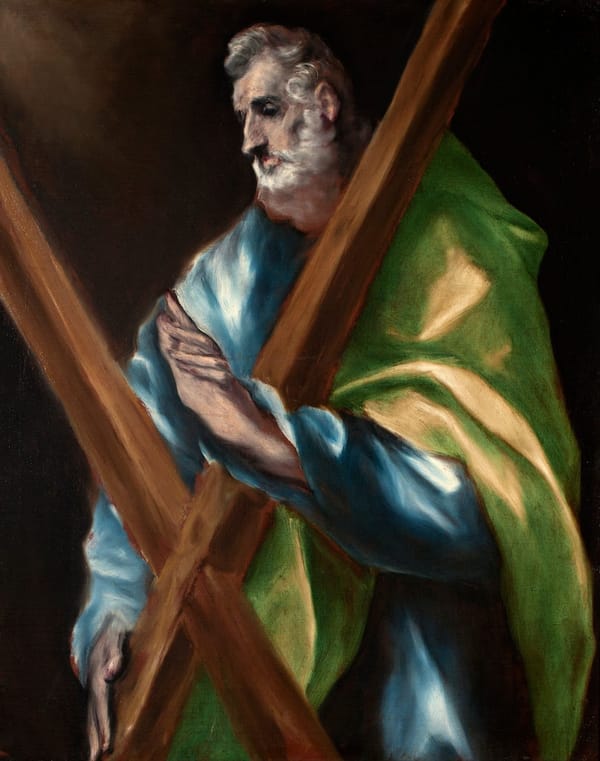
November 30: Saint Andrew, Apostle (at the beginning of the year)
We open our Proper of Saints for Advent with St. Andrew, because, although his feast frequently occurs before this holy season has begun, it sometimes happens that we have entered Advent when the memory of this great apostle has to be celebrated by the Church. This feast is therefore destined to terminate with solemnity the cycle which is at its close, or to add lustre to the new one which has just begun. It seems, indeed, fitting that the Christian year should begin and end with the cross, which has merited for us each of the years that it has pleased the divine goodness to grant us, and which is to appear, on the last day, in the clouds of heaven, as the seal put on time.
We should remember that Saint Andrew is the apostle of the cross. To Peter, Jesus has given firmness of faith; to John, warmth of love; the mission of Andrew is to represent the cross of his divine Master. Now it is by these three, faith, love, and the cross, that the Church renders herself worthy of her Spouse. Everything she has or is, bears this threefold character. Hence it is that after the two apostles just named, there is none who holds such a prominent place in the universal liturgy as Saint Andrew.
But let us read the life of this glorious fisherman of the lake of Genesareth, who was afterwards to be the successor of Christ Himself, and the companion of Peter, on the tree of the cross. The Church has compiled it from the ancient Acts of the martyrdom of the holy apostle, drawn up by the priests of the Church of Patras, which was founded by the saint. The authenticity of this venerable piece has been contested by Protestants, inasmuch as it makes mention of several things which would militate against them. Their sentiment has been adopted by several critics of the seventeenth and eighteenth centuries. On the other hand, these Acts have been received by a far greater number of Catholic writers of eminence; amongst whom may be mentioned the great Baronius, Labbe, Natalis Alexander, Gallandus, Lumper, Morcelli, &c. The Churches, too, of both east and west, which have inserted these Acts in their respective Offices of St. Andrew, are of some authority, as is also St. Bernard, who has made them the groundwork of his three admirable sermons on St. Andrew.
Let us now listen to the several Churches on earth, celebrating the grand triumph of our apostle. Let us begin with Rome, the mother and mistress of all Churches. Nothing could be more expressive than the language she uses in praise of the apostle of the cross. First, she employs the words of the Gospel, which record the circumstances of his vocation; then, she selects the most touching passages from the Acts of his martyrdom, drawn up by the priests of Patras; and both are intermingled with appropriate sentiments of her own. Our first selection shall be from the responsories of Matins.
The antiphons of Vespers are full of a lyric gracefulness and unction.
Antiphons
The following hymn was composed in honour of the holy apostle, by Pope St. Damasus, the friend of St. Jerome. There is an allusion in it to the name Andrew, which amongst its many meanings has that of beauty.
Hymn
Vitamque nomen exprimens,
Hoc to decorum prædicat
Crucis beatæ gloria.
Hoc ipso jam vocabulo
Signaris, isto nomine
Decorus idem mystice.
Crux quem beata diligit,
Cui crux amara præparat
Lucis futurae gaudia.
Cluit gemello stigmate,
Dum probra vincis per crucem,
Crucisque pandis sanguinem.
Curamque nostri suscipe,
Quo por crucis victoriam
Cœli potamus patriam.
expressive of thy life,
declares how beautiful thou art
in the glory of thy blessed cross.
thy very name
points to the mystic
beauty of thy soul.
the blessed cross loves thee,
the bitter cross prepares for thee
the joys of the light to come.
shines in thee with a twofold beauty:
for by the cross thou dost vanquish insults,
and thou preachest to men the divine blood shed on the cross.
and take us under thy care;
that so, by the victory of the cross,
we may reach our heavenly country.
The two following sequences, in honour of the apostle of the cross, were written in the middle ages. The first belongs to the eleventh century. Like all the sequences of that period, it has no regular rhythm.
Sequence
Digna laude universa categorizet Ecclesia.
Apostoli Andreæ, admiranda praefulgentis gratia.
Mox ejus intrans habitacula, audiebat eloquia.
Et duxit eum ad dulcifluam Salvatoris presentiam.
Artem piscandi commutans dignitate apostolica.
Sancti Spiritus præclara perlustravit potentia;
Gratulare ergo tanto patre, Achaia;
Honorata multimoda signorum frequentia.
Te lues inferna et mors tenet æterna.
Jam Regem tuum spectas, jam in ejus conspectu, Andrea, stas.
Sis ergo nobis inclyta dulcedo, spirans intima cœlestis vitæ balsama.
Let the universal Church sing in worthy strains.
Of the apostle Andrew, so bright in his admirable graces.
He straightway entered his dwelling, and listened to his words;
And he led him to the loved presence of the Saviour.
Giving him, in exchange for his art of fishing, the dignity of an apostle.
Was visited by the glorious power of the Holy Ghost,
Rejoice, then, O Achaia! that thou hast such an apostle,
And honoured thee with his many and manifold miracles.
The pains of hell and eternal death are thine:
O Andrew! now thou seest thy King: now thou art in his presence;
The second sequence, written in rhythm and correct metre, is the composition of the pious Adam of Saint Victor, the greatest lyric poet of the middle ages.
Sequence
Et Andreae delectemur
Laudibus apostoli.
Et pro Christo tot labores,
Digne decet recoli.
Cui primum lux illuxit,
Joannis indicio.
Petri simul et Andreæ
Sequitur electio.
Verbi fiunt assertores,
Et forma justitiæ.
Vigilemque gerunt curam
Nascentis Ecclesiæ.
Et in partes mittitur
Andreas Achaiæ.
Currit, Dei gratia,
Magna pars provinciæ.
Doctor pius et insignis
Cor informat populi.
Quid Andreas egerit,
Iræ surgunt stimuli.
Cui præsens vita vilis,
Viget patientia.
Non enervat robur mentis
Judicis insania.
Suo gestit conformari
Magistro discipulus.
Et crucis appetitur
Triumphalis titulus.
Victurus in perpetuum:
Neo vult volente populo
Deponi de patibulo.
Luce perfusus nimia,
Cum luce, cum lætitia,
Pergit ad lucis atria.
Cujus preces pretiosæ,
Cujus mortis luminosae
Dulcis est memoria,
Nos ad illud lumen clarum,
Pie pastor animarum,
Tua transfer gratia.
and be delighted in the praises
sung to Andrew the apostle.
and all his labours for Christ,
deserve a worthy celebration.
’Twas he on whom the light first shone;
the Baptist showed it him.
our Lord called Peter and Andrew
by the one same election.
are become heralds of the Word,
and models of every virtue.
and carefully watch over
the infant Church.
from his brother, and sent
into the country about Achaia.
by the grace of God,
into Andrew’s net.
forms the hearts of his people
by his faith, life, preaching, and miracles.
what Andrew had done,
he was excited to great anger.
set little value on this life,
and armed itself with patience.
or threatens him with tortures,
but cannot shake his constant soul.
Andrew, as a true disciple, is proud
to be thus made like his Master.
ambitious to have
the trophy of triumph, the cross.
which was to make him live for ever;
the people resolve to loose him from it:
but he would not have it so; and clings to his cross.
for nearly half an hour;
and then, in this light, and in this joy,
he mounts to the realms of light.
whose prayers are so precious,
and whose bright death
is so sweet to think on,
from this vale of tears,
and transfer us to that fair land of light,
O thou good shepherd of souls.
The pieces so far given belong to the Roman liturgy, being taken from the books of this mother of Churches, or from those of the different Churches of the west, which follow the form of her Offices. We will now give, in honour of our holy apostle, some of the formulæ which the other ancient liturgies used for his feast; we will begin with the Ambrosian rite, from which we take the following beautiful preface.
Preface
The Gallican liturgy also celebrated the glories of St. Andrew. Amongst the few fragments which have been handed down to us of this liturgy, there is not a single piece in poetry. The following preface, or, as it was then called, Contestation, will show that the Church of Gaul, from the fourth to the eighth century, shared the enthusiasm of the Roman and Ambrosian Churches for the glorious apostle of the cross.
Contestation
The Mozarabic liturgy is extremely rich in its praises of St. Andrew, both in the missal and the breviary: we must limit ourselves to the following beautiful prayer.
Capitulum
The Greek Church is as fervent as any of the Churches of the west in celebrating the prerogatives and merits of St. Andrew. He is the more dear to it, because Constantinople considers him as her patron apostle. It would, perhaps, be difficult for the Greeks to give any solid proofs of St. Andrew’s having founded, as they pretend, the Church of Byzantium; but this is certain, that Constantinople enjoyed, for many centuries, the possession of the precious treasure of the saint’s relics. They were translated to that city in the year 357, through the interest of the emperor Constantius, who placed them in the basilica of the apostles built by Constantine. Later on, that is, about the middle of the sixth century, Justinian caused them to be translated a second time, but only from one part of that same basilica to another. We borrow the two following beautiful hymns from the Menæa of the Greeks; the first is sung in the evening Office, the second in the morning Office.
In the solemn evening office
When he appeared who clothed himself with our flesh in a virginal yet fruitful womb, and was thus the Son of a Virgin, the teacher of piety, giving us this model of purity; then wast thou happy, O Andrew, most ardent lover of virtue; disposing in thy heart to ascend step by step, and wast raised up from glory to the unspeakable glory of the Lord our God. Beseech him, that he save and enlighten our souls.
In the morning office
The Church of Constantinople, so devoted, as we have seen, to the glory of St. Andrew, was at length deprived of the precious treasure of his relics. This happened in the year 1210, when the city was taken by the crusaders. Cardinal Peter of Capua, the legate of the holy See, translated the body of St.
Andrew into the cathedral of Amalfi, a town in the kingdom of Naples, where it remains to this day, the glorious instrument of numberless miracles, and the object of the devout veneration of. the people. It is well known how, at the same period, the most precious relics of the Greek Church came, by a visible judgement of God, into the possession of the Latins. Byzantium refused to accept those terrible warnings, and continued obstinate in her schism. She was still in possession of the head of the holy apostle, owing, no doubt, to this circumstance, that in the several translations which had been made, it had been kept in a separate reliquary by itself. When the Byzantine empire was destroyed by the Turks, divine Providence so arranged events, as that the Church of Rome should be enriched with this magnificent relic. In 1462, the head of St. Andrew was, therefore, brought thither by the celebrated Cardinal Bessarion; and on Palm Sunday, the twelfth of April, the heroic Pope Pius II. went in great pomp to meet it as far as the Milvian bridge (Ponte Molle), and then placed it in the basilica of St. Peter, on the Vatican, where it is at present, near the confession of the prince of the apostles. At the sight of this venerable head, Pius II. was transported with a religious enthusiasm, and before taking up the glorious relic in order to carry it into Rome, he pronounced the following magnificent address, which we give as a conclusion to the liturgical praises given by the several Churches to St. Andrew.
At length thou hast arrived, O most holy and venerable head of the saintly apostle! The fury of the Turks has driven thee from thy resting-place, and thou art come as an exile to thy brother, the prince of the apostles. Thy brother will not fail thee; and by the will of God, the day will come when men shall say in thy praise: O happy banishment, which caused thee to receive such a welcome! Meanwhile, here shalt thou dwell with thy brother, and share in his honours.
‘This is Rome, the venerable city, which was dedicated by thy brother’s precious blood. The people thou seest, are they whom the blessed apostle, thy most loving brother, and St. Paul, the vessel of election, regenerated unto Christ our Lord. Thus the Romans are thy kinsmen. They venerate, and honour, and love thee as their father’s brother; nay, as their second father; and are confident of thy patronage in the presence of the great God.
O most blessed apostle Andrew! thou preacher of the truth, and defender of the dogma of the most holy Trinity! with what joy dost thou fill us on this day, whereon it is given us to behold thy sacred and venerable head, which deserved that, on the day of Pentecost, the holy Paraclete should rest upon it in the form of fire!
O ye Christians that visit Jerusalem out of reverence for your Saviour, that there ye may see the places where His feet have stood; lo! here is the throne of the Holy Ghost. Here sat the Spirit of the Lord. Here was seen the Third Person of the Trinity. Here were the eyes that so often saw Jesus in the flesh. This was the mouth that so often spake to Jesus; and on these cheeks did that same Lord doubtless impress His sacred kisses.
O wondrous sanctuary, wherein dwelt charity, and kindness, and gentleness, and spiritual consolation. Who could look upon such venerable and precious relics of the apostle of Christ, and not be moved? and not be filled with tender devotion? and not shed tears for very joy? Yea, O most admirable apostle Andrew! we rejoice, and are glad, and exult, at this thy coming, for we doubt not that thou thyself art present here, and bearest us company as we enter with thy head into the holy city.
The Turks are indeed our enemies, as being the enemies of the Christian religion: but in that they have been the occasion of thy coming amongst us, we are grateful to them. For what greater blessing could have befallen us than that we should be permitted to see thy most sacred head, and that our Rome should be filled with its fragrance? Oh! that we could welcome thee with the honours which are due to thee, and receive thee in a way becoming thy exceeding holiness! But accept our good will, and our sincere desires to honour thee, and suffer us now to touch thy relics with our unworthy hands, and, though sinners, to accompany thee within the walls of the city.
‘Enter, then, the holy city, and show thy love to her people. May thy coming be a boon to Christendom. May thy entrance be peaceful, and thy abode amongst us bring happiness and prosperity. Be thou our advocate in heaven, and, together with the blessed apostles Peter and Paul, defend this city, and protect, with thy love, all Christian people; that, by thy intercession, the mercy of God may be upon us; and if His indignation be enkindled against us by reason of our manifold sins, let it fall upon the impious Turks and the pagan nations that blaspheme our Lord Jesus Christ. Amen.’
Thus has the glory of St. Andrew been blended, in Rome, with that of St. Peter. But the apostle of the cross, whose feast was heretofore kept in many Churches with an octave, has also been chosen as patron of one of the kingdoms of the west. Scotland, when she was a Catholic country, had put herself under his protection. May he still exercise his protection over her, and, by his prayers, hasten her return to the true faith!
Let us now, in union with the Church, pray to this holy apostle, for this is the glorious day of his feast: let us pay him that honour which is due to him, and ask him for the help of which we stand in need.
We have scarce begun our mystic journey of Advent, seeking our divine Saviour Jesus, when lo! God grants us to meet thee, O blessed Andrew, at our very first step. When Jesus, our Messias, began His public life, thou hadst already become the obedient disciple of His Precursor, who preached His coming: thou wast among the first of them who received the Son of Mary as the Messias foretold in the Law and the Prophets. But thou couldst not keep the heavenly secret from him who was so dear to thee; to Peter, then, thou didst bear the good tidings, and didst lead him to Jesus.
O blessed apostle! we also are longing for the Messias, the Saviour of our souls; since thou hast found Him, lead us also unto Him. We place under thy protection this holy period of expectation and preparation, which is to bring us to the day of our Saviour’s Nativity, that divine mystery in which He will manifest Himself to the world. Assist us to render ourselves worthy of seeing Him on that great night. The baptism of Penance prepared thee for receiving the grace of knowing the Word of life; pray for us that we may become truly penitent and may purify our hearts, during this holy time, and thus be able to behold Him, who has said: ‘Blessed are the clean of heart, for they shall see God.’
Thou hast a special power of leading souls to Jesus, O glorious saint! for even he, who was to be made the pastor of the whole flock, was presented to the Messias by thee. By calling thee to Himself on this day, our Lord has given thee as the patron of Christians who, each year at this season, are seeking that God in whom thou art now living: they must begin it with praying to thee to show them the way which leads to Jesus.
Thou teachest us this way; it is that of fidelity, of fidelity even to the cross. In that way thou didst courageously walk: and because the cross leads to Jesus Christ, thou didst passionately love the cross. Pray for us, O holy apostle! that we may begin to understand this love of the cross; and that, having understood it, we may put it in practice. Thy brother says to us in his Epistle: ‘Christ having suffered in the flesh, be you also armed with the same thought.’* Thy feast, O blessed Andrew! shows us thee as the living commentary of this doctrine. Because thy Master was crucified, thou wouldst also be crucified. From the high throne to which thou hast been raised by the cross, pray for us, that the cross may be unto us the expiation of the sins which are upon us, the quenching of the passions which burn within us, and the means of uniting us by love to Him, who, through love alone for us, was nailed to the cross.
Important, indeed, and precious are these lessons of the cross: but the cross, O blessed apostle, is the perfection and the consummation, and not the first commencement. It is the Infant God, it is the God of the crib that we must first know and love; it was the Lamb of God that St. John pointed out to thee; and it is that Lamb whom we so ardently desire to contemplate. The austere and awful time of Jesus’ Passion has not come; we are now in Advent. Fortify us for the day of combat; but the grace we now most need is compunction and tender love. We put under thy patronage this great work of our preparation for the coming of Jesus into our hearts.
Remember also, O blessed Andrew, the holy Church, of which thou wast the pillar, and which thou hast beautified by the shedding of thy blood: lift up thy hands for her to Him, whose battle she is for ever fighting. Pray that the cross she has to bear in this her pilgrimage may be lightened; that she may love this cross, and that it may be the source of her power and her glory. Remember with especial love the holy Roman Church, the mother and mistress of all Churches; and by reason of that fervent love she has for thee, obtain for her victory and peace by the cross. Visit anew, in thy apostolic zeal, the Church of Constantinople, which has forfeited true light and unity, because she would not render homage to Peter, thy brother, whom thou honouredst as thy chief, out of love to Him who is the common Master of both him and thee. And lastly, pray for Scotland, that has dishonoured thy protection for these three past ages; obtain for her that the days of her rebellion from the faith may be shortened, and, with the rest of our isle of saints, she may soon return to the fold of the one Shepherd.
We will close this day with a prayer to the Saviour, whom we are expecting; and celebrate, by this ancient and venerable hymn, the mystery of His coming.
Hymn for the time of Advent
(In the Mozarabic breviary; in the hymnarium)
Salvete, plebes gentium,
Visum per astra mittite,
Sperate signum gloriæ.
Venire Jesum nuntiant,
Redemptionis praevia
Quæ nos redemit gratia.
Et corda laeta exaestuant,
Cum vox fidelis personat
Praenuntiatrix gloriam.
Quo est redemptum saeculum,
Exceptionis inclytum
Abhinc ciamus canticum.
Punire quo non saeculi
Venit, sed ulcus torgere,
Salvando quod perierat.
Adesse Christum januis,
Sanctis coronas reddere,
Cœli que regna pandere.
Sidusque salvans promitur;
Jam nos jubar præfulgidum
Ad jus vocat cœlestium.
Videre sicut es Deus,
Ut laeta nos haec visio
Evellat omni tartaro.
Cum candidato martyrum
Globo, adunes cœlibi
Nos tunc beato cœtui.
Eljusque soli Filio,
Cum Spiritu Paraclito,
Et nunc et in perpetuum.
Hail, all ye people and nations!
lift up your eyes to heaven,
and await the sign of glory.
announcing the coming of Jesus;
it is the harbinger of our redemption,
of the grace which saved us.
and how do our hearts swell with joy,
when the faithful voice comes
heralding in our glory!
whereby the world is redeemed,
inspire us with a solemn canticle
in praise of Jesus’ coming.
and he came not to punish,
but to heal the sores and sins of the world,
saving his creature that was lost.
it will tell the world that Christ is at its very doors,
to give the saints their crowns,
and throw open the kingdom of heaven.
the star of our salvation is rising;
and even now its splendid rays are calling us
to our right to heaven.
and wish to see thee as thou art, God.
Happy vision,
which will put us out of all reach of hell!
surrounded by the white-robed army of martyrs,
thou mayst admit us also
into their pure company.
and to his only Son,
and to the holy Paraclete,
be glory both now and for over.
* 1 St. Peter iv. 1. ↩︎
November 30: St. Andrew, Apostle (at the end of the year)
THIS feast is destined each year to terminate with solemnity the cycle which is at its close, or to add lustre to the new one which has just begun. It seems, indeed, fitting that the Christian year should begin and end with the cross, which has merited for us each of those years which it has pleased the divine goodness to grant us, and which is to appear, on the last day, in the clouds of heaven, as the seal put on time.
We should remember that Saint Andrew is the Apostle of the Cross. To Peter, Jesus has given firmness of faith; to John, warmth of love; the mission of Andrew is to represent the Cross of his divine Master. Now it is by these three, faith, love, and the Cross, that the Church renders herself worthy of her Spouse. Everything she has or is, bears this threefold character. Hence it is that after the two Apostles just named, there is none who holds such a prominent place in the universal Liturgy as Saint Andrew.
But let us read the life of this glorious fisherman of the lake of Genesareth, who was afterwards to be the successor of Christ himself, and the companion of Peter, on the tree of the Cross. The Church has compiled it from the ancient Acts of the Martyrdom of the holy Apostle, drawn up by the priests of the Church of Patrae, which was founded by the Saint . The authenticity of this venerable piece has been contested by Protestants, inasmuch as it makes mention of several things which would militate against them. Their sentiment has been adopted by several critics of the 17th and 18th centuries. On the other hand, these Acts have been received by a far greater number of Catholic writers of eminence; amongst whom may be mentioned the great Baronius, Labbe, Natalia Alexander, Gallandus, Lumper, Morcelli, etc. The Churches, too, of both East and West, which have inserted these Acts in their respective Offices of St. Andrew, are of some authority, as is also St. Bernard, who has made them the groundwork of his three admirable sermons on St. Andrew.
Nothing could be more expressive than the language used by holy Church in praise of the Apostle of the Cross. First, she employs the words of the Gospel, which record the circumstances of his vocation; then, she selects the most touching passages from the Acts of his martyrdom, drawn up by the priests of Patrae; and both are intermingled with appropriate sentiments of her own. Our first selection shall be from the Responsories of Matins.
℟. Cum perambularet Dominus juxta mare Galilaeae, vidit Petrum et Andream retia mittentes in mare: et vocavit eos, dicens:* Venite post me, faciam vos fieri piscatores hominum.℣. Erant enim piscatores, et ait illis:* Venite post me, faciam vos fieri piscatores hominum.
℟. When the Lord was walking by the sea of Galilee, he saw Peter and Andrew casting nets into the sea, and he called them, saying:* Come after me, I will make you to be fishers of men.℣. For they were fishers, and he saith to them:* Come after me, I will make you to be fishers of men.
Antiphons.
In order to avoid a lengthy repetition, we refer our readers to the Advent Volume for the translation of the various liturgical pieces.
God grants us to meet thee, O blessed Andrew, at the threshold of the mystic Season of Advent, on which we are so soon to enter. When Jesus, our Messias, began his public life, thou hadst already become the obedient disciple of the Precursor, who preached his coming: thou wast among the first of them who received the Son of Mary as the Messias foretold in the law and the prophets. But thou couldst not keep the heavenly secret from him who was so dear to thee; to Peter, then, thou didst bear the good tidings, and didst lead him to Jesus.
O blessed Apostle! We also are longing for the Messias, the Saviour of our souls; since thou hast found him, lead us also unto him. We place under thy protection the holy period of expectation and preparation, which is to bring us to the day of our Saviour's Nativity, that divine mystery in which he will manifest himself to the world. Assist us to render ourselves worthy of seeing him on that great night. The baptism of penance prepared thee for receiving the grace of knowing the Word of life; pray for us that we may become truly penitent and may purify our hearts, during that holy time, and thus be able to behold him, who has said: Blessed are the clean of heart, for they shall see God.
Thou hast a special power of leading souls to Jesus, O glorious Saint! For even he, who was to be made the pastor of the whole flock, was presented to the Messias by thee. By calling thee to himself on this day, our Lord has given thee as the patron of Christians who, each year, seeking again that God in whom thou art now living, pray to thee to show them the way which leads to Jesus.
Thou teachest us this way; it is that of fidelity, of fidelity even to the Cross. In that way thou didst courageously walk: and because the Cross leads to Jesus Christ, thou didst passionately love the Cross. Pray for us, O holy Apostle! That we may begin to understand this love of the Cross; and that having understood it, we may put it in practice. Thy brother says to us in his Epistle: Christ having suffered in the flesh, be you also armed with the same thought. Thy feast, O blessed Andrew! Shows us thee as the living commentary of this doctrine. Because thy Master was crucified, thou wouldst also be crucified. From the high throne to which thou had been raised by the Cross, pray for us, that the Cross may be unto us the expiation of the sins which are upon us, the quenching of the passions which burn within us, and the means of uniting us by love to him, who, through love alone for us, was nailed to the Cross.
Tuesday of the First Week of Advent
Cap. ii.Verbum, quod vidit Isaias filius Amos, super Juda et Jerusalem. Et erit in novissimis diebus praeparatus mons domus Domini in vertice montium, et elevabitur super colles: et fluent ad eum omnes Gentes. Et ibunt populi multi, et dicent: Venite, et ascendamus ad montem Domini et ad domum Dei Jacob: et docebit nos vias suas: et ambulabimus in semitis ejus, quia de Sion exibit lex, et verbum Domini de Jerusalem.
Ch. ii.The word that Isaias the son of Amos saw concerning Juda and Jerusalem. And in the last days the mountain of the house of the Lord shall be prepared on the top of mountains, and it shall be exalted above the hills: and all nations shall flow unto it. And many people shall go and say: Come and let us go up to the mountain of the Lord, and to the house of the God of Jacob: and he will teach us his ways: and we will walk in his paths, for the law shall come forth from Sion, and the word of the Lord from Jerusalem.
How the Church loves to hear and say these grand words of the prophet: Come, let us go up to the mountain of the Lord! She repeats them in the Lauds of every feria in Advent; and her children bless the Lord, who, that we might have no difficulty in finding Him, has made Himself like to a high mountain; high, indeed, yet can we all ascend it. It is true that, at first, this mountain is, as we learn from another prophet, a small stone which is scarcely perceptible, and this to show the humility of the Messias at His birth; but it soon becomes great, and all people see it, and are invited to dwell on its fertile slopes, yea, to go up to its very summit, bright with the rays of the Sun of justice. It is thus, O Jesus, that Thou callest us all, and that Thou approachest towards all, and the greatness and sublimity of Thy mysteries are put within the reach of our littleness. We desire to join, without delay, that happy multitude of people which is journeying on towards Thee; we are already with them; we are resolved to fix our tent under Thy shadow, O Mountain ever blessed! There shelter us, and let us be out of reach of the noise of the world beneath us. Suffer us to go so far up, that we may lose all sight of that same world’s vanities. May we never forget those paths which lead even to the blissful summit, where the mountain, the figure, disappears, and the soul finds herself face to face with Him, whose vision eternally keeps the angels in rapture, and whose delight is to be with the children of men!*
Hymn for the Time of Advent
(Composed in the ninth century, and taken from the hymnarium of B. Joseph-Maria Tommasi)
Adventum Dei altissimi,
Prolem excelsi germinis,
Dives et inops concrepent:
Partum puellæ inclytum,
Natum ante luciferum,
Dei potentis Filium.
Deum regnare regibus;
Hostem calcare improbum,
Mundum sanare languidum.
Omnes exsultent populi:
Excelsus venit humilis,
Salvare quod perierat.
Sanctaque regnat Trinitas;
Coævus Patri Filius,
Terris descendit Dominus.
Emmanuel jam prope est;
Mutorum linguæ jam sonent,
Claudi in occursum pergite.
Simul manducent paleas:
Agnoscat bos et asinus
Jacentem in præsepio.
Sacrum praecedit verticem;
Regali nato nobili,
Reges parate munera.
Virgo Maria audiit!
Credendo mater foeta fit,
Et virgo virum nesciit.
Magnum triumphum plaudite,
Cursu cervorum currite:
Redemptor ecce jam venit.
Clauso sedentes lumine,
Noctis tenebras solvere,
Lumen verum percipere.
Credat, Persa et India:
Dignando Deus homo fit,
Et Verbum cum Patre manet.
Deo Patri, et Filio,
Una cum sancto Spiritu,
In sempiterna sæcula.
Prayer from the Gallican Missal
(In Adventu Domini, Contestatio)
* Prov. viii. 31. ↩︎
| Previous November 29: St. Saturninus, Martyr | Next November 30: St. Andrew, Apostle (at the end of the year) |