Daily reading
December 2 · Sanctoral
December 2, 2027
From Dom Guéranger’s The Liturgical Year.
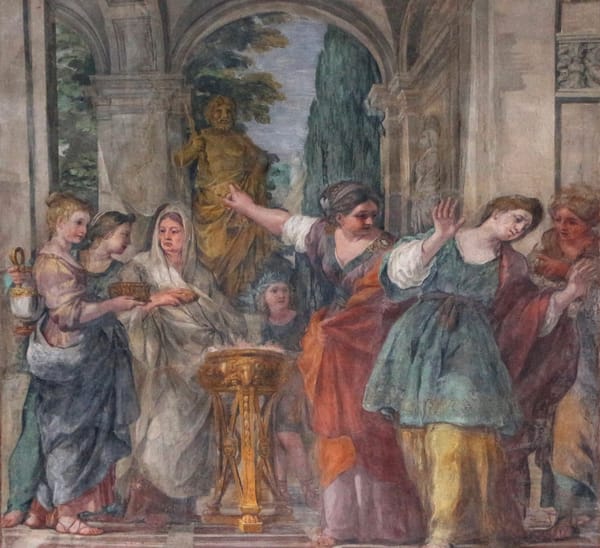
December 2: Saint Bibiana, Virgin and Martyr
Of the saints whose feasts are kept during Advent, five are virgins. The first, St. Bibiana, whom we honour to-day, is a daughter of Rome; the second, St. Barbara, is the glory of the eastern Churches; the third, St. Eulalia of Merida, is one of Spain’s richest treasures; the fourth, St. Lucy, belongs to beautiful Sicily; the fifth, St. Odilia, is claimed by France. These five wise virgins lighted their lamps and watched, waiting for the coming of the Spouse. Such was their constancy and fidelity, that four of them shed their blood for the love of Him, after whom they longed. Let us take courage by this noble example; and since we have not, as the apostle expresses it, as yet resisted unto blood, let us not think it hard if we suffer fatigue and trouble in the holy exercises of this penitential season of Advent: He, for whom we do them all, will soon be with us and repay us. To-day, it is the chaste and courageous Bibiana, who instructs us by her glorious example.
Holy Bibiana, most wise virgin! thou hast gone through the long unbroken watch of this life; and when, suddenly, the Spouse came, thy lamp was bright and richly fed with oil. Now thou art dwelling in the abode of the eternal marriage-feast, where the Beloved feeds among the lilies. Remember us who are still living in the expectation of that same divine Spouse, whose eternal embrace is secured to thee for ever. We are awaiting the birth of the Saviour of the world, which is to be the end of sin and the beginning of justice; we are awaiting the coming of this Saviour into our souls, that He may give them life and union with Himself by love; we are awaiting our Judge, the Judge of the living and the dead. Most wise virgin! intercede for us, by thy fervent prayers, with this our Saviour, our Spouse, and our Judge; pray that each of these three visits may work and perfect in us that divine union, for which we have all been created. Pray also, O faithful virgin, for the Church on earth, which gave thee to the Church in heaven, and which so devoutly watches over thy precious remains. Obtain for her that strict fidelity, which will ever render her worthy of Him, who is her Spouse as He is thine. Though He has enriched her with the most magnificent gifts, and given her confidence by His promises which cannot fail, yet does He wish her to ask, and us to ask for her, the graces which will lead her to the glorious destiny which awaits her.
We will to-day consider the state of nature at this season of the year. The earth is stripped of her wonted verdure, the flowers are gone, the fruits are fallen, the leaves are torn from the trees and scattered by the wind, and every living thing stiffens with the cold. It seems as though the hand of death had touched creation. We see the sun rise after the long night of his absence; and scarcely have we felt his warmth at noon, than he sets again, and leaves us in the chilly darkness. Each day he shortens his visit. Is the world to become sunless, and are men to live out the rest of life in gloom? The old pagans, who witnessed this struggle between light and darkness, and feared the sun was going to leave them, dedicated the twenty-fifth day of December, the winter solstice, to the worship of the sun. After this day their hopes revived on seeing the glorious luminary again mounting up in the sky, and gradually regaining his triumphant position.
We Christians can have no such feelings as these; our light is the true faith, which tells us that there is a Sun to be sought for which never sets, and is never eclipsed. Having Him, we care little for the absence of any other brightness; nay, all other light, without Him, can only lead us astray. O Jesus! Thou true light, that enlightenest every man coming into this world! Thou didst choose, for Thy birth among us, a time of the year which forces us to reflect upon the miserable state of the world when Thou didst come to save it. ‘The evening was coming on, and the day was far spent,’ says St. Bernard: ‘the Sun of justice had all but set, so that exceeding scanty was His light or warmth on earth: for the light of divine knowledge was very faint, and, sin abounding, the heat of charity had grown cold. There was neither angel to visit men, nor prophet to speak to them; both seemed in despair, for the hardness and obstinacy of man had made every effort useless: then I said —they are the words of our Redeemer—then I said, lo! I come!’* O Jesus! O Sun of justice! give us a clear knowledge of what the world is without Thee; what our understanding is without Thy light; and what our heart, without Thy divine heat. Open Thou the eyes of our faith; that whilst seeing with the eyes of the body the gradual decrease of the material light, we may think of that other darkness, which is in the soul that has not Thee. Then, indeed, will the cry which comes from the depths of our misery make its way to Thee, and Thou wilt come on the day Thou hast fixed, dispelling every shadow of darkness by Thy irresistible brightness.
Prayer for the Time of Advent
(The Mozarabic breviary, Wednesday of the second week of Advent, Capitula)
* First Sermon of Advent. ↩︎
Thursday of the First Week of Advent
Cap. v.Cantabo dilecto meo canticum patruelis mei vineæ suæ. Vinea facta est dilecto meo in cornu filio olei. Et sepivit eam, et lapides elegit ex illa, et plantavit eam electam, et aedificavit turrim in medio ejus et torcular exstruxit in ea: et exspectavit ut faceret uvas, et fecit labruscas. Nunc ergo habitatores Jerusalem, et viri Juda, judicate inter me et vineam meam. Quid est quod debui ultra facere vineæ meæ, et non feci ei? an quod exspectavi ut faceret uvas, et fecit labruscas? Et nunc ostendam vobis quid ego faciam vineæ meæ: auferam sepem ejus, et erit in direptionem; diruam maceriam ejus, et erit in conculcationem. Et ponam eam desertam: non putabitur, et non fodietur, et ascendent vepres et spinse, et nubibus mandabo ne pluant super eam imbrem. Vinea enim Domini exercituum domus Israel est, et vir Juda germen ejus delectabile: et exspectavi ut faceret judicium, et ecce iniquitas; et justitiam, et ecce clamor.
Ch. v.I will sing to my beloved the canticle of my cousin concerning his vineyard. My beloved had a vineyard on a hill, in a fruitful place. And he fenced it in, and picked the stones out of it, and planted it with the choicest vines, and built a tower in the midst thereof, and set up a wine-press therein: and he looked that it should bring forth grapes, and it brought forth wild grapes. And now, O ye inhabitants of Jerusalem, and ye men of Juda, judge between me and my vineyard. What is there that I ought to do more to my vineyard, that I have not done to it? Was it that I looked that it should bring forth grapes, and it hath brought forth wild grapes? And now I will show you what I will do to my vineyard: I will take away the hedge thereof, and it shall be wasted; I will break down the wall thereof, and it shall be trodden down. And I will make it desolate: and it shall not be pruned, and it shall not be digged, but briars and thorns shall come up, and I will command the clouds to rain no rain upon it. For the vineyard of the Lord of hosts is the house of Israel, and the man of Juda his pleasant plant; and I looked that he should do judgement, and behold iniquity; and do justice, and behold a cry.
We are awaiting the birth of a Child who is to appear seven hundred years after the time of Isaias; and this Child will be the world’s Saviour. Men will persecute Him, load Him with calumnies and injuries, and, but a few hours before they crucify Him, they shall hear this parable from His lips: ‘There was a man, a householder, who planted a vineyard, and made a hedge round about it, and dug in it a press, and built a tower, and let it out to husbandmen: and went into a strange country. And when the time of the fruits drew nigh, he sent his servants to the husbandmen, that they might receive the fruits thereof. And the husbandmen laying hands on his servants, beat one, and killed another, and stoned another. Again he sent other servants more than the former; and they aid to them in like manner. And last of all, he sent to them his son, saying: They will reverence my son.’* See, Christians, this Son is coming to you. Will you reverence Him? Will you treat Him as the Son of God, with that honour and love which are due to Him? Take notice of the wickedness of men; it has a progress in malice. In the days of Isaias, the Jews despised the prophets; but the prophets, though sent by God, were only men. The Son of God came, and they would not acknowledge Him; a far greater crime, assuredly, than to stone the prophets. What, then, would be the crime of Christians, who not only acknowledge Him who is now coming to them, but are His members by Baptism, if they will not open their hearts to this Messias, whom the Father is sending into the vineyard? What punishment would not the ungrateful vine deserve, planted, as it has been, with so much love, should it persist in yielding nothing but bitter fruit? Ah, dear Jesus! let not this be: make us generous: make us produce abundant flower and fruit for the day of Thy coming, which is so near at hand.
Prayer for the Churches of France during Advent
(Taken from the Prophet Isaias)
Prayer from the Ambrosian Missal
(Fourth Sunday of Advent)
* St. Matt xxi. 33-37 ↩︎
| Previous Wednesday of the First Week of Advent | Next Thursday of the First Week of Advent |