Daily reading
December 6 · Sanctoral
December 6, 2027
From Dom Guéranger’s The Liturgical Year.
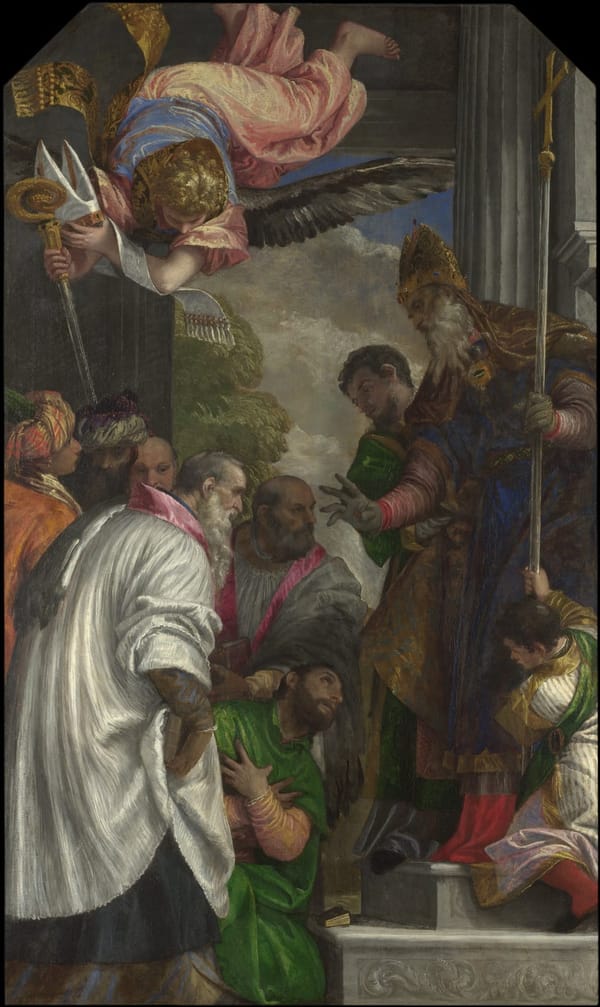
December 6: St. Nicholas, Bishop of Myra and Confessor
Divine Wisdom has willed that on the way which leads to the Messias, our great High Priest, there should be many pontiffs to pay Him the honour due to Him. Two Popes, St. Melchiades and St. Damasus; two holy doctors, St. Peter Chrysologus and St. Ambrose; two bishops, St. Nicholas and St. Eusebius; these are the glorious pontiffs who have been entrusted with the charge of preparing, by their prayers, the way of the Christian people towards Him, who is the sovereign Priest according to the order of Melchisedech. As each of their feasts comes we will show their right to have been thus admitted into the court of Jesus. To-day the Church celebrates with joy the feast of the great thaumaturgus Nicholas, who is to the Greek Church what St. Martin is to us. The Church of Rome has honoured the name of Nicholas for nearly a thousand years. Let us admire the wonderful power which God gave him over creation; but let us offer him our most fervent congratulations for that he was permitted to be one of the three hundred and eighteen bishops, who proclaimed, at Nicæa, that the Word is consubstantial with the Father. The humiliations of the Son of God did not scandalize him. Neither the lowliness of the flesh, which the sovereign Lord of all things assumed to Himself in the womb of the Virgin, nor the poverty of the crib, hindered him from confessing the Son of Mary to be Son of God, equal to God; and for this reason, God has glorified this His servant, and given him the power to obtain, each year, for the children of the Church, the grace of receiving this same Jesus, the Word, with simple faith and fervent love. Let us now listen to the eulogy of St. Nicholas, which the Roman Church has inserted in her liturgy.
Almost all the breviaries of the Latin Church, up to the seventeenth century, contain most fervent praises of the virtues and miracles of St. Nicholas, and give the beautiful Office of the holy bishop, which was composed about the twelfth century. We have spoken elsewhere of this Office as regards the music; at present we will only mention its being drawn up exclusively on the Acts of St. Nicholas, and its being more explicit on some circumstances of the saint’s life than is the legend of the Roman breviary. The following portions of this Office dwell with complacency on a fact which is not mentioned in our liturgy: we mean the miraculous oil, which, for almost eight hundred years, has flowed without ceasing from the tomb of the holy bishop, and by means of which God has frequently wrought miracles. The responsory and antiphon which we give are upon the miracle of the oil itself. They were formerly so familiar to the faithful, that in the thirteenth century their music was sung to the responsory Unus Panis, and to the antiphon O quam suavis est, of the Office of Corpus Christi.
Responsory
Antiphon
Hymn I
Præsulis praeconium,
Ut nos summus Adonai,
Rex et Pater omnium,
Ad salutis portum trahi
Faciat per Filium.
Matris, ab infantia,
Quarta semel bibit illam,
Atque sexta feria;
Ne per lactis puer stillam
Solveret jejunia.
Nicolaus praesulis,
Pietatis ita rorem
Cunctis pluit populis,
Ut vix parem aut majorem
Habeat in sæculis.
Virgines prohibuit;
Far in fame, vas in mari,
Servat et distribuit;
Qui timebant naufragari,
Nautis opem tribuit.
Furtem qui commiserat;
Et Judæus baptizatur,
Furtumque recuperat;
Illi vita restauratur;
Hic ad fidem properat.
Decus, honor, gloria,
Plebem omnem, clerum totum,
Mentes, manus, labia,
Ad reddendum Deo votum,
Tua juvet gratia.
Virtus et victoria,
Quae det nobis ut beati
Nicolai gaudia
Assequamur laureati,
Post vitam in patria.
the praise of the pontiff Nicholas;
that so the sovereign Adonai,
the King and Father of all creatures,
may grant us to be brought by his Son,
to the port of salvation.
he took it but once
on each fourth and sixth feria,
nor would the child
break his fast
by one drop of milk.
Nicholas so abundantly
gave to all men the dew of piety,
that scarce could any age
find a better
or so good a pastor.
he distributes corn to the people in a famine;
he brings up from the depths of the sea a vase
that had fallen in;
he brings help to mariners
who were well nigh to shipwreck.
who had committed a theft;
the Jew is baptized and recovers
what had been stolen from him;
the one is restored to life;
the other is brought to the faith.
and honour, and glory of the priesthood!
help by thy gracious intercession
the whole people, the whole clergy;
that their minds, and hands, and lips,
may pay their tribute to our God.
to the most high Trinity!
May it give us to come, after this life,
with our laurel wreaths upon us,
to the joys which Nicholas the blessed
possesses in our country of heaven.
Hymn II
Nicolaum prædicet,
Læte promens vocis sonum
Clerus, et magnificet:
Se cor promptum, se cor pronum
Sono vocis ampliet.
Lingua, tribus, natio:
Orbis terræ, maris sinus,
Sexus et conditio;
Hospes, cives, peregrinus,
Pari psallat studio.
Cunctis beneficia
Præsul, cujus nomen abit
Numquam e memoria;
Quisque mœstus germinabit,
Florens sicut lilia.
Carnis spernens opera,
Nihil agens aut locutus,
Nisi salutifera;
Vinclis carnis absolutus,
Tandem scandit æthera.
Hoc præsenti sæculo,
Oleum declarat satis,
Quod manat de tumulo;
Et dat munus sanitatis
Imploranti populo.
Virtus et victoria,
Quæ det nobis ut beati
Nicolai gaudia
Assequamur laureati,
Post vitam in patria.
joyfully raise their voice in song,
and magnify Nicholas
the father and patron of the clergy;
and let their chants give fresh devotion
to their already fervent and docile heart.
and every tongue and tribe and nation;
let the sea, and land;
let all, whatever their sex or condition,
guest or citizen or stranger,
sing the praises of Nicholas with one like enthusiasm.
in the memory of men,
ever gave, gives, and will give favours to all;
he will make him,
who was pining away in grief,
bloom in joy as a lily.
he spurned the deeds of the flesh;
he did nothing and spoke nothing
but what was unto salvation:
and now, having been loosed from the bonds of the flesh,
he has mounted to the starry realms.
even in this very age,
is plainly enough manifested by the oil
which flows from his tomb,
giving to all people, that ask it,
the boon of health.
to the most high Trinity.
May it give us to come, after this life,
with our laurel wreaths upon us,
to the joys which Nicholas the blessed
possesses in our country of heaven.
It was impossible for Adam of Saint-Victor to remain silent in the praise of St. Nicholas. The Churches, in the middle ages, received from him the following beautiful sequence.
Sequence
Vocali concordia,
Ad beati Nicolai
Festiva solemnia.
Qui in cunis adhuc jacens,
Servando jejunia;
A papillis cœpit summa
Promereri gaudia.
Litterarum studia,
Alienus et immunis
Ab omni lascivia.
Felix Confessor,
Cujus fuit dignitatis
Vox de cœlo nuntia.
Præsulatus sublimatur
Ad summa fastigia.
Erat in ejus animo
Pietas eximia,
Et oppressis impendebat
Multa beneficia.
Tollitur infamia,
Atque patris earumdem
Levatur inopia.
Et contra fluctuum
Sævitiam luctantes,
Navi pene dissoluta;
In tanto positi
Periculo: clamantes
Voce dicunt omnes una:
O beate Nicolae,
Nos ad maris portum trahe
De mortis angustia.
Tu qui tot auxiliaris
Pietatis gratia.
Dum clamarent, nec incassum,
Ecce quidam, dicens: Adsum
Ad vestra præsidia.
Statim aura datur grata:
Et tempestas fit sedata,
Quieverunt Maria.
Ex ipsius tumba manat
Unctionis copia:
Quae infirmos omnes sanat
Per ejus suffragia.
Vitiorum in profundo
Jam passi naufragia,
Gloriose Nicolae,
Ad salutis portum trahe,
Ubi pax et gloria.
Impetres a Domino,
Prece pia:
Quæ sanavit læsionem
Multorum peccaminum
In Maria.
Gaudeant per sæcula;
Et coronet eos Christus
Post vitæ curricula.
let us exult
on this festive solemnity
of blessed Nicholas.
When a babe in his cradle,
he began to fast,
And thus deserved, before weaned from the breast,
the joys of heaven.
upon a course of studies,
Yet follows not,
yet knows not, impurity.
Blessed confessor indeed,
whose worth was known
by a message from heaven,
he was promoted and exalted
to the supreme dignity of pontiff.
There was in his soul
the most tender compassion,
which prompted him to bestow continual benefits
on those who suffered oppression.
from virgins by the gold he gave;
and by the same he relieved
their father’s poverty.
when a furious storm
attacked them,
and their bark was well-nigh wrecked:
and in this extreme danger,
they cry out
with one voice, saying:
‘O holy Nicholas!
help us out of these straits of death,
and lead us into harbour!
thou whose kind heart is ever ready
to help them that are in affliction.’
They prayed; nor was it in vain:
for lo! a voice was heard saying: ‘I am here
to help you.’
Straightway arose a favourable wind:
the storm was lulled:
the sea was calm.
From his tomb there flows
an abundant oil:
It heals all kinds of sickness,
through the intercession of the saint.
have already suffered
shipwreck in the sea of sin:
Ah! glorious Nicholas,
lead us into the harbour of salvation,
where there is peace and glory.
which thy merciful prayers
must get us from the Lord:
It is that unction
which healed the wound
of Magdalene’s many sins.
come to the eternal joys;
And may Jesus crown them
after this life is run.
But none of the sequences of St. Nicholas was so popular as the one we now give. It is to be found in a great many processionals up to the seventeenth century, and on its model were composed innumerable others, which, though drawn up in praise of various patrons, not only kept the measure and the melody, but the very expressions, ingeniously turned here and there, of the sequence of St. Nicholas.
Sequence
Olei perfusio.
Adfuit praesidio.
Defunctum in bivio.
Judæus indicio.
Redditur cum filio.
Farris augmentatio.
Ergo laudes Nicolao
Concinat hæc concio.
Propulsato vitio,
Sospes regreditur.
by the miraculous oil.
are delivered by Nicholas’ prayers.
a corpse which lay on the road.
on witnessing the miraculous recovery of his money.
and a child that was lost to his father, are both recovered.
by multiplying corn in a famine!
Let, then, this congregation
sing the hymns of Nicholas’ praise;
with earnest hearts,
will go back cured of their spiritual ailments.
But no Church has evinced such enthusiasm for St. Nicholas as the Greek Church in its Menæa. The illustrious thaumaturgus was evidently one of the firmest hopes of the Byzantine empire, and Constantinople transmitted the same confidence to Russia, which even to this day professes great devotion to St. Nicholas. We extract, as usual, a few stanzas from the sacred chants which the Church of St. Sophia anciently sang in the Greek language, and which the gilded domes of Moscow re-echo still, every year, in Slavonic.
Hymn to St. Nicholas
(Taken from the Menæa of the Greeks)
Holy pontiff Nicholas, how great is thy glory in God’s Church! Thou didst confess the name of Jesus before the proconsuls of the world’s empire and suffer persecution for His name’s sake; afterwards thou wast witness to the wonderful workings of God, when He restored peace to His Church; and a short time after this again, thou didst open thy lips, in the assembly of the three hundred and eighteen fathers, to confess with supreme authority the Divinity of our Saviour Jesus Christ, for whose sake so many millions of martyrs had already shed their blood. Receive the devout felicitations of the Christian people throughout the universe, who thrill with joy when they think of thy glorious merits. Help us by thy prayers during these days when we are preparing for the coming of Him, whom thou didst proclaim to be consubstantial with the Father, Vouchsafe to assist our faith and to obtain fresh fervour to our love. Thou now beholdest face to face that Word by whom all things were made and redeemed; beseech Him to permit our unworthiness to approach Him. Be thou our intercessor with Him. Thou hast taught us to know Him as the sovereign and eternal God; teach us also to love Him as the supreme benefactor of the children of Adam. It was from Him, O charitable pontiff, that thou didst learn that tender compassion for the sufferings of thy fellow-men, which made all thy miracles to be so many acts of kindness: cease not, now that thou art in the company of the angels, to have pity on us and to succour our miseries.
Stir up and increase the faith of mankind in the Saviour whom the Lord hath sent them. May this be one of the fruits of thy prayer, that the divine Word may be no longer unknown and forgotten in this world, which He has redeemed with His Blood. Ask for the pastors of the Church that spirit of charity, which shone so brilliantly in thee; that spirit which makes them like their divine Master, and wins them the hearts of their people.
Remember, too, O holy pontiff, that Church of the east which still loves thee so fervently. When thou wast on this earth, God gave thee power to raise the dead to life; pray now, that the true life, which consists in faith and unity, may return once more and animate that body which schism has robbed of its soul. By thy supplications, obtain of God that the sacrifice of the Lamb, who is so soon to visit us, may be again and soon celebrated under the cupolas of St. Sophia. May the sanctuaries of Kiew and Moscow become resanctified by the return of the people to unity. May the pride of the crescent be humbled into submission to the cross, and the schismatic be brought to acknowledge the power of the keys of St. Peter; that thus there may be henceforth neither Scythian, nor barbarian, but one fold under one Shepherd.
Let us resume our considerations upon the state of the world at the time immediately preceding the coming of the Messias. Everything proves that the prophecies which foretold the great event have now been fulfilled. Not only has the sceptre been taken from Juda; the weeks of Daniel also are almost expired. The other scriptural predictions relative to the great revolutions, which were to take place in the world, have been successively fulfilled. The empires of the Assyrians, the Medes, the Persians, and the Greeks, have fallen one after the other; that of the Romans is now at the zenith of its greatness; in its turn, it must yield to the eternal empire of the Messias. This succession of empires, which was to result in a perfect kingdom, was foretold; and all is now ready for its final accomplishment. God has also said, by one of His prophets: ‘Yet one little while, and I will move heaven and earth . . . and I will move all nations, and the Desired of all nations shall come.’* Descend, therefore, O Thou eternal Word! All is consummated. The misery of the world is extreme; the crimes of men cry to heaven for vengeance; the whole human race is threatened with self-destruction, and without knowing what it does, it calls for Thee as its only resource. Then come! All the predictions which were to designate the Redeemer have been spoken and promulgated. There is no longer a prophet in Israel, and the oracles of the Gentile world have ceased to speak. Come, Lord Jesus, and fulfil all things, for the fulness of time has come.
Prayer for the Time of Advent
(The Mozarabic breviary, first Sunday of Advent, Capitulum)
* Aggeus ii 7. 8. ↩︎
Monday of the Second Week of Advent
Cap. xiii.Onus Babylonis, quod vidit Isaias filius Amos. Super montem caliginosum levate signum, exaltate vocem, levate manum, et ingrediantur portas duces. Ego mandavi sanctificatis meis, et vocavi fortes meos in ira mea, exsultantes in gloria mea. Vox multitudinis in montibus, quasi populorum frequentium: vox sonitus regum, gentium congregatarum. Dominus exercituum præcepit militiæ belli, venientibus de terra procul, a summitate cœli; Dominus, et vasa furoris ejus, ut disperdat omnem terram. Ululate, quia prope est dies Domini, quasi vastitas a Domino veniet. Propter hoc omnes manus dissolventur, et omne cor hominis contabescet, et conteretur. Torsiones et dolores tenebunt, quasi parturiens dolebunt: unusquisque ad proximum suum stupebit, facies combustæ vultus eorum. Ecco dies Domini veniet crudelis et indignationis plenus, et iræ, furorisque ad ponendam terram in solitudinem, et peccatores ejus conterendos de ea. Quoniam stellæ cœli, et splendor earum non expandent lumen suum: obtenebratus est sol in ortu suo, et luna non splendebit in lumine suo. Et visitabo super orbis mala, et contra impios iniquitatem eorum: et quiescere faciam superbiam infidelium, et arrogantiam fortium humiliabo.
Ch. xiii.The burden of Babylon, which Isaias the son of Amos saw. Upon the dark mountain lift ye up a banner, exalt the voice, lift up the hand and let the rulers go into the gates. I have commanded my sanctified ones, and have called my strong ones in my wrath, them that rejoice in my glory. The noise of a multitude in the mountains, as it were of many people: the noise of the sound of kings, of nations gathered together. The Lord of hosts hath given charge to the troops of war, to them that come from a country afar off, from the end of heaven: the Lord and the instruments of his wrath, to destroy the whole land. Howl ye, for the day of the Lord is near, it shall come as a destruction from the Lord. Therefore shall all hands be faint, and every heart of man shall melt, and shall be broken. Gripings and pains shall take hold of them, they shall be in pain as a woman in labour: every one shall be amazed at his neighbour, their countenances shall be as faces burnt. Behold, the day of the Lord shall come, a cruel day, and full of indignation, and of wrath, and fury, to lay the land desolate, and to destroy the sinners thereof out of it. For the stars of heaven, and their brightness shall not display their light: the sun shall be darkened in his rising, and the moon shall not shine with her light. And I will visit the evils of the world, and against the wicked for their iniquity: and I will make the pride of infidels to cease, and will bring down the arrogance of the mighty.
The Church puts before us again, in the Office of to-day, the terrible spectacle of the last coming of Jesus Christ. The sinful Babylon, of which Isaias speaks, is the world grown old in its crimes; the cruel day, full of indignation and wrath, is that on which the Messias will return to judge the world, with His sign glittering in the clouds. The words used by the prophet to describe the terror of the inhabitants of Babylon are so expressive, that it is difficult to meditate upon them seriously and not tremble. You, then, who, in this second week of preparation for the birth of our Saviour, are still wavering and undecided as to what you intend to do for the day of His coming, reflect upon the connection that there is between the two comings. If you receive your Saviour in the first, you need be in no fear for the second; but if you despise the first, the second will be to your destruction, nor will the cries of your despair save you. The Judge will come on a sudden, at midnight, at the very time when you persuade yourself that He is far off from you.
Say not that the end of the world is not yet come, and that the destinies of the human race are not filled up: it is not the world that is here in question, it is you individually. True the day of the Lord will be terrible, when this world shall be broken up as a vessel of clay, and the remnants of creation shall be a prey to devouring flames; but, long before that day of universal terror, your own day of judgement will come. The inexorable Judge will come to you, you will stand before His face, you will have none to defend you, and the sentence He will pass will be eternal; and though the nature of that sentence, whether for or against you, will not be known to the rest of the world until the last and general judgement, still is this His coming to you, at your own judgement, terrible above measure. Remember, therefore, that what will make the terror of the last day so great is, that then will be solemnly and publicly confirmed what was judged irrevocably, though secretly, between your own soul and her Judge; just as the favourable sentence, which the good receive at the happy moment of their death, will be repeated before the immense assembly of men and angels on the last day. Is it wise, then, Christians, to put off your conversion, on the plea of the day of the Lord not having to come for ages, when it might be this night that your soul were required of you?* The Lord is coming: lose no time; prepare to meet Him; a humble and contrite and converted heart is sure to find acceptance.
Canticle of the Last Judgment
(It is an interpolation of appropriate sentences into the Responsory Libera: it was occasionally so sung in the fifteenth and sixteenth centuries)
Nescio vos, cultores criminis: Vos decepit gloria sæculi; Descendite ad ima barathri, Cum Zabulon et suis ministris. O proh dolor! quanta tristitia! Quantus luctus! quanta suspiria!* Dum veneris judicare sæculum per ignem.℣. Jam festinat Rex ad judicium, Dies instat horrenda nimium; Et quis erit nobis refugium, Nisi Mater Virgo, spes omnium, Quæ pro nobis exoret Filium? O Jesu Rex, exaudi poscimus
Preces nostras, et salvi erimus;* Quando cœli movendi sunt et terra.℣. Creator omnium rerum Deus qui me de limo terræ formasti, et mirabiliter proprio sanguine redemisti, corpusque meum, licet modo putrescat, de sepulchro facies in die judicii resuscitari; exaudi, exaudi me, ut animam meam in sinu Abrahæ patriarchæ tui jubeas collocari;* Dum veneris judicaro saeculum per ignem.
Prayer from the Ambrosian Liturgy
(In the third week of Advent)
* St. Luke xii. 20. ↩︎
| Previous December 5: St. Sabas, Abbot | Next Monday of the Second Week of Advent |