Daily reading
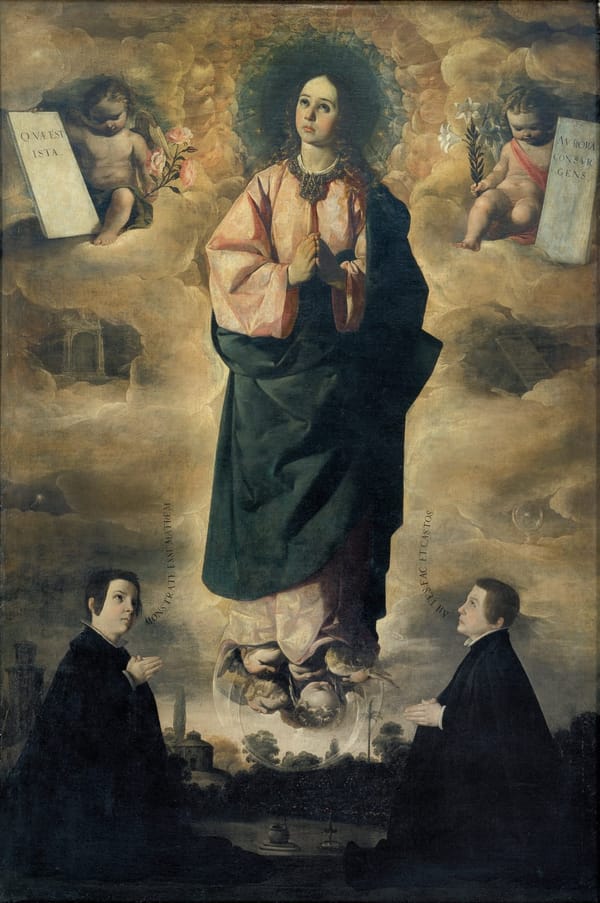
December 9: The Second Day within the Octave of the Immaculate Conception
Let us consider how the immaculate Mary came into this world nine months after her conception, and how each day of her life gave man fresh reason to hope for the great promises made him by God. Let us admire the fulness of grace which God has given to her, and contemplate the respect and the love wherewith the holy angels look upon her as the future Mother of Him who is to be their Head and King, as well as ours. Let us follow this august Queen to the temple of Jerusalem, where she is presented by her parents, St. Joachim and St. Anne. When but three years of age, she was initiated into all the secrets of divine love. 'I always rose at midnight (thus she spoke of herself, in a revelation to St. Elizabeth of Hungary), and went before the altar of the temple, where I besought of God that I might observe all the commandments of His Law, and be enriched with those graces which would render me pleasing to His Majesty. I most earnestly prayed Him, that I might live to see that most holy virgin who was to bring forth into this world His own divine Son. I asked Him to grant me to enjoy the use of my eyes that I might see her, of my tongue that I might praise her, of my hands that I might serve her, of my feet that I might go her errands, and of my knees that I might adore the Son of God resting in her arms.’
Thou, O Mary, thou thyself wast this Virgin, who was worthy of the praises of men and angels! But God had not yet revealed it to thee, and thy heavenly humility forbade thy thinking that the immense dignity, which thou didst so deeply venerate, could ever be thine. Nay, thou wast the first and the only one of the daughters of Israel that had renounced all hope of ever being the Mother of the Messias. To be Mother of the Messias was, indeed, an ineffable honour; but it seemed as though it could only be received on the condition of having another spouse besides God, and this thou wouldst not suffer; thou wouldst be united to God alone, and thy vow of virginity which made thee so, was dearer to thee than the possibility of any privilege, which would rob thee of even a tittle of that. Thy marriage with St. Joseph, therefore, was a fresh lustre added to thy incomparable purity, whilst, in the designs of God, it provided thee with the protection which thy coming honours would soon require. We follow thee, O bride of Joseph, into thy house at Nazareth, where is to be spent thy humble life. There we behold thee diligent in all thy duties, the valiant woman of the Scriptures,1 the object of the admiration of God and of His angels. Suffer us, O Mary! to unite our Advent devotions with the prayers which thou didst offer up for the coming of the Messias; with the veneration wherewith thou didst think upon her that was to be His Mother; and with the inflamed desires wherewith thou didst long for the divine Saviour. We salute thee as the Virgin2 foretold by Isaias; it is thyself, O blessed Mother, that deservest the praise and love of the holy people and city, the redeemed of the Lord.3
Sequence (Taken from the Cluny Missal of 1523)
Genitricem gratiæ,
Salutis dulcedinem,
Fontem Sapientiæ.
Regina prudentiæ,
Virgo plena gratia,
Aurora laetitiae.
Castitatis lilium;
Jaspide splendidior,
Mœroris solatium.
Fidei principium.
Mater admirabilis,
Vas virtutis pretium.
Mater honestissima,
Odor nardi pretiosi,
Rosa suavissima.
Stella fulgentissima,
Generosa Mater, gaude,
Virginum sanctissima.
Regina consilii,
Peperisti florem florum,
Christum fontem gaudii.
Donatrix auxilii,
Memor esto miserorum,
In die judicii.
Charitatis regula,
Victoris stipendium,
Aromatum cellula.
Virgo sine macula,
Honor et imperium,
Per aeterna saecula.
the Mother of grace,
the sweetness of salvation,
the fount of Wisdom.
the Queen of prudence,
the Virgin full of grace,
the aurora of joy.
the lily of chastity;
she is brighter than the jasper,
our solace in sorrow.
source whence came the author of our faith,
Mother most admirable,
precious vessel of virtue.
Mother of the beautiful King;
thou art the perfume of precious ointment;
thou art the sweetest rose.
O brightest of stars,
O noblest of mothers,
O Virgin most holy!
and Queen of counsel,
didst bring forth the flower of flowers,
Jesus the source of our joy.
help of the needy,
be mindful of us sinners
on the day of judgement.
the model of charity,
the encouragement to victory,
the treasury of every fragrance.
immaculate Virgin,
be queenly honour
for ever.
Prayer from the Gregorian Sacramentary
(In the daily Prayers for Advent)
Thursday of the Second Week of Advent
Cap. xix.Onus Ægypti. Ecce Dominus ascendet super nubem levem: et ingredietur Ægyptum: et commovebuntur simulacra Ægypti a facie ejus, et cor Ægypti tabescet in medio ejus: et concurrere faciam Ægyptios adversus Ægyptios, et pugnabit vir contra fratrem suum, et vir contra amicum suum, civitas adversus civitatem, regnum adversus regnum.
Ch. xix.The burden of Egypt. Behold the Lord will ascend upon a light cloud: and will enter into Egypt: and the idols of Egypt shall be moved at his presence, and the heart of Egypt shall melt in the midst thereof: and I will set the Egyptians to fight against the Egyptians, and they shall fight brother against brother, and friend against friend, city against city, kingdom against kingdom.
The Egypt which the Lord is here represented as visiting, and whose idols and empire He will overthrow, is the city of satan, which is to be destroyed, and to give place to the city of God. But how peaceful is the divine Conqueror’s entrance into His conquest! it is on a cloud, a light cloud, that He comes, as on His triumphal chariot. How many mysteries in these few words! ‘There are three clouds,’ says Peter of Blois; 'the first the obscurity of the prophets; the second, the depth of the divine decrees; the third, the prodigy of a Virgin Mother.’1 First, as to the obscurity of the prophets, it is essential to every prophecy that it be thus veiled, to the end that man’s free will may not be interfered with; but under this cloud the Lord comes at last, and when the day comes for the prophecy to be accomplished, all things are clear enough. Thus was it with the first coming; so will it be with the second. Then, as to the decrees of God; as they are ordinarily made manifest by second, that is by created, causes only, it almost always happens that the extreme simplicity of the means employed by the divine Wisdom takes men by surprise. Never was this so observable as in the grand event of the Incarnation. Men would naturally expect that, in restoring a fallen world, a power equal, at least, to that which first created it would be displayed; and all they are told about the portent is: ‘You will find the Child wrapped in swaddling clothes, and laid in a manger’! O almighty power of God, how dazzling is Thy light through this cloud! how strong art Thou in this apparent weakness!
But there is the third cloud; it is the Virgin Mary; a light cloud, ‘for,’ says St. Jerome, ‘neither concupiscence, nor the burden of earthly marriage, weighs upon her a cloud, too, laden with a refreshing Dew, since it holds the Just One, who is to be rained down upon us, that our seething passions may be quenched, and the soil of our spiritual life made fertile. How sweet is the majesty of our divine King, when seen thus through this beautiful cloud! O incomparable Virgin! the whole Church of God recognizes thee in that mysterious cloud which the prophet Elias,2 from the summit of Mount Carmel, saw rising up from the sea, little, at first, like a man’s foot, but sending at last such a plentiful rain that all Israel was refreshed by its abundance. Delay not, we pray thee; give us that heavenly and divine Dew which thou possessest within thee. Our sins have made the heavens as brass, and we are parched; thou alone of creatures art just and pure! Beseech our Lord, who has set up His throne of mercy in thee, to come speedily and destroy our enemies and bring us peace.
Hymn for Advent
(The Mozarabic breviary, first Sunday of Advent)
Mundum salvare veniens,
Formam assumpsit corporis
Nostræ similitudinis.
Virginis intrat uterum,
Nasciturus in corpore,
Mortis vincla disrumpere.
Videbunt lumen fulgoris,
Cum Salvator advenerit
Redimere quos condidit.
Cecinerunt oracula,
Nunc veniet in gloria,
Nostra ut curet vulnera.
Simul in Dei Filio,
Parati eum suscipere
Adventus sui gloria.
coming to save the world,
assumed to himself a body
like unto ours.
enters the Virgin’s womb,
that he may be born in the flesh,
and break the bonds of death.
but they shall see the brightest light,
when the Saviout shall come
to redeem his creatures.
oracles of the prophets anciently sang,
shall now come in glory
to cure our wounds.
and in the Son of God,
and be ready to receive him
in his glorious coming.
Prayer from the Ambrosian Breviary
(Sixth Sunday of Advent, Preface)
| Previous Wednesday of the Second Week of Advent | Next Thursday of the Second Week of Advent |