Daily reading
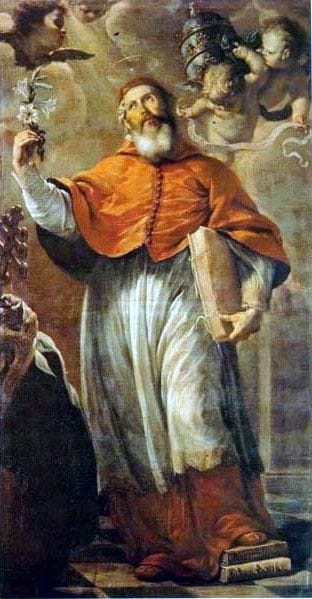
December 11: Saint Damasus, Pope and Confessor
This great Pontiff comes before us in the liturgical year, not to bring us tidings of peace as St. Melchiades did, but as one of the most illustrious defenders of the great mystery of the Incarnation. He defends the faith of the universal Church in the divinity of the Word, by condemning, as his predecessor Liberius had done, the acts and the authors of the celebrated Council of Rimini. With his sovereign authority, he bore witness to the teaching of the Church regarding the Humanity of Jesus Christ, and condemned the heretic Apollinaris, who taught that Jesus Christ had assumed only the flesh and not the soul of man. He commissioned St. Jerome to make a new translation of the new Testament from the Greek, for the use of the Church of Rome; here, again, giving a further proof of the faith and love which he bore to the Incarnate Word. Let us honour this great Pontiff, whom the Council of Chalcedon calls ‘the ornament and support of Rome by his piety.’ St. Jerome, too, who looked upon St. Damasus as his friend and patron, calls him ‘a man of the greatest worth; a man whose equal could not be found, well versed in the holy Scriptures, and a virgin doctor of the virgin Church.’ The legend of the breviary gives us a brief account of his life.
Prose
(Taken from the Cluny missal of 1523)
Holy Pontiff Damasus! during thy life on earth, thou wast the light, which guided the children of the Church; for thou didst teach them the mystery of the Incarnation, and didst guard them against those perfidious doctrines, wherewith hell ever strives to corrupt that glorious symbol of our faith, which tells us of God’s infinite mercy towards us, and of the sublime dignity of man thus mercifully redeemed. Seated on the Chair of Peter, thou didst confirm thy brethren, and thy faith failed not; for Jesus had prayed to His Father for thee. We rejoice at the infinite recompense with which this divine Prince of pastors has rewarded the unsullied purity of thy faith, O thou ‘virgin doctor of the virgin Church!’ Oh that we could have a ray of that light which now enables thee to see Jesus in His glory! Pray for us, that we may have light to see Him, and know Him, and love Him, under the humble guise in which He is so soon to appear to us. Obtain for us the science of the sacred Scriptures, in which thou wast so great a master; and docility to the teachings of the Bishop of Rome, to whom, in the person of St. Peter, Christ has said: ‘Launch out into the deep!’*
Obtain also for all Christians, O thou the successor of this prince of the apostles, that they be animated with those sentiments, which St. Jerome thus describes in one of his letters addressed to thee: ‘It is the Chair of Peter that I will consult, for from it do I derive that faith which is the food of my soul. I will search for this precious pearl, heeding not the vast expanse of sea and land which I must pass over. Where the body is, there shall the eagles be gathered together. It is now in the west that the Sun of justice rises. I ask the Victim of salvation from the priest, and from the shepherd the protection of the sheep. On that rock I know the Church is built. He that eats the Lamb in any house but this, is profane. He that is not in Noah’s ark, shall perish in the waters of the deluge. I know not Vitalis, I reject Meletius, I pass by Paulinus. He that gathers not with thee, Damasus, scatters; for he that is not of Christ, is of Antichrist.’
Let us contemplate our divine Saviour in the womb of His most holy Mother Mary. Let us, together with the holy angels, adore Him in this state of profound humiliation, to which His love for us has brought Him. See Him there offering Himself to His Father for the redemption of mankind, and commencing at once to fulfil the office of our Mediator, which He has taken upon Himself. What an excess of love is this of our Jesus, that He is not satisfied with having humbled Himself in assuming our nature,though that alone would have sufficed to redeem a million worlds! The eternal Son of God wills to remain, as other children, nine months in His Mother’s womb: after that, to be born in poverty, to live a life of labour and suffering, and to be obedient to death, even to the death of the cross. O Jesus! mayst Thou be praised and loved by all creatures for this Thy immense love of us! Thou hast come down from heaven the Victim that art to take the place of all those which were hitherto offered, but which could not efface man’s sin. At length, the earth possesses its Saviour, though as yet unseen. God will not curse the earth, which, though covered with crime, is rich in such a treasure as this. Still repose, O Jesus, in the chaste womb of Mary, that living ark which contains the true manna sent for the food of man. But the time is approaching for Thee to leave this loved sanctuary. The tender love which Thou hast received from Mary, must be changed for the malice wherewith men will treat Thee; yet it must needs be that Thou be born on the day which Thou Thyself hast decreed: it is the will of Thy eternal Father, it is the expectation of the world, it is the salvation of all who shall love Thee.
Prose in Honor of the Blessed Virgin
(Taken from the Cluny missal of 1523)
Prayer for the Time of Advent
(The Mozarabic breviary, Monday of the first week of Advent)
* St. Luke v. 4. ↩︎
Saturday of the Second Week of Advent
Cap. xxv.Domine, Deus meus es tu, exaltabo te, et confitebor nomini tuo: quoniam fecisti mirabilia, cogitationes antiquas fideles. Amen. Quia posuisti civitatem in tumulum, urbem fortem in ruinam, domum alienorum, ut non sit civitas, et in sempiternum non aedificetur. Super hoc laudabit te populus fortis, civitas gentium robustarum timebit, te. Quia factus es fortitudo pauperi, fortitudo egeno in tribulatione sua: spes a turbine, umbraculum ab æstu.... Et faciet Dominus exercituum omnibus populis in monte hoc convivium pinguium, convivium vindemiae, pinguium medullatorum, vindemiae defæcatæ. Et praecipitabit in monte isto faciem vinculi colligati super omnes populos, et telam quam orditus est super omnes nationes. Præcipitabit mortem in sempiternum: et auferet Dominus Deus lacrymam ab omni facie, et opprobrium populi sui auferet de universa torra: quia Dominus locutus est. Et dicet in die illa: Ecco Deus noster iste, exspectavimus eum, et salvabit nos: iste Dominus, sustinuimus eum, exsultabimus et lætabimur in salutari ejus.
Ch. xxv.O Lord, thou art my God, I will exalt thee, and give glory to thy name: for thou hast done wonderful things, thy designs of old faithful. Amen. For thou hast reduced the city to a heap, the strong city to ruin, the house of strangers to be no city, and to be no more built up for ever. Therefore shall a strong people praise thee, the city of mighty nations shall fear thee. Because thou hast been a strength to the poor, a strength to the needy in his distress: a refuge from the whirlwind, a shadow from the heat And the Lord of hosts shall make unto all people, in this mountain, a feast of fat things, a feast of wine, of fat things full of marrow, of wine purified from the lees. And he shall destroy in this mountain the face of the bond with which all people were tied, and the web that he began over all nations. He shall cast death down headlong for ever: and the Lord God shall wipe away tears from every face. and the reproach of his people he shall take away from off the whole earth: for the Lord hath spoken it. And they shall say in that day: Lo, this is our God, we have waited for him, and he will save us: this is the Lord, wo have patiently waited for him, we shall rejoice and be joyful in his salvation.
Yet a little while, and the conqueror of death will appear, and then, in the joy of our hearts, we will say: Lo! this is our God; wo have waited for Him, and He will save us; we have patiently waited for Him; this is He, and we will rejoice and be joyful in His salvation. Let us, therefore, prepare the way of the Lord that wo may receive Him worthily; and in this work of our preparation, let us have recourse to Mary. Saturday is the day which is sacred to her; she will the more readily grant the prayers said to her upon it. Let us consider her in her grand privilege of being full of grace, carrying in her womb Him whom we so long to possess. If we ask her by what means she rendered herself worthy of such an immense favour, she will tell us that in her was simply fulfilled the prophecy, which the Church so continually repeats during these days of Advent: ‘Every valley shall be filled up.’ The humble Mary was the valley blessed by the Lord: a valley beautiful and fertile, in which God sowed the divine wheat, our Saviour Jesus: for it is written in the psalm, that the valleys shall abound with corn.* O Mary! it is thy humility that drew down upon thee the admiration of thy Creator. If, from the high heaven where He dwells, He had perceived a virgin more humble in her love, He would have chosen her in preference et thee: but no, it is thou that didst win His predilection, O mystic valley, ever verdant and lovely in thy flowers of grace. We that, like high hills, are so proud and such sinners, what shall we do? We must look on this our God, who comes to us in infinite humility, and then humble ourselves out of love and gratitude. O blessed Mother! obtain this grace for us. Pray for us that henceforth we may submit ourselves to the will of our Lord as thou didst, when thou didst speak those admirable words: ‘Behold the handmaid of the Lord: may it be done to me according to thy word!’
Prose in Honor of the Blessed Virgin
(Taken from the Cluny missal of 1523)
Verbi bajulus fidelis,
Sacris disserit loquelis
Cum beata Virgine.
Pandit intus in conclave,
Et ex Eva format Ave,
Evæ verso nomine.
Adest Verbum caro factum;
Semper tamen est intactum
Puellare gremium.
Et quam homo non deflorat,
Non torquetur nec laborat
Quando parit filium.
Crede solum, et est satis;
Non est nostræ facultatis
Solvere corrigiam.
Est in rubo et in igne:
Ne appropiet indigne
Calciatus quisquam.
Novo ritu, novo more,
Fructum protulit cum flore;
Sicque Virgo peperit.
Fructus gaudii, non luctus;
Non erit Adam seductus,
Si de hoc gustaverit.
Piæ Matris pium onus,
Cujus est in cœlo thronus
Nascitur in stabulo.
Nostros deleat reatus;
Quia noster incolatus
Hic est in periculo.
faithful bearer of the word,
holds sacred converse
with the holy Virgin.
he discloses the good and sweet word;
and inverting the name of Eve, Eva becomes Ave,
his salutation Hail!
instantly there was present the Word made flesh;
and yet the pure Maid
a Virgin still for ever.
Mother, yet not losing the treasure;
giving birth to her child,
yet not in pain or travail.
and all thou, my soul,
canst do is to believe it:
we have not power to loose the latchet.
of the burning bush;
let him that would approach,
take off the sandals from his feet.
once yielded a flower and fruit;
it was a new law, a new way:
so was it when the Virgin brought forth her Son.
a Fruit of joy, not of woe.
There will be no Adam deceived,
if men but eat of this.
lovely burden of a lovely Mother!
He who has a throne in heaven,
has a stable for his birth-place!
wipe away all our guilt;
for our sojourn
here is full of dangers.
Prayer from the Mozarabic Breviary
(For the Friday of the third week of Advent)
* Ps. lxiv. 14. ↩︎
| Previous Friday of the Second Week of Advent | Next Saturday of the Second Week of Advent |