Daily reading
December 13 · Sanctoral
December 13, 2027
From Dom Guéranger’s The Liturgical Year.
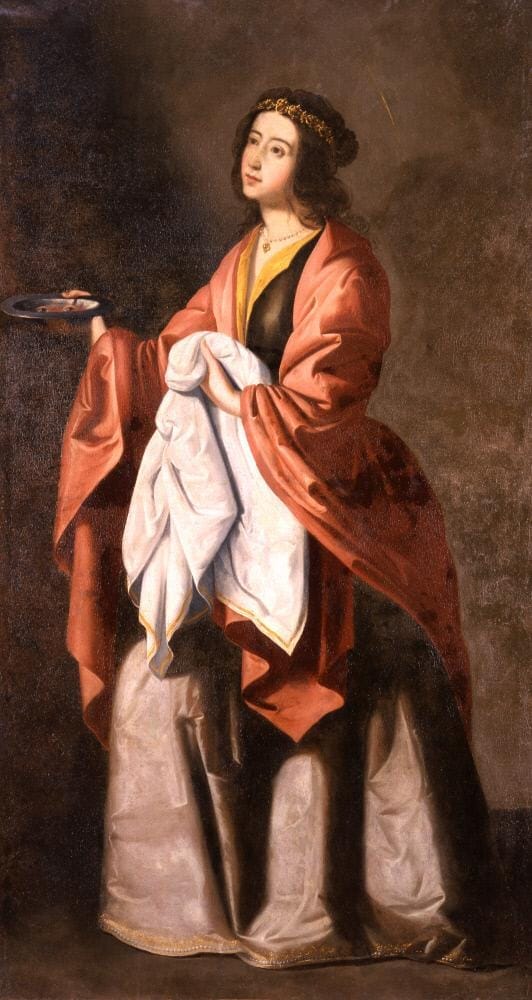
December 13: St. Lucy, Virgin and Martyr
We here give some of the antiphons which occur in the Office of the saint: they form a lyric poem of great beauty.
O virgin Lucy! why askest thou of me, what thyself canst straightway grant unto thy mother?
Because of thee, O virgin Lucy! the city of Syracuse shall be honoured by the Lord Jesus Christ.
Words of Lucy: I bless thee, the Father of my Lord Jesus Christ, because by thy Son the fire around me was quenched.
In thy patience thou didst possess thy soul, O Lucy, bride of Christ! thou didst hate the things that are in the world, and thou shinest among the angels. Thou didst conquer the enemy by thine own blood.
We present ourselves before thee, O virgin martyr, beseeching thee to obtain for us that we may recognize in His lowliness that same Jesus whom thou now seest in His glory. Take us under thy powerful patronage. Thy name signifies light; guide us through the dark night of this life. O fair light of virginity! enlighten us; evil concupiscence has wounded our eyes: pray for us, O thou bright light of virginity! that our blindness be healed, and that rising above created things, we may be able to see that true light, which shineth in darkness, but which darkness cannot comprehend. Pray for us, that our eye may be purified, and may see, in the Child who is to be born at Bethlehem, the new Man, the second Adam, the model on which the life of our regeneration must be formed. Pray too, O holy virgin, for the Church of Rome and for all those which adopt her form of the holy Sacrifice; for they daily pronounce at the altar of God thy sweet name; and the Lamb, who is present, loves to hear it. Heap thy choicest blessings on the fair Isle, which was thy native land, and where grew the palm of thy martyrdom. May thy intercession secure to her inhabitants firmness of faith, purity of morals, and temporal prosperity, and deliver them from the disorders which threaten her with destruction.
December 13 (the Same Day): St. Odilia, Virgin and Abbess
On this same day, we have also the fifth of the wise virgins, whose bright lamps light us, during Advent, to the crib of Jesus their Spouse. Odilia did not shed her blood for Him, as did Bibiana, Barbara, Eulalia, and Lucy; her offering was her tears and her love. Her wreath of lilies blends sweetly with the roses, which form the crowns of her four companions. Her name is held in special veneration in the east of France, and beyond the Rhine. The holy hill whereon her tomb has rested now these thousand years, is still visited by numerous and devout pilgrims. Several kings of the Capetian race, and several emperors of the house of Hapsburg, were descendants of the father of our saint, Adalric or Atticus, Duke of Alsace.
Odilia was born blind. Her father insisted on her being removed from the house, for her presence would have been a continual humiliation to him. It seems as though this affliction was permitted by Providence, in order that the action and power of divine grace might be the more clearly manifested in her regard. The little exile was taken from her mother, and placed in a monastery. God, who designed to show the virtue of the holy Sacrament of regeneration, permitted that her Baptism should be deferred until she had reached her thirteenth year. The time at length came for Odilia to be made a child of God. No sooner was she taken from the baptismal font, than she received her eyesight, which was but a feeble figure of the light which faith had lit up in her soul. This prodigy restored Odilia to her father and to the world; and from that time forward, she had to defend, against unceasing attacks, the virginity which she had vowed to God. Her personal beauty, and her father’s wealth and power, attracted to her many rich suitors. She refused them all; and her father himself built a monastery on the rocks of Hohenburg, wherein she served her divine Lord, governed a large community, and gave relief to every sort of suffering.
After a long life spent in prayer, penance, and works of mercy, the day came which was to reward her for it all. It was this very day, the thirteenth of December, the feast of the holy virgin Lucy. The sisters of Hohenburg, desirous of treasuring up her last words, assembled round their saintly abbess. She was in an ecstasy, and already dead to the things of this life. Fearing lest she should die before she had received that holy Viaticum, which leads the soul to Him who is her last end, the sisters thought it their duty to rouse her from the mystic sleep, which, so it seemed to them, rendered her forgetful of the duties which she had to perform. Being thus brought to herself, she turned to the community, and said to them: ‘Dear sisters, why have you disturbed me? Why would you again oblige me to feel the weight of this corruptible body, when I had once left it? By the favour of His divine Majesty, I was in the company of the virgin Lucy, and the delights I was enjoying were so great that no tongue could tell them, nor ear hear them, nor human eye see them.’ No time was lost in giving her the Bread of life and the Chalice of salvation, which having received, she immediately rejoined her heavenly companion, and the thirteenth day of December thus united into one the feasts of the abbess of Hohenburg and of the martyr of Syracuse.
The Church of Strasburg, which honours Odilia as one of its greatest glories, has the following lessons for this feast. By giving them a place here, we do not adopt the statement they contain with regard to the rule which was followed in the monastery of Hohenburg. Mabillon, who proves that St. Odilia followed the rule of St. Benedict, shows that the Canonical Rule, as it was called, did not exist at that time.
The ways of God in thy regard, O holy virgin, were admirable indeed, and He manifested in thee the riches and power of His grace. He deprived thee of sight, that so thy soul might the more eagerly cling to His own infinite beauty; and when afterwards He bestowed on thee thy bodily vision, thou hadst already made choice of the better part. The harshness of thy father deprived thee of the innocent pleasures of home; but it prepared thee to become the spiritual mother of so many noble virgins, who, following thy example, trampled on all the vanities of the world. Thou didst choose a life of humility, because thy heavenly Spouse Jesus had humbled Himself for our sake. Thou didst imitate Him also in His being our divine Deliverer, and taking upon Himself all our miseries, for thou hadst the tenderest compassion on the poor and the sick. Thou didst take on thyself the care of a poor leper, that had been abandoned by all else; with a mother’s courage thou didst feed him, and affectionately dress his loathsome sores. And is it not this that our Jesus is coming down from heaven to do for us; to heal our wounds by embracing our human nature, and to nourish us with that food, which He is preparing to give us at Bethlehem? Whilst the leper was receiving thy loving care, the frightful disease which excluded him from the society of his fellow-creatures suddenly disappeared; a delicious odour came from his whole person, whereas before, none but a saint like thyself could have borne to approach him. Is it not this which Jesus is coming down to do for us? The leprosy of sin was upon us; His grace heals us, and man regenerated sheds around him the good odour of Christ.1
In the midst of the joys which thou art now sharing with Lucy, remember us, O thou that wast ever so compassionate to the needy! We cannot forget the tears thou didst shed, and the prayers thou didst offer up for the soul of thy father after his death, whereby thou didst deliver him from purgatory, and open the gates of heaven to him that had banished thee from his house. Thou art no longer in the land of tears; thine eyes are opened to the light of heaven, and contemplate God in His glory: pray therefore for us, for thy prayers are now more powerful than heretofore. Think of us who are poor and infirm; obtain the cure of our maladies. The Emmanuel, who is coming to us, tells us that He is the Physician of our souls, for He has said: 'They that are in health need not the Physician, but they that are ill.’2 Ask Him to cure us of the leprosy of sin, and make us become even like unto Himself. Pray for France, thy country, and help her to maintain the purity of the Catholic faith. Watch over the ruins of the holy empire. Heresy has disunited the members of that great body; but it will once more flourish, if our Lord, propitiated by such prayers as thine, vouchsafe to bring Germany back again to the true faith and to submission to the Church. Yes, pray that these glorious things be brought about for the honour and glory of thy divine Spouse, and that nations, now weary of their errors and disunion, may unite together in propagating the kingdom of God upon earth.
Let us consider the ever blessed Mother of God leaving her humble dwelling at Nazareth, in order to visit her cousin, St. Elizabeth. The Church honours this mystery of the Visitation on the Friday in Ember Week of Advent, as we have mentioned above, in the Proper of the Time. We will let St. Bonaventure relate this sublime incident of Mary’s life, convinced that our readers will be pleased to hear the seraphic Doctor revealing to them, with his wonderful unction, these preludes to the birth of Jesus.
‘After, this, our Lady, pondering the words spoken unto her by the angel concerning her cousin Elizabeth, resolved to visit her, that she might congratulate with her and render her service. She, therefore, together with Joseph her spouse, set out from Nazareth for the house of Elizabeth, which might perhaps be fourteen or fifteen miles distant from Jerusalem. Neither the roughness nor the length of the journey discouraged her; but she walked with haste, forasmuch as she wished to be little seen in public. She was not like other mothers, burthened by her Child, nor was it to be thought that the Lord Jesus would be a burthen to His Mother. See, therefore, how the Queen of heaven and earth takes this journey alone, with none but her spouse Joseph; not riding, but walking; neither is she escorted by troops of soldiers and barons, nor attended by handmaids and fine ladies. Her train is poverty, humility, modesty, and the beauty of all virtues. The Lord Himself, too, is with her; and He verily hath a numerous and honourable suite, but it is not that of the world, vain and pompous.
‘Now, when she had entered the house of Elizabeth, she greeted her saying: “ Hail! my sister Elizabeth!” But she, exulting, and all full of joy, and inflamed by the holy Spirit, rises and most tenderly embraces Mary, exclaiming for joy: “Blessed art thou among women, and blessed is the fruit of thy womb! And whence is this to me, that there should come unto me the Mother of my Lord?” For as soon as the Virgin had greeted Elizabeth, John, in his mother’s womb, was filled with the Holy Ghost, as was likewise the mother. Nor was it that the mother was filled and then her child, but contrariwise the child was filled first, and he communicated the Spirit unto the mother. The babe effected nought in Elizabeth’s soul, but he merited that the Holy Ghost should do a work in her soul, because the grace of the divine Spirit had descended into him with greater abundance, and he was the first to receive the grace. And as Elizabeth had perceived the coming of Mary, so did John perceive the coming of Jesus. Therefore was it that he leaped for joy, and she prophesied. See the virtue of our Lady’s words, when by their utterance the Holy Ghost is conferred; for so replenished was Mary with Him, that, by her merits, He filled others also with Himself. Upon this, Mary made answer unto Elizabeth, saying: “My soul doth magnify the Lord, and my spirit hath rejoiced in God my Saviour.”
Sequence in Honor of the Mother of God
(Taken from the ancient Roman-French missals)
Celebris in Matris Dei
Agitur memoria.
Decantemus in hac die
Semper Virginis Mariæ
Landes et præconia.
Omnis homo, omni hora,
Ipsam ora et implora
Ejus patrocinia.
Psalle, psalle, nisu toto,
Cordis, oris, voce, voto:
Ave plena gratia!
Ave, Domina cœlorum,
Inexperta viri torum,
Parens paris nescia.
Fœcundata sine viro,
Genuisti more miro
Genitorem filia.
Florens hortus Austro flante,
Porta clausa post et ante,
Via viris invia.
Fusa cœli rore tellus,
Fusum Gedeonis vellus,
Deitatis pluvia.
Salve, splendor firmamenti:
Tu caliginosae menti
Desuper irradia.
Placa mare, maris stella,
Ne involvat nos procella
Et tempestas obvia.
Amen.
for on it we make commemoration of Mary,
the Mother of God.
Lot us sing to-day
the praises and the dignity of the ever blessed
Virgin Mary.
Whoe’er thou art,
and where’er thou art,
pray to her, beseech her to help thee.
Sing, sing, with all thy heart
and voice’s power;
Hail Mary! full of grace.
Hail, Queen of heaven,
purest of Virgins,
yet incomparable Mother!
Made fruitful by God,
thou, his creature, didst give birth,
O prodigy of prodigies! to thy Creator.
Here was the prophecy fulfilled;
that a garden should flower under the breath of the south wind;
that all its gates were closed, and no man could enter.
Mary is the earth spoken of as enriched with the dew of heaven;
she is as Gedeon’s fleece prefigured her,
filled with the dew of the Godhead.
Hail, Mary, thou brightness of heaven!
bring to our darkness
the light that is from above.
O star of the sea,
calm its storms,
and suffer not that they overwhelm us.
Amen.
Introit of Advent
(Ambrosian missal, sixth Sunday, Ingressa)
Monday of the Third Week of Advent
Cap. xxviii.Hæc dicit Dominus Deus: Ecce ego mittam in fundamentis Sion lapidem, lapidem probatum, angularem, pretiosum, in fundamento fundatum. Qui crediderit, non festinet. Et ponam in pondere judicium, et justitiam in mensura, et subvertet grando spem mendacii, et protectionem aquæ inundabunt. Et delebitur fœdus vestrum cum morte, et pactum vestrum cum inferno non stabit.
Ch. xxviii.Thus saith the Lord God: Behold I will lay a stone in the foundations of Sion, a tried stone, a corner-stone, a precious stone, founded in the foundation. He that believeth, let him not hasten. And I will set judgement in weight, and justice in measure; and hail shall overturn the hope of falsehood, and waters shall overflow its protection. And your league with death shall be abolished, and your covenant with hell shall not stand.
Heavenly Father! Thou art preparing to set in the foundations of Sion a corner-stone, that is tried and solid; and this stone, which is to give firmness to Sion Thy Church, is Thy Incarnate Son. It was prefigured, as Thy apostle assures us,1 by that rock of the desert, which yielded the abundant and saving stream that quenched the thirst of Thy people. But now Thou art about to give us the reality; it has already come down from heaven, and the hour is fast approaching when Thou wilt lay it in the foundations. O sacred Stone, which makest all one, and givest solidity to the whole structure! By Thee it will come to pass, that there shall be no longer Jew or Gentile, but all nations shall become one family. Men shall no more build on sand, nor set up houses which floods and storms may overturn. The Church shall rise up from the stone which God now sets, and, secure on the great foundation, her summit shall touch the clouds. With all his weakness, and all his fickleness, man will partake of Thy immutability, O divine Stone, if he will but lean on Thee. Woe to him that rejects Thee, for Thou hast said, and Thou art the eternal Truth: 'Whosoever shall fall upon that stone, shall be bruised; and upon whomsoever it shall fall, it will grind him to powder.’2 From this twofold evil, O Thou that art chief corner-stone, deliver us, and never permit us to be of the number of those blind men who rejected Thee. Give us grace ever to honour and love Thee as the cause of our strength, and the one sole origin of our solidity: and since Thou hast communicated this Thy quality of the rock to one of Thine apostles, and by him to his successors unto the end of the world, grant us ever to cling to this rock, the holy Roman Church, in union with which all the faithful on the face of the earth are preparing to celebrate the glorious solemnity of Thy coming, O precious and tried Stone! Thou art coming, that Thou mayst destroy the kingdom of falsehood, and break the league which mankind had made with death and hell.
Hymn for Advent
(In the Mozarabic breviary, first Sunday of Advent)
Rerum parenti proximas
Quas esse sentit gratias,
Laudesque promat maximas.
Perfecit olim tradita,
Cum nos redemit unicus
Factoris orbis Filius.
Tulit reatum criminum,
Sumensque nostrum pulverem,
Mortis peremit principem.
Sed sempiternus a Patre,
Duabus in substantiis,
Persona sola est Numinis.
Nitescat ut cultu novo
Renatus in nato Deo,
Factus novus vetus homo.
Ovans trophæo, gentium
Renata plebs per gratiam
Hæc festa præbet annua.
Votis feratur omnibus,
Quos sustinere convenit,
Tanti diei gloriam.
Orbemque terror presserit;
Succurrat hæc humillima
Susceptionis dignitas.
Ejusque soli Filio,
Cum Spiritu Paraclito,
In sempiterna sæcula.
laud the graces that are nigh,
and sing their highest praises
to their Creator.
who created this world, redeemed us,
he fulfilled the promises
which the heavensent prophets spoke in the ages past.
and shown himself to men,
took away the punishment due to their sins;
and assuming our nature, though but dust, he vanquished the prince of death.
but begotten eternally from the Father,
in the two substances there is but one Person,
that is the Person of the Word.
that our old man being changed into the new,
we may put on new beauty
by being regenerated in the new-born God.
in gladness and exultation
at the trophy won by the divine Nativity,
keep every year its feast.
be celebrated with devout solemnity by all,
who have so just a share
in the glory of this great day.
shall burst upon the world and fill it with fear,
this most humble expression
of our devout celebration of the first may give us confidence.
and to his only Son,
and to the holy Spirit,
be glory for ever and ever.
Prayer from the Ambrosian Missal
(In the Mass of the sixth Sunday of Advent, Preface).
| Previous December 12: The Fifth Day within the Octave of the Immaculate Conception | Next December 13 (the Same Day): St. Odilia, Virgin and Abbess |