Daily reading
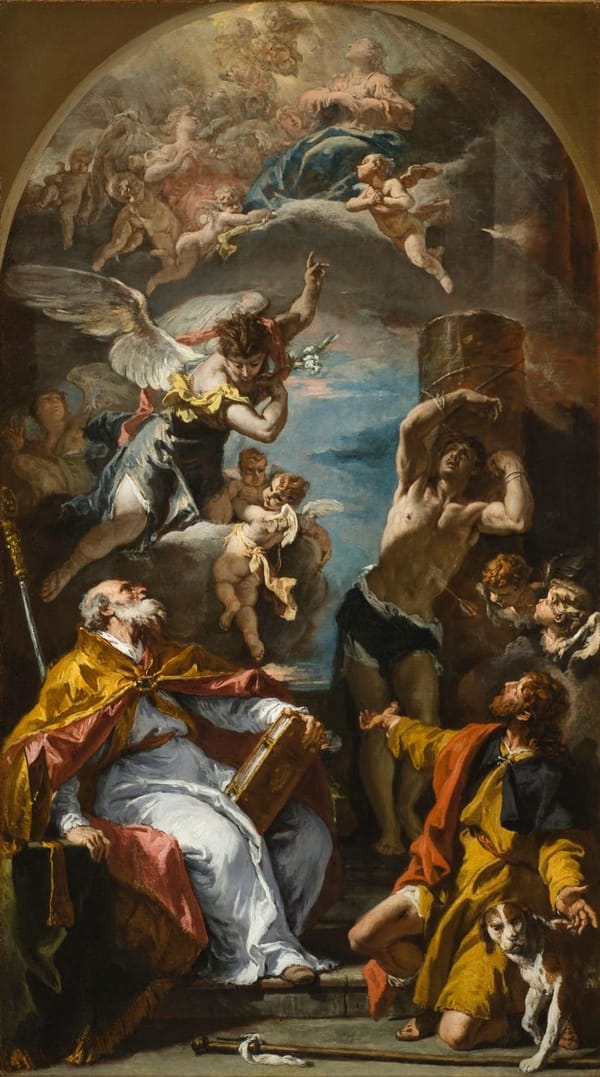
December 16: Saint Eusebius, Bishop of Vercelli and Martyr
When asked to tell the names of the saints who were foremost in defending the dogma of the Incarnation, we think at once of the intrepid Eusebius of Vercelli, as one of the glorious number. The Catholic faith, which was so violently attacked in the fourth century by the Arian heresy, was maintained at that time by the labours and zeal of four sovereign Pontiffs: Sylvester, who confirmed the decrees of the Council of Nicæa: Julius, the supporter of St. Athanasius; Liberius, whose faith failed not, and who, when restored to his liberty, confounded the Arians; and lastly, Damasus, who destroyed the last hopes of the heretics. One of these four Pontiffs appears on our Advent calendar—Damasus, whose feast we kept but a few days since. The four Popes have for their fellow-combatants, in this battle for the Divinity of the Incarnate Word, four great bishops, of whom it may be said that the defence of the dogma of the Consubstantiality of the Son of God was what they lived for, and that to say anathema to them was to say anathema to Christ Himself; all four most powerful in word and work, lights of the Churches of the world, objects of the people’s love, and the dauntless witnesses of Jesus. The first and greatest of the four is the bishop of the second See of Christendom, St. Athanasius, the Patriarch of Alexandria: the second is St. Ambrose of Milan, whose feast we kept on the seventh of this month; the third is the glory of Gaul, St. Hilary, bishop of Poitiers; the fourth is the ornament of Italy, St. Eusebius, bishop of Vercelli, whom we have to honour to-day. Hilary will come to us during Christmastide, and will stand at the crib of the Word, whose Divinity he so bravely confesses; Athanasius will meet us at Easter, and help us to celebrate, in the triumphant Resurrection, Him whom he proclaimed as God in those dark times, when human wisdom hoped to destroy, by fifty years of peace, that Church which had survived the storm of three centuries of persecution. St. Eusebius’ place is Advent; and divine Providence has thus chosen him as one of the patrons of the faithful during this mystic season. His powerful prayers will help us to come devoutly to Bethlehem, and see in the Child, that is lying there, the eternal Word of God. So great were the sufferings which St. Eusebius had to undergo for the Divinity of Jesus, that the Church awards him the honours of a martyr, although he did not actually shed his blood. Let us now listen to the admirable account which the Church gives us of his life.
That Council was held the following year, at Milan; Eusebius was invited by Constantius to be present at it, which was what the legates of Liberius had desired and begged. So far was he from being duped by the synagogue of the malicious Arians to side with them against St. Athanasius, that he openly declared from the first that several of those present were known to him to be heretics, and he therefore proposed that they should subscribe to the Nicene Creed before proceeding any further. This the Arians, infuriated with anger, refused to do; whereupon, he not only refused to subscribe to what was drawn up against Athanasius, but he also, by a most ingenious device, succeeded in having the name of St. Denis the martyr blotted out from the decree, which the craft of the Arians had induced him to sign. Wherefore, they being exceedingly angry against Eusebius, loaded him with injuries, and had him sent into banishment. The holy man, on his side, shaking off the dust from his feet, caring little either for the threats of the emperor, or the sword which was held over him, submitted to banishment as to something which belonged to his episcopal office. Being sent to Scythopolis, he there endured hunger, thirst, blows, and sundry other punishments; he generously despised his life for the true faith, feared not death, and gave up his body to the executioners.
Valiant soldier of Jesus, Eusebius, martyr and pontiff, how much labour and suffering thou didst undergo for the Messias! And yet, they seemed to thee to be little in comparison with what is due to this eternal Word of the Father, who, out of His pure love, has made Himself the Servant of His own creatures, by becoming Man for them in the mystery of the Incarnation. We owe the same debt of gratitude to this divine Saviour. He is born in a stable for our sake, as He was for thine; pray, therefore, for us that we may be ever faithful to Him both in war and in peace; and that we may resist our temptations and evil inclinations with that same firmness, wherewith we would confess His name before tyrants and persecutors. Obtain for the bishops of our holy mother the Church such vigilance, that no false doctrines may surprise them, and such courage that no persecution may make them yield. May they be faithful imitators of the divine Pastor, who gives His life for His sheep; and may they ever feed the flock entrusted to them in the unity and charity of Jesus Christ.
Let us consider how our blessed Lady, having returned to Nazareth, is overwhelmed with joy to feel living within her Him, who gives being to every created thing, and whom she loves with all the intensity of the Mother of God. Joseph, the faithful guardian of her virginity, tenderly loves this his spouse, and blesses God for having entrusted such a treasure to his keeping. The angels crowd round this favoured house wherein dwell their sovereign Lord, and she whom He has chosen to be His Mother. Never was there happiness like that which fills this little dwelling; and yet, God has decreed to visit it with a heavy trial, in order that He may give an occasion to Mary to exercise heroic patience, and to Joseph an occasion of meriting by his exquisite prudence. Let us listen to the Meditation of St. Bonaventure, in which he thus ponders the Gospel narrative:
'But while our Lady and Joseph her spouse were thus dwelling together, the Infant Jesus grew within His Mother’s womb. Then Joseph, perceiving that Mary was with Child, was above all measure grieved. Here give, I pray thee, all thine attention, for thou hast many fair things to learn. If thou wouldst know wherefore it was that our Lord wished that His Mother should have a husband, whereas He always wished that she should be a Virgin, I answer thee that He so wished on three accounts: firstly, that she might not be disgraced when it was seen that she was a Mother: secondly, that she might have Joseph’s aid and company; and thirdly, that the birth of the Son of God might be concealed from the devil.
‘Now, Joseph did look many times on Mary, and grief and trouble of heart fell upon him, and his displeasure was seen in his face, and he turned his eyes away from her as one that was guilty of that which he perforce suspected. See how God permits His servants to be afflicted and sorely tried, that they may so receive their crown. Now Joseph was minded to put her away privately. In very truth may it be said of this holy man, that his praise is in the Gospel, for the Gospel says of him that he was a just man, that is, a man of great virtue. For albeit they say that no shame, nor suffering, nor insult can befall a man so grievous as that of his wife’s unfaithfulness; yet did Joseph restrain himself withal, and would not accuse Mary, but bore this great injury patiently. He sought not how to avenge himself, but, overcome with pity, and wishing to forgive, he was minded to put her away privately. But herein also had our Lady her share of tribulation, for she took notice of Joseph’s trouble, and it sorely grieved her. Yet did she humbly hold her peace, and hide the gift of God. Better did it seem unto her that evil should be thought of her than that she should reveal the divine mystery, and say aught of herself which would come nigh to boasting. Therefore did she beseech our Lord that Himself would right this matter, and make pass this grief from Joseph and herself. Here thou mayst learn what great tribulation and anxiety was theirs. But God came unto their assistance.
‘He therefore sent His angel, who spake unto Joseph in his sleep, and told him that his spouse had conceived of the Holy Ghost, and that he was to abide with her in all surety and joy. Whereupon, the tribulation ceased, and they were both exceedingly comforted. So likewise would it befall us if we would suffer patiently, for after a storm God brings a calm. Neither oughtest thou to doubt this, for God suffereth not His servants to be afflicted save for their good. After this, Joseph requested our Lady to narrate unto him what had happened; and she faithfully narrated all unto him. Whereupon Joseph remains with his blessed spouse, and lives with her in all contentment, and loves her above what words can say, and diligently provides her with whatsoever she needed. So also our Lady continues to remain confidently with Joseph, and they live right joyfully in their poverty.’
Prayer for the Time of Advent
(The Mozarabic breviary, Wednesday of the first week of Advent, Capitula)
Thursday of the Third Week of Advent
Cap. xxxiii.Domine, miserere nostri: te enim exspectavimus: esto brachium nostrum in mane, et salus nostra in tempore tribulationis. A voce angeli fugerunt populi, et ab exaltatione tua dispersæ sunt Gentes. Et congregabuntur spolia vestra sicut colligitur bruchus, velut cum fossæ plenæ fuerint de eo. Magnifìcatus est Dominus, quoniam habitavit in excelso: implevit Sion judicio et justitia. Et erit fides in temporibus tuis: divitiæ salutis sapientia et scientia: timor Domini ipse est thesaurus ejus. Conterriti sunt in Sion peccatores: possedit tremor hypocritas. Quis poterit habitare de vobis cum igne devorante? quis habitabit ex vobis cum ardoribus sempiternis? Qui ambulat in justitiis, et loquitur veritatem, qui projicit avaritiam ex calumnia, et excutit manus suas ab omni munere, qui obturat aures suas ne audiat sanguinem, et claudit oculos suos ne videat malum. Iste in excelsis habitabit, munimenta saxorum sublimitas ejus: panis ei datus est, aquæ ejus fideles sunt. Regem in decore suo videbunt oculi ejus: cernent terram de longe.
Ch. xxxiii.O Lord, have mercy on us: for we have waited for thee: be thou our arm in the morning, and our salvation in the time of trouble. At the voice of the angel the people fled, and at the lifting up thyself the nations are scattered. And your spoils shall be gathered together as the locusts are gathered, as when the ditches are full of them. The Lord is magnified, for he hath dwelt on high: he hath filled Sion with judgement and justice. And there shall be faith in thy times, riches of salvation, wisdom and knowledge: the fear of the Lord is his treasure. The sinners in Sion are afraid: trembling hath seized upon the hypocrites. Which of you can dwell with devouring fire? which of you shall dwell with everlasting burning? He that walketh in justices, and speaketh truth, that casteth away avarice by oppression, and shaketh his hands from all bribes, that stoppeth his ears lest he hear blood, and shutteth his eyes that he may see no evil. He shall dwell on high, the fortifications of rocks shall be his highness: bread is given him, his waters are sure. His eyes shall see the king in his beauty; they shall see the land far off.
Happy he whose eyes shall thus contemplate the new-born King in the sweet majesty of His love and His humility! He shall be so taken with this His beauty, that the earth, with all its magnificence, shall appear as nothing in his eyes. The only thing he will care to look upon, will be the Child laid in a manger, and wrapped in swaddling clothes. But, that we may have this happiness of closely contemplating the divine King who is coming to us, that we may merit to enter His court, we must do as the prophet bids us: we must walk in justice, and speak truth. Let us listen to the pious Rabanus Maurus, who expresses this, with much unction, in his first sermon on preparation for the feast of Christmas: ‘If at all times it behoves us to be adorned with the comeliness of good works, we should be so, with an especial care, on the day of our Saviour’s birth. Consider within yourselves, my brethren, what you would do, were a king, or prince, to invite you to come to celebrate his birthday. Your garments would be as new, as elegant, even as magnificent, as you could procure them, for you would think it an insult to him who invited you, were you to appear before him with anything upon you that was tom, or poor, or unclean. Show a like solicitude on the occasion of the coming feast: and let your souls, beautified with the several ornaments of virtue, go forth to their King. He loves the pearls of simplicity, and the flowers of chaste sobriety: wear them therefore. Let your consciences be composed in a holy calm, now that the solemn feast of Jesus’ Nativity is so close upon us. Assist at it lovely in your chastity, gorgeous in your charity, beauteous by your almsdeeds, brilliant with justice and humility, and, above all, radiant in the love of God. If the Lord Jesus shall see you thus when you keep His feast, believe me, He will do more than visit your souls; He will treat you with such familiarity, that He will choose them for His favourite abode, and there He will dwell for ever, as it is written: Behold! I will come, and I will dwell with them and they shall be my people, and I will be their God.’ Christians, you have no time to lose: quickly prepare yourselves for this great visit. Let sinners be converted and become just: let the just become more just; let the holy become more holy, for He that is coming is the Lord our God, and none else.
Prose for the Time of Advent
(Composed in the eleventh century, and taken from the ancient Roman-French missals)
Per quem condita sunt sæcula;
Cœlum quod plurima luce coruscat, et diversa sidera;
Sol mundi schema, noctium decus luna, cunctaque splendentia;
Mare, solum, alta, plana, et profunda flumina;
Aeris ampla spatia: quæ discurrunt aves, venti atque pluvia.
Haec simul cuncta tibi soli Deo Patri militant.
Nunc et in ævum, sine fine per sæcula:
Laus eorum tua gloria:
Qui pro salute nostra Prolem unicam,
Pati in terra misisti sine culpa, sed ob nostra delicta.
Te, sancta Trinitas, precamur, ut corpora nostra et corda regas et protegas, et dones peccatorum veniam. Amen.
By whom all ages were made;
The firmament, which shines with much light, and the countless stars;
The sun, the ornament of the world; the moon, which is the night’s beauty; and all shining things;
The sea, the land, the hills, the plains, and the deep rivers;
The wide space of the air, through which float birds, and winds, and rain;
All these obey thee alone, O God, as their Maker and King.
Now and evermore, for endless ages:
Their praise is thy glory;
Who for our salvation didst send thine only-begotten Son,
In whom could be no sin, to suffer on earth for our sins.
We beseech thee, O holy Trinity, to govern and protect our souls and bodies, and grant us forgiveness of cur sins. Amen.
Prayer from the Ambrosian Missal
(Second Sunday of Advent, Præfatio)
| Previous Wednesday in Ember Week of Advent | Next Thursday of the Third Week of Advent |