Daily reading
December 18 · Sanctoral
December 18, 2027
From Dom Guéranger’s The Liturgical Year.
December 18: Second Antiphon
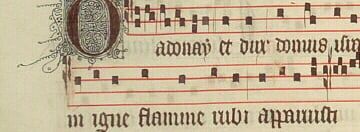
O sovereign Lord! O Adonai! come and redeem us, not by Thy power, but by Thy humility. Heretofore, Thou didst show Thyself to Moses Thy servant in the midst of a mysterious flame; Thou didst give Thy law to Thy people amidst thunder and lightning; now, on the contrary, Thou co mest not to terrify, but to save us. Thy chaste Mother having heard the emperor’s edict, which obliges her and Joseph her spouse to repair to Bethlehem, prepares everything needed for Thy divine Birth. She prepares for Thee, O Sun of justice! the humble swathing-bands, wherewith to cover Thy nakedness, and protect Thee, the Creator of the world, from the cold of that midnight hour of Thy Nativity! Thus it is that Thou wiliest to deliver us from the slavery of our pride, and show man that Thy divine arm is never stronger than when he thinks it powerless and still. Everything is prepared, then, dear Jesus! Thy swathing-bands are ready for Thy infant limbs! Come to Bethlehem, and redeem us from the hands of our enemies.
December 18 (the Same Day): The Expectation of the Blessed Virgin Mary
This feast, which is now kept not only throughout the whole of Spain but in many other parts of the Catholic world, owes its origin to the bishops of the tenth Council of Toledo, in 656. These prelates thought that there was an incongruity in the ancient practice of celebrating the feast of the Annunciation on the twenty-fifth of March, inasmuch as this joyful solemnity frequently occurs at the time when the Church is intent upon the Passion of our Lord, so that it is sometimes obliged to be transferred into Easter time, with which it is out of harmony for another reason; they therefore decreed that, henceforth, in the Church of Spain there should be kept, eight days before Christmas, a solemn feast with an octave, in honour of the Annunciation, and as a preparation for the great solemnity of our Lord’s Nativity. In course of time, however, the Church of Spain saw the necessity of returning to the practice of the Church of Rome, and of those of the whole world, which solemnize the twenty-fifth of March as the day of our Lady’s Annunciation and the Incarnation of the Son of God. But such had been, for ages, the devotion of the people for the feast of the eighteenth of December, that it was considered requisite to maintain some vestige of it. They discontinued, therefore, to celebrate the Annunciation on this day; but the faithful were requested to consider, with devotion, what must have been the sentiments of the holy Mother of God during the days immediately preceding her giving Him birth. A new feast was instituted, under the name of 'the Expectation of the blessed Virgin’s delivery.’
This feast, which sometimes goes under the name of Our Lady of O, or the feast of O, on account of the great antiphons which are sung during these days, and, in a special manner, of that which begins O Virgo virginum (which is still used in the Vespers of the Expectation, together with the O Adonai, the antiphon of the Advent Office), is kept with great devotion in Spain. A High Mass is sung at a very early hour each morning during the octave, at which all who are with child, whether rich or poor, consider it a duty to assist, that they may thus honour our Lady’s Maternity, and beg her blessing upon themselves. It is not to be wondered at that the holy See has approved of this pious practice being introduced into almost every other country. We find that the Church of Milan, long before Rome conceded this feast to the various dioceses of Christendom, celebrated the Office of our Lady’s Annunciation on the sixth and last Sunday of Advent, and called the whole week following the Hebdomada de Exceptato (for thus the popular expression had corrupted the word Expectato). But these details belong strictly to the archaeology of liturgy, and enter not into the plan of our present work; let us, then, return to the feast of our Lady’s Expectation, which the Church has established and sanctioned as a new means of exciting the attention of the faithful during these last days of Advent.
Most just indeed it is, O holy Mother of God, that we should unite in that ardent desire thou hadst to see Him, who had been concealed for nine months in thy chaste womb; to know the features of this Son of the heavenly Father, who is also thine; to come to that blissful hour of His birth, which will give glory to God in the highest, and, on earth, peace to men of good-will. Yes, dear Mother, the time is fast approaching, though not fast enough to satisfy thy desires and ours. Make us redouble our attention to the great mystery; complete our preparation by thy powerful prayers for us, that when the solemn hour has come, our Jesus may find no obstacle to His entrance into our hearts.
The Great Antiphon to Our Lady
Saturday in Ember Week of Advent
The lessons from the prophet Isaias are interrupted to-day also; and a homily on the Gospel of the Mass is read in their place. As this Gospel is repeated to-morrow, in the Mass of the fourth Sunday of Advent, we will, for the present, omit it, and be satisfied with mentioning the reason of the same Gospel being assigned to the two days.
The primitive custom, in the Roman Church, was to hold ordinations in the night between Saturday and Sunday, just as Baptism was administered to the catechumens in the night between Holy Saturday and Easter Sunday. The ceremony took place towards midnight, and Sunday morning was always far advanced before the termination; so that the Mass of ordination was considered as the Mass of Sunday itself. Later on, discipline relaxed, and these severe vigils were given up; the ordination Mass, like that of Holy Saturday, was anticipated; and, as the fourth Sunday of Advent and the second of Lent had not hitherto had a proper Gospel, since they had not had a proper Mass, it was settled, about the tenth or eleventh century, that the Gospel of the Mass of ordinations should be repeated in the special Mass of the two Sundays in question.
The Station is at St. Peter’s on account of the ordinations. This basilica was always one of the largest of the city of Rome, and was therefore the best suited for the great concourse of people.
Let us honour Mary upon this day of the week, which is consecrated to her; let us borrow a canticle from the oriental Church, ever profuse in its praise of the Mother of God.
Hymn Taken from the Anthology of the Greeks
(December 15)
Prayer from the Mozarabic Missal
(Fifth Sunday of Advent, Illatio)
| Previous Friday in Ember Week of Advent | Next December 18 (the Same Day): The Expectation of the Blessed Virgin Mary |