Daily reading
Epiphanytide
Semidouble · Temporal
January 23, 2028
From Dom Guéranger’s The Liturgical Year.

|
The Third Sunday after Epiphany
THE variation of Easter Sunday necessitates almost every year a different arrangement of the Sundays after the Epiphany from that in which they stand in the Missal. Septuagesima often comes in January and the Feast of the Purification is occasionally later than Quinquagesima Sunday; hence the office of these four last Sundays may have to be transferred to another season of the liturgical cycle. We were obliged then to provide for these changes and simplify them for the Faithful by adopting our present plan. We have inserted here the third and fourth Sundays as usually falling in Christmastide, while the office of the fifth and sixth Sundays will be found in the volumes of Septuagesima and the second after Pentecost, this latter season being the one in which they are most frequently kept.
Mass
The Introit represents the Angels of God adoring him on his entrance into this world, as St Paul* explains this passage of the Psalms. The Church celebrates with David the gladness of Sion, and the joy of the daughters of Juda.
Introit
Collect
Commemoration of the Blessed Virgin Mary
The third Prayer is one of the following:
Against the persecutors of the Church
For the Pope
Epistle
Cap. XII.Fratres, nolite esse prudentes apud vosmetipsos: nulli malum pro malo reddentes: providentes bona non tantum coram Deo, sed etiam coram omnibus hominibus; si fieri potest, quod ex vobis est, cum omnibus hominibus pacem habentes: non vosmetipsos defendentes, carissimi, sed date locum iræ; scriptum est enim; Mihi vindicta, ego retribuam, dicit Dominus. Sed si esurierit inimicus tuus, ciba ilium; si sitit, potum da illi: hoc enim faciens, carbones ignis congeres super caput ejus. Noli vinci a malo, sed vince in bono malum.
Ch. XII.Brethren, be not wise in your own conceits. To no man rendering evil for evil. Providing good things not only in the sight of God, but also in the sight of all men. If it be possible, as much as in you, having peace with all men. Not revenging yourselves, my dearly beloved, but give place unto wrath. For it is written: 'Revenge to me, I will repay,' saith the Lord. But 'if thy enemy be hungry, give him to eat: if he thirst, give him to drink: for doing this, thou shalt heap coals of fire upon his head.’ Be not overcome by evil, but overcome evil by good.
This love of our neighbour, recommended to us by the Apostle, is a consequence of that universal brotherhood which our Saviour, by his Birth, brought us from heaven. He came to establish peace between heaven and earth; men, therefore, ought to be at peace one with another. Our Lord bids us not to be overcome by evil, but to overcome evil by good:—and did not he first practise this by coming among us, who were children of wrath, that he might make us children of adoption by his humiliations and his sufferings?
In the Gradual, the holy Church again celebrates the coming of Emmanuel, and invites all nations, and all the kings of the earth, to come and praise his holy name.
Gradual
Gospel
Cap. VIII.In illo tempore, Cum descendisset Jesus de monte, secutæ sunt eum turbæ multæ; et ecce leprosus veniens, adorabat eum dicens: Domine, si vis, potes me mundare. Et extendens Jesus manum, tetigit eum dicens: Volo, mundare. Et confestim mundata est lepra ejus. Et ait illi Jesus: Vide, nemini dixeris; sed vade, ostende te sacerdoti et offer munus, quod præcepit Moyses, in testimonium illis. Cum autem introisset Capharnaum, accessit ad eum centurio, rogans eum et dicens; Domine, puer meus jacet in domo paralyticus, et male torquetur. Et ait illi Jesus: Ego veniam et curabo eum. Et respondens centurio, ait: Domine, non sum dignus ut intres sub tectum meum; sed tantum dic verbo, et sanabitur puer meus. Nam et ego homo sum sub potestate constitutus, habens sub me milites, et dico huic: vade, et vadit; et alii: veni, et venit; et servo meo: fac hoc, et facit. Audiens autem Jesus, miratus est, et sequentibus se dixit: Amen dico vobis, non inveni tantam fidem in Isræl. Dico autem vobis, quod multi ab oriente et occidente venient, et recumbent cum Abraham et Isaac et Jacob in regno cœlorum; filii autem regni ejicientur in tenebras exteriores: ibi erit fletus et stridor dentium. Et dixit Jesus centurioni: Vade, et sicut credidisti, fiat tibi. Et sanatus est puer in illa hora.
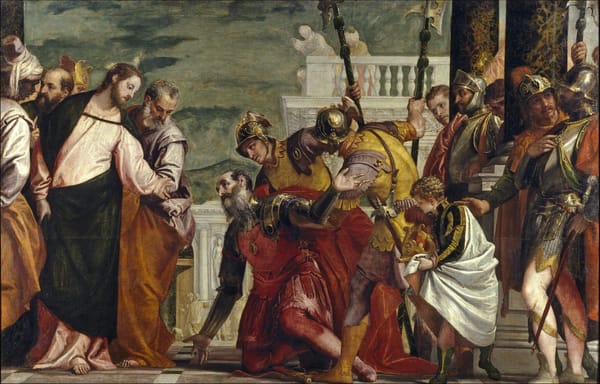
Ch. VIII.At that time, when Jesus was come down from the mountain, great multitudes followed him; and behold a leper came and adored him, saying: Lord, if thou wilt, thou canst make me clean. And Jesus stretching forth his hand, touched him, saying: I will, be thou made clean. And forthwith his leprosy was cleansed. And Jesus saith to him: See thou tell no man, but go, show thyself to the priest, and offer the gift which Moses commanded for a testimony unto them. And when he had entered unto Capharnaum, there came to him a centurion, beseeching him, and saying: Lord, my servant lieth at home sick of the palsy, and is grievously tormented. And Jesus saith to him: I will come and heal him. And the centurion making answer, said: Lord, I am not worthy that thou shouldst enter under my roof; but only say the word, and my servant shall be healed. For I also am a man under authority, having under me soldiers; and I say to this, Go, and he goeth, and to another, Come, and he cometh, and to my servant, Do this, and he doeth it. And when Jesus heard this, he marvelled, and said to them that followed him: Amen, I say to you, I have not found so great faith in Israel. And I say unto you, that many shall come from the east and the west, and shall sit down with Abraham, and Isaac, and Jacob, in the kingdom of heaven; but the children of the kingdom shall be cast out into the exterior darkness: there shall be weeping and gnashing of teeth. And Jesus said to the centurion: Go, and as thou hast believed, so be it done to thee. And the servant was healed at the same hour.
The human race was infected with the leprosy of sin: the Son of God touches it by the mystery of the Incarnation, and restores it to health. But he requires that the sick man, now that he is healed, shall go and show himself to the priest, and comply with the ceremonies prescribed by the law; and this, to show that he allows a human priesthood to co-operate in the work of our salvation. The vocation of the Gentiles, of which the Magi were the first-fruits, is again brought before us in the faith of the centurion. A Roman soldier, and millions like him, shall be reputed as true children of Abraham, Isaac and Jacob; while they who are the sons of this Patriarch according to the flesh, shall be cast out from the feast-chamber into the gloom of blindness; and their punishment shall be given as a spectacle to the whole earth.
Let man, then, saved as he has been by the coming of Emmanuel, sing a hymn of praise to the power of God, who has wrought our salvation by the strength of his almighty arm. Man had been sentenced to death; but now that he has God for a Brother, he shall not die: he will live: and could he spend his life better than in praising the works of this God that has saved him?
Offertory
Secret
Commemoration of the Blessed Virgin Mary
Against the persecutors of the Church
For the Pope
Preface
℣. Dominus vobiscum. ℟. Et cum spiritu tuo.
℣. Sursum corda. ℟. Habemus ad Dominum.
℣. Gratias agamus Dominum Deo nostro. ℟. Dignum et justum est.
℣. The Lord be with you. ℟. And with thy spirit.
℣. Lift up your hearts. ℟. We have them fixed on God.
℣. Let us give thanks to the Lord our God. ℟. It is meet and just.
After having distributed the Bread of Life, the Church reminds us how the people were in admiration at the words of Jesus. The children of the Church, initiated into all his Mysteries, are at this moment enjoying the effects of that ineffable Word, by means of which the Redeemer has changed the bread into his Body, and the wine into his Blood.
Communion
Postcommunion
Commemoration of the Blessed Virgin Mary
Against the persecutors of the Church
For the Pope
Vespers
The Psalms, Antiphons, Capitulum, Hymn, and Versicle are given on pages 89-96.
Antiphon of the Magnificat
* Heb. i 6. ↩︎
January 23: St. Raymond Pennafort, Confessor
|
THE glorious choir of martyrs, that stands round our Emmanuel till the day of his Presentation in the Temple, opens its ranks from time to time to give admission to the confessors, whom divine Providence has willed should grace the cycle during this sacred season. The martyrs surpass all the other saints in number; but still, the confessors are well represented. After Hilary, Paul, Maurus, and Antony, comes Raymund of Pennafort, one of the glories of the Order of St Dominic and of the Church, in the thirteenth century.
According to the saying of the Prophets, the Messias is come to be our Lawgiver; nay, he is himself our law. His words are to be the rule of mankind; he will leave with his Church the power of legislation, to the end that she may guide men in holiness and justice, in all ages. As it is his Truth that presides over the teaching of the Faith, so is it his Wisdom that regulates canonical discipline. But the Church, in the compilation and arrangement of her laws, engages the services of men, whom she judges to be the most competent for the work, by their knowledge of Canon Law and the holiness of their lives.
St Raymund has the honour of having been intrusted to draw up the Church's Code of Canon Law. It was he who, in the year 1234, compiled, by order of Pope Gregory the Ninth, the five Books of the Decretals; and his name will ever be associated with this great work which forms the basis of the actual discipline of the Church.
Raymund was a faithful disciple of that God who came down from heaven to save sinners by calling them to receive pardon. He has merited the beautiful title, conferred on him by the Church, of excellent Minister of the Sacrament of Penance. He was the first who collected together into one body of doctrine the maxims of Christian morality, which regulate the duties of the confessor with regard to the faithful who confess their sins to him. The Sum of Penitential Cases opened the series of those important treatises in which learned and holy men have carefully considered the claims of law and the obligations of man, in order to instruct the Priest how to pass judgement, as the Scripture says, between leprosy and leprosy.*
In fine, when the glorious Mother of God, who is also the Mother of men, raised up for the redemption of captives the generous Peter Nolasco—whom we shall meet, a few days hence, at the Crib of our Redeemer—Raymund was an important instrument in this great work of mercy; and it is with good reason that the Order of Mercy looks upon him as one of its Founders, and that so many thousand captives, who were ransomed by the Religious of that Order from the captivity of the Moors, have honoured him as one of the principal authors of their liberty.
Let us now read the account of the actions of this holy man, whose life was indeed a full one, and rich in merit. The Lessons of his Feast thus abridge his history.
We take the following Hymn from the Dominican Breviary.
Hymn
Præsules, Reges, populique terræ:
Cujus æternæ fuit universis Cura salutis.
Exhibet purus, niveusque morum:
Omne virtutum rutilare cernis lumen in illo.
Patrum Colligit mira studiosus arte:
Quæque sunt prisci sacra digna cedro dogmata juris.
Currit invectus stadio patenti:
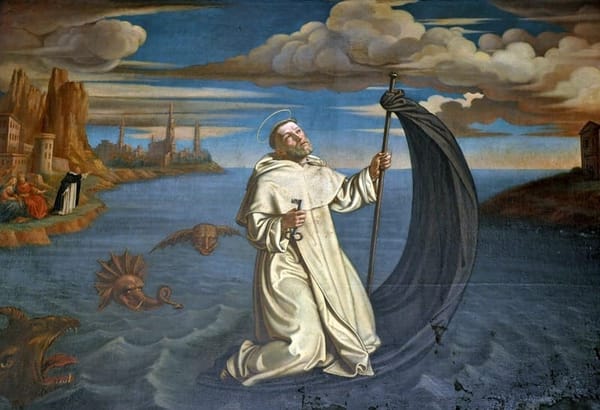
Veste componens, baculoque cymbam, æquora calcat.
Da vitæ tutum sine clade cursum:
Da perennalis sine fine vitæ Tangere portum.
celebrate the glorious name of Raymund,
to whom the salvation of all mankind was an object of loving care.
reflected all the marvels of the mystic life;
and the light of every virtue shines brightly forth in him.
he collects together the scattered Decrees of the Sovereign Pontiffs,
and all the sacred maxims of the ancient Canons, so worthy to be handed down to all ages.
he spreads his mantle, and his staff the mast,
he rides upon the waves.
with innocence and safety,
and reach at length the port of life eternal.
Faithful dispenser of the Mystery of reconciliation! It was from the Heart of an Incarnate God that thou didst draw the sweet charity which made thee the friend of the sinner. Thou didst love thy fellow-men, and didst labour to supply all their wants, whether of soul or body. Enlightened by the rays of the Sun of Justice, thou hast taught us how to discern between good and evil by giving us those rules whereby our wounds are judged and healed. Rome was the admirer of thy knowledge of her laws, and it is one of her glories that she received from thy hand the sacred Code whereby she governs the Churches of the world.
Excite in our hearts, O Raymund! that sincere compunction which is the condition required of us when we seek our pardon in the Sacrament of Penance. Make us understand both the grievousness of mortal sin, which separates us from our God for all eternity, and the dangers of venial sin, which disposes the tepid soul to fall into mortal sin. Pray, that there may abound in the Church men Med with charity and learning, who may exercise that sublime ministry of healing souls. Preserve them from the two extremes of rigorism, which drives to despair, and of laxity which flatters into sloth. Revive amongst them the study of the holy Canons, which can alone keep disorder and anarchy from the fold of Christ. Oh! thou that hadst such tender love for captives, console all that are pining now in exile or in prison; pray for their deliverance; and pray that we all may be set loose from the ties of sin, which but too often make them slaves in their souls who boast of their outward liberty.
Thou wast the confidant of the Heart of Mary, the Queen of Mercy, and she made thee share with her in the work of the Redemption of Captives. Pray for us to this incomparable Mother of God, that we may have the grace to love the Divine Child she holds in her arms. May she be induced, by thy prayers, to be our Star on the Sea of this world, more stormy by far than that which thou didst pass, when sailing on thy miraculous bark.
Remember, too, thy dear Spain, where thou didst pass thy saintly life. Her Church is in mourning, because she has lost the Religious Orders which made her so grand and so strong: pray that they may be speedily restored to her, and assist her as of old. Protect the Dominican Order, of whose Habit and Rule thou wast so bright an ornament. Thou didst govern it with great prudence whilst on earth; now that thou art in heaven, be a father to it by thy love. May it repair its losses. May it once more flourish in the universal Church, and produce, as in former days, those fruits of holiness and learning which made it one of the chief glories of the Church of God.
* Deut. xvii 8. ↩︎
January 23 (the Same Day): St. Ildephonsus, Bishop and Confessor
The Gothic Church of Spain deputes, today, one of her most glorious Prelates, to represent her at the Crib of the Divine Babe, and to celebrate his ineffable Birth. The praise, which falls from Ildephonsus’ lips, seems, at our first hearing it, to have the Mother’s dear honour for its only theme: but, how can we honour the Mother, without at the same time proclaiming the praise of the Son, to whose Birth she owes all her greatness?
Among the glorious Pontiffs, who honoured the noble episcopate of Spain, during the 7th and 8th centuries—for example: Leander, Isidore, Fulgentius, Braulio, Eugenius, Julian, Helladius—among them, and in the foremost rank, stands Ildephonsus, with his glory of having been the Doctor of the Virginity of the Mother of God, just as Athanasius is the Doctor of the Divinity of the Word, Basil the Doctor of the Divinity of the Holy Ghost, and Augustine the Doctor of Grace. The holy Bishop of Toledo has treated the dogma of Mary’s Virginity in all its completeness. With profound learning and with fervid eloquence, he proves, against the Jews, that Mary conceived without losing her Virginity; against the followers of Jovinian, that she was a Virgin in her Delivery; against the disciples of Helvidius, that she remained a Virgin, after she had given birth to her Divine Son. Other holy Doctors had treated separately on each of these sublime questions, before our Saint: but he brought together all their teachings, and merited that a Virgin-Martyr should rise from her tomb to thank him for having defended the honour of the Queen of Heaven. Nay, Mary herself, with her own pure hand, clothed him with that miraculous Chasuble, which was an image of the robe of light wherewith Ildephonsus shines now in heaven, at the foot of Mary’s Throne.
The Monastic Breviary gives us the following Lessons, in the Office of our holy Bishop.
We salute thee with devout hearts, O holy Pontiff! who standest pre-eminent in thy love of the Mother of God, even in that glorious Spain, where her honour has had such brave defenders. Come, and take thy place near the Crib of Jesus, where this incomparable Mother is watching over this Babe, who, being both her God and her Son, consecrated her virginity, but did not impair it.1 Pray for us to her, and remind her that she is our Mother also. Ask her to receive the hymns we sing in her honour, and to bless the offering we make of our hearts to her divine Son. That our prayer may find a readier welcome from this august Queen, we will make use of thy own words, O holy Doctor of Mary’s Virginity; and thus will we speak to her:
I come to thee, the sole Virgin-Mother of God; I prostrate myself before thee, the sole co-operatrix of the Incarnation of my God; I humble myself before thee, that wast alone found worthy to be the Mother of my Lord; I pray to thee, the Handmaid, unlike all others, of thy Son, that thou obtain for me the forgiveness of my sins, that thou procure for me the being cleansed from my evil deeds, that thou get me a love of thy grand glory, that thou reveal unto me the exceeding sweetness of thy Jesus, that thou grant me to proclaim and defend the purity of our holy Faith. Grant, that I may cling to my God and to thee, and be faithful to thy Son and to thee—to him as my Creator, to thee as Mother of my Creator; to him as the Lord of hosts, to thee as the Handmaid of the Lord of all; to him as God, to thee as Mother of God; to him as my Redeemer, to thee as the instrument of my redemption.
He became the price of my ransom, but he became so by his becoming incarnate from thy flesh. He assumed a mortal Body, but he took it from thine, and with this his sacred Body he blotted out my sins. My own human nature, which he took to his kingdom, and set it, above the Angels, on the right hand of his Father, he took from thy pure flesh and blood, when he humbled himself and was made Man.
I, then, am thy servant, O Mary! because thy Son is my Lord. Thou art our Lady, because thou art the Handmaid of our Lord. I am the servant of the Handmaid of my Lord, because thou, that art our Lady, wast made Mother of my Lord. I pray thee, I fervently pray thee, O Holy Virgin! that I may receive Jesus by that Holy Spirit, by whom thou didst become Mother of Jesus. May I be made to know Jesus by that Holy Spirit, by whom thou didst know, and possess, and bring forth Jesus. May I speak of Jesus in that same Holy Spirit, in whom thou didst confess thyself the Handmaid of the Lord. May I love Jesus in that same Holy Ghost, in whom thou adorest him as thy God, and gazest upon him as thy Son. And may I obey this thy Jesus as faithfully, as he himself, though God, was subject to thee, and to Joseph.2
January 23 (the Same Day): St. Emerentiana, Virgin and Martyr
Commemoration of Saint Emerentiana
Three days have scarcely passed since the martyrdom of St Agnes, when the Liturgy, so jealous of every tradition, invites us to visit the Martyr's tomb. There we shall find a young Virgin named Emerentiana; she was the friend and foster-sister of our dear little heroine, and has come to pray and weep at the spot where lies her loved one, so soon and so cruelly taken from her. Emerentiana has not yet been regenerated in the waters of Baptism; she is going through the exercises of a Catechumen; but her heart already belongs, by faith and desire, to Jesus.
Whilst the young girl is pouring forth her grief over the tomb of her much loved Agnes, she is surprised by the approach of some pagans; they ridicule her tears, and bid her pay no more of this sort of honour to one who was their victim. Upon this, the child, longing as she was to be with Christ, and to be clasped in the embraces of her sweet Agnes, was fired with holy courage—as well she might near such a Martyr's tomb—and turning to the barbarians, she confesses Christ Jesus, and curses the idols, and upbraids them for their vile cruelty to the innocent Saint who lay there.
This was more than enough to rouse the savage nature of men, who were slaves to the worship of Satan; and scarcely had the child spoken, when she falls on the tomb, covered with the heavy stones thrown on her by her murderers. Baptized in her own blood, Emerentiana leaves her bleeding corpse upon the earth, and her soul flies to the bosom of God, where she is to enjoy, for ever, union with him, in the dear company of Agnes.
Let us unite with the Church, which so devoutly honours these touching incidents of her own history. Let us ask Emerentiana to pray that we may have the grace to be united with Jesus and Agnes in heaven; and congratulate her on her triumph, by addressing her in the words of the holy Liturgy.
| Previous January 22: Sts. Vincent and Anastasius, Martyrs | Next January 23: St. Raymond Pennafort, Confessor |