Daily reading
Epiphanytide
Semidouble · Temporal
January 30, 2028
From Dom Guéranger’s The Liturgical Year.

|
The Fourth Sunday after Epiphany
Mass
Introit
Collect
Then are added the Collects special to the season of Christmas, in honour of our Lady, against the persecutors of the Church, or for the Pope; which are given above, page 251.
Epistle
Cap. XIII.Fratres, nemini quidquam debeatis, nisi ut invicem diligatis: qui enim diligit proximum, legem implevit. Nam: Non adulterabis; Non occides; Non furaberis; Non falsum testimonium dices; Non concupisces, et si quod est aliud mandatum, in hoc verbo instauratur: Diliges proximum tuum sicut teipsum. Dilectio proximi malum non operatur. Plenitudo ergo legis est dilectio.
Ch. XIII.Brethren, owe no man any thing, but to love one another; for he that loveth his neighbour hath fulfilled the law. For, 'Thou shalt not commit adultery: Thou shalt not kill: Thou shalt not steal: Thou shalt not bear false witness: Thou shalt not covet': and if there be any other commandment, it is comprised in this word: 'Thou shalt love thy neighbour as thyself.’ The love of our neighbour worketh no evil. Love, therefore, is the fulfilling of the law.
During this holy season, when the very Son of God is giving so great a proof of his love for man, whose nature he has assumed, the Church is continually exhorting the Faithful, in the words of the Apostle, to practise charity towards each other. Emmanuel comes to us as our Lawgiver: now he has resumed his whole Law in the precept of Love; he is come in order to unite what sin had divided. Let us comply with his divine intentions, and accomplish with earnestness the Law he has imposed upon us.
Gradual
Gospel
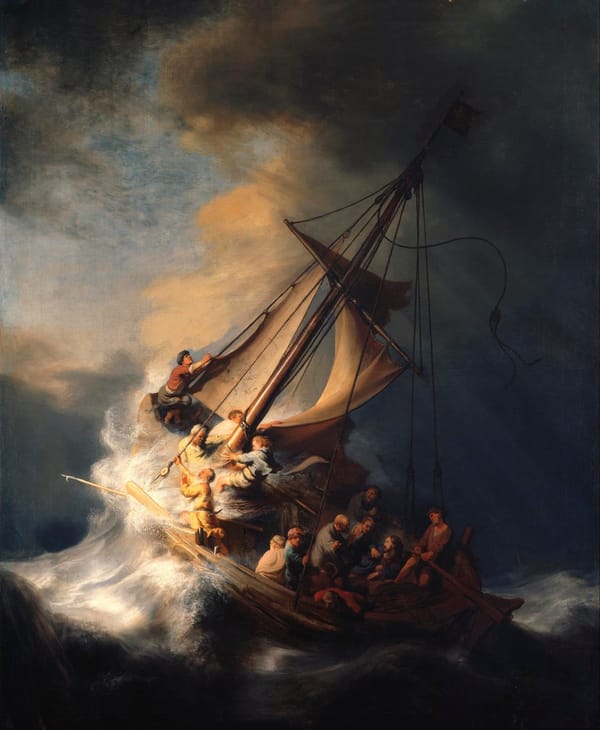
Cap. VIII.In illo tempore, Ascendente Jesu in naviculam, secuti sunt eum discipuli ejus. Et ecce motus magnus factus est in mari, ita ut navicula operiretur fluctibus; ipse vero dormiebat. Et accesserunt ad eum discipuli ejus, et suscitaverunt eum dicentes: Domine, salva nos. perimus. Et dicit eis Jesus: Quid timidi estis, modicæ fidei? Tunc surgens, imperavit ventis et mari, et facta est tranquillitas magna. Porro homines mirati sunt, dicentes: Qualis est hic, quia venti et mare obediunt ei?
At that time, when Jesus entered into the boat, his disciples followed him; and behold a great tempest arose in the sea, so that the boat was covered with waves; but he was asleep. And his disciples came to him, and awakened him, saying: Lord, save us, we perish. And Jesus saith to them: Why are ye fearful, O ye of little faith? Then rising up, he commanded the winds and the sea, and there came a great calm. But the men wondered, saying: What manner of man is this, for the winds and the sea obey him!
Let us adore the power of our Emmanuel, who is come to calm the tempest which threatened the human race with death. In the midst of their danger, the successive generations of men had cried out: Lord! save us; we perish. When the fulness of time had come, he awoke from his rest; he had but to command, and the power of our enemies was destroyed. The malice of the devils, the darkness of idolatry, the corruption of paganism—all yielded. Nation after nation was converted to Jesus. They had said, when in their misery and blindness: 'Who is this Jesus, whom no power can resist?' and then they embraced his Law. This power of Jesus to break down every obstacle, and that, too, at the very time when men were disquieted at his apparent slumbering, has often shown itself in the past ages of the Church. How many times has he not chosen for saving the world that period which seemed the least likely for rescue! The same happens in the life of each one among us. Oftentimes we are tossed to and fro by violent temptations; it would seem as though the billows must sink us; and yet our will is firmly anchored to God! And what is all this, if not Jesus sleeping in the storm-tossed boat, protecting us by this his sleeping? And if our cry for help at length awaken him, it is only to proclaim his own and our victory; for he has already conquered, and we have conquered in him.
Offertory
Secret
To this are added the other Secrets, as given on page 255. The Preface is that of the Blessed Trinity, page 256.
Communion
Postcommunion
Then are added the other Postcommunions, as given on page 257.
Vespers
The Psalms, Antiphons, Capitulum, Hymn and Versicle are given on pages 89-96.
Antiphon of the Magnificat
January 30: St. Martina, Virgin and Martyr
A FOURTH Roman Virgin, wearing on her brow a martyr’s crown, comes today to share the honours given to Agnes, Emerentiana, and Prisca, and offer her palm to the Lamb. Her name is Martina, which the pagans were wont to give to their daughters in honour of their god of war. Her sacred relics repose at the foot of the Capitoline hill, in the ancient temple of Mars, which has now become the beautiful Church of Saint Martina. The holy ambition to render herself worthy of him whom she had chosen as her divine Spouse, gave her courage to suffer torments and death for his sake; so that of her, as of the rest of the martyrs, we may say those words of the Liturgy, washed her robes in the Blood of the Lamb. Our Emmanuel is the Mighty God,1 the Lord that is mighty in war,2 not, like the Mars of the pagans, needing the sword to win his battles. He vanquishes his enemies by meekness, patience, and innocence, as in the martyrdom of today’s Saint, whose victory was grander than was ever won by Rome’s boasted warriors.
This illustrious Virgin, who is one of the Patrons of the City of Rome, is honoured by having her praises sung by one of the Popes. It was Urban the Eighth who wrote the Hymns which are recited on her feast, and which we subjoin to the Lessons which recount the glorious combats of our Saint.
We unite into one the three hymns of Urban the Eighth, in which the holy Church prays for the deliverance of Jerusalem. It is the last cry of the Crusades.
Hymn
Cives Romulei, plaudite gloriæ:
Insignem meritis dicite Virginem,
Christi dicite Martyrem.
Inter delicias, inter amabiles
Luxus illecebras, ditibus affluit
Faustæ muneribus domus.
Se rerum Domino, et munifica manu
Christi pauperibus distribuens opes,
Quærit præmia cœlitum.
Non virgæ horribili vulnere commovent :
Hinc lapsi e Superum sedibus Angeli
Cœesti dape recreant.
Se rictu placido projicit ad pedes;
Te, Martina, tamen dans gladius neci
Cœli coetibus inserit.
Quæ fumat, precibus jugiter invocat,
Et falsum perimens auspicium, tui
Delet nominis omine.
Da pacis requiem Christianum plagis;
Armorum strepitus, et fera prælia
In fines age Thracios.
Vexillo, Solymas nexibus exime,
Vindexque innocui sanguinis hosticum
Robur funditus erue.
Nostrarum obsequium respice mentium :
Romæ vota libens excipe, quæ pio
Te ritu canit, et colit.
Tu, qui Martyribus dexter ades, Deus
Une, et Trine, tuis da famulis jubar,
Quo clemens animos beas.
of the glorious Martina.
Sing the praises of this admirable Virgin
and Martyr of Christ.
and was brought up in every delicacy,
surrounded by all that could pamper nature,
and with riches of a princely house at her command.
dedicates herself to the Creator of all things,
and with a liberal hand distributes her riches to the poor of Christ,
that she may gain the riches of heaven.
or the cruel wound-inflicting rods.
Angels descend from heaven,
comforting her with divine food.
and tamely come crouching at her feet.
The sword, Martina! gave thee the wished-for death,
and death united thee to the choirs of heaven.
where clouds of incense shroud devotion's love;
and thy blessed name banishes
that of the false deity Mars.
and give to Christian countries the rest of holy peace,
driving unto Thracian coasts
the din of arms and war.
deliver Jerusalem from her chains.
Avenge innocent blood,
and once for all crush down the Turkish foe,
see this homage of our loving hearts.
Hear the prayers of thy Rome,
which on this festive day offers thee its hymns and reveres thy name.
take from us the pleasures which would make us fall.
O Triune God! give to thy servants the blessed light,
wherewith thy mercy crowns the soul with bliss.
Thus does Christian Rome hymn thy praises, O generous Martyr! and whilst praising, begs thee to protect her with thy loving care. She is safe from danger, if shielded by such watchfulness as thine. Hear her prayers, and drive far from the Holy City the enemies that would plot her ruin. She has foes more to be dreaded than they that attack her walls with the cannon of their fierce artillery; she has them who plot the destruction of her independence. Disconcert these plans of perfidy, and remember, O Martina! that the City which now asks thy aid was the mother that trained thee to be a martyr.
Obtain for us from Jesus, thy Spouse, the courage to destroy those idols of our affections, to which we are so prone to offer the sacrifice of our hearts. The enemies of our salvation are untiring in their attacks upon our frailty; oh! stretch out to us thy helping hand; that hand which made the idols of Rome tremble, is not less powerful now to stay the violence of the world that threatens to destroy our souls. Thy own brave combats have given thee a place of honour near our Redeemer’s Crib: if, like thee, we will but resist and conquer, this Mighty God will welcome us, too, and bless us. He came into this world that he might vanquish our enemies, but he requires of us to share with him the toils of the battle. Pray for us, O Martina! that our confidence in God may ever be accompanied by diffidence in ourselves, and we shall never be cowards in the great contest for heaven!
| Previous January 29: St. Francis of Sales, Bishop | Next January 30: St. Martina, Virgin and Martyr |