Daily reading
Lent
Double · March 17 · Sanctoral
March 17, 2028
From Dom Guéranger’s The Liturgical Year.
A Double leads the weekday.Rubric
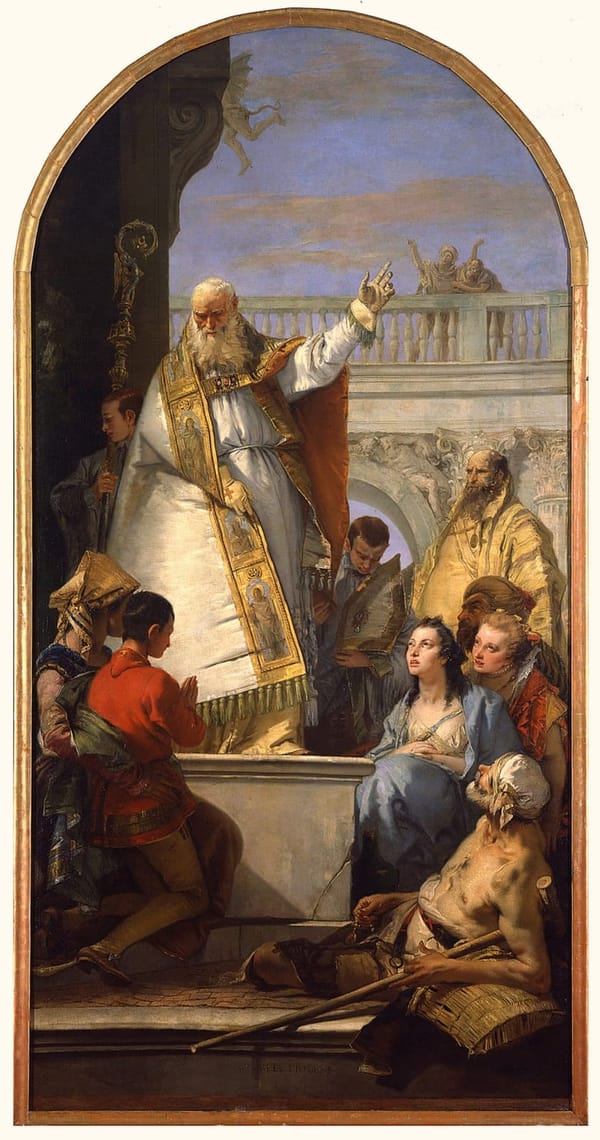 |
March 17: St. Patrick, Apostle of Ireland, Bishop and Confessor
The saint we have to honour to-day is the apostle of that faithful people, whose martyrdom has lasted three hundred years: it is the great St. Patrick, he that gave Erin the faith. There shone most brightly in this saint that gift of the apostolate, which Christ has left to His Church, and which is to remain with her to the end of time. The ambassadors or missioners, sent by our Lord to preach His Gospel, are of two classes. There are some who have been entrusted with a small tract of the Gentile world; they had to sow the divine seed there, and it yielded fruit more or less according to the dispositions of the people that received it: there are others, again, whose mission is like a rapid conquest, that subdues a whole nation, and brings it into subjection to the Gospel. St. Patrick belongs to this second class; and in him we recognize one of the most successful instruments of God's mercy to mankind.
And then, what solidity there is in this great saint’s work! When is it that Ireland received the faith? In the fifth century, when Britain was almost wholly buried in paganism; when the race of the Franks had not as yet heard the name of the true God; when Germany had no knowledge of Christ’s having come upon the earth; when the countries of northern Europe deeply slumbered in infidelity: yes, it was before these several nations had awakened to the Gospel, that Ireland was converted. The faith, brought to her by her glorious apostle, took deep root and flourished and fructified in this isle, more lovely even by grace than she ifl by nature. Her saints are scarcely to be numbered, and went about doing good in almost every country of Europe; her children gave, and are still giving, to other countries, the faith that she herself received from her beloved patron. And when the sixteenth century came with its protestantism; when the apostasy of Germany was imitated by England, Scotland, and the whole north of Europe, Ireland stood firm and staunch; no persecution, however cleverly or however cruelly carried on against her, has been able to detach her from the faith taught her by Saint Patrick.
Let us honour the admirable apostle, chosen by God to sow the seed of His word in this privileged land; and let us listen to the simple account of his labours and virtues, thus given in the lessons of his feast:
The following sequence, in honour of our saint, is taken from an ancient manuscript missal, published by Messingham, in his Florilegiam Insulœ Sanctorum, Paris, 1624:
Sequence
Qua conscendit ad superna
Vir Dei Patricius.
Puer bonus Christi crucem
Veneratur ocyus.
Fons erupit, donum lucis
Cæco nato præbuit.
Quo nutrici, quæ languebat,
Sanitatem tribuit.
Fit cuetos porcorum:
Aurum quo redimitur
Reperit decorum.
Satan hunc vexavit:
Sed Helias artuum
Robur reparavit.
Moribus imbutus,
Corpus abstinentiis,
Moysen secutus;
In montis cacumina
Scandit et jejunat;
Glacierum fragmina
Succendens adunat.
Documentis et doctrina
Studet evangelicis.
Doctor est, nutu divino,
Transmissus Hibemicis.
Fur punitur plagie duris,
Et ejus successio.
Obiit ante, post revectus
Orante Patricio.
Prece congregata
Pellit ab Hibernia,
Mari liberata.
Cœlos aliquoties
Apertos aspexit;
Et Jesum suspiciens
Dominum conspexit.
Transit pater ab hac luce
Signis plenus,
Christo duce,
Lucie ad palatium.
Confer, bone Jesu, tua
Pietate gaudium.
whereon Patrick, the man of God,
ascended to heaven!
the holy youth devoutly venerated
the cross of Christ.
a fount gushed forth upon the spot,
and with its waters he gave sight to one born blind.
and by it restored
his nurse to health.
and was made keeper of swine:
but the saint found a piece of glittering gold,
and with it bought his freedom.
with bodily injuries;
but Elias healed him,
and gave him back his strength.
and, like Moses,
he restrained his body
from vices by fasting.
He ascends a high mountain,
and there he fasts.
He throws ice upon a fire,
and it burns as though it were wood.
and teaching of Germanus,
and studies under him the maxims of the Gospel.
sends him to teach salvation
to the people of Hibernia.
was discovered by its bleating;
and he and his family were punished with a severe scourge.
and asked to be restored to health. He was first punished with real death,
and was then restored to life by Patrick’s prayer.
all venomous reptiles,
and drove them from Hibernia’s shore.
At times, he saw
the heavens opened;
and as he gazed above,
he saw the Lord Jesus.
Our father passed out of this world,
under the guidance of Christ;
and, glorious by his miracles,
he was taken to the courts
of heavenly light.
by his intercession,
that we may enter into joy.
The following antiphons and prayers are taken from the Officium Sancti Patricii, Paris, 1622:
Another favourite antiphon, used in the ancient Proper Office of St. Patrick, was composed of the words spoken to him by the angel:
We conclude these liturgical extracts with a prayer from an ancient manuscript breviary of Armagh.
Prayer
Thy life, great saint, was spent in the arduous toils of an apostle; but how rich was the harvest thou didst reap! Every fatigue seemed to thee light, if only thou couldst give to men the precious gift of faith; and the people to whom thou didst leave it have kept it with a constancy which is one of thy greatest glories. Pray for us, that this faith, without which it is impossible to please God,1 may take possession of our hearts and minds. It is by faith that the just man liveth,2 says the prophet, and it is faith that, during this holy season of Lent, is showing us the justice and mercy of God, in order that we may be converted, and offer to our offended Lord the tribute of our penance. We are afraid of what the Church imposes on us, simply because our faith is weak. If our principles were those of faith, we should soon be mortified men. Thy life, though so innocent, and so rich in good works, was one of extraordinary penance: gain for us thy spirit, and help us to follow thee, at least at a humble distance. Pray for Erin, that dear country of thine, which loves and honours thee so fervently. She is threatened with danger even now, and many of her children have left the faith thou didst teach. An odious system of proselytism has disturbed thy flock; protect it, and suffer not the children of martyrs to be apostates. Let thy fatherly care follow them that have been driven by suffering to emigrate from their native land: may they keep true to the faith, be witnesses of the true religion in the countries to which they have fled, and ever show themselves to be the obedient children of the Church. May their misfortunes thus serve to advance the kingdom of God. Holy pontiff! intercede for England; pardon her the injustice she has shown to thy children; and, by thy powerful prayers, hasten the happy day of her return to Catholic unity. Pray, too, for the whole Church; thy prayer, being that of an apostle, easily finds access to Him that sent thee.
Friday of the Second Week of Lent
The Station for to-day is in the church of Saint Vitalis, martyr, the father of the two illustrious Milanese martyrs, Saints Gervasius and Protasius.
Collect
Epistle
Cap. xxxvii.In diebus illis: Dixit Joseph fratribus suis: Audite somnium meum quod vidi: Putabam nos ligare manipulos in agro: et quasi consurgere manipulum meum, et stare, vestrosque manipulos circumstantes adorare manipulum meum. Responderunt fratres ejus: Numquid rex noster eris? aut subjiciemur ditioni tuæ? Hæe ergo causa somniorum atque sermonum, invidiæ et odii fomitem ministra vit. Aliud quoque vidit somnium, quod narrans fratribus ait; Vidi per somnium quasi solem, et lunam, et Stellas undecim adorare me, Quod quum patri suo et fratribue retulisset, increpavit eum pater suns, et dixit: Quid sibi vult hoc somnium quod vidisti? Num ego, et mater tua, et fratres tui adorabimus te super terram? Invidebant ei igitur fratres sui: pater vero rem tacitus considerabat. Cumque fratres illiue in pascendis gregibus patris morarentur in Sichem, dixit ad eum Israël: Fratres tui pascunt oves in Siohimie: veni, mittam te ad eos. Quo respondente: Præsto sum; ait ei: Vade, et vide si cuneta prospera sint erga fratres tuos, et pecora: et renuntia mihi quid agatur. Missus de valle Hebron, venit in Sichem: invenitque eum vir errantem in agro, et interrogavit quid quæreret. At ille respondit: Fratres meos quæro: indica mihi ubi paecant greges. Dixitque ei vir: Recesserunt de loco isto; audivi autem eos dicentes: Eamus in Dothain. Perrexit ergo Joseph post fratres suos, et invenit eos in Dothain. Qui cum vidissent eum procul, antequam accederet ad eos, cogitaverunt ilium occidere, et mutuo loquebantur: Ecce somniator venit: venite, occidamus eum, et mittamus in cistemam veterem: dicemusque: Fera pessima devoravit eum, et tune apparebit quid illi prosint somnia sua. Audiens autem hoc Ruben, nitebatur liberare eum de manibus eorum, et dicebat: Non interficiatis animam ejus, nec effundatis sanguinem; sed projicite eum in cisternam hane, quæ est in solitudine, manusque vestras servate innoxias. Hoc autem dicebat, volens eripere eum de manibus eorum, et reddere patri suo.
Ch. xxxvii.In those days: Joseph said to his brethren: Hear my dream which I have dreamed. I thought we were binding sheaves in the field; and my sheaf arose, as it were, and stood, and your sheaves, standing about, bowed down before my sheaf. His brethren answered: Shalt thou be our king? or shall we be subject to thy dominion? Therefore this matter of his dreams and words ministered nourishment to their envy and hatred. He dreamed also another dream, which he told his brethren, saying: I saw in a dream, as it were, the sun, and the moon, and eleven stars, worshipping me. And when he had told this to his father and brethren, his father rebuked him and said: What meaneth this dream that thou hast dreamed? shall I and thy mother, and thy brethren, worship thee upon the earth? His brethren therefore envied him, but his father considered the thing with himself. And when his brethren abode in Sichem, feeding their father’s flocks, Israel said to him: Thy brethren feed the sheep in Sichem; come, I will send thee to them. And when he answered: I am ready; he said to him: Go, and see if all things be well with thy brethren and the cattle, and bring me word again what is doing. So being sent from the vale of Hebron, he came to Sichem. And a man found him there wandering in the field, and asked him what he sought. But he answered: I seek my brethren; tell me where they feed their flocks. And the man said to him: They are departed from this place; for I heard them say: Let us go to Dothain. And Joseph went forward after his brethren, and found them in Dothain. And when they saw him afar off, before he came nigh them, they thought to kill him, and said one to another: Behold the dreamer cometh; come, let us kill him, and cast him into some old pit: and we will say: Some evil beast hath devoured him: and then it shall appear what his dreams avail him. And Ruben hearing this, endeavoured to deliver him out of their hands, and said: Do not take away his life, nor shed his blood; but cast him into this pit that is in the wilderness, and keep your hands harmless. Now he said this, being desirous to deliver him out of their hands, and to restore him to his father.
To-day the Church reminds us of the apostasy of the Jewish nation, and of the consequent vocation of the Gentiles. This instruction was intended for the catechumens; let us, also, profit by it. The history here related from the old Testament is a figure of what we read in to-day’s Gospel. Joseph is exceedingly beloved by his father Jacob, not only because he is the child of his favourite spouse Rachel, but also because of his innocence. Prophetic dreams have announced the future glory of this child: but he has brothers; and these brothers, urged on by jealousy, are determined to destroy him. Their wicked purpose is not carried out to the full; but it succeeds at least this far, that Joseph will never more see his native country. He is sold to some merchants. Shortly afterwards, he is cast into prison; but he is soon set free, and is made the ruler, not of the land of Chanaan that had exiled him, but of a pagan country, Egypt. He saves these poor Gentiles from starvation, during a most terrible famine, nay, he gives them abundance of food, and they are happy under his government. His very brothers, who persecuted him, are obliged to come down into Egypt, and ask food and pardon from their victim. We easily recognize in this wonderful history our divine Redeemer, Jesus, Son of God and Son of Mary. He was the victim of His own people’s jealousy, who refused to acknowledge in Him the Messias foretold by the prophets, although their prophecies were so evidently fulfilled in Him. Like Joseph, Jesus is the object of a deadly conspiracy; like Joseph, He is sold. He traverses the shadow of death, but only to rise again, full of glory and power. But it is no longer on Israel that He lavishes the proofs of His predilection; He turns to the Gentiles, and with them He henceforth dwells. It is to the Gentiles that the remnant of Israel will come seeking Him, when, pressed by hunger after the truth, they are willing to acknowledge, as the true Messias, this Jesus of Nazareth, their King, whom they crucified.
Gospel
Cap. xxi.In illo tempore: Dixit Jesus turbis Judæorum, et principibus sacerdotum parabolam hane: Homo erat paterfamilias, qui plantavit vineam, et sepem circumdedit ei, et fodit in ea torcular, et ædifieavit turrim, et locavit eam agricolis, et peregre profectus est. Cum autem tempus fructuum appropinquasset, misit servos suos ad agricolas, ut acciperent fructus ejus. Et agricolæ, apprehensis servis ejus, alium ceciderunt, alium occiderunt, alium vero lapidaverunt. Iterum misit alios servos plures priori bus, et fecerunt illis similiter. Novissime autem misit ad eos filium suum, dicens: Verebuntur filium meum. Agricolæ autem videntes filium, dixerunt intra se: Hic est hæres: venite, occidamus eum, et habebimus hæreditatem ejus. Et apprehensum eum ejecerunt extra vineam, et occiderunt. Cum ergo venerit dominus vineae, quid faciet agricolis illis? Aiunt illi: Malos male perdet: et vineam suam locabit aliis agricolis, qui reddant ei fructum temporibus suis. Dicit illis Jesus: Nunquam legistis in Scripturis: Lapidem quem reprobaverunt ædificantes, hicfactus est in caput anguli? A Domino factum est istud, et est mirabile in oculis nostris. Ideo dico vobis, quia auferetur a vobis regnum Dei, et dabitur genti facienti fructus ejus. Et qui ceciderit super lapidem istum, confringetur: super quem vero ceciderit, conteret eum. Et cum audissent principes sacerdotum et pharisæi parabolas ejus, cognoverunt quod de ipsis diceret. Et quærentes eum tenere, timuerunt turbas: quoniam sicut prophetam eum habebant.
Ch. xxi.At that time: Jesus spoke to the multitude of the Jews, and to the chief priests this parable: There was a man an householder, who planted a vineyard, and made a hedge round about it, and dug in it a press, and built a tower, and let it out to husbandmen, and went into a strange country. And when the time of the fruits drew nigh, he.sent his servants to the husbandmen, that they might receive the fruits thereof. And the husbandmen laying hands on his servants, beat one, and killed another, and stoned another. Again he sent other servants, more than the former; and they did to them in like manner. And last of all he sent to them his son, saying: They will reverence my son. But the husbandmen seeing the son, said among themselves: This is the heir, come, let us kill him, and we shall have his inheritance. And taking him, they cast him forth out of the vineyard, and killed him. When, therefore, the lord of the vineyard shaU come, what will he do to those husbandmen? They say to him: He will bring those evil men to an evil end: and will let out his vineyard to other husbandmen that shall render him the fruit in due season. Jesus saith to them: Have you never read in the Scriptures: The stone which the builders rejected, the same is become the head of the corner? By the Lord this has been done, and it is wonderful in our eyes. Therefore I say to you, that the kingdom of God shall be taken from you, and shall be given to a nation yielding the fruits thereof. And whosoever shall fall on this stone, shall be broken; but on whomsoever it shall fall, it shall grind him to powder. And when the chief priests and pharisees had heard his parables, they knew that he spoke of them. And seeking to lay hands on him they feared the multitude; because they held him as a prophet.
Here we have more than the mere figures of the old Law, which show us our Redeemer in the far distant future; we have the great reality. Yet a little while, and the thrice holy Victim will have fallen beneath the blows of His persecutors. How awful and solemn are the words of Jesus, as His last hour approaches! His enemies feel the full weight of what He says; but, in their pride, they are determined to keep up their opposition to Him, who is the Wisdom of the Father. They have made up their minds not to acknowledge Him to be what they well know He is—the stone, on which he that falls shall be broken, and which shall grind to powder him on whom it shall fall. But what is the vineyard, of which our Lord here speaks? It is revealed truth; it is the rule of faith and morals; it is the universal expectation of the promised Redeemer; and, lastly, it is the family of the children of God, His inheritance, His Church. God had chosen the Synagogue as the depository of such a treasure; He willed that His vineyard should be carefully kept, that it should yield fruit under their keeping, and that they should always look upon it as His possession, and one that was most dear to Him. But, in its hard-heartedness and avarice, the Synagogue appropriated the Lord’s vineyard to itself. In vain did He, at various times, send His prophets to reclaim His rights; the faithless husbandmen put them to death. The Son of God, the Heir, comes in Person. Surely, they will receive Him with due respect, and pay Him the homage due to His divine character! But no; they have formed a plot against Him; they intend to cast Him forth out of the vineyard, and kill Him. Come, then, ye Gentiles, and avenge this God! Leave not a stone on a stone of the guilty city that has uttered this terrible curse: ‘May His Blood be upon us and upon our children!’1 But you shall be more than the ministers of the divine justice; you yourselves are now the favoured people of God. The apostasy of these ungrateful Jews is the beginning of your salvation. You are to be keepers of the vineyard to the end of time; you are to feed on its fruits, for they now belong to you. From east and west, from north and south, come to the great Pasch, that is being prepared! Come to the font of salvation, O ye new people, who are gathered unto God from all nations under the sun! Your mother the Church will fill up from you, if you be faithful, the number of the elect; and when her work is done, her Spouse will return, as the dread Judge, to condemn those who would not know the time of their visitation.2
Let us encourage within ourselves the spirit of humility and penance by the following hymn, which we take from the Greek liturgy. It was composed by St. Andrew of Crete.
Hymn (Feria V. quintæ hebdomadæ)
| Previous Thursday of the Second Week of Lent | Next Friday of the Second Week of Lent |