Daily reading
Lent
Double · March 27 · Sanctoral
March 27, 2028
From Dom Guéranger’s The Liturgical Year.
A Double leads the weekday.Rubric
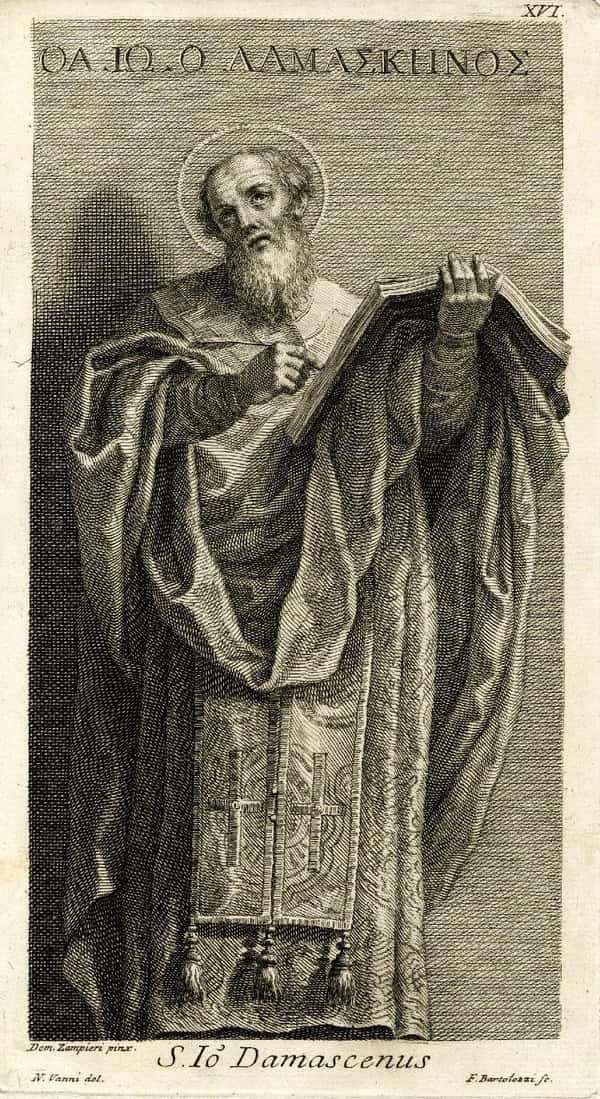 |
March 27: St. John Damascene, Confessor and Doctor of the Church
The faithful have not forgotten that on the first Sunday of Lent the Greeks keep one of their greatest solemnities, that of Orthodoxy. History proves that the Church of Constantinople, the new Rome, did not share the indefectibility of that of the old Rome, for it passed through a cycle of heresies on the dogma of the Incarnation. It rejected successively the consubstantiality of the Word, the unity of Person in Jesus Christ, and the integrity of His two natures. It seemed as though there were nothing left for heretical emperors and patriarchs to deny. Yet there was one more error to proclaim before the measure of false teaching was filled up.
Christ enthroned in heaven could not be belittled, but His images might be proscribed on earth. Heresy was powerless to touch the King even in these pictorial representations, but schism could at least shake off the yoke of His Vicar, and this last denial rolled the stone to the door of a tomb which the Crescent was one day to seal.
The heresy of the Iconoclasts or Image-breakers represents the last phase of Oriental error with regard to the Incarnation of the Son of God. It was right that the feast which commemorates the restoration of the holy Images should receive the glorious name of the Feast of Orthodoxy. It celebrates the last blow struck at Byzantine dogma, and recalls all those delivered by the councils of the Church between the first and second of Nicæa. A peculiar solemnity was given to this feast by the fact that all the anathemas formulated in previous times against the adversaries of revealed truth were renewed in the Church of St. Sophia while the Cross and the holy Images were exalted in triumph and the emperor stood at his throne.
Satan, the sworn foe of the Word, showed clearly that he looked upon the doctrine of the Iconoclasts as his last resource. There is no heresy which has caused more martyrdoms or more destruction. Nero and Diocletian seemed to be reincarnate in the baptized Caesars who defended it: Leo the Isaurian, Constantine Copronymus, Leo the Armenian, Michael the Stammerer and his son Theophilus. The edicts of persecution, published in defence of the idols of former times, were renewed for the destruction of the idolatry which was said to defile the Church.
In the early days of the heresy, St. Germanus of Constantinople reminded the crowned theologian of Isauria that Christians do not adore images but give them a relative honour, which is due to the persons of the saints whom they represent. The imperial pontiff replied by sending the patriarch into exile. The soldiers, whom the emperor charged to carry out his will, gave themselves up to the pillage of churches and private houses. On all sides venerated statues fell under the hammer of the destroyer. Mural paintings were covered with chalk, vestments and sacred vessels mutilated and destroyed on account of images in embroidery or enamel. Masterpieces of art, which had nourished the devotion of the people, were publicly burnt, and the artist who dared to represent Christ, Our Lady, or the saints, was himself subjected to fire and torture together with those of the faithful who had not been able to restrain their sorrow at the sight of such destruction. The shepherds bowed beneath the storm and yielded to re grettable compromises, and the reign of terror was soon supreme over the deserted flock.
But the noble family of St. Basil, both monks and consecrated virgins, rose en masse to withstand the tyrant. They passed through exile, imprisonment, starvation, scourging, death by drowning and the sword, but they saved the tradition of ancient art and the faith of their ancestors. The whole Order seems personified in the holy monk and painter Lazarus, who was first tempted by flattery and threats, then tortured and put in chains. It was impossible to repress him. His hands were burned with red-hot plates, but he still continued to exercise his art for the love of the saints, for the sake of his brethren, and for God, and he outlived his persecutors.
The heresy of the Iconoclasts helped, moreover to establish the temporal independence of the Roman pontiffs, for when the Isaurian threatened to enter Rome and destroy the statue of St. Peter, all Italy rose to repel the invasion of these new barbarians, defend the treasures of her basilicas and withdraw the Vicar of Christ from the yoke of Byzantium.
It was a glorious period, a hundred and twenty years, comprising the reigns of great popes, from St. Gregory II. to St. Paschal I. In the history of the Eastern Church it begins with John Damascene, who saw the opening of the conflict, and ends with Theodore the Studite, whose indomitable firmness secured the final triumph. For many centuries this period, which gave so many saints to the Greek Kalendar, was unrepresented in the Latin Liturgy. The feast of to-day was added by Pope Leo XIII. in 1892, and now John Damascene, the quondam vizier, the protege of Our Lady, the monk, whose excellent doctrine won for him the name of ‘Golden stream,’ commemorates in the Western cycle the heroic struggle in which the East rendered such glorious services to the Church and to the world.
The account given by the Liturgy of the life of this holy Doctor is so complete that we need add nothing further. But it will be well to give a short summary of the definitions by which in the eighth and sixteenth centuries the Church has avenged the holy Images from the attacks made on them by hell. The second Council of Nicæa declares that: ‘It is lawful to place in churches, in frescoes, in pictures, on vestments and the sacred vessels, on the walls of houses and in public streets, images, whether painted or mosaic or of other suitable material, representing Our Lord and Saviour Jesus Christ, our most pure Lady, the holy Mother of God, the angels and the saints; and it is equally lawful to burn incense before them and surround them with lights.’1 ‘Not that we must believe that these images have any divinity or virtue of their own,’ says the Council of Trent against the Protestants, ‘or that we must put our confidence in them as the pagans did in their idols. But the honour which is given to the images is referred to Christ the prototype,2 to whom through them all our adoration is addressed, and to the saints whom we venerate in their portraits.’3
O champion of the holy Images, obtain for us as the Church asks of thee,4 that we may imitate the virtues and experience the aid of those whom we see thus represented. The image directs our veneration and our prayers to those to whom they are due, to Christ the King and to the saints, who are the princes of His army and the most valiant of His soldiers, for it is right that the King should share with His army the honours of His triumph.5 The image is the book of those who cannot read, and even the learned may gain more from an instant’s gazing at an eloquent picture than from the prolonged study of many volumes.6 The work of the Christian artist is not only an act of religion but also an apostolate; thus it is easy to understand the opposition raised by hell in all times of disturbance against Christian art. We unite ourselves with thee, O glorious saint, in thy warfare against the devil, and cry: ‘Get thee behind us, Satan, with that envy which will not suffer us to look upon the image of Our Lord and thus be sanctified. Thou wilt not permit us to contemplate those sufferings which were the source of our salvation, to admire the gracious condescension of our God, to recognize and praise the power displayed in His miracles. Thou art envious of the saints and of the glory they have received from God, and wilt not have us contemplate this glory, lest the sight inspire us to imitate their courage and their faith. Thou canst not endure the thought that our confidence in them will profit us both in soul and in body. We will not follow thee, O jealous demon, thou enemy of mankind.’7
Be thou rather our guide, dear saint, whom sacred science salutes as one of her earliest Doctors.
‘Knowledge is the most precious of all treasures,’8 as thou didst once tell us, and it was thy desire to lead men to the only master who cannot lie, Christ the power and the wisdom of God. If they hear His voice in Holy Scripture, they will gain a true knowledge of all things. If they dispel all darkness of heart and mind, they will not stay on the threshold of the truth, but will pass into the secret of the nuptial chamber.9
Our Blessed Lady herself foretold the teaching and the works of John. She appeared to the master, whose voice he obeyed as that of God, and said to him: ‘Suffer the waters to flow, the clear sweet waters whose abundance will spread throughout the whole world, whose virtue will refresh souls athirst for knowledge and purity, whose power will stay the floods of heresy and transform them into a marvellous sweetness.’
The queen of the heavenly minstrels declared that thou, dear John, hadst received the prophetic harp and psaltery to sing the new canticle of the Lord our God in rivalry with the Cherubim.10 The daughters of Jerusalem, who are the Churches, sing the death and resurrection of Christ,11 and thou art one of the chief cantors. Lead us from the feasts of our exile— the Pasch of time—through the Red Sea and the desert to the eternal feast where all images of earth will vanish before the realities of heaven, where all knowledge will pass into vision, where reigns in glory the queen who inspired thy song, Mary, the mother of us all.
- Concil., Nic. II., sees. vii. ↩︎
- This formula, which gives the true theological basis of the cult of images, is borrowed by the Council of Trent from the second Council of Nicæa, and was originally taken word for word from St. John Damascene, De fide Orthodoxy iv. 16. ↩︎
- Concil., Trident,, sess. xxv. ↩︎
- Collect of the feast. ↩︎
- Damasc., De Imaginibus, i. 19-21. ↩︎
- Damasc., Comment, in Basil. ↩︎
- Ibid., De Imaginibus, iii. 3. ↩︎
- Ibid., Dialectica, i. ↩︎
- Ibid. ↩︎
- Joan. Hierosolymit., Vita J. Dama&ceni, xxxi. ↩︎
- Ibid ↩︎
Monday of the Fourth Week of Lent
The Station is in the venerable church of the Four Crowned (brothers); their names are, Severus, Severianus, Carpophorus, and Victorious; they suffered martyrdom under the persecution of Diocletian. Their bodies, as also the head of the great martyr St. Sebastian, are among the relics of this church.
Collect
Præsta, quæsumus, omnipotens Deus: ut observations sacras annua devotione recolentes, et corpore tibi placeamua et mente. Per Christum Dominum nostrum. Amen.
Grant, we beseech thee, O almighty God, that we, who annually celebrate this holy fast, may be well pleasing to thee, both in body and mind. Through Christ our Lord. Amen.
Epistle
3. Cap. iii.
St. Paul explained to us, in yesterday’s Epistle, the antagonism that there is between the Synagogue and the Church; he showed us how Sara’s son, who was the father’s favourite, was persecuted by the son of Agar. The two women, who appear before Solomon, are another figure of the same truth. The child whom they both claim is the Gentile people, which has been brought to the knowledge of the true God. The Synagogue, typified by the woman who has caused death to her child, has misled the people confided to her care; and now unjustly claims one that does not belong to her. And whereas it is not from any motherly affection, but only from pride, that she puts forward such a claim, it matters little to her what becomes of the child, provided only he be not given to the true mother, the Church. Solomon, the king of peace, who is one of the Scriptural types of Christ, adjudges the child to her that has given him birth, and nourished him; and the pretensions of the false mother are rejected. Let us, then, love our mother, the holy Church, the bride of Jesus. It is she that has made us children of God by Baptism. She has fed us with the Bread of life; she has given us the holy Spirit; and, when we had the misfortune to relapse into death by sin, she, by the divine power given to her, has restored us to life. A filial love for the Church is the sign of the elect; obedience to her commandments is the mark of a soul in which God has set His kingdom.
Gospel
Cap. ii.In illo tempore: Prope erat Pascha Judaeorum, et ascendit Jesus Jerosolymam: et invenit in templo vendentes boves, et oves, et columbas, et nummularios sedentes. Et cum fecisset quasi flagellum de funiculis, omnes ejecit de templo, oves quoque, et boves, et nummulariorum effudit aes, et mensas subvertit. Et his, qui columbas vendebant, dixit: Auferte ista hine, et nolite facere domum Patris mei, domum negotiationis. Recordati sunt vero discipuli ejus quia scriptum est: Zelus domus tuae comedit me. Responderunt ergo Judæi, et dixerunt ei: Quod signum ostendis nobis quia hæc facis? Respondit Jesus, et dixit eis: Solvite templum hoc, et in tribus diebus excitabo illud. Dixerunt ergo Judæi: Quadraginta et sex annis ædificatum est templum hoc, et tu in tribus diebus excitabis illud? Ille autem dicebat de templo corporis sui. Cum ergo resurrexisset a mortuis, recordati sunt discipuli ejus, quia hoc dicebat, et crediderunt Scripturæ, et sermoni quem dixit Jesus. Cum autem esset Jerosolymis in Pascha in die festo, multi crediderunt in nomine ejus, videntes signa ejus, quæ faciebat. Ipse autem Jesus non credebat semetipsum eis, eo quod ipse nosset omnes, et quia opus ei non erat ut quis testimonium perhiberet de homine, ipse enim sciebat quid esset in homine.
Ch. ii.At that time the Pasch of the Jews was at hand, and Jesus went up to Jerusalem And he found in the temple them that sold oxen, and sheep, and doves, and the changers of money sitting. And when he had made as it were a scourge of little cords, he drove them all out of the temple, the sheep also and the oxen; and the money of the changers he poured out, and the tables he overthrew. And to them that sold doves he said: Take these things hence, and make not the house of my Father a house of traffic. And his disciples remembered that it was written: The zeal of thy house hath eaten me up. The Jews therefore answered, and said to him: What sign dost thou shew unto us, seeing thou dost these things? Jesus answered and said to them: Destroy this temple, and in three days I will raise it up. The Jews then said: Six and forty years was this temple in building, and wilt thou raise it up in three days? But he spoke of the temple of his body. When therefore he was risen again fromthe dead, hic disciples remembered that he had said this, and they believed the Scripture, and the word that Jesus had said. Now when he was at Jerusalem, at the Pasch, upon the festival day, many believed in his name, seeing his signs which he did. But Jesus did not trust himself to them, for that he knew all men, and because he needed not that any should give testimony of man, for he knew what was in man.
We read in the Gospel of the first Tuesday of Lent, that Jesus drove from the temple them that were making it a place of traffic. He twice showed this zeal for His Father’s house. The passage we have just read from St. John refers to the first time. Both occasions are brought before us during this season of Lent, because this conduct of our Saviour shows us with what severity He will treat a soul that harbours sin within her. Our souls are the temple of God, created and sanctified by God to the end that He might dwell there. He would have nothing to be in them, which is unworthy of their destination. This is the season for self-examination; and if we have found that any passions are profaning the sanctuary of out souls, let us dismiss them; let us beseech our Lord to drive them out by the scourge of His justice, for we, perhaps, might be too lenient with these sacrilegious intruders. The day of pardon is close at hand; let us make ourselves worthy to receive it. There is an expression in our Gospel which deserves a special notice. The evangelist is speaking of those Jews who were more sincere than the rest, and believed in Jesus, because of the miracles He wrought; he says: Jesus did not trust Himself to them, because He knew all men. So that there may be persons who believe in and acknowledge Jesus, yet whose hearts are not changed! Oh the hardness of man’s heart! Oh cruel anxiety for God’s priests! Sinners and worldlings are now crowding round the confessional; they have faith, and they confess their sins: and the Church has no confidence in their repentance! She knows that, a very short time after the feast of Easter, they will have relapsed into the same state in which they were on the day when she marked their foreheads with ashes. These souls are divided between God and the world; and she trembles as she thinks on the danger they are about to incur by receiving holy Communion without the preparation of a true conversion. Yet, on the other hand, she remembers how it is written that the bruised reed is not to be broken, nor the smoking flax to be extinguished.* Let us pray for these souls, whose state is so full of doubt and danger. Let us, also, pray for the priests of the Church, that they may receive from God abundant rays of that light, whereby Jesus knew what was in man.
Let us pray for the conversion of sinners, using the beautiful Preface given us by the Roman pontifical, and formerly recited during the reconciliation of the public penitents.
Preface
* Is. xlii. 3. ↩︎
| Previous The Fourth Sunday of Lent | Next Monday of the Fourth Week of Lent |