Daily reading
Semidouble · Movable from Easter · Temporal
March 28, 2028
From Dom Guéranger’s The Liturgical Year.
Tuesday of the Fourth Week of Lent
The Station is in the church of Saint Laurence in Damaso; so called, because it was built, in the fourth century, in honour of the glorious archdeacon of Rome, by Pope St. Damasus, whose body rests here.
Collect
Epistle
Cap. xxxii.In diebus illis, locutus est Dominus ad Moysen, dicens: Descende de monte: peccavit populus tuus, quem eduxisti de terra Ægypti. Recesserunt cito de via, quam ostendisti eis: feceruntque sibi vitulum conflatilem, et adoraverunt, atque immolantes ei hostias, dixerunt: Isti sunt dii tui, Israël, qui te eduxerunt de terra Ægypti. Rursumque ait Dominus ad Moysen: Cemo quod populus iste duræ cervicis sit: dimitte me, ut irascatur furor meus contra eos, et deleam eos, faciamque te in gentem magnam. Moyses autem orabat Dominum Deum suum, dicens: Cur, Domine, irascitur furor tuus contra populum tuum, quem eduxisti de terra Ægypti in fortitudine magna, et in manu robusta? Ne, quæso, dicant Ægyptii: Callide eduxit eos, ut interficeret in montibus, et deleret e terra: quiescat ira tua, et esto placabilis super nequitia populi tui. Recordare Abraham, Isaac, et Israël, servorum tuorum, quibus jurasti per temetipsum, dicens: Multiplicabo semen vestrum sicut Stellas cceli; et universam terram hanc, de qua locutus sum, dabo semini vestro, et possidebitis eam semper. Placatusque est Dominus ne faceret malum, quod locutus fuerat adversus populum suum,
Ch. xxxii.In those days, the Lord spoke to Moses saying: Go, get thee down from the mountain: thy people, which thou hast brought out of the land of Egypt, hath sinned. They have quickly strayed from the way which thou didst show them; and they have made to themselves a molten calf, and have adored it, and sacrificing victims to it, have said: These are thy gods, O Israel, that have brought thee out of the land of Egypt. And again the Lord said to Moses: I see that this people is stiff-necked: let me alone that my wrath may be kindled against them, and that I may destroy them, and I will make of thee a great nation. But Moses besought the Lord his God, saying: Why, O Lord, is thy indignation enkindled against thy people, whom thou hast brought out of the land of Egypt, with great power, and with a mighty hand? Let not the Egyptians say, I beseech thee: He craftily brought them out, that he might kill them in the mountains, and destroy them from the earth; let thy anger cease and be appeased upon the wickedness of thy people. Remember Abraham, Isaac and Israël thy servants, to whom thou swarest by thy own self, saying: I will multiply your seed as the stars ofheaven; and this whole land that I have spoken of, I will give to your seed, and you shall possess it for ever. And the Lord was appeased from doing the evil which he had spoken against his people.
When the world first received the preaching of the Gospel, idolatry was the prevailing crime. For many centuries after, all the catechumens, who were instructed in the true faith, were tainted with it. It was in order to inspire them with a horror of their past lives, that the Church read to them, on this day, the terrible words of God, who, had not Moses interceded, was about to exterminate His people, because they had relapsed into idolatry; and this, after He had worked in their favour the most unheard-of miracles, and had come in person to give them His Law. The worship of false gods is no longer to be found amongst us; but it exists in all those countries, where the Gospel has been preached and rejected. Strange as it may sound, yet it is most true: Europe, with all its civilization, would return to idolatry, were it to lose the faith of our Lord Jesus Christ. Not much more than a centqry ago, an idol was erected to reason; it had its altar, its decorations and its incense; and they who paid homage to it were Europeans! Individuals or peoples, once slaves to Satan, are not their own masters to say, ‘We will go thus far in sin, and no farther’The descendants of Noe, notwithstanding the terrible lesson given to them by the deluge, fell into idolatry; nay, Abraham was called by God from the rest of men, lest he should be led away by the almost universal corruption. Let us be grateful to the Church, who, by her teachings of faith and morals, preserves us from this degrading abomination; and let us resist our passions, which, if the light of faith were taken from us, would lead us to idolatry.
Gospel
Cap. vii.In illo tempore: Jam die festo mediante, ascendit Jesus in templum, et docebat. Et mirabantur Judæi, dicentes: Quomodo hic litteras scit, cum non didicerit? Responds eis Jesus, et dixit: Mea doctrina non est mea, sed ejus qui misit me. Si quis voluerit voluntatem ejus facere, cognoscet de doctrina, utrum ex Deo sit an ego a meipso loquar. Qui a semetipso loquitur, gloriam propriam quærit: qui autem quærit gloriam ejus qui misit eum, hic verax est, et injustitia in illo non est. Nonne Moyses dedit vobis legem? et nemo ex vobis facit legem. Quid me quæritis interficere? Respondit turba, et dixit: Dæmonium habes: quis te quærit interficere? Respondit Jesus, et dixit eis: Unum opus feci, et omnes miramini. Propterea Moyses dedit vobis circumcisionem (non quia ex Moyse est, sed ex patribus): et in Sabbato circumciditis hominem. Si circumcisionem accipit homo in Sabbato, ut non solvatur lex Moysi: mihi indignamini quia totum hominem sanum feci in Sabbato? Nolite judicare secundum faciem, sed justum judicium judicate. Dicebant ergo quidam ex Jerosolymis: Nonne hic est quem quærunt interficere? Et ecce palam loquitur, et nihil ei dicunt. Numquid vere cognoverunt principes quia hic est Christus? Sed hunc scimus unde sit: Christus autem cum venerit, nemo scit unde sit. Clamabat ergo Jesus in templo docens, et dicens: Et me scitis, et unde sim scitis: et a meipso non veni, sed est verus qui misit me, quem vos nescitis. Ego scio eum: quia ab ipso sum, et ipse me misit. Quærebant ergo cum apprehendere: et nemo misit in ilium manus, quia nondum venerat hora ej us. De turba autem multi crediderunt in eum.
Ch. vii.At that time: About the midst of the feast, Jesus went up into the temple and taught. And the Jews wondered, saying: How doth this man know letters, having never leamed? Jesus answered them, and said: My doctrine is not mine, but his that sent me. If any man will do the will of him, he shall know of the doctrine whether it be of God, or whether I speak of myself. He that speaketh of himself, seeketh his own glory; but he that seeketh the glory of him that sent him, he is true, and there is no injustice in him. Did not Moses give you the law? And yet none of you keepeth the law. Why seek you to kill me? The multitude answered and said: Thou hast a devil: who seeketh to kill thee? Jesus answered, and said to them: One work I have done, and you all wonder. Therefore Moses gave you circumcision (not because it is of Moses, but of the fathers); and on the Sabbath-day you circumcise a man. If a man receive circumcision on the Sabbath-day that the law of Moses may not be broken, are you angry at me, because I have healed the whole man on the Sabbath-day? Judge not according to the appearance, but judge just judgment. Some therefore of Jerusalem said: Is not this he whom they seek to kill? And behold he speaketh openly, and they say nothing to him. Have the rulers known for a truth that this is the Christ? But we know this man whence he is. But when the Christ cometh, no man knoweth whence he is. Jesus therefore cried out in the temple, teaching and saying: You both know me, and you know whence I am; and I am not come of myself, but he that sent me is true, whom you know not; I know him because I am from him, and he hath sent me. They sought therefore to apprehend him; and no man laid hands on him, because his hour was not yet come. But of the people many believed in him.
This Gospel carries our thoughts to the sacrifice of ihe divine Lamb, which is to be offered up in Jerusalem. The hour has not yet come, but it is fast approaching. His enemies are already seeking how they may put Him to death. So blinded are they by their passions, that they accuse Him of being a violater of the Sabbath, because He healed the sick, by the simple act of His will, on the Lord’s day! In vain does Jesus refute their prejudices, by reminding them that they themselves have no scruple in fulfilling the law of circumcision on this day, or (as He said to them, on another occasion) in drawing out of the pit an ass or an ox that may have fallen in.1 They are deaf to all He says; they are men of one idea, and it is, that their victim shall not escape death. His miracles are incontestable, and all are wrought out of a motive of mercy and love. The only time He refuses to work one, is when His enemies ask Him to satisfy their curiosity and pride by letting them see a sign. This exercise of His power of working miracles, far from exciting them to admiration and gratitude, only incites them to envy, and in their envy, they declare, not only that He acts by Beelzebub,2 but that He has a devil within Him. We shudder at such a blasphemy. Yet, such is the pride of these Jewish doctors that they care neither for common sense nor for religion, and their hearts thirst more and more for the Blood of Jesus. Whilst some of the people allow themselves to be seduced by their leaders into the same feelings against Jesus, others, who affect to be indifferent, reason about Him, and then declare it to be their opinion that this Jesus does not realize in Himself the character of the promised Messias! They argue that, when the Christ cometh no one will know whence He is. But have not the prophets declared that He is to be of the family of David? Now every Jew knows well enough that Jesus is of that royal race. Besides, they own that there is to be something mysterious about the Messias, and that He is to come from God. Had they listened with docile attention to the teachings of Jesus—teachings which He had confirmed by numerous miracles—they would have been enlightened both as to His temporal birth, and to His being the Son of God. But indifference and the perversity of the human heart keep them in culpable ignorance; and, perhaps, on the day of His death, they will join in the cry: ‘Let His Blood be upon us and upon our children!’3
The Greek liturgy supplies us with the following humble act of contrition. We take it from the hymn composed by St. Andrew of Crete.
Canon Magnus
(Feria V. Hebdomadæ V. Jejuniorum)
March 28: St. John Capistran, Confessor
|
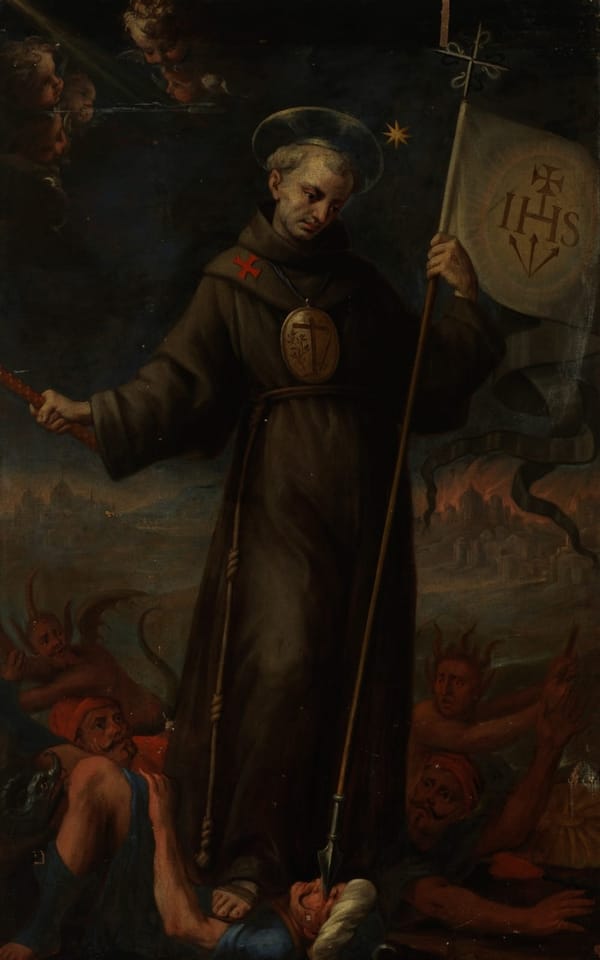
The nearer the Church approaches to the end of her earthly existence, the more she seems to love to enrich her cycle with feasts that recall the glorious past. Indeed, one of the objects of the sacred Liturgy is to keep before our minds all that God has done for us. ‘Remember the days of old: think upon every generation,’1 said God to His people in the alliance of Sinai. It was a law in Jacob that the fathers should hand on these traditions to their children, who were in their turn to transmit them to their descendants.2 The Church has taken the place of the ancient Israel and her annals speak, even more than those of the Jewish people, of the manifestations of divine power. The children of the new Sion have more right than the sons and daughters of Juda to say, as they look back on the past: ‘Thou art thyself my king and my God, who commandest the saving of Jacob.’
At the time when the defeat of the Iconoclasts was being completed in the East, a new and most terrible war was beginning in which the West was to fight for the sake of civilization and for the cause of the Incarnate Word of God. Like a sudden torrent, Islam overwhelmed Eastern Europe, reaching even to Gaul, and for a thousand years it disputed, foot by foot, with Christ and His Chutch, the land occupied by the Latin races. The glorious Crusades of the twelfth and thirteenth centuries, which attacked this power in its very centre, only succeeded in paralyzing it for the time being. In Spain the struggle continued until the triumph of the Cross was complete, but in other parts of Europe Christian princes forgot the traditions of Charlemagne and St. Louis, grew weary of the holy war, and gave themselves up to the pursuit of their private ambition, so that the Crescent was able once more to defy the Christian powers and renew its plan of universal conquest.
In 1453 Byzantium, the capital of the Eastern empire, fell before the Turkish janissaries, and three years later Mahomet II. invested Belgrade on the very outskirts of the Western empire. It might have been expected that all Europe would hasten to the aid of the besieged fortress, for if this last dyke were to fall, Hungary, Austria and Italy would be overwhelmed and the peoples of the North and West would share the fate of the East, that life in death, that irremediable sterility of soil and intelligence which still holds captive the once brilliant Greece. But this imminent danger only resulted in deepening the breach in Christian unity, and the Christian nations were at the mercy of a few thousand infidels. Only the Papacy was true to itself in the midst of all this egoism and perfidy. Truly Catholic in its thoughts, its labours, its sufferings, as in its joys and triumphs, it took up the common cause which had been basely betrayed by kings and princes. The powerful were deaf to the Pope’s appeals, but he turned to the humble and, trusting more in prayer to the God of armies than in military tactics, he sought for the deliverers of Christendom among the poor.
It was then that John Capistran, the saint of to-day, attained the consummation of his glory and his sanctity. At the head of a few poor men of good-will, unknown peasants gathered together by the Franciscan Friars, this ‘poor man of Christ’ undertook to defeat the strongest and best organized army of the century. On July 14, 1456, he broke through the Ottoman lines with John Hunyades, the only one of the Hungarian nobles who would accompany him, and revictualled Belgrade; and on July 22, feeling that he could no longer endure the defensive, he threw himself, to the stupefaction of Hunyades, on the enemy entrenchments. His troops were armed only with flails and pitchforks, and their only strategy was the name of Jesus. John had inherited this victorious battle-cry from his master, Bernardine of Siena. The Psalmist said: ‘Some trust in chariots and some in horses: but we will call upon the name of the Lord our God.’3 This name, so holy and so terrible, proved once more the salvation of the people. At the end of that memorable day twenty-four thousand Turks lay dead on the field of battle; three hundred cannon and all the spoils of the infidels were in the hands of the Christians, and Mahomet II. was seeking a distant hiding-place for his shame. The news of this victory, so like that of Gedeon,4 reached Rome on August 6, and Pope Callistus III. decreed that henceforth the Universal Church should keep a solemn commemoration of the Transfiguration of Our Lord on that day, for it was with the soldiers of the Cross as with the heroes of Israel,5 ‘they got not the possession of the land by their own sword: neither did their own arm save them, but thy right hand and thy arm and the light of thy countenance because thou wast pleased with them,’ as with Thy beloved Son on Mount Thabor.6
Let us read the life of St. John Capistran as related in the Liturgy:
‘The Lord is with thee, O most valiant of men. Go in this thy strength and thou shalt deliver Israel out of the hand of Madian. Know that I have sent thee.’7 Thus did the angel of the Lord salute Gedeon when he chose him from among the least of his people8 to fulfil a high destiny. Thus do we in our turn salute thee, O glorious son of St. Francis of Assisi, and we beseech thee to be our constant aid. The enemy whom thou didst defeat on the field of battle is no longer an imminent peril for the West, but there is a greater danger, as Moses said to his people after their deliverance from Egypt: ‘Take heed and beware lest at any time thou forget the Lord thy God . . . lest after thou hast eaten and art filled, hast built goodly houses . . . and shalt have herds of oxen and flocks of sheep and plenty of gold and of silver, and of all things; thy heart be lifted up and thou remember not the Lord who brought thee out of the house of bondage.’9 If the Turk had conquered in that struggle of which thou wert the hero, what would have become of the civilization of which we are so proud? Since thy day the Church has had once more to champion the cause of Society, which the heads of the nations no longer seem to understand. May the need of giving expression to the gratitude which is due to her preserve her children from the forgetfulness which is the great evil of the present generation. We thank God for the feast of to-day; it is a perpetual memorial of His goodness and of the noble deeds of His saints. Help us to conquer in that warfare which is being incessantly carried on within our own souls against the world, the flesh, and the devil. May the name of Jesus put our enemies to flight, may His Cross be our standard and lead us through the death of self-love to the triumph of the Resurrection.
| Previous Monday of the Fourth Week of Lent | Next March 28: St. John Capistran, Confessor |