Daily reading
Paschal Time
Double · Movable from Easter · Temporal
April 21, 2028
From Dom Guéranger’s The Liturgical Year.
 |
Friday in Easter Week
EIGHT days ago, we were standing near the Cross, on which died the Man of Sorrows,1 abandoned by his Father, and rejected, by a solemn judgement of the Synagogue, as a false Messias: and lo! this is the sixth time the sun has risen upon our earth since the voice of the angel was heard proclaiming the Resurrection of this adorable Victim. The Church, his widowed spouse, then lay prostrate before the justice of the eternal God and Father, who 'spared not even his own Son,’2 because he had taken upon himself the likeness of sin; but now she is feasting in the sight of her Jesus’ triumph, for he bids her be exceeding glad. But if within this glad Octave, there be one day, rather than another, on which she should proclaim his triumph, it assuredly is the Friday; for it was on that day she saw him ‘filled with reproaches’3 and crucified.
To-day, therefore, let us meditate upon our Saviour’s Resurrection as being the zenith of his own dear glory, and as the chief argument whereon rests our faith in his divinity.’If Christ be not risen again,' says the Apostle, ‘your faith is vain:’4 but, because he is risen again, our faith rests on the surest of foundations. Our Redeemer owed it to us, therefore, that our certainty with regard to his Resurrection should be perfect. In order to give this master truth such evidence as would preclude all possibility of doubt, two things were needed: his death was to be certified, and the proofs of his Resurrection were to be incontestable. Jesus fulfilled both these conditions, and with the most scrupulous completeness. Hence his triumph over death is a fact so deeply impressed on our minds, that even now, nineteen hundred years since it happened, we cannot celebrate our Easter without feeling a thrill of enthusiastic admiration akin to that which the guards at his tomb experienced when they found their Captive gone.
Yes, Jesus was truly dead. The afternoon of Friday was at its close, and Joseph of Arimathea and Nicodemus took down the Body from the Cross; they gave it, stiff and covered with blood as it was, to his afflicted Mother Who could doubt of his death? The terrible agony of the previous night, when his human nature shrank at the foresight of the cup he had to drink; the treachery of one, and the infidelity of the rest of his Apostles, which broke his Sacred Heart; the long hours of insult and cruelty, the barbarous scourging, which Pilate devised as a means of softening brutal Jews to pity; the Cross, to which he was fastened with nails that opened four founts of Blood; the anguish of his agonizing Heart, when he beheld his Mother at the foot of the Cross; the burning thirst, which choked the throbs of life still left; the spear that pierced his side through to the very Heart, and drew from it a stream of Blood and water—these are proofs enough that death had made God his victim. Dear Jesus! they are now but so many motives for us to love thy beautiful glory. How could we, for whom thou didst suffer death, be unmindful of the sufferings that caused it? How could we forget them now, for they enhance the splendour of thy Resurrection?
He therefore gained a true victory over death: He appeared on the earth as a conqueror of a very different kind from any that had hitherto been known. Here was a fact which it was impossible to deny: a Man, whose whole life had been spent in obscurity, was put to death by the most cruel tortures, and amidst the insulting shouts of his unworthy fellow-citizens. Pilate sent to the Emperor Tiberius an official account of the judgement and death of One, whom he represented as calling himself the King of the Jews. What would men think, after all this, of them that professed themselves followers of this Jesus? The philosophers, the wits, the slaves of the world and pleasure, would point the finger of scorn at them, and say:’Lo! these are they that adore a God who died on a Cross!’ But if this God rose again from the grave, is not his death an evidence of his divinity? He died, and he rose again; he foretold his death and his Resurrection; who but a God could thus hold in his power 'the keys of death and hell'?5
Yet so it was: Jesus was put to death, and rose again from the grave. How do we know it? By the testimony of his Apostles; they saw him after he had risen, they touched him, they conversed with him for forty days. But are these Apostles to be credited? Surely they are, for never was there a testimony that bore such internal evidence of truth. What interest could these men have in publishing the glory of their Master, who had been put to a death that brought ignominy both upon himself and them, if they knew that he never rose again, as he had promised he would? The chief priests bribed the soldiers to say that while they were asleep his disciples, poor timid men as they were, came during the night and stole away the Body. They thought by this to throw discredit upon the testimony of the Apostles. But what folly! We may justly address to them the sarcastic words of St Augustine: 'What! do you adduce sleeping witnesses? Surely, you yourselves must have been asleep, to have had recourse to such a scheme as this!’6 But, as for the Apostles, what motive could they have for preaching the Resurrection, if it never took place?’In such a supposition,’ says St John Chrysostom, ‘they would have looked upon their Master as a false prophet and an impostor: and is it likely they would go and defend him against the accusations of a whole nation? Would they expose themselves to all manner of suffering for One who had so cruelly deceived them? What was there to encourage them in such an undertaking? The rewards he had promised them? But if he had not fulfilled his promise of rising again, how could they trust to the rest of his promises?’7 No: we must either deny every principle of nature and common sense or we must acknowledge the testimony of the Apostles to be a true one.
Moreover this testimony was the most disinterested that could be, for it brought nothing but persecution and death upon them that gave it. It was a proof that God was with such men as these, who, but a few hours before, had been timid cowards, and now were fearless of every danger, asserting their conviction with an intrepidity which human courage could never inspire, and this too in cities which were very centres of civilization and learning. The world was made to listen to their testimony, which they confirmed by miracles· and thousands of every tongue and nation were converted into believers of Jesus’ Resurrection. When at length, these Apostles laid down their lives for the doctrines they had preached, they left the world in possession of the truth of the Resurrection; and the seed they had sown in lands where even the Roman Empire had not extended its conquests produced a quick and world-wide harvest. All this gave to the astounding fact which they proclaimed a guarantee and a certainty beyond suspicion. It was impossible to. refuse such evidence without going against every principle of reason. Yes, O Jesus! thy Resurrection is as certain as thy death. Thy Apostles could never have preached, they could never have converted the world as they did, unless they had had truth on their side.
But the Apostles are no longer here to give their testimony: the equally solemn testimony of the Church has succeeded to theirs, and proclaims, with a like authority, that Jesus is no longer among the dead. By the Church we here mean those hundreds of millions of Christians, who have proclaimed the Resurrection of Jesus by keeping, for now nineteen hundred years, the feast of the Pasch. And can there be room for doubt here? Who is there that would not assent to what has been thus attested every year since the Apostles first announced it? Among these countless proclaimers of our Lord’s Resurrection, there have been thousands of learned men, the bent of whose mind led them to sift every truth, and who, before embracing the faith, had examined its tenets in the light of reason; there have been millions of others, whose acceptance of a dogma like this, which puts a restraint on the passions, was the result of the conviction that the only way to eternal happiness is in the due performance of the duties this dogma imposes; and, finally, there have been millions of others, who, by their virtues, were the support and ornament of the world, but who owed all their virtues to their faith in the death and Resurrection of Jesus.
Thus, the testimony of the Church, that is of the wisest and best portion of mankind, is admirably united with that of the Apostles, whom our Lord himself appointed as his first witnesses. The two testimonies are one. The Apostles proclaimed what they had seen; we proclaim, and shall proclaim to the end, what the Apostles preached. The Apostles made themselves sure of the Resurrection, which they had to preach to the world; we make ourselves sure of the veracity of their word. They believed after experience; so also do we. They had the happiness of seeing, hearing, and touching the Word of Life;8 we see and hear the Church, which they established throughout the world, although it was but in its infancy when they were taken from the earth. The Church is that tree of which Jesus spoke in the parable, saying, that though exceeding small in its first commencement, it would afterwards spread out its branches far and wide.9 St Augustine in one of his Easter sermons has these fine words:’As yet, we see not Christ; but we see the Church: therefore let us believe in Christ. The Apostles, on the contrary, saw Christ; but they saw not the Church except by faith. They saw one thing, and they believed another: so, likewise, let us do. Let us believe in the Christ, whom as yet we see not; and by keeping ourselves with the Church which we see, we shall come at length to see him, whom as yet we cannot see.’10
Having thus, O Jesus! the certainty of thy glorious Resurrection, as well as that of thy death on the Cross, we confess thee to be the great God, the Creator and sovereign Lord of all things. Thy death humbled, thy Resurrection exalted thee: but thou thyself wast the author of both the humiliation and the exaltation. Thou saidst to thine enemies: ‘No man taketh my life away from me; but I lay it down of myself; and I have power to lay it down, and I have power to take it up again.’11 None but a God could have such power, none but a God could have exercised it as thou hast done: we, therefore, are confessing thy divinity when we confess thy Resurrection. We beseech thee, make worthy of thine acceptance this humble and delighted homage of our faith!
In Rome, the Station is at the church of St Mary ad Martyres. It was the ancient pantheon of Agrippa, and had been dedicated to all the false gods; it was given by the Emperor Phocas to St Boniface IV, who consecrated it to the Mother of God and all the martyrs. It is not known where to-day’s Station was held previously to the seventh century, when this church was chosen. The neophytes were thus assembled, for the second time within the Octave, in a temple dedicated to Mary: it would show them how much the Church desired to inspire them with confidence in her who had become their mother, and whose office it is to lead to her Son all those whom he calls by his grace to become his brethren.
Mass
The Introit, which is taken from the Psalms, reminds the neophytes of the passage through the Red Sea, and how its waters were gifted with the power of delivering the Israelites. The Church continually alludes to this great event, during the whole Paschal Octave.
Introit
Ps. Attendite, popule meus, legem meam: inclinate aurem vestram in verba oris mei.℣. Gloria Patri.
Eduxit.
Ps. Attend, O my people, to my law: incline your ears to the words of my mouth.℣. Glory, etc.
The Lord, etc.
The Pasch is the reconciliation of man with God, for the Father can refuse nothing to such a conqueror as our risen Jesus, his Son. In her Collect, the Church prays that we may ever show ourselves worthy of such a covenant, by faithfully living up to the mystery of the Paschal regeneration.
Collect
To this is added one of the Collects given in Wednesday's Mass, p. 218.
Epistle
I Cap. iii.Charissimi, Christus semel pro peccatis nostris mortuus est, Justus pro injustis, ut nos offerret Deo, mortificatus quidem carne, vivificatus autem Spiritu. In quo et his, qui in carcere erant, spiritibus veniens prædicavit: qui increduli fuerant aliquando, quando exspectabant Dei patientiam in diebus Noe, cum fabricaretur area: in qua pauci, id est octo animæ salvæ factæ sunt per aquam. Quod et vos nunc similis formæ salvos facit baptisma: non carnis depositio sordium, sed conscientiæ bonæ interrogatio in Deum, per Resurrectionem Jesu Christi Domini nostri, qui est in dextera Dei.
I Ch. iii.Dearly beloved: Christ died once for our sins, the just for the unjust; that he might offer us to God, being put to death indeed in the flesh, but enlivened in the spirit. In which also coming, he preached to those spirits that were in prison; which had been some time incredulous, when they waited for the patience of God in the days of Noe, when the ark was a building: wherein a few, that is, eight souls, were saved by water. Whereunto Baptism being of the like form, now saveth you also: not the putting away of the filth of the flesh, but the examination of a good conscience towards God by the Resurrection of Jesus Christ, who is on the right hand of God.
Again it is the Apostle St Peter who speaks to us, and his instructions are of peculiar interest to our neophytes. He begins by telling them how the Soul of our Redeemer descended into limbo; and how, among the prisoners detained there, were some of those who had perished in the deluge, yet had found salvation in its waters. They were at first incredulous, and despised the threats made known to them by Noe; but when the flood came and swept them away, they repented of their sin, and asked and obtained pardon. The Apostle then goes on to speak of the favoured inhabitants of the ark; they are a type of our neophytes, whom we have seen pass through the waters of the font, and thereby become, as did the sons of Noe, fathers of a new generation of children of God. Baptism, says the Apostle, is not like other washings of the body; it is the cleansing of the soul, provided she be sincere in the solemn promise she vows at the font, to be faithful to the Christ who saves her, and to renounce Satan and all that is his. The Apostle concludes by telling us that the mystery of our Saviour’s Resurrection is the source of the grace of Baptism: hence the Church has chosen the feast of Easter for the solemn administration of this Sacrament.
Gradual
The Sequence Victimæ Paschali, p. 145.
Gospel
Cap. xxviii.In illo tempore: Undecim discipuli abierunt in Galilæam, in montem, ubi constituerat illis Jesus. Et videntes eum, adoraverunt: quidam autem dubitaverunt. Et accedens Jesus locutus est eis, dicens: Data est mihi omnis potestas in cœlo, et in terra. Euntes ergo docete omnes gentes, baptizantes eos in nomine Patris, et Filii, et Spiritus Sancti: docentes eos servare omnia quæcumque mandavi vobis: et ecce ego vobiscum sum omnibus diebus, usque ad consummationem sæculi.
Ch. xxviii.At that time: The eleven disciples went into Galilee, unto the mountain where Jesus had appointed them. And seeing him they adored: but some doubted. And Jesus coming, spoke to them, saying: All power is given to me in heaven and in earth. Going, therefore, teach ye all nations: baptizing them in the name of the Father, and of the Son, and of the Holy Ghost. Teaching them to observe all things whatsoever I have commanded you; and behold I am with you all days, even to the consummation of the world.
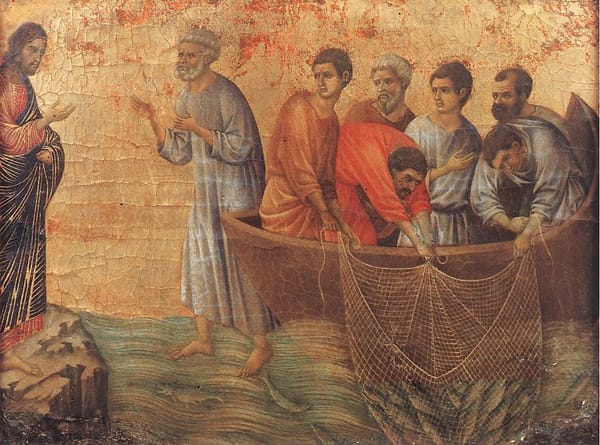
St Matthew's description of the Resurrection is shorter than those given by the other Evangelists; his few brief words on Jesus' appearing to the Apostles in Galilee are the subject of to-day's Gospel. It was in Galilee that our Lord vouchsafed to show himself not only to the Apostles, but moreover to several other persons. The Evangelist tells us how some of those, that were thus favoured, readily believed; and how others doubted, before yielding the assent of their faith. He then relates the words wherewith Jesus gave his Apostles the mission to preach the Gospel to all nations; and since he is to die no more, he promises to be with them for ever, even to the end of the world. But the Apostles are not to live to the end of the world: how, then, will he fulfil his promise? The Apostles, as we said before, are perpetuated by the Church; the two testimonies—of the Apostles and of the Church—are inseparably linked together; and our Lord Jesus Christ preserves this united testimony from error or interruption. The Liturgy of to-day brings before us a proof of its irresistible power. Peter, Paul and John preached Jesus' Resurrection, and established the Christian faith in Rome; five centuries after, the Church, which continued their work, received from an Emperor the gift of the temple, which had once been consecrated to all the false gods, but which St Peter's successor dedicated to Mary, the Mother of God, and to that legion of witnesses of the Resurrection, whom we call martyrs. At the sight of this magnificent edifice, which for three hundred years had been deserted by the pagans, but now is reconciled by the Church, and holds within its walls the Christian people, our neophytes could not refrain from exclaiming: 'Oh! truly is Christ risen, who, after being put to death on the Cross, thus triumphs over the Caesars, and over the gods of Olympus!'
The Offertory is composed of those words of Exodus, wherein God commands his people to celebrate each year the anniversary of the Passover. If this were so for an event which was but figurative, and whose effects did not extend beyond this life, how fervently and joyously ought Christians to keep the anniversary of that other Passover, whose results are to be eternal, and whose divine reality has put an end to all the ancient figures!
Offertory
In the Secret, the Church beseeches God to accept this present Sacrifice for the forgiveness of the sins of her neophytes. But how is this? Their sins have been already effaced. It is true; their sins have been washed away in the waters of Baptism; but God's foreknowledge of the Sacrifice that would now be offered to him, led him to grant his pardon even before the petition for mercy had really been made.
Secret
To this is added one of the Secrets given in Wednesday's Mass, p. 224.
The Communion Anthem joyously proclaims the command, given by our Saviour to his Apostles and his Church, to teach all nations, and to baptize all people. This order is the warrant of their mission. The use made of it by the Apostles, and continued by the Church, during these nineteen hundred years, plainly proves that he who spoke these words is still living, and will for ever live.
Communion
After nourishing her children with the Bread of eternal life, the Church, in the Postcommunion, again prays that they may receive forgiveness of the sins which they commit in this present life, and which would be to their everlasting perdition, were not the merits of our Saviour's death and Resurrection ever present before the justice of God.
Postcommunion
To this is added one of the Post communions given in Wednesday's Mass, p. 225.
This is the sixth day of the creation. Upon it, the hand of the Son of God formed the body of man out of the slime of the earth, into which he breathed a living soul. This was the creature that was to be the king of the visible creation. A simple command of the divine Word had sufficed to call from the earth all the animals that live upon it; but when, towards the close of this great day, the Creator said, 'Let us make man to our image and likeness,' he did more than merely command, he seems to have deliberated: he deigned to become the artificer of his work. Let us adore this his sovereign goodness towards our race, and ever gratefully honour the Friday of each week, as the day whereon the Son of God completed the work he began on the Sunday by the creation of him who was to be master and lord of the world. Nor is this the only mystery that should make Friday dear to us. It was on this same day that the divine Word, having taken upon himself the flesh he himself had made, died upon the Cross, that he might save his rebellious and lost creature man. O sacred day! Day that didst witness both our creation and our redemption! Thou speakest to us of the Son of God, and of his love for us, even more sweetly than of his power! Let us express all this by reciting the following devout prayer, which the Mozarabic Liturgy uses on the Friday of Easter Week:
Capitula
To-day let us hearken to the Church of Armenia celebrating the Resurrection. For thirteen centuries she has sung the following stanzas, which a confrere has translated, for our work, from the hymn book, or Charagan. The sentiment is the same as we find expressed in other Liturgies; but there is, moreover, the style peculiar to the Armenian character. The reader will be pleased with the fragrance of antiquity which he will find in these verses, whose vigorous and solemn lyric beauty surpasses that of the liturgical compositions of the Greek Church.
In Resurrectione Domini
We are far from having exhausted the treasury of Adam of St Victor: let us take another of his sequences. The one we select seems the most appropriate to the Friday of the Easter Octave.
Sequence
Die Christus tertia resurrexit;
Surgens cum victoria,
Collocat in gloria quos dilexit.
Crucis in patibulo immolatur;
Clauditur in tumulo,
Tandem in diluculo suscitatur.
Nobis est præsidio,
Si credamus: Christi resurrectio
Facit ut a vitio resurgamus.
Christus fuit moriens pro peccato;
Sanguinis effusio
Abluit nos, impio triumphato.
Nostræ morti duplici fert medelam:
Vitae pandit aditum,
Nostrum sanat gemitum et querelam.
Dat signum potentiæ, resurgendo,
Principem nequitiæ,
Per arma justitiæ, devincendo.
Fecit, in qua facinus mundi lavit,
In qua mors occiditur,
In qua vita redditur, hostis ruit.
Alleluia canitur, corde puro;
Quia culpa tollitur
Et vita promittitur in futuro.
Fac tuos resurgere, Jesu Christe;
Salutaris omnibus
Sit tuis fidelibus dies iste.
he rose again on the third.
By his victorious Resurrection,
he shares his own glory with those he loves.
for his faithful people;
he is placed in the tomb:
he rises at dawn of day.
the Cross and Passion of Christ are a safeguard:
his Resurrection gives us
to rise from our sins.
was our all-sufficient victim:
the shedding of his Blood was our purification,
and the defeat of our wicked enemy.
for ours that was twofold:
it opens to us the way of life,
and takes away our mourning and grief.
give proof of power by rising,
and conquering the prince of wickedness
by the armour of justice.
for on it the world was cleansed of its crimes,
death was slain, life was restored,
and the enemy defeated.
and with a pure heart, should be sung to-day;
for sin is taken away,
and life is promised for the future.
to rise again when the evening of this world sets in!
May this present day
be one of grace to all thy faithful.
April 21: St. Anselm, Bishop, and Doctor of the Church
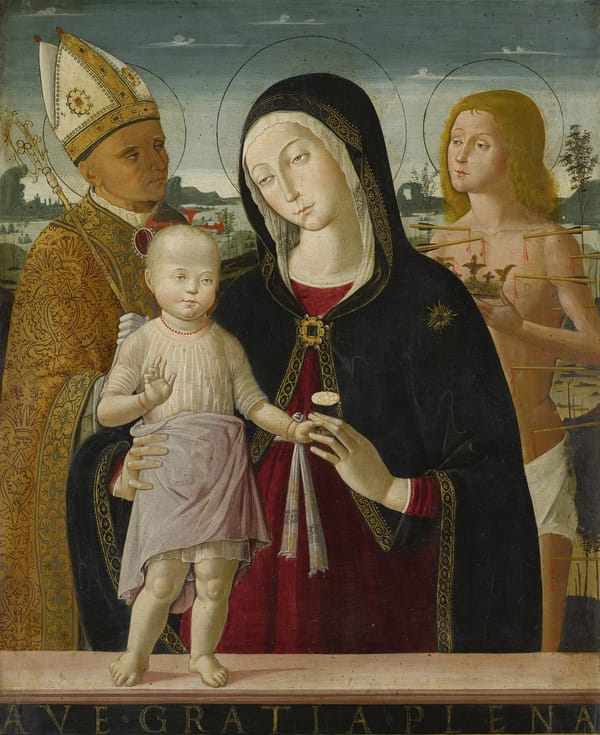 |
A MONK, a Bishop, a Doctor of the Church—such was the Saint whose feast comes to gladden us on this twenty-first day of April. He was a martyr, also, at least in desire, and we may add, in merit too—for he did enough to earn the glorious palm. When we think of Anselm, we picture to ourselves a man in whom are combined the humility and meekness of the cloister with the zeal and courage of the episcopal dignity; a man who was both a sage and a saint; a man whom it was impossible not to love and respect.
He left his native country of Piedmont for the Monastery of Bec in France, where he became a Benedictine monk. Being elected Superior, he realized in himself the type of an Abbot, as drawn by St Benedict in his Rule: ‘He that is made Abbot,’ says the holy Patriarch, ‘should study to give help rather than to give commands,’1 We read that the love entertained for Anselm by his brethren was beyond description. His whole time was devoted to them, either in giving them spiritual direction, or in communicating to them his own sublime knowledge of the sacred sciences. After governing them for several years, he was taken from them, and compelled to accept the dignity of Archbishop of Canterbury. He was a worthy successor of Augustine, Dunstan, Elphege, and Lanfranc; and by his own noble example of courage, he prepared the way for the glorious martyr Thomas, who succeeded him in less than a century.
As bishop, his whole life was spent in fighting for the liberty of the Church. Though gentle as a lamb by nature, he was all energy for this great cause. He used to say: ‘Christ would not have his Spouse be a slave; there is nothing in this world that God loves more than the liberty of his Church.’ There was a time when the Son of God allowed himself to be fettered with bonds in order that he might loosen us from the chains of our sins; but now that he has risen in triumph from the dead, he wills that his Spouse should be, like himself, free. She cannot otherwise exercise the ministry of salvation confided to her by her divine Lord; and yet there is scarcely a single hundred years of her existence in which she has not had to fight for this holy liberty. The rulers of this earth, with very few exceptions, have ever been jealous of her influence, and have sought to lessen it by every possible means. In our own times there are numbers of her children who do not even know that she has any rights or privileges; they would be at a loss to understand you, if you told them that she is the Spouse of Christ, and therefore a queen; they think it quite enough for her, if she enjoy the same amount of freedom and toleration as the sects she condemns; and they cannot see how, under such conditions as these, the Church is not the kingdom he wished her to be, but a mere slave. St Anselm would have abominated all such theories as these; so does every true Catholic. He is not driven into disloyalty to the Church by the high-sounding words, progress and modern society; he knows that there is nothing on earth equal to the Church; and when he sees the world convulsed by revolutions, he knows that all comes from the Church having been deprived of her rights. One of these is that she should not only be recognized, in the secret of our conscience, as the one only true Church, but that, as such, she should be publicly confessed and outwardly defended against every opposition or error. Jesus, her divine Founder, promised to give her all nations as her inheritance; he kept his promise, and she was once the Queen and Mother of them all. But nowadays, a new principle has been asserted, to the effect that the Church and all sects must be on an equal footing as far as the protection of the State goes. The principle has been received with acclamation, and hailed as a mighty progress achieved by modern enlightenment: even Catholics, whose previous services to religion had endeared them to our hearts and gained our confidence, have become warm defenders of the impious theory.
Trying as were the times when St Anselm governed the See of Canterbury, they were spared the humiliation of producing and ratifying such doctrine as this. The tyrannical interference of the Norman kings was an evil far less injurious than the modern system, which is subversive of the very idea of a Church. Open persecution would be a boon, compared to the fashionable error of which we are speaking. A winter torrent brings desolation in its track: but in the summer, when the flood is over, nature brings back her verdure and flowers. The errors which now prevail are like a great sea that gradually sweeps over the whole earth: and when the Church can find no spot whereon to rest, she will take her flight to heaven, and men must expect the speedy coming of the judge.
Anselm was not only the zealous and heroic defender of the rights and privileges of the Church; he was also a light to men by his learning. The contemplation of revealed truths was his delight. He studied them in their bearings one upon the other, and his writings occupy a distinguished place in the treatises of Catholic Theology. God had blessed him with extraordinary talent. Amidst all the troubles and anxieties and occupations of his various duties, he found time for study. Even when passing from place to place, as an exile, he was intent on the meditation of the mysteries of religion, thus preparing those sublime reflections which he has left us on the articles of our Faith.
The Church gives us, in her Liturgy, the following sketch of our Saint’s life:
We take the following Responsories and Antiphons from an office approved by the Holy See:
℣. Afflictions await me; but I fear none of them, so that I may consummate my course.* And your joy shall soon be changed into mourning, alleluia.℟. When the Fathers were assembled in Council, Urban, the Pope, cried out: Where art thou, Father and Master Anselm, Archbishop of the English? Come up here to us; fight for thine own and our Mother, and help us, alleluia.℣. Blessed be thy wisdom, and blessed the word of thy mouth!* Come up here to us; fight for thine own and our Mother, and help us, alleluia.
The following hymn is from the same Office:
Hymn
Laurea doctor redimitus astat:
Festus Anselmo chorus æmuletur
Dicere carmen.
Sæculi florem pereuntis horret;
Atque Lanfranci documenta quærens,
Intrat eremum.
Fertur immotæ fidei volatu:
Dogmatum puros latices an ullus
Altius hausit?
Te voves charæ soboli: benignis
Debiles portas humeris, alacres
Prævius hortans.
Quid times luctam? properant triumphi;
Exteras gentes, generosus exsul,
Lumine reples.
Parta, cui Christus nihil ante ponit,
Urget Anselmum: studio quis aequo
Vindicat ipsam?.
Pontifex summus tibi fert honores;
Te fides poscit: siluere Patres:
Dogma tuere.
Sis ad æternam Triadem, precamur,
Cuncta cui dignas resonent per orbem
Sæcula laudes.
a true monk, a doctor with his laurel wreath upon him.
Let our festive choir sing
fervently a hymn in his praise.
so wise, indeed, that he trampled on the flower of this perishable world,
and fled to solitude,
that he might receive instruction from Lanfranc.
he entered into the mysteries of the Word.
Did any mortal drink more fully
than he of the limpid fount of Truth?
thou didst tenderly care for thy flock.
Thou didst carry the weak upon thy shoulders
and encourage the fervent by thine own example.
O fear not the combat! Triumph shall be thine.
When he sends thee into exile, thou wilt shine,
as a generous light, upon lands beyond the sea.
which he won for us by redeeming us,
excited Anselm’s zeal.
Never had it a braver defender than he.
The Supreme Pontiff showed thee great honour,
when, in the presence of the Fathers, he said to thee:
‘Fight for the faith! Defend our dogmas!’
be mindful of the holy flock!
Intercede for us to the Blessed Three,
to whom be worthy praise from all for ever.
O holy Pontiff Anselm! beloved of God and men! the Church, whose cause thou didst so zealously defend on earth, celebrates, this day, thy praise, and honours thee as one of her dearest Saints. Thy meekness, condescension and charity gave thee a resemblance to Jesus, the Good Shepherd. Like him, thou couldst truly say: I know my sheep, and my sheep know me.2 Thou didst watch over them day and night, lest the wolf should come and find them unprotected. Far from fleeing at his approach, thou didst go forth to meet him, and nothing could induce thee to yield to his sacrilegious tyranny. Heroic champion of the Church's liberty! protect it in these our days, when there is not a country left where it is not insulted or ignored. Raise up in every place pastors with a spirit of holy independence such as thou hadst; that thus the faithful may take courage and that every Christian may boldly and proudly confess that he himself is a member of the Church, and that the interests of our spiritual mother are far more deserving of our solicitude than those of the whole world besides.
God had gifted thee, O Anselm, with that Christian philosophy which bows down to the teachings of faith, and which, being thus purified by humility, is elevated to the intelligence of the sublimest truths. The Church, in acknowledgement of the benefits she derived from thy learning, has conferred upon thee the title of Doctor, which for a long time was confined to those great men who lived in the early Christian Ages, and whose writings are the reflex of the preaching of the Apostles. Thy teaching has been deemed worthy of being numbered with that of the ancient Fathers, for it came from the same divine Spirit, and was the result of prayer rather than of study. Obtain for us, O holy Doctor, that ‘our faith,' like thine, ‘may seek understanding,'Nowadays, there are many who blaspheme what they know not;3 but there are many also who know little or nothing of what they believe. Hence arise a deplorable confusion of ideas, compromises are made between truth and error, and the only true doctrines are despised, scouted, or at least undefended. Pray to our heavenly Father, O Anselm, that he would bless the world with holy and learned men, who may teach the path of truth, and dispel the mists of error; that thus the children of the Church may not be led astray.
Look down with affection, O holy Pontiff, on the venerable Order, which, when God called thee from the vanities of the world, received thee, made thee one of her children, gave thy soul its life, and thy mind the light of wisdom. She claims thy protection. Thou art a son of the great Patriarch Benedict: forget not thy brethren. Bless them in France, where thou didst first embrace the Monastic Life; bless them in England, where thou wast Primate, and yet still the humble monk. Pray for the two countries, for both are dear to thee. Faith is weak in one; and heresy reigns supreme in the other. Beseech our Lord to show his mercy to both: he is all-powerful, and he turns not a deaf ear to the prayers of his Saints. If, in his justice, he have decreed not to restore to these two countries their ancient Catholic constitution, pray that, at least, the number of souls saved may be great, that conversions may be frequent, and that the labourers sent at the eleventh hour to the vineyard may emulate the zeal of them that were first called!
| Previous Thursday in Easter Week | Next April 21: St. Anselm, Bishop, and Doctor of the Church |