Daily reading
Paschal Time
Semidouble · Movable from Easter · Temporal
April 23, 2028
From Dom Guéranger’s The Liturgical Year.

|
Quasimodo or Low Sunday
THE OCTAVE OF THE PASCH
OUR neophytes closed the Octave of the Resurrection yesterday. They were before us in receiving the admirable mystery; their solemnity would finish earlier than ours. This, then, is the eighth day for us who kept the Pasch on the Sunday, and did not anticipate it on the vigil. It reminds us of all the glory and joy of that feast of feasts, which united the whole of Christendom in one common feeling of triumph. It is the day of light, which takes the place of the Jewish Sabbath. Henceforth, the first day of the week is to be kept holy. Twice has the Son of God honoured it with the manifestation of his almighty power. The Pasch, therefore, is always to be celebrated on the Sunday; and thus every Sunday becomes a sort of Paschal feast, as we have already explained in the Mystery of Easter.
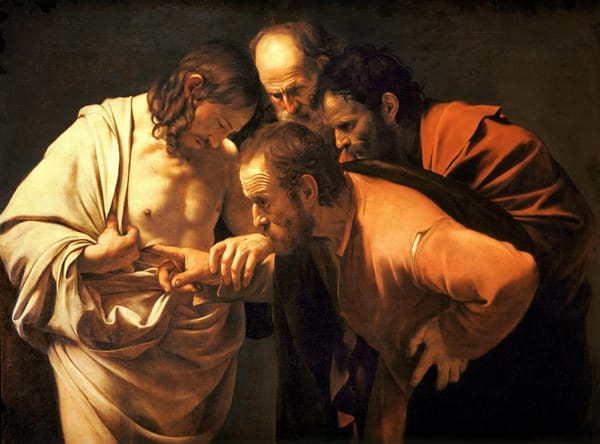
Our risen Jesus gave an additional proof that he wished the Sunday to be, henceforth, the privileged day. He reserved the second visit he intended to pay to all his disciples for this the eighth day since his Resurrection. During the previous days, he has left Thomas a prey to doubt; but to-day he shows himself to this Apostle, as well as to the others, and obliges him, by irresistible evidence, to lay aside his incredulity. Thus does our Saviour again honour the Sunday. The Holy Ghost will come down from heaven upon this same day of the week, making it the commencement of the Christian Church: Pentecost will complete the glory of this favoured day.
Jesus’ apparition to the eleven, and the victory he gains over the incredulous Thomas—these are the special subjects the Church brings before us to-day. By this apparition, which is the seventh since his Resurrection, our Saviour wins the perfect faith of his disciples. It is impossible not to recognize God in the patience, the majesty, and the charity of him who shows himself to them. Here, again, our human thoughts are disconcerted; we should have thought this delay excessive; it would have seemed to us that our Lord ought to have at once either removed the sinful doubt from Thomas's mind, or punished him for his disbelief. But no: Jesus is infinite wisdom, and infinite goodness. In his wisdom, he makes this tardy acknowledgement of Thomas become a new argument of the truth of the Resurrection; in his goodness, he brings the heart of the incredulous disciple to repentance, humility, and love; yea, to a fervent and solemn retractation of all his disbelief. We will not here attempt to describe this admirable scene, which holy Church is about to bring before us. We will select, for our to-day’s instruction, the important lesson given by Jesus to his disciple, and through him to us all. It is the leading instruction of the Sunday, the Octave of the Pasch, and it behoves us not to pass it by, for, more than any other, it tells us the leading characteristic of a Christian, shows us the cause of our being so listless in God’s service, and points out to us the remedy for our spiritual ailments.
Jesus says to Thomas: ‘Because thou hast seen me, thou hast believed: blessed are they that have not seen, and have believed!’ Such is the great truth, spoken by the lips of the God-Man: it is a most important counsel, given, not only to Thomas, but to all who would serve God and secure their salvation. What is it that Jesus asks of his disciple? Has he not heard him make profession that now, at last, he firmly believes? After all, was there any great fault in Thomas’s insisting on having experimental evidence before believing in so extraordinary a miracle as the Resurrection? Was he obliged to trust to the testimony of Peter and the others, under penalty of offending his divine Master? Did he not evince his prudence, by withholding his assent until he had additional proofs of the truth of what his brethren told him? Yes, Thomas was a circumspect and prudent man, and one that was slow to believe what he had heard; he was worthy to be taken as a model by those Christians who reason and sit in judgement upon matters of faith. And yet, listen to the reproach made him by Jesus. It is merciful, and withal so severe! Jesus has so far condescended to the weakness of his disciple as to accept the condition on which alone he declares that he will believe: now that the disciple stands trembling before his risen Lord, and exclaims, in the earnestness of faith,’My Lord and my God!' oh! see how Jesus chides him! This stubbornness, this incredulity, deserves a punishment: the punishment is, to have these words said to him:’Thomas! thou hast believed, because thou hast seen!
Then was Thomas obliged to believe before having seen? Yes, undoubtedly. Not only Thomas, but all the Apostles were in duty bound to believe the Resurrection of Jesus even before he showed himself to them. Had they not lived three years with him? Had they not seen him prove himself to be the Messias and the Son of God by the most undeniable miracles? Had he not foretold them that he would rise again on the third day? As to the humiliations and cruelties of his Passion, had he not told them, a short time previous to it, that he was to be seized by the Jews in Jerusalem, and be delivered to the gentiles? that he was to be scourged, spit upon, and put to death?1
After all this, they ought to have believed in his triumphant Resurrection, the very first moment they heard of his Body having disappeared. As soon as John had entered the sepulchre, and seen the windingsheet, he at once ceased to doubt; he believed. But it is seldom that man is so honest as this; he hesitates, and God must make still further advances, if he would have us give our faith! Jesus condescended even to this: he made further advances. He showed himself to Magdalen and her companions, who were not incredulous, but only carried away by natural feeling, though the feeling was one of love for their Master. When the Apostles heard their account of what had happened, they treated them as women whose imagination had got the better of their judgement. Jesus had to come in person: he showed himself to these obstinate men, whose pride made them forget all that he had said and done, sufficient indeed to make them believe in his Resurrection. Yes, it was pride; for faith has no other obstacle than this. If man were humble, he would have faith enough to move mountains.
To return to our Apostle. Thomas had heard Magdalen, and he despised her testimony; he had heard Peter, and he objected to his authority; he had heard the rest of his fellow-Apostles and the two disciples of Emmaus, and no, he would not give up his own opinion. How many there are among us who are like him in this! We never think of doubting what is told us by a truthful and disinterested witness, unless the subject touch upon the supernatural; and then we have a hundred difficulties. It is one of the sad consequences left in us by original sin. Like Thomas, we would see the thing ourselves: and that alone is enough to keep us from the fulness of the truth. We comfort ourselves with the reflection that, after all, we are disciples of Christ; as did Thomas, who kept in union with his brother-Apostles, only he shared not their happiness. He saw their happiness, but he considered it to be a weakness of mind, and was glad that he was free from it!
How like this is to our modem rationalistic Catholic! He believes, but it is because his reason almost forces him to believe; he believes with his mind, rather than from his heart. His faith is a scientific deduction, and not a generous longing after God and supernatural truth. Hence how cold and powerless is this faith! how cramped and ashamed! how afraid of believing too much! Unlike the generous unstinted faith of the saints, it is satisfied with fragments of truth, with what the Scripture terms diminished truths.2 It seems ashamed of itself. It speaks in a whisper, lest it should be criticized; and when it does venture to make itself heard, it adopts a phraseology which may take off the sound of the divine. As to those miracles which it wishes had never taken place, and which it would have advised God not to work, they are a forbidden subject. The very mention of a miracle, particularly if it have happened in our own times, puts it into a state of nervousness. The lives of the saints, their heroic virtues, their sublime sacrifices—it has a repugnance to the whole thing! It talks gravely about those who are not of the true religion being unjustly dealt with by the Church in Catholic countries; it asserts that the same liberty ought to be granted to error as to truth; it has very serious doubts whether the world has been a great loser by the secularization of society.
Now it was for the instruction of persons of this class that our Lord spoke those words to Thomas:’Blessed are they who have not seen, and have believed.' Thomas sinned in not having the readiness of mind to believe. Like him, we also are in danger of sinning, unless our faith have a certain expansiveness, which makes us see everything with the eye of faith, and gives our faith that progress which God recompenses with a superabundance of light and joy. Yes, having once become members of the Church, it is our duty to look upon all things from a supernatural point of view. There is no danger of going too far, for we have the teachings of an infallible authority to guide us. ‘The just man liveth by faith.’3 Faith is his daily bread. His mere natural life becomes transformed for good and all, if only he be faithful to his Baptism. Could we suppose that the Church, after all her instructions to her neophytes, and after all those sacred rites of their Baptism which are so expressive of the supernatural life, would be satisfied to see them straightway adopt that dangerous system which drives faith into a nook of the heart and understanding and conduct, leaving all the rest to natural principles or instinct? No, it could not be so. Let us therefore imitate St Thomas in his confession, and acknowledge that hitherto our faith has not been perfect. Let us go to our Jesus, and say to him: 'Thou art my Lord and my God! But alas! I have many times thought and acted as though thou wert my Lord and my God in some things, and not in others. Henceforth I will believe without seeing; for I would be of the number of those whom thou callest blessed!’
This Sunday, commonly called with us Low Sunday, has two names assigned to it in the Liturgy: Quasimodo, from the first word of the Introit; and Sunday in albis (or, more explicitly, in albis depositis), because on this day the neophytes assisted at the Church services attired in their ordinary dress. In the Middle Ages it was called Close-Pasch, no doubt in allusion to its being the last day of the Easter Octave. Such is the solemnity of this Sunday that not only is it of Greater Double rite, but no feast, however great, can ever be kept upon it.
At Rome, the Station is in the basilica of St Pancras, on the Aurelian Way. Ancient writers have not mentioned the reason of this Church being chosen for to-day's assembly of the faithful. It may, perhaps, have been on account of the saint's being only fourteen years old when put to death: a circumstance which gave the young martyr a sort of right to have the neophytes round him, now that they were returning to their everyday life.
Mass
The Introit repeats those beautiful words of St Peter, which were addressed, in yesterday's Epistle, to the newly baptized. They are like new-born babes, lovely in their sweet simplicity, and eager to drink from the breasts of their dear mother, the Church, the spiritual milk of faith—that faith which will make them strong and loyal.
Introit
On this the last day of the great Octave, the Church, in her Collect, bids farewell to the glorious solemnities that have so gladdened us, and asks our Lord to grant that our lives and actions may ever reflect the holy influence of our Pasch.
Collect
Epistle
I Cap. v.Charissimi, omne, quod natum est ex Deo, vincit mundum: et hæc est victoria, quæ vincit mundum, fides nostra. Quis est, qui vincit mundum, nisi qui credit quoniam Jesus est Filius Dei? Hic est qui venit per aquam et sanguinem, Jesus Christus: non in aqua solum, sed in aqua et sanguine. Et spiritus est, qui testificatur, quoniam Christus est veritas. Quoniam tres sunt, qui testimonium dant in cœlo: Pater, Verbum et Spiritus Sanctus: et hi tres unum sunt. Et tres sunt, qui testimonium dant in terra: Spiritus et aqua et sanguis: et hi tres unum sunt. Si testimonium hominum accipimus, testimonium Dei majus est: quoniam hoc est testimonium Dei quod majus est, quoniam testificatus est de Filio suo. Qui credit in Filium Dei, habet testimonium Dei in se.
I Ch. v.Dearly beloved: Whatsoever is born of God, overcometh the world: and this is the victory which overcometh the world, our faith. Who is he that overcometh the world, but he that believeth that Jesus is the Son of God? This is he that came by water and blood, Jesus Christ: not by water only, but by water and blood. And it is the spirit which testifieth, that Christ is the truth. And there are three who give testimony in heaven, the Father, the Word, and the Holy Ghost. And these three are one. And there are three that give testimony on earth: the spirit, the water, and the blood, and these three are one. If we receive the testimony of men, the testimony of God is greater. For this is the testimony of God which is greater, because he hath testified of his Son. He that believeth in the Son of God, hath the testimony of God in himself.
The Apostle St John here tells us the merit and power of faith: it is, says he, a victory, which conquers the world, both the world outside, and the world within us. It is not difficult to understand why this passage from St John's Epistles should have been selected for to-day's Liturgy: it is on account of its being so much in keeping with the Gospel appointed for this Sunday, in which our Lord passes such eulogy upon faith. If, as the Apostle here assures us, they Overcome the world who believe in Christ, that is not sterling faith which allows itself to be intimidated by the world. Let us be proud of our faith, esteeming ourselves happy that we are but little children when there is a question of receiving a divine truth; and let us not be ashamed of our eager readiness to admit the testimony of God. This testimony will make itself heard in our hearts, in proportion to our willingness to hear it. The moment John saw the winding-bands which had shrouded the Body of his Master, he made an act of faith; Thomas, who had stronger testimony than John (for he had the word of the Apostles, assuring him that they had seen their risen Lord), refused to believe: he had not overcome the world and its reasonings, because he had not faith.
The two Alleluia Versicles are formed of two texts alluding to the Resurrection. The second speaks of the scene which took place on this day, in the cenacle.
Gospel
Cap. xx.In illo tempore: Quum sero esset die illo, una sabbatorum, et fores essent clausæ, ubi erant discipuli congregati propter metum Judaeorum: venit Jesus, et stetit in medio, et dixit eis: Pax vobis. Et cum hoc dixisset, ostendit eis manus et latus. Gavisi sunt ergo discipuli, viso Domino. Dixit ergo eis iterum: Pax vobis. Sicut misit me Pater, et ego mitto vos. Hæc cum dixisset, insufflavit et dixit eis: Accipite Spiritum Sanctum; quorum remiseritis peccata, remittuntur eis: et quorum retinueritis, retenta sunt. Thomas autem unus ex duodecim, qui dicitur Didymus, non erat cum eis quando venit Jesus. Dixerunt ergo et alii discipuli: Vidimus Dominum. Ille autem dixit eis: Nisi videro in manibus ejus fixuram clavorum, et mittam digitum meum in locum clavorum, et mittam manum meam in latus ejus, non credam. Et post dies octo, iterum erant discipuli ejus intus: et Thomas cum eis. Venit Jesus januis clausis, et stetit in medio, et dixit: Pax vobis. Deinde dicit Thomæ: Infer digitum tuum huc, et vide manus meas, et after manum tuam, et mitte in latus meum: et noli esse incredulus, sed fidelis. Respondit Thomas, et dixit ei: Dominus meus, et Deus meus. Dixit ei Jesus: Quia vidisti me, Thoma, credidisti: beati qui non viderunt et crediderunt. Multa quidem et alia signa fecit Jesus in conspectu discipulorum suorum, quæ non sunt scripta in libro hoc. Hæc autem scripta sunt, ut credatis, quia Jesus est Christus Filius Dei: et ut credentes, vitam habeatis in nomine ejus.
Ch. xx.At that time: When it was late that same day, being the first day of the week, and the doors were shut where the disciples were gathered together for fear of the Jews, Jesus came and stood in the midst, and said to them: Peace be to you. And when he had said this, he showed them his hands and his side. The disciples therefore were glad when they saw the Lord. He said therefore to them again: Peace be to you. As the Father hath sent me, I also send you. When he had said this, he breathed on them; and he said to them: Receive ye the Holy Ghost: whose sins you shall forgive, they are forgiven them; and whose sins you shall retain, they are retained. Now Thomas, one of the twelve, who is called Didymus, was not with them when Jesus came. The other disciples therefore said to him: We have seen the Lord. But he said to them: Except I shall see in his hands the print of the nails, and put my finger into the place of the nails, and put my hand into his side, I will not believe. And after eight days again his disciples were within, and Thomas with them. Jesus cometh, the doors being shut, and stood in the midst, and said: Peace be to you. Then he said to Thomas: Put in thy fingers hither, and see my hands, and bring hither thy hand, and put it into my side; and be not faithless, but believing. Thomas answered and said to him: My Lord and my God! Jesus saith to him: Because thou hast seen me, Thomas, thou hast believed: blessed are they that have not seen, and have believed. Many other signs also did Jesus in the sight of his disciples, which are not written in this book. But these are written, that you may believe that Jesus is the Christ, the Son of God: and that believing you may have life in his name.
We have said enough about St Thomas’ incredulity; let us now admire his faith. His fault has taught us to examine and condemn our own want of faith; let us learn from his repentance how to become true believers. Our Lord, who had chosen him as one of the pillars of his Church, has been obliged to treat him with an exceptional familiarity: Thomas avails himself of Jesus’ permission, puts his finger into the sacred wound, and immediately he sees the sinfulness of his past incredulity. He would make atonement, by a solemn act of faith, for the sin he has committed in priding himself on being wise and discreet: he cries out, and with all the fervour of faith: My Lord and my God! Observe, he not only says that Jesus is his Lord, his Master, the same who chose him as one of his disciples: this would not have been faith, for there is no faith where we can see and touch. Had Thomas believed what his brother-Apostles had told him, he would have had faith in the Resurrection; but now he sees, he has experimental knowledge of the great fact; and yet, as our Lord says of him, he has faith. In what? In this, that his Master is God. He sees but the humanity of Jesus, and he at once confesses him to be God. From what is visible, his soul, now generous and repentant, rises to the invisible:’Thou art my God!' Now, O Thomas! thou art full of faith! The Church proposes thee to us, on thy feast, as an example of faith. The confession thou didst make on this day is worthy to be compared with that which Peter made, when he said:’Thou art Christ, the Son of the living God!’4 By this profession, which neither flesh nor blood had revealed to him, Peter merited to be made the rock whereon Christ built his Church: thine did more than compensate thy former disbelief; it gave thee, for the time, a superiority over the rest of the Apostles, who, so far at least, were more taken up with the visible glory, than with the invisible divinity, of their risen Lord.
The Offertory gives us another text of the Gospel relative to the Resurrection.
Offertory
In the Secret, the Church expresses the holy enthusiasm wherewith the Paschal mystery fills her; she prays that this joy may lead her to the never-ending one of the eternal Easter.
Secret
While giving the Bread of heaven to her neophytes and other children, the Church sings in her Communion Antiphon the words spoken by Jesus to Thomas. This Apostle was permitted to touch our Lord's sacred wounds; we, by the holy Eucharist, are brought into still closer intimacy with this same Jesus: but that we may derive the profit intended by such condescension, we must have a faith lively and generous, like that which he exacted from his Apostles.
Communion
The Church concludes the prayers of her Sacrifice by asking that the divine mystery, instituted to be a support to our weakness, may give us untiring perseverance.
Postcommunion
Vespers
When the feast of the Annunciation is deferred till after Easter, it is kept on the Monday following Low Sunday: its First Vespers are now sung, and a commemoration only is made of the Sunday, at the end of the Office. We have given these below, p. 310. Other years, the Vespers are those of Paschal time, which will be found at p. 81.
Antiphon of the Magnificat
Oremus.
Let us Pray.
As an appropriate prayer wherewith to close the day, we offer to our readers the following beautiful one, wherein the Gothic Church of Spain celebrates the mystery of the eighth day—the Octave of Easter.
Once more let us listen to the devout Adam of St Victor. His sequences were great favourites with our Catholic forefathers of the Middle Ages. The triumph of our Redeemer over death was a subject which this great liturgical poet has often treated in a most masterly way.
Sequence
Nova parit gaudia;
Resurgenti Domino
Conresurgunt omnia.
Elementa serviunt,
Et auctoris sentiunt
Quanta sit potentia.
Et aer volubilis:
Fluit aqua labilis,
Terra manet stabilis:
Alta petunt levia,
Centrum tenent gravia,
Renovantur omnia.
Et mare tranquillius;
Spirat aura levius,
Vallis nostra floruit.
Revirescunt arida,
Recalescunt frigida,
Postquam ver intepuit.
Princeps mundi tollitur,
Et ejus destruitur
In nobis imperium;
Dum tenere voluit
In quo nihil habuit,
Jus amisit proprium.
Homo jam recuperat
Quod prius amiserat,
Paradisi gaudium:
Viam præbet facilem,
Cherubim versatilem
Amovendo gladium.
Et captivos liberat,
Quos culpa ligaverat
Sub mortis interitu.
Pro tanta victoria
Patri, Proli gloria
Sit cum Sancto Spiritu!
creates new joy.
All creatures rise together
with their Lord.
The elements obey him,
and feel their Creator's
mighty power.
air is swift;
water is flowing;
earth is firm;
light things tend aloft,
and those that are heavy seek their centre:
but all are now renewed.
the sea more tranquil,
the winds breathe softer.
Our valley is filled with flowers;
and now that gentle spring is come,
the dry things have put on green again,
and the cold a genial warmth.
The prince of this world
is made captive,
and has no longer power over us:
by striving to take him over
whom he had no claim,
he lost his own.
man now regains
what he had lost
—the joys of heaven;
the angel sheathes
his two-edged sword,
and leaves the passage free.
and liberates them
whom sin had
made captives of death.
For this great victory,
be glory to Father, Son,
and Holy Ghost.
April 23: St. George, Martyr
|
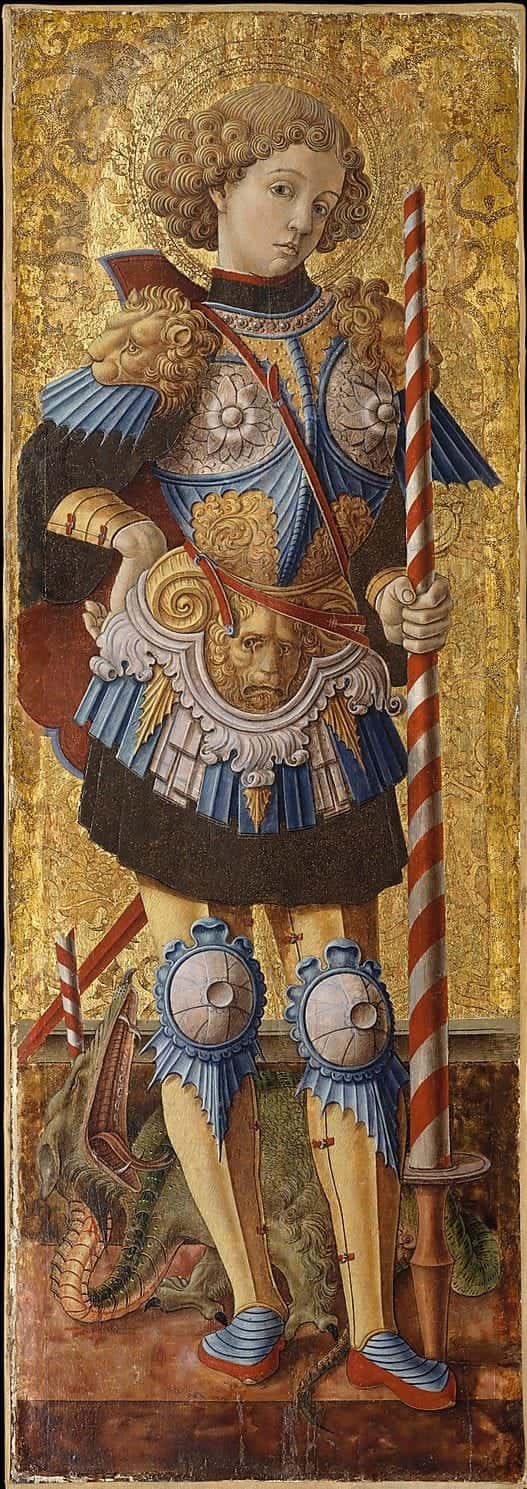
CLAD in his bright coat of mail, mounted on his war-steed, and spearing the dragon with his lance, George, the intrepid champion of our Risen Jesus, comes to gladden us today with his feast. From the East, where he is known as the great Martyr, devotion to St George soon spread in the Western Church, and our Christian armies have always loved and honoured him as one of their dearest patrons. His martyrdom took place in Paschal Time; and thus he stands before us as the guardian of the glorious sepulchre, just as Stephen, the Protomartyr, watches near the crib of the Infant God.
The Roman Liturgy gives no lessons on the life of St George; but, in their stead, reads to us a passage from St Cyprian on the sufferings of the martyrs. This derogation from the general rule dates from the fifth century. At a celebrated Council held in Rome in the year 496, Pope St Gelasius drew up, for the guidance of the faithful, a list of books which might or might not be read without danger. Among the number of those that were to be avoided, he mentioned the ‘Acts of St Georg,' as having been compiled by one who, besides being an ignorant man, was also a heretic. In. the East, however, there were other ' Acts ' of the holy martyr, totally different from those current in Rome; but they were not known in that city. The cultus of St George lost nothing, in the holy city, by this absence of a true legend. From a very early period, a church was built in his honour; it was one of those that were selected as Stations, and gave a Title to a Cardinal; it exists to this day, and it is called Saint George in Velabro (the Veil of Gold) .
The Bollandists were in possession of several copies of the forbidden ‘Acts '; they found them replete with absurd stories, and, of course, they rejected them. Father Papebroch has given us other and genuine ‘Acts ' written in Greek, and quoted by St Andrew of Crete. They bring out the admirable character of our martyr, who held an important post in the Roman army during the reign of the Emperor Diocletian. He was one of the first victims of the great persecution and suffered death at Nicomedia. Alexandra, the Emperor's wife, was so impressed at witnessing the Saint’s courage, that she professed herself a Christian, and shared the crown of martyrdom with the brave soldier of Christ.
As we have already said, devotion to St George dates from a very early period. St Gregory of Tours gives us several proofs of its having taken root in Gaul. St Clotilde had a singular confidence in the holy martyr, and dedicated to him the Church of her dear Abbey of Chelles. But this devotion became more general and more fervent during the Crusades, when the Christian armies witnessed the veneration in which St George was held by the Eastern Church, and heard the wonderful things that were told of his protection on the field of battle. The Byzantine historians have recorded several remarkable instances of the kind; and the Crusaders returned to their respective countries publishing their own experience of the victories gained through the Saint's intercession. The Republic of Genoa chose him for its patron; and Venice honoured him as its special protector, after St Mark. But nowhere was St George so enthusiastically loved as in England. Not only was it decreed in a Council held at Oxford, in the year 1222, that the feast of the Great Martyr should be observed as one of obligation; not only was devotion to the valiant soldier of Christ encouraged, throughout Great Britain, by the first Norman Kings; but there are documents anterior to the invasion of William the Conqueror, which prove that St George was invoked as the special patron of England even so far back as the ninth century. Edward III did but express the sentiment of the country when he put the Order of the Garter, which he instituted in 1330, under the patronage of the warrior Saint. In Germany, King Frederic III founded the Order of St George in the year 1468.
St George is usually represented as killing a dragon; and where the representation is complete, there is also given the figure of a princess, whom the Saint thus saves from being devoured by the monster. This favourite subject of both sacred and profane art is purely symbolical, and is of Byzantine origin. It signifies the victory won over the devil, by the martyr's courageous profession of faith; the princess represents Alexandra, who was converted by witnessing the Saint’s heroic patience under his sufferings. Neither the ' Acts ' of St George nor the hymns of the Greek Liturgy allude to the martyr's having slain a dragon and rescued a princess. It was not till after the fourteenth century that this fable was known in the West; and it arose from a material interpretation of the emblems with which the Greeks honoured St George, and which were introduced among us by the crusaders.
Although, as has been said, the Office of St George in the Roman Breviary has been taken from the Common of Martyrs in Paschal Time, the following historical lesson has recently been approved for the Dioceses of England:
Let us, in honour of our glorious patron, recite the following stanzas, taken from the Menæa of the Greek Church:
Hymn (Die XXIII Aprilis)
Thou, O George, art the glorious type of a Christian soldier. Whilst serving under an earthly monarch, thou didst not forget thy duty to the King of heaven. Thou didst shed thy blood for the faith of Christ; and he, in return, appointed thee protector of Christian armies. Be their defender in battle, and bless with victory them that fight in a just cause. Protect them under the shadow of thy standard; cover them with thy shield; make them the terror of their enemies. Our Lord is the God of Hosts; and he frequently uses war as the instrument of his designs, both of justice and mercy. They alone win true victory who have heaven on their side; and such soldiers, when on the battle-field, seem to the world to be doing the work of man, whereas it is the work of God they are furthering. Hence are they more generous, because more religious, than other men. The sacrifices they have to make, and the dangers they have to face, teach them unselfishness. What wonder, then, that soldiers have given so many martyrs to the Church!
But there is another warfare, in which we Christians are all enlisted, and of which St Paul speaks, when he says: Labour as a good soldier of Christ; for no man is crowned, save he that striveth lawfully.1 That we have thus to strive and fight during our life, the same Apostle assures us in these words: Take unto you the armour of God, that ye may be able to resist in the evil day, and to stand in all things perfect. Stand, therefore, having your loins girt about with truth, and having on the breastplate of justice, and your feet shod with the preparation of the Gospel of peace. In all things taking the shield of faith, wherewith ye may be able to extinguish all the fiery darts of the most wicked one. And take unto you the helmet of the hope of salvation, and the sword of the spirit, which is the word of God.2 We, then, are soldiers, as thou wast, O holy martyr! Before ascending into heaven, our divine leader wishes to review his troops; do thou present us to him. He has loaded us with honours, notwithstanding our past disloyalties; we must, henceforth, prove ourselves worthy of our position. In the Paschal Communion which we have received, we have a pledge of victory; how can we ever be so base as to permit ourselves to be conquered! Watch over us, O sainted warrior! Let thy prayers and example encourage us to fight against the dragon of hell. He dreads the armour we wear; for it is Jesus himself that prepared it for us, and tempered it in his own precious Blood: may we, like thee, present it to him whole and entire, when he calls us to our eternal rest!
There was a time when the whole Christian world loved and honoured thy memory with enthusiastic joy: but now, alas! this devotion has grown cold, and thy feast passes unnoticed by thousands. O holy martyr! avenge this ingratitude by imitating thy divine King, who maketh his sun to rise upon both good and bad; take pity on this world, perverted as it is by false doctrines, and tormented at this very time by the most terrible scourges. Have compassion on thy dear England, which has been seduced by the dragon of hell, and by him made the instrument for effecting his plots against the Lord and his Christ. Take up thy spear as of old; give the monster battle, and emancipate the isle of Saints from his slavish yoke. Heaven and earth join in this great prayer! In the name of our Risen Jesus, aid thine own and once devoted people to a glorious resurrection!
| Previous April 22: Sts. Soter and Caius, Popes and Martyrs | Next April 23: St. George, Martyr |