Daily reading
Paschal Time
Double · April 24 · Sanctoral
April 24, 2028
From Dom Guéranger’s The Liturgical Year.
A Double leads the weekday.Rubric
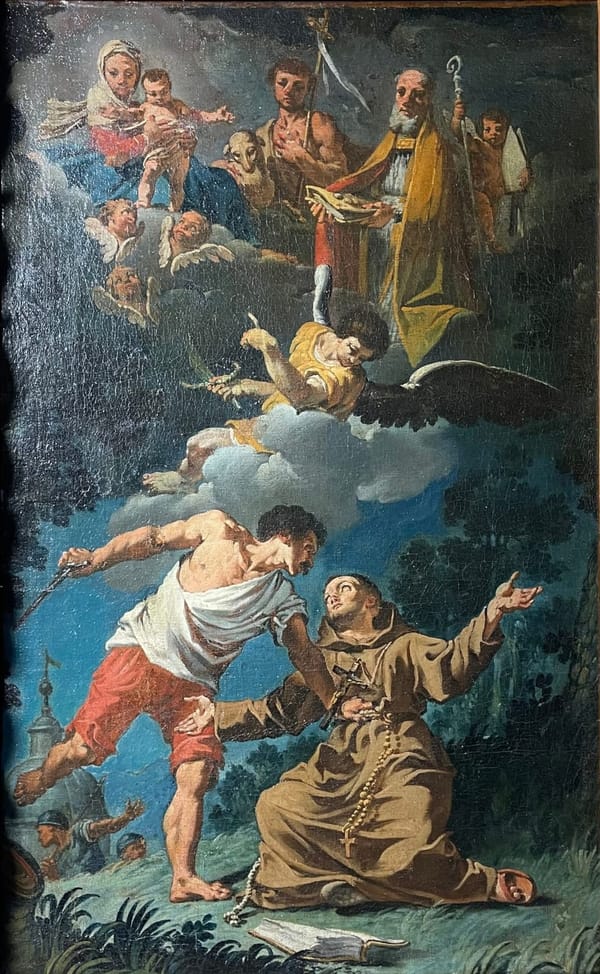 |
April 24: St. Fidelis of Sigmaringen, Martyr
OUR Risen Lord would have around him a bright phalanx of martyrs. Its privileged members belong to the different centuries of the Church’s existence. Its ranks open today to give welcome to a brave combatant, who won his palm, not in a contest with paganism, as those did whose feasts we have thus far kept, but in defending his mother, the Church, against her own rebellious children. They were heretics that slew this day’s martyr, and the century that was honoured with his triumph was the seventeenth.
Fidelis was worthy of his beautiful name. Neither difficulty nor menace could make him fail in his duty. During his whole life, he had but the glory and service of his divine Lord in view: and when the time came for him to face the fatal danger, he did so, calmly but fearlessly, as behoved a disciple of that Jesus who went forth to meet his enemies. Honour, then, be to-day to the brave son of St Francis! truly he is worthy of his seraphic Patriarch, who confronted the Saracens, and was a martyr in desire!
Protestantism was established and rooted by the shedding of torrents of blood; and yet Protestants count it as a great crime that, here and there, the children of the true Church made an armed resistance against them. The heresy of the sixteenth century was the cruel and untiring persecutor of men, whose only crime was their adhesion to the old faith—the faith that had civilized the world. The so-called Reformation proclaimed liberty in matters of religion, and massacred Catholics who exercised this liberty, and prayed and believed as their ancestors had done for long ages before Luther and Calvin were bom. A Catholic who gives heretics credit for sincerity when they talk about religious toleration, proves that he knows nothing of either the past or the present. There is a fatal instinct in error, which leads it to hate the Truth; and the true Church, by its unchangeableness, is a perpetual reproach to them that refuse to be her children. Heresy starts with an attempt to annihilate them that remain faithful; when it has grown tired of open persecution it vents its spleen in insults and calumnies; and when these do not produce the desired effect, hypocrisy comes in with its assurances of friendly forbearance. The history of Protestant Europe, during the last three centuries, confirms these statements; it also justifies us in honouring those courageous servants of God who, during that same period, have died for the ancient faith.
Let us now respectfully listen to the account given us, in the Liturgy, of the life and martyrdom of St Fidelis; we shall find that the Church has not grown degenerate in her Saints.
How truly couldst thou, O Fidelis! say with the Apostle: I have finished my course!1 Yea, thy death was even more beautiful than thy life, holy as that was. How admirable the calmness wherewith thou didst receive death! how grand the joy wherewith thou didst welcome the blows of thine enemies—thine, because they were those of the Church! Thy dying prayer, like Stephen's, was for them; for the Catholic, while he hates heresy, must love the heretics who put him to death. Pray, O holy martyr, for the children of the Church. Obtain for them an appreciation of the value of faith, and of the favour God bestowed on them when he made them members of the true Church. May they be on their guard against the many false doctrines which are now current through the world. May they not be shaken by the scandals which abound in this age of effeminacy and pride. It is faith that is to bring us to our Risen Jesus: and he urges it upon us by the words he addressed to Thomas: Blessed are they that have not seen and have believed!2 Of this number we wish to be: and therefore is it that we cling to the Church, the sovereign mistress of faith. We wish to believe her, and not human reason, which has neither the power to fathom the word of God, nor the right to sit in judgement over it. Jesus has willed that this holy faith should come down to us bearing on itself the strengthening testimony of the martyrs; and each age has had its martyrs. Glory to thee, O Fidelis, who didst win thy palm by combating the errors of the pretended Reformation! Take a martyr’s revenge, and pray without ceasing to our Jesus, that he would bring all heretics back to the faith and to union with the Church. They are our brethren by baptism; pray for them, that they may return to the Fold, and that we may one day celebrate with them the true Paschal banquet, wherein the Lamb of God gives himself to be our food, not figuratively, as in the Old Law, but really and truly, as fits the New Covenant.
Monday of the Second Week after Easter
THE first week has been devoted to the joyous celebration of our Emmanuel’s return to us. He has been visiting us each day, in order to make us sure of his Resurrection. He has said to us: See me! Touch me! Feel! it is indeed I!1 But we know that his visible presence among us is not to last beyond forty days. This happy period is rapidly advancing; the time seems to go so quickly! In a few weeks, he, for whom the whole earth has been in such expectation, will have disappeared from our sight. O Expectation and Saviour of Israel! why wilt thou he as a stranger in the land, and as a wayfaring man turning in to lodge? Why wilt thou be as a wanderer?2—So much the more precious are the hours, then! Let us keep close by his side; when we cannot hear his words, let us fix our eyes upon him; but when he does speak, let us treasure up the beautiful words, for they are as the last will of our dearest Master.
During these forty days he is continually with his disciples, not indeed to persuade them of his Resurrection (for of that they had no longer any doubt), but, as St Luke says, that he might speak to them of the Kingdom of God.3 He has redeemed man by his Blood, and his victory over death; he has wrought reconciliation between heaven and earth—all that now remains to be done is the organization of the Church. The Church is the Kingdom of God; for it is in and by her that God is to reign upon the earth. The Church is the Spouse of the risen Jesus; it is he that raised her up to so exalted an honour; and now he would give her the dowry which will prepare her for that glorious day when the Holy Ghost is to descend upon her, and proclaim her to all nations as Spouse of the Incarnate Word, and Mother of the elect.
Three things are needed by the Church in order that she may carry on her mission: a constitution framed by the very hand of the Son of God, whereby she will become a visible and permanent society; the possession of all the truths which her divine Lord came upon this earth to reveal or confirm—and in this is included the right to teach, and teach infallibly; thirdly, the means whereby she may efficaciously apply to the faithful the fruit of Jesus’ sacrifice on the Cross, that is to say, the graces of salvation and sanctification. Hierarchy, Doctrine, Sacraments—these are the all-important subjects upon which our Lord instructs his disciples during the forty days between his Resurrection and Ascension.
But before following him in his divine work of organizing the Church, let us spend the rest of this week in considering him as the Risen Jesus, dwelling among men, and winning their admiration and love. We have contemplated him in the humility of his swathing-bands and Passion; let us now exultingly feast on the sight of his glory.
He presents himself to us as the most beautiful of the sons of men.4 He was always so, even when he veiled the splendour of his beauty under the infirmity of the mortal flesh he had assumed; but what must not this splendour be now that he has vanquished death, and permits the rays of his glory to shine forth without restraint? His age is for ever fixed at that of thirtythree: it is the period of life wherein man is at the height of his strength and beauty, without a single sign of decay. It was the state in which God created Adam, whom he formed to the likeness of the Redeemer to come; it will be the state of the bodies of the just on the day of the general Resurrection—they will bear upon them the measure of the perfect age5 which our Lord had when he arose from his tomb.
But it is not only by the beauty of his features that the Body of our Risen Jesus delights the eye of such as are permitted to gaze upon him: it is now endowed with the glorious qualities of which the three Apostles caught a glimpse on Mount Thabor. In the Transfiguration, however, the Humanity shone as the sun because of its union with the Person of the Word; but now, besides the Brightness due to it by the Incarnation, the glorified Body of our Redeemer has that which comes from his being Conqueror and King. His Resurrection has given him such additional resplendence that the sun is not worthy to be compared with him; and St John tells us that he is the Lamp that lights up the heavenly Jerusalem.6
To this quality which the Apostle of the Gentiles calls Brightness,7 is added that of Impassibility, whereby the Body of our Risen Lord has ceased to be accessible to suffering or death, and is adorned with the immortality of life. This Body is as truly and really a Body as ever; but it is now impervious to any deterioration or weakness; its life is to bloom for all eternity. The third quality of our Redeemer’s glorified Body is Agility, by which it can pass from one place to another, instantly and without effort. The Flesh has lost that weight which, in our present state, prevents the body from keeping pace with the longings of the soul. He passes from Jerusalem to Galilee in the twinkling of an eye, and the Spouse of the Canticle thus speaks of him: The voice of my Beloved! Behold he cometh leaping upon the mountains, skipping over the hills!8 Finally, the Body of our Emmanuel has put on the quality of Subtility (which the Apostle calls ‘Spirituality’),9 whereby it is enabled to penetrate every material obstacle more easily than a sunbeam makes its way through glass. On the morning of his Resurrection, he passed through the stone that stood against the mouth of the sepulchre; and on the same day he entered the Cenacle, though its doors were shut, and stood before his astonished disciples.
Such is our Saviour, now that he is set free from the shackles of mortality. Well may the little flock that is favoured with his visits exclaim on seeing him: How fair and comely art thou,10 O dearest Master! Let us join our praises with theirs, and say: Yes, dearest Jesus, thou art beautiful above all the sons of men! A few days back and we wept at beholding thee covered with wounds, as though thou hadst been the worst of criminals: but now our eyes feast on the resplendent charm of thy divine beauty. Glory be to thee in thy triumph! Glory, too, be to thee in thy generosity, which has decreed that these our bodies, after having been purified by the humiliation of the tomb, shall one day share in the prerogatives which we now admire in thee!
Let us, destined as we are to share in the glory of our Jesus, offer to him this beautiful canticle, which used to be sung in the churches of Germany during the Middle Ages:
Sequence
Leo Juda magne, crucis virtute
Mors peccati, vita justitiæ.
Pro gustu scientiae, medicina gratiae
Pro rapina gloriae.
Jus romphææ restrinxit flammeae,
Paradisi pandis hortum,
Stirps obedientiæ, medicina gratiae.
Pax est in terris, fulgur inferis,
Et lux superis;
Dies duplicis baptismi, Legis et Evangelii.
Dum vetus transit, novum surgit.
Haec dies Domini,
Gaude mens expers fermenti, plena panis azymi.
Signatis postibus, assum Pascha
Nocte domo una,
Jam cum lactucis ede agrestibus.
Pellitis pedibus, cum baculo propera,
Et caput cum intestinis
Et pedibus vora.
Christe, mundans hyssopo,
Fac et dignos hoc mysterio;
Mare siccans, Leviathan perforans
Maxillam hamo armilla.
Sopi, suscita;
De torrente bibens in via
Damna nostra;
Tu Pontifex, hostia,
Torcular calcans, tu uva.
Plena septemplici rore,
Specie rosæ rubor,
Lilii candor,
Quo te tantæ clementiae Consilio,
Microcosmi inclinaveras Auxilio,
Ut miseris particeps
Redemptor esses,
Absque peccati naevo,
Gestans formulam peccati?
Servi, Domine,
Spes anastaseos primae,
Ultimae, per jusjurandum
Semini Abrahæ firma et nos.
Dux athanatos,
Nos tuo convivificans corpori,
Commortuos Adæ parent veteri;
Tu membris fortioribus
Jungens infirma,
Vitæ æternæ des pascua, tu Pascha.
Strong Lion of Juda! by the power of the Cross,
|thou art the Death of sin, and the Life of justice.
thou now givest us the fruit of the Tree of Life: to remedy the theft
committed by his ambition for glory, thou givest the medicine of grace.
the fiery sword which justly menaced us.
Thou openest heaven to us,
O Root of obedience! O Medicine of Grace!
which brings peace to earth, and terror to hell,
and light to heaven.
It is the day of the twofold baptism—of the Law and the Gospel.
the old one passes away, and the new rises in its stead.
This is the day which the Lord hath made: let us,
who have put away the old leaven and feed on the unleavened, let us rejoice!
thy threshold is signed with the Blood of the Lamb: eat the Pasch
prepared by fire in the night;
eat it in the One House; yea, eat it with wild lettuce.
shoe thy feet, and, with a stave in thy hand,
hasten and eat the head and entrails
and feet of the Lamb.
this day, with hyssop;
make us worthy of the Mystery.
Dry up the sea that we may pass; and with the hook
(of thy Cross) take the Leviathan.
inspirit us with thy chalice,
O thou that didst drink
of the torrent of our miseries in the way!
O thou our High Priest,
our Victim, our Wine-presser, our Vine!
rich with the dew of the seven gifts,
ruddy as the rose,
and fair as the lily!
—whence that merciful design of thine,
that made thee stoop to aid this little world,
sharing our nature
that thou mightest redeem us miserable men,
and taking the likeness of sin,
O thou the sinless God!
thou that hast made thyself Brother of thy creature man!
O Hope of our first and eternal Resurrection!
we beseech thee, by the promise
made to Abraham’s seed,
give us strength, O immortal King!
and make us, who were sharers
in our First Parent’s death, to be fellow-members of thy life.
Unite our weakness with thy strength, and bless us,
O Blessed Paschal Lamb!
with the pastures of eternal Life.
| Previous April 23: St. George, Martyr | Next Monday of the Second Week after Easter |