Daily reading
Paschal Time
Double of the II Class · April 25 · Sanctoral
April 25, 2028
From Dom Guéranger’s The Liturgical Year.
A Double of the II Class leads the weekday.Rubric

|
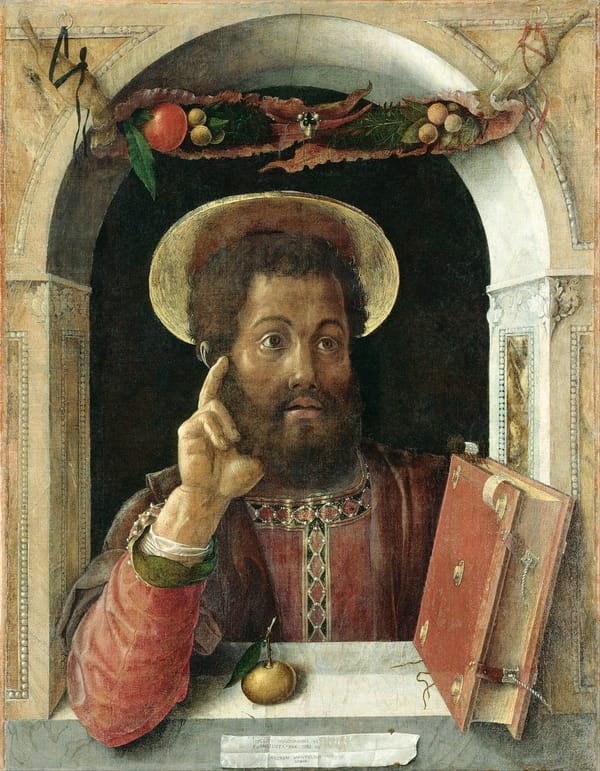
April 25: St. Mark, Evangelist (and the Greater Litanies)
THE cycle of holy Mother Church brings before us to-day the Lion, who, together with the Man, the Ox, and the Eagle, stands before the throne of God.1 It was on this day that Mark ascended from earth to heaven, radiant with his triple aureole of Evangelist, Apostle and Martyr.
As the preaching made to Israel had its four great representatives—Isaias, Jeremias, Ezechiel, and Daniel —so, likewise, would God have the New Covenant to be embodied in the four Gospels, which were to make known to the world the life and teachings of his divine Son. The holy Fathers tell us that the Gospels are like the four streams which watered the garden of pleasure.2 and that this garden was a figure of the future Church. The first of the Evangelists—the first to register the actions and words of our Redeemer—is Matthew, whose star will rise in September; the second is Mark, whose brightness gladdens us today; the third is Luke, whose rays will shine upon us in October; the fourth is John, whom we have already seen in Bethlehem, at the crib of our Emmanuel.
Mark was the beloved disciple of Peter; he was the brilliant satellite of the sun of the Church. He wrote his Gospel at Rome, under the eyes of the Prince of the Apostles. The Church was already in possession of the history given by Matthew; but the faithful of Rome wished their own Apostle to narrate what he had witnessed. Peter refused to write it himself, but he bade his disciple take up his pen, and the Holy Ghost guided the hand of the new Evangelist. Mark follows the account given by Matthew; he abridges it, and yet he occasionally adds a word, or an incident, which plainly prove to us that Peter, who had seen and heard all, was his living and venerated authority. One would have almost expected that the new Evangelist would pass over in silence the history of his master’s fall, or at least have said as little as possible about it; but no—the Gospel written by Mark is more detailed on Peter's denial than is that of Matthew; and as we read it, we cannot help feeling that the tears elicited by Jesus’ look when in the house of Caiphas, were flowing down the Apostle’s cheeks as he described the sad event. Mark’s work being finished, Peter examined it and gave it his sanction; the several Churches joyfully received this second account of the mysteries of the world’s redemption, and the name of Mark was made known throughout the whole earth.
Matthew begins his Gospel with the human genealogy of the Son of God, and has thus realized the prophetic type of the Man; Mark fulfils that of the Lion, for he commences with the preaching of John the Baptist, whose office as precursor of the Messias had been foretold by Isaias, where he spoke of the voice of one crying in the wilderness—as the Lion that’ makes the desert echo with his roar.
Mark, having written his Gospel, was next to labour as an Apostle. Peter sent him first to Aquileia, where he founded an important Church: but this was not enough for an Evangelist. When the time designed by God came, and Egypt, the source of countless errors, was to receive the truth, and the haughty and noisy Alexandria was to be raised to the dignity of the second Church of Christendom—the second see of Peter—Mark was sent by his master to effect this great work. By his preaching, the word of salvation took root, grew up, and produced fruit in that most infidel of nations; and the authority of Peter was thus marked, though in different degrees, in the three great cities of the Empire: Rome, Alexandria and Antioch.
St Mark may be called the first founder of the monastic life by his instituting, in Alexandria itself, what were called the Therapeutes. To him, also, may be justly attributed the origin of that celebrated Christian school of Alexandria which was so flourishing even in the second century.
But glorious as were these works of Peter's disciple, the Evangelist and Apostle Mark was also to receive the dignity of martyr. The success of his preaching excited against him the fury of the idolaters. They were keeping a feast in honour of Serapis; and this gave them an opportunity which they were not likely to lose. They seized Mark, treated him most cruelly, and cast him into prison. It was there that our Risen Lord appeared to him during the night, and addressed him in these words, which afterwards formed the arms of the Republic of Venice: ' Peace be to thee, Mark, my Evangelist!' To which the disciple answered: ‘Lord '—for such were his feelings of delight and gratitude that he could say but that one word, as it was with Magdalen, when she saw Jesus on the morning of the Resurrection. On the following day Mark was put to death by the pagans. He had fulfilled his mission on earth, and heaven opened to receive the Lion, who was to occupy the place allotted to him near the throne of the Ancient of days, as shown to the Prophet of Patmos in his sublime vision.3
In the ninth century the West was enriched with the relics of St Mark. They were taken to Venice; and, under the protection of the sacred Lion, there began for that city a long period of glory. Faith in so great a patron achieved wonders; and from the midst of islets and lagoons there sprang into existence a city of beauty and power. Byzantine art raised up the imposing and gorgeous church, which was the palladium of the Queen of the Seas; and the new Republic stamped its coinage with the Lion of St Mark. Happy would it have been for Venice had she persevered in her loyalty to Rome and in the ancient severity of her morals.
Let us listen to the Churches of the East and West speaking his praise. We will begin with a hymn composed in the ninth century by St Paulinus, one of St Mark’s successors as bishop of Aquileia.
Hymn
Lux ilia Patris quæ iucet de solio,
Quæ fons, origo, splendor lucis aureæ,
Habensque semper lumen indeficiens,
Cœlum serenat arcens mundi tenebras.
Suscepit almum radium sub pectore
Marcus beatus, doctor evangelicus;
Factus lucerna more tanti luminis,
Ardens fugavit sæculi caliginem.
Aureis septem unum de candelabris,
Cingitque totum mundum claro sidere:
Ecciesiarum nititur sub culmine,
Sustentat altæ fundamenta fabricæ.
Propheta sanctus, animai lætissimum
Vidit Joannes, ceu Christi recubitor,
Leonis hoc et typice sub specie
Clamore multo per deserta frendere.
Aquileiensem dudum famosissimam
Urbem sacrati Verbi pullulantia
Disseminavit, satosque centuplices
Fructus ad alta vexit felix horrea.
Nam fundamentum fidei fortissimum
Fixerat unum petram super limpidam,
Quam flumen undans, nec ventorum fulmina
Quassare possunt, torrentes nec pluviæ.
Athleta Chris ti compta pulchris liliis,
Mistumque palmis, lauro atque rosulis,
Portabat gaudens diadema vertice
Ingressus urbem Romam Christo comite.
Sancto repletus Spiritu, lætissimos
Fines per omnes jugiter Memphiticos
Patris tremendi prædicabat unicum
Venisse mundi pro salute Filium.
Tumens parabat tormentorum spicula:
Vinxit catenis, transfixit aculeis,
Dilaniando flagris sancta viscera:
Carceris umbras misit ad phantasticas.
Dedit in urbem Marcus Alexandriam:
Christi dicavit mox ibi basili cam,
Quam expiavit pretioso sanguine:
Vallavit almæ fidei munimine.
Sit Nate semper tibi super sidera
Honor, potestas, Sanctoque Spiritui;
Sit Trini tati virtus individuæ,
Per infinita sæculorum sæcula.
the light which shines from the Father's throne:
the light which is the fount and source and splendour of the golden light:
the light that never fails,
beautifies heaven, and expels darkness from the world.
received into his heart
a lovely ray of this sparkling sacred light.
He became as a lamp reflecting that great light
and dispelling the gloom of this world by his brilliant flame.
and one of the seven golden candlesticks
whose brightness shines as a star throughout the universe.
He was one of the foundations
that support lofty structure of the Church
seen of old by the holy prophet Ezechiel,
and by John, the disciple that leaned on Jesus' breast.
Mark was prefigured under the type of a lion,
whose wild roar is heard in the wilderness.
that city of ancient fame.
There he sowed the seed of the divine word,
and with joy garnered into heaven
a hundredfold of fruit.
He gave it solidity of unshaken faith
by building it on that faultless Rock,
against which the billows and storms
and floods vent their rage in vain.
wearing a wreath of fair lilies,
with palm and laurel and roses:
and thus crowned, he joyfully entered Rome,
led thither by Christ.
and, filled with the Holy Ghost,
traverses the ever fertile land of Egypt,
preaching that the only begotten Son of the Father Almighty
had come into the world for the world's salvation.
prepared various torments for him:
he was bound with chains, pierced with arrows,
and after his holy flesh had been torn by scourges,
he was thrust into a dismal dungeon.
Alexandria to know the true God.
He there built a church, which he dedicated to Christ,
consecrated by the shedding of his own blood,
and fortified by the solidity of holy faith.
To thee, O Jesus, who reignest in heaven above,
and to the Holy Ghost, be honour and power!
To the undivided Trinity be adoration paid
for endless ages!
The Greek Church celebrates the memory of the holy Evangelist in the Menæa: we extract the following stanzas:
Hymn (Die XXV Aprilis)
Thou, O Mark, art the mystic Lion, who, with the Man, the Ox and the Eagle, art yoked to the chariot whereon the King of kings pursues his triumphant course through the earth. Ezechiel, the prophet of the Ancient Testament, and John, the prophet of the New Law, saw thee standing nigh the throne of Jehovah. How magnificent is thy glory! Thou art the historian of the Word made Flesh, and thou publishest to all generations his claims to the love and adoration of mankind. The Church reveres thy writings, and bids us receive them as inspired by the Holy Ghost.
It was thou that, on the glad day of Easter, didst announce to us the Resurrection of our Lord: pray for us, O holy Evangelist, that this divine mystery may work its effects within us; and that our hearts, like thine own, may be firm in their love of our Risen Jesus, that so we may faithfully follow in him that new life which he gave us by his Resurrection. Ask him to give us his peace, as he did to his Apostles when he showed himself to them in the Cenacle, and as he did to thee when he appeared to thee in thy prison.
Thou wast the beloved disciple of Peter; Rome was honoured by thy presence: pray for the successor of Peter, thy master; pray for the Church of Rome, against which the wildest storm is now venting its fury. Pray to the Lion of the Tribe of Juda: he seems to sleep; and yet we know that he has but to show himself, and the victory is gained.
Apostle of Egypt! what has become of thy flourishing Church of Alexandria, Peter’s second see, the hallowed scene of thy martyrdom? Its very ruins have perished. The scorching blast of heresy made Egypt a waste, and God, in his anger, let loose upon her the torrent of Mahometanism. Twelve centuries have passed since then, and she is still a slave to error and tyranny: is it to be thus with her till the coming of the Judge? Pray, we beseech thee, for the countries thou didst so zealously evangelize, but whose deserts are now the image of her loss of faith.
And can Venice be forgotten by thee, who art her dearest patron? Her people still call themselves thine for the faith; bless her with prosperity; obtain for her that she may be purified by her trials, and return to the God who had chastised her in his justice. A nation that is loyal to the Church must prosper: let Venice, then, return to her former fidelity to Rome, and who knows but that the sovereign Ruler of the world, being appeased by thy powerful intercession, may make thy Venice what she was before she rebelled against the Holy See and tarnished the glories she won at Lepanto!
April 25 (the Same Day): The Greater Litanies
SAINT MARK’S PROCESSION
This day is honoured in the Liturgy by what is called Saint Mark's Procession. The term, however, is not a correct one, inasmuch as a procession was a privilege peculiar to April 25 previously to the institution of our Evangelist’s feast, which even so late as the sixth century had no fixed day in the Roman Church. The real name of this procession is The Greater Litanies. The word Litany means Supplication, and is applied to the religious rite of singing certain chants whilst proceeding from place to place in order to propitiate heaven. The two Greek words Kyrie eleison (Lord, have mercy on us) were also called Litany, as likewise were the invocations which were afterwards added to that cry for mercy, and which now form a liturgical prayer used by the Church on certain solemn occasions.
The Greater Litanies (or processions) are so called to distinguish them from the Minor Litanies, that is, processions of less importance as far as the solemnity and concourse of the faithful were concerned. We gather from an expression of St Gregory the Great that it was an ancient custom in the Roman Church to celebrate, once each year, a Greater Litany, at which all the clergy and people assisted. This holy Pontiff chose April 25 as the fixed day for this procession, and appointed the Basilica of St Peter as the Station.
Several writers on the Liturgy have erroneously confounded this institution with the processions prescribed by St Gregory for times of public calamity. It existed long before his time, and all that he did was to fix it on April 25. It is quite independent of the feast of St Mark, which was instituted at a much later period. If April 25 occur during Easter week, the procession takes place on that day (unless it be Easter Sunday), but the feast of the Evangelist is not kept till after the octave.
The question naturally presents itself—why did St Gregory choose April 25 for a procession and Station in which everything reminds us of compunction and penance, and which would seem so out of keeping with the joyous season of Easter? The first to give a satisfactory answer to this difficulty was Canon Moretti, a learned liturgiologist of the eighteenth century. In a dissertation of great erudition, he proves that in the fifth, and probably even in the fourth, century, April 25 was observed at Rome as a day of great solemnity. The faithful went, on that day, to the Basilica of St Peter, in order to celebrate the anniversary of the first entrance of the Prince of the Apostles into Rome, upon which he thus conferred the inalienable privilege of being the capital of Christendom. It is from that day that we count the twenty-five years, two months and some days that St Peter reigned as Bishop of Rome.* The Sacramentary of St Leo gives us the Mass of this solemnity, which afterwards ceased to be kept. St Gregory, to whom we are mainly indebted for the arrangement of the Roman Liturgy, was anxious to perpetuate the memory of a day which gave to Rome her grandest glory. He therefore ordained that the Church of St Peter should be the Station of the Great Litany, which was always to be celebrated on that auspicious day. April 25 comes so frequently during the octave of Easter that it could not be kept as a feast, properly so called, in honour of St Peter’s entrance into Rome; St Gregory, therefore, adopted the only means left of commemorating the great event.
But there was a striking contrast resulting from this institution, of which the holy Pontiff was fully aware, but which he could not avoid: it was the contrast between the joys of Paschal Time and the penitential sentiments wherewith the faithful should assist at the procession and Station of the Great Litany. Laden as we are with the manifold graces of this holy season, and elated with our Paschal joys, we must sober our gladness by reflecting on the motives which led the Church to cast this hour of shadow over our Easter sunshine. After all, we are sinners, with much to regret and much to fear; we have to avert those scourges which are due to the crimes of mankind; we have, by humbling ourselves and invoking the intercession of the Mother of God and the Saints, to obtain the health of our bodies, and the preservation of the fruits of the earth; we have to offer atonement to divine justice for our own and the world’s pride, sinful indulgences, and insubordination. Let us enter into ourselves, and humbly confess that our own share in exciting God’s indignation is great; and our poor prayers, united with those of our holy Mother the Church, will obtain mercy for the guilty, and for ourselves who are of the number.
A day, then, like this, of reparation to God’s offended majesty, would naturally suggest the necessity of joining some exterior penance to the interior dispositions of contrition which filled the hearts of Christians. Abstinence from flesh meat has always been observed on this day at Rome; and when the Roman Liturgy was established in France by Pepin and Charlemagne, the Great Litany of April 25 was, of course, celebrated, and the abstinence kept by the faithful of that country. A Council of Aix-la-Chapelle, in 836, enjoined the additional obligation of resting from servile work on this day: the same enactment is found in the Capitularia of Charles the Bald. As regards fasting, properly so called, being contrary to the spirit of Paschal Time, it would seem never to have been observed on this day, at least not generally. Amalarius, who lived in the ninth century, asserts that it was not then practised even in Rome.
During the procession, the Litany of the Saints is sung, followed by several versicles and prayers. The Mass of the Station is celebrated according to the Lenten Rite, that is, without the Gloria in excelsis, and in purple vestments. We have inserted the Litany of the Saints in the following volume, for the Rogation Days.
We take this opportunity of protesting against the negligence of Christians on this subject. Even persons who have the reputation of being spiritual think nothing of being absent from the Litanies said on St Mark’s and the Rogation Days. One would have thought that when the Holy See took from these days the obligation of abstinence, the faithful would be so much the more earnest to join in the duty still left—-the duty of prayer. The people’s presence at the Litanies is taken for granted: and it is simply absurd that a religious rite of public reparation should be one from which almost all should keep away. We suppose that these Christians will acknowledge the importance of the petitions made in the Litanies; but God is not obliged to hear them in favour of such as ought to make them and yet do not. This is one of the many instances which might be brought forward of the strange delusions into which private and isolated devotion is apt to degenerate. When St Charles Borromeo first took possession of his see of Milan, he found this negligence among his people, and that they left the clergy to go through the Litanies of April 25 by themselves. He assisted at them himself, and walked barefooted in the procession. The people soon followed the sainted pastor’s example.
* Moretti, De Festo in honorem Principis Apostolorum Romæ ad diem XXV Aprilis instituto. Romæ, 1742, 10. ↩︎
Tuesday of the Second Week after Easter
WHAT are these wounds in the midst of thy hand?1 Such was the exclamation of the Prophet Zacharias, who lived five hundred years before the Birth of our Emmanuel: and we are almost forced to use it, now that we behold the Wounds that shine so brightly in the glorified Body of our Risen Lord. His hands and feet bear the mark of the nails, and his side that of the spear; the Wounds are as visible and as deep as when he was first taken down from the Cross. Put in thy finger hither, said Jesus, holding out his wounded hands to Thomas; put thy hand into my Side!2
We assisted at this wonderful interview on Sunday last—the incredulity of the disciple was made an occasion for the most incontestable proof of the Resurrection: but it also taught us that, when our Lord rose from the tomb, he retained in his glorified Flesh the stigmata of his Passion. Consequently, he will retain them for ever, inasmuch as no change can have further place in his Person. What he was the moment after his Resurrection, that will he be for all eternity. But we are not to suppose that these sacred stigmata, which tell of his humiliation on Calvary, are in the slightest degree a lessening of his glory. He retains them because he wishes to do so; and he wishes it, because these Wounds, far from attesting defeat or weakness, proclaim his irresistible power and triumph. He has conquered death; the Wounds received in the combat are the record of his victory. He will enter heaven on the day of his Ascension, and the rays of light which beam from his Wounds will dazzle the eyes of even the angels. In like manner, as the holy Fathers tell us,3 his martyrs who have imitated him in vanquishing death will also shine with special brightness in those parts of their bodies where they were tortured.
And is not our Risen Jesus to exercise, from his throne in heaven, that sublime mediatorship for which he assumed our human nature? Is he not to be ever disarming the anger of his Father justly irritated by our sins? Is he not to make perpetual intercession for us, and obtain for mankind the graces necessary for salvation? Divine Justice must be satisfied; and what would become of poor sinners, were it not that the Man-God, by showing the precious Wounds on his Body, stays the thunderbolts of heaven, and makes mercy preponderate over judgement?4 O sacred Wounds! the handiwork of our sins, and now our protection! we shed bitter tears when we first beheld you on Calvary; but we now adore you as the five glories of our Emmanuel! Hail most precious Wounds! our hope and our defence!
And yet the day will come when these sacred stigmata, which are now the object of the angels’ admiration, will be again shown to mankind, and many will look upon them with fear; for, as the Prophet says: They shall look upon him whom they have pierced.5 These men, who, during life, heeded neither the sufferings of the Passion, nor the joys of the Resurrection, but rather despised and insulted them, will have treasured up for themselves the most terrible vengeance; for could it be that a God could be crucified, and rise again, and both to no purpose? We can understand how sinners will say, on that last day: Fall upon us, ye mountains! and ye hills, cover us!6—‘hide us from the sight of these Wounds, which now dart upon us the lightnings of angry justice!’
O sacred Wounds of our Risen Jesus! be a source of mercy and joy, on that dread day, to all them that spent the Easters of their earthly pilgrimage in rising to a holy life! Happy the disciples who were privileged to gaze upon you during these forty days! and happy we, if we venerate and love you! Let us here borrow the devout words of St Bernard:7 ‘Where can I that am weak find security and rest, but in the Wounds of Jesus? The greater is his power to. save, the surer am I in my dwelling there. The world howls at me, the body weighs me down, the devil sets snares to take me: but I fall not, for I am on the firm rock. I have sinned a grievous sin; my conscience will throw me into trouble, but not into despair, for I will remember the Wounds of my Lord. Yes, he was wounded for our iniquities!8 What I have not of mine own I take to myself from the Heart of my Jesus, for it is overflowing with mercy. Neither are there wanting outlets, through which it may flow—they have pierced his hands and feet9 and with a spear they have opened his side, enabling me, through these chinks, to suck honey out of the rock, and oil out of the hardest stone,10 that is, to taste and see how sweet is the Lord.11 He thought thoughts of peace,12 and I knew it not, for who hath known the mind of the Lord? or who hath been his counsellor?13 But the nail that wounded is the key that opened to me to see the design of the Lord. I looked through the aperture, and what saw I? The nail and Wound both told me that truly God was in Christ reconciling the world to himself.14 The iron pierced his soul,15 and reached even to his heart, so that henceforth he cannot but know how to compassionate with me in my infirmities. The secret of his heart is revealed by the Wounds of his Body; the great mystery of mercy is revealed—the bowels of the mercy of our God, in which the Orient from on high hath visited us.16 What, O Lord, could more clearly show me than do thy Wounds, that thou art sweet and mild, and plenteous in mercy?’17
Let us express our Paschal joy, to-day, in the words of a charming sequence of the eleventh century. We have taken it from a missal of the Abbey of Murbach:
Sequence
Ecclesia Christi canat,
Ob quam patrem matremque deserens,
Se vestiit natura,
Et synagogam respuit.
Tuo sacro latere
Sacramenta manarunt illius;
Conservatur in salo saeculi.
Sed portas offracturus,
Hanc etiam hostibus Illius Eruiturus,
Tyranno Goliath, Quem lapillo
Prosternis unico.
Amoena, Christe,
Ludit in pace
Omnis Ecclesia tute in horto;
Resurgens, Christe,
Hortum florentis
Paradisi tuis Obstructum
Diu, reseras, Domine,
Rex regum.
a canticle to her Beloved,
who out of love for her, left father and mother,
clad himself with our nature,
and cast off the Synagogue.
O Christ,
flowed from thy sacred Side.
on the wood of thy Cross.
but thou didst break its gates:
and, to deliver her from her enemies,
the tyrant Goliath, and with a single stone
didst lay him low.
under the shade
of the pleasant Vine,
enjoys peace,
and safely lives in the garden.
By thy Resurrection,
O Lord, King of kings,
thou openest the long-closed garden
of thy flowery Paradise.
- Zach. xiii 6. ↩︎
- St John xx 27. ↩︎
- St Augustine De Civitate Dei, Lib. xxii, Cap. xxix. St Ambrose In Lucam, Lib. x. ↩︎
- St James ii 13. ↩︎
- Zach. xii 12. ↩︎
- St Luke xxiii 30. ↩︎
- In Cantica, Serm. lxi ↩︎
- Isa. liii 5. ↩︎
- Ps. xxi 17. ↩︎
- Deut. xxxii 13. ↩︎
- Ps. xxxiii 9. ↩︎
- Jer. xxix 11. ↩︎
- Rom. xi 34. ↩︎
- 2 Cor. v 19. ↩︎
- Ps. civ 18. ↩︎
- St Luke i 78. ↩︎
- Ps. lxxxv 5. ↩︎
| Previous Monday of the Second Week after Easter | Next April 25 (the Same Day): The Greater Litanies |