Daily reading
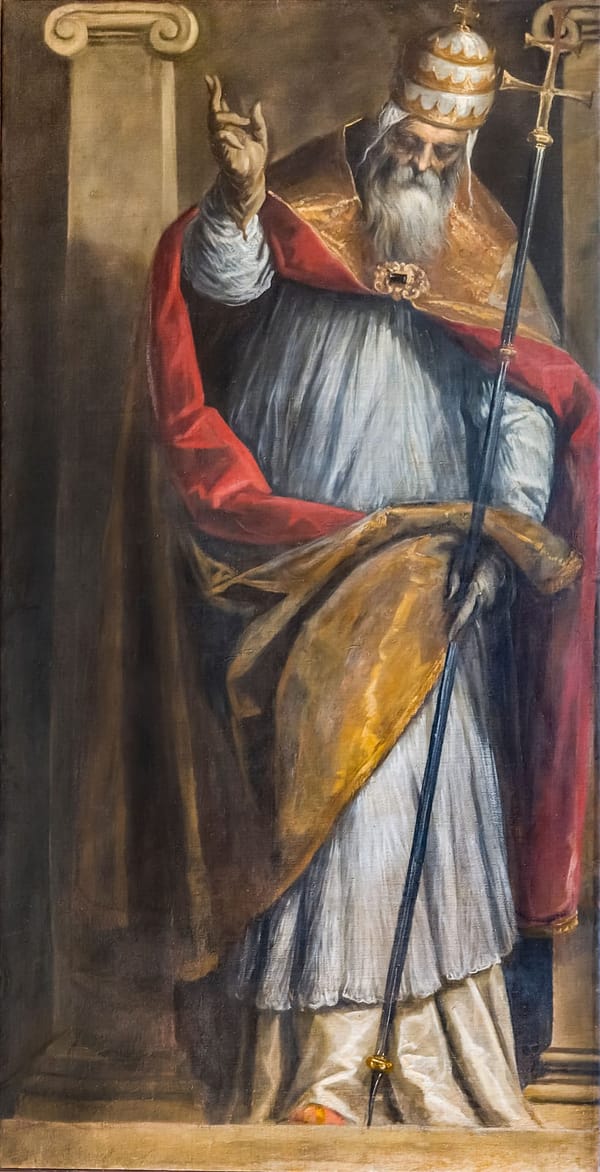
April 26: Sts. Cletus and Marcellinus, Popes and Martyrs
TWO bright stars appear this day on the ecclesiastical cycle, proclaiming the glory of our Jesus, the Conqueror of death. Again they are two pontiffs, and martyr pontiffs. Cletus leads us to the very commencement of the Church, for he was a disciple of Peter, and his second successor in the See of Rome. Marcellinus was a witness of the great persecution under Diocletian; he governed the Church on the eve of her triumph. Let us honour these two fathers of Christendom, who laid down their lives in its defence; and let us offer their merits to Jesus, who supported them by his grace, and cheered them with the hope that one day they would share in his Resurrection.
The following is the account given of St Cletus by the Liturgy:
The Life of St Marcellinus is thus given in the Breviary:
Pray for us, O holy Pontiffs, and look with fatherly love upon the Church on earth, which was so violently persecuted in your times, and at the present day is far from enjoying peace. The worship of idols is revived; and though they be not of stone or metal, yet they that adore them are as determined to propagate their worship as were the pagans of former days to make all men idolaters. The gods and goddesses now in favour are called Liberty, Progress, and Modern Civilization. Every measure is resorted to, in order to impose these new divinities upon the world; they that refuse to adore them are persecuted; governments are secularized, that is, unchristianized; the education of youth is made independent of all moral teaching; the religious element is rejected from social life as an intrusion: and all this is done with such a show of reasonableness that thousands of well-minded Christians are led to be its advocates, timid perhaps and partial, but still its advocates. Preserve us, O holy martyrs! from being the dupes of this artful impiety. It was not in vain that our Jesus suffered death, and rose again from the grave. Surely after this he deserves to be what he is—King of the whole earth, under whose power are all creatures. It is in order to obey him that we wish no other liberty save that which he has based upon the Gospel; no other progress save that which follows the path he has marked out; no other civilization save that which results from the fulfilment of the duties to our fellow-men, which he has established. It is he that created human nature, and gave it its laws; it is he that redeemed it, and restored to it its lost rights. Him alone, then, do we adore. O holy martyrs! pray that we may never become the dupes or slaves of the theories of human pride, even if they that frame or uphold them should have power to make us suffer or die for our resistance.
Wednesday of the Second Week after Easter
WE are not to suppose that because the sacred Humanity of our Risen Jesus is resplendent with glory and majesty, it is therefore less accessible to mortals. His kindness and condescension are the same as before; nay, he seems to have become more affectionate than ever, and more desirous to be with the children of men. Surely we have not forgotten what happened during the joyous octave of the Pascli! His affectionate greeting to the holy Women, when on their way to the sepulchre; his appearing to Magdalen under the form of a gardener; his conversation with the two disciples of Emmaus, and the means he took to make them recognize him; his showing himself, on the Sunday evening, to the Ten, greeting them with his Peace be to you, allowing them to touch him, and even condescending to eat with them; his amiably bidding Thomas, on the eighth day, convince himself of the reality of the Resurrection by feeling the Wounds; his meeting his disciples at the Lake of Genesareth, blessing their fishing, and providing them with a repast on the bank—all this is proof of the tender love and intimacy wherewith our Saviour treated his creatures during the forty days after his Resurrection.
As to his visits to his blessed Mother, we shall have another occasion for speaking of them; to-day we will consider him in the midst of his disciples. So frequently is he with them, that St Luke calls it an appearing to them for forty days.1 The apostolic college is reduced to eleven; for the place of the traitor Judas is not to be filled up till after our Lord’s Ascension, immediately before the descent of the Holy Ghost. How beautiful in their simplicity are these future messengers of the Good Tidings to mankind!2 A short while ago they were weak and hesitating in their faith; they forgot all they had seen and heard; they fled from their Master in the hour of trial. As he had foretold it to them, they were scandalized at his humiliations and death. The news of his Resurrection made little impression upon them; they even disbelieved it. And yet they found him so affectionate, so gentle in his reproaches, that they soon resumed the confidence and intimacy they had had with him during his mortal life. Peter, who had been the most unfaithful, as well as the most presumptuous, of all, has now regained his position of the most honoured of the Apostles, and, in a few days hence, is to receive a special proof of Jesus’ having forgotten his past disloyalty. He and his fellow Apostles can think of nothing now but Jesus. When he is with them they feast on the beauty and glory of his appearance. His words are dearer to them than ever, for they understand them better, now that they have been enlightened by the mysteries of the Passion and Resurrection. They eagerly listen to all that he says, and he says more than formerly, because he is so soon to leave them. They know that the day will soon come when they will no longer be able to hear his voice; they, therefore, treasure up his words as though they were his last will, and how could they better fit themselves for the mission he has entrusted to them? It is true they do not, as yet, fully enter into all the mysteries they are to preach to the world—they could not even remember so many sublime things—but Jesus tells them that he will soon send upon them the Holy Ghost, who will not only give them courage, but will also bless them with spiritual understanding, and will enable them to remember all that he, Jesus, has taught them.3
Nor must we forget the holy women, those faithful companions of Jesus, who followed him up to Calvary, and were the first to be rewarded with the joys of the Resurrection. Their divine Master could not overlook them now: he praises their devotedness, he encourages them; he takes every opportunity of repaying them. Heretofore, as the Gospel tells us,4 they provided him with food; now that he needs no earthly nourishment he feasts them with his dear presence; they see him, they hear his words; the very thought that he is soon to be taken from them makes these happy days doubly precious to them. They are the venerable mothers of the Christian people; they are our illustrious ancestors in the Faith; and on the day of the descent of the Holy Ghost, we shall find them with the Apostles in the Cenacle receiving the Tongues of Fire. Woman is to be represented on that glorious occasion, when the Church is to be made manifest before the world; the women of Calvary and the sepulchre are chosen for this office, and right well do they deserve to share in the bright joys of Pentecost.
Let us recite the following sequence in honour of our dear Jesus, who passes these forty days with his Apostles and the holy women. It was composed by Adam of St Victor:
Sequence
Lux succedit tenebris,
Morti resurrectio;
Lætis cedant tristia,
Cum sit major gloria
Quam prima confusio;
Umbram fugat veritas,
Vetustatem novitas,
Luctum consolatio.
Quod praeit in capite,
Membra sperent singula.
Pascha novum Christus est,
Qui pro nobis passus est,
Agnus, sine macula.
Prædam Christus eruit.
Quod Samson praecinuit.
Dum leonem lacerat.
David, fortis viribus,
A leonis unguibus
Et ab ursi faucibus
Gregem patris liberat.
Samson, Christum figuravit,
Cujus mors victoria.
Samson dictus Sol eorum:
Christus lux est electorum Quos illustrat gratia.
Botrus fluit in dilectae penetrai Ecclesiae.
Musto gaudent debriari
Gentium primitiae.
In regales transit usus:
Saccus fit soccus gratiæ,
Caro victrix miseriae.
Dei regnum perdiderunt;
Sed non deletur penitus
Cain, in signum positus.
Lapis iste nunc electus,
In trophæum stat erectus et in caput anguli.
Novam creat creaturam,
Tenens in se ligaturam
Capiti gloria,
Membrisque concordia!
Light follows darkness,
and resurrection death.
Sorrow gives place to joy,
for our glory is greater than
was our former shame.
Truth dispels the shadow;
the new what was old;
and consolation mourning.
Let the members hope to have
what now their Head enjoys.
Our new Pasch is Christ
—the spotless Lamb
that was slain for us.
from the enemy that surrounded us.
It is the victory prefigured by Samson,
when he tore the lion to pieces;
and by the powerful David,
when he rescued his father’s flock
from the lion’s grasp
and the bear's jaw.
he was a type of Christ, whose death was a victory.
Samson signifies their Sun:
so is Christ the Light of his elect,
for he makes his grace shine upon them.
the vine-stream flows into the store-house of the beloved Church.
and the first-fruits of the Gentiles
drink their fill and are glad.
is made a robe for kings:
that garment is the Flesh that triumphed over suffering,
and became an ornament of grace.
because they put the King to death;
they are not utterly destroyed,
for, like Cain, they are set as a sign.
is now the chosen one,
set up as a trophy, and made the chief corner-stone.
he creates us new creatures;
he unites in himself the two peoples (Jew and Gentile).
to our head!
and to the members peace!
| Previous Tuesday of the Second Week after Easter | Next Wednesday of the Second Week after Easter |