Daily reading
Paschal Time
Double · April 29 · Sanctoral
April 29, 2028
From Dom Guéranger’s The Liturgical Year.
A Double leads the weekday.Rubric
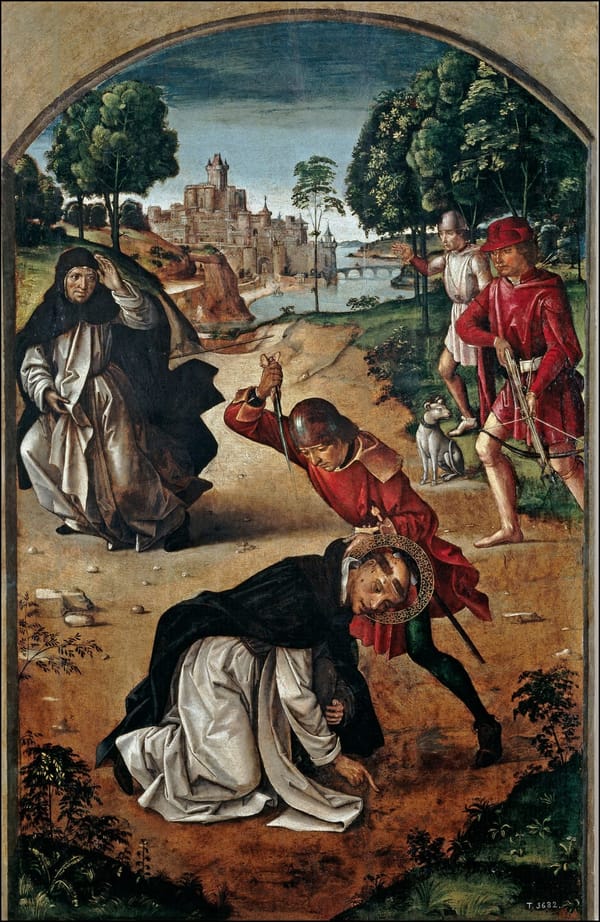 |
April 29: St. Peter, Martyr
THE hero deputed this day by the Church to greet our Risen Lord was so valiant in the good fight that martyrdom is part of his name. He is known as Peter the Martyr; so that we cannot speak of him without raising the echo of victory. He was put to death by heretics, and is the grand tribute paid to our Redeemer by the thirteenth century. Never was there a triumph hailed with greater enthusiasm than this. The martyrdom of St Thomas of Canterbury excited the admiration of the faithful of the preceding century, for nothing was so dear to our forefathers as the liberty of the Church; the martyrdom of St Peter was celebrated with a like intensity of praise and joy. Let us hearken to the fervid eloquence of the great Pontiff, Innocent IV, who thus begins the Bull of the martyr's canonization: ‘The truth of the Christian faith, manifested, as it has been, by great and frequent miracles, is now beautified by the new merit of a new Saint. Lo! a combatant of these our own times comes, bringing us new and great and triumphant signs. The voice of his blood shed (for Christ) is heard, and the fame of his martyrdom is trumpeted, through the world. The land is not silent that sweateth with his blood; the country that produced so noble a warrior resounds with his praise; yea, the very sword that did the deed of parricide proclaims his glory . . . . Mother Church has great reason to rejoice, and abundant matter for gladness; she has cause to sing a new canticle to the Lord, and a hymn of fervent praise to her God; . . . the Christian people has cause to give forth devout songs to its Creator. A sweet fruit, gathered in the garden of faith, has been set upon the table of the eternal King: a grape-bunch taken from the vineyard of the Church has filled the royal cup with new wine . . . . The flourishing Order of Preachers has produced a red rose, whose sweetness is most grateful to the King; and from the Church here on earth there has been taken a stone, which, after being cut and polished, has deserved a place of honour in the temple of heaven.'1
Such was the language wherewith the supreme Pontiff spoke of the new martyr, and the people responded by celebrating his feast with extraordinary devotion. It was kept as were the ancient festivals, that is, all servile work was forbidden upon it. The churches served by the Fathers of the Dominican Order were crowded on his feast; and the faithful took little branches with them, that they might be blessed in memory of the triumph of Peter the Martyr. This custom is still observed; and the branches blessed by the Dominicans on this day are venerated as being a protection to the houses where they are kept.
How are we to account for all this fervent devotion of the people towards St Peter? It was because he died in defence of the faith; and nothing was so dear to the Christians of those days as faith: Peter had received the charge to seize all the heretics who at that time were causing great disturbance and scandal in the country round about Milan. They were called Cathari, but in reality were Manicheans; their teachings were detestable, and their lives most immoral. Peter fulfilled his duty with a firmness and equity which soon secured him the hatred of the heretics; and when he fell a victim to his holy courage, a cry of admiration and gratitude was heard throughout Christendom. Nothing could be more devoid of truth than the accusations brought by the enemies of the Church and their indiscreet abettors against the measures formerly decreed by the public law of Catholic nations, in order to foil the efforts made by evil-minded men to injure the true faith. In those times, no tribunal was so popular as that whose office it was to protect the faith, and to put down all them that attacked it. It was to the Order of St Dominic that this office was mainly entrusted; and well may they be proud of the honour of having so long held one so beneficial to the salvation of mankind. How many of its members have met with a glorious death in the exercise of their stem duty! St Peter is the first of the martyrs given by the Order for this, holy cause: his name, however, heads a long list of others who were his brethren in religion, his successors in the defence of the faith, and his followers to martyrdom. The coercive measures that were once, and successfully, used to defend the faithful from heretical teachers have long since ceased to be used: but for us Catholics, our judgement of them must surely be that of the Church. She bids us to-day honour as a martyr one of her Saints, who was put to death whilst resisting the wolves that threatened the sheep of Christ’s fold; should we not be guilty of disrespect to our Mother if we dared to condemn what she so highly approves? Far, then, be from us that cowardly truckling to the spirit of the age, which would make us ashamed of the courageous efforts made by our forefathers for the preservation of the faith! Far from us that childish readiness to believe the calumnies of Protestants against an institution which they naturally detest! Far from us that deplorable confusion of ideas which puts truth and error on an equality, and, from the fact that error can have no rights, concludes that truth can claim none!
The following is the account given us by the Church of the virtues and heroism of St Peter the Martyr:
The following Antiphons and Responsory are taken from the Dominican Breviary:
The victory was thine, O Peter! and thy zeal for the defence of our holy faith was rewarded. Thou didst ardently desire to shed thy blood for the holiest of causes, and by such a sacrifice to confirm the faithful of Christ in their religion. Our Lord satisfied thy desire; he would even have thy martyrdom be in the festive season of the Resurrection of our divine Lamb, that his glory might add lustre to the beauty of thy holocaust. When the death-blow fell upon thy venerable head, and thy generous blood was flowing from the wounds, thou didst write on the ground the first words of the creed, for whose holy truth thou wast giving thy life.
Protector of the Christian people! what other motive hadst thou, in all thy labours, but charity? What else but a desire to defend the weak from danger induced thee not only to preach against error, but to drive its teachers from the flock? How many simple souls, who were receiving divine truth from the teaching of the Church, have been deceived by the lying sophistry of heretical doctrine, and have lost the faith? Surely the Church would do her utmost to ward off such dangers from her children; she would do all she could to defend them from enemies, who were bent on destroying the glorious inheritance which had been handed down to them by millions of martyrs! She knew the strange tendency that often exists in the heart of fallen man to love error; whereas truth, though of itself unchanging, is not sure of its remaining firmly in the mind, unless it be defended by learning or by faith. As to learning, there are but few who possess it; and as to faith, error is ever conspiring against it, and, of course, with the appearance of truth. In the Christian ages it would have been deemed not only criminal, but absurd, to grant to error the liberty which is due only to truth; and they that were in authority considered it a duty to keep the weak from danger, by removing from them all occasions of a fall; just as the father of a family keeps his children from coming in contact with wicked companions who could easily impose on their inexperience, and lead them to evil under the name of good.
Obtain for us, O holy martyr, a keen appreciation of the precious gift of faith—that element which keeps us in the way of salvation. May we zealously do everything that lies in our power to preserve it, both in ourselves and in them that are under our care. The love of this holy faith has grown cold in so many hearts; and frequent intercourse with heretics or free-thinkers has made them think and speak of matters of faith in a very loose way. Pray for them, O Peter, that they may recover that fearless love of the truths of religion which should be one of the chief traits of the Christian character. If they be living in a country where the modem system is introduced of treating all religions alike—that is, of giving equal rights to error and to truth—let them be all the more courageous in professing the truth, and detesting the errors opposed to the truth. Pray for us, O holy martyr, that there may be enkindled within us an ardent love of that faith without which it is impossible to please God.2 Pray that we may become all earnestness in this duty, which is of vital importance to salvation; that thus our faith may daily gain strength within us, till at length we shall merit to see in heaven what we have believed unhesitatingly on earth.
Saturday the Second Week after Easter
THIS being Saturday, let us once more think of Mary, and of the joy she feels at the Resurrection of her Son. She had been his companion in his sufferings; there was not one that she had not endured, and suffered as far as a mere creature could suffer: so, too, there is not a single glory or gladness of the Resurrection in which she is not now made to participate. It was meet that she, to whom God had granted the grace and merit of sharing in the work of the Redemption, should take her part in the prerogatives which belong to her Jesus, now that he is risen. Her soul is raised to a higher state of perfection; grace loads her with new favours; her actions and sentiments become more than ever heavenly.
She was the first to receive a visit from Jesus after his Resurrection—the first, consequently, to receive from him his own new life. Can we be astonished at her receiving it when we remember that every Christian, who, being purified by his having compassionated with Jesus in his Passion, unites himself afterwards with holy Church, in the sublime mystery of the Pasch, becomes a sharer in the life of his risen Lord? This transformation, which in us is weak, and often, alas! of short duration, was perfect in Mary, for her high vocation and her incomparable fidelity deserved that it should be so; of her, then, far more truly than of us, it may be said that she was indeed risen in her Jesus. The thought of these forty days, during which Mary still possesses her divine Son on this earth, reminds us of those other forty of Bethlehem, when we paid our affectionate homage to the young Virgin-Mother who fed her divine Babe at her breast; we heard the angels singing their Gloria, we saw the shepherds and the Magi; all was exquisite sweetness. What mainly impressed us then was the humility of our Emmanuel; we recognized him as the Lamb that had come to take away the sins of the world; there was nothing that betokened the Mighty God. What changes have happened since that dear time! What sorrows have pierced Mary's heart before her reaching this blissful season of Paschal joy! The sword foretold by Simeon is now, indeed, sheathed, yea, broken for ever, but oh! how sharp and cruel have been its thrusts! Well may Mary now say with the Psalmist: According to the multitude of my sorrows in my heart, thy comforts, O Lord, have given joy to my soul!1 The Lamb, the gentle little Lamb, has become the Lion of the tribe of Juda; and Mary, the Mother of the Babe of Bethlehem, is equally the Mother of the glorious Conqueror.
With what delight does he not show the glories of his victories to his Mother! His work is done, and now he is the beautiful crowned King of Ages; yes, this is he whom she held for nine months within her womb, whom she fed at her breast, and who, for all eternity, will honour her as his Mother. He honours her during these last forty days on earth with every possible mark of affection; he satisfies her maternal love by frequently visiting her. How admirable must not these interviews be between such a Son and Mother! How delightedly must not Mary look upon her Jesus now? the same dear one, it is true, but oh! so changed from what he was a few days ago! That face, so familiar to Mary, beams with a light which is new even to her. The Wounds that remain in his hands, feet, and side, dart forth a brightness which effaces every recollection of sadness. But how shall we speak of the joy wherewith Jesus gazes upon Mary, his Immaculate Mother—his companion in the work of man’s salvation—the creature who is more perfect and more worthy of love than all other creatures put together? Who could describe the conversations of such a Son with such a Mother, during these days preceding his Ascension, when another long separation is to follow? Eternity will tell us what they were; but, even now, if we love the Son and the Mother, we can imagine some little of what passed between them. Jesus would offer to Mary some compensation for the prolongation of her stay on earth, which is required of her by her ministry as Mother of men; more privileged than was heretofore Martha’s sister, she hears his every word, and feeds on its sweetness in an ecstasy of love. O happy hours, to be followed by long years of absence, flow slowly by! Give this blessed Mother time to satiate her love with the sight and caresses of this dearest and most beautiful of the sons of men! O Mary! by these hours of joy which repaid thee for those long bitter ones of thy Jesus’ Passion, pray to him for us, that he permit us to feel and relish his presence in our hearts during this our exile, wherein we are absent from him.2 Thus shall we persevere in our devoted service until the arrival of that blissful moment when we are to be united with him in heaven, never again to be separated from him.
Let us offer to the blessed Mother this beautiful sequence, wherewith the Churches of Germany used formerly to celebrate her Seven Joys, of which the Resurrection was one of the grandest.
Sequence
Deus summæ bonitatis et misericordiæ,
Qui tuae humilitatis
Et dulcorem suavitatis vidit et fragrantiæ.
Cum per angelum mandatur tibi salus gratiæ;
Modum quæris, demonstratur,
Dum consentis, incarnatur confestim rex gloriæ.
Ut hunc regem mereamur habere propitium,
Et ab eo protegamur,
Protecti recipiamur in terra viventium.
Quod tu solem stella paris, velut luna radium;
Pariendo non gravaris,
Virgo manes, non mutaris propter puerperium.
Suum non perdit decorem, cum odor emittitur;
Sic nec propter creatorem
Virginitatis candorem tu perdis, cum nascitur.
Esto nobis recta via apud tuum fiilium,
Atque pro tua gratia
Repelle nostra vitia per secundum gaudium.
Stella monet, quam morari vides super filio
Cum a magis adorari
Ipsum cernis et ditari munere tam vario.
Tresque reges trinitatem in dicto sacrificio;
Aurum mentis puritatem,
Myrrha carnis castitatem, thus est adoratio.
A peccatis simus mundi per te, Virgo Maria,
Et virtutibus fœcundi,
Læti tecum et jocundi, lætemur in patria.
Cum a morte suscitatur Christus die tertia.
Per hoc fides roboratur,
Spes redit et mors fugatur per te, plena gratia;
Homo captus liberatur,
Et ab humo sublevatur
Sursum ad coelestia.
Funde preces cunctis horis, ut per istud gaudium,
Post cursum hujus laboris,
Beatis jungamur choris supernorum civium.
Ascendentem dum vidisti filium in gloria.
Tunc aperte cognovisti
Quod tu mater exstitisti, cujus eras filia.
Via, per quam ascendatur ad cœli palatia;
Ergo surgat et sequatur
Istam viam, qui moratur in mundi miseria.
Ne subjici valeamus dæmonis imperio;
Sed ad coelos ascendamus,
Ubi semper gaudeamus, tecum et cum filio.
De supernis qui descendit in linguis Paraclitus,
Dum confirmat et defendit,
Replet, mundat et accendit Apostolos penitus,
Ut per ignem sit sanatus homo linguis perditus,
Et per ignem emendatus
Qui fuerat maculatus per peccatum primitus.
Ora, Virgo, tuum natum, ut in hoc exilio
Nostrum deleat reatum,
Ne sit in nobis peccatum in magno judicio.
Cum de mundo te vocavit Christus ad coelestia,
Super thronos exaltavit,
Exaltatam honoravit speciali gratia.
Qui nemini reservatur in coelesti curia;
Nec virtutibus ditatur,
Nisi cui per te datur virtutum custodia.
Sentiamus bonitatis tuæ beneficia;
Et nos serves a peccatis,
Et perducas cum beatis ad aeterna gaudia.
A peccatis nos emunda per haec septem gaudia;
Et fœcunda nos fœcunda,
Et duc tecum ad jocunda Paradisi gaudia.
the God of all goodness and mercy,
being pleased with the loveliness of thy humility,
meekness, and purity, is announced as having to be born of thee.
by the angel who hails thee full of grace.
Thou askest how? and thou art told.
Thou consentest: and the King of glory instantly becomes incarnate in thy womb.
that we may deserve to receive mercy from this King,
be protected by him, and, thus protected,
be admitted into the land of the living.
the Star, givest birth to the Sun, as the Moon emits its ray.
This birth injures thee not;
thou remainest a Virgin as before.
by sending forth its fragrance;
so neither losest thou the bloom of thy Virginity
by giving birth to thy Creator.
be to us the way that leads to thy Son;
and, by thy second Joy,
graciously intercede for us, that we be converted from our sins.
Thou seest a star resting over thy Child,
the Magi adoring him,
and offering their varied gifts.
three Kings, Trinity;
the gold signifies purity of soul;
the myrrh, chastity of body; the incense, adoration.
pray for us, that we may be cleansed from our sins,
enriched with virtue, and united with thee
in the happiness and bliss of the heavenly Country.
when Jesus rose from the tomb, on the third day.
By this Mystery, faith is strengthened, hope restored, and death put to flight;
and thou, O full of grace, hadst thy share in effecting these wonders.
Man, who had been made captive, is set free,
and raised from earth
to heaven above.
pray hourly for us, that, by this Joy,
we may be associated with the choirs of the heavenly citizens,
after this life’s labours are over.
when thou wast present at thy Son’s Ascension into heaven.
Then didst thou clearly know
that he whose Mother thou wast was thy Creator.
the path whereby we are to ascend to heaven.
Let us then, who dwell in this miserable world,
arise, and follow this path.
to pray that we may never be made subject to Satan’s power;
but that we ascend to heaven,
where, with thee and thy Son, we may rejoice for all eternity.
was when the Holy Ghost descended, in the form of fiery tongues, from heaven,
strengthening, defending,
filling, cleansing, and inflaming the Apostles.
that man, who owed his perdition to a tongue,
might be saved by such fire; and that he who, at the beginning,
had been defiled by sin, might by fire be purified.
intercede for us to thy Son,
that he pardon us our sins, now in this our exile,
lest there be found guilt upon us at the great judgement.
when he called thee out of this world to heaven,
placed thee on thy throne,
and honoured thee with special favours.
such as none of the blessed in heaven enjoy;
nor can any mortal attain to the perfection of virtue,
unless by thine intercession he receive the safeguard of virtue.
give us to feel the proofs of thy loving intercession,
which will preserve us from sin,
and lead us to eternal joys, in the company of the Blessed.
pray that we may be purified from our sins;
and, being made fruitful in good works,
lead us, O fruitful Mother, to the blissful joys of heaven.
| Previous Friday of the Second Week after Easter | Next Saturday the Second Week after Easter |