Daily reading
Paschal Time
Double · Movable from Easter · Temporal
April 30, 2028
From Dom Guéranger’s The Liturgical Year.

|
Second Sunday after Easter
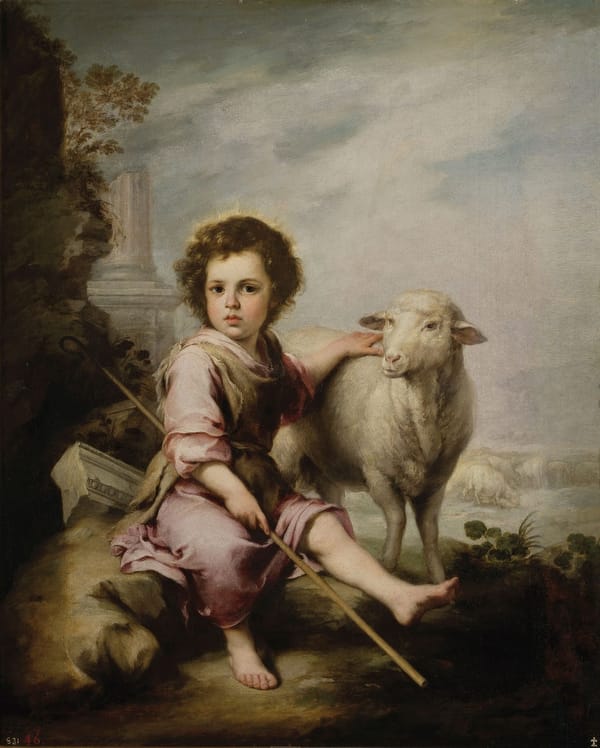
THIS Sunday goes under the name of Good Shepherd Sunday, because in the Mass there is read the Gospel of St John, wherein our Lord calls himself by this name. How very appropriate is this passage of this Gospel to the present season, when our divine Master began his work of establishing and consolidating the Church, by giving it the pastor, or shepherd, who was to govern it to the end of time!
In accordance with the eternal decree, the Man-God, on the fortieth day after his Resurrection, is to withdraw his visible presence from the world. He is not to be again seen upon the earth till the last day, when he will come again to judge the living and the dead. And yet he could never abandon mankind, for which he offered himself on the Cross, and delivered from death and hell by rising triumphantly from the grave. He will continue to be its Head after his Ascension into heaven: but what shall we have on earth to supply his place? We shall have the Church. It is to the Church that he will leave all his own authority to rule us; it is into the hands of the Church that he will entrust all the truths he has taught; it is the Church that he will make the dispenser of all those means of salvation which he has destined for the world.
This Church is a society, unto which all mankind is invited. It is composed of two classes of members; the governing and the governed; the teaching and the taught; the sanctifying and the sanctified. This society is the Spouse of Christ; it is by her that he produces his elect. She is the one only Mother of the elect; out of her bosom there is no salvation.
But how is this society to subsist? how is it to persevere through the long ages of time, even to the last day? who is to give it unity and adhesion of its parts? what is to be the visible link between its members—the palpable sign of its being the true Spouse of Christ, in the event of other societies rising up and disputing her titles? If Jesus himself could have remained with us we should have had nothing to fear, for where he is, there also are truth and life; but, as he says, he is going, and we may not as yet follow him. Give ear, then, and learn what is the primary quality of the true Spouse of Christ.
Jesus was one day, previous to his Passion, in the country of Cesarea Philippi; his Apostles were standing around him, and he began questioning them about what they thought of him. One of them, Simon the son of John or Jonas, and brother to Andrew, answered in the name of all, and said: Thou art Christ, the Son of the living God!1 Jesus expressed his pleasure at receiving Simon’s testimony, which was not the result of any human knowledge, but the expression of a divine revelation there and then granted to him; and he immediately told this Apostle that from that time forward he was to be, not Simon, but Peter (which means a rock). Christ had been spoken of by the prophets under the name of a Rock, or Stone;2 by thus solemnly conferring upon his disciple a title so characteristically that of the Messias, Jesus would give us to understand that Simon was to have something in common with himself which the other Apostles were not to have. After saying to him: ‘Thou art Peter (that is, thou art the rock), he added:' And upon this rock I will build my Church.’3
Let us weigh the force of these words of the Son of God: I will build my Church. He has, then, a project in view—he intends to build a Church. It is not now that he will build it, but at some future period; but one thing we already know as a certainty—it is that this Church will be built on Peter. Peter will be its foundation; and whosoever is not on that foundation will not belong to the Church. Let us again give ear to the text: And the gates of hell shall not prevail against my Church. In scriptural language gates signify powers: the Church of Christ, therefore, is to be proof against all the efforts of hell. And why? Because the foundation which Jesus is to give to it shall be one that no power can shake. The Son of God continues: And I will give to thee the keys of the kingdom of heaven. In the language of the Jews, keys signify the power of governing; and in the Gospel Parables the kingdom of heaven is the Church built by Christ. By saying to Peter (which is henceforth to be Simon’s name), I will give to thee the keys of the kingdom of heaven, Jesus implied this: ‘I will make thee the King of my Church, of which thou art to be the foundation!’ Nothing could be clearer. But let us remember that all these magnificent promises regard the future.4
That future has now become the present. We are now come to the last days of Jesus’ visible presence here below. The time is come for him to make good his promise, and found the kingdom of God—that Church which he was to build upon the earth. The Apostles, in obedience to the order sent them by the angels, are come into Galilee. Our Lord appears to them on the shore of the lake of Tiberias: after providing them with a mysterious repast, and whilst they are all attentive to his words, he suddenly addresses himself to Peter: Simon, son of John, lovest thou me?5 Observe, he does not call him Peter; he, as it were, goes back to the day when he said to him: Simon, son of Jonas, thou art Peter; he would have his disciples note the connection between the promise and its actual fulfilment. Peter, with his usual eagerness, answers his Master’s question: Yea, Lord, thou knowest that I love thee. Jesus resumes, with a tone of authority: Feed my lambs! Then repeating the question, he says: Simon, son of John, lovest thou me? Peter is surprised at his Master’s urging such an inquiry; still he answers with the same simplicity as before: Yea, Lord, thou knowest that I love thee: and as soon as he has given answer, Jesus repeats the words of investiture: Feed my lambs!
The disciples respectfully listen to this dialogue; they see plainly that, here again. Peter is made an object of Jesus’ partiality, and is receiving something which they themselves are not to receive. They remember what happened at Cesarea Philippi and how. ever since that day, Peter has been treated by their Master with especial honour. And yet there is another privilege or office to be added to this of feeding the lambs. A third time, then, Jesus says to Peter: Simon, son of John, lovest thou me? This is too much for the Apostle. These three questionings of his love bring to his mind the three denials he had so sinfully made to the servant girl of Caiphas. He feels the allusion to his recent infidelity; and this third time, his answer implies a prayer for forgiveness; his reply bespeaks humility rather than assurance: Lord! says he, thou knowest all things! Thou knowest that I love thee! Then, making Peter’s authority complete, Jesus pronounces these imposing words: Feed my sheep!6
Here, then, we have Peter made shepherd by him who says of himself: I am the good Shepherd. Firstly, our Lord gives his Apostle, twice over, the care of his lambs; this does not make him the complete shepherd: but when he bids him feed his sheep too, the whole flock is subjected to his authority. Now, therefore, let the Church show herself, let her take her stand, let her spread herself through the length and breadth of the nations; Simon, the son of John, is proclaimed its visible head. Is the Church a building? he is the foundation-stone, the Petra, the rock. Is she a kingdom? he holds the keys, that is, the sceptre. Is she a fold? he is the shepherd.
Yes, this Church, which Jesus is now organizing, which is to be proclaimed to the world on the day of Pentecost, is to be a fold. The Word, the Second Person of the blessed Trinity, is come down from heaven, that he may gather together in one the children of God that were dispersed;7 and the time is at hand when there shall he but one fold and one shepherd.8 O Jesus! our divine Shepherd! we bless thee, we give thee thanks. It is by thee that the Church thou art now founding subsists and lives through every age, congregating and saving all that put themselves under her guidance. Her authority, her strength, her unity, all come from thee, her infinitely powerful and merciful shepherd! We likewise bless and thank thee that thou hast secured this authority, this strength, this unity, by giving us Peter as thy Vicar, Peter our shepherd in and by thee, Peter to whom all, both sheep and lambs, owe obedience, Peter in whom thou, our divine Head, wilt be for ever visible, even to the end of the world!
In the Greek Church, the second Sunday after Easter, which we call Good Shepherd Sunday, goes under the appellation of the Sunday of the holy Myrophorœ, that is Perfume-Bearers. The Office celebrates the devotion of the holy women who brought their perfumes to the sepulchre, that they might embalm the Body of Christ. Joseph of Arimathea is also commemorated in the Greek Liturgy of this week.
The Roman Church reads the Acts of the Apostles in her Matins, from last Monday to the third Sunday after Easter exclusively.
Mass
The Introit takes a tone of triumph. It celebrates in the words of the Royal Psalmist the mercy of the Lord, which by the foundation of the Church has filled the whole earth. The heavens (by which, in the mysterious language of the Scripture, is frequently meant the Apostles), were firmly established by the Word of the Lord, when Jesus (the Word) gave them Peter as their shepherd and their rock.
Introit
Ps. Exsultate justi in Domino: rectos decet collaudatio.℣. Gloria Patri.
Misericordia.
Ps. Rejoice in the Lord, O ye just! Praise becometh the upright.℣. Glory, etc.
The earth, etc.
In the Collect, the Church asks the grace of holy Joy for her children: it is the spirit of Eastertide. Surely, it is a duty to rejoice at our having been saved from death by our Jesus' Resurrection! Moreover, these Paschal joys are a preparation for those of eternity.
Collect
To this are added two of the following Collects:
Of the Blessed Virgin
Against the Persecutors of the Church
For The Pope
Epistle
1 Cap. ii.Charissimi, Christus passus est pro nobis, vobis relinquens exemplum, ut sequamini vestigia ejus. Qui peccatum non fecit, nec inventus est dolus in ore ejus: qui quum malediceretur, non maledicebat, quum pateretur, non comminabatur: tradebat autem judicanti se injuste: qui peccata nostra ipse pertulit in corpore suo super lignum: ut peccatis mortui, justitiae vivamus: cujus livore sanati estis. Eratis enim sicut oves errantes, sed conversi estis nunc ad pastorem et episcopum animarum vestrarum.
1 Ch. ii.Dearly beloved: Christ also suffered, leaving you an example, that you should walk in his steps. Who did no sin, neither was guile found in his mouth. Who, when he was reviled, did not revile; when he suffered, he threatened not: but delivered himself to him that judged him unjustly: who his own self bore our sins in his body upon the tree: that we being dead to sins, should live to justice: by whose stripes you were healed. For you were as sheep going astray; but you are now converted to the shepherd and bishop of your souls.
It is the prince of the Apostles, the visible shepherd of the universal Church, who addresses these words to us. Observe how he ends by turning our thoughts to the invisible shepherd, whose Vicar he is; and how carefully he avoids any allusion to himself. So, also, when assisting his disciple Mark to write his Gospel, he would not allow him to relate the history of Christ's having made him the shepherd of the whole flock; whereas, he insisted on his telling every circumstance of his thrice denying Jesus to be his Master. See, too. how feelingly the Apostle here speaks of his Saviour—of the sufferings he endured, of his patience, of his devotedness for those poor straying sheep of whom he was to form his fold! These words will one day be verified in Peter himself. The hour will come when, like his Master, he will be fastened to a cross, and patiently endure every insult and cruelty. Jesus told him that it was to be so. After entrusting him with the care of the sheep and lambs, our Lord told him that when he should have grown old, he would stretch forth his hands upon a cross, and suffer violence from men.9 This is to happen not merely to Peter, but to a considerable number of his successors, who are one with himself, and whom future generations are to see continually persecuted, exiled, imprisoned, and put to death. Let us also follow Jesus' steps, by cheerfully suffering for justice’ sake: we owe it to him who from all eternity, being equal in glory to God the Father, deigned to come down to our earth that he might be the shepherd and bishop of our souls.
The first Alleluia Versicle commemorates the repast at Emmaus: in a few moments we also shall know Jesus in the breaking of the Bread of Life.
The second proclaims, in Jesus’ own words, the dignity and qualities of a shepherd, his love for his sheep, and the eagerness wherewith his sheep recognize him as their Master.
Alleluia.℣. Ego sum Pastor bonus; et cognosco oves meas, et cognoscunt me meæ, alleluia.
Alleluia.℣. I am the good Shepherd, and I know my sheep, and my sheep know me, alleluia.
Gospel
Cap. x.In illo tempore: Dixit Jesus Pharisæis: Ego sum Pastor bonus. Bonus pastor animam suam dat pro ovibus suis. Mercenarius autem et qui non est pastor, cujus non sunt oves propriae, videt lupum venientem, et dimittit oves, et fugit: et lupus rapit et dispergit oves: mercenarius autem fugit, quia mercenarius est, et non pertinet ad eum de ovibus. Ego sum Pastor bonus: et cognosco oves meas, et cognoscunt me meae. Sicut novit me Pater, et ego agnosco Patrem: et animam meam pono pro ovibus meus. Et alias oves habeo, quæ non sunt ex hoc ovili: et illas oportet me adducere, et vocem meam audient, et fiet unum ovile, et unus pastor.
Ch. x.At that time: Jesus said to the Pharisees: I am the good Shepherd. The good shepherd giveth his life for his sheep. But the hireling, and he that is not the shepherd, whose own the sheep are not, seeth the wolf coming, and leaveth the sheep, and flieth, and the wolf catcheth, and scattereth the sheep: and the hireling flieth, because he is a hireling: and he hath no care for the sheep. I am the good Shepherd: and I know mine, and mine know me. As the Father knoweth me, and I know the Father: and I lay down my life for my sheep. And other sheep I have, that are not of this fold: them also I must bring, and they shall hear my voice, and there shall be one fold, and one shepherd.
Divine Shepherd of our souls! how great is thy love for thy sheep! Thou givest even thy life to save them. The fury of wolves does not make thee flee from us; thou becomest their prey, that we may escape. Thou didst die in our stead, because thou wast our Shepherd. We are not surprised at thy requiring from Peter a greater love than thou didst require from his brother Apostles: thou didst will to make him their and our shepherd. Peter answered thee without hesitation, that he loved thee; and thou didst confer upon him thine own name, together with the reality of thine office, in order that he might supply thy place after thy departure from this world. Be thou blessed, O divine Shepherd! for thy having thus provided for the necessities of thy fold, which could not be one, were it to have many shepherds without one supreme shepherd. In obedience to thy command, we bow down before Peter, with love and submission; we respectfully kiss his sacred feet; for it is by him that we are united to thee; it is by him that we are thy sheep. Preserve us, O Jesus, in the fold of Peter, which is thine. Keep far from us the hireling who usurps the place and rights of the shepherd. He has intruded himself, or been intruded by violence, into the fold, and would have us take him as the master; but he knows not the sheep, and the sheep do not know him. Led, not by zeal, but by avarice and ambition, he flieth at the approach of danger. He that governs through worldly motives is not a man to lay down his life for others. The schismatic pastor loves himself; he does not love thy sheep; how could he give his life for them? Protect us, O Jesus, from this hireling! He would separate us from thee, by separating us from Peter, whom thou hast appointed thy Vicar; and we are determined to recognize no other. Anathema to him who would command as in thy name, and yet not be sent by Peter! Such a pastor could be but an impostor; he would not rest on the foundation; he would not have the keys of the kingdom of heaven; to follow him would be our ruin. Grant, then, Good Shepherd, Jesus! that we may ever keep close to thee and to Peter; that as he rests upon thee, we may rest upon him; and thus we may defy every tempest, for thou, dear Lord, hast said: A wise man built his house upon a rock; and the rain fell, and the floods came, and the winds blew, and they beat upon that house, and it fell not; for it was founded on a rock.10
The Offertory is an aspiration to God. taken from the royal Prophet.
Offertory
In the Secret, the Church prays that the divine energy of the Mystery, about to be consummated on the Altar may produce within us the effect for which we long—death to sin. and resurrection to grace.
Secret
To this the priest adds two of the following Secrets.
Of the Blessed Virgin
Against The Persecutors Of The Church
For the Pope
The Communion Anthem speaks to us of the beautiful Mystery of to-day—the Good Shepherd. Let us once more offer our homage to the Son of God, who deigns to assume this endearing character; and let us ever be his devoted sheep.
Communion
Jesus, the Good Shepherd, has given himself, in this divine banquet, to his sheep: holy Church prays, in the Postcommunion, that we may ever be penetrated with sentiments of love for this august Sacrament; we ought to glory in it, as being the food that prepares us for immortality.
Postcommunion
To this the priest adds two of the following Postcommunions.
Of the Blessed Virgin
Against the Persecutors of the Church
For the Pope
Vespers
The Psalms, Hymn and Versicle are given on pages 81-90.
Antiphon of the Magnificat
Oremus.
We will close the day with this beautiful preface taken from the Mozarabic Missal. It commemorates the Resurrection.
Illatio
(Feria vi Paschœ)
April 30: St. Catherine of Siena, Virgin
 |
THE Dominican Order, which yesterday presented a rose to our Risen Jesus, now offers him a lily of surpassing beauty. Catharine of Siena follows Peter the Martyr: it is a coincidence willed by Providence, to give fresh beauty to this season of grandest mysteries. Our divine King deserves everything we can offer him; and our hearts are never so eager to give him every possible tribute of homage as during these last days of his sojourn among us. See how nature is all flower and fragrance at this loveliest of her seasons! The spiritual world harmonizes with the visible, and now yields her noblest and richest works in honour of our Lord, the author of grace.
How grand is the Saint whose feast comes to gladden us to-day! She is one of the most favoured of the holy Spouses of the Incarnate Word. She was his, wholly and unreservedly, almost from her very childhood. Though thus consecrated to him by the vow of holy virginity, she had a mission given to her by divine Providence which required her living in the world. But God would have her to be one of the glories of the religious state; he therefore inspired her to join the Third Order of St Dominic. Accordingly, she wore the habit, and fervently practised during her whole life the holy exercises of a Tertiary.
From the very commencement, there was something heavenly about this admirable servant of God, which we fancy existing in an angel who had been sent from heaven to live in a human body. Her longing after God gave one an idea of the vehemence wherewith the blessed embrace the Sovereign Good on their first entrance into heaven. In vain did the body threaten to impede the soaring of this earthly seraph; she subdued it by penance, and made it obedient to the spirit. Her body seemed to be transformed, so as to have no life of its own, but only that of the soul. The Blessed Sacrament was frequently the only food she took for weeks together. So complete was her union with Christ that she received the impress of the sacred stigmata, and with them the most excruciating pain.
And yet in the midst of all these supernatural favours, Catharine felt the keenest interest in the necessities of others. Her zeal for their spiritual advantage was intense, whilst her compassion for them in their corporal sufferings was that of a most loving mother. God had given her the gift of miracles, and she was lavish in using it for the benefit of her fellow-creatures. Sickness and death itself were obedient to her command; and the prodigies witnessed at the beginning of the Church were again wrought by the humble Saint of Siena.
Her communings with God began when she was quite a child, and her ecstasies were almost without interruption. She frequently saw our Risen Jesus, who never left her without having honoured her either with a great consolation or with a heavy cross. A profound knowledge of the mysteries of our holy faith was another of the extraordinary graces bestowed upon her. So eminent indeed was the heavenly wisdom granted her by God that she, who had received no education, used to dictate the most sublime writings, wherein she treats of spiritual things with a clearness and eloquence to which human genius could never attain, and with a certain indescribable unction which no reader can resist.
But God would not permit such a treasure as this to lie buried in a little town of Italy. The Saints are the supports of the Church; and though their influence be generally hidden, yet at times it is open and visible, and men then learn what are the instruments which God uses for imparting blessings to a world that would seem to deserve little else besides chastisement. The great question, at the close of the fourteenth century, was the restoration to the Holy City of the privilege of having within its walls the Vicar of Christ, who for sixty years had been absent from his see. One saintly soul, by merits and prayers, known to heaven alone, might have brought about this happy event after which the whole Church was longing; but God would have it done by a visible agency, and in the most public manner. In the name of the widowed Rome—in the name of her own and the Church's Spouse—Catharine crossed the Alps, and sought an interview with the Pontiff, who had not so much as seen Rome. The prophetess respectfully reminded him of his duty; and in proof of her mission being from God, she told him of a secret which was known to himself alone. Gregory XI could no longer resist; and the Eternal City welcomed its Pastor and Father. But at the Pontiff's death, a frightful schism, the forerunner of greater evils to follow, broke out in the Church. Catharine, even to her last hour, was untiring in her endeavours to quell the storm. Having lived the same number of years as our Saviour had done, she breathed forth her most pure soul into the hands of her God, and went to continue in heaven her ministry of intercession for the Church she had loved so much on earth, and for souls redeemed in the precious Blood of her divine Spouse.
Our Risen Jesus, who took her to her eternal reward during the season of Easter, granted her whilst she was living on earth a favour which we mention here as being appropriate to the mystery we are now celebrating. He one day appeared to her, having with him his blessed Mother. Mary Magdalen—she that announced the Resurrection to the Apostles—accompanied the Son and the Mother. Catharine's heart was overpowered with emotion at this visit. After looking for some time upon Jesus and his holy Mother, her eyes rested on Magdalen, whose happiness she both saw and envied. Jesus spoke these words to her: ‘My beloved! I give her to thee, to be thy mother. Address thyself to her, henceforth, with all confidence. I give her special charge of thee.' From that day forward, Catharine had the most filial love for Magdalen, and called her by no other name than that of mother.
Let us now read the beautiful, but too brief, account of our Saint’s life, as given in the Liturgy.
Her learning was not acquired, but infused. Theologians proposed to her the most difficult questions of divinity, and received satisfactory answers. No one ever approached her, who did not go away a better man. She reconciled many that were at deadly enmity with one another. She visited Pope Gregory the Eleventh, who was then at Avignon, in order to bring about the reconciliation of the Florentines, who were under an interdict on account of their having formed a league against the Holy See. She told the Pontiff that there had been revealed to her the vow which he, Gregory, had made of going to Rome a vow which was known to God alone. It was through her entreaty that the Pope began to plan measures for taking possession of his See of Rome, which he did soon after. Such was the esteem in which she was held by Gregory, and by Urban the Sixth, his successor, that she was sent by them on several embassies. At length, after a life spent in the exercise of the sublimest virtues, and after gaining great reputation on account of her prophecies and many miracles, she passed hence to her divine Spouse, when she was about the age of three and thirty. She was canonized by Pius the Second.
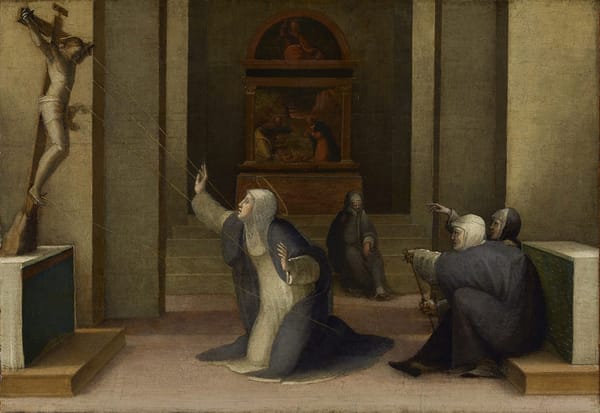
Being once at Pisa, on a Sunday, and having received the Bread of heaven, she was rapt in an ecstasy. She saw our crucified Lord approaching her. He was encircled with a great light, and from his five Wounds there came rays, which fell upon the five corresponding parts of Catharine's body. Being aware of the favour bestowed upon her, she besought our Lord that the stigmata might not be visible. The rays immediately changed from the colour of blood into that of gold, and passed, under the form of a bright light, to the hands, feet and heart of the Saint. So violent was the pain left by the wounds, that it seemed to her as though she must soon have died, had not God diminished it. Thus our most loving Lord added favour to favour, by permitting her to feel the smart of the wounds, and yet removing their appearance. The servant of God related what had happened to her to Raymund, her confessor. Hence, when the devotion of the faithful gave a representation of this miracle, they painted, on the pictures of St Catharine, bright rays coming from the five stigmata she received.***Her learning was not acquired, but infused. Theologians proposed to her the most difficult questions of divinity, and received satisfactory answers. No one ever approached her, who did not go away a better man. She reconciled many that were at deadly enmity with one another. She visited Pope Gregory the Eleventh, who was then at Avignon, in order to bring about the reconciliation of the Florentines, who were under an interdict on account of their having formed a league against the Holy See. She told the Pontiff that there had been revealed to her the vow which he, Gregory, had made of going to Rome a vow which was known to God alone. It was through her entreaty that the Pope began to plan measures for taking possession of his See of Rome, which he did soon after. Such was the esteem in which she was held by Gregory, and by Urban the Sixth, his successor, that she was sent by them on several embassies. At length, after a life spent in the exercise of the sublimest virtues, and after gaining great reputation on account of her prophecies and many miracles, she passed hence to her divine Spouse, when she was about the age of three and thirty. She was canonized by Pius the Second.
Pope Pius II, one of the glories of Siena, composed the two following hymns in honour of his saintly and illustrious fellow-citizen. They form part of the Office of St Catharine of Siena in the Dominican Breviary.
Hymn
Pope Pius II, one of the glories of Siena, composed the two following hymns in honour of his saintly and illustrious fellow-citizen. They form part of the Office of St Catharine of Siena in the Dominican Breviary.
Hymn
Quæ tu is læti, Catharina, sacris,
Hoc quidem pacto modulamur omnes,
Perfer Olympo.
Annuas nobis veniam, praecamur:
Non sumus tanti ingenii, fatemur,
Optima virgo.
Virginis laudes Quis in orbe toto
Fœminæ invictæ peritura numquam
Carmina pandet?
Moribus praestans, sapiens abunde;
Temperans, fortis, pia, justa, prudens,
Æthera scandis.
Quo nequit dici sanctius per orbem?
Vulnerum formam miserata Christi,
Exprimis ipsa.
Et malis cunctis penitus refertæ,
Fortiter spernens pretiosa quæque,
Sidera adisti.
Filio magni Genitoris almo,
Spiritum Sanctum veneremur, et sit
Laus tamen una.
these canticles of praise, which we,
gladdened by thy feast,
sing thus in thine honour.
pardon us, we beseech thee.
Nay, we own, O glorious Saint!
that we are not equal to the task we have undertaken.
Is there, in the wide world, a poet that could write an ode
immortal enough for this heroine,
whom no enemy could vanquish?
thou wast rich in virtue and wisdom;
and with the riches of thy temperance, fortitude,
piety, justice and prudence, thou didst ascend into heaven.
which were never surpassed in this world?
Thy compassion for the sufferings of Christ
stamped thee with the impress of his wounds.
of this short, mournful, and miserable life,
which abounds with every evil,
thou didst mount to heaven.
to the Son ever blessed of the Eternal Father!
let us give glory to the Holy Ghost!
to the Three, one equal praise!
Hymn
Jure censeris, quoniam triumphos
Ipsa cœlorum, probitate mira,
Nacta refulges.
Et simul munus probitatis almæ
Accipis cœlo, cumulata cunctis
Denique rebus.
Orbis exemplar, pietate plenum
Praedicatorum venerata Patrem,
Ordine fulges.
Nullus omatus, nitor ecce nullus
Corporis, semper fugiens iniqua
Crimina vitæ.
Quam pie flagris cruor hinc et inde
Fluxerat rivis! hominumque demum
Crimina flebas.
Orbe terrarum cruciantur omnes:
Quotque vel curis agitantur ipsi
Undique diris.
Si tuæ laudes repetantur omnes:
Tu quidem longe pietate cunctis
Inclyta præstas.
Et duces iras posuere sævas:
Hi necem diram populo minata
Sæpe Senensi.
Viribus summis operam dedisti:
Litteræ doctæ, lepidæque
Claris Urbibus exstant.
Niteris rectum suadere cunctis:
Sic ais: Tan tum probitas beatos
Efficit omnes.
Fortiter temnens, nihil extimescens,
Præmium nostræ vocitare vitæ
Sæpe solebas.
Quo sacros artus cineresque busto
Linqueres, cœlos aditura flentes
Ipsa docebas.
Hostiam libans, lacrymis obortis,
Dixeras cunctis documenta vitæ,
Voce suprema.
Filio magni Genitoris almo
Spiritum Sanctum veneremur, et sit
Laus tamen una.
thy praise, O Catharine!
for, by thy wondrous virtues, thou hast received
a triumphant welcome from heaven itself.
where thou art enriched with all good things,
that thou hast received the reward of thy holy life,
and the recompense of thy grand virtue.
that perfect model of every virtue;
thou didst enter his Order
and art one of its brightest glories.
none had charms for thee.
Thou couldst not brook sin,
the injustice offered to God by his creature.
and to atone for the sins of men,
oft didst thou severely scourge thyself till thine innocent blood
would flow in streams on the ground.
no matter where they might be, or what their misfortune.
Thy sympathy was ever ready for them, too,
that were a prey to care.
were we to tell all thy praises, O Catharine!
whose sanctity far surpassed
that of other mortals.
who were threatening
the people of Siena with death,
withdrew at thy word.
to the study of sacred things:
and thy letters, teeming with wisdom and elegance,
are still treasured in some of our richest cities.
and persuading all to follow what was right.
Thus didst thou speak to them:
'Virtue alone can make man happy.'
for the dread claims of death,
which thou wast wont to call
the recompense of life.
to leave thy sacred body to the tomb,
and ascend into heaven, thou gavest lessons of consolation
to them that stood weeping around thee.
and received amidst abundant tears of devotion the saving Host,
thou gavest thy last instructions
to all how to lead a holy life.
to the Son ever blessed of the Eternal Father!
let us give glory to the Holy Ghost!
to the Three, one equal praise!
Holy Church, filled as she now is with the joy of her Jesus’ Resurrection, addresses herself to thee, O Catharine, who followest the Lamb whithersoever he goeth1 Living in this exile, where it is only at intervals that she enjoys his presence, she says to thee: Hast thou seen him whom my soul loveth?2 Thou art his Spouse; so is she: but there are no evils, no separation, for thee; whereas for her, the enjoyment is at rare and brief periods, and, even so there are clouds that dim the lovely light. What a life was thine, O Catharine! uniting in itself the keenest compassion for the sufferings of Jesus, and an intense happiness by the share he gave thee of his glorified life. We might take thee as our guide both to the mournful mysteries of Calvary, and to the glad splendours of the Resurrection. It is these latter that we are now respectfully celebrating: oh! speak to us of our Risen Jesus. Is it not he that gave thee the nuptial ring, with its matchless diamond set amidst four precious gems? The bright rays which gleam from thy stigmata tell us that when he espoused thee to himself thou sawest him all resplendent with the beauty of his glorious Wounds. Daughter of Magdalen! like her, thou art a messenger of the Resurrection; and when thy last Pasch comes—the Pasch of thy thirty-third year—thou takest thy way to heaven, to keep it for eternity. O zealous lover of souls! love them more than ever, now that thou art in the palace of the King, our God. We too are in the Pasch, in the new life; intercede for us, that the life of Jesus may never die within us, but that we may strengthen its power by loving him with an ardour like thine own.
Obtain for us, great Saint, something of the filial devotedness for holy Mother Church which prompted thee to do such glorious things! Her sorrows and her joys were thine; for there can be no love for Jesus where there is none for his Spouse: and is it not through her that he gives us all his gifts? Oh, yes! we too wish to love this mother of ours; we will never be ashamed to own ourselves as her children! we will defend her against her enemes; we will do everything that lies in our power to win others to acknowledge, love, and be devoted to her.
Our God used thee as his instrument, O humble virgin, for bringing back the Roman Pontiff to his See. Thou wast stronger than the powers of this earth, which would fain have prolonged an absence disastrous to the Church. The relics of Peter in the Vatican, of Paul on the Ostian Way, of Lawrence and Sebastian, of Cecily and Agnes, exulted in their glorious tombs when Gregory entered with triumph into the Holy City. It was through thee, O Catharine, that a ruinous captivity of seventy years’ duration was brought on that day to a close, and that Rome recovered her glory and her life. In these our days, hell has changed its plan of destruction! men have deprived its Pontiff-King of the city which was chosen by Peter as the See where the Vicar of Christ should reign to the end of the world. Is this design of God, this design which was so dear to thee, O Catharine!—is it now to be frustrated? Oh! beseech him to end this sacrilege speedily. Come to our aid!—and though thy divine Spouse, in his just anger, permits us to suffer these humiliations, pray that at least they may be shortened.
Pray, too, for unhappy Italy, which was so dear to thee, and which is so justly proud of its Saint of Siena. Impiety and heresy are now permitted to run wild through the land; the name of thy Spouse is blasphemed; the people are taught to love error, and to hate what they had hitherto venerated; the Church is insulted and robbed; faith has long since been weakened, but now its very existence is imperilled. Intercede for thy unfortunate country, dear Saint! oh! surely, it is time to come to her assistance, and rescue her from the hands of her enemies. The whole Church hopes that thou mayest effect the deliverance of this her illustrious province: delay not, but calm the storm which seems to threaten a universal wreck!
| Previous Saturday the Second Week after Easter | Next April 30: St. Catherine of Siena, Virgin |