Daily reading
Paschal Time
Double of the II Class · May 1 · Sanctoral
May 1, 2028
From Dom Guéranger’s The Liturgical Year.
A Double of the II Class leads the weekday.Rubric

|
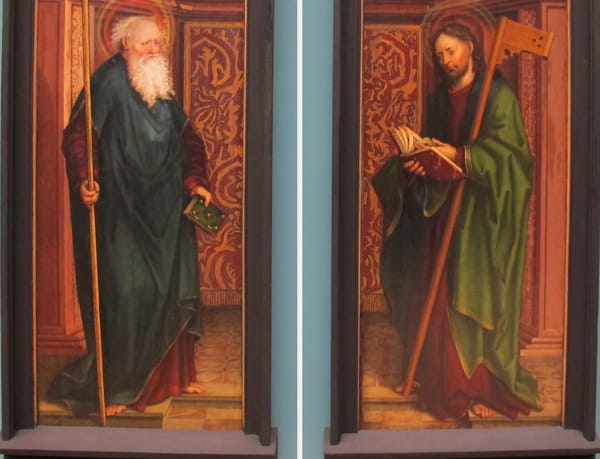
May 11 [May 1]: Sts. Philip and James the Less, Apostles
[This feast day, previously kept on May 1, was moved to May 11 when the feast of St. Joseph the Worker was established on May 1. The Solemnity of St. Joseph, which was replaced by St. Joseph the Work, was originally celebrated on the Third Sunday after Easter, as it was in the time of Dom Guéranger, whose article on that feast can be found here.-Ed.]
From Dom Guéranger's The Liturgical Year.
TWO of the favoured witnesses of our beloved Jesus' Resurrection come before us on this first day of May. Philip and James are here, bearing testimony to us that their Master is truly risen from the dead, that they have seen him, that they have touched him, that they have conversed with him,1 during these forty days. And, that we may have no doubt as to the truth of their testimony, they hold in their hands the instruments of the martyrdom they underwent for asserting that Jesus, after having suffered death, came to life again and rose from the grave. Philip is leaning upon the cross to which he was fastened, as Jesus had been; James is holding the club wherewith he was struck dead.
Philip preached the Gospel in the two Phrygias, and his martyrdom took place at Hierapolis. He was married when he was called by our Saviour; and we learn from writers of the second century that he had three daughters, remarkable for their great piety, one of whom lived at Ephesus, where she was justly revered as one of the glories of that early Church.
James is better known than Philip. He is called, in the sacred Scripture, Brother of the Lord,2 on account of the close relationship that existed between his own mother and the blessed Mother of Jesus. He claims our veneration during Paschal Time, inasmuch as he was favoured with a special visit from our Risen Lord, as we learn from St Paul.3 There can be no doubt but that he had done something to deserve this mark of Jesus’ predilection. St Jerome and St Epiphanius tell us that our Saviour, when ascending into heaven, recommended to St James’s care the Church of Jerusalem, and that he was accordingly appointed the first bishop of that city. The Christians of Jerusalem, in the fourth century, had possession of the chair on which St James used to sit when he assisted at the assemblies of the faithful. St Epiphanius also tells us that the holy Apostle used to wear a lamina of gold upon his forehead as the badge of his dignity. His garment was a tunic made of linen.
He was held in such high repute for virtue that the people of Jerusalem called him ' The Just and when the time of the siege came, instead of attributing the frightful punishment they then endured to the deicide they or their fathers had .committed, they would have it to be a consequence of the murder of James, who, when dying, prayed for his people. The admirable Epistle he has left us bears testimony to the gentleness and uprightness of his character. He there teaches us, with the eloquence of an inspired writer, that works must accompany our faith if we would be just with that justice which makes us like our Risen Lord.
The bodies of SS Philip and James repose in the Basilica of the Holy Apostles at Rome. These relics are counted as one of the richest treasures of the Holy City, and there is reason to believe that this first of May is the real anniversary of their translation. For a long period the Church of Rome kept special feasts in honour of four only of the Apostles: SS Peter and Paul, St John the Evangelist, and St Andrew (Peter’s brother): the rest were united in the solemnity of June 29, and a vestige of this is still to be found in the office of that day, as we shall see later on. The reception of the bodies of SS Philip and James, which were brought from the East somewhere about the sixth century, gave rise to the institution of to-day's feast; and this led gradually to the insertion into the Calendar of special feasts for the other Apostles and Evangelists.
Let us now read the brief account given of St Philip in the Liturgy.
The Breviary then gives the two following Lessons upon St James:
The Greek Church celebrates the memory of these two Apostles on distinct days, which are the anniversaries of their martyrdom. The following stanzas are from the hymn in honour of St Philip:
Hymn (Die XIV Novembris)
Let us now make a selection from the Menæa in honour of St James, whose memory is so affectionately cherished by the Eastern Churches:
Hymn (Die XXIII Octobris)
Holy Apostles! you saw our Risen Jesus in all his glory. He said to you on the evening of that great Sunday: Peace be to you! He appeared to you during the forty days following, that he might make you certain of his Resurrection. Great indeed must have been your joy at seeing once more that dear Master, who had admitted you into the number of his chosen Twelve; and his return made your love of him more than ever fervent. We address ourselves to you as our special patrons during this holy season, and most earnestly do we beseech you to teach us how to know and love the great mystery of our Lord’s Resurrection. May our hearts glow with Paschal joy, and may we never lose the new life that our Jesus has now given unto us.
Thou, O Philip! wast devoted to him, even from the first day of his calling thee. Scarcely hadst thou come to know him as the Messias, than thou didst announce the great tidings to thy friend Nathanael. Jesus treated thee with affectionate familiarity. When about to work the great miracle of the multiplication of the loaves, it was to thee that he addressed himself, and said to thee: Whence shall we buy bread, that these may eat?4 A few days before the Passion of thy divine Master, some of the Gentiles wished to see this great Prophet, of whom they had heard such wonderful things, and it was to thee that they applied. How fervently didst thou not ask him, at the Last Supper, to show thee the Father! Thy soul longed for the divine light; and when the rays of the Holy Ghost had inflamed thy spirit, nothing could daunt thy courage. As a reward of thy labours, Jesus gave thee to share with him the honours of the Cross. O holy Apostle! intercede for us, that we may imitate thy devotedness to Jesus; and that, when he deigns to send us the Cross, we may reverence and love it.
We also honour thy love of Jesus, O thou that art called the brother of the Lord, on whose venerable features was stamped the likeness of our Redeemer. If, like the rest of the Apostles, thou didst abandon him in his Passion, thy repentance was speedy and earnest, for thou wast the first, after Peter, to whom he appeared after his Resurrection. We affectionately congratulate thee, O James, for the honour thus conferred upon thee; do thou, in return, obtain for us that we may taste and see how sweet is our Risen Lord.5 Thy ambition was to give him every possible proof of thy gratitude; and the last testimony thou didst bear, in the faithless city, to the divinity of thy dear Master (when the Jews took thee to the top of the Temple) opened to thee, by martyrdom, the way that was to unite thee to him for eternity. Pray for us, O thou generous Apostle, that we also may confess his holy Name with the firmness which befits his disciples; and that we may ever be brave and loyal in proclaiming his rights as King over all creatures.
O holy Apostles! we beseech you to unite your prayers, and intercede for the Churches of the East, to which you preached the Gospel. Have compassion on Jerusalem, the dupe of schism and heresy; obtain her purification and her liberty; and rid her Holy Places of the sacrileges that have so long polluted them. Lead back the Christians of Asia Minor to union with the fold governed by the one supreme pastor. And lastly, pray for Rome, the city where your bodies repose, awaiting their glorious Resurrection. In return for the long hospitality she has given you, shield her with your protection; and permit not that the city of Peter, your venerable Head, should be deprived of its grandest glory—the presence of the Vicar of Christ.
Monday of the Third Week after Easter
THE first stone of the Church is laid; and on this foundation Jesus now begins to build. The shepherd of the sheep and lambs has been proclaimed; it is time to form the fold. The keys of the kingdom have been given to Peter; it is time to inaugurate the kingdom. Now this Church, this fold, this kingdom, designate a society which is to be called Christian, after the name of its Founder. This society, composed of the disciples of Christ, is destined to receive within it every individual of the human race; and if all do not actually enter, it is not in consequence of any ban of exclusion. It will subsist to the end of time; for there can be no elect out of its pale. It will be One; for Christ says not: ‘I will build my Churches he speaks but of One. It will be holy; for all the means of sanctification are in its keeping. It will be Catholic, that is, Universal, in order that, being known in all times and places, men may be able to hear its teachings and follow them. It will be Apostolic; that is to say, that how long soever this world may last, it will come down, by lawful succession, from these men with whom Jesus is, during these forty days, arranging everything that is connected with its establishment.
Such is to be the Church, out of which there is no salvation for those who, having known her, have refused to become her members. A few days hence, and the world will hear of her existence. The spark that is now but in Judea will soon become a fire spread throughout the whole earth. Before the close of the century, not only will there be members of the Church in every province of the vast Roman Empire, but even in countries where Rome has never planted the standard of her proud eagles. Nay more, this miraculous propagation is to be perpetual—in every page new apostles will set forth, and win new victories for this immortal Church. Nothing human is lasting; but the Church's ceaseless duration will excite the spleen of incredulity and baffle all its calculations. Persecutions, heresies, schisms, apostasies, and scandals—all will strive to work her ruin; but she will survive them all. The descendants of her bitterest foes will call her mother. Thrones and dynasties, nations, and even whole races, will be carried away by the tide of time: she alone will subsist throughout the ages, stretching out her arms to receive all men, teaching ever the same truths, repeating, even to the last day, the same symbol of faith, and ever faithful to the instructions given her by our Risen Jesus during these forty days preceding his Ascension.
How shall we worthily thank thee, O God our Saviour, for thy having, even at our first entrance into life, made us members of this thy immortal Spouse, which alone possesses thy heavenly teachings and the means whereby is wrought salvation? We have no need to search for thy Church; it is in and by her that we live, even here below, the supernatural life, the perfection of which is to be given to us in heaven, provided we be faithful to grace. Oh! show thy mercy to those countless souls who have not had the privilege we have enjoyed, and whose entrance into thy Church is to cost them many a painful sacrifice. Strengthen them with light; give them courage; rouse them from indifference; bless their efforts; that thus, O divine Shepherd! thy fold may increase, and thy Church, thy Spouse, may be, as thou hast promised she ever shall be, the joyful mother of children!
Let us continue our homage to the mystery of the Pasch, borrowing another canticle from the inexhaustible Adam of Saint-Victor.
Sequence
Lux insignis, lux unica,
Lux lucis et laetitiae,
Lux immortalis gloriae.
Commendat ab initio,
Quam Christi resurrectio
Ditavit privilegio.
Lucis exsultent filii,
Vindicent membra meritis
Conformitatem Capitis.
Et vota sunt solemnia;
Primae diei dignitas
Prima requirit gaudia.
Paschalis est victoria,
Sub multis aenigmatibus
Prius promissa patribus.
Quod vetus lex praecinuit
Figuram res exterminat,
Et umbram lux illuminat.
Quid hœdus gesserit,
Nostra purgans piacula,
Messias nobis aperit.
Solvit a morte debita;
Praedam captans illicitam,
Praeda privatur licita.
Caro peccati nescia;
Die reflorens tertia
Corda confirmat dubia.
Tu Christo nos vivifica!
Mors morti non obnoxia,
Da nobis vitæ praemia.
the brilliant light, the light above all other,
the light of light and joy,
the light of immortal glory.
from the very beginning of the world:
the day enriched
with the prerogative of Christ’s Resurrection.
exult with the hope of everlasting joy:
let the members so act as to merit
to be like their Head.
so are our prayers.
The grandest of days
should have the grandest joy.
is the most glorious of feasts.
It was promised to our fathers
under many types.
and all is made visible that was foretold in the Old Law.
The reality effaces the figure;
and light throws light on the shadow.
—has revealed to us
the mysteries of the spotless Lamb
and the Kid.
he delivered us from the death we so truly deserved.
Death, making a prey of him on whom he had no claim,
was deprived of the prey that was justly his own.
cancelled the sins of ours:
it rose again on the third day,
and, reblooming, refreshed all wavering hearts.
give us to live in Jesus.
O undying death!
give us the prize of life.
| Previous April 30: St. Catherine of Siena, Virgin | Next Monday of the Third Week after Easter |