Daily reading
Paschal Time
Double · May 5 · Sanctoral
May 5, 2028
From Dom Guéranger’s The Liturgical Year.
A Double leads the weekday.Rubric
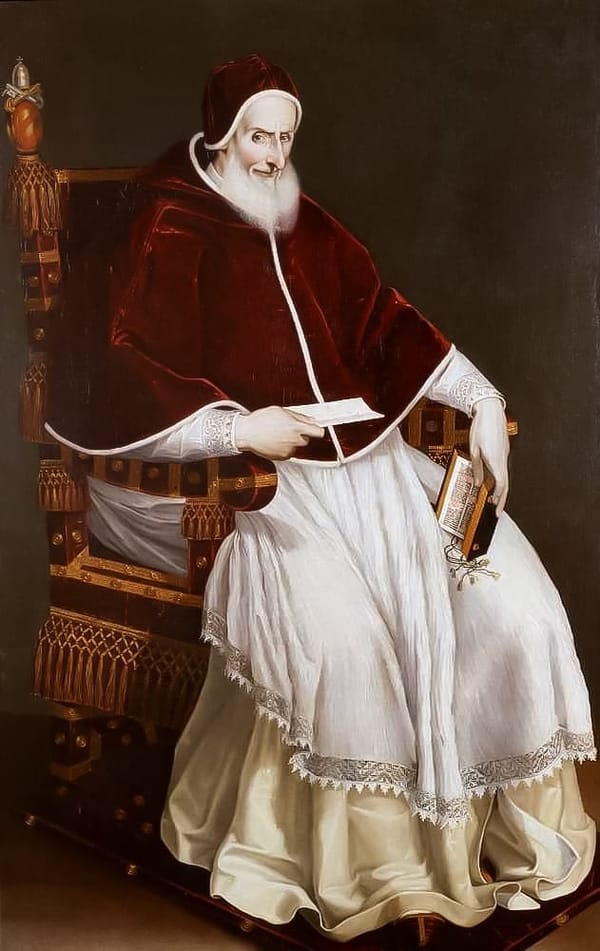 |
May 5: St. Pius V, Pope
WE have already met with the names of several Pontiffs on the Paschal Calendar. They form a brilliant constellation around our Risen Jesus, who, during the period between his Resurrection and Ascension, gave to Peter, their predecessor, the keys of the kingdom of heaven. Anicetus, Soter, Caius, Cletus and Marcellinus, held in their hands the palm of martyrdom: Leo was the only one who did not shed his blood in the cause of his divine Master. To-day there comes before us a holy Pope who governed the Church in these latter times; he is worthy to stand amidst the Easter group of Pontiffs. Like Leo, Pius V was zealous in combating heresy; like Leo, he saved his people from the barbarian yoke.
The whole life of Pius V was a combat. His pontificate fell during those troubled times when Protestantism was leading whole countries into apostasy. Italy was not a prey that could be taken by violence: artifice was therefore used, in order to undermine the Apostolic See and thus develop the whole Christian world in the darkness of heresy. Pius defended the Peninsula with untiring devotedness from the danger that threatened her. Even before he was raised to the Papal Throne he frequently exposed his life by his zeal in opposing the preaching of false doctrines. Like Peter the Martyr, he braved every danger and was the dread of the emissaries of heresy. When seated on the Chair of Peter, he kept the innovators in check by fear, roused the sovereigns of Italy to energy and by measures of moderate severity drove back beyond the Alps the torrent that would have swept Christianity from Europe had not the Southern States thus opposed it. From that time forward, Protestantism has never made any further progress: it has been wearing itself out by doctrinal anarchy. We repeat it: this heresy would have laid all Europe waste, had it not been for the vigilance of the pastor who animated the defenders of truth to resist it where it already existed, and who set himself as a wall of brass against its invasion in the country where he himself was the master.
Another enemy, taking advantage of the confusion caused in the West by Protestantism, organized an expedition against Europe. Italy was to be its first prey. The Ottoman fleet started from the Bosphorus. This again would have meant the ruin of Christendom but for the energy of the Roman Pontiff, our Saint. He gave the alarm, and called the Christian Princes to arms. Germany and France, tom by domestic factions that had been caused by heresy, turned a deaf ear to the call. Spain alone, together with Venice and the little Papal fleet, answered the summons of the Pontiff. The Cross and Crescent were soon face to face in the Gulf of Lepanto. The prayers of Pius V decided the victory in favour of the Christians, whose forces were much inferior to those of the Turks. We shall return to this important event when we come to the Feast of the Rosary in October. But we cannot omit to mention to-day the prediction uttered by the holy Pope, on the evening of the great day of October 7, 1571. The battle between the Christian and Turkish fleets lasted from six o'clock in the morning till late in the afternoon. Towards evening, the Pontiff suddenly looked up towards heaven, and gazed upon it in silence for a few seconds. Then turning to his attendants, he exclaimed: ' Let us give thanks to God! The Christians have gained the victory!' The news soon arrived at Rome; and thus, Europe once more owed her salvation to a Pope! The defeat at Lepanto was a blow from which the Ottoman Empire has never recovered: its fall dates from that glorious day.
The zeal of this holy Pope for the reformation of Christian morals, his establishment of the observance of the laws of discipline prescribed by the Council of Trent and his publication of the new Breviary and Missal have made his six years' pontificate to be one of the richest periods of the Church’s history. Protestants themselves have frequently expressed their admiration of this vigorous opponent of the so-called Reformation.
‘I am surprised,’ said Bacon, ‘that the Church of Rome has not yet canonized this great man.’ Pius V did not receive this honour till about a hundred and thirty years after his death; so impartial is the Church, when she has to adjudicate this highest of earthly honours even to her most revered Pastors!
Of the many miracles which attested the merits of this holy Pontiff, even during his life, we select the two following: As he was one day crossing the Vatican piazza, which is on the site of the ancient Circus of Nero, he was overcome with a sentiment of enthusiasm for the glory and courage of the martyrs who had suffered on that very spot in the first persecution. Stooping down, he took up a handful of dust from the hallowed ground which had been trodden by so many generations of the Christian people since the peace of Constantine. He put the dust into a cloth which the Ambassador of Poland, who was with him, held out to receive it. When the Ambassador opened the cloth, after returning to his house, he found it all saturated with blood, as fresh as though it had been that moment shed: the dust had disappeared. The faith of the Pontiff had evoked the blood of the martyrs, which thus gave testimony against the heretics that the Roman Church, in the sixteenth century, was identically the same as that for which those brave heroes and heroines laid down their lives in the days of Nero.
The heretics attempted more than once to destroy a life which baffled all their hopes of perverting the faith of Italy. By a base and sacrilegious stratagem, aided by treachery, they put a deadly poison on the feet of the crucifix which the Saint kept in his Oratory, and which he was frequently seen to kiss with great devotion. In the fervour of prayer, Pius was about to give this mark of love to the image of his crucified Master, when suddenly the feet of the crucifix detached themselves from the Cross and eluded the proffered kiss of the venerable old man. The Pontiff at once saw through the plot whereby his enemies would fain have turned the life-giving Tree into an instrument of death.
In order to encourage the faithful to follow the sacred Liturgy, we will select another interesting example from the life of this great Saint. When, lying on his bed of death, and just before breathing his last, he took a parting look at the Church on earth, which he was leaving for that of heaven, he wished to make a final prayer for the flock which he knew was surrounded by danger; he therefore recited, but with a voice that was scarcely audible, the following stanza of the Paschal hymn: ‘We beseech thee, O Creator of all things! that in these days of Paschal joy, thou defend thy people from every assault of death!’1
Let us now read the eulogy of this saintly Pope of modern times, as given in the divine Office:
St Pius is one of the leading glories of the Dominican Order. We find the following Responsories and Hymns in the Breviary of that Order:
Responsories
Hymn
Canora pangant organa:
Nimbosque pellant nubilos
Sacræ diei gaudia.
Fregit draconis impetum:
Piique sumpto nomine,
Hostem repressit impium.
Umbone firmo depulit:
Sectariorum spicula
Mucrone forti messuit.
Sacris stetit pro mcenibus,
Ut barbaros acinaces
Arceret a fidelibus.
Cura revexit sedula:
Et impiis erroribus
Objecit hic repagula.
Non vinxit in sudario
Necessitates publicas
Toto juvans ærario.
Manus habens tomatiles,
Pavit greges famelicos
Effusione munerum.
In hoc paschali gaudio,
Ab omni mortis impetu
Tuum defende populum.
give forth their glad sound in honour of blessed Pius!
Let the joys of this sacred day
dispel all stormy clouds.
and he conquered the devil in battle:
he took the name of Pius
and repressed the impious foe.
against the dangers that attacked the Church:
he was the strong sword
that mowed down the ranks of the heretics.
who stood for the defence of the Holy City,
that he might protect the faithful
from the scimitar of the Turks.
redisciplined morals;
and to impious errors
he opposed a barrier of restraint.
to hide his wealth in a napkin;
he threw open his whole treasury,
that he might relieve the necessities of his people.
with his hands ever pouring forth charity,
he fed and amply provided for his subjects
when suffering famine.
that in these days of Paschal joy
thou defend thy people
from every assault of death.
The following hymn is placed near the tomb of our Saint, in the Church of Saint Mary Major, for the use of those who visit his shrine:
Hymn
Cultus Dei contemnitur:
Ultrixque culpam persequens,
Jam poena terris imminet.
Cœlestium de sedibus
Præsentiorem vindicem,
Quam te, Pie, invocabimus?
Intensiore robore
Quam tu, superni numinis
Promovit in terris decus;
Avertit a cervicibus,
Quod christianis gentibus
Jugum parabant barbari.
Tu supplices nunc aspice:
Tu civium discordias
Compesce et iras hostium.
Terras revisat, ut
Deo Tuti queamus reddere
Mox lætiora cantica.
Uni Deo sit gloria,
Laus et potestas omnia
Per sæculorum sæcula.
for the worship of God is despised:
the chastisement that avenges guilt
is menacing our earth.
which of the heavenly citizens
can we better invoke
in our defence than thee, O Pius?
no mortal ever laboured
with such zealous vigour
to promote God's glory on earth as thou didst;
to free Christian lands from the yoke
which barbarians were seeking
to put upon them.
that thou art in heaven:
look upon us thy clients!
Restrain civil discord and repel our enemies.
that in calm security
we may sing our canticles to God
with a gladder heart.
one God, be glory,
praise and power, for ever
and ever.
Pontiff of the living God! thou wast, whilst on earth, the pillar of iron and wall of brass, spoken of by the prophet.2 Thine unflinching firmness preserved the flock entrusted to thee from the violence arid snares of its many enemies. Far from desponding at the sight of the dangers thou didst redouble thy courage just as men raise the embankments higher when they see the torrent swell. By thee was the spread of heresy checked; by thee was the Mussulman invasion repelled, and the haughty Crescent humbled. God honoured thee by choosing thee as the avenger of his glory and the deliverer of the Christian people: receive our thanks and the homage of our humble praise! By thee were repaired the injuries .done to the Church during a period of unusual trial. The true reform—the reform that is wrought by authority—was vigorously applied by thy strong and holy hand. To thee is due the restoration of the Divine Service by the publication of the books of holy Liturgy. And all these glorious deeds were done in the six short years of thy laborious pontificate!
Hear now the prayers addressed to thee by the Church Militant, whose destinies were once in thy hands. When dying, thou didst beseech our Risen Jesus to grant her protection against the dangers which were then threatening her: oh! see the state to which licentious error has now reduced almost the whole Christian world! The Church has nothing left to her wherewith to make head against her countless enemies, save the promises of her divine Founder; all visible support is withdrawn from her; she has been deprived of everything except the merit of suffering and the power of prayer. Unite, O holy Pontiff, thy prayers to hers, and show how unchanged is thy love of the flock of Christ. Protect in Rome the Chair of thy successor attacked by open violence and astute hypocrisy. Princes and peoples seem to have conspired against God and his Christ: disconcert the schemes of sacrilegious ambition, and the plots of impiety which would fain give the lie to the word of God. Avert, by thine intercession, the scourges which are threatening those nations that have become ungrateful to the Church and indifferent to the attempts made against her to whom they owe all they possess. Pray that the blind may see and the wicked be confounded. Pray that the True Faith may enlighten those numberless souls that call error truth and darkness light.
In the midst of this dark and menacing night, thine eyes, O holy Pontiff, discern them that are the faithful sheep of Christ: bless them, aid them, increase their number. Graft them on the venerable Tree which dieth not, that they may not be carried away by the storm. Obtain for them docility to the Faith and traditions of Holy Church; it is their only stay amidst the tide of error which is now threatening to deluge the whole world. Preserve to the Church the holy Order in which thou wast trained for the high mission destined for thee; maintain within her that race of men, powerful in work and word, zealous for the faith and sanctification of souls, of which we read in her Annals, and which has yielded saints such as thyself. And lastly, O Pius, remember that thou wast once the Father of the faithful: continue to be so, by thy powerful intercession, till the number of the elect be filled up!
- The Stanza recited by the dying Pontiff was, in the Breviary of his time, as follows: Quæsumus, Auctor omnium, In hoc Paschali gaudio, Ab omni mortis impetus Tuum defende populum. When the hymns were corrected under the pontificate of Urban the Eighth, this stanza was totally changed: Ut sis perenne mentibus, etc. [The Monastic Breviary has retained the original.—Tr.] ↩︎
- Jer. i 18. ↩︎
Friday of the Third Week after Easter
CHURCH of Jesus! that wast promised by him to the earth during the days of his mortal life; that camest forth from his sacred Side when wounded by the spear upon the Cross; that wast organized and perfected by him during the last days of his sojourn here below; we lovingly greet thee as our mother; thou art the Spouse of our Redeemer, and it is through thee that we were born to him. It is thou that gavest us life by baptism; it is thou that givest us the word, which enlightens us; it is thou that ministerest to us the helps, whereby we are led, through our earthly pilgrimage, to heaven; it is thou that governest us, in the spiritual order, by thy holy ordinances.
Under thy maternal care we are safe; we have nothing to fear. What can error do against us? Thou art the pillar and ground of the truth!1 What effect can the revolutions of our earthly habitation have upon us? We know, that if everything else should fail us, thou wilt ever be with us. It was during these very days which precede the Ascension, that our Lord Jesus said to his Apostles, and through them, to their successors: Behold! I am with you all days, even to the consummation of the world.2 What a promise of duration was this! If we consult the history of these last eighteen hundred years, it will tell us that this promise has never once been broken. The gates of hell have risen up against thee innumerable times; but they have never prevailed against thee, no, not for one single moment!
And thus it is, O Church! that being founded on Christ thy Spouse, thou givest us a share in thine own divine immutability! Established as we are in thee, there is not a truth which the eye of our faith cannot see; there is not a blessing which, despite our weakness, we may not make our own; there is no object shown us by hope, which we may not attain. Thou holdest us in thine arms; and from the height whereto thou raisest us, we see the mysteries of time and the secrets of eternity. Our eye admiringly follows thee, whether we consider thee as militant on earth, suffering in thy dear ones who are in the temporary state of expiation, or triumphant in heaven. Thou art with us in our exile, and already art thou, in millions of thy children, heiress of the eternal kingdom. Keep us near thee, nay, within thee, O thou our Mother, who art the beloved Spouse of our Lord. To whom shall we go but to thee? Is it not to thee, and to thee alone, that he has entrusted the words of eternal life?
How much they are to be pitied, O Church! who do not know thee! And yet, if they are seeking God with all their heart, they will, one day, know thee. How much they are to be pitied who once knew thee, and afterwards, in their pride and ingratitude, denied thee! And yet no one ever fell into such misery, unless he first voluntarily shut his eyes against the light that was within him. How much they are to be pitied who know thee, and still live enjoying what thou givest thy children, and who yet take side with thine enemies in insulting and betraying thee! They are men whose character is shallowness of mind; they speak their opinions as though they were oracles; they have contracted the flippant effrontery of our age: and to hear them speak of thee, one would suppose that they look on thee as a human institution, which they may approve or blame according to their humour.
Instead of revering whatsoever thou hast taught regarding thyself and thy rights; instead of revering what thou hast ordained, regulated, and practised; these Catholics, whose sympathies are all with thine enemies, would have thee conform thy teachings and conduct with the so-called Progress of the times. The whole world is given to thee as thine inheritance; and yet these insolent children would have thee be content with what they think proper to assign to thee. Thou, the Mother of mankind, must be under their wise care! It is from them thou must, henceforth, learn how best to fulfil thy mission! Godless men, adorers of what they called the rights of man, dared, a century back, to expel thee from political life, which up till then thou hadst kept in harmony with its divine Master. These men have left disciples, who would have thee withdraw from everything that regards the outward world, and look on as a mere stranger. Thou must no longer exercise the rights given thee by the Son of God over both soul and body; this royalty of thine is out of date, and thou must be satisfied to enjoy the liberty which, in virtue of the law of Progress, is granted alike to error and to truth. The wise and powerful ones of this world have dethroned the Vicar of thy Spouse after a thousand years' reign; and instead of resenting such a project with holy indignation, as tending to the destruction of the last bulwark of Christendom—there are many among us who approve of it, and this on principles which are, it is true, in favour with rationalistic politicians, but which are formally condemned by thy teachings, thy acts, nay, by thy very existence. How short-sighted are such Catholics as these, who hope to make thee acceptable to the world by giving thee the semblance of a human institution! The world is too shrewd: it knows thee to be essentially supernatural, and this is what it never can tolerate.
Wiser and more Christian by far are they who, detesting such profane theories, have, like devoted Machabees, drawn the sword against thine enemies, O Church of Christ! and even in an age like this, when faith has grown weak, have so well understood their Christian duty as to die in thy defence, and, by so dying, to win the crown of martyrdom. Yes, it is our duty to confess thee: to disguise thee is to belie thee. Thou art one of the articles of our Creed: 'I believe the holy Catholic Church.' Thou hast been known these nineteen hundred years; and shall men now pretend that thou must conform to the world’s capricious views? This cannot be. Jesus made thee be like himself—a sign of contradiction:3 and as such we must receive thee. We must listen to thy protestations against false principles and practices, and not attempt to remodel thee. Only God has power to give his Church a form other than that he has already given her.
Blessed are they who share thy lot, dear Church of our Redeemer! In these unchristian times thou art unpopular. Thou wast so in ages long gone by, when men could not become thy children save at the risk of being despised. It is the same now, and we are resolved to espouse thy cause. We confess thee to be our mother, inaccessible to the changes of this world. Whether honoured or persecuted, thou continuest thy mission here below. Thus will it be until the time comes when this earth, which was created to be thy kingdom, shall see thee ascend to heaven, and flee from a world which will deserve the severest chastisements of God’s anger, because of its having despised and rejected thee.
In honour of the divine Spouse of our Mother, let us sing this paschal canticle, taken from the ancient Missals of Flanders.
Sequence
Alleluia, votis, voce solemnia
Celebrando paschalia.
Congaudeat turma,
Sacro fonte nivea,
Spernens Phlegethontis undas.
Aptemus fibras
Arte musica;
Voce sonora
Modificantes
Prorsus neumata
Voce satis tinnula.
Factus nostra ob remedia,
Crucis tulit robora;
Maneret, subiit lethalia.
Passus praelibare pocula.
Transfixus clavis et lancea.
Descendit ad ima Tartara.
Revehit potens ampla ovando trophæa.
Ac resumpta carne,
Resurgit victor
Die hodierna.
Ipsi canamus odas.
Redit æterna,
Et cœli clara
Nobis patescit aula.
Alleluia! and by its prayers and hymns,
celebrate the Paschal solemnity.
share in the common joy;
it comes, white as snow, from the sacred font,
having been rescued from the waters of the stream of hell.
string our harps
to tune;
And sing,
whilst going through
the many-varied modes,
with voices sweet and ringing.
has become the Victim of our salvation,
and has carried the wood of his Cross.
that we might have eternal life.
the bitter cup of gall.
with the nails and spear.
he descended into the depths below.
and brought back, in power and triumph, the richest trophies.
his Soul was reunited to his Body;
and this is the day
of his glorious Resurrection.
to him our lays of joy.
and heaven’s bright gate
thrown open to us
by him.
| Previous Thursday of the Third Week after Easter | Next Friday of the Third Week after Easter |