Daily reading
Paschal Time
Greater Double · May 8 · Sanctoral
May 8, 2028
From Dom Guéranger’s The Liturgical Year.
A Greater Double leads the weekday.Rubric

|
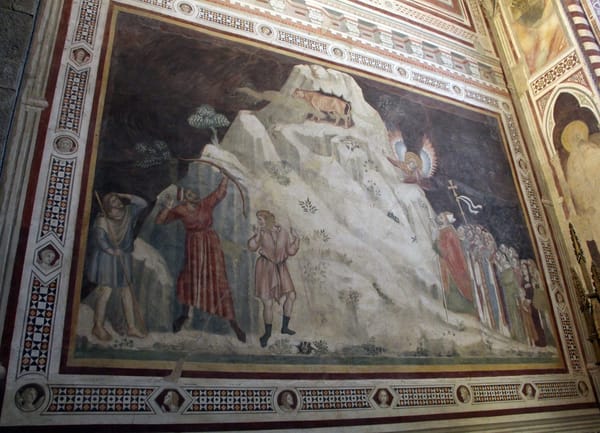
May 8: The Apparition of St. Michael the Archangel
DAVID foretold that Emmanuel's entrance into this world would be greeted by the angels and that they would humbly adore him on his first appearance among us.1 We saw this prophecy fulfilled on the ever blessed night when Mary brought forth the Fruit of her womb. The angelic choir sang one of their heavenly hymns, which led the shepherds to the stable; we blended our songs with theirs in homage to our infant God. The Resurrection of our Emmanuel was sure to be honoured by the presence of these blessed spirits, who had witnessed with amazement and trembling the humiliations and cruelties of his Passion. The moment he passed through the barrier that imprisoned him in his sepulchre, an angel, with a face bright as the sun, and garments white as snow, came and rolled back the stone, and proclaimed to the holy women that he whom they were seeking had risen. When they entered the cave of the sepulchre, two other angels, clad in white robes, appeared to them, and repeated the tidings of Jesus' triumph.
Let us reverently honour these princely heralds of our deliverance, and consider with what respect they cluster round Jesus their King and God during the forty days after his Resurrection. They adore this glorified humanity, which they are soon to see raised up to the highest heavens and enthroned at the Father's right hand. They rejoice with us in the happiness given by this Paschal feast, which restores immortality to us in the person of our Risen Saviour; and thus, as St Gregory told us a few days back, ‘it is the feast of the angels, because, by recalling us to heaven, it fills up their number,’2 It was but right, therefore, that one day in Paschal Time should be devoted to honouring the angelic spirits. On the day previous to the Annunciation we kept the Feast of St Gabriel, our Lady's honoured messenger; to-day it is St Michael, the Archangel and prince of the heavenly host, who is to receive our love and praise. He himself selected this day, by appearing on it and leaving us a pledge of his presence and protection.
The very name of Michael urges us to honour this glorious spirit; it is a cry of enthusiasm and fidelity, for it signifies: ‘Who is like unto God?’ Satan trembles at hearing this name, for it reminds him of the noble protest wherewith the bright Archangel answered the call of the rebel angels. Michael proved his strength and prowess when he fought the great battle in heaven. On that account, he was made the guardian and protector of God's people; first of the Jews, and afterwards of the Christian Church, for the Synagogue has forfeited all her honours. Michael now watches over Jesus' Spouse, our mother; he supports her in her trials and she wins no triumph in which he has not had some part.
But we are not to suppose that the holy Archangel is so engaged in attending to the general interests of Christ's kingdom on earth that he cannot listen to the prayers of each individual member of the Church. God has given him a compassionate love for men; and there is not a single soul that escapes his notice. He wields the sword in defence of the Spouse of Christ; he wars with the dragon, who is ever lying in wait for the Woman and her Child;3 but, at the same time, he is attentive to each one of us; for fter having confessed our sins to Almighty God, and to the Blessed Mary ever a Virgin, we acknowledge them likewise to Blessed Michael the Archangel and beseech him to pray for us to the Lord our God.
He assists at every death-bed, for his special office is to receive the souls of the elect on their quitting the flesh. With loving solicitude and princely bearing, he presents them to the Light Eternal and introduces them into the House of God’s glory. It is Holy Church herself that tells us, in the words of her Liturgy, of these prerogatives of the great Archangel. She teaches us that he has been set over Paradise, and that God has given him the charge of leading to heaven the souls of them that are to be received there. On the last day, when our Risen Jesus is to appear on the clouds of heaven to judge mankind, all of whom will then have resumed their bodies in the general resurrection, Michael with the rest of the angels will have to fulfil a ministry of awful import—that of separating the good from the bad. Our Catholic forefathers, in the Middle Ages, were fond of representing the holy Archangel engaged in this dread function, standing at the foot of Jesus’ judgement-seat, and holding a scale, in which he is weighing the souls of men and their works.
Devotion to St Michael was sure to spread through the Church, especially after the worship of idols had been banished from the various countries, and men were no longer tempted to give divine honour to creatures. Constantine built a celebrated Church called Michaelion in honour of the great Archangel, and at the time when Constantinople fell under the power of the Turks, there were no fewer than fifteen churches bearing the name of Saint Michael, either in the city or the suburbs. In other parts of Christendom this devotion took root only by degrees; and it was through apparitions of the holy Archangel that the faithful were prompted to have recourse to him. These apparitions were local and for reasons which to us might seem of secondary importance: but God, who from little causes produces great effects, made use of them whereby to excite Christians to have confidence in their heavenly protector. The Greeks celebrate the apparition that took place at Chone, the ancient Colosse in Phrygia. There was in that city a Church dedicated to St Michael, and it was frequently visited by a holy man named Archippus, who was violently persecuted by the pagans. One day, when Archippus was at his devotions in his favourite St Michael's, his enemies resolved to destroy both him and the Church. Hard by ran a brook which flowed into the river Lycus; they turned it aside and flooded the ground on which the church stood. Suddenly there appeared the Archangel St Michael holding a rod in his hand: the water immediately receded, and flowed into a deep gulf near Colosse, where the Lycus empties itself and disappears. The date of this apparition is not certain, but it occurred at the period when the pagans were numerous enough in Colosse to harass the Christians.
Another apparition, which encouraged devotion to St Michael in Italy, took place on Mount Gargano, in Apulia; it is the one honoured by to-day's feast. A third happened on Mount Tomba, on the coast of Normandy: we shall commemorate it on October 16.
The feast we are keeping to-day is not so solemn as the one of September 29; it is, however, more exclusively in honour of St Michael, inasmuch as the autumn feast includes all the choirs of the angelic hierarchy. The Roman Breviary gives us the following account of the apparition on Mount Gargano:
Holy Church tells us of the glories of St Michael in several portions of the Liturgy; but particularly in the following Responsory and Antiphons, taken from to-day's Office:
The first of the following hymns is used by the Church in the Vespers of the Feasts of St Michael. The second is taken from the Lauds. They speak the praises, not only of our great Archangel, but likewise of St Gabriel, St Raphael, and of all the blessed spirits in general. The Church has not instituted a feast for the collective celebration of the nine choirs of Blessed Spirits, but she includes all the members of the angelic host in her tribute of honour on the Feasts of St Michael.
First Hymn
Te vita, Jesu, cordium,
Ab ore qui pendent tuo
Laudamus inter Angelos.
Ducum corona militat:
Sed explicat victor crucem
Michael salutis signifer.
In ima pellit tartara,
Ducemque cum rebellibus
Coelesti ab arce fulminat.
Sequamur hunc nos principem,
Ut detur ex Agni throno
Nobis corona gloriæ.
Qui, quos redemit Filius,
Et sanctus unxit Spiritus,
Per Angelos custodiat.
who obey thee, we praise thee,
O Jesus, thou brightness and power of the Father,
thou life of our hearts!
this army of a thousand thousand princes,
at whose head is Michael, the Conqueror,
the standardbearer of salvation, who unfurls the Cross.
the cruel dragon into the depths of hell,
and drove the rebels, with their chief,
from the heavenly city.
that we may deserve to receive,
from the throne of the Lamb,
a crown of glory.
who, by means of the angels,
guards those whom the Son hath redeemed
and the Holy Spirit anointed.
Second Hymn
Gentis humanæ sator et redemptor,
Cœlitum nobis tribuas beatas
Scandere sedes.
Cœlitus nostras veniat; serenæ
Auctor ut pacis lacrymosa in orcum
Bella releget.
Pellat antiquos, et amica cœlo
Quæ triumphator statuit per orbem,
Templa revisat.
Adsit e cœlo Raphael, utomnes
Sanet ægrotos, dubiosque vitæ
Dirigat actus.
Et sacer nobis chorus Angelorum
Semper assistat, simul et micantis
Regia cœli.
Patris, ac Nati, pariterque Sancti
Spiritus, cujus resonat per omnem
Gloria mundum.
the Creator and Redeemer of mankind!
grant that we may ascend to the happy thrones
of the heavenly citizens.
come from heaven into this our temple,
bring us sweet peace,
and drive dismal war back again to hell.
come and rout our ancient foe;
may he often visit the heaven-loved temples
which the triumphant Jesus has placed throughout the world.
descend and visit us,
that he may heal all that are infirm
and direct our faltering steps in the path of life.
may the holy choir of angels;
may the bright court of heaven
ever assist and protect us.
Father, Son, and Holy
Ghost, whose glory is proclaimed through the whole world,
grant us this our prayer.
The following sequence is from the collection of the Monastery of Saint-Gall, and was composed by the monk Notker in the eleventh century:
Sequence
Rex cœlice, laudes Cuncta
Pangat jam canora
Caterva symphonia
Odas, atque solvat
Concio tibi nostra.
Michaelis inclyta valde festa,
Per quæ lætabunda
Perornatur machina Mundi tota.
Spirituum sunt agmina
Per te facta.
Facis hæc flammea
Per angelicas Officinas.
Sed cum simus nos ultima Factura,
Sed imago tua.
Nobis hæc ter tripartita
Per privata officia.
Phalanx et archangelica,
Principans turma.
Ac Potestas almiphona,
Dominantia numina,
Divinaque subsellia,
Cherubim ætherea,
Ac Seraphim ignicoma.
Vera dans Verbi nuntia, Atque Raphael,
Vitæ vernula, Transferte nos inter Paradisicolas.
Complentur mandata,
Quæ dat ejusdem Sophia,
Compar quoque Pneuma,
Una permanens in usia,
Cui estis administrantia Deo millia
Millium sacra.
Bis atque quingenta vestra
Centena millena
Assistunt in aula,
Ad quam Rex ovem centesimam verbigena,
Drachmamque decimam Vestra
Duxit ad agalmata.
Nos per rura terrea, pars electa,
Harmonica vota damus hinc
Per lyricas citharas.
Nostra Deo sint accepta auream super aram
Thymiamata, quo in coeva jam gloria
Condecantemus Alleluia.
may our whole assembly and choir
now sound forth
its instruments of sweet music
and sing hymns
in thy praise.
of Michael's most glorious feast,
which fills the whole earth
with great joy.
created by thee,
into nine choirs;
when thou wiliest
to seek their ministry.
whereas we are thy last,
but made after thine image.
according to their special offices,
reveals to us the mysterious design of God.
then the phalanx of Archangels;
then the host of the Principalities.
the sweet-sounding Powers,
The spiritual Dominations,
the divine Thrones,
the ethereal Cherubim,
the burning Seraphim.
messenger of the Incarnate Word! Raphael,
our guide through life! lead us to the company of the citizens of Paradise.
all the commands of the Father,
the Son who is his Wisdom,
and the co-equal Spirit,
the Three, One in essence,
the God before whom ye stand thousands
of thousands in number, as ministering spirits.
times a hundred thousand;
and hither did the King,
the Father of the Word,
bring the hundredth sheep,
and the tenth groat,
that they might share in your bliss.
and we the elect flock on earth,
give forth our tuneful praise
on sweetsounding harps.
when set on the golden altar, be acceptable to God;
Thus, when united in the same eternal glory,
may we sing together our Alleluia!
How beautiful art thou, O Michael. in thy heavenly armour, giving glory to the God whose enemy thou hadst overcome! Thine humble and fervent gaze is fixed on the throne of Jehovah, whose rights thou didst defend, and who gave thee the victory. Thy sublime cry: ‘Who is like unto God?’ roused the faithful legions and became thy name and thy crown. It will remind us for all eternity of thy fidelity to our Creator and thy triumph over the dragon. Meanwhile, we enjoy thy loving protection; we are thy happy clients.
Guardian angel of Holy·Church! now is the time for thee to exert all the might of thine arm. Satan is furious in his efforts against the noble Spouse of thy Master; brandish thy bright sword, and give battle to this implacable enemy. The kingdom of Christ is shaken to its very foundations. Is it that the reign of the Man of Sin is about to be proclaimed on the earth? Are we near that last day when, this guilty world is to be destroyed by fire, and thou art to exercise, in the name of the Sovereign Judge, the terrible office of separating the goats from the sheep? If this earth is still to exist; if the mission of the Church is not yet completed; is it not time for thee, O Michael! to show the dragon of hell that he may not, with impunity, insult on this earth the God who created it, who redeemed it, and whose name is King of kings and Lord of lords? The forces of error and crime are unceasingly dragging the world to the brink of the precipice; save it, O glorious Archangel, by confounding the dark plots which are laid for its destruction!
Thou, O Michael, art the protector of our souls in their passage from time to eternity. During this present life thine eye is upon our wants, and thine ear open to our prayers. Though awed by the brightness of thy glory, we love thee, dear prince of heaven! and we live happy and contented beneath the shadow of thy wings. In a few days, or at most years, our holy Mother the Church will be performing her last sacred rites over our lifeless remains; she will pray for us to our heavenly Father, that we may be delivered from the lion's mouth, and that the standard-bearer, St Michael, may bring us into the holy light.4 Watch over us now, O holy Archangel, lest we should then not deserve thy protection. The dragon is ever threatening us; he makes no secret of his wish to devour us. Teach us, O Michael, to repeat thy beautiful words: ' Who is like unto God?’ God’s honour, the rights he has over us, our obligation to be faithful to him, and serve him, and confess him as our Lord in all times and places—yes! these thoughts must be our shield in danger, and the armour wherewith we must fight, like thee, and win the battle. But we need the sturdy courage which resulted from the love thou hadst within thee. Oh! pray for us, that we, too, may love our common Lord and Master; then shall we be invincible. Satan cannot make head against a creature that is filled with the love of the great God.
God created thee, O Michael! and thou lovest him as thy Creator; but he has not only created us, he has redeemed us, yea, and at the price of his own Blood! What, then, should be the intensity of our love for him! Strengthen this love in our hearts; and since we are fighting under thy leadership, guide us, inspirit us; let thy look give us courage; ward off from us the blows of the enemy’s sword. We venture to hope that thou wilt be present at our last moments, O standard-bearer of our salvation! In return for our tender devotion towards thee, deign to keep guard round our deathbed, cover it with thy shield. If the dragon see the flash of thy sword, he will not dare to come near us. May our soul, on leaving the body, throw herself with affection into thine arms! Cast her not from thee, O holy Archangel, when she seeks to cling to thee; carry her to the judgement-seat, cover her beneath thy wings, calm her fears; and may the Lord, thy Master, bid thee bear her speedily to the kingdom of eternal bliss!
Monday of the Fourth Week after Easter
OUR Risen Jesus is not satisfied with establishing his Church and constituting the hierarchy which is to govern it in his name to the end of time; he also confides in his disciples his divine word, that is, the truths he is come to reveal to mankind, into which truths he has given them an insight during the three years preceding his Passion. The word of God, which is also called revelation, is, together with grace, the most precious gift that heaven could bestow upon us. It is by the word of God that we know the mysteries of his divine essence, the plan according to which he framed the creation, the supernatural end he destined for such of his creatures as he endowed with understanding and free-will, the sublime work of redemption by the Incarnation of the Second Person of the Blessed Trinity—in a word, the means whereby we are to honour and serve him, and attain the end for which we were made.
From the very commencement of the world, God revealed his word to man; later on, he spoke by the prophets; but when the fulness of time came, he sent upon the earth his Only Begotten Son, that he might complete this first revelation. We have seen how, for three years, Jesus has been teaching men, and how, in order that he might make them the more easily understand his words, he has stooped to their littleness. Though his teaching was of the sublimest possible character, yet did he make it so intelligible that no instruction could be compared to his in clearness. It was for this reason that he made use of simple parables, whereby he conveyed his divine truths to the mind of his hearers. His Apostles and disciples, who were afterwards to preach his Gospel to the world, received from him frequent special instructions; although, until the accomplishment of the mysteries of his Death and Resurrection, they were slow in understanding his teaching. Since his Resurrection, they are better able to appreciate his instructions, for not only are his words more telling now that he is in the glory of his triumph over death, but the minds of his hearers have become more enlightened by the extraordinary events that have occurred. If he could say to them at the Last Supper: I will not now call you servants; but I have called you my friends: because all things whatsoever I have heard from my Father, I have made known unto you;1 how must he not treat them now that he has repeated to them the whole of his teaching, given them the whole word of God, and is on the eve of sending the Holy Spirit upon them, in order to perfect their understanding, and give them power to preach the Gospel to the entire world?
O holy word of God! O holy revelation! through thee are we admitted into divine mysteries, which human reason could never reach. We love thee, and are resolved to be submissive to thee. It is thou that givest rise to the grand virtue, without which it is impossible to please God;2 the virtue which commences the work of man's salvation, and without which this work could neither be continued nor finished. This virtue is faith. It makes our reason bow down to the word of God. There comes from its divine obscurity a light far more glorious than are all the conclusions of reason, how great soever may be their evidence. This virtue is to be the bond of union in the new society which our Lord is now organizing. To become a member of this society, man must begin by believing; that he may continue to be a member, he must never, not even for one moment, waver in his faith. We shall soon be hearing our Lord saying these words: He that believeth and is baptized shall be saved; but he that believeth not shall be condemned.3 The more clearly to express the necessity of faith, the members of the Church are to be called by the beautiful name of the faithful: they who do not believe are to be called infidels.
Faith, then, being the first link of the supernatural union between man and God, it follows that this union ceases when faith is broken, that is, denied; and that he who, after having once been thus united to God, breaks the link by rejecting the word of God, and substituting error in its place, commits one of the greatest of crimes. Such a one will be called a heretic, that is, one who separates himself; and the faithful will tremble at his apostasy. Even were his rebellion to the revealed word to fall upon only one article, still he commits enormous blasphemy; for he either separates himself from God as being a deceiver, or he implies that his own created, weak, and limited reason is superior to eternal and infinite Truth.
As time goes on, heresies will rise up, each attacking some dogma or other; so that scarcely one truth will be left unassailed; but all this will serve for little else than to bring out the revelation purer and brighter than before. There will, however, come a time, and that time is our own, when heresy will not confine itself to some one particular article of faith; but will proclaim the total independence of reason, and declare revelation to be a forgery. This impious system will give itself the high-sounding name of rationalism, and these are to be its leading doctrines: Christ's mission a failure and his teaching false; his Church an insult to man's dignity; the eighteen centuries of Christian civilization a popular illusion! The followers of this school, the so-called philosophers of modem times, would have subverted all society, had not God come to its assistance, and fulfilled the promise he made, of never allowing his revealed word to be taken away from mankind, nor the Church, to whom he confided his word, to be destroyed.
Others go not so far as this. They do not pretend to deny the benefits conferred on the world by the Christian religion; the facts of history are too evident to be contested: still, as they will not submit their reason to the mysteries revealed by God, they have a way peculiar to themselves for eliminating the clement of faith from this world. As every revealed truth, and every miracle confirmatory of divine interposition, is disagreeable to them, they attribute to natural causes every fact which bears testimony to the Son of God being present among us. They do not insult religion, they simply pass it by; they hold that the supernatural serves no purpose; people, they say, have taken appearances for realities. The laws of history and common sense count for nothing. Agreeably to their system, which they call naturalism, they deny what they cannot explain; they maintain that the people of the past eighteen centuries have been deceived, and that the Creator cannot suspend the laws of nature, just as the rationalists teach that there is nothing above reason.
Are reason and nature, then, to be obstacles to our Redeemer’s love for mankind? Thanks be to his infinite power, he would not have it so! As to reason, he repairs and perfects her by faith; and he suspends the laws of nature, that we may cheerfully believe the word whose truth is guaranteed by the testimony of miracles. Jesus is truly risen; let reason and nature rejoice; for he has ennobled and sanctified them by the glad mystery.
Let us proclaim the triumph of the Redeemer whom we adore. Let us make our own this sequence of the Cluny Missal of 1523.
Sequence
Leo de tribu Juda.
Mors vicit mortem,
Et mors nostra est vita.
Mira bella, et stupenda satis
Inter oves victoria.
Ut moriens superaret fortem
Cum callida versutia.
Domum ejus ingressus
Est Rex aeternus,
Et averni confregit vasa.
Drachmam secum quæ perierat
Asportavit, et patefecit regni claustra.
Paradisi porta
Quæ clausa fuerat
Per lignum vetitum
Et lethale in primaevo.
Quam clauserat Eva conditori,
Clauseratque cunctis
Postmodum natis
De stirpe sua.
Quæ commisit protoplastus,
Reseravit dextra per stirpis materiam.
Susceperat mors indemnem,
Quem tenere numquam potuerat propter culpam.
Dum ambiit illicita.
Quæ tenebat juste
Perdidit acquisita.
Ampliare voluerat in secessu,
Et remansit evacuata.
Hic verus est agnus legalis
Qui multis se manifestavit figuris,
Tandem se hostiam pro mundo
Dedit Patri ut redimeret membra sua.
Hic lapis est angularis,
Quem reprobaverunt aedificantes.
Jam factus est in caput anguli
Super omnes in excelso.
Regnum ejus magnum
Et potestas ejus prima per sæcula.
the Lion of the Tribe of Juda, hath conquered.
Death hath conquered death;
and that Death is our Life.
Strange was the war, and stupendous the victory
that was seen by the flock of Christ.
When he, by his Death,
vanquished the strong and crafty enemy.
The Eternal King
forced the enemy’s house,
and broke the armour of hell.
He brought back the groat that was lost,
and opened the gates of heaven.
Heaven’s gate,
that had been shut, at the beginning of the world,
by the forbidden fruit,
which brought death;
The gate, which Eve had closed
against him from whom she had been formed
and against all the children
that were to be born of her race;
Yea, what our first parent thus sinfully closed,
was thrown open by the right hand of the God that assumed our flesh.
Death laid hands on him
on whom it had no claim because he was free from sin;
And by thus coveting
what was not its own,
it lost what it hitherto had justly held.
By wishing to add to its prey,
it was made to yield up what it had devoured.
Christ is the true Lamb,
that was foretold in the Law under manifold figures,
and who, at length, offered himself to the Father
as a Victim for the world's redemption.
This is the Corner-Stone,
rejected by the builders.
He is now the Head of the Corner,
set high above all the rest.
His kingdom is great, and his power supreme:
they are for ever and ever.
| Previous May 7: St. Stanislaus, Bishop and Martyr | Next Monday of the Fourth Week after Easter |